warning AUDI R8 SPYDER 2014 Manual PDF
[x] Cancel search | Manufacturer: AUDI, Model Year: 2014, Model line: R8 SPYDER, Model: AUDI R8 SPYDER 2014Pages: 244, PDF Size: 61.06 MB
Page 92 of 244
90 Homelink®
Homelink®
Universal remote
control
General information
The Homelink universal remote control can
be programmed with hand-held transmitters
from existing equipment.
You must first program the Homelink ® trans
mitter before you can use the system
~ page 90, Programming the Homelink ®
transmitter.
I n o rder to prog ram the Homelink ® transmit
ter for devices utilizing rolling code, a second pe rson on a ladder who can safely reach the
garage doo r opener motor is recommended.
It is also necessary to locate the "learn" but
ton on your garage door opener motor . Refer
to the operating instructions for the opener,
as the location and color of this button may
vary by manufacturer .
You can still use the original remote control
for the device at any time.
A WARNING
-
- Never use the Homelink® transmitter
with any garage door opener that does
have not the safety stop and reverse fea
ture as requ ired by federa l safety stand
ards. This includes any garage door open
er model manufactured before April 1,
1982.
- A garage door opener which cannot de
tect an object, signa ling the door to stop
and reverse does not meet current feder
al safety standards. Using a garage door
opener without these features increases
risk of serious injury or death.
- For safety reasons never release the
parking brake or start the engine while
anyone is stand ing in front of the vehicle.
- A garage door or an estate gate may
sometimes be set in motion when the
Homelink ® remote control is being pro
grammed. If the device is repeatedly ac- tivated, this can overstrain motor and
damage its e
lectrical components -an
overheated motor is a fire hazard!
- To avoid possib le injuries or property
damage, please always make absolutely
certain that no persons or objects are lo
cated in the range of motion of any
equ ipment being operated.
(!) Tips
- If you would like more information on
Homelink ®, where to purchase the
Homelink ® compatible products, or
would like to purchase the Homelink®
Home Lighting Package, please call toll
free: 1-800-355-3515.
- For Declaration of Compliance to United
States FCC and Industry Canada regula
tions~
page 230.
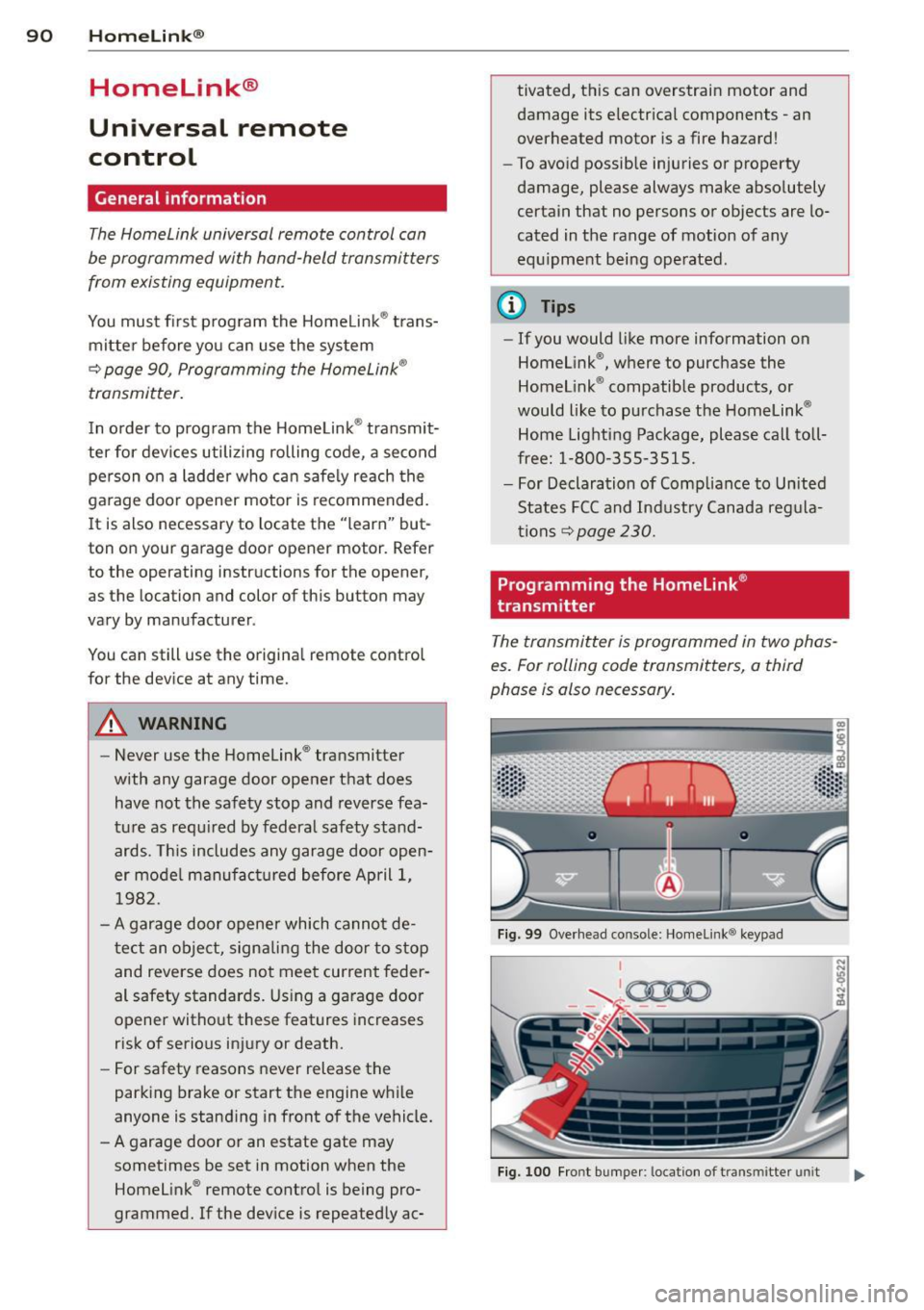
Programming the Homelink ®
transmitter
The transmitter is programmed in two phas
es. For rolling code transmitters, a third
phase is also necessary.
Fig. 99 Overhead co nsole: Homelink ® keypad
I
'-.. ~0000 - - ,r.;-_ - -
Fig. 100 Fro nt bumper : location of tra nsmi tter unit
Page 95 of 244
Driving Safely
General notes
Safe driving habits
Please remember -safety first!
This chapter contains important information,
tips, instructions and warnings that you need
to read and observe for your own safety, the
safety of your passengers and others . We have
summarized here what you need to know
about safety belts, airbags, child restraints as
well as child safety. Your safety is for us
priori
ty number 1.
Always observe the information
and warnings in this section - for your own
safety as well as for that of your passengers.
The information in this section applies to all
model versions of your vehicle . Some of the
features described in this section may be
standard equipment on some models, or may
be optional equipment on others. If you are
not sure, ask your authorized Audi dealer.
A WARNING
- Make certain that you follow the instruc
tions and heed the WARNINGS in this
Manual. It is in your interest and in the
interest of your passengers.
- Always keep the complete owner's litera
ture in your Audi when you lend or sell
your vehicle so that this important infor
mation will always be available to the
driver and passengers.
- Always keep the owner's literature handy
so that you can find it easily if you have
questions.
Safety equipment
The safety features are part of the occupant
restraint system and work together to help
reduce the risk of injury in a wide variety of
accident situations .
Your safety and the safety of your passengers
should not be left to chance. Advances in
technology have made a variety of features
available to help reduce the risk of injury in an
Driving Safely 93
accident. The following is a listing of just a
few of the safety features in your Audi:
- sophisticated safety belts for driver and all
passenger seating positions,
- safety belt pretensioners ,
- front airbags,
- knee airbags,
- side airbags in the seats
- adjustable head restraints,
- adjustable steering column.
These individual safety features can work to
gether as a system to help protect you and
your passengers in a wide range of accidents.
These features cannot work as a system if
they are not always properly adjusted and
properly used!
Safety is everybody's responsibility!
Important things to do before driving
Safety is everybody's job! Vehicle and occu
pant safety always depends on the informed and careful driver.
For your safety and the safety of your passen
gers,
before driving always:
~ Make sure that all lights and signals are op
erating correctly .
~ Make sure that the tire pressure is correct.
~ Make sure that all windows are clean and af
ford good visibility to the outside.
~ Secure all luggage and other items carefully
r=:> page 60.
~ Make sure that nothing can interfere with
the pedals.
~ Adjust front seat, head restraint and mirrors
correctly for your height .
~ Instruct passengers to adjust the head re
straints according to their height .
~ Make sure to use the right child restraint
correctly to protect children¢
page 132,
Child Safety.
~ Sit properly in your seat and make sure that
your passengers do the same¢
page 57,
General recommendations. .,..
•
•
Page 96 of 244
94 Driving Safel y
• Fasten your safety be lt and wear it properly .
Also instruct your passengers to fasten their
safety belts proper ly
¢ pag e 103.
What impairs driving safety?
Safe driving is directly related to the condi
tion of the vehicle, the driver as well as the
driver 's ability to concentrate on the rood
without being distracted.
The driver is responsible for the safety of the
vehicle and all of its occupants. If your ability
to drive is impaired, safety risks for everybody
in the vehicle increase and you also become a
hazard to everyone else on the road
¢ .&, .
Therefore:
• Do not let yourself be distracted by passen
gers or by using a cellular telephone.
• NEVER dr ive when your dr iving ability is im
paired (by medicat ions, alcohol, drugs, etc.) .
• Observe all traffic laws, rules of the road
and speed limits and plain common sense.
• ALWAYS adjust your speed to road, traff ic
and weathe r conditions.
• Take frequent breaks on long trips . Do not
drive for more than two hours at a stretch .
• Do NOT drive when you are tired , under
pressure or when you are stressed.
A WARNING , .
Impaired driving safety increases the risk
of serious personal injury and death when
ever a vehicle is being used.
Proper occupant
seating positions
Proper seating position for the driver
The proper driver seating position is impor
tant for safe, relaxed driving.
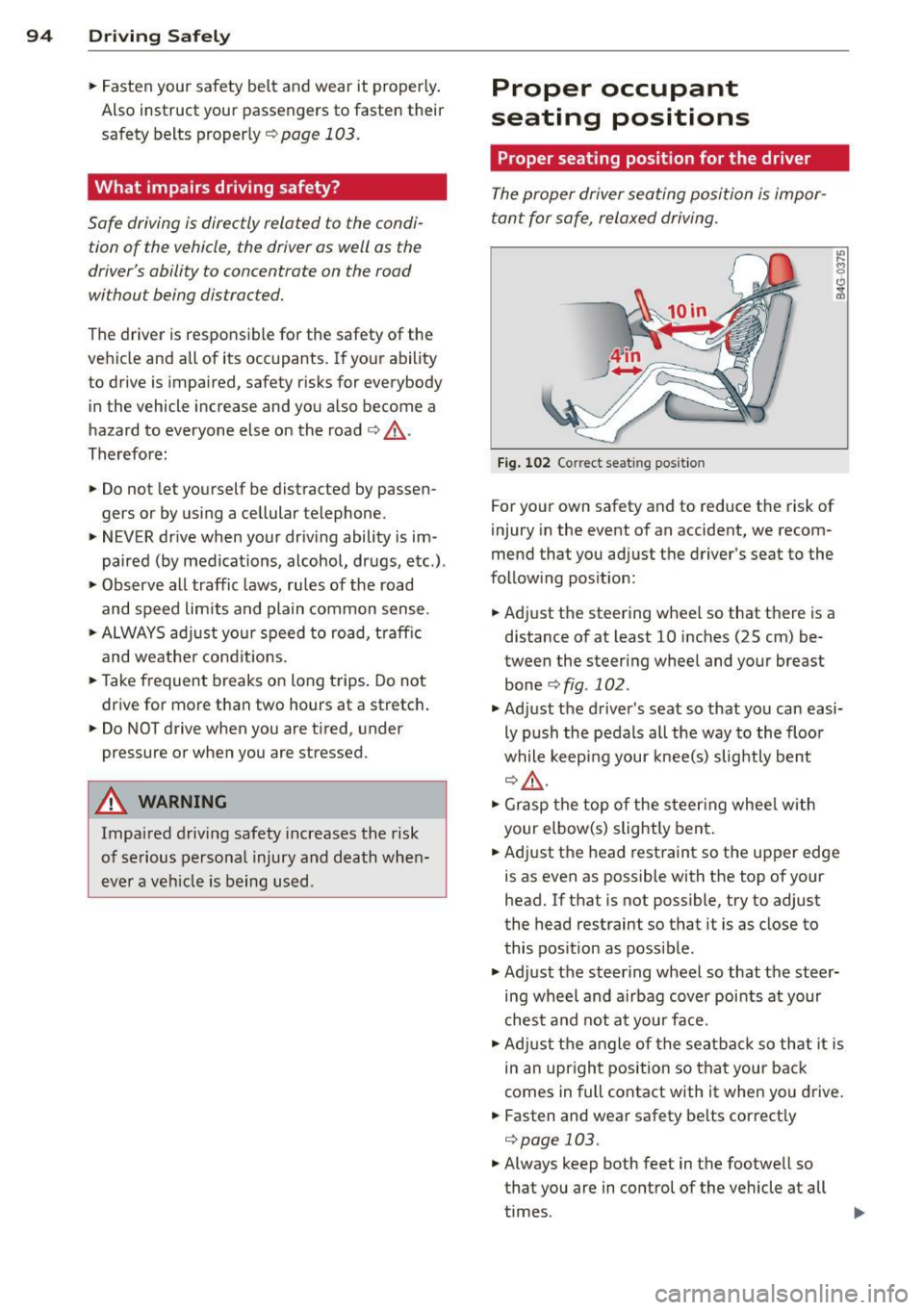
Fig. 102 Correc t seat ing posit ion
For your own safety and to reduce the risk of
injury in the event of an accident, we recom
mend that you adjust the driver's seat to the
following position:
• Adjust the steering wheel so that there is a
distance of at least 10 inches (25 cm) be
tween the steering wheel and your breast
bone
¢ fig . 102 .
• Adjust the driver's seat so that you can easi
ly push the pedals all the way to the floor
while keeping your knee(s) slightly bent
¢.&_ .
• Grasp the top o f the steer ing whee l w ith
your elbow(s) slightly bent.
• Adjust the head restraint so the upper edge
is as even as possible with the top of your
head. If that is not possible, try to adjust
the head restraint so that it is as close to
this position as possible .
• Adjust the steering wheel so that the steer
ing wheel and airbag cover points at your
chest and not at your face.
• Adjust the angle of the seatback so that it is
in an upright position so that your back
comes in full contact with it when yo u drive.
• Fasten and wear safety be lts correctly
¢ page 103.
• Always keep both feet in the footwell so
that you are in control of the vehicle a t all
times .
Page 97 of 244
For detailed information on how to adjust the
driver's seat, see ¢
page 5 7, General recom
mendations.
A WARNING
Drivers who are unbelted, out of position
or too close to the airbag can be seriously
injured by an airbag as it deploys. To help
reduce the risk of serious personal injury:
- Always adjust the driver's seat and the
steering wheel so that there are at least
10 inches (25 cm) between your breast
bone and the steering wheel.
- Always adjust the driver's seat and the
steering wheel so that there are at least
4 inches (10 cm) between the knees and
the lower part of the instrument panel.
- Always hold the steering wheel on the
outside of the steering wheel rim with
your hands at the 9 o'clock and 3 o'clock
positions to help reduce the risk of per
sonal injury if the driver's airbag inflates.
- Never hold the steering wheel at the
12 o'clock position or with your hands at
other positions inside the steering wheel
rim or on the steering wheel hub. Hold
ing the steering wheel the wrong way
can cause serious injuries to the hands,
arms and head if the driver's airbag in
flates
- Pointing the steering wheel toward your
face decreases the ability of the supple mental driver's airbag to protect you in a
collision.
-Always sit in an upright position and nev
er lean against or place any part of your
body too close to the area where the air
bags are located.
- Before driving, always adjust the front
seats and head restraints properly and
make sure that all passengers are prop
erly restrained.
- Never adjust the seats while the vehicle
is moving. Your seat may move unexpect
edly and you could lose control of the ve
hicle.
- Never drive with the backrest reclined or
tilted far back! The farther the backrests
Driving Safely 95
are tilted back, the greater the risk of in
jury due to incorrect positioning of the
safety belt and improper seating posi
tion .
- Children must always ride in child seats
¢
page 132 . Special precautions apply
when installing a child seat on the front
passenger seat¢
page 111.
Proper seating position for the front
passenger
The proper front passenger seating position
is important for safe, relaxed driving.
For your own safety and to reduce the risk of
injury in the event of an accident, we recom
mend that you adjust the seat for the front
passenger to the following position:
"'Adjust the angle of the seatback so that it is
in an upright position and your back comes
in full contact with it whenever the vehicle is
moving.
"'Adjust the head restraint so the upper edge
is as even as possible with the top of your
head. If that is not possible, try to adjust
the head restraint
so that it is as close to
this position as possible ¢
page 96.
"' Keep both feet flat on the floor in front of
the front passenger seat.
"' Fasten and wear safety belts correctly .
For detailed information on how to adjust the
front passenger's seat, see ¢
page 5 7, Gener
al recommendations .
A WARNING
Front seat passengers who are unbelted,
out of position or too close to the airbag
can be seriously injured or killed by the air
bag as it deploys. To help reduce the risk of
serious personal injury:
- Passengers must always sit in an upright
position and never lean against or place
any part of their body too close to the
area where the airbags are located.
-
•
•
Page 98 of 244
96 Driving Safely
-Passengers who are unbelted, out of po
sition or too close to the airbag can be
seriously injured by an airbag as it de
ploys with great force in the blink of an
eye.
- Always make sure that there are at least
10 inches (25 cm) between the front
passenger's breastbone and the instru
ment panel.
- Always make sure that there are at least
4 inches (10 cm) between the front pas
senger's knees and the lower part of the
instrument panel.
- Each passenger must always sit on a seat
of their own and properly fasten and
wear the safety belt belonging to that
seat.
- Before driving, always adjust the front
passenger seat and head restraint prop
erly.
- Always keep your feet on the floor in
front of the seat . Never rest them on the
seat, instrument panel, out of the win
dow, etc. The airbag system and safety
belt will not be able to protect you prop
erly and can even increase the risk of in
jury in a crash.
- Never drive with the backrest reclined or
tilted far back! The farther the backrests
are tilted back, the greater the risk of in
jury due to incorrect positioning of the
safety belt and improper seating posi
tion.
- Children must always ride in child seats
¢page 132. Special precautions apply
when installing a child seat on the front
passenger seat
r:::;, page 111.
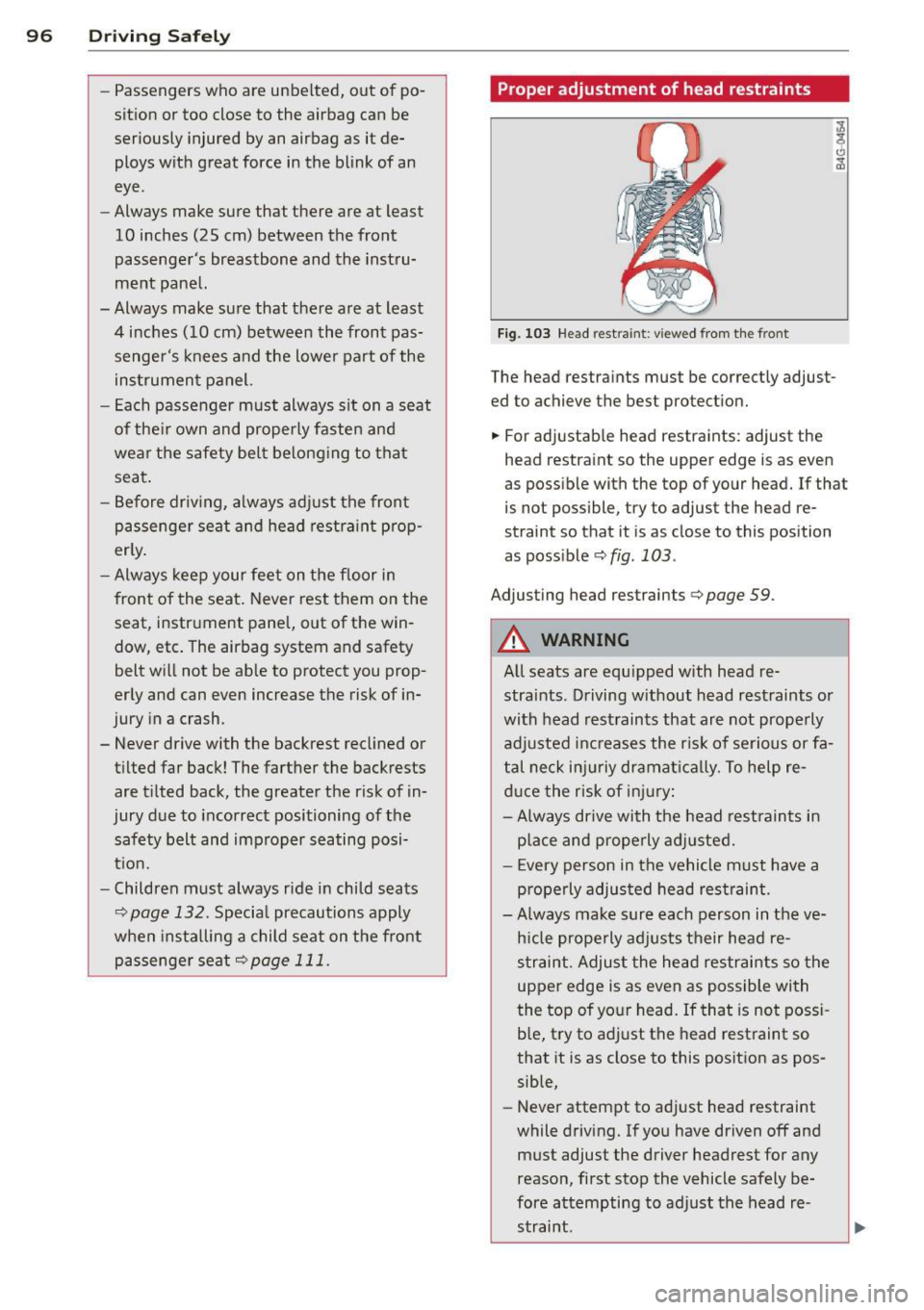
Proper adjustment of head restraints
Fig. 103 Head restra int: v iewed from the front
The head restraints must be correctly adjust
ed to achieve the best protection.
.,. For adjustable head restraints: adjust the
head restraint so the upper edge is as even
as possible with the top of your head. If that
is not possible, try to adjust the head re
straint so that it is as close to this position
as possible
r:::;, fig. 103 .
Adjusting head restraints¢
page 59.
A WARNING ~
All seats are equipped with head re-
straints. Driving w ithout head restraints or
with head restraints that are not properly
adjusted increases the risk of serious or fa
tal neck injuriy dramat ically. To help re
duce the risk of injury:
- Always drive with the head restraints in
p la ce and properly adjusted.
- Every person in the vehicle must have a
properly adjusted head restraint.
- Always make sure each person in the ve
h icle properly adjusts their head re
straint. Adjust the head restraints so the
upper edge is as even as possible with
the top of your head. If that is not possi
ble, try to adjust the head restraint so
that it is as close to this position as pos
sible,
- Never attempt to adjust head restraint
while driving. If you have driven off and must adjust the driver headrest for any
reason, first stop the vehicle safely be
fore attempting to adjust the head re
straint .
Page 99 of 244
-Children must always be properly re
strained in a child restraint that is appro
priate for their age and size
c:> page 132.
Examples of improper seating positions
The occupant restraint system can only re
duce the risk of injury if vehicle occupants are
properly seated.
Improper seating positions can cause serious
injury or death. Safety belts can only work
when they are properly positioned on the
body. Improper seating positions reduce the
effectiveness of safety belts and will even in
crease the risk of injury and death by moving
the safety belt to critical areas of the body .
Improper seating positions also increase the
risk of serious injury and death when an air
bag deploys and strikes an occupant who is
not in the proper seating position. A driver is
responsible for the safety of all vehicle occu
pants and especially for children. Therefore:
.,. Never allow anyone to assume an incorrect
seating position when the vehicle is being
used
c:> ,&. .
The following bullets list only some sample
positions that wi ll increase the risk of serious
injury and death . Our hope is that these exam
ples will make you more aware of seating po
sitions that are dangerous.
Therefore, whenever the vehicle is
moving:
- never stand up in the vehicle
- never stand on the seats
- never kneel on the seats
- never ride with the seatback reclined
- never lean up against the instrument panel
- never sit on the edge of the seat
- never sit sideways
- never lean out the window
- never put your feet out the window
- never put your feet on the instrument panel
- never rest your feet on the seat cushion or
back of the seat
- never ride in the footwell
Driving Safely 97
-never ride in the cargo area
A WARNING
Improper seating positions increase the
risk of serious personal injury and death
whenever a vehicle is being used.
- Sitting incorrectly places occupants at
risk of being critically injured if the air
bags deploy and strike them.
- Before you start driving, seat yourself
properly and always maintain this seat
ing position during the trip. Before each
trip, instruct your passengers to seat
themselves properly and to maintain this
seating position during the trip
c:> page 57, General recommendations .
Driver and passenger
side footwell
Important safety instructions
A WARNING
A lways make sure that the knee airbag can
inflate without interference. Objects be
tween yourself and the airbag can increase
the risk of injury in an accident by interfer
ing with the way the airbag deploys or by
being pushed into you as the airbag de
ploys .
- No persons (children) or animals should
ride in the footwell in front of the pas
senger seat . If the airbag deploys, this
can result in serious or fatal injuries.
- No objects of any kind should be carried
in the footwell area in front of the driv
er 's or passenger's seat. Bulky objects
(shopping bags, for example) can ham
per or prevent proper deployment of the
airbag. Small objects can be thrown
through the vehicle if the airbag deploys
and injure you or your passengers .
•
•
-
Page 100 of 244
98 Driving Safely
Pedal area
Pedals
The pedals must always be free to move and
must never be interfered with by a floor mat
or any other object.
Make sure that all pedals move freely without
interference and that nothing prevents them
from returning to their original positions .
Only use floor mats that leave the peda l area
free and can be secured with floor mat fasten
ers.
If a brake circuit fails, increased brake peda l
travel is required to bring the vehicle to a full
stop.
A WARNING
Pedals that cannot move freely can cause
loss of vehicle control and increase the r isk
of serious injury.
- Never place any objects in the driver 's
footwell. An object could get into the
peda l area and interfere w ith pedal func
tion. In case of sudden braking or an ac
cident, you would not be ab le to bra ke or
accelerate!
- Always make su re that nothing can fall
or move into the driver's footwell.
Floor mats on the driver side
Always use floor mats that can be securely
attached to the floor mat fasteners and do
not interfere with the free movement of the
pedals.
... Make su re that the floor mats are properly
secured and cannot move and interfere with
the pedals~ .&_.
Use only floor mats that leave the pedal a rea
unobstructed and that are firmly secured so
that they cannot s lip out of position. You can
obtain suitable floor mats from your author
ized Audi Dealer.
Floor mat fasteners are installed in your Audi . Floor mats used in your vehicle must be at
tached to these fasteners . Properly securing
the floor mats will prevent them from sliding
into positions that could interfere with the
pedals or impair safe operat ion of your vehicle
in other ways.
A WARNING ,-
Pedals that cannot move freely can result
i n a loss of vehicle control and increase the
r isk of ser ious persona l injury.
- Always make sure that floor mats are
p roperly secured.
- Never place or install floor mats or other
f loor coverings in the vehicle that cannot
be prope rly secured in place to prevent
them from slipping and interfer ing wi th
the peda ls or the ability to contro l the
vehicle.
- Never pla ce or install floor mats or other
floor coverings on top of already instal
led floor mats . Additiona l floor mats and
other coverings will reduce the size of
the pedal area and interfere with the
pedals.
- Always properly reinsta ll and secure floor
mats that have been taken out for clean
ing.
- Always make sure that objects cannot
fall into the dr iver footwell while the ve
hicle is moving . Objects can become
trapped under the brake pedal and accel
erator pedal causing a loss of vehicle
control.
Stowing luggage
Loading the luggage compartment
All luggage and other objects must be prop erly stowed and secured in the luggage com
partment.
Loose items in the luggage compartment can
shift s udden ly, changing vehicle handling
characteristics. Loose items can a lso increase
the risk of serious persona l injury in a sudden
vehicle maneuver or in a co llision.
Page 101 of 244
In a collision, the laws of physics mean that
even smaller items that are loose in the ve hi
cle will become heavy missiles that can cause
serious injury. Items in the vehicle possess en
ergy which vary with vehicle speed and the
weight of the item . Vehicle speed is the most
sig nificant factor.
For examp le, in a frontal coll is ion at a speed
of 30 mph (48 km/h), the forces acting on a
10 -lb (4 .5 kg) object are about 20 times the
norma l we ight of the item. Th is means that
the we ight of the item would suddenly be
about 200 lbs. (90 kg). You can imag ine the
in ju ries that a 200 lbs. (90 kg) item flyi ng
freely th roug h the passenge r compartment
could cause in a collision like this.
~ WARNING
Improperly stored luggage or other items
can fly through the vehicle ca us ing serious
personal in jury in the event of hard brak
ing or an acc ident. To help reduce the risk
of serious personal injury :
-Always put objects, for examp le, luggage
or other heavy items in the luggage com
partment .
A WARNING
Heavy loads will influence the way your ve
hicle handles . T o help reduce the r is k of a
loss of control leading to ser ious personal
injury:
- Always keep i n m ind whe n transporting
heavy objects, that a c hange in t he cen
t er of g ravity c an also cause c hanges in
vehicle handling .
- Never exceed the G ross Ax le Weight R at
ing or the Gross Veh icle Weight R ating
specified on t he safety compliance s tic k
er on the left door jamb. Exceeding pe r
missib le we ight standa rds can cause the
vehicle to s lide and handle differently.
- Please obse rve info rmation on safe driv
ing
c:;, page 93 .
Dr iving S afel y 99
A WARNING
Always make sure that the doors, all win
dows a nd the front lid are secure ly closed
and locked to reduce the r is k of injury
when the vehicle is not be ing used .
- After closing the front lid, always make sure that it is p rope rly closed and locked .
- Never leave your veh icle unattended es
pecially with the front lid left open . A
child co uld craw l into the luggage com
pa rtment and close the front lid becom
ing tr apped and unable to ge t out. Being
trapped in a veh icle can lead to se rious
pe rsonal injury .
- Never let c hild ren play i n or aroun d the
veh icle .
- Never let p assenger s ride in the luggage
comp artment. Vehicle oc cupants mus t
always be prope rly restrained in one of
the vehicle's seating pos it ions .
(D Tips
The t ire press ure mu st cor respond to t he
l oad. The t ire p ress ure is shown on the tire
pressure label. The tire pressure labe l is lo
cated on the d river's side B-pi llar . The t ire
pressure label lists the recommended cold
tire inflation pressures for the vehicle at i ts maximum capac ity we ight and the tires
that we re on your vehicle at the t ime it
was manufactured. For recommended tire
p ressures fo r no rma l load cond it ions,
please see chapter
c:;, page 193.
Reporting Safety
Defects
Applicable to U.S.A.
If you belie ve that your vehi cle
has a d efe ct which could cau se
a crash or could caus e injur y or
d eath, you should immediat ely
inform th e National High way
Tr affi c Safet y Administration
•
•
Page 103 of 244

http ://www .tc.gc.ca/eng/
ro ad safety/me nu.htm
Active rollover
protection system
Function
The active rollover protection system helps
protect vehicle occupants in the event of a rollover.
Fig. 104 Rollbar deployme nt range
Fig . 105 Rollbar deploye d
The active rollover protection system consists
of:
- two rollbars
- the safety belts with belt tens ioners
- th e windshield frame
- the rollover sensors .
The active rollover protection system provides
additional safety in the event of a rollover.
With in milliseconds, sensors deploy two roll
bars located behind the headrests
c> fig. 105.
The rollbars, reinforced windshield frame and
belt tensioners help protect vehicle occupants
in the event of a rollover.
Driving Safely 101
The rollover protection system functions
when the convertible top is both open and
closed.
_& WARNING
Do not use the area behind the headrests
c> fig. 104 as a storage area. This is the
area where the rollbars deploy. If the roll
over protection system is triggered, ob
jects placed there can be propelled
through the vehicle and make it more diffi
cult for the rollbars to deploy. This increas
es the risk for serious or life-threatening
injuries.
When is rollover protection deployed?
Rollover protection deploys in a collision or
rollover.
Depend ing on the collision, sensors through
out the vehicle and the control module trigger
the rollover system to deploy.
For safety reasons, rollover protection also de
ploys during front, side and rear collisions
above a certain level of sever ity.
Page 104 of 244
102 Driving Safel y
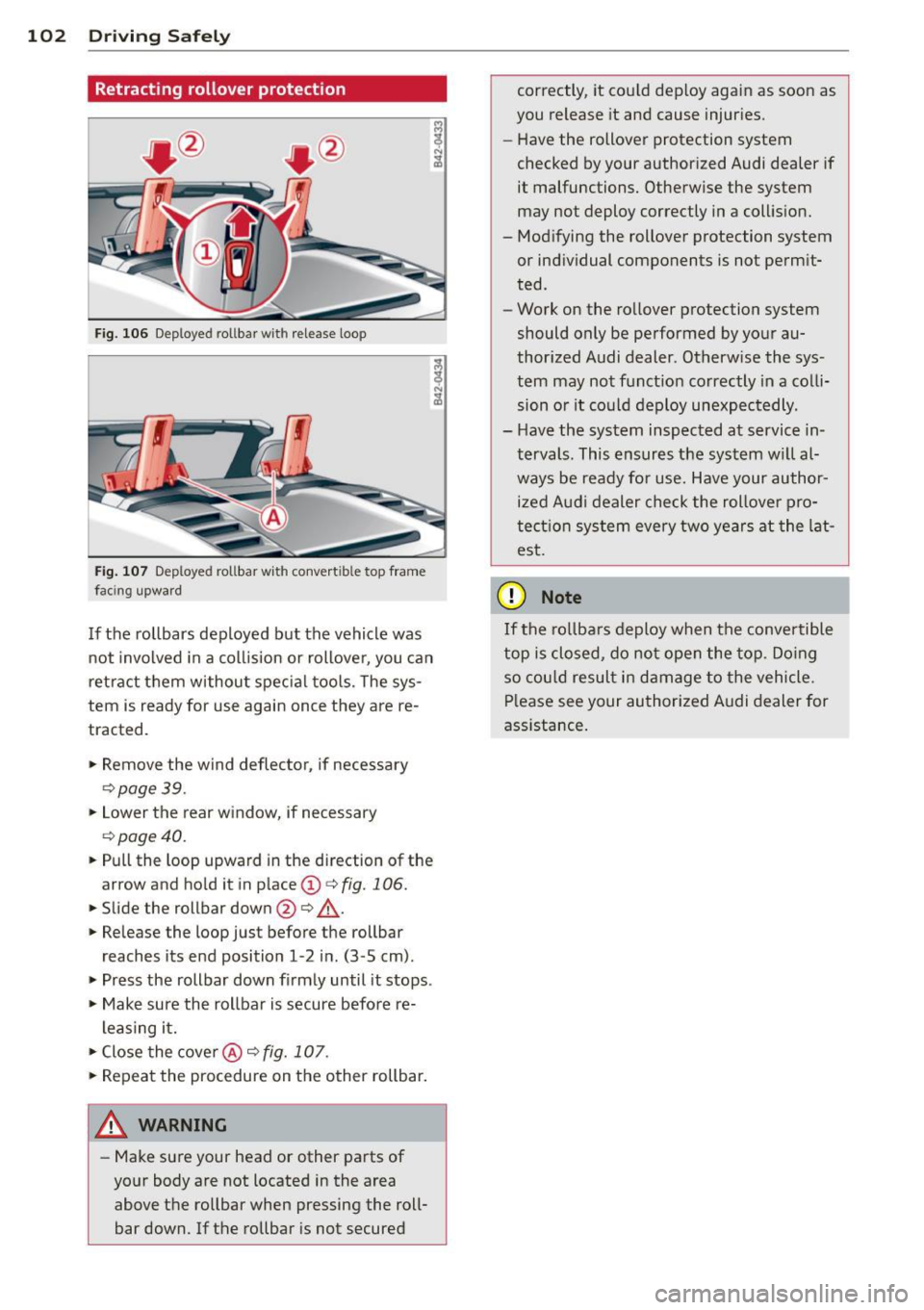
Retracting rollover protection
Fig. 106 Deployed roll bar w it h release loop
Fig . 107 Dep loye d rollbar w it h convert ible top frame
fac in g upwa rd
If the rollbars deployed but the vehicle was
not involved in a collision or rollover, you can
retract them without spec ia l tools. The sys
tem is ready for use again once they are re
tracted .
.,. Remove the w ind deflec to r, if necessary
c> page39 .
.,. Lower the rear window, if necessary
c> page40 .
.,. Pull the loop upward in the direction of the
arrow and ho ld it in p lace
(I) <=> fig. 106 .
.,. Slide the rollbar down@ c> /1. .
.,. Re lease the loop just before the rollbar
reaches its end position 1-2 i n. (3-5 cm) .
.,. Press the rollbar down firmly until it stops .
.,. Make sure the rollbar is secure before re
leas ing it .
.,. Close the cove r@ c>
fig. 107 .
.,. Repeat the procedure on t he other rollbar.
A WARNING
- Make su re your head or other parts of
yo ur body are not located in the area
above the rollbar when pressing the roll
bar down. If the rollbar is not secured -
correctly, it cou ld dep loy again as soon as
you release it and cause injur ies.
- Have the rollover protection system
checked by your author ized Audi dealer if
it malfunctions. Otherwise the system
may not deploy correctly in a collis ion.
- Mod ifying the rollover protection system
or individual components is not pe rm it
ted .
- Work on the ro llover protection system
should only be performed by your au
thor ized Audi dealer. Otherw ise the sys
tem may not f unct ion co rrectly in a colli
sion o r it co uld deploy unexpectedly.
- Have the system inspected at service in
tervals . This ensures the system w ill al
ways be ready for use. Have your author
i z ed Aud i dealer check the rollover pro
tec tion sys tem every two years at the lat
est.
(D Note
If the ro llba rs deploy when the convertible
top is clo sed, do no t open the top. Do ing
so cou ld resul t in damage to the vehicle.
P lease see your authorized A udi dealer for
ass istance.