warning AUDI R8 SPYDER 2015 Owners Manual
[x] Cancel search | Manufacturer: AUDI, Model Year: 2015, Model line: R8 SPYDER, Model: AUDI R8 SPYDER 2015Pages: 232, PDF Size: 58.36 MB
Page 199 of 232
subsequent vehicle start-ups as long as the mal
function exists.
When the malfunction indicator is illuminated,
the system may not be able to detect or signa l
l ow tire pressure as intended. TPMS malfunctions
may occur for a variety of reasons, including the
installation of rep lacement or a lternate tires or
wheels on the vehicle that prevent the TPMS from functioning properly. Always check the
T PMS malfunction telltale after replacing one or
more tires or wheels on your vehicle to ensure
that the replacement or alternate tires and
wheels allow the TPMS to continue to function
properly .
Introduction
The tire pressure monitoring system monitors air
pressure in all four road wheels while the vehicle
is moving.
As soon as the tire pressure monitoring system
senses a s ignificant loss of a ir pressure in one or
several tires, text messages and ye llow symbo ls
appear in the instrument cluster display to a le rt
the driver. The
[I] warning light in the instru
ment cluster comes on when the tire is signifi
cantly underinflated .
The warning
light [l'J also illuminates in the case
of a system malfunction.
Be aware that tire p ressure is also dependent on
the temperat ure of the t ire. For every 18 ° F
(10 °() increase in tire temperature, tire pressure
increases by about 1.5 psi (0.1 bar) . The tire
warms up while the vehicle is moving and tire
pressure rises. So you shou ld adjust tire pressure
only when they are
cold, when the temperature
of the tires is roughly the same as the ambient
air temperature.
In order to keep the tire pressure monitoring sys
tem properly calibrated, tire pressure on all four
tires should be checked at regular intervals .
The tire pressure is shown on the label located on
~ the driver 's side B-pillar (visible when the door is r--
~ open) .
,...., \!) ..,.,
N
"' ,....,
Tires a nd w hee ls
A WARNING
-
When the tire pressure monitoring system
warning light is lit, one or more of your tires is
significantly under- inflated . You should stop
and check your t ires as soon as poss ible, and
i nflate them to the proper pressure as indicat
ed on the vehicle 's t ire pressure label
¢ page 176. Driving on a significant ly under
inflated tire causes the tire to overheat and
can lead to tire failure. Under-inflation also is
likely to impair the vehicle's handling and
stopping ability.
@ For the sake of the environment
Driving with under -inflated tires reduces fuel
efficiency and tire tread life.
(D Tips
- Each tire should be checked monthly when
the temperature of the tires is about the
same as ambient air temperature and set to
the recommended inflation pressure as
specified on the tire pressure label
¢page 176.
- The tire pressure mon itoring system helps
the driver to keep an eye on tire pressures.
But the driver still has the responsib ility for
ma inta ining the correct tire pressure.
- Tire pressure must only be adjusted when
the temperature of the tires is about the
same as amb ient air temperature.
- When tires are replaced, the sensors and
valves should not be exchanged. The valve
core, nut, valve seal ing and seal washer (re
placement kit) needs to be replaced. If nec
essary, the valve and the wheel electronics
have to be replaced.
- The tire pressure mon itoring system on your
Audi was calibrated using tires with "RO"
identification. We recommend using these
tires .
- If you sho uld put different wheels and tires
on your vehicle (e .g. winter whee ls and
tires), you must be certain that the wheels
197
Page 200 of 232
Tires and wheels
and tires are compatible with the tire pres
sure monitoring system. Otherwise the sys
tem will register a malfunction and a fault message will be displayed. For more infor
mation, contact your authorized Audi deal
er.
- For Declaration of Compliance to United
States FCC and Industry Canada regulations
c:> page 218.
Programming a new set of tires
Applies to veh icles: w ith tire pressure monitoring syste m
When driving with a new set of tires, you can pro
gram them to the tire pressure monitoring sys
tem using the menu disp lay.
.,. Turn the ignition on .
.,. Select the menu:
Set> Tire pressure > Wheel
change.
.,. Confirm that you would like to begin the pro
gramming process . The message
Wheel sen
sors are being initialised. This may take a few
minutes ...
appears in the instrument cluster
display.
You can switch between programmed tire sets at
any time without reinitializing the system.
(D Tips
- If the programming process was not com
pleted successfully, the message
Wheel
sensors could not be initialised
appears in
the display and them indicator light
turns on. If this happens, repeat the proce
dure.
- Do not store the tire pressure if there are
snow chains on the tire.
TPMS Tire pressure monitoring system
malfunction
A malfunction can have various causes.
If the [I] warning light in the instrument cluster
flashes for approximately one minute and then
remains continuously illuminated and additional
ly
the m symbol appears in the display, the tire
pressure monitoring system is not available. The
198
text Tire pressure! System malfunction appears
in the display. This can have various causes.
- A wheel sensor or other component may have
fai led.
- During initialization the system has detected
more than 4 wheels on the vehicle, for example
while driving next to another car with a tire pressure monitoring system.
- Audi replacement parts were not used.
- If snow cha ins are being used, system function
can be compromised due to the shielding prop
erties of the chains .
- The tire pressure monitoring system may not
be available because of a rad io malfunction.
- Transmitters with the same frequency, such as
radio headphones in the vehicle or radio equip
ment, can cause a temporary disruption of the
system through excessive electromagnetic
fields .
- Eliminate the interference if you can and then
proceed as follows: Turn off the engine for 20
minutes. Then drive another 10 minutes.
If the
warning light comes on again, you should con
tact your authorized Audi dealer immediately
to have the problem corrected.
- Do not use commercially available tire sealants.
Otherwise, the electrical components of the
tire pressure monitoring system will no longer
work properly and the sensor for the tire pres
sure monitoring system will have to be replaced
by a qualified workshop.
Page 201 of 232
What do I do now? Trunk escape handle
Appl ies to vehicles: with trunk escape handle
In case of an emergency, the front lid can be
opened from the inside using the trunk escape
handle.
.. To open the front lid pull the handle.
The trunk escape handle inside t he luggage com
partment is made of fluorescent material to glow
in the dark .
.&_ WARNING
The trunk escape handle is to be used only in
an emergency.
Vehicle tool kit
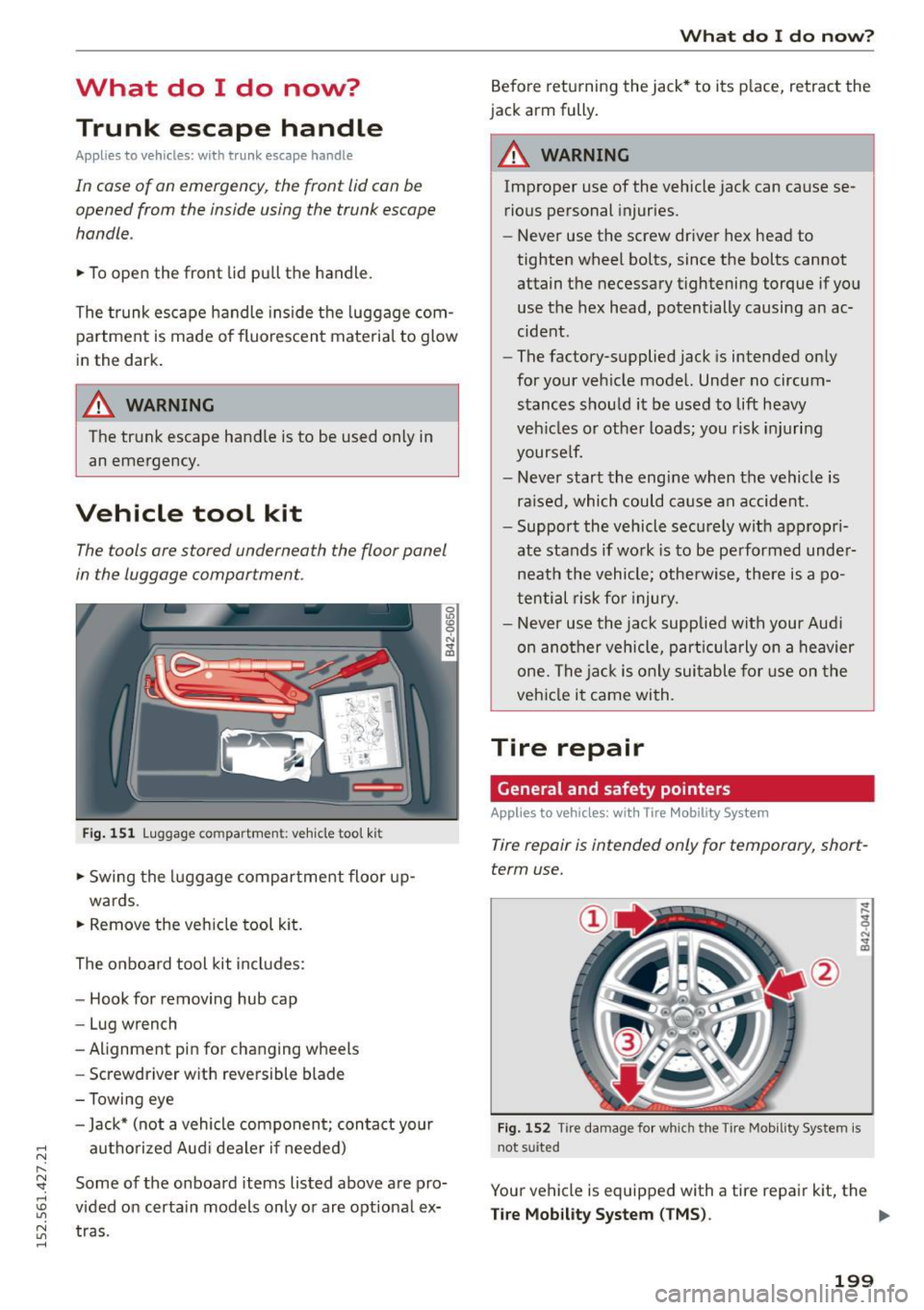
The tools are stored underneath the floor panel
in the luggage compartment.
Fig. 151 Luggage compartment: veh icle tool kit
"' Swing the luggage compar tment floo r up-
wards .
.. Remove the vehicle tool kit.
The onboard tool kit incl udes:
- Hook for removing hub cap
- Lug wrench
- Alignment pin for changing wheels
- Screwdr iver w ith reversible blade
- Towing eye
- Jack* (not a vehicle component; contact your
,..... authorized Aud i dealer i f needed)
N
I'-
~ Some of the on board items listed above are pro-
.... :5: vided on certa in models only or are optiona l ex-
N l/1 .... tras.
What do I do no w?
Before returning the jack* to its p lace, retract the
jack arm fully.
.&_ WARNING
-
Improper use of the vehicle jack can cause se-
rious personal injuries.
- Never use the screw driver hex head to
tighten wheel bo lts, since the bolts cannot
attain the necessary tightening torque if yo u
use the hex head, potentially causing an ac
cident.
- The factory-supplied jack is intended only
for your veh icle model. Under no circum
stances should it be used to
lift heavy
veh icles or other loads; you risk injuring
yourse lf.
- Never start the engine when the vehicle is
raised, which could cause an accident.
- Support the vehicle securely with appropri
ate stands if work is to be pe rformed under
neath the vehicle; otherwise, the re is a po
tential risk fo r injury.
- Never use the jack supplied with your Aud i
on another vehicle, part icularly on a heavier
one. The jack is only suitable for use on the
vehicle it came with.
Tire repair
General and safety pointers
Applies to vehicles: with Tire Mobility System
Tire repair is intended only for temporary, short
term use.
Fig. 152 Tire damage for which the Tire Mobility System Is
not suited
Your vehicle is equipped with a tire repa ir kit, the
T ire Mob il it y Sy stem ( TMS). .,.
19 9
Page 202 of 232
What do I do now?
In the event of a tire fai lure, the TM S is in the
luggage compartment under the floor . It consists
of the tire sealant and an electric a ir pump.
Using
TM S, tire damage ca used by fore ign bodies
up to about
0.1 6 inch (4 mm ) in diameter can be
sea led reliab ly .
The foreign object can stay in the ti re.
The tire sealant must not be u sed:
- for cuts or punctures in the t ire which are larger
than 0 .16 inch (4 mm) ¢
fig. 152 (D
- for damage to the rim@
- if you have been driving w ith very low tire pres-
sures or tires with no a ir @
Using the
T MS is described in the section
c=;, page 201, Preliminary steps.
TM S can be used a t temperatures down to -4 °F
(- 20 °().
A WARNING
Take the following precautions after repairing
the t ire :
- Do not drive faster than 50 mph (80 km/h)!
- Avoid full-throttle acce le rat ion, heavy brak-
ing and fast cornering .
- T he veh icle's road behavior can be affected.
- T ires sealed w ith
TMS are intended only for
t e mp orary , short -term use.
- After using the tire sea lant the tire pressure
monitoring system may no longer work
properly. Dr ive carefully to the next profes
sional repair facility.
- TMS must NOT be used,
- for cuts or punctures in the tire which are
larger than 0.16 inch (4 mm)
- for damage to the rim
- if you have been driving with very low tire
pressures or tires with no air
- Seek profess iona l assistance if it is not pos
sible to repair the tire with the tire sealant.
A WARNING
The tire sealant must not come into contact
with skin, eyes or clothing.
200
- If you get any tire sea lant in yo ur eyes or
come into contact w ith it, rinse the affected
area thoroughly with clean water. Find a phys ician immediately!
- Change any clothing contaminated w ith tire
sealant immediately.
- Do not inha le the vapor!
- If you have swallowed tire sealant, rinse
your mouth thoroughly right away and dr ink
plenty of water.
- Do not induce vom it ing! Find a physician
i mmedia tely!
- If you have allergic react ions, find a physi
cian immediately.
- Keep the tire sealant away from children.
(D Note
Do not use commercially availab le tire seal
ants. The electr ical components of the tire
pressure monitoring system w ill no longer
work properly .
@ For the sake of the environment
Used sealant bottles can be dropped off at a
recycling facility.
(D Tips
-If sea lant has run out, allow it to dry. Then
you can peel it off.
- Have the tire sea lant rep laced every 4 years
at a dealership.
Page 203 of 232
....
Preliminary steps
Applies to vehicles: with Tire Mobility System
Some preliminary steps are necessary for tire re
pair.
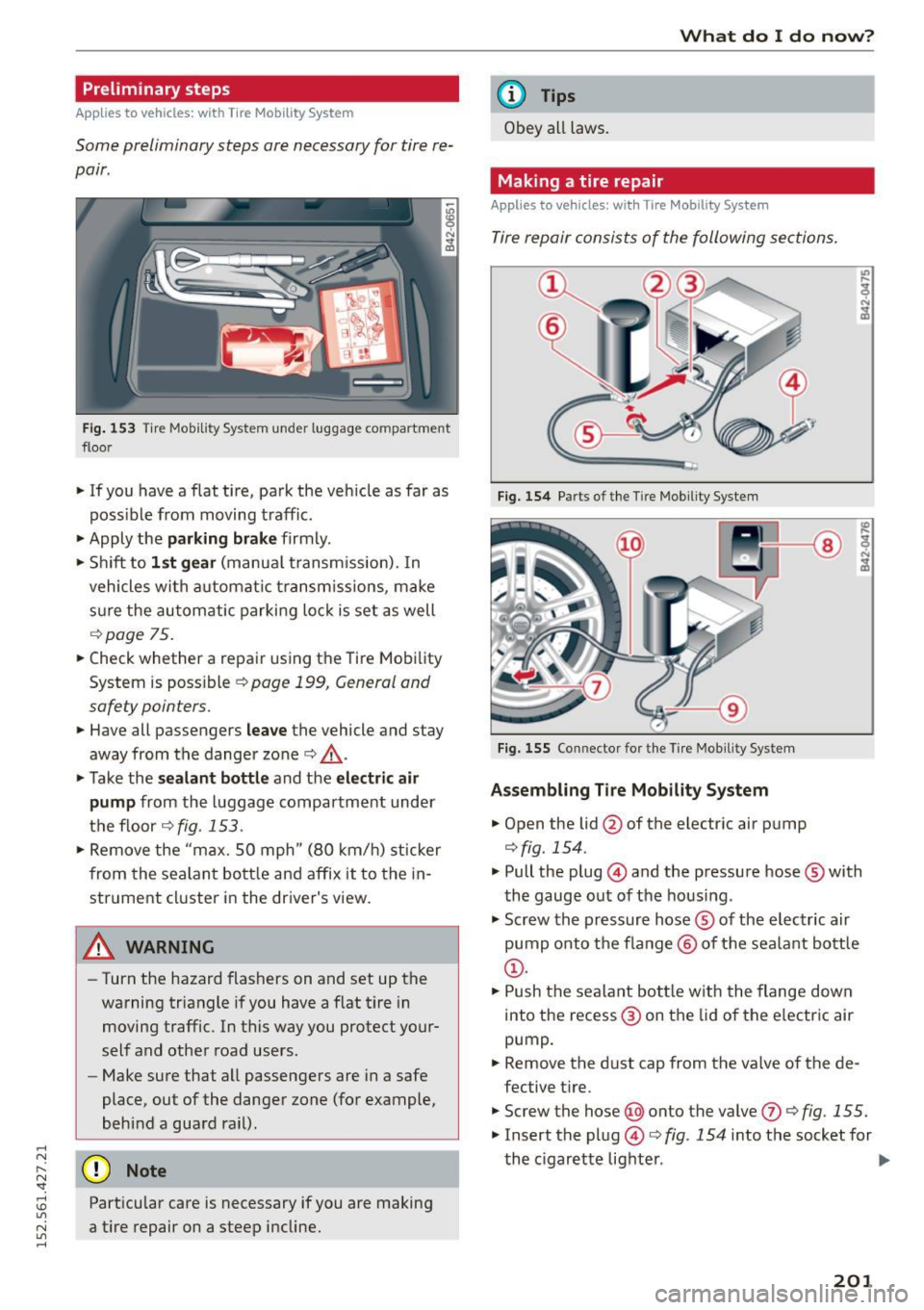
Fig . 153 Tire Mobility System under luggage compartment
floor
.. If you have a flat tire, park the veh icle as far as
poss ible from moving traff ic .
.. Apply the
parking brak e firmly .
.. Sh ift to
1 st ge ar (manual t ransm ission). In
vehicles wi th a utomat ic t ransm issions, make
s ur e the automatic parking lock is set as well
r::!) page 7 5 .
.. Check whether a repair using the Tire Mobi lity
System is poss ible ¢
page 199, General and
safety pointers .
.. Have all passengers lea ve the vehicle and stay
away from the danger zone
c:> &_ .
.. Take the sea lant bottle and the electri c air
pump from the luggage compa rtment under
the f loor
c:> fig. 153.
.. Remove the "max. 50 mph" (80 km/h) sticker
from the sealant bott le and affix it to the in
strument cluster in the driver's view.
A WARNING
- Turn the hazard flashers on and set up the
warning triangle if you have a flat tire in
moving traffic. In this way you protect your
self and other road users.
- Make sure that all passengers are in a safe
place, out of the danger zone (for example,
behind a guard rail).
~ (D Note
"1: .... I.O
"' N
"' ....
Particular care is necessary if you are making
a t ire repair on a steep incline.
What do I do no w?
(D Tips
Obey all laws.
Making a tire repair
Applies to vehicles: with Tire Mob ility System
Tire repair consists of the following sections.
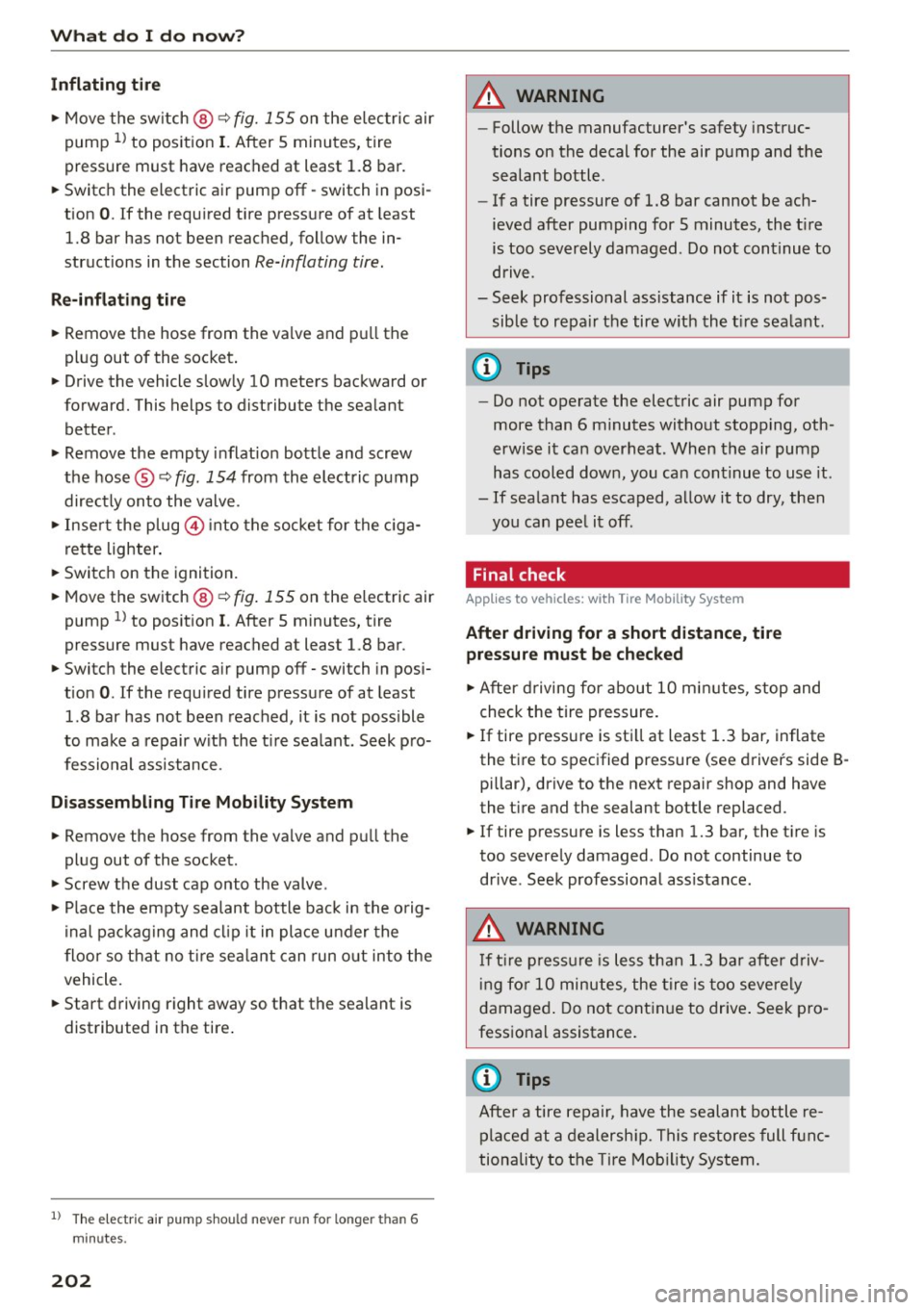
Fig. 154 Parts of the Tire Mob ility System
Fi g. 1 55 Connector for the Tire Mobility System
Assembling Ti re Mobili ty System
.. Open the lid@ of the electr ic air pump
¢fig. 154 .
.,. Pull the plug @and the pressure hose ® with
the gauge out of the housing .
.,. Screw the pressure hose ® of the electric air
pump onto t he f lange @ of the sea lant bottle
@ .
.. Push the sealant bott le w it h the flange down
into the recess @ on the lid of the electr ic air
pump .
.. Remove the dust cap from the valve of the de
fective tire.
.. Screw the hose@) onto the valve
(J) r::;, fig. 155.
.,. Insert the plug @r::;, fig. 154 into the socket for
the c igarette lighter .
IJi-
201
Page 204 of 232
What do I do now?
Inflating tire
.,. Move the switch @¢ fig. 155 on the e lec tric air
pump
ll to posit io n I. After 5 minutes, tire
pressure must have reached at least 1.8 bar.
.,. Switc h the electric a ir pump off -switch in posi
tion
0 . If the requ ired tire press ure of at least
1.8 bar has not been reached, follow the in
structions in the section
Re-inflating tire.
Re-inflating tire
.,. Remove the hose from the va lve and p ull the
pl ug out of the soc ket .
.,. Drive the vehicle s low ly 10 meters backward or
forward. This helps to distribute the sea lant
better .
.,. Remove the empty inflat ion bott le and screw
t h e hose ®¢
fig. 154 from the electric p ump
direc tly onto the
valve .
.,. Inse rt the plug @ into the socket for the c iga
r e tte lighter .
.,. Swi tc h on the igni tion .
.,. Move t he sw itch @¢
fig. 155 on the e lectric air
pump
ll to posit ion I. After 5 minutes, tire
pressure must have reached at least 1.8 bar .
.,. Switc h the electric a ir pump off -switch in posi
tion
0 . If the requ ired t ire p ressure of at least
1.8 bar has not been reached, it is not poss ible
to mak e a re pair w it h t he tir e se alant. Seek p ro
fessional assis tance.
Disassembling Tire Mobility System
.,. Remove the hose from the valve and pu ll the
pl ug out of the socket .
.,. Screw the dust cap onto the
valve .
.,. Place the em pty sealant bottle bac k in the o rig
i nal pa cka ging and clip it in pla ce u nder the
f loo r so t hat no ti re se alant c an run o ut into the
vehicle.
.,. Start d riving r ight away so t hat the sea lant is
dist ributed in the tire .
1
> T h e e le ctr ic air pu m p sh o ul d never r un for long er than 6
m in utes .
202
A WARNING ,_ -
- Follow the manufacturer's safety instruc
tions on the decal for the air pump and the
sealant bottl e .
- If a tire pressure of 1.8 bar cannot beach
ieved after pumping for S minutes, the t ire
is too severely damaged . Do not con tinue to
d rive .
- Seek pro fessional ass istance if it is not pos
sib le to r epa ir th e tire w ith the t ire sea lant .
(D Tips
- Do not operate the electric air pump for
more than 6 minutes witho ut stopping, oth
erw ise i t can overhea t. When th e air pum p
ha s cooled dow n, you can con tinu e to use it.
- If sea la nt has escaped, a llow it to dry, then
you can pee l it off .
· Final check
App lies to vehicles: with Tire Mobility System
After driving for a short distance, tire
pressure must be checked
.,. Aft er d riving for about 10 m inutes, stop and
check the tire pressure.
.,. If tire pressure is sti ll at least 1.3 bar, inflate
the t ire to specified pressure (see d rivers side B
pillar), drive to the next repair shop and have
the t ire and the sealant bottle replaced.
1> Iftire pressure is less than 1.3 bar, the t ire is
too severe ly damaged . Do not continue to
dr ive . Seek professiona l assistance .
A WARNING
If tire pr ess ure is le ss than 1.3 bar afte r driv
i ng f or 10 minu tes , the tire is to o seve rely
d amaged . Do not cont in ue to drive . Seek pro
fess iona l assistance.
{D Tips
A ft er a tire re pa ir, have the sealant bottle re
pla ced at a dealersh ip. T his restores full f unc
tion ality to the Tire Mob ility System .
Page 206 of 232
What do I do now?
• Align the jack so that its arm@ c> fig. 158 en
gages in the designated lifting point in the door
s ill and the movable base @ lies flat on the
ground . The base @ must be
vertical under the
lifting point @.
• Wind the jack up further until the flat tire
comes off the ground
c> ,&. .
Position the vehicle jack only under the designat
ed lifting points on the sill<=>
fig. 157. There is ex
actly
one location for each side of the vehicle .
The jack must not be posit ioned at any other lo
cation
c> .&, c>(D .
An unstable surface under the jack can cause the
vehicle to slip off the jack . Always provide a firm
base for the jack on the ground . If necessary
place a sturdy board or similar support under the
jack. On
hard, slippe ry surfac es (such as tiles)
use a rubber mat or similar to prevent the jack
from slipping
c> .&, .
A WARNING
-
-You or your passengers could be injured
while changing a wheel if you do not follow
sa fety precautions:
- Position the vehicle jack only at the desig
nated lifting points and align the jack.
Otherwise, the vehicle jack could slip and
cause an injury if it does not have suffi
cient hold on the vehicle.
- A soft or unstable surface under the jack
may cause the vehicle to slip off the jack .
Always provide a firm base for the jack on
the ground. If necessary, use a sturdy
board under the jack.
- On hard, slippery surface (such as tiles)
use a rubber mat or similar to prevent the
jack from slipping.
- To help prevent injury to yourself and your
passengers:
- Do not raise the vehicle until you are sure
the jack is securely engaged.
- Passengers must not remain in the vehicle
when it is jacked up.
- Make sure that passengers wait in a safe
place away from the vehicle and well away
from the road and traffic.
204
- Make sure jack position is correct, adjust
as necessary and then continue to raise
the jack.
(D Note
A floor jack or the pads on the hoist arms
must
not be positioned at the points shown
-arrow-.
Removing the wheel
Follow these instructions step-by-step for chang
ing the wheel.
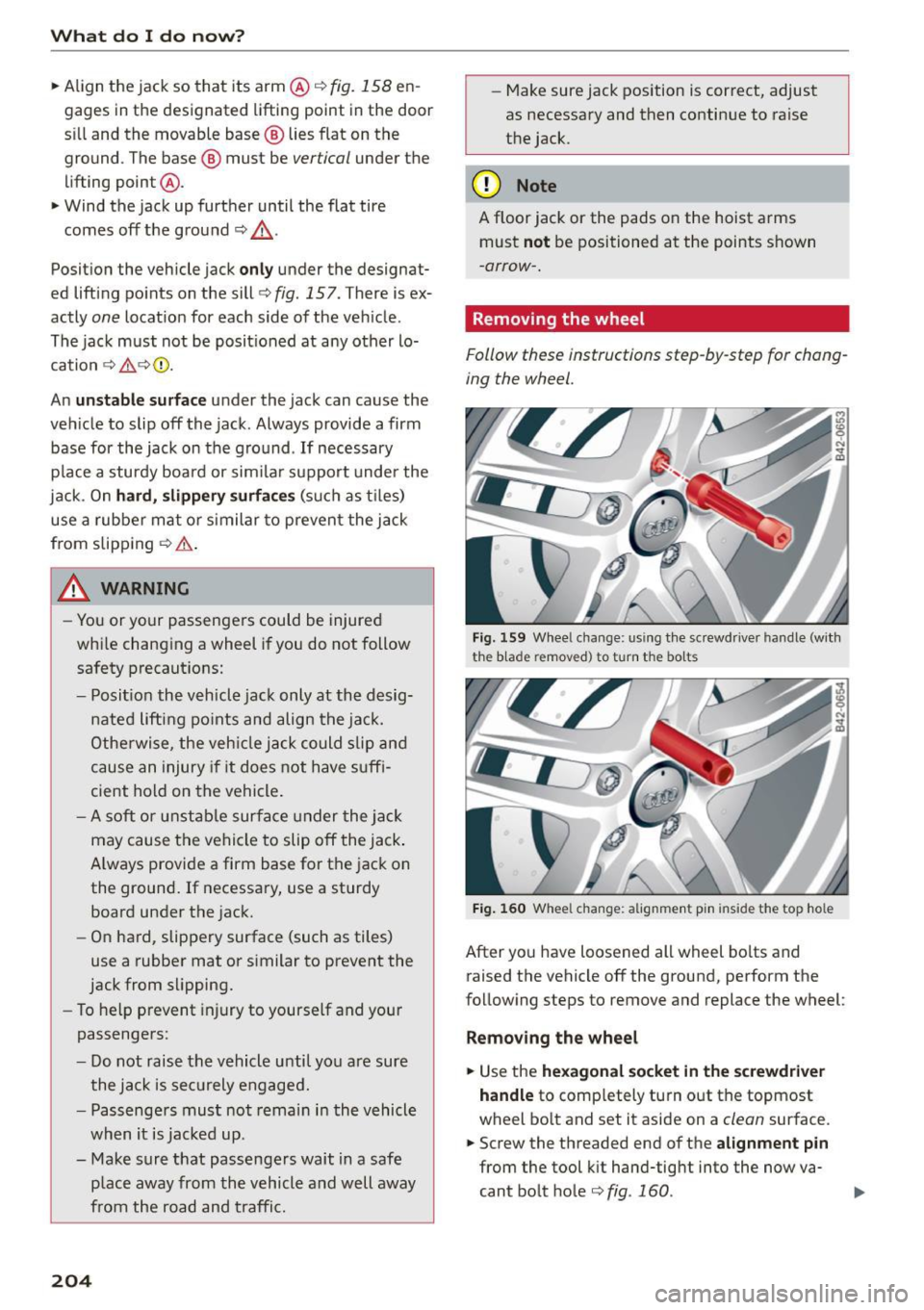
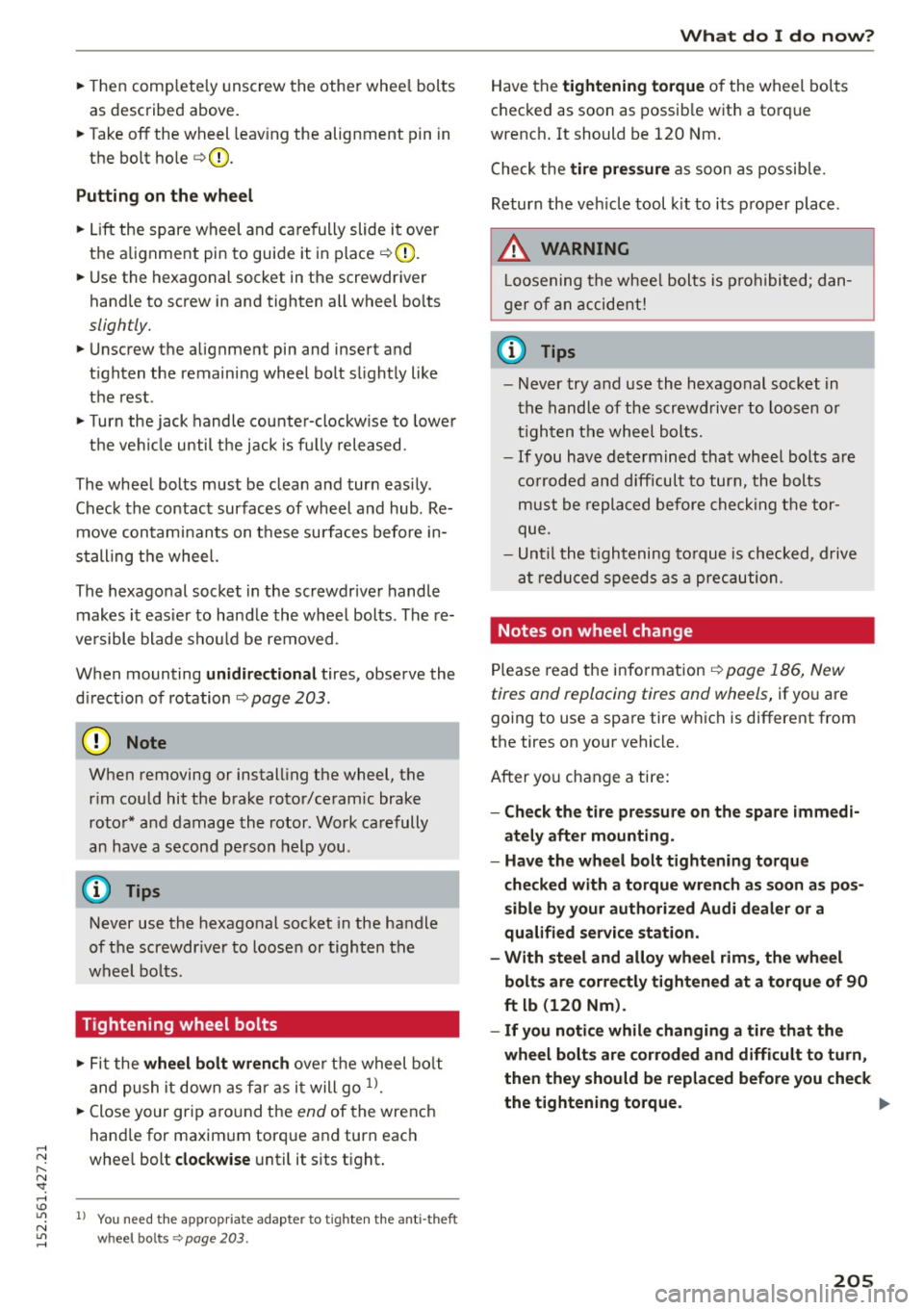
Fig. 159 Whee l chan ge: using the screwd river handle (wit h
the blade removed) to turn t he bolts
Fig. 160 Whee l chan ge: alignme nt pin inside the top hole
After you have loosened all wheel bolts and
raised the vehicle off the ground, perform the
following steps to remove and replace the wheel:
Removing the wheel
• Use the hexagonal socket in the screwdriver
handle
to completely turn out the topmost
wheel bolt and set it aside on a
clean surface .
• Screw the threaded end of the
alignment pin
from the tool kit hand-tight into the now va
cant bolt hole<=>
fig. 160.
Page 207 of 232
..... N
r-N "': ..... \!) 1.1'1
N 1.1'1 .....
~ Then comp lete ly unscrew th e othe r whee l bolts
as descr ibed above.
~ Takeoff the wheel le aving the alignment pin in
t he bolt hole
Q (D.
Putting on th e w hee l
~ Lift the spare wheel and carefully slide it over
the alignment pin to guide it in place
q (D.
~ Use the hexagonal socket in the screwdriv er
hand le to screw in and tighten all wheel bo lts
s ligh tly.
~ Unscrew the alignmen t pin and insert and
t ighten the remaining wheel bolt s light ly like
the rest .
~ Turn the jack handle counter-clockw ise to lowe r
the vehi cle until the jack is fu lly released.
The wheel bolts must be clean and turn easily. Check the contact surfaces of wheel and hub . Re
move contaminants on these surfaces before in
stall ing the wheel.
The hexagonal socket in the screwdriver handle makes it eas ier to hand le the wheel bolts . The re
ve rsible blade shou ld be removed .
When mounting
un idirectional tires, observe the
d irection of rotation
q page 203 .
When removing or install ing the wheel, the
r im could hit the brake rotor/ceramic brake
roto r* and damage the rotor. Wo rk ca refully
an have a second pe rson help you .
{D) Tips
Never use the hexagonal socket in the handle
of t he screwdr iver to loose n or tighten the
wheel bo lts.
Tightening wheel bolts
~ Fi t the wheel bolt wrench ove r th e wheel bo lt
and push it down as fa r as it will go
l).
~ Close your grip aro und the end of the wrench
hand le for max im um torq ue and turn eac h
whee l bolt
cloc kwi se u ntil it s its t ight .
l) You need t he appro pria te adapte r to t ight en th e an ti- th eft
wheel bo lts
<=:> p age 20 3.
What do I d o now?
Have the tightening torque of the wheel bolts
checked as soon as possib le with a torqu e
w renc h. It should be 120 Nm .
Check the
tire pre ssure as soon as possible.
Return the veh icle tool k it to its p roper place .
A WARNING
Loosening the whee l bolts is p roh ibited; dan
ger of an accident!
(D Tips
- Never try and use the hexagonal socket in
the handle of the screwdrive r to loosen o r
tighten t he whee l bolts.
- If you hav e determined that wheel bolts are
co rroded and difficult to turn, the bolts
must be replaced before checki ng t he tor
que.
- Unt il the t ightening to rque is checked, d rive
a t redu ced s peed s as a precaution.
Notes on wheel change
Please read t he info rmation q page 186, New
tires and replacing tires and wheels,
if yo u are
going to us e a spare tire w hich is different from
the ti res on your vehicle.
After you change a tire:
- Che ck the tire pre ssure on the spar e imm ed i
ate ly after mounting .
- Have the wheel bolt tightening torque
c he cked with a torque wrench as soon as po s
s ible by your authorized Audi d ealer or a
qualified service station .
- With steel and all oy wheel rim s, th e wheel
bolts ar e corre ctl y tightened at a torque of 90
ft lb
( 120 Nm ).
- If you noti ce while changing a tire that the
wheel bolts are corroded and diffi cult to turn ,
then the y should be replaced before you check
the tightening to rque .
IJ>-
205
Page 208 of 232
What do I do now?
-Repl ace th e fl at ti re with a n ew one and h ave
it ins talled on you r vehicle as soon as
po ssible. Remount the wheel co ve r.
Until th en, driv e with extr a car e and at redu ced
s pe eds .
A WARNING
-If you are go ing to equip your vehicle with
t ires or rims which differ from those wh ich
were factory installed, then be sure to read
the informat ion¢
page 186, New tires and
replacing tires and wheels.
- Always store the tools securely in luggage
compartment . Otherwise, in an accident or
sudden maneuver they cou ld fly forward,
caus ing injury to passengers i n the vehicle .
(D Note
Do not use commercially available t ire sea l
ants. Otherwise, the electrical components of
the t ire pressure monito ring system* will no
longer wo rk properly and the sensor fo r the
tire pressure monitor ing system will have to
be rep laced by a qualified workshop.
Jump-starting
General
If necessary, the engine can be started by con
necting it to the battery of another vehicle.
-
If the engine sho uld fail to start because of a d is
charged or weak battery, the battery can be con
nected to the battery of
another vehicle, using a
pai r of jumpe r cable s to start the engine.
Both batteries must be rated at 12 vo lts. The
ca
pacit y
(Ah) of the booster battery must not be
substantially less than the capacity of the dis
charged battery.
Jump er c ables
Use only jumper cables of sufficiently large cro ss
s e ctio n
to safely carry the s tarte r cu rrent . Refer
to the manufact urer's specifications.
Use o nly jumper cables wh ich have
insulated ter
minal clamps and are p roperly marked for d is
tinction:
206
plu s(+) ca ble : in most cases colo red red
minu s(-) c abl e:
in most cases colo red bla ck
A WARNING
-
Batteries conta in e lectr ic ity, acid, and gas.
Any of these can cause very serious or fata l in
jury . Follow the instructions below for sa fe
handling of your vehicle's battery.
- Always shie ld your eyes and avoid leaning
over the battery whenever possib le .
- A discharged battery can a lready freeze at
tempera tures just below 32 °F (0 °C). Befo re
connecting a jumper cab le, the frozen bat
tery must be thawed comp lete ly, otherwise
it could exp lode.
- Do not allow battery acid to contact eyes or
skin . Flush any contacted area with water
immed iately.
- Improper use of a booster battery to start a
veh icle may cause an explosion.
- Vehicle batter ies generate explosive gases .
Keep sparks, f lame and lighted cigarettes
away from batteries.
- Do not try to jump start any vehicle with a
low acid level in the battery.
- The voltage of the booster battery must al
so have a 12 -Vo lt rat ing. The capacity (Ah)
of the booster battery should not be lower
than that of the discharged battery. Use of batter ies of different voltage or substantial
ly different "Ah" rating may cause an explo
sion and personal injury.
- Never charge a frozen battery. Gas trapped
in the ice may cause an exp losion .
- Never charge or use a battery that has been frozen. The battery case may have be weak
ened.
- Use of batter ies of different voltage or sub
stantially d iffe rent capacity (Ah) rating may
cause an exp losion and injury. The capacity
(Ah) of the booster battery sho uld not be
lower than that of the discharged battery.
- Before you check anything in the engine
compa rtment, always re ad and heed all
WARNINGS
¢page 155, Working in the en -
gine comportment. .,,.
Page 209 of 232
.... N
l'
N "1: rl I.O
"' N
"' ....
(D Note
-Applying a higher vo ltage booster battery
will cause expensive damage to sensitive electronic components, such as control
units, relays, radio, etc.
- T here m ust be no e lectrica l contact between
the vehicles as otherwise current could al
ready start to flow as soon as the pos itive
(+) terminals are connected .
@ Tips
-The discharged battery must be properly
con nected to the vehicle's electrical system.
- Switch
off any car phone, or follow the car
phone instruct ions for this situation.
Use of jumper cables
Make sure to connect the jumper coble clomps in
exa ctly the order described below!
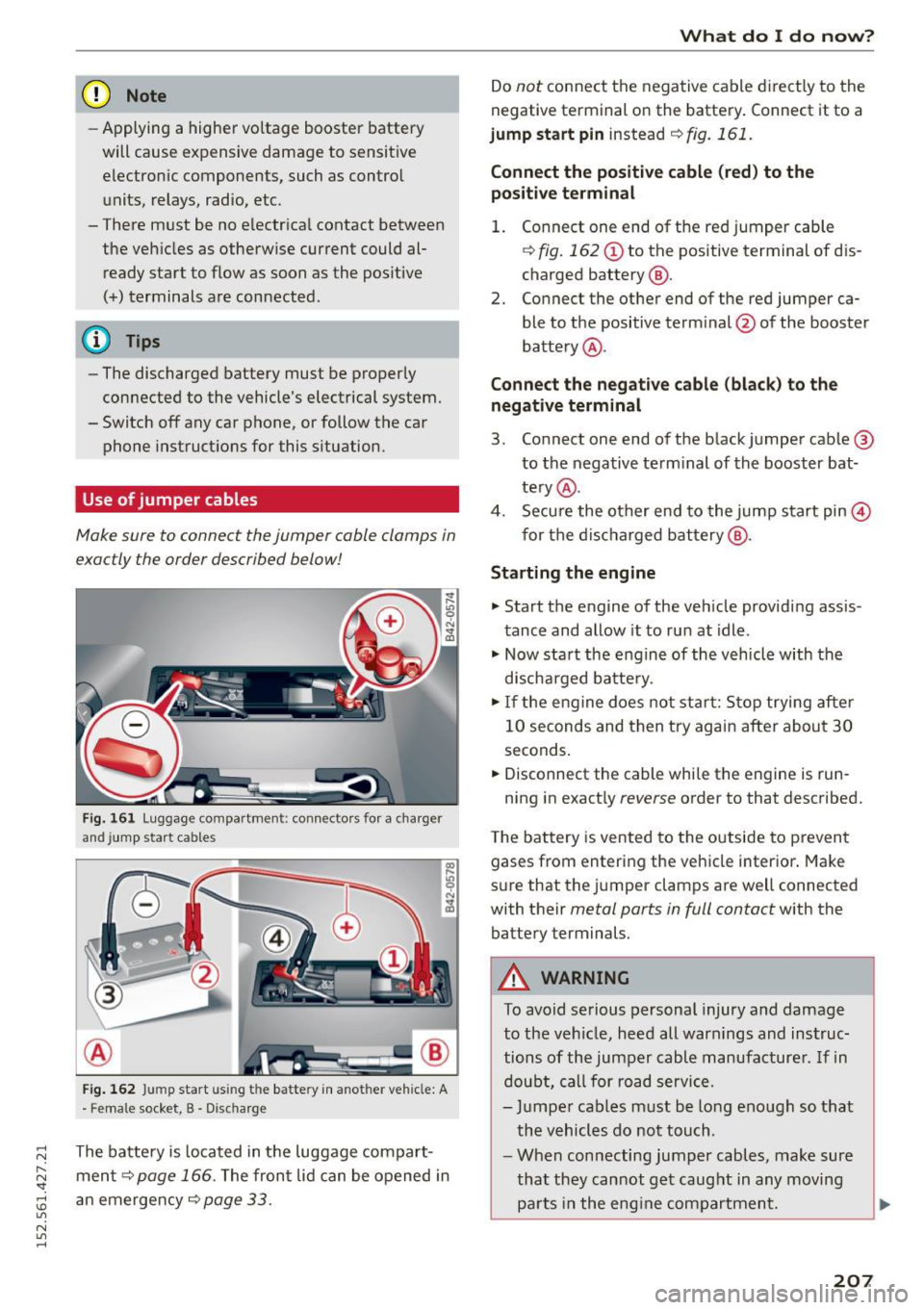
F ig . 161 Luggag e comp artm ent: conn ectors fo r a charg er
an d jump start cab les
®
Fig . 162 Jump start using th e batte ry in a not her ve hicl e: A
• Fe male sock et, B • D isch arge
The batte ry is located in the luggage compart
ment ~
page 166 . The front lid can be opened in
a n emergency
r=;, poge 33.
What do I do no w?
Do not connect the negative cable d irect ly to the
n egat ive terminal on the battery . Connect it to a
jump start pin instead r=;, fig. 161.
Connect the po sitive cable (r e d ) to the
po sitive terminal
1. Connect one end of the red jumper cab le
r=;, fig . 162 (D to th e positive t erminal of dis
charged battery @.
2. Connect the o ther end of the red jumper ca
ble to the positive term inal @ofthe booster
battery @.
Conne ct the neg ative c able (bl ack ) to the
neg ativ e terminal
3. Connect one end of the b lack jumper cable @
to the negative term inal of the booster bat
tery @.
4. Secu re the other end to the jump start pin@
for the d isc harged battery @.
Starting the engine
"'Start the engine of the veh icle provid ing assis
tance and allow it to run at idle .
"' Now sta rt the engine of the vehicle with the
d ischa rged ba ttery.
"'I f the engine does not star t: Stop trying afte r
10 seconds and then try again after about 30
seconds .
"' Disconnect the cable while the engine is run-
ning in exact ly
reverse orde r to that described.
T he bat tery is vented to the outside to p reven t
gases from entering the vehicle interior . Make
s u re that th e jumper clamps ar e well connect ed
with their
metal ports in full contact with the
battery terminals.
A WARNING .
To avoid se rious personal injury and damage
to the veh icle , heed all warnings and ins truc
tions of the jumper cable manufacture r. If in
doubt, call for road service.
- Ju mpe r cables m ust be long eno ugh so that
the vehicles do not touch .
- When connecting jumper cables, make sure
that they can not g et caug ht in any moving
parts in the eng ine compartment. ..,.
207