warning AUDI R8 SPYDER 2015 Owners Manual
[x] Cancel search | Manufacturer: AUDI, Model Year: 2015, Model line: R8 SPYDER, Model: AUDI R8 SPYDER 2015Pages: 232, PDF Size: 58.36 MB
Page 144 of 232
Driving and en vironment
Driving and environment
Break-in period
A new vehicle must be broken in, and the break-in
period shou ld be 1 ,500 miles (2,500 km) . Do not
use full acceleration for the first 600 miles
(1 ,000 km) and do not exceed the maximum en
gine speed of 6,000 rpm You must also not use
full accelerat ion between 600 and 1,200 miles
(1,000 to 2,000 km) . From 1,200 to 1,500 miles
(2 ,000 to 2,500 km), you can gradually increase
maximum eng ine speed to 8,250 rpm for brief
pe riods.
During the first hours of operation, there is
greater fr iction in the eng ine and the transmis
sion than later when all the moving pa rts have
b roken in .
The way you drive during the first 1,500 miles
(2 ,500 km) affects engine quality . If you drive at
modera te engine speeds thereafter, part icu larly
when the engine is cold, yo u red uce eng ine wea r
and increase the potential mileage o f the engine.
Do not dr ive at RPMs that a re too
low. Shift down
when the engine is no longe r runni ng "smooth
ly". Extremely high RPMs are gover ned automati
cally.
Avoid damaging the
vehicle
W hen you are driving on poor roads, or over
curbs, steep ramps, etc ., make certain that low
lying parts such as spoilers and exhaust system
parts do not bottom out and get damaged .
This is especially true for vehicles with low-slung
chassis (sports chassis) and fully loaded vehicles.
Driving through water on
roads
Note the following to avoid vehicle damage when
d riving through water, for examp le on flooded
roads:
- The water must no t be any h igher than the bot
tom of the vehicle body.
142
- Do not drive faster than walk ing speed .
A WARNING
After driv ing through water, mud, s lush, etc .,
the brakes may be s low to take effect because
of wet brake rotors and pads. Dry the brakes
first by brak ing carefully to restore the full
braking effect.
(D Note
Vehicle components such as the eng ine,
transmission , suspension or e lectrical system
can be severe ly damaged by dr iv ing t hrough
water .
(D Tips
- Check the dept h of the water before driving
through it.
- Do not stop the vehicle, drive in reverse or switch the engine off when driv ing through
water.
- Keep in mind that oncoming veh icles may
create waves that raise the water level and
make it too deep for your vehicle to d rive
through safely .
- Avoid driving through salt water because it
can cause corrosion.
Catalytic converter
It is very important that your emission control
system (catalytic converter) is functioning prop
erly to ensure that your vehicle is running in an
environmen tally sound manner.
.,. Always use lead-free gasoline ~ page 151,
Fuel supply.
.,. Never r un the tank down all the way to empty.
.,. Never put too much mo tor o il in yo ur engi ne
~ page 160, Adding engine oil 'l::r..
.,. Never try to push- or tow-sta rt your vehicle .
The cata lytic converter is an effi cien t "clean -up"
device built in to the exhaust system of the vehi
cle. The cata lytic conve rter burns many of the
po llutants in the exhaust gas before they are re
l eased into the atmosphere.
-
Page 145 of 232
..... N
r-N "': ..... \!) ..,.,
N ..,., .....
The exclusive use of unleaded fuel is critically im
portant for the life of the catalytic converter and
proper functioning of the engine.
A WARNING
- Do not park or operate the vehicle in areas where the hot exhaust system may come in contact with dry grass, brush, fuel spill or
other material which can cause a fire .
- Do not apply additional undercoating or
rustproofing on or near the exhaust mani
fold, exhaust pipes, catalytic converter or
heat shields. During driving, the substance
used for undercoating could overheat and
cause a fire.
([) Note
-Be aware that just one tank filling with lead
ed
fuel will already seriously degrade the
performance of the catalytic converter.
- Do not exceed the correct engine oil level
~page 160.
- Do not drive until the fuel tank becomes
completely empty. The engine could misfire.
Unburned fuel could also get into the ex
haust system and this could cause the cata
lytic converter to overheat.
- Do not turn off the ignition while the vehicle
is moving.
- Do not continue to operate your vehicle un
der these conditions, as otherwise fuel can
reach the catalytic converter. This could re
sult in overheating of the converter, requir
ing its replacement.
- To assure efficient operation of the Emission
Control System:
- Have your vehicle maintained properly and in accordance with the service recommen
dations in your Warranty
& Maintenance
booklet.
- Lack of proper maintenance as well as im
proper use of the vehicle will impair the
function of the emission control system
and could lead to damage.
Driving and environment
{® For the sake of the environment
Even when the Emission Control System is op
erating properly, the exhaust gas can have a
sulfur-like exhaust gas smell under some op
erating states. This depends on the sulfur
content of the fuel being used. Using a differ
ent brand of fuel may help, or filling the tank
with lead-free super grade gasoline .
Shutting down vehicle
If you would like your vehicle to remain inopera
tive for a longer period of time , contact an Audi
or other specialized dealer. They can advise you
on necessary precautions e.g. corrosion preven
tion, maintenance and storage. Pay attention to
additional information concerning the battery.
Refer to~
page 164.
Operation and
maintenance
Fuel economy, environmental impact, and wear
on your engine, brakes and tires largely depend
on three factors:
-your personal driving style
- operating conditions
- technical limitations
By having your vehicle regularly serviced by an
authorized Audi dealer helps to ensure that it runs properly and economically. The condition of
your vehicle not only affects its safety and ability
to hold its value, it also affects
fuel consump
tion.
The amount of oil used is related to engine load
and speed.
It is normal for the oil consumption of a new en
gine to reach its lowest value after a certain mile
age has been driven.
You must drive your vehicle about 3,000 miles (5,000 kilometers) before you can properly as
sess oil consumption .
This also applies to fuel consumption and engine output . .,,.
143
Page 147 of 232
.....
Vehicle care and cleaning General information
Regular, proper care helps to maintain your vehi
cle's value.
It can a lso be a req uirement when
submitting warranty claims for corrosion damage
and paint defects on the body.
The required cleaning and care products can be
obtained from your authorized Audi dea ler or a
qualified workshop. Read and follow the instruc
tions for use on the packaging.
A WARNING
-Us ing clean ing and care products incorrectly
can be dangerous to your health.
- Always store cleaning and care products out
of reach of children to reduce the r isk of poi
soning.
@ For the sake of the environment
- Preferably use environmentally-friendly products when buying cleaning agents.
- Do not dispose of leftover cleaning and care
products with household trash.
Car washes
The longer deposits remain on the vehicle, the
more the surface can be damaged. High tempera
tures such as those caused by sunlight increase
the damaging effect .
Before washing, wet heavy deposits with plenty
of water.
Stubborn depos its such as bird droppings or tree
sap are best removed with plenty of water and a
microfiber cloth .
A lso, was h the underside of your vehicle once
road salt stops being used for the season.
Pressure washers
When washing your veh icles w ith a pressure
washer, always follow the operating instructions
"' provided with the pressure washer. This is espe-
r--
~ cially important in regard to the pressure and
; spraying distance . Do not aim the spray directly
~ at seals on side windows, doors, the engine com -,.... Vehicle care and cleaning
partment lid, the front lid
or the convertible top
or at tires, rubber hoses, insulating material
orsensors* or camera lenses *. Keep a distance of
at least 16 inches (40 cm).
Do not remove snow and ice with a pressure
washer .
Never use rotary nozzles or high pressure noz
zles.
The water temperature must not be above 140 °F
(60 °().
Automatic car washes
Spray off the veh icle before washing.
Make sure that the windows are closed and the
windshield wipers are off. Follow instructions
from the car wash operator, especially if there are
accessor ies attached to your vehicle .
If possible, use car washes that do not have
brushes .
Only use car washes where the vehicle remains
stationary and the washing equipment moves
around t he vehic le when washing and drying. Car
washes that move the vehicle through the car
wash using a chain are not recommended.
Washing by hand
Clean the vehicle starting from the top and work
ing down using a soft sponge or cleaning brush.
Use solvent-free cleaning prod ucts .
Washing vehicles with matte finish paint by
hand
To avoid damaging the paint when washing, first
remove dust and large particles from your vehi
cle. Insects, grease spots and fingerprints are
best removed with a spec ia l cleaner for matte
finish paint.
Apply the prod uct using a microfiber cloth . To
avo id damaging the paint surface, do not use too
much pressure.
Rinse the vehicle thoroughly with water. Then
c lean using a neutral shampoo and a soft micro
fiber cloth.
Rinse the vehi cle thoroughly again and let it air
dry. Remove any water residue using a sham my . .,.
145
Page 148 of 232
Vehicle care and cleaning
A WARNING
-Only wash the vehicle when the ignition is
off and follow the instructions from the car
wash operator to reduce the risk of acci
dents.
- To reduce the risk of cuts, protect yourself
from sharp metal components when wash ing the underbody or the inside of the wheel
housings.
- After washing the vehicle, the braking effect
may be delayed due to moisture on the
brake rotors or ice in the winter. The bra kes
must be dried first with a few caref ul brake
applications .
@ Note
-If you wash the ve hicle in an au tomatic car
wash, you must retract the extend able rear
spoi ler * if necessary, and fold the exterior
mirrors in to reduce the risk of damage .
Power folding exterior mirrors* must only
be fo lded in and out using the power folding
funct ion.
- To prevent paint damage, do not wash the
vehicle in direct sunlight.
- To red uce the risk of damage, do not wash
the power top with a pressure washer. -
To reduce the risk of damage, do not wash
decorative decals * with a pressure washer.
- T o reduce the risk of damage to the surface,
do not use insect remov ing sponges, kitchen
sponges or similar items.
- Matte finish painted vehicle components:
- To reduce the risk of damage to the sur-
face, do not use polish ing agents or hard
wax.
- Never use car wash cycles that apply pro
tective wax. It can destroy the matte fin ish effect .
- Do not place any stickers or magnet ic
signs on vehicle parts painted w ith matte
finish paint. The pa int could be damaged
when the stickers o r magnets are re
moved.
- Do not wash the vehicle using cleaning
products that contain alcohol when the en
gine is hot. This increases the risk of dam
age to plastic components, such as cracking.
@ For the sake of the environment
Only wash the vehicle in facilities spec ial ly de
signed for that purpose. This w ill reduce the
risk of dirty water contaminated with oil from
entering the sewer system .
Cleaning and care information
When cleaning and caring for individual vehicle
components, refer to the following table . The in
formation contained there is simp ly recommen
dations. For questions or for components that are not listed, refer to an authorized Audi dealer
or a qualified workshop. A
lso fo llow the informa
tion found in
¢ .&. .
Cleaning exterior
Component Situation Solution
Wiper blades
Dirty ¢ page 53, Cleaning windshield wiper blades
Headlights/ Dirty Soft sponge with a mild soap solutiona>
tail lights
Sensors
/
Dirty Sensors: soft cloth with a solvent-free cleaning product
camera lenses Camera lenses: soft cloth w ith an alcoho l-free clean ing sol-
ution
Snow/ice Hand brush/solvent-free de-icing spray
Wheels Road salt Water
Brake dust Acid-free special cleaning solution
146
...
Page 150 of 232
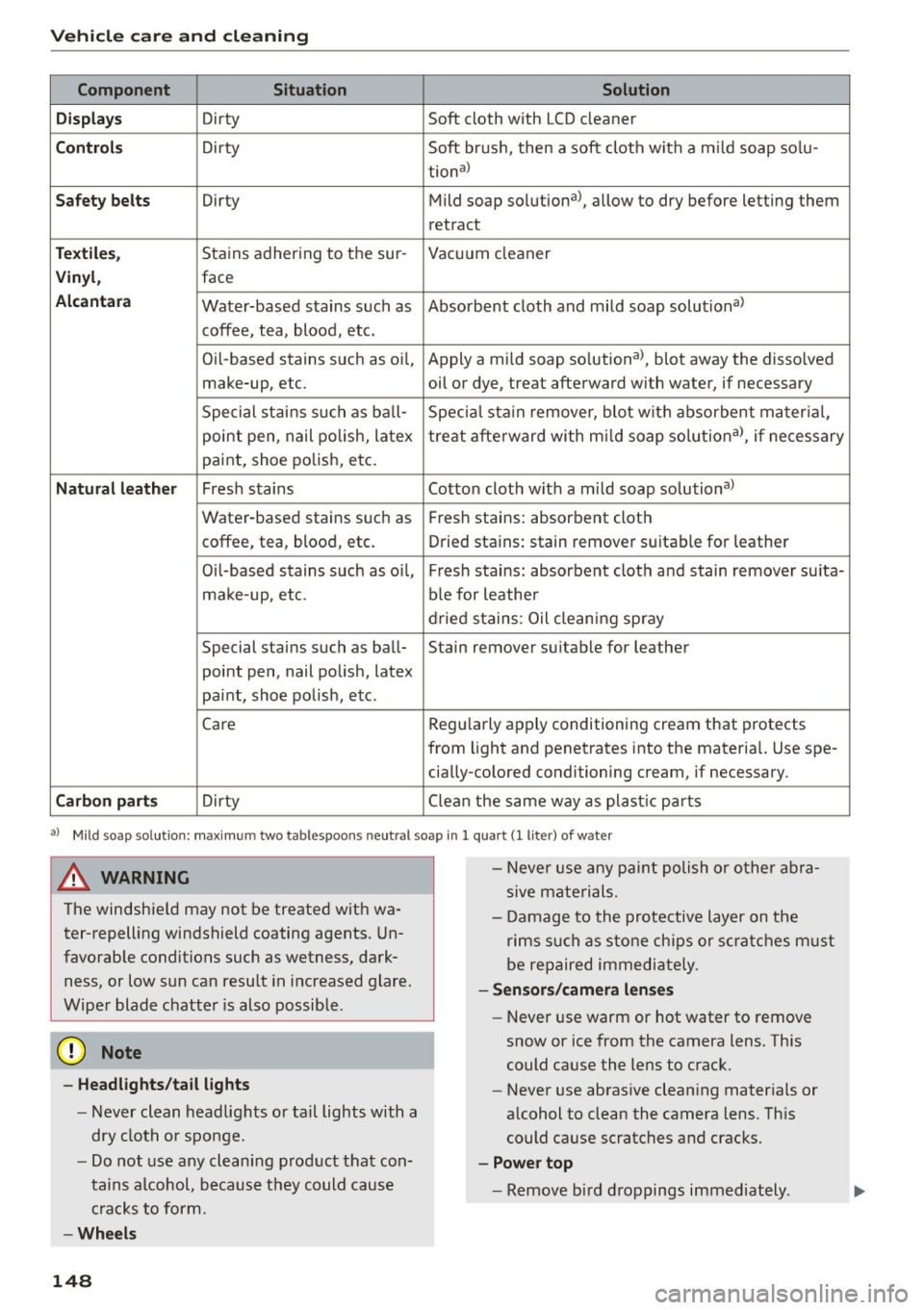
Vehicle care and cleaning
Component Situation Solution
Displays
Dirty Soft cloth with LCD cleaner
Controls Dirty Soft brush, then a soft cloth with a mild soap solu-
tional
Safety belts Dirty Mild soap solution a>, allow to dry before letting them
retr act
Textiles, Stains adhering to the sur- Vacuum cleaner
Vinyl, face
Alcantara Water-based stains such as Absorbent cloth and mild soap solutional
coffee, tea, blood, etc.
Oil-based stains such as o il, Apply a mi ld soap solutiona>, blot away the disso lved
make-up, etc. oil ori dye, treat afterward with water, if necessary
Special stains such as ball- Special stain remover, blot with absorbent material,
point pen, nail polish, latex treat afterward with mild soap solutional, if necessary
paint, shoe polish, etc.
Natural leather Fresh stains Cotton cloth with a mild soap solutional
Water-based stains such as
Fresh stains: absorbent cloth
coffee, tea, blood, etc. Dried stains: stain remover suitable for leather
Oil-based stains such as oil, Fresh stains: absorbent cloth and stain remover suita-
make-up, etc. ble for leather
dried stains: Oil cleaning spray
Special stains such as ball- Stain remover suitable for leather
point pen, nail polish, latex
paint, shoe polish, etc.
Care Reg
ula rly apply conditioning cream that protects
from light and penetrates into the materia l. Use spe-
cially-co lored conditioning cream, if necessary.
Carbon parts Dirty Clealil the same way as plastic parts
aJ Mild soap so lution: max im um two ta blespoo ns neut ral so ap in 1 quart (l lite r) of w ate r
A WARNING
Th e windshie ld may not be treated with wa
ter-repelling windshield coating agents. Un
favorable conditions such as wetness, dark
ness, or low sun ca n resu lt in increased glare.
Wiper blade chatter is also possible .
(D Note
-Headlights/tail lights
- Never clean headlights or tail lights with a
dry cloth or sponge.
- Do not use any cleaning product that con
tains alcohol, because they could cause
cracks to form.
-Wheels
148
-
- Never use any paint polish or other abra
sive materials.
- Damage to the protective layer on the
r ims such as stone chips or scratches must
be repaired immed iately.
-Sensors/camera lenses
- Never use warm or hot water to remove
snow or ice from the camera lens. This
could cause the lens to crack.
- Never use abrasive clean ing materials or
a lcohol to clean the camera lens. This
could cause scratches and cracks.
- Power top
- Remove bird droppings immediately .
Page 154 of 232
Fuel supply and filling your fuel tank
fill up at busy gas stations where the seasonal
adjustment is more like ly to be made in time.
0 Note
- Methanol fuels which do not meet these re
quirements may cause corrosion and dam
age to plastic and rubber components in the
fuel system.
- Do not use fuels that fail to meet the spec i
fied criteria in this chapter.
- If you are unable to determine whether or
not a particular fuel blend meets the speci
fications, ask your service station or its fuel
supplier.
- Do not use fuel for which the contents can
not be identified.
- Fuel system damage and performance prob
l ems resulting from the use of fuels differ
ent from those specified are not the respon
sibility of Audi and are not covered under
the New Vehicle or the Emission Control
System Warranties.
- If you experience a loss of fuel economy or
driveability and performance problems due
to the use of one of these fuel blends, we
recommend that you switch to unb lended
fuel.
Gasoline additives
A major concern among many auto manufactur
ers is carbon deposit build-up caused by the type
of gasoline you use.
A lthough gasol ine grades differ from one manu
facturer to another, they have certain things in
common. All gaso line grades contain substances
that can cause deposits to collect on vita l engine
parts, such as fuel injectors and intake valves. A l
though most gasoline brands include additives to
keep engine and fuel systems clean, they are not
equally effect ive .
Audi recommends using TOP TIER Detergent Gas
oline. For more information on TOP TIER Deter
gent Gasoline, please go to the official website (www.toptiergas .com).
152
After an extended period of using inadequate
fuels, built-up carbon deposits can rob your en gine of peak performance .
([) Note
Damage or malfunction due to poor fuel qual
ity is not covered by the Audi New Vehicle
Limited Warranty.
Fuel tank
· Fuel filler neck
The fuel filler neck is located on the right rear
s id e panel behind the fuel filler flap.
If the unlocking system should fail, you can still
open the flap manually -for detailed instructions
see
~page 154.
You can find the fuel tank capacity of your vehicle
i n
Technical Data .
The label on the inside of the fuel filler flap tells
you the correct fuel for your vehicle. For more in
formation about fuel specifications, see
~ page 151 .
Your vehicle fue l tank has an on-board refueling
vapor recovery system. This feature helps to pre
vent fuel vapors from escap ing from the tank and
polluting the environment while you refuel your
vehicle. In order to fill the tank properly while
protecting the environment, please follow this
refueling procedure carefully.
& WARNING
-Under normal operating conditions, never car
ry additional fuel containe rs in your car . Gas
canisters and other containers used to trans port f uel can be dangerous. Such containers,
full or empty, may leak and could cause a fire
in a collision. If you must transport fuel to
use for your lawn mower, snow blower, etc., be very careful and always observe local and
state laws regarding the use, transpo rtation
and storage of such fuel containers. Make cer
tain the container meets indus try s tandar ds
(ANSI/ASTM F8S2 -86).
Page 155 of 232
.... N
l'
N "1: .... I.O
"' N
"' ....
(D Note
Never drive yo ur vehicle unti l the fuel tank is
completely dry . The irregular supp ly of fuel
can cause misfir ing. Gasoline co uld enter into
the exhaust system and damage the catalyt ic
converter .
Refueling
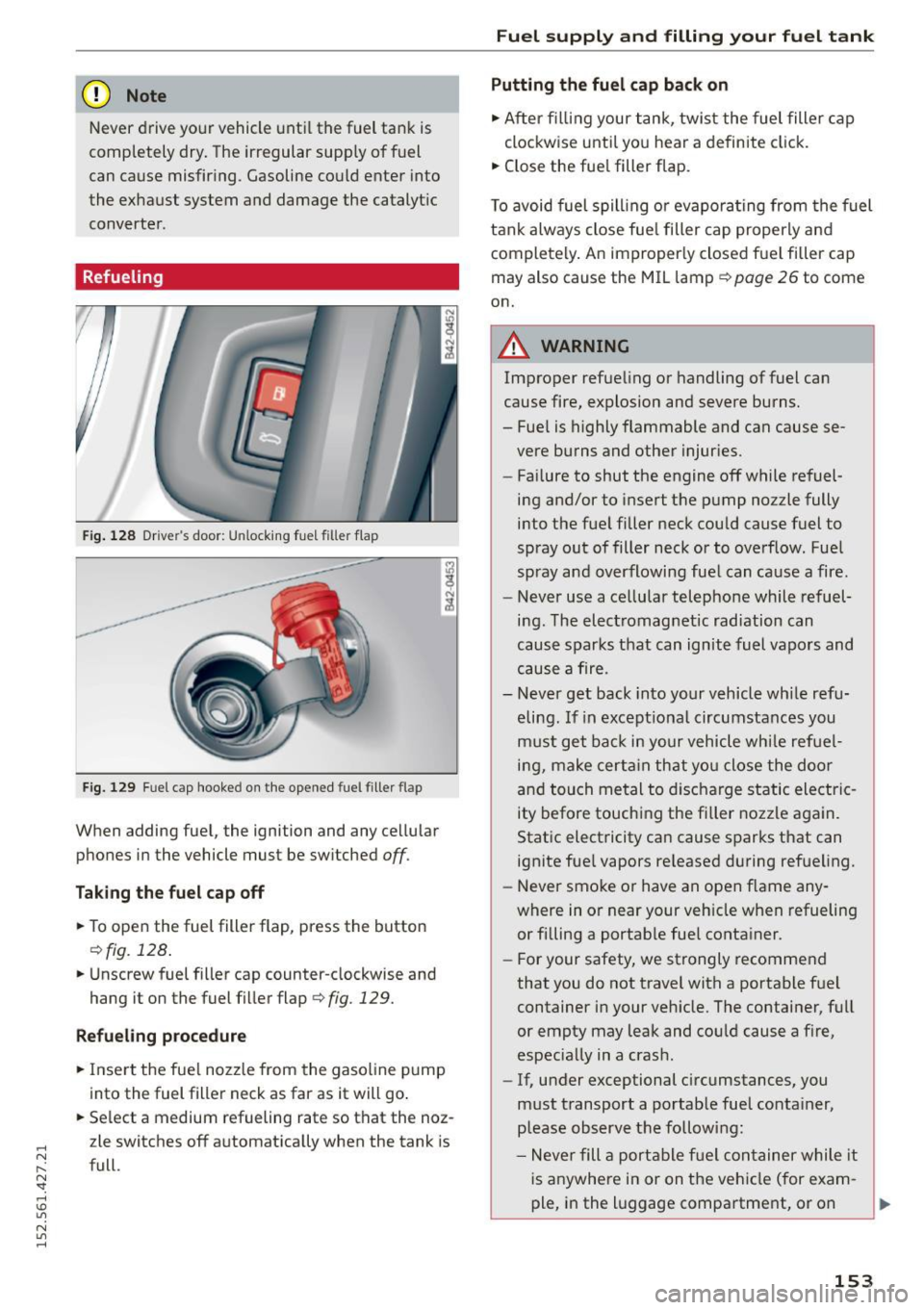
F ig. 12 8 Drive r's door: Unlocking f uel filler f lap
F ig . 129 Fu el cap hooke d on th e opene d fu el fil ler fla p
When adding fuel, the ignition and any cellular
phones in the vehicle must be sw itched
off .
Taking the fuel cap off
.. To open the fuel filler flap, press the button
¢ fig. 128 .
.. Unscrew fuel filler cap counte r-clockwise and
hang it on the fuel filler flap
¢ fig. 129.
Refueling procedure
.. Inse rt the fue l nozz le from the gasoline pump
into the fuel filler neck as far as it will go .
.. Se lect a medium refueling rate so that the noz
z le switches off automat ica lly when the tank is
full.
Fuel supply and filling your fuel tank
Putting the fuel cap back on
.,. After f illing your tank, twis t the fuel filler cap
clockw ise unti l yo u hear a definite cl ick .
.. Close the fue l filler flap.
T o avoid fuel spill ing o r evapora ting from the fuel
tank always close fue l filler cap properly and
complete ly . An improper ly closed f uel filler cap
may also cause the MIL lamp ¢
page 26 to come
on.
A WARNING
--Improper refue ling or handling of fuel can
cause fire, explosion and severe burns.
- Fue l is highly flammable and can cause se
vere burns and other injur ies.
- Fa ilure to shut the engine off while re fuel
ing and/or to insert the pump nozzle fully
into the fue l filler neck cou ld cause fuel to
spray out of filler neck or to overflow. Fue l
sp ray an d overflowing fue l can ca use a fire.
- Never use a ce llular telepho ne while refuel
ing . T he elec tromagnetic radiation can
cause sparks that can ignite fuel vapo rs and
cau se a fire .
- Never get back into yo ur vehicle wh ile refu
e ling . If in except iona l circumst ances you
m ust get ba ck in yo ur vehicle whi le refuel
i n g, make cert ain that yo u close the doo r
a nd tou ch me tal to disch arge st atic electric
ity before touch ing the filler nozzle aga in.
Static elect ricity ca n cause s parks that can
ignite fue l vapors re leased d uring refueling.
- Never smoke o r have an open f lame any
where in or near your veh icle w hen refueling
or fi lling a portab le fue l conta iner.
- For your safety, we strongly recomme nd
that you do not travel with a portable f uel
container in your veh icle. The container, f ull
or empty may leak and cou ld cause a f ire,
especia lly in a cras h .
- If, under exceptional c ircumstances, you
must t ransport a po rtab le fuel conta iner,
p lease observe t he follow ing :
- Never fill a por table fuel co ntainer while it
is anywhere in or on the veh icle (for exam -
p le, in the l uggage compa rtme nt, or on ..,.
153
Page 157 of 232
.... N
l'
N "1: .... I.O
"' N
"' ....
Checking and filling Engine compartment lid
Releasing the engine compartment lid
The engine compartment lid is released from in
side the vehicle.
~
-------- .J;
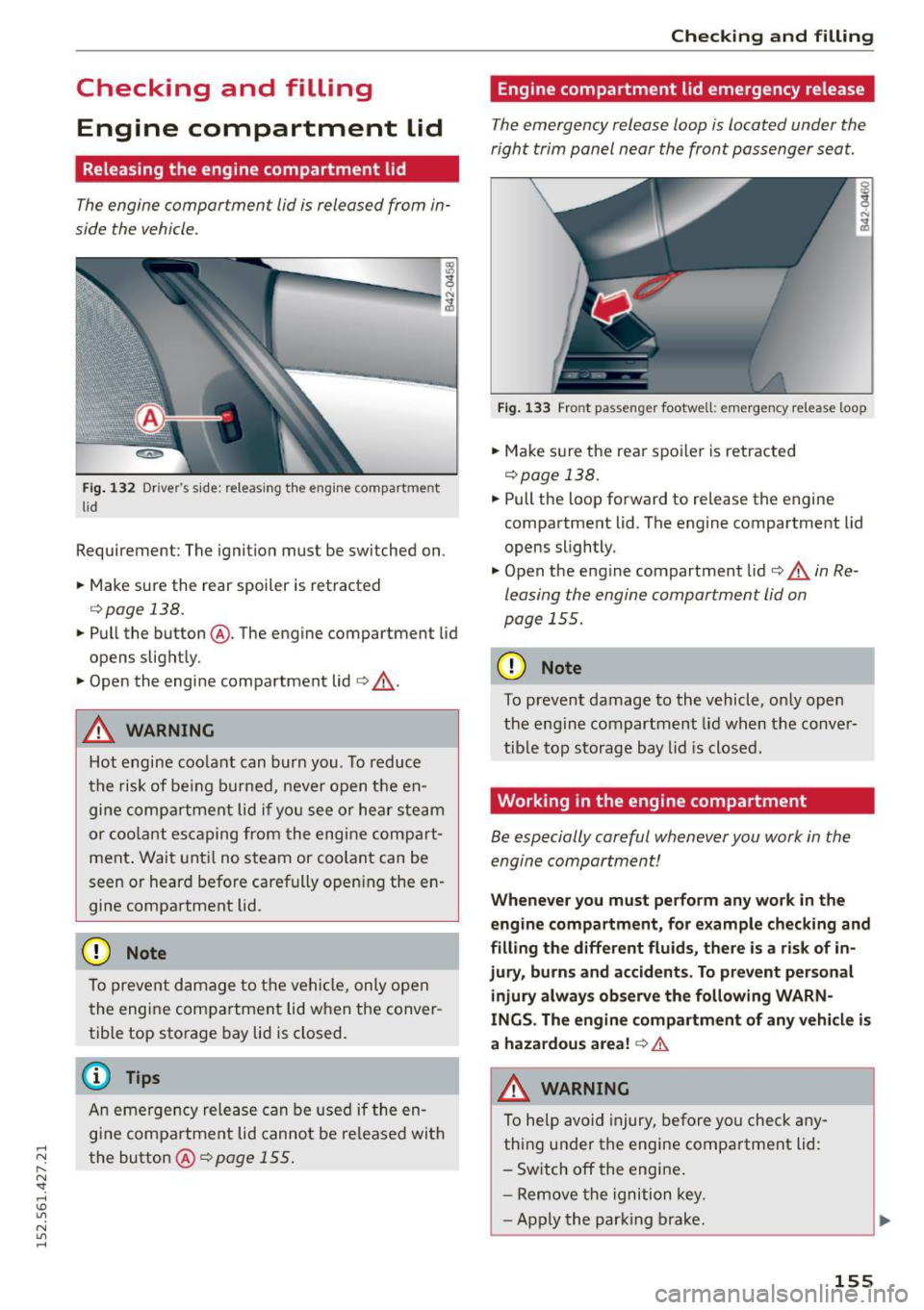
Fig. 132 Driver's side: releasing t he engine compartment
lid
Requirement: The ignition must be switched on .
" Make sure the rear spoiler is retracted
¢page 138.
"Pull the button @. The engine compartment lid
opens slight ly.
" Open the engi ne compartment lid¢_&, .
& WARNING
Hot engine coo lant can burn you. To reduce
t he risk of be ing burned, never open the en
gi ne comp artment lid i f yo u s ee or he ar s team
or cool an t es caping from the engine compart
ment . Wait unt il no steam or coo lant can be
seen or heard befo re carefully open ing the e n
gine compartment lid.
CD Note
To preve nt d amage to t he veh icle, only open
t he engine compartment lid when the conver
tible top storage bay lid is closed.
@ Tips
An emergency release can be use d if the en
gi ne compa rtment lid canno t be re leased with
the button @¢
page 155 .
-
Checking and filling
Engine compartment lid emergency release
The emergency release loop is located under the
right trim panel near the front passenger seat.
F ig . 1 33 Front passenger footwell: emerge ncy release loop
"Ma ke su re the rea r spoile r is retracted
¢page 138.
" Pull the loop forward to release the engine
compartment lid. The engine compartment lid
opens slightly.
" Open the engine compartment lid¢ &,
in Re
leasing the engine compartment lid on
page 155.
CD Note
To prevent damage to the vehicle, o nly open
the engine compartment lid when the conve r
tib le to p storage bay lid is closed.
Working in the engine compartment
Be especially careful whenever you work in the
engin e compartment!
Whenever you must perform any work in the
eng ine compartm ent, for example checking and
filling the differ ent fluid s, there is a ri sk of in
jury, burns and accident s. To prevent personal
injury alway s ob serve the following WARN
INGS . The engine compartment of any vehicle is
a hazardou s area !
c:> &.
,&. WARNING
To help avoid injury, be fore yo u check any
thing u nder the engine compartment lid:
- Sw itch off the engi ne .
- Remove the ignition key .
- Apply the par king brake.
-
155
Page 158 of 232
Checking and filling
-Move selector lever of S tronic to "N" (Neu
tral); put manual transmission in Neutral.
- Always let the engine cool down. Hot com
ponents will burn skin on contact .
- To reduce the risk of being burned, never
open the engine compartment lid if you see
or hear steam or coolant escaping from the
engine compartment. Wait until no steam
or coolant can be seen or heard before care
fully opening the engine compartment lid.
- Keep children away from the engine com
partment .
- Never spill fluids on hot engine compo
nents. They can cause a fire.
- Never open the coolant reservoir cap when
the engine is still warm . The coolant system
is pressurized and hot coolant could spray
out .
- Protect your face, hands and arm from
steam or hot engine coolant by placing a
thick rag over the cap when you open the coolant reservoir .
- Do not remove the engine cover under any
circumstances . This increases the risk of
burns.
- If work on the fuel system or the electrical
system is necessary :
- Always disconnect the battery.
- Never smoke or work near heaters or open
flames. Fluids in the engine compartment
could start a fire.
- Keep an approved fire extinguisher imme
diately available .
- To avoid electrical shock and personal injury
while the engine is running or being started,
never touch:
- Ignition cables
- Other components of the high voltage
electronic ignition system.
- If you must perform a check or repair with
the engine running:
- First, fully apply the parking brake, move
selector lever of S tronic to
"N" (Neutral);
put manual transmission in Neutral.
- Always use extreme caution to prevent
clothing, jewelry, or long hair from getting
caught in the radiator fan, V-belts or other
156
moving parts, or from contacting hot
parts. Tie back hair before starting, and
wear no clothing that will hang or droop into the engine.
- Minimize exposure to emission and chemi
cal hazards
¢ .&..
A WARNING
California Proposition 65 Warning:
- Engine exhaust, some of its constituents,
and certain vehicle components contain or
emit chemicals known to the State of Cali
fornia to cause cancer and birth defects and reproductive harm. In addition, certain flu
ids contained in vehicles and certain prod
ucts of component wear contain or emit
chemicals known to the State of California
to cause cancer and birth defects or other
reproductive harm.
- Battery posts, terminals and related acces
sories contain lead and lead compounds,
chemicals known to the State of California
to cause cancer and reproductive harms.
Wash hands after handling.
@ Note
When adding fluids, always make sure that
they are poured into the proper container or
filler opening, otherwise serious damage to
vehicle systems will occur.
@ For the sake of the environment
To detect leaks in time , inspect the vehicle
floor pan from underneath regularly. If you
see spots from oil or other vehicle fluids, have
your vehicle inspected by an authorized Audi
dealer .
· Closing the engine compartment lid
.. Make sure that the rear spoiler is retracted
¢page 138 .
.. Pull the engine compartment lid down until the
pressure from the struts is reduced.
.. Press the engine compartment lid closed
¢ _A . ..,
Page 159 of 232
.... N
l'
N "1: .... I.O
"' N
"' ....
_& WARNING
-When you close the engine compartment
lid, check it to make sure the safety catch
has properly engaged . The engine compart-
Engine compartment
Checking and filling
ment lid should be flush with the surround
ing vehicle body parts.
-If you notice while driving that the engine
compartment lid is not secured properly,
stop at once and close it.
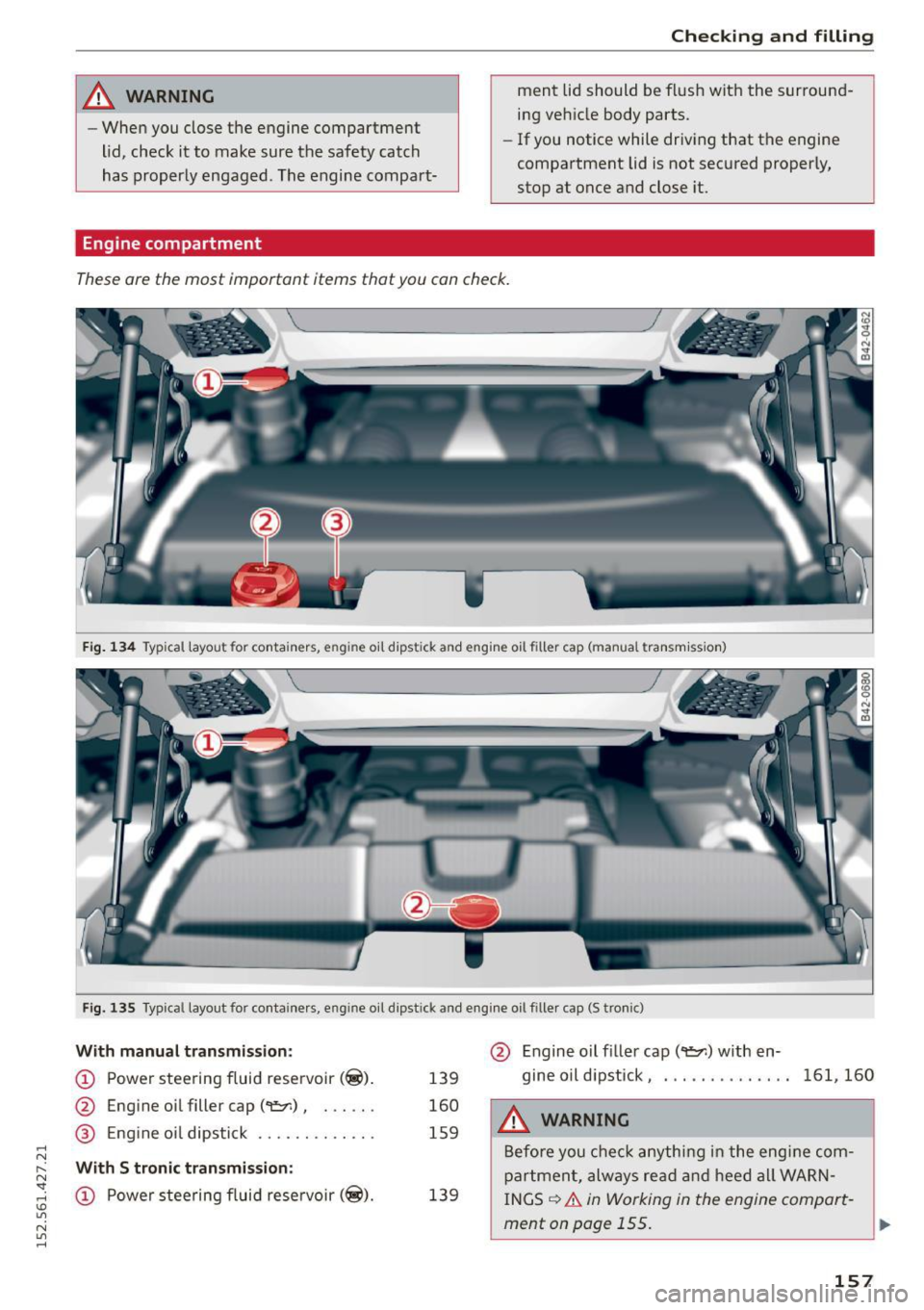
These ore the most important items that you con check.
Fig. 134 Typical l ayout for conta iners , engine oil dipst ick and engin e oil fille r cap (manual tran smis sion)
Fig. 135 Typica l layout for conta iners, engine o il dipst ick and e ng in e oil fille r cap (S tronic)
With manual transmission:
(!) Power steering fluid reservoir(@).
@ Engine oil filler cap ("1::r.) , ... .. .
@ Engin e oil dipstick ............ .
With S tronic transmission:
(!) Power steering fluid reservoir(@).
139
160
159
139
@ Engine oil filler cap ("1::r.) with en-
gine oil dipstick, ............ .. 161,160
_& WARNING
Before you check anything in the engine com
partment, always read and heed all WARN
INGS ~ .&. in Working in the engine compart-
ment on page 155. ..,.
157