brake light AUDI R8 SPYDER 2015 User Guide
[x] Cancel search | Manufacturer: AUDI, Model Year: 2015, Model line: R8 SPYDER, Model: AUDI R8 SPYDER 2015Pages: 232, PDF Size: 58.36 MB
Page 70 of 232
On the road
- The engine cannot be started by pushing or
towing the vehicle .
@I For the sake of the environment
To avoid unnecessary eng ine wear and to re
duce exhaust emissions , do not let your vehi
cle stand and warm up. Be ready to drive
off
immediately after starting your vehicle.
Stopping the engine
On vehicle s wi th S tron ic*, the engine can be
turned
off in the neutral position N and in each
gear (1 -7 and R) .
.. Tu rn the ignition key to posit ion (!) co
page 66,
fig. 77 .
A WARNING
- Never turn off the engine until the vehicle
has come to a complete stop .
- The brake booster and servotronic only work
when the eng ine is running . W ith the igni
t ion turned
off , you have to apply more force
when steering or braking. Since you cannot
steer and stop normally , this can lead to ac
c idents and serious injuries .
(D Note
-If the engine has been under heavy load for
an extended period of time, heat builds up
i n the eng ine compartment after the engine
i s switched
off -there is a r isk of damag ing
the engine . A llow the engine to continue to
run at id le for a short time or drive until it
has coo led down before you turn it off
q page 73.
-If the engine has been under heavy load for
an extended period of time, it can become
extremely hot . You should not park your ve
hicle over easily combustible objects or
areas (e .g . grass or leaves) . There is a risk of
starting a fire .
{!) Tips
After the engine has been switched off, the ra
diator fan can continue to run for up to 10 m i
nutes - even w ith the ignition switched
off . It
68
can also switch on again after some time if
the coo lant temperature rises as the result of
heat bu ildup or if the engine compartment is
heated by the sun's rays and the engine is hot .
Parking brake
Parking brake
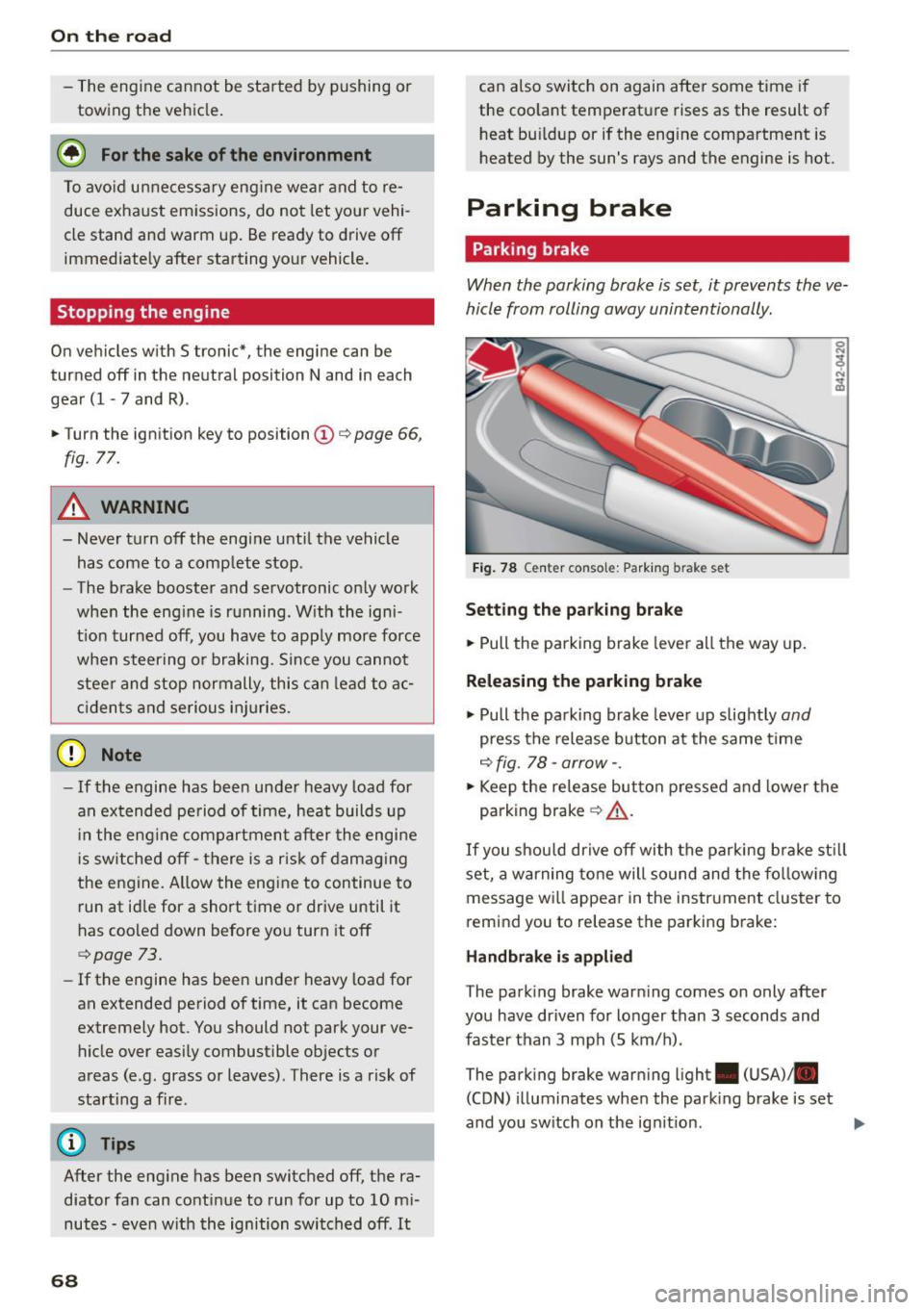
When the parking brake is set, it prevents the ve
hicle from rolling away unintentionally.
Fig . 78 C ente r co nsol e: Park ing bra ke set
S etting th e pa rking brak e
.. Pull th e parking brake lever all the way up.
Releasing the p arkin g brake
.. Pull the parking brake lever up slightly and
press the release button at the same time
c::> fig . 78 -arrow- .
.. Keep the release button pressed and lower the
parking brak e
q &_.
If you shou ld drive off with the parking bra ke st ill
set, a warning tone will sound and the fo llow ing
message wi ll appear in the instrument cluster to
r e mind you to release the parking brake:
H and brake i s appli ed
T he park ing brake warn ing comes on only after
you have driven for longer than 3 seconds and
faster than 3 mph (5 km/h) .
The parking brake warning ligh t. (USA)/ .
(CON) illuminates whe n the park ing brake is set
and you sw itch on the ign it ion .
Page 73 of 232
.... N
l'
N "1: .... I.O
"' N
"' ....
To store maximum speed
•Turnoff the ignit ion.
• Briefly press the button in the instrument clus
ter
9 page 70, fig. 79. The odometer and the
digital clock are now illuminated.
• Press the button for at least 2 seconds. The cur
rently stored maximum speed appears in the
display
or the crossed out symbol for warning
threshold 2, if no maximum speed was set pre
viously.
• Press the function selector sw itch in the wiper
lever @r=>
fig. 80 up or down to change the set
val ue. Values run up or down in steps of 6 mph
(10 km/h).
To delete maximum speed
•Turnoff the ignition .
• Briefly press the button in the instrument clus
ter
9 page 70, fig. 79 . The odometer and the
digital clock are now illum inated.
• Press the button for at least 2 seconds. The cur
rently stored maximum speed appears in the
display.
• Press the
iRESETI button in the wiper lever @
r:=> fig. 80 until the crossed out speed warning
symbol for warning threshold 2 appears in the
display.
A few seconds after the adjustment is completed,
the illumination for the odometer and the digital
clock w ill go out.
@ Tips
This warning threshold can also be controlled
through the trip computer
r=> page 23, Navi
gating the menu.
On the road
Cruise control
Switching the system on
The cruise control system makes it possible to
drive at a constant speed starting at 20 mph (30kmlh).
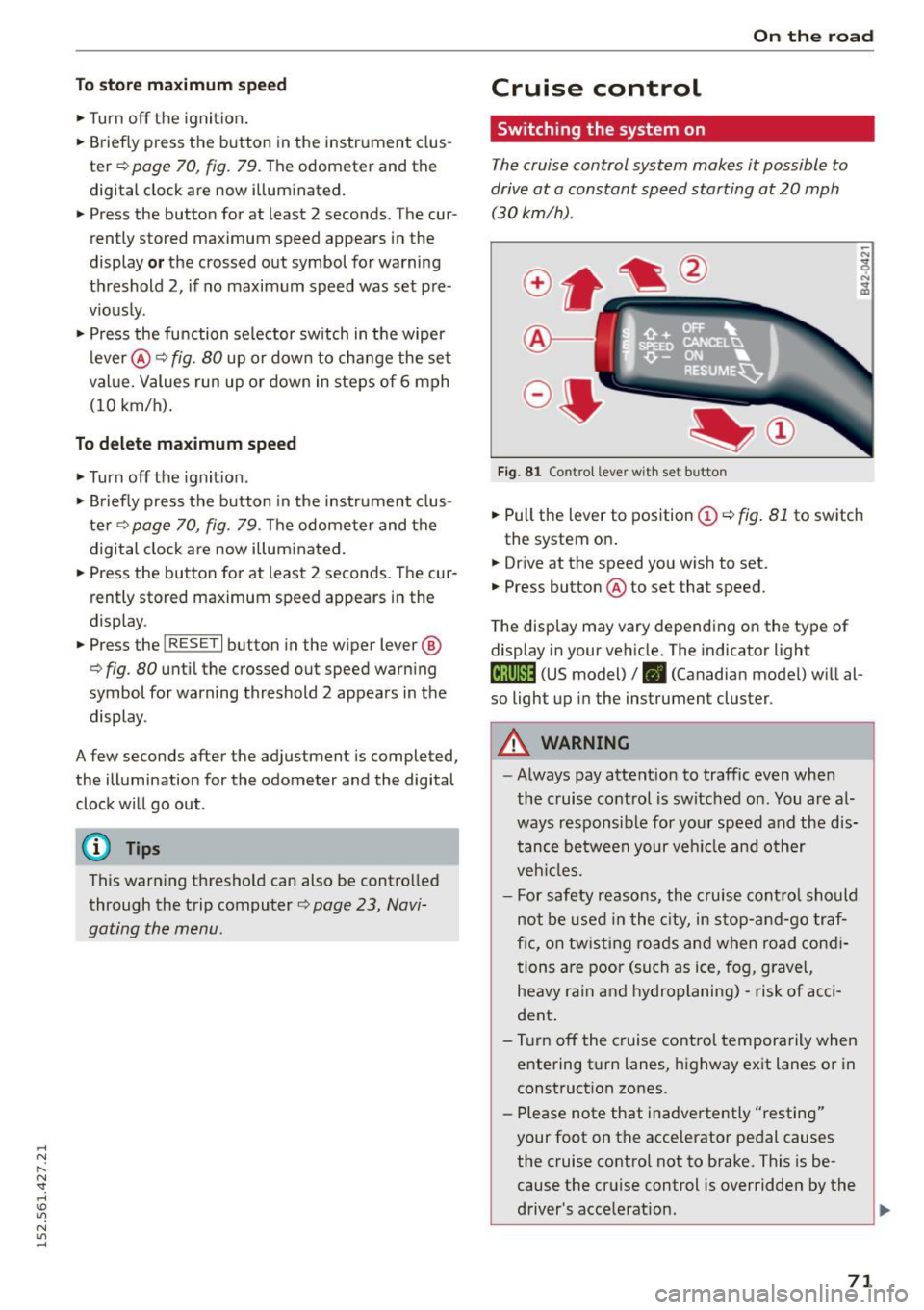
Fig. 81 Contro l lever with set button
• Pull the lever to position (Dr=> fig . 81 to switch
the system on .
• Drive at the speed you wish to set.
• Press button @to set that speed.
The display may vary depending on the type of
display in your vehicle. The indicator light
(lj;jl)~i~ (US model)/ . (Canadian model) will al
so light up in the instrument cluster.
A WARNING
--
-Always pay attention to traffic even when
the cruise control is switched on. You are al
ways responsible for your speed and the dis
tance between your veh icle and other
veh icles.
- For safety reasons, the cruise control should
not be used in the city, in stop-and -go traf
fic, on twisting roads and when road condi
tions are poor (such as ice, fog, gravel,
heavy rain and hydroplaning) -risk of acci
dent .
- T urn off the cruise control temporarily when
entering turn lanes, highway exit lanes or in
construction zones.
- Please note that inadvertently "resting"
your foot on the accelerator pedal causes
the cruise control not to brake. This is be
cause the cruise control is overridden by the
driver's acce lerat ion.
71
Page 75 of 232
throug h im perce ptib le contro l processes . The
damping provides individua l modulation of
damping forces. For example, with damping
characterist ics set to prov ide greater comfort,
damping is set somewhat harder for a brief peri
od only as requ ired, when round ing a curve and
when braking .
Standard setting
Select the standard sett ing if you prefer a sus
pension setting emphasi zing comfort.
Sport s etting
Select the sport setting if you prefe r a spor ty sus
pension setting. The LED in the button
[l] comes
on to indicate sport setting .
@ Tips
The warning/indicato r ligh t R in the instr u
ment cluster comes on in the event of a mal
function. Drive to the closest a uthorized Audi
dea ler as soon as possible and have the mal
function repaired.
Sporty driving
Warming up and cooling down
B y care fully warming up and cooling down you r
veh icle, you can he lp ensure tha t it is not over
stressed unnecessarily du ring sporty driving.
W hen warming up , the veh icle is driven a t a max
i mum eng ine speed of 6 000 R PM
(Vl O engine) or
70 00 RPM (V8 engine) in order to raise the en
g ine oi l tempe ratu re to a minimum of 140 °F
(60 °() . The tires also only reach the ir full road
h olding capability once they have warmed up.
The cooling fan can continue to run in you r vehi
cle after the engine is switched off . However,
d riving the vehicle to cool it down is part icu larly
important. During sporty driving, the engine and
brakes, the exhaust system, and the transmission
all become extremely hot . Before you park the
ve hicle, you should dr ive it for a few m iles/kilo-
~ mete rs a t light load in the low rpm range to al-
~ low i t to cool down. "': ,...., \!) 1.1'1
N 1.1'1 ,....,
On th e road
Driving on a track
Befo re you take your veh icle o ut on a track, en
s u re th at i t is in perfe ct condi tion. Fo r ex ample ,
yo u should chec k the tire trea d an d the bra ke
pads . It is bes t to inc rease tire pressu re by about
0 .3 bar.
W hen dr iving on a track , oil consump tion may be
somewhat higher than in "norma l" ope rat ion
¢ page 159 .
You should definitely inspec t your ve hicle afte r
s u bje cting it to seve re condi tions. Are the br ake
pads OK? Is there any thing unusua l about the
t ir es, including the inner and outer sidewalls (e .g.
tread , blistering)? A re the air intakes free of
l eaves and tire dust? Is the o il level OK?
Your a uth orized Audi dea ler or q ua lified wor k
sho p will be happy to underta ke an inspection be
fore and after use on the race track .
A WARNING ._
Some race tracks (e.g. steeply banked turns)
may affect the response of t he ESC.
(D Tips
- Review the t rack requ irements and condi
tions befo re you sta rt driv ing.
- W hen d riven on a race track, all vehicle
parts are severe ly stressed. This can result
in increased wear .
73
Page 77 of 232
.... N
l'
N "1: .... I.O
"' N
"' ....
heavy loads. This can result in increased
wear .
- The Launch Control Program only funct ions
when the parking brake is released and the
vehicle speed is less than 3 mph (5 km/h).
S tronic
Description
Applies to vehicles: with S tronic
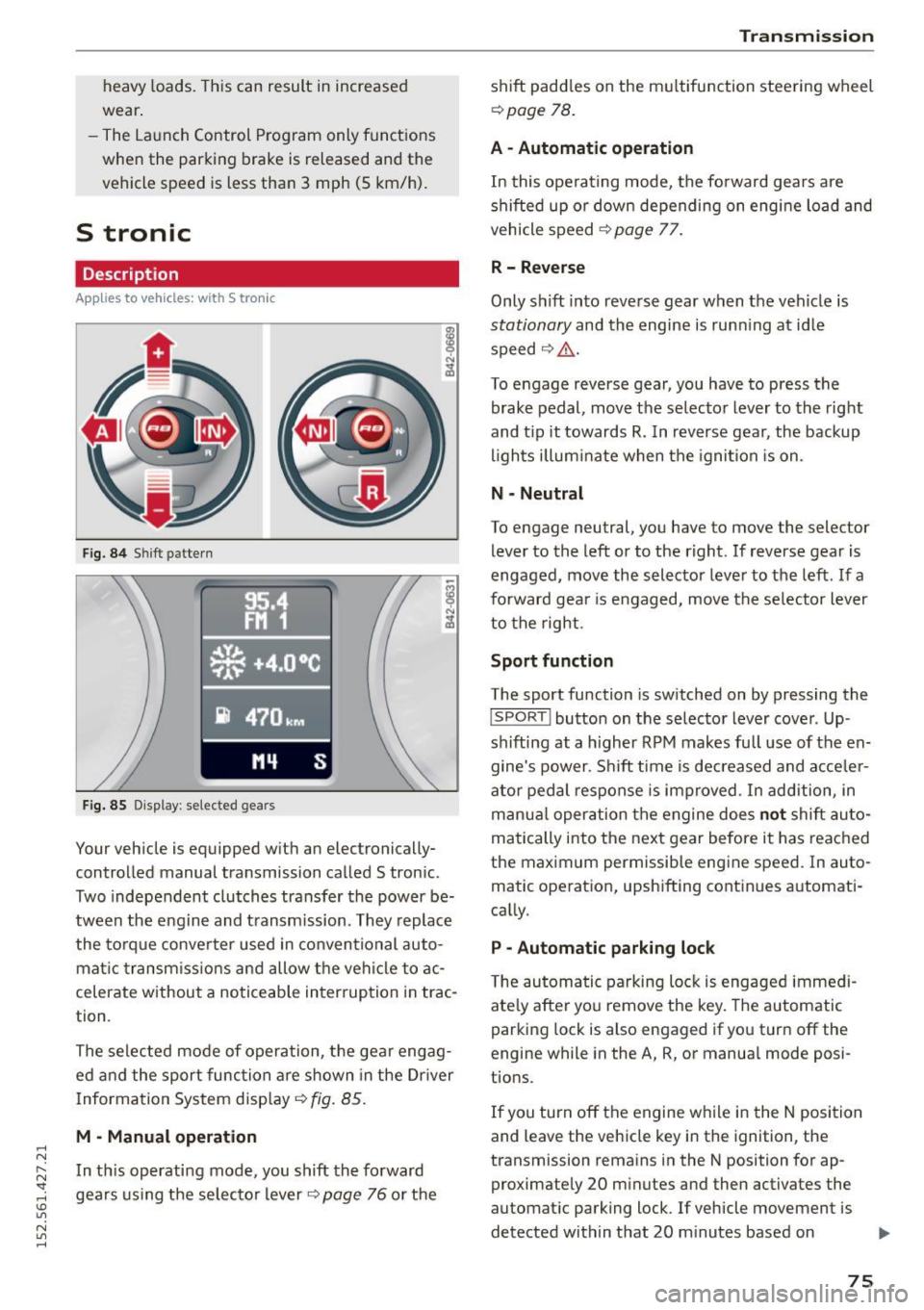
Fig. 84 Shift pattern
Fig. 85 Display : selected gea rs
Your vehicle is equipped with an electronically
controlled manual transmission called S tronic .
Two independent clutches transfer the power be
tween the eng ine and transmission. They replace
the torque converter used in conventional auto
mat ic transmissions and allow the vehicle to ac
celerate without a noticeable interruption in trac
tion .
The selected mode of operation, the gear engag ed and the sport function are shown in the Dr iver
Information System display ¢
fig. 85.
M -Manual operation
In this operating mode, you shift the forward
gears using the selector lever
r=>v page 76 or the
Transmission
shift paddles on the multifunction steering wheel
¢ page 78.
A - Automatic operation
In this operating mode, the forward gears are
shifted up or down depending on engine load and
vehicle speed
¢ page 77.
R- Reverse
Only s hift into reverse gear when the vehicle is
stationary and the engine is runn ing at idle
speed ¢
Li')...
To engage reverse gear, you have to press the
brake pedal, move the selector lever to the right
and t ip it towards
R. In reverse gear, the backup
lights illuminate when the ignition is on .
N -Neutral
To engage neutral, you have to move the selector
lever to the left or to the right . If reverse gear is
engaged,
move the selector lever to the left . If a
forward gea r is engaged, move the selector lever
to the right.
Sport function
The sport function is switched on by pressing the
I SPORT ! button on the selector lever cover . Up
shifting at a higher RPM makes full use of the en
gine's power . Shift time is decreased and acceler
ator pedal response is improved . In addition, in
manua l operation the engine does
not shift au to
matically into the next gear before it has reached
the maximum permissible engine speed. In auto
matic operation, upshifting continues automati
cally.
P -Automatic parking lock
The automatic parking lock is engaged immedi
ately after you remove the key. The automatic
parking lock is also engaged if you turn off the
engine while in the A, R, or manual mode posi
tions .
If you turn off the engine while in the N position
and leave the vehicle key in the ignition, the
transmission remains in the N position for ap proximately 20 minutes and then activates the
automatic parking lock . If vehicle movement is
detected within that 20 minutes based on
IIJI.
75
Page 78 of 232
Transmi ssio n
rotation of the whee ls, then the time wi ll in
crease a ccording ly .
A WARNING
- If a gear is engaged when the vehicle is sta
tionary, the acce lerator must not be pressed
inadvertently under any circumstances. Oth
erwise the vehicle will immed iately start to
move - sometimes even if the park ing brake
is f irmly applied.
- Before you or other persons open the engine compartment l id and work on a running en
gine, select neutral pos it ion
N and firmly
apply the handbra ke. Always read and fol
low the app licab le warn ings¢
page 155,
Working in the engine compartment.
@ Tips
- If you accidenta lly shifted into N w hile d riv
i ng, you can engage a gear in the normal
way using the selecto r lever.
- An indicator light i s displayed if a malfunc
tion occurs while in S tronic. Refer to
~page 78.
Manual mode
App lies to veh icles: w ith 5 tro nic
S tronic allows the driver to shift gears man ua lly.
Starting from a stop
.,. Press and ho ld the brake pedal.
.. Move the selecto r leve r to the left.
.. Tap the se lec tor lever forwa rd
0 -
.. Re lease the brake pedal and press the accelera -
tor pedal ¢ .&,. .
Shifting
.,. To shift up, tap the selector lever fo rward 0 -
.,. To shift down, t ap the sele ctor lever to the re ar
o.
Stopp ing temporarily
.,. Press the brake pedal to prevent the vehicle
from moving, for examp le at traff ic lights .
Par king
.. Press and ho ld the brake pedal¢.&,. .
76
.. Activate the parking brake .
.. Turn off the ignition and remove the key .
Stopping on an incline
.,. Always keep the vehicle stat ionary using the
foot brake to prevent it from " rolling back"
¢ .&,. . D o not try to p revent the vehicle from
"ro lling back" when a gear is engaged by in
creasing engine speed.
.. Activate the parking brake.
Starting on a hill
.. With a gear engaged, remove your foot from
the brake, accelerate and slowly release the
parking brake.
When acce lera ting, S tronic sh ifts i nto the nex t
gear in gea rs 1, 2, 3, 4, 5 and 6 shor tly befo re
the maximum permissib le engine speed is
r eached.
If you have se lec ted a lower gear than the current
one, S tron ic w ill shift down only when the engine
will not be ove r-revved.
You can switch to a utomat ic operation at any
time
¢ page 77.
A WARNING
-
- Never leave your vehicle with the engine
ru nning while in gear. If you must leave yo ur
vehicle with the engine r unning, set the
parking brake firmly and engage neutral
N .
- With the engine r unning and a gear engag
ed, you have to ho ld the vehicle with the
foot brake .
- Do not accelerate when you sh ift gears with
the vehicle stationary and the engine run ning.
- Before driving down a steep slope, reduce
your speed and sh ift into a lower gear with S
tronic.
- Do not ride the bra kes or press the bra ke
pedal too often or too long. Constant brak
ing causes the brakes to overheat and sub
stantially reduces brak ing performance, in
creases braking d istance or causes comp lete
fa ilu re of the brake system. ..,.
Page 79 of 232
..... N
r-N "': ..... \!) ..,.,
N ..,., .....
(D Note
If you must stop on an incline, always hold
the vehicle in p lace with the foot brake to pre
vent it from rolling back. Do not try to prevent the vehicle from rolling back when the gear is
engaged by increasing speed, as this may
damage the clutch.
Automatic mode
Applies to vehicles: with S tronic
St arting fro m a stop
"' Press and hold the brake pedal.
"' Tap the se lector lever towards A.
"' Re lease the brake pedal and press the accelera-
tor pedal
¢ ,&. in Manual mode on page 76.
Under certain circumstances (driving in the
mounta ins for example), it can be beneficia l to
switch temporarily to the manual shift program
¢
page 76 in order to adjust the gear ratios to
driving conditions
manually.
Kick-down
Applies to vehicles: with S tronic
When you depress the accelerator pedal beyond
the resistance point, S tronic downsh ifts into a
lower gear, depending on vehicle speed and en
g ine rpm. It shifts up into the next higher gear
once the maximum specified engine RPM is reached . Exception: you have activated the sport
function.
.&, WARNING
Please note that the wheels could spin on
slic k or slippery roads when kick-down is ac
tive.
l) Market -spec ifi c
-
Tra nsm issio n
Launch control program
Applies to vehicles: with S tronic
The Launch Control Program enables maximum
acceleration.
Requirement: The engine must be at operat ing
temperature and the steering wheel must not be
turned.
"' With the engine running, press the
I!]!
!ESC OFFjll button one time . The Ill indicator
light and the message
ESC S port - Cau tion!
Limi ted stabil ity! appears in the driver infor
mation system display.
"' Press the brake pedal with your left foot and
hold it down.
"' Engage a gear.
"' Press the
I SPORT ! button on the selecto r lever
cover.
"' Press the accelerator pedal at the same time
with your right foot unti l the engine has
reached a constant speed.
"' Remove your left foot from the brake¢.&_ .
A WARNING
--
- Always adapt your dr iving to the traffic flow.
- Only use the Launch control program when
road and traffic cond itions allow it and oth
er drivers will not be endangered or both
ered by your driving and the vehicle's accel
eration.
- Please note that the driving wheels can spin
and the vehicle can b reak away when ESC is
sw itched off, espec ial ly when the road is
slippery .
- Once you have accelerated, you sho uld
sw itch the ESC back on by pressing the
[fil
but ton.
(D Tips
- The tra nsmission temperature may increase
signif icant ly afte r using the Launch Contro l
Program. If that happens, the program may
not be availab le for a few minutes . It wi ll be
available again after a cool-down period .
77
Page 80 of 232
Transmission
-When acce le rat ing using the Launch Cont ro l
program, all vehicle pa rts are subject to
heavy loads. T his can result in increased
wear.
Steering wheel with shift paddles
App lies to veh icles: with S tron ic
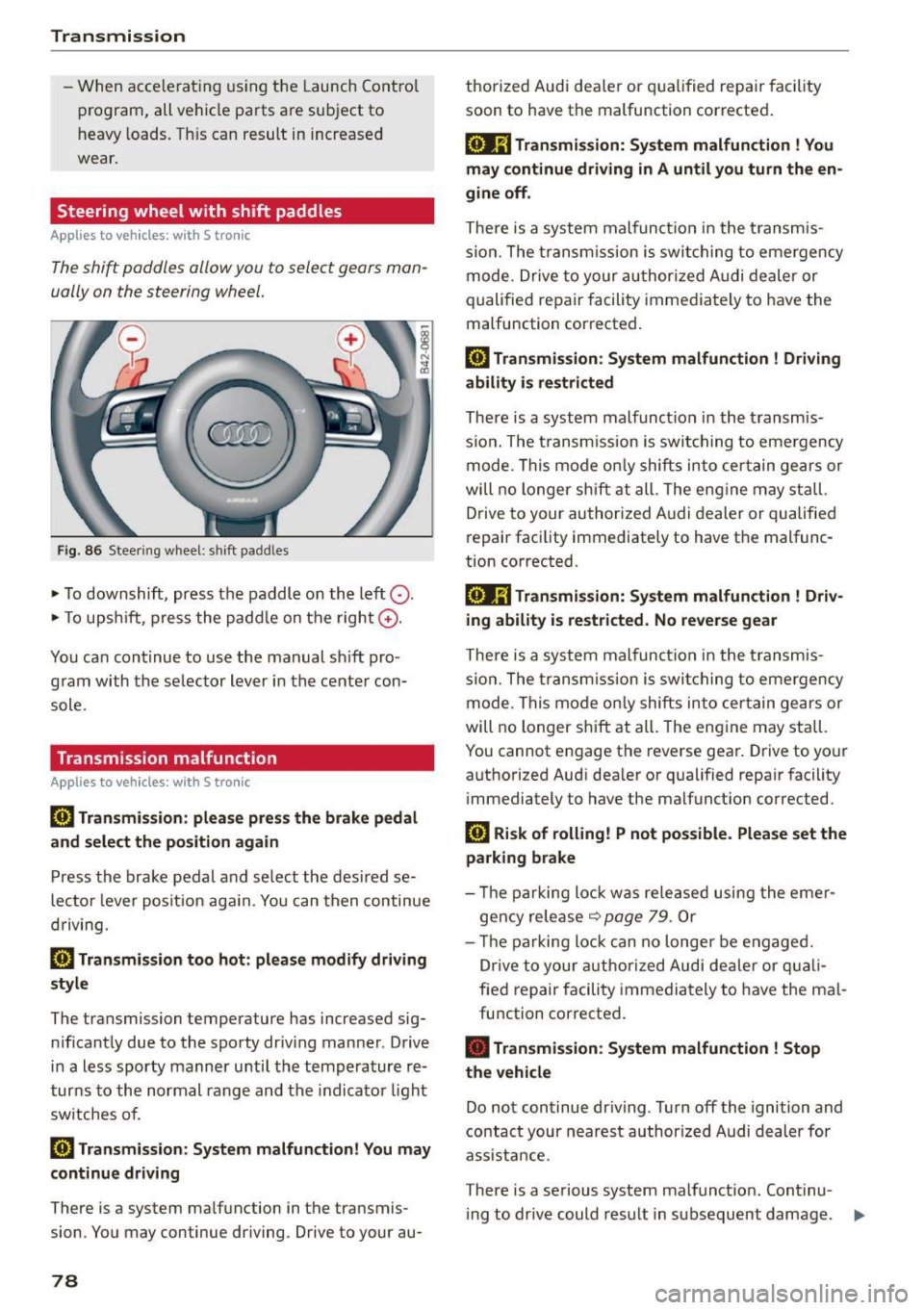
The shift paddles allow you to select gears man
ually on the steering wheel.
F ig . 8 6 Steer ing w heel: shi ft padd les
• To downshift, press t he paddle on the left 0 -
• To upsh ift, p ress the padd le on the right G) .
You ca n continue to use the manual s hift pro
g ram with the se lector lever in the cente r con
sole.
Transmission malfunction
Applies to vehicles : with S tro nic
l'§J Transmis sion : please press the brake pedal
and select the position again
Press th e brake pedal a nd se lect the desi red se
lec to r l eve r pos it io n aga in. Yo u can then continue
d riving.
[O] Transmission too hot: please modify driving
style
The transmission temperature has increased sig n ificant ly due to the spo rty dr iv ing man ner . Drive
i n a less sporty manner u nti l t h e temperature re
t ur ns to the normal rang e and the indicator light
sw itches of.
[i1 Transmi ssion : System malfunction! You may
continue driving
There is a system ma lfunction in the transmis
sion . You may continue driving. Drive to your au-
78
thorized Audi dea ler or q ua lif ied repa ir facility
soon to have the malfunction corrected .
[o.Jij Transmission: Sy stem malfunction ! You
may continue driving in A until you turn the en
gine off .
There is a system malfunc tion i n the trans mis
s io n. The tran sm iss ion i s swi tchi ng to eme rgency
mode. Drive to your author ized A udi dealer or
q ualified repair facili ty imme diate ly to have the
malfunction corrected.
l'§J Transmission : System malfunction ! Driving
ability is restricted
There is a system malfunct ion in the t ransmis
s io n. The t ransm iss ion is swit ching to eme rgency
m ode. Thi s mo de onl y shifts in to ce rtain ge ars or
will no l onger shi ft at all. The eng ine may st all.
D rive to your au thori zed A udi dealer or qualified
repair fac ility immediately to have t he malfunc
tion corrected.
[oJ;j Transmission: System malfunction ! Driv
ing ability is restricted. No reverse gear
There is a system malfun ction i n the trans mis
s ion . The tran sm iss ion i s swi tchi ng t o em ergency
mode. T his mode o nly shifts in to cer tain gears or
will no longer shift at all . The eng ine may stall.
You cannot e ngage the reverse gea r. Drive to yo ur
aut ho rized Aud i dea ler or q ualified repa ir facility
i mmediately t o have the malfunct ion corrected.
[i1 Risk of rolling! P not pos sible. Please set the
parking brake
- Th e parking lo ck was re le ase d using the eme r
gency rele ase
~ page 7 9 . O r
- Th e parking lo ck can no l onge r be engage d.
Dr ive t o your authoriz ed Audi de aler or q uali
fie d repair f acili ty immedia tely to have the ma l
fu nction cor rected.
• Transmission : System malfunction ! Stop
the vehicle
Do no t con tinue dr iving . Tur n off the ignition and
contact your nea rest author ized Audi d eal er for
ass ista nce.
There is a serious system malfunct ion. Continu -
i ng to dr ive could result in s ubsequent damage. .,.
Page 81 of 232
.... N
l'
N "1: .... I.O
"' N
"' ....
(D Note
If S tronic has switched to emergency opera
tion mode, you should have the malfunction corrected as soon as possible.
Parking lock emergency release
App lies to vehicles: with S tro nic
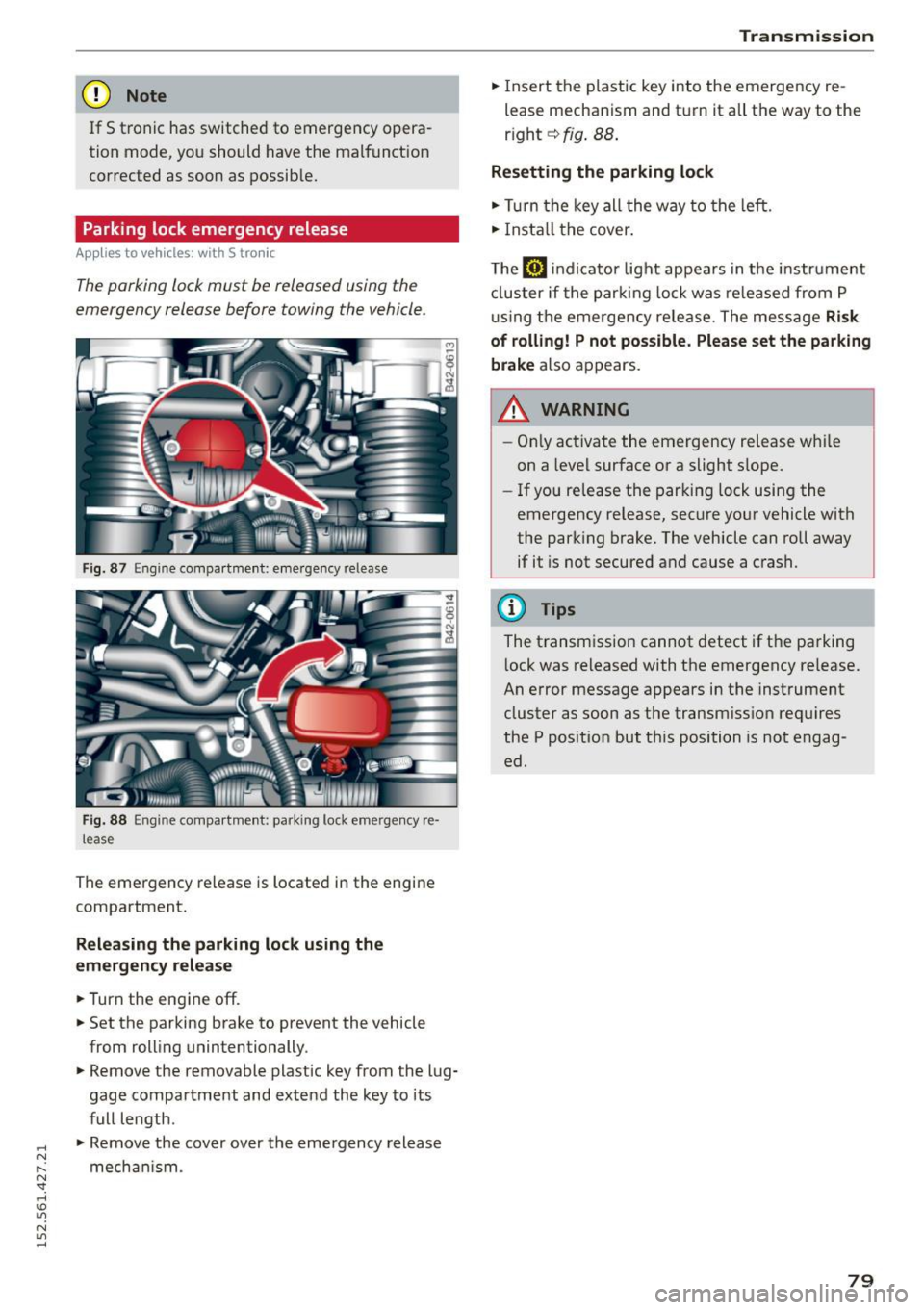
The parking lock must be released using the
emergency release before towing the vehicle.
F ig. 87 Engine compart men t: emergency release
Fig. 88 Engine compa rtment: parking lock emergency re·
lease
The emergency release is located in the engine
compartment.
Releasing the parking lock using the
emergency release
.,. Turn the engine off .
.,. Set the parking brake to prevent the vehicle
from rolling unintentionally .
.,. Remove the removable plastic key from the lug
gage compartment and extend the key to its
full length .
.,. Remove the cover over the emergency release
mechan ism .
Tran smission
.,. Insert the plastic key into the emergency re
lease mechanism and turn it all the way to the
r ight ~
fig. 88.
Resetting the parking lock
.,. Turn the key all the way to the left.
.,. Install the cover.
The
[il indicator light appears in the instrument
cluster if the parking lock was released from
P
using the emergency release. The message Risk
of rolling! P not possible. Please set the parking
brake
also appears.
,&_ WARNING
- Only activate the emergency release whi le
on a level surface or a slight s lope.
- If you release the parking lock using the
emergency release, secure your vehicle with
the parking brake. The vehicle can roll away if it is not secured and cause a crash.
(D Tips
The transmission cannot detect if the parking
l ock was released with the emergency re lease.
An error message appears in the instrument
cluster as soon as the transmiss ion requires
the
P position but th is position is not engag
ed.
79
Page 136 of 232
Intelligent technology
Intelligent technology
Notice about data
recorded by vehicle
control modules
Your vehicle is not equipped with an Event Data
Reco rder (EDR) , insta lled by some manufactu rers
for the express pu rpose of captur ing data fo r re
trieval after an accident or crash event. ED R 's are
sometimes called "crash recorders" .
Some state laws restrict the retr ieval or down
loading of da ta stored by EDR's that were instal
led in a vehicle for the express p urpose of retriev
ing data after an accident or crash event without
the owner's consent.
Al though you r vehicle is not eq uipped w ith an
E DR, it is equipped with a number of electronic
control modu les for vario us vehicle systems such
as, for example, engine function, emission con
trol, as we ll as for the airbags and safety belts.
These electronic control modules also record ve
hicle-related data during norma l vehicle opera
tion for diagnostic and repair purposes . The re
cording capacity of the electronic contro l mod
ules is lim ited to data (no sound is recorded) and
only a small amount of data is actually recorded
over a very l imited per iod of t ime and stored
when a system fault or other condition is sensed by a control unit. Some of the data then stored
may re late to veh icle speed, direction, braking as
well as restraint system use and performance in
the event of a crash o r other cond ition . Stored
data can only be read and downloaded with spe
cial equipment.
Electronic Stabilization
Control (ESC)
Description
ESC helps to improve road holding and vehicle
dynamics to help reduce the probability of sk id
d ing and loss of veh icle contro l.
It works only
when the engine is runn ing. ESC detects certain
d ifficult driving situations, including when the ve
h icle is beginn ing to spin (yaw) out of control and
he lps you to get the veh icle back under control by
134
selective ly braking the wheels, and/or reducing
engine power and providing steering assistance
to help ho ld the veh icle on the driver's intended
course. The ind icator light
GJ in the instrument
cluster blinks when ESC is taking act ion to help
you contro l the vehicle .
ESC has limitations. It is important to remember
that ESC cannot overcome the laws of physics. It
will not always be able to help out under all con
dit ions you may come up against. For example,
ESC may not always be able to help you master
s ituations where there is a sudden change in the
coefficient of fric tion of the road surface. When
there is a sect ion of dry road that is suddenly cov
ered with water, slush or snow, ESC cannot per
f orm the same way it would on the dry surface . If
the vehicle hydrop lanes (rides on a cushion of wa
ter instead of the road surface), ESC will not be
able to help you steer the vehicle because contact
with the pavement has been interrupted and the
vehicle cannot be braked or steered . During fast
corner ing, particularly on wind ing roads, ESC
cannot always dea l as effectively with difficult
driv ing situations as at lower speeds .
Always adjust your speed and driving style to road, traffic and weather condit ions . ESC cannot
overr ide the veh icle's phys ica l limits, increase the
available traction, or keep a vehicle on the road if
road departure is a result of driver inattention.
Instead, ESC improves the possibility of keeping
the vehicle under control and on the road during
extreme maneuvers by using the driver's steering
inputs to help keep the vehicle going in the in
tended direction. If you are traveling at a speed
that causes you to run off the road before ESC
can prov ide any assistance, you may not experi
ence the benefits of ESC.
ESC includes and/or works together with the an
ti-lock brake system (ABS), brake assist sys tem
and anti -slip regulation (ASR) . ESC is sw itched on
all the t ime . In certai n situations when you need
less tract ion, you ca n sw itch off ESC by p ress ing
the button
l!l . Be sure to sw itch ESC on again
when you no longe r need less traction. .,..
Page 137 of 232
.... N
l'
N "1: .... I.O
"' N
"' ....
Anti-loc k br aking sy stem (ABS )
ABS prevents the wheels from locking up when
brak ing . T he vehicle can st ill be stee red even dur
ing hard braking. App ly steady pressure to the
brake peda l. Do not pump the peda l. A pulsing in
the brake pedal indicates that the system is help
ing you to brake the vehicle.
Brake assist sy ste m
The brake assist system can decrease braking dis
tance. It increases braking power when the dr iver
presses the brake pedal quick ly in emergency sit
uations. You must press and ho ld the brake pedal
until the situation is over.
Anti -slip regulation (ASR )
ASR reduces engine power when the drive whee ls
begin to spin and adapts the force to the road
conditions. This makes it easier to start, acceler
ate and dr ive up h ills.
Electronic diff erential lock (EDL )
The EDL brakes wheels that are spinning and
transfers the drive power to the other drive wheel or wheels if the vehicle is equipped w ith all-whee l
drive*. This function is available up to about 60
mph (100 km/h) .
I n extreme cases , EDL automatically switches off
to help keep the brake on the braked wheel from
overheating . EDL wi ll switch on again automati
cally when conditions have returned to normal.
A WARNING
- ESC, ABS, ASR and EDL cannot overcome the
laws of phys ics. Th is is especially important
on slippery or wet roads. If the syst ems be
gin act ing to stab ilize your vehicle, you
sho uld immediately cha nge your speed to
match the roa d and traffic con ditions. Do
not let the increased safety provided by
these systems tempt you to take risks . Do
ing so wi ll increase the risk of a loss of vehi
cle contro l, collis ion and serio us personal in
juries .
- Always adapt your speed to road, traffic and
weather cond it ions. The risk of losing con
tro l of the veh icle increases when driving
Int ellig ent t echnolo gy
too fast, especially through curves and on
slippery or wet roads, and when dr iving too
close to vehicles up ahead. ESC, ABS, the
brake assist system, EDL and ASR cannot
prevent coll is ions .
- Always accelerate with special care on even,
smooth surfaces such as those that are wet
or covered with ice and snow. The drive
wheels can spin even with these assistance sys tems that cannot always help to reduce
the risk of loss of veh icle control.
(D Tips
- ABS and ASR only wo rk correctly when all
four wheels are eq uipped with ident ical
tire s. Different tire s izes can lead to a reduc
t ion i n engine power.
- Yo u may hear noises when the systems de
sc ribed a re wo rking.
- If the ind icator light GJ or II (USA mod
els) ;tiJ (Canada models) appea rs, there
may be a malfunction~
page 15,
~ page 15.
Switching on/off
ESC turns on automatically when you start the
engine.
SPORT •
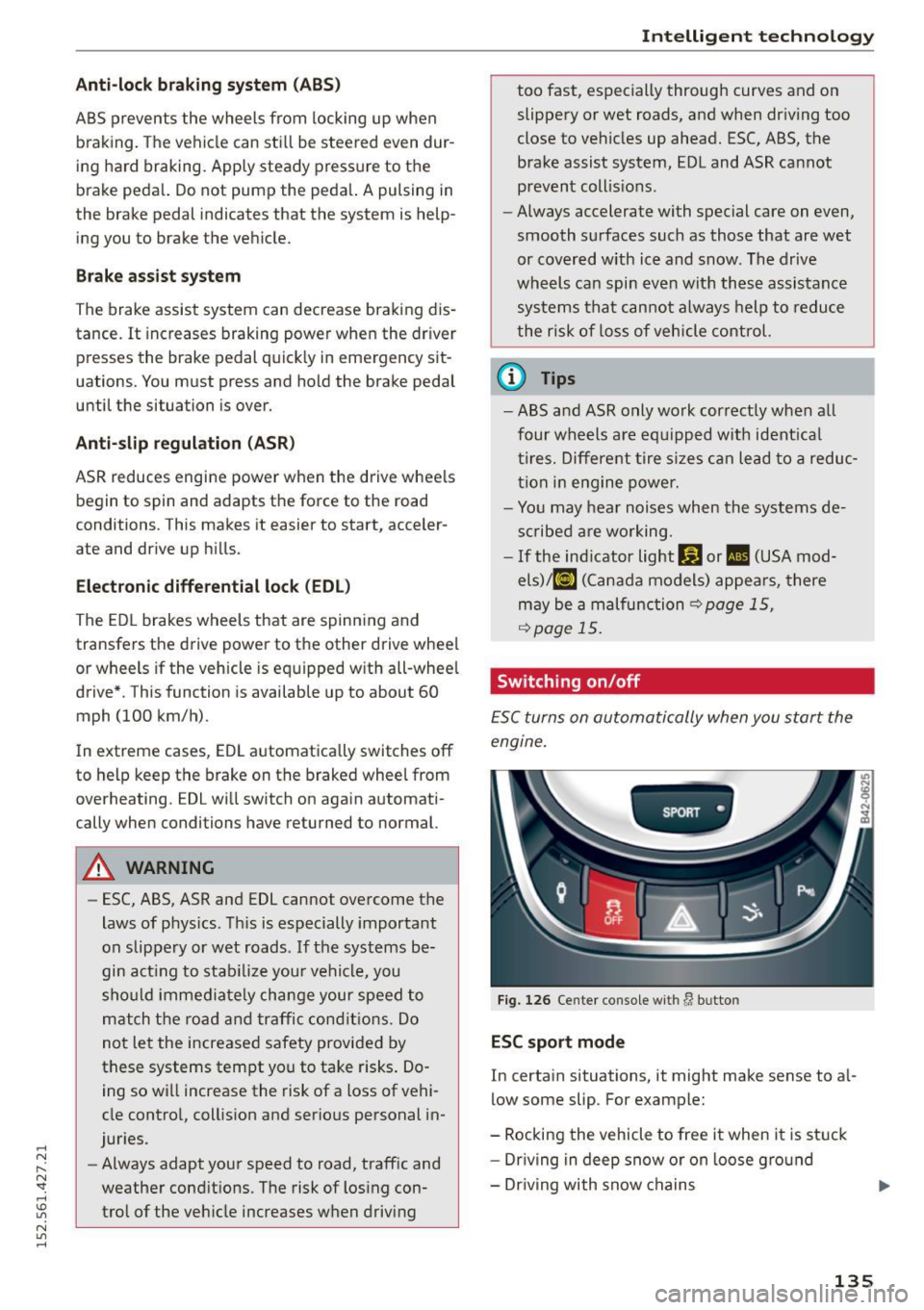
Fig . 12 6 Cente r co nsole wit h lJ bu tto n
ESC sport mode
In certain situations, it might make sense to a l
low some slip. For example:
- Rocking the vehicle to free it when it is st uck
- Driving in deep snow or on loose gro und
- Dr iving with snow chains
135