oil AUDI R8 SPYDER 2015 User Guide
[x] Cancel search | Manufacturer: AUDI, Model Year: 2015, Model line: R8 SPYDER, Model: AUDI R8 SPYDER 2015Pages: 232, PDF Size: 58.36 MB
Page 139 of 232
..... N
r-N "': ..... \!) 1.1'1
N 1.1'1 .....
This can cause a temporary reduction in braking
force compared to dry brakes. You can compen
sate for this by pressing the brake pedal harder.
Cor ro sion
There may be a tendency for dirt to bui ld up on
the brake pads and corrosion to fo rm on the discs
if the car is not driven regularly or only for short
trips with little use of the brakes.
If the b rakes are not used frequently, or if corro
sion has formed on the discs, it is advisab le to
clean off the pads and discs by braking firmly a
few times from a moderately high speed
c:> &. .
Faults in the brake sy stem
If you should notice a sudden increase in brake
pedal travel, then one of the two brake circuits
may have fai led
c:> .&, .
Low brak e flu id le vel
Malfunct ions can occur in the brake system if the
brake fluid level is too low. The brake flu id leve l is
monitored e lectronically.
Br ake power assis t un it
T he brake power assist unit increases the pres
sure that you generate with the brake pedal.
It
works only when the eng ine is running .
Brak e lining wear sta tu s
Brake lining wear may be checked by visual in
spection of the condition of the brake pads
through the openings in the wheel. If necessary,
the wheel may be removed for this inspection
c:> page 203 .
.8, WARNING
-New brake pads don't have the best stop
ping power and must be "broken-in" during
the init ial 250 mi les ( 400 km) of normal city
driving. The break -in period can be consider
ably longer for vehicles with ceramic brake
rotors *. You can compensate for this by
pressing the brake pedal more firmly. This
also applies later when new pads are instal
led .
- You should perform brak ing maneuvers for
the purpose of clean ing the brake system
Int elli ge nt te chn olo gy
only if road conditions permit. Other road
users must not be put at r isk -you may
cause an accident!
- Before descending a steep grade, reduce
speed and sh ift transmission into a lower
gear or lower dr iving range. Do not ride the
brakes or hold the pedal down too long or
too often. This could cause the bra kes to get
hot and dimin ish braking effic iency .
- Do not "ride the brakes" by rest ing your foot
on the pedal when you do not intend to
brake. This may cause the brakes to over
heat, premat ure wear and increased stop
ping distance.
- Under certain cl imatic and operat ing condi
tions such as passing thro ugh water, dr iv ing
in heavy rain or after washing the vehicle,
the effectiveness of the brakes can be re
duced . In winter, ice can accumulate on the
brake pads, lin ings, discs and drums. Care
fully apply brakes for a test. Brakes will dry and ice coatings will be cleaned off after a
few careful brake applications.
- Driving for an extended period of t ime on
salt-covered roads without using your brakes can also affect braking efficiency .
Clean off accum ulated salt coating from
b rake discs and pads with a few cautious
brake applications.
- If you damage the front spoiler, or if you in
stall a different spoiler, be su re the air flow
to the front brakes is not obstructed . O ther
wise the brake system could overheat reduc
ing the effectiveness of the entire brake sys
tem .
- Fai lure of one brake circuit will impai r the
braking capability resu lting in an increased
stopping distance . Avoid driving the vehicle
and have it towed to the nearest Aud i dea ler
or qualif ied workshop.
- Never let the vehicle roll to a stop with the
engine shut off.
- If the brake booster is not working, for ex
ample when towing your veh icle, or because
the brake booster has somehow been dam
aged, the brake pedal must be pressed con
siderably harder to make up for the lack of booster assistance.
1 37
Page 140 of 232
Intelligent technology
Rear spoiler
The rear spoiler improves vehicle handling and
enhances driver control.
SPORT •
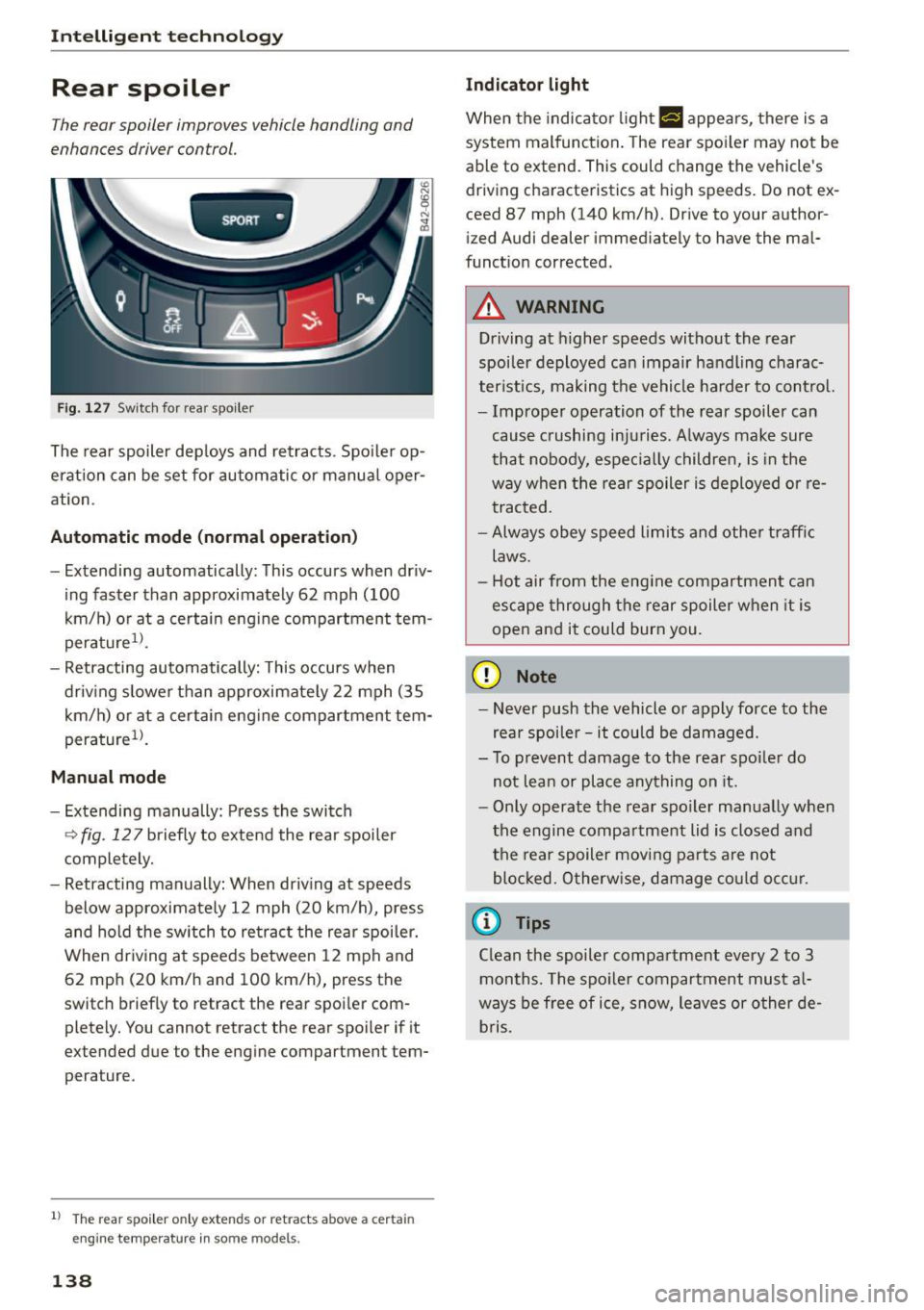
Fig. 127 Switch for rear spoiler
The rear spoiler deploys and retracts. Spo iler op
eration can be set for automatic or manual oper
ation.
Automatic mode (normal operation)
-Extending automatically: This occurs when driv
ing faster than approximately
62 mph (100
km/h) or at a certain engine compartment tem
perature1l.
- Retracting automatically: This occurs when
driv ing s lower than approximate ly
22 mph (35
km/h) or at a certain engine compartment tem
perature1l.
Manual mode
- Extending manually: Press the switch
~ fig. 12 7 briefly to extend the rear spoi ler
completely.
- Retracting manually: When dr iving at speeds
below approximately
12 mph (20 km/h), press
and hold the switch to retract the rear spoiler.
When dr iving at speeds between
12 mph and
62 mph (20 km/h and 100 km/h), press the
switch briefly to retract the rear spoiler com
pletely. You cannot retract the rear spoiler if it
extended due to the engine compartment tem
perature.
1 > The rear spoiler only extends or retracts above a certain
e ngine temperature in some mode ls.
138
Indicator light
When the indicator light I-· appears, there is a
system malfunction. The rear spoi ler may not be
able to extend. This could change the vehicle's
driving character istics at high speeds. Do not ex
ceed 87 mph
(140 km/h). Drive to your author
i zed Audi dealer immediately to have the mal
function corrected.
A WARNING
-
Driving at h igher speeds without the rear
spoiler deployed can impair handling charac
ter istics, making the vehicle harder to control.
- Improper operation of the rear spoiler can
cause crushing injuries. A lways make sure
that nobody , especial ly children, is in the
way when the rear spoiler is deployed or re
tracted.
- Always obey speed limits and other traffic
laws.
- Hot air from the engine compartment can
escape through the rear spoiler when it is
open and it could burn you.
(D Note
-Never push the vehicle or apply force to the
rear spoiler -it could be damaged.
- To prevent damage to the rear spo iler do
not lean or place anything on it.
- Only operate the rear spo iler manually when
the engine compartment lid is closed and
the rear spoiler moving parts are not
bloc ked. Otherwise, damage could occur.
(D Tips
Clean the spoiler compartment every 2 to 3
months. The spoiler compartment must al
ways be free of ice, snow, leaves or other de
bris.
Page 141 of 232
..... N
r-N "': ..... \!) ..,.,
N ..,., .....
Power steering
When the engine is running, power steering
makes i t easier for the driver to steer.
Power steering helps the driver steer the vehicle
with litt le physical effort.
If the engine is not running, the power steering
system is also not working. In this case, you will
find it extremely difficult to turn the steering
wheel.
If you turn the steering fully to the left or right
when the vehicle is stationary, you place a very
heavy load on the power steering system. Turning
the steering wheel fully to the left or right wi ll
cause noise in the system . It also reduces engine
idle speed.
(D Note
Do not hold the steering turned fully to the
left or right for more than 10 seconds when
the engine is running. There is a risk of dam
age to the power steering system.
@ Tips
- In the event of a power steering system fail
ure, or if the engine is not running (while
being towed), you will still be able to steer
the vehicle. However, you will require more
effort to do so.
- If the power steering system has a leak or is
defective, you should immediately contact a
qualified workshop .
- The power steering system requires a spe
cial hydraul ic fluid . The power steering fluid
reservoir is located in the engine compart
ment. The correct hydraulic fluid level is im
portant for proper operation of the power
steering system. The power steering fluid
l evel is checked according to the Audi main
tenance service schedule.
Dry sump lubrication
High lateral and longitudinal forces affect the en
gine and the vehicle during sporty driving. Dry
sump lubrication ensures that your engine is sup-
Intelligent technology
plied with oil and properly lubricated even under
these conditions.
In a "norma l" vehicle the oil pump sends the oil
from the oil pan to the lubrication points in the
engine . The oil then returns to the oil pan. In ex
treme situations, the oil pump may draw in air,
wh ich results in insufficient oi l pressure .
With dry sump lubrica tion, the oil is not in the oil
pan (it is "dry"), but in a separate oi l tank. While
one pump supplies the engine with oil, a second
pump suct ions the oil out of the engine and re
turns it to the o il tank. Because the oil tank is tall
and narrow, oil pressure is constant even under
extreme conditions .
In add ition, the oi l pan in vehicles with dry sump
lubrication is noticeably shallower . This allows
the engine to be installed lower in the vehicle,
bringing down the center of gravity . This im
proves your vehicle's handling.
Driving with your quattro
With oil-wheel drive, all four wheels are driven .
General information
With all-wheel drive, power is distributed to all
four wheels . This happens automatically depend
ing on your driving style and the road conditions
at the time . See also
c:::.> page 134.
The all-whee l drive concept is designed for high
engine power . Your vehicle is exceptionally pow
erful and has excellent driving characterist ics
both under normal driving conditions and on
snow and ice. Always read and fo llow safety pre
cautions
c:::.> .&_ .
Winter tires
When driving in the winter, your vehicle with all
wheel drive has an advantage, even with regular
t ir es . In winter road condit ions it may be advisa
ble to mount winter tires (or all-season t ires) for
improved driveability and brak ing: these tires
must be mounted on
all four wheels. See also
c:::.> page 193 , Winter tires.
139
Page 144 of 232
Driving and en vironment
Driving and environment
Break-in period
A new vehicle must be broken in, and the break-in
period shou ld be 1 ,500 miles (2,500 km) . Do not
use full acceleration for the first 600 miles
(1 ,000 km) and do not exceed the maximum en
gine speed of 6,000 rpm You must also not use
full accelerat ion between 600 and 1,200 miles
(1,000 to 2,000 km) . From 1,200 to 1,500 miles
(2 ,000 to 2,500 km), you can gradually increase
maximum eng ine speed to 8,250 rpm for brief
pe riods.
During the first hours of operation, there is
greater fr iction in the eng ine and the transmis
sion than later when all the moving pa rts have
b roken in .
The way you drive during the first 1,500 miles
(2 ,500 km) affects engine quality . If you drive at
modera te engine speeds thereafter, part icu larly
when the engine is cold, yo u red uce eng ine wea r
and increase the potential mileage o f the engine.
Do not dr ive at RPMs that a re too
low. Shift down
when the engine is no longe r runni ng "smooth
ly". Extremely high RPMs are gover ned automati
cally.
Avoid damaging the
vehicle
W hen you are driving on poor roads, or over
curbs, steep ramps, etc ., make certain that low
lying parts such as spoilers and exhaust system
parts do not bottom out and get damaged .
This is especially true for vehicles with low-slung
chassis (sports chassis) and fully loaded vehicles.
Driving through water on
roads
Note the following to avoid vehicle damage when
d riving through water, for examp le on flooded
roads:
- The water must no t be any h igher than the bot
tom of the vehicle body.
142
- Do not drive faster than walk ing speed .
A WARNING
After driv ing through water, mud, s lush, etc .,
the brakes may be s low to take effect because
of wet brake rotors and pads. Dry the brakes
first by brak ing carefully to restore the full
braking effect.
(D Note
Vehicle components such as the eng ine,
transmission , suspension or e lectrical system
can be severe ly damaged by dr iv ing t hrough
water .
(D Tips
- Check the dept h of the water before driving
through it.
- Do not stop the vehicle, drive in reverse or switch the engine off when driv ing through
water.
- Keep in mind that oncoming veh icles may
create waves that raise the water level and
make it too deep for your vehicle to d rive
through safely .
- Avoid driving through salt water because it
can cause corrosion.
Catalytic converter
It is very important that your emission control
system (catalytic converter) is functioning prop
erly to ensure that your vehicle is running in an
environmen tally sound manner.
.,. Always use lead-free gasoline ~ page 151,
Fuel supply.
.,. Never r un the tank down all the way to empty.
.,. Never put too much mo tor o il in yo ur engi ne
~ page 160, Adding engine oil 'l::r..
.,. Never try to push- or tow-sta rt your vehicle .
The cata lytic converter is an effi cien t "clean -up"
device built in to the exhaust system of the vehi
cle. The cata lytic conve rter burns many of the
po llutants in the exhaust gas before they are re
l eased into the atmosphere.
-
Page 145 of 232
..... N
r-N "': ..... \!) ..,.,
N ..,., .....
The exclusive use of unleaded fuel is critically im
portant for the life of the catalytic converter and
proper functioning of the engine.
A WARNING
- Do not park or operate the vehicle in areas where the hot exhaust system may come in contact with dry grass, brush, fuel spill or
other material which can cause a fire .
- Do not apply additional undercoating or
rustproofing on or near the exhaust mani
fold, exhaust pipes, catalytic converter or
heat shields. During driving, the substance
used for undercoating could overheat and
cause a fire.
([) Note
-Be aware that just one tank filling with lead
ed
fuel will already seriously degrade the
performance of the catalytic converter.
- Do not exceed the correct engine oil level
~page 160.
- Do not drive until the fuel tank becomes
completely empty. The engine could misfire.
Unburned fuel could also get into the ex
haust system and this could cause the cata
lytic converter to overheat.
- Do not turn off the ignition while the vehicle
is moving.
- Do not continue to operate your vehicle un
der these conditions, as otherwise fuel can
reach the catalytic converter. This could re
sult in overheating of the converter, requir
ing its replacement.
- To assure efficient operation of the Emission
Control System:
- Have your vehicle maintained properly and in accordance with the service recommen
dations in your Warranty
& Maintenance
booklet.
- Lack of proper maintenance as well as im
proper use of the vehicle will impair the
function of the emission control system
and could lead to damage.
Driving and environment
{® For the sake of the environment
Even when the Emission Control System is op
erating properly, the exhaust gas can have a
sulfur-like exhaust gas smell under some op
erating states. This depends on the sulfur
content of the fuel being used. Using a differ
ent brand of fuel may help, or filling the tank
with lead-free super grade gasoline .
Shutting down vehicle
If you would like your vehicle to remain inopera
tive for a longer period of time , contact an Audi
or other specialized dealer. They can advise you
on necessary precautions e.g. corrosion preven
tion, maintenance and storage. Pay attention to
additional information concerning the battery.
Refer to~
page 164.
Operation and
maintenance
Fuel economy, environmental impact, and wear
on your engine, brakes and tires largely depend
on three factors:
-your personal driving style
- operating conditions
- technical limitations
By having your vehicle regularly serviced by an
authorized Audi dealer helps to ensure that it runs properly and economically. The condition of
your vehicle not only affects its safety and ability
to hold its value, it also affects
fuel consump
tion.
The amount of oil used is related to engine load
and speed.
It is normal for the oil consumption of a new en
gine to reach its lowest value after a certain mile
age has been driven.
You must drive your vehicle about 3,000 miles (5,000 kilometers) before you can properly as
sess oil consumption .
This also applies to fuel consumption and engine output . .,,.
143
Page 148 of 232
Vehicle care and cleaning
A WARNING
-Only wash the vehicle when the ignition is
off and follow the instructions from the car
wash operator to reduce the risk of acci
dents.
- To reduce the risk of cuts, protect yourself
from sharp metal components when wash ing the underbody or the inside of the wheel
housings.
- After washing the vehicle, the braking effect
may be delayed due to moisture on the
brake rotors or ice in the winter. The bra kes
must be dried first with a few caref ul brake
applications .
@ Note
-If you wash the ve hicle in an au tomatic car
wash, you must retract the extend able rear
spoi ler * if necessary, and fold the exterior
mirrors in to reduce the risk of damage .
Power folding exterior mirrors* must only
be fo lded in and out using the power folding
funct ion.
- To prevent paint damage, do not wash the
vehicle in direct sunlight.
- To red uce the risk of damage, do not wash
the power top with a pressure washer. -
To reduce the risk of damage, do not wash
decorative decals * with a pressure washer.
- T o reduce the risk of damage to the surface,
do not use insect remov ing sponges, kitchen
sponges or similar items.
- Matte finish painted vehicle components:
- To reduce the risk of damage to the sur-
face, do not use polish ing agents or hard
wax.
- Never use car wash cycles that apply pro
tective wax. It can destroy the matte fin ish effect .
- Do not place any stickers or magnet ic
signs on vehicle parts painted w ith matte
finish paint. The pa int could be damaged
when the stickers o r magnets are re
moved.
- Do not wash the vehicle using cleaning
products that contain alcohol when the en
gine is hot. This increases the risk of dam
age to plastic components, such as cracking.
@ For the sake of the environment
Only wash the vehicle in facilities spec ial ly de
signed for that purpose. This w ill reduce the
risk of dirty water contaminated with oil from
entering the sewer system .
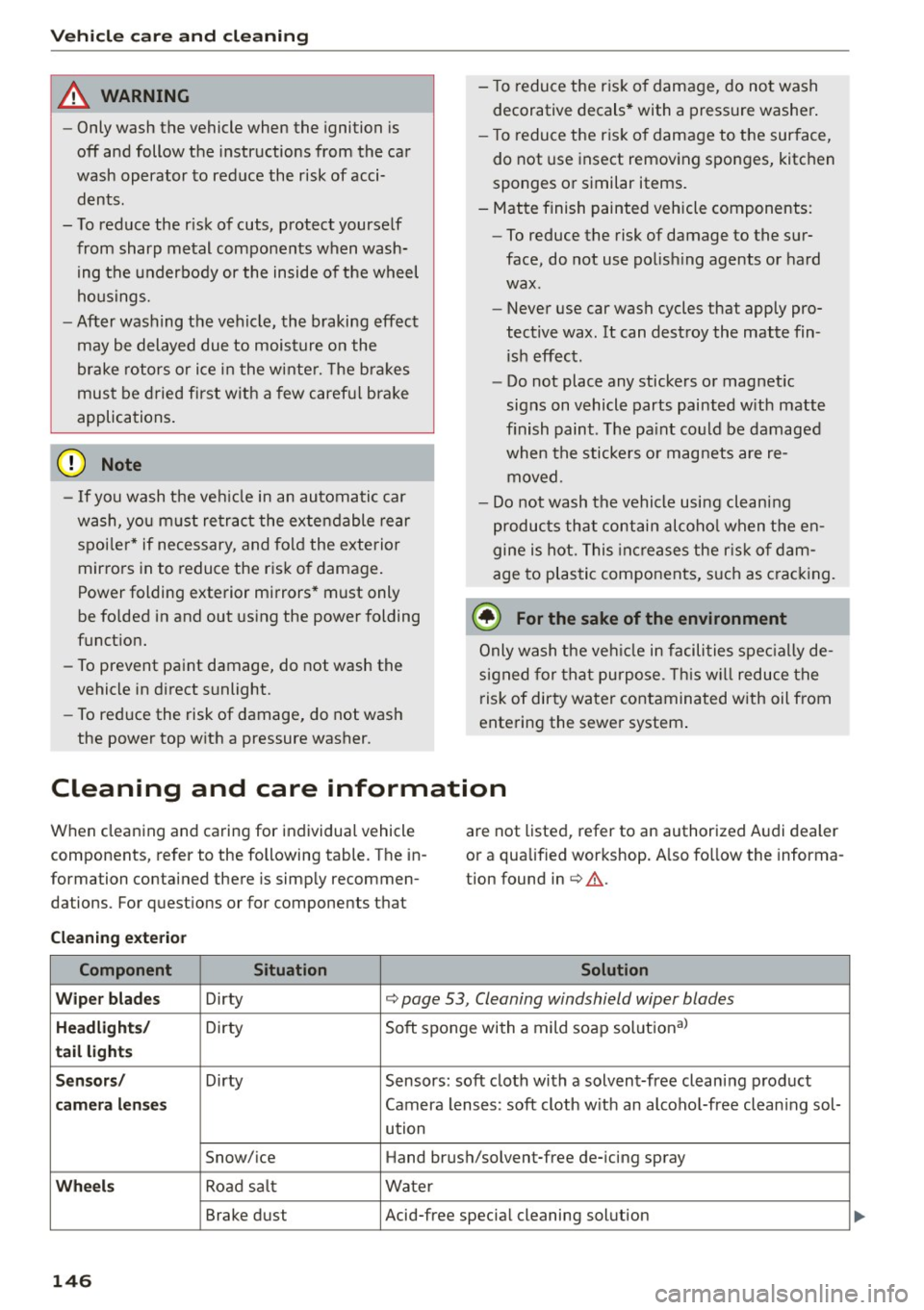
Cleaning and care information
When cleaning and caring for individual vehicle
components, refer to the following table . The in
formation contained there is simp ly recommen
dations. For questions or for components that are not listed, refer to an authorized Audi dealer
or a qualified workshop. A
lso fo llow the informa
tion found in
¢ .&. .
Cleaning exterior
Component Situation Solution
Wiper blades
Dirty ¢ page 53, Cleaning windshield wiper blades
Headlights/ Dirty Soft sponge with a mild soap solutiona>
tail lights
Sensors
/
Dirty Sensors: soft cloth with a solvent-free cleaning product
camera lenses Camera lenses: soft cloth w ith an alcoho l-free clean ing sol-
ution
Snow/ice Hand brush/solvent-free de-icing spray
Wheels Road salt Water
Brake dust Acid-free special cleaning solution
146
...
Page 149 of 232
..... N
r-N "": ..... \!) 1.1"1
N 1.1"1 .....
Vehicle care and cleaning
Component S ituation Solution
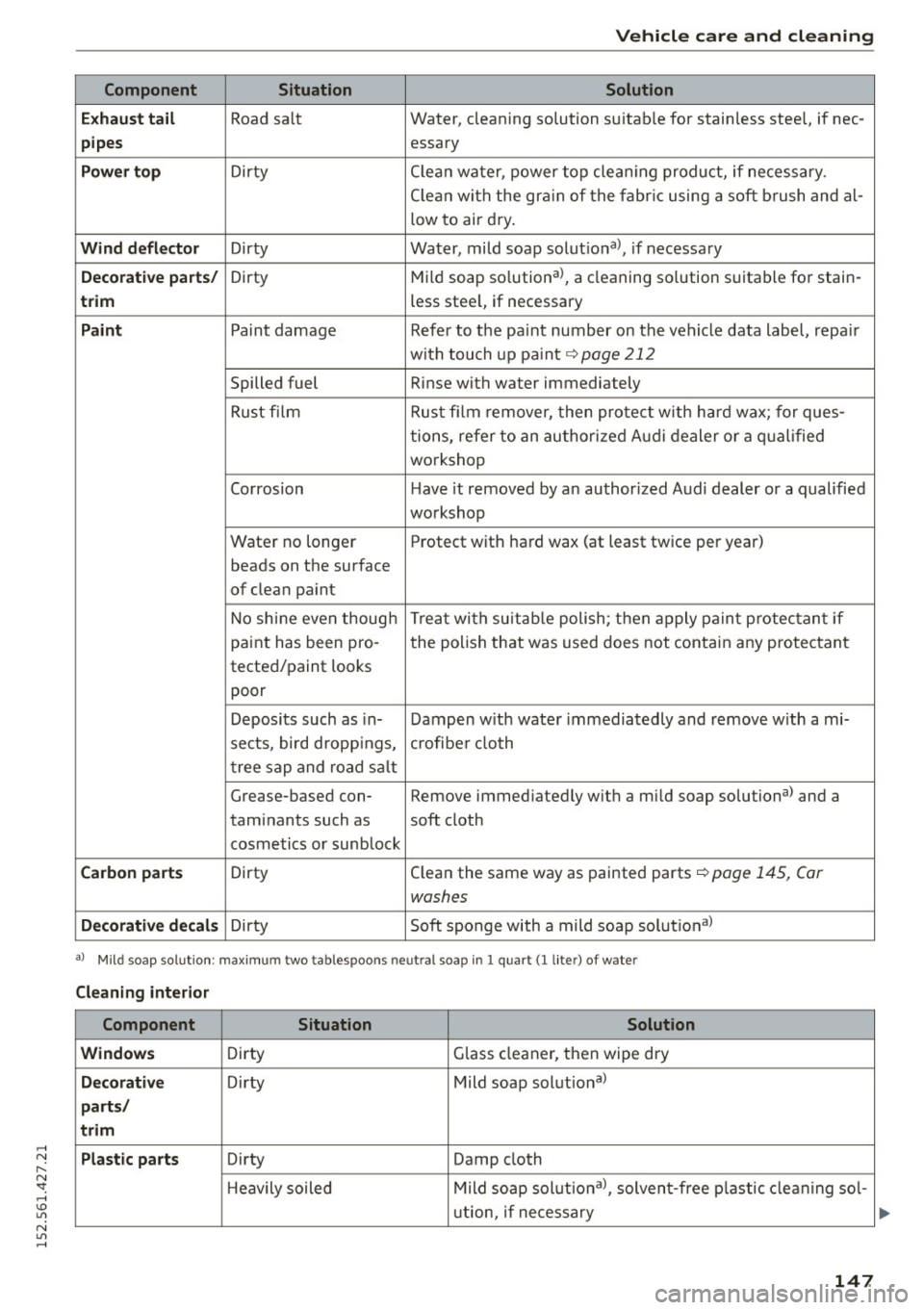
Ex haust t ail
Road sa lt Water, cleaning
solution suitable for stainless steel, if nee-
pip es essary
Power to p Dirty Clean water, power top clean ing product, if necessary .
C lean with the gra in of the fabr ic using a soft brush and al-
l ow to air d ry .
W ind d efle ct o r Dirty Water, mild soap solutiona), if necessary
Decorati ve p arts/ Dirty Mild soap solution al, a cleaning so lution suitable for stain-
trim less stee l, if necessary
P ai nt Paint damage Refer to the pa int number on the vehicle data label, repair
with touch up paint ~
page 212
Spilled fuel Rinse with water immediately
Rust fi lm Rust film remover, then protect with hard wax; for ques-
tions, refer to an authorized A udi dealer or a q ualified
workshop
Corrosion Have it removed by an authorized Audi dealer or a qualified
workshop
Water no longer Protect with hard wax (at least twice per year)
beads on the surface
of clean paint
No shine even though Treat with suitab le polish; then apply paint p rotectant if
paint has been pro- the polish that was used does not contain any protectant
tected/paint looks
poor
Deposits such as in- Dampen w ith water immediatedly and remove w ith a mi-
sects, bird dropp ings, crofibe r cloth
tree sap and road sa lt
Grease-based con-Remove immediatedly w ith a mild soap solutional and a
taminants such as soft cloth
cosmetics or sunblock
C ar bon p art s Dirty Clean the same way as painted parts~ page 145, Car
washes
D ecorativ e decal s Dirty Soft
sponge with a mild soap solutiona)
aJ Mild soap solution: max imu m two tablespo ons n eutral soap in 1 quart (I lite r) of water
Cle anin g int erior
Compon ent Situation Solution
Windo ws
Dirty
Glass cleaner, then wipe dry
Deco rative Dirty Mild soap solutional
parts/
trim
Pl as tic par ts
Dirty Damp cloth
Heavily soiled Mild soap solutional, solvent-free plastic clea ning so l-
u tion, if necessary
147
Page 150 of 232
Vehicle care and cleaning
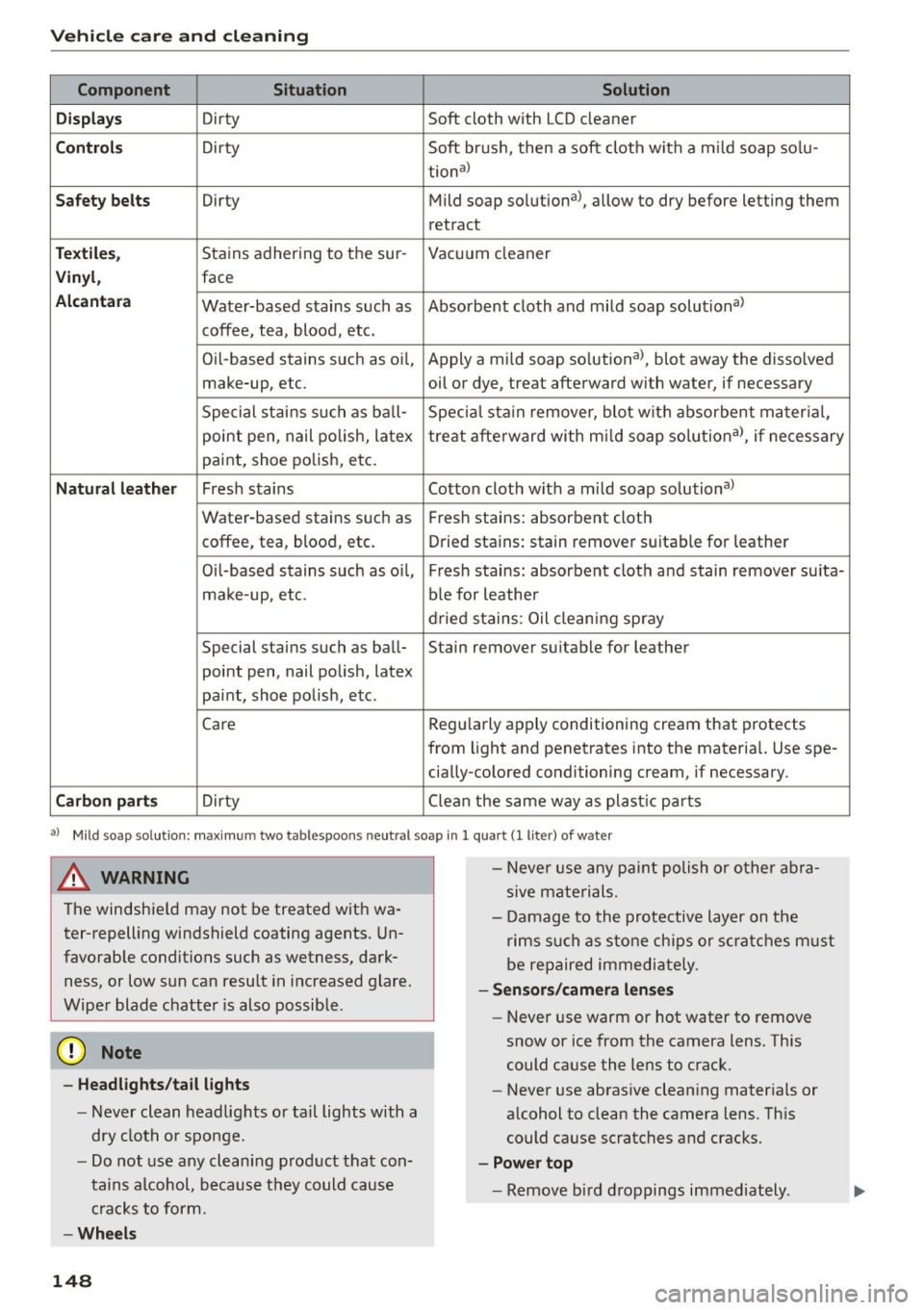
Component Situation Solution
Displays
Dirty Soft cloth with LCD cleaner
Controls Dirty Soft brush, then a soft cloth with a mild soap solu-
tional
Safety belts Dirty Mild soap solution a>, allow to dry before letting them
retr act
Textiles, Stains adhering to the sur- Vacuum cleaner
Vinyl, face
Alcantara Water-based stains such as Absorbent cloth and mild soap solutional
coffee, tea, blood, etc.
Oil-based stains such as o il, Apply a mi ld soap solutiona>, blot away the disso lved
make-up, etc. oil ori dye, treat afterward with water, if necessary
Special stains such as ball- Special stain remover, blot with absorbent material,
point pen, nail polish, latex treat afterward with mild soap solutional, if necessary
paint, shoe polish, etc.
Natural leather Fresh stains Cotton cloth with a mild soap solutional
Water-based stains such as
Fresh stains: absorbent cloth
coffee, tea, blood, etc. Dried stains: stain remover suitable for leather
Oil-based stains such as oil, Fresh stains: absorbent cloth and stain remover suita-
make-up, etc. ble for leather
dried stains: Oil cleaning spray
Special stains such as ball- Stain remover suitable for leather
point pen, nail polish, latex
paint, shoe polish, etc.
Care Reg
ula rly apply conditioning cream that protects
from light and penetrates into the materia l. Use spe-
cially-co lored conditioning cream, if necessary.
Carbon parts Dirty Clealil the same way as plastic parts
aJ Mild soap so lution: max im um two ta blespoo ns neut ral so ap in 1 quart (l lite r) of w ate r
A WARNING
Th e windshie ld may not be treated with wa
ter-repelling windshield coating agents. Un
favorable conditions such as wetness, dark
ness, or low sun ca n resu lt in increased glare.
Wiper blade chatter is also possible .
(D Note
-Headlights/tail lights
- Never clean headlights or tail lights with a
dry cloth or sponge.
- Do not use any cleaning product that con
tains alcohol, because they could cause
cracks to form.
-Wheels
148
-
- Never use any paint polish or other abra
sive materials.
- Damage to the protective layer on the
r ims such as stone chips or scratches must
be repaired immed iately.
-Sensors/camera lenses
- Never use warm or hot water to remove
snow or ice from the camera lens. This
could cause the lens to crack.
- Never use abrasive clean ing materials or
a lcohol to clean the camera lens. This
could cause scratches and cracks.
- Power top
- Remove bird droppings immediately .
Page 157 of 232
.... N
l'
N "1: .... I.O
"' N
"' ....
Checking and filling Engine compartment lid
Releasing the engine compartment lid
The engine compartment lid is released from in
side the vehicle.
~
-------- .J;
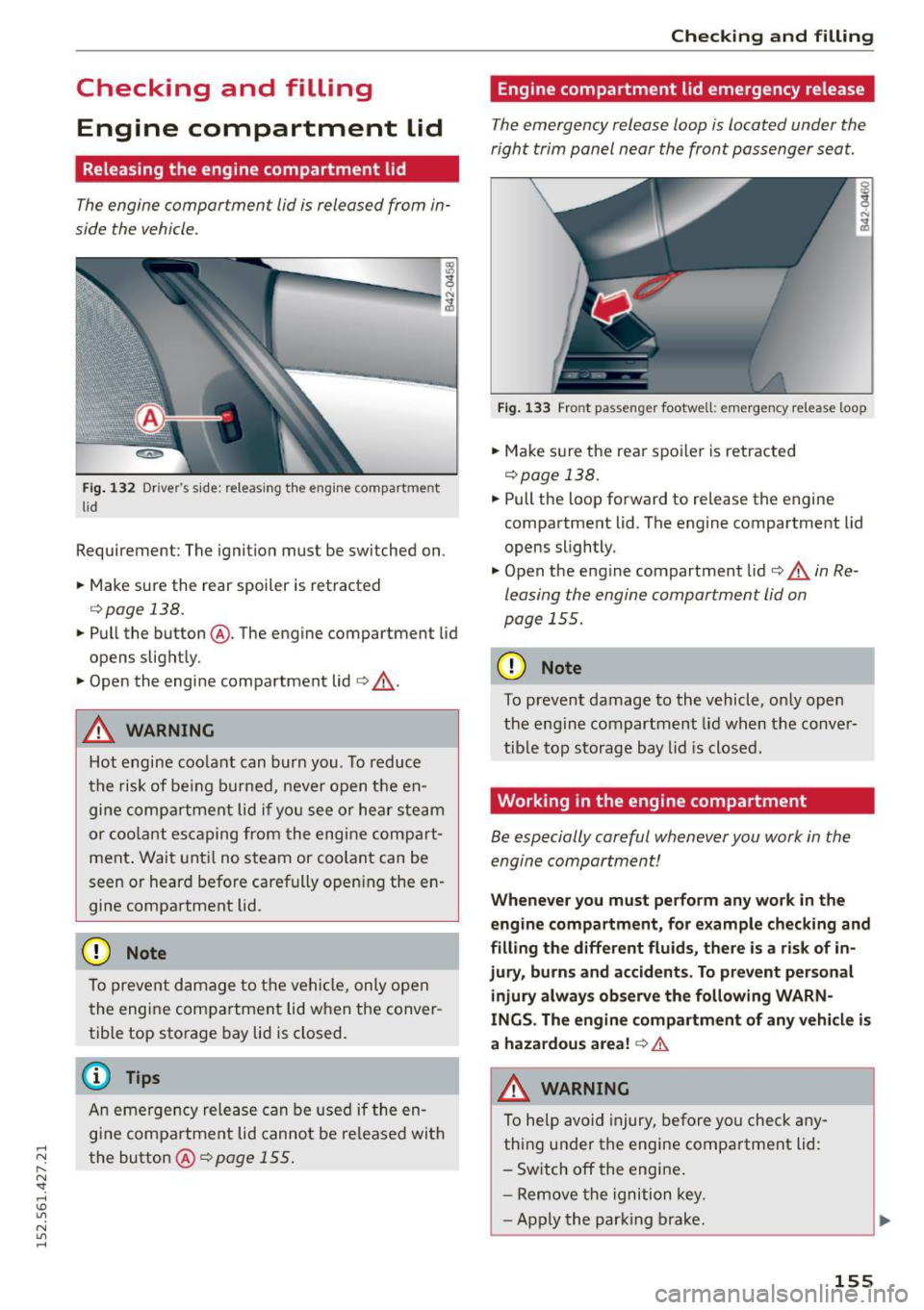
Fig. 132 Driver's side: releasing t he engine compartment
lid
Requirement: The ignition must be switched on .
" Make sure the rear spoiler is retracted
¢page 138.
"Pull the button @. The engine compartment lid
opens slight ly.
" Open the engi ne compartment lid¢_&, .
& WARNING
Hot engine coo lant can burn you. To reduce
t he risk of be ing burned, never open the en
gi ne comp artment lid i f yo u s ee or he ar s team
or cool an t es caping from the engine compart
ment . Wait unt il no steam or coo lant can be
seen or heard befo re carefully open ing the e n
gine compartment lid.
CD Note
To preve nt d amage to t he veh icle, only open
t he engine compartment lid when the conver
tible top storage bay lid is closed.
@ Tips
An emergency release can be use d if the en
gi ne compa rtment lid canno t be re leased with
the button @¢
page 155 .
-
Checking and filling
Engine compartment lid emergency release
The emergency release loop is located under the
right trim panel near the front passenger seat.
F ig . 1 33 Front passenger footwell: emerge ncy release loop
"Ma ke su re the rea r spoile r is retracted
¢page 138.
" Pull the loop forward to release the engine
compartment lid. The engine compartment lid
opens slightly.
" Open the engine compartment lid¢ &,
in Re
leasing the engine compartment lid on
page 155.
CD Note
To prevent damage to the vehicle, o nly open
the engine compartment lid when the conve r
tib le to p storage bay lid is closed.
Working in the engine compartment
Be especially careful whenever you work in the
engin e compartment!
Whenever you must perform any work in the
eng ine compartm ent, for example checking and
filling the differ ent fluid s, there is a ri sk of in
jury, burns and accident s. To prevent personal
injury alway s ob serve the following WARN
INGS . The engine compartment of any vehicle is
a hazardou s area !
c:> &.
,&. WARNING
To help avoid injury, be fore yo u check any
thing u nder the engine compartment lid:
- Sw itch off the engi ne .
- Remove the ignition key .
- Apply the par king brake.
-
155
Page 158 of 232
Checking and filling
-Move selector lever of S tronic to "N" (Neu
tral); put manual transmission in Neutral.
- Always let the engine cool down. Hot com
ponents will burn skin on contact .
- To reduce the risk of being burned, never
open the engine compartment lid if you see
or hear steam or coolant escaping from the
engine compartment. Wait until no steam
or coolant can be seen or heard before care
fully opening the engine compartment lid.
- Keep children away from the engine com
partment .
- Never spill fluids on hot engine compo
nents. They can cause a fire.
- Never open the coolant reservoir cap when
the engine is still warm . The coolant system
is pressurized and hot coolant could spray
out .
- Protect your face, hands and arm from
steam or hot engine coolant by placing a
thick rag over the cap when you open the coolant reservoir .
- Do not remove the engine cover under any
circumstances . This increases the risk of
burns.
- If work on the fuel system or the electrical
system is necessary :
- Always disconnect the battery.
- Never smoke or work near heaters or open
flames. Fluids in the engine compartment
could start a fire.
- Keep an approved fire extinguisher imme
diately available .
- To avoid electrical shock and personal injury
while the engine is running or being started,
never touch:
- Ignition cables
- Other components of the high voltage
electronic ignition system.
- If you must perform a check or repair with
the engine running:
- First, fully apply the parking brake, move
selector lever of S tronic to
"N" (Neutral);
put manual transmission in Neutral.
- Always use extreme caution to prevent
clothing, jewelry, or long hair from getting
caught in the radiator fan, V-belts or other
156
moving parts, or from contacting hot
parts. Tie back hair before starting, and
wear no clothing that will hang or droop into the engine.
- Minimize exposure to emission and chemi
cal hazards
¢ .&..
A WARNING
California Proposition 65 Warning:
- Engine exhaust, some of its constituents,
and certain vehicle components contain or
emit chemicals known to the State of Cali
fornia to cause cancer and birth defects and reproductive harm. In addition, certain flu
ids contained in vehicles and certain prod
ucts of component wear contain or emit
chemicals known to the State of California
to cause cancer and birth defects or other
reproductive harm.
- Battery posts, terminals and related acces
sories contain lead and lead compounds,
chemicals known to the State of California
to cause cancer and reproductive harms.
Wash hands after handling.
@ Note
When adding fluids, always make sure that
they are poured into the proper container or
filler opening, otherwise serious damage to
vehicle systems will occur.
@ For the sake of the environment
To detect leaks in time , inspect the vehicle
floor pan from underneath regularly. If you
see spots from oil or other vehicle fluids, have
your vehicle inspected by an authorized Audi
dealer .
· Closing the engine compartment lid
.. Make sure that the rear spoiler is retracted
¢page 138 .
.. Pull the engine compartment lid down until the
pressure from the struts is reduced.
.. Press the engine compartment lid closed
¢ _A . ..,