oil AUDI R8 SPYDER 2015 Owner's Manual
[x] Cancel search | Manufacturer: AUDI, Model Year: 2015, Model line: R8 SPYDER, Model: AUDI R8 SPYDER 2015Pages: 232, PDF Size: 58.36 MB
Page 159 of 232
.... N
l'
N "1: .... I.O
"' N
"' ....
_& WARNING
-When you close the engine compartment
lid, check it to make sure the safety catch
has properly engaged . The engine compart-
Engine compartment
Checking and filling
ment lid should be flush with the surround
ing vehicle body parts.
-If you notice while driving that the engine
compartment lid is not secured properly,
stop at once and close it.
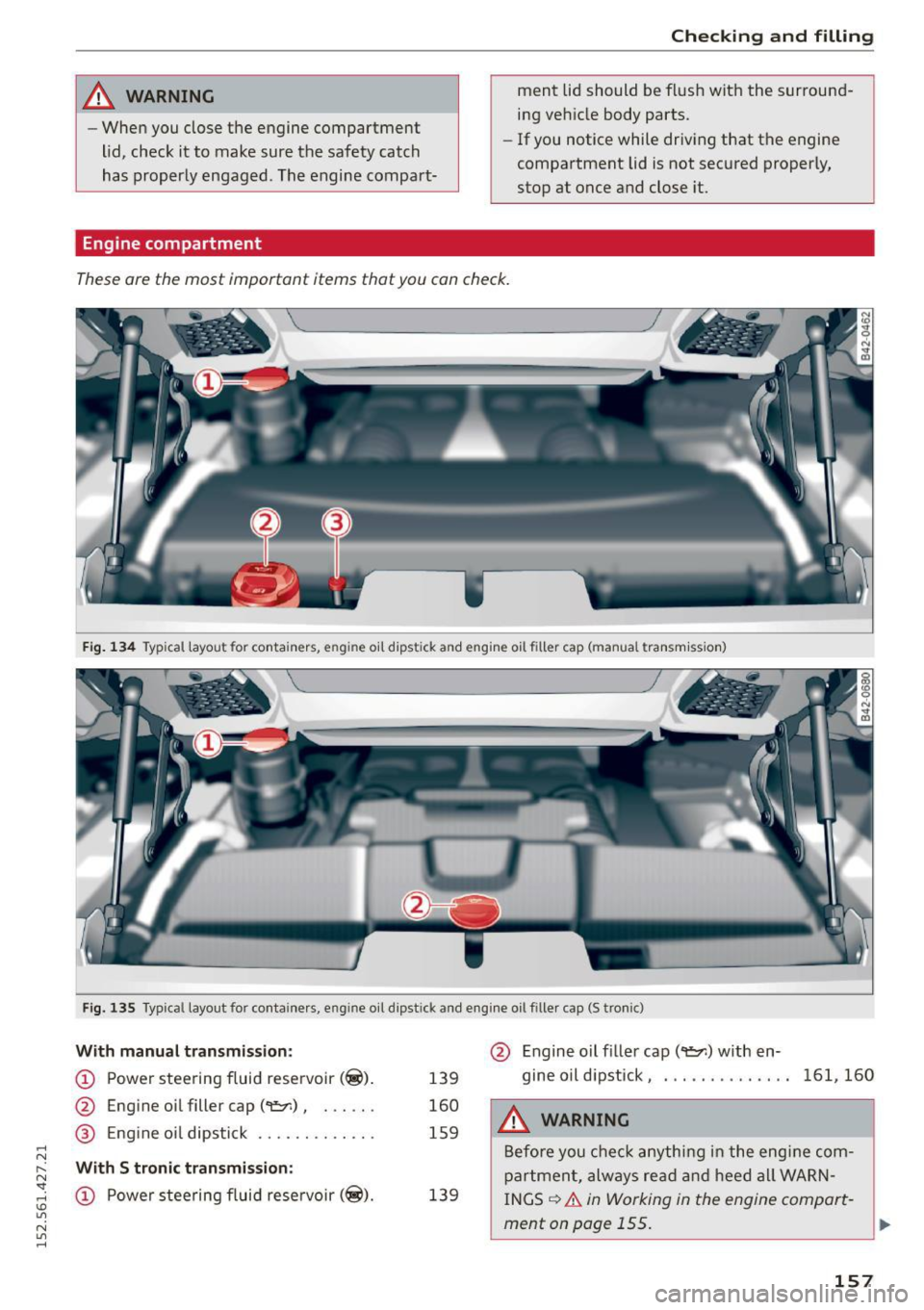
These ore the most important items that you con check.
Fig. 134 Typical l ayout for conta iners , engine oil dipst ick and engin e oil fille r cap (manual tran smis sion)
Fig. 135 Typica l layout for conta iners, engine o il dipst ick and e ng in e oil fille r cap (S tronic)
With manual transmission:
(!) Power steering fluid reservoir(@).
@ Engine oil filler cap ("1::r.) , ... .. .
@ Engin e oil dipstick ............ .
With S tronic transmission:
(!) Power steering fluid reservoir(@).
139
160
159
139
@ Engine oil filler cap ("1::r.) with en-
gine oil dipstick, ............ .. 161,160
_& WARNING
Before you check anything in the engine com
partment, always read and heed all WARN
INGS ~ .&. in Working in the engine compart-
ment on page 155. ..,.
157
Page 160 of 232
Checking and filling
(D Tips
The coolant expansion tank is located under the convertible top storage bay lid
¢page 163.
Engine oil
Engine oil specificat ions
The engine oil used must conform to exact speci
fications .
The service interval display in the instrument
cluster of your vehicle will inform you when it is
time for an oil change . We recommend that you
have your oil changed by an authorized Audi Serv
ice Advisor.
If you have to top off the oil between oil changes,
use the Audi oil quality standard specified in the
table.
Audi oil quality standard
Gasoline
VW 502 00 or
engine vw 504 00
Using the proper engine oil is important for the
functionality and service life of the engine. Your
engine was factory-filled with a high-quality oil
which can usually be used throughout the entire
year.
(D Note
Your Limited New Vehicle Warranty does not
cover damage or malfunctions due to failure
to follow recommended maintenance and use
requirements as set forth in the Audi Owner's
Manual and Warranty
& Maintenance booklet.
- Use only a high quality engine oil that ex-
pressly complies with the Audi oil quality
standard specified for your vehicle's engine .
Using any other oil can cause serious engine
damage.
- Do not mix any lubricants or other additives
into the engine oil. Doing so can cause en
gine damage.
158
(D Tips
If you need to add oil and there is none availa
ble that meets the Audi oil quality standard
your engine requires, you may add a total of
no more than 0.5 quart/liter of a high-quality
"synthetic"oil that meets the following speci
fications.
- ACEA A3 or API SM with a viscosity grade of
SAE OW-30, SAE 5W-30 or SAE 5W-40.
- For more information about engine oil that
has been approved for your vehicle, please
contact either your authorized Audi dealer
or Audi Customer Relations at
1 (800) 822-2834 or visit our web site at
www.audiusa.com or www.audicanada.ca.
Engine oil consumption
The engine in your vehicle depends on on ade
quate amount of oil to lubricate and cool all of
its moving ports.
In order to provide effective lubrication and cool
ing of internal engine components, all internal
combustion engines consume a certain amount
of oil. Oil consumption varies from engine to en
gine and may change significantly over the life of
the engine. Typically, engines with a specified break-in period (see
¢ page 142) consume more
oil during the break-in period than they consume
after oil consumption has stabili zed.
Under normal conditions , the rate of oil con
sumption depends on the quality and viscosity of
the oil, the RPM (revolutions per minute) at
which the engine is operated, the ambient tem perature and road conditions . Further factors are
the amount of oil dilution from water condensa
tion or fuel residue and the oxidation level of the
oil. As any engine is subject to wear as mileage
builds up, the oil consumption may increase over
time until replacement of worn components may
become necessary.
With all these variables coming into play, no
standard rate of oil consumption can be estab
lished or specified. There is no alternative to reg
ular and frequent checking of the oil level, see
Note.
Page 161 of 232
.... N
l'
N "1: .... I.O
"' N
"' ....
If the yellow engine oil level warning symbol in
the instrument cluster
Ell lights up, you should
check the oil leve l as soon as possible
¢ page 159. Top off the oil at your earliest con
venience
¢ page 160.
A WARNING
Before you check anything in the engine com
partment, always read and heed all WARN
INGS
¢&. in Working in the engine compart
ment on page 155.
(D Note
Dr iving with an insufficient oil level is like ly to
cause severe damage to the engine.
@ Tips
- The oil pressure warning display. is not
an indicator of the oil l evel. Do not rely on
it . Instead, check the oil l evel in your en
gine at regular interval s, pref erably each
time y ou refu el, and alway s before going
o n a long trip .
- If
you have the imp ression your e ngine co n
s u mes ex cess ive amo unts of o il, we re com
mend tha t you cons ult yo ur A udi dealer to
have the cause of your concern properly di
agnosed. Keep in mind that the accurate measurement of oil consumpt ion requires
great care and may take some time. Your
A udi dealer has instructions about how to
measure oil consumpt ion accurately.
Checking the engine oil level
Ap plies to vehicles: with ma nual transmission
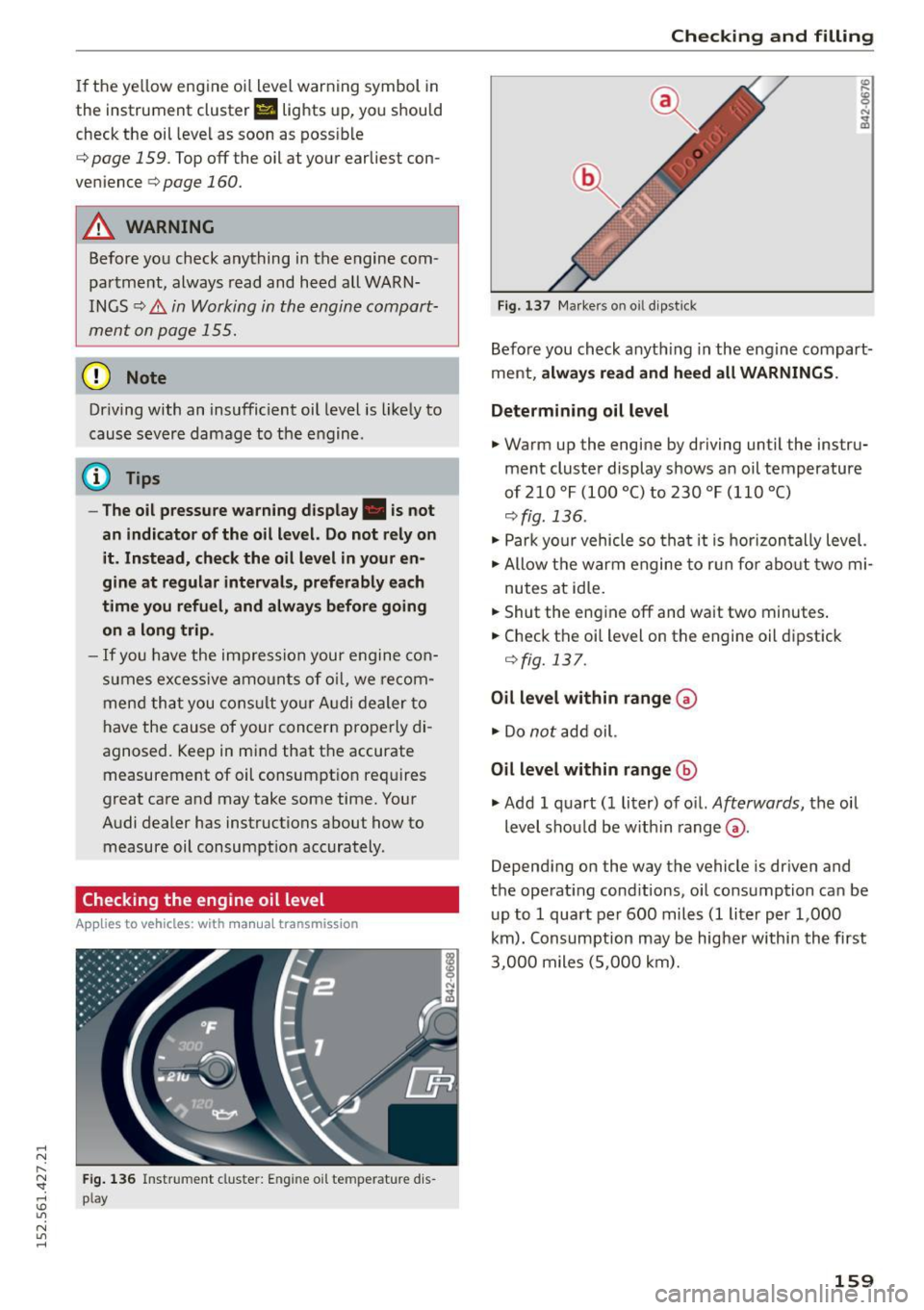
F ig . 1 36 Ins trument cluste r: Engine oil temperature dis
p lay
Chec king and filling
Fig. 137 Ma rke rs on oi l d ipst ick
Before you ch eck a nyth ing in the engine compart
ment,
alwa ys read and h eed all WARNINGS .
Determin ing
oil level
.,. Warm up the engine by driving until the instru
ment cluste r display shows an oil temperature
of 210 °F (100 °C) to 230 °F (110 °C)
¢ fig. 136 .
.,. Park your vehicle so tha t it is hor izon tally level.
.,. Allow t he warm engine to r un fo r abo ut two mi
nutes at idle.
.. Shut the engine off and wait two minutes .
.. Check the oil level on the engine oil dipst ick
¢fig. 137.
Oil level within range (v
.,. Do not add oil.
Oil level within range@
.,. Add 1 quart (1 liter) of o il. Afterwards, the oil
level shou ld be w ith in range
G) .
Depend ing on the way the vehicle is driven and
the operat ing cond itions, oil consumption ca n be
u p to 1 quart per 600 miles(! liter per 1,000
km). Consumption may be higher withi n th e first
3,0 00 miles (5,000 km) .
159
Page 162 of 232
Checking and filling
Checking the engine oil level
App lies to veh icles: w ith S tro nic
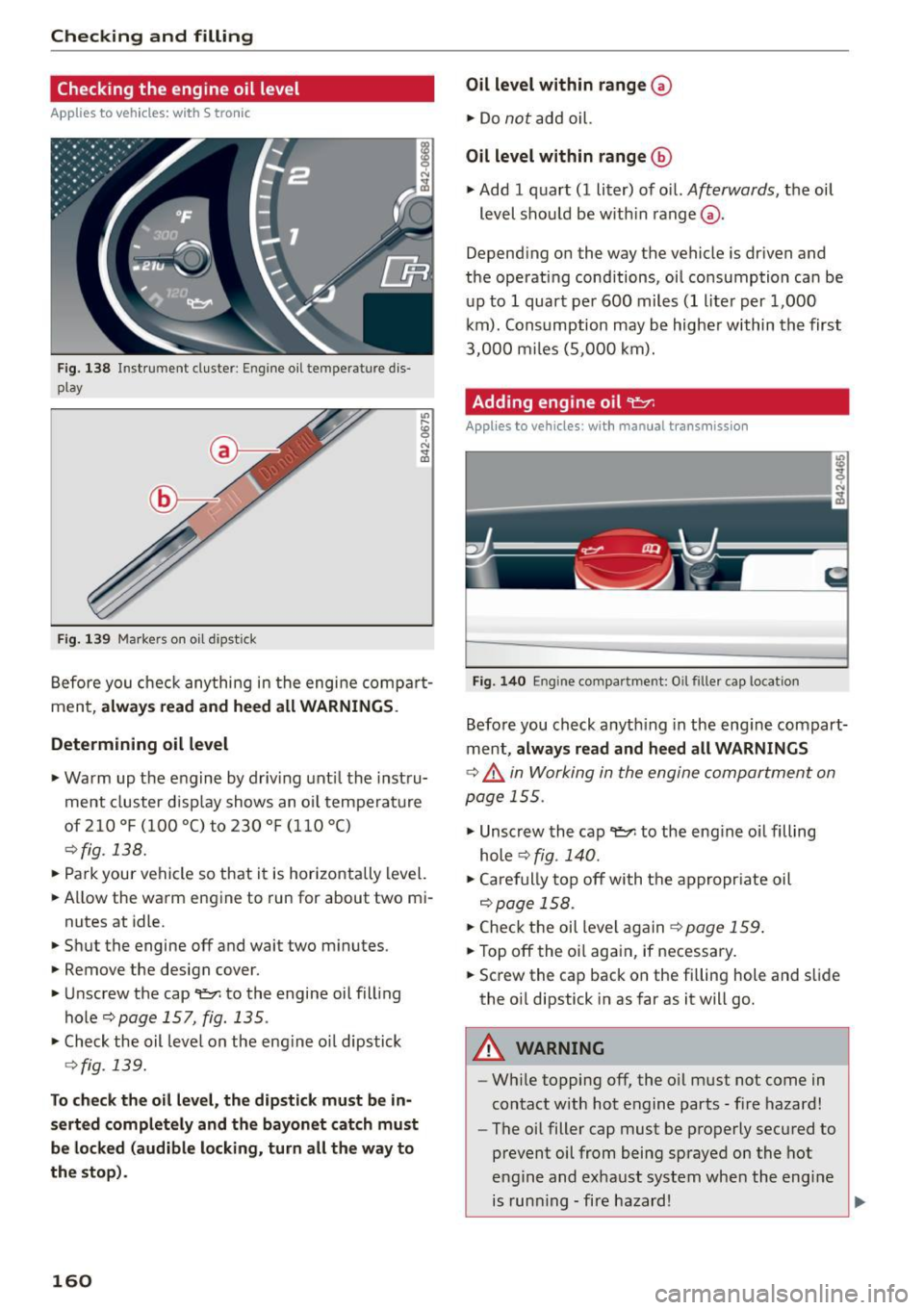
Fig. 138 Inst rumen t cl uste r: Eng ine oil temperature dis
play
Fig. 139 Markers on o il dipstic k
Before you check anything in the engine compart
ment,
always read and heed all WARNINGS .
Determining oil level
• Warm up the engine by driv ing until the inst ru
ment cluster display shows an o il temperature
of 210 ° F (100 °C) to 230 ° F (110 °C)
¢fig. 138.
"Park your vehicle so that it is horizonta lly level.
• Allow the warm engine to run for about two mi-
nutes at idle.
• Shut the engine off and wait two minutes.
• Remove the design cover.
" Unscrew the cap
'l:::,-: to the engine oil fil ling
hole¢
page 157, fig . 135 .
• Check the oil level on the engine oil dipstick
¢ fig . 139.
To check the oil level, the dipstick must be in
serted completely and the bayonet catch must
be locked (audible locking, turn all the way to
the stop).
160
Oil level within range (v
" Do not add oil.
Oil level within range@
• Add 1 quart (1 liter) of o il. A~erwards, the oil
level should be w ithin range
(v .
Depending on the way the vehicle is driven and
the operating cond itions, oil consumption can be
up to 1 quart per 600 miles (1 liter per 1,000
km). Consumption may be higher within the first
3,000 miles (5,000 km).
Adding engine oil~
Applies to vehicles: wi th manual t rans miss ion
Fig . 140 Engine compartment: Oil fille r cap location
Befo re you check anyth ing in the eng ine compart
ment,
always read and heed all WARNINGS
¢ .&. in Working in the engine compartment on
page 155.
"Unscrew the cap ce:;,, to the eng ine oi l filling
hole ¢
fig. 140 .
"Carefully top off with the appropriate oil
<=)page 158.
"Check the oil level again ¢ page 159 .
"Top off the oil again, if necessary.
" Screw the cap back on the filling hole and slide
the oi l dipstick in as far as it will go.
A WARNING
- Wh ile topping off, the o il must not come in
contact with hot engine parts - f ire hazard!
- The oil filler cap must be properly secured to
prevent oil from being sprayed on the hot
engine and exhaust system when the engine
is runn ing - fire hazard! .,._
Page 163 of 232
-If your skin has come in contact with the en
gine oil, you must subsequently cleanse it
thoroughly.
0 Note
- The oil level must not be above range
¢ page 159, fig. 137 0-danger of convert
er or engine damage! Contact an authorized
Audi dealer to draw off oil, if necessary.
- Audi does not recommend the use of oil ad
ditives. They may damage the engine and
adversely affect your New Vehicle Warranty.
@ For the sake of the environment
- Under no circumstances can the oil come in
contact with the sewage network or the soil.
- Observe and follow legal regu lations when
disposing of empty oil containers.
Adding engine oil~
Applies to vehicles: with S tron ic
0 N
-N
~
"' a,
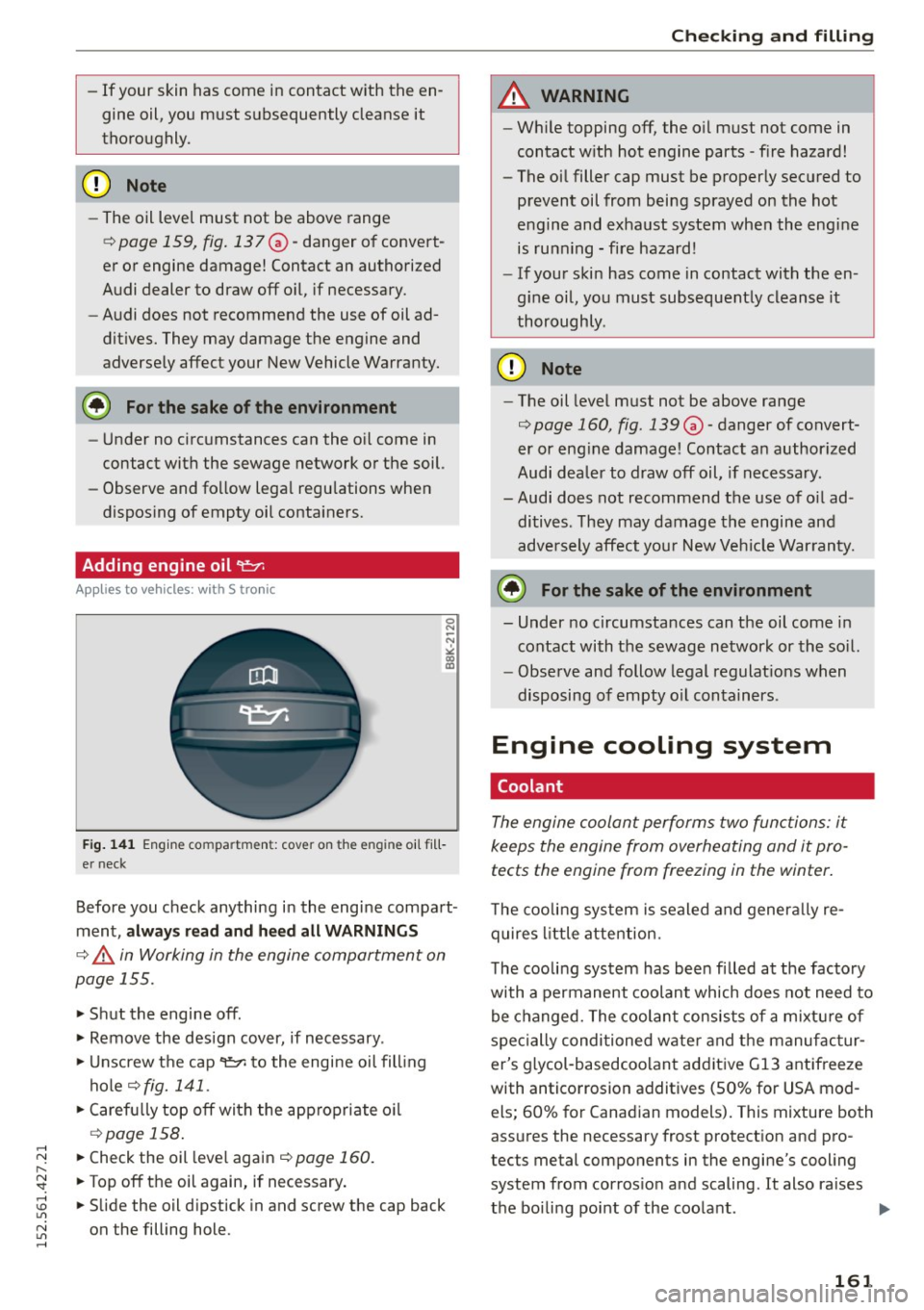
F ig . 141 Engin e co mp artm en t: cove r on t he engin e oil fi ll
er neck
Before you check anything in the engine compart
ment,
always read and heed all WARNINGS
¢.&. in Working in the engine compartment on
page 155.
.,. Shut the engine off .
.. Remove the design cover, if necessary .
.,. Unscrew the cap
'l=?1 to the engine oil fill ing
hole ¢
fig. 141 .
.. Carefully top off with the appropriate o il
¢page 158.
.. Check the oil level again ¢ page 160.
.. Top off the oil again, if necessary .
.. Slide the oil dipstick in and screw the cap back
on the filling hole.
Chec king and filling
A WARNING
- While topping off, the oil must not come in
contact with hot engine parts -fire hazard!
- The oil filler cap must be properly secured to
prevent oil from being sprayed on the hot
engine and exhaust system when the engine
is running -fire hazard!
- If your skin has come in contact with the en
g ine oil, you must subsequently cleanse it
thoroughly .
(D Note
-The oil level must not be above range
¢ page 160, fig . 139 0 -danger of convert
er or eng ine damage! Contact an author ized
Audi dea ler to draw off oil, if necessary.
- Audi does not recommend the use of oil ad
ditives . They may damage the engine and
adversely affect you r New Vehicle Warranty.
@ For the sake of the environment
- Under no circumstances can the oil come in
contact with the sewage network or the soil.
- Observe and follow legal regulations when
disposing of empty o il containers .
Engine cooling system
Coolant
The engine coolant performs two functions: it
keeps the engine from overheating and it pro
tects the engine from freezing in the winter.
T he coo ling system is sealed and genera lly re
quires little attention.
The cooling system has been filled at the factory
with a permanent coolant which does not need to
be changed. The coolant consists of a mixtu re of
specially conditioned wate r and the manufactur
er's glycol-basedcoolant additive Gl3 antifreeze
with anticorrosion additives (50% for USA mod els; 60% for Canadian models). This mixture both
assures the necessary frost protection and pro
tects metal components in the engine's cooling
system from corrosio n and scaling. It also ra ises
the boiling point of the coolant .
1111-
161
Page 165 of 232
..... N
r-N "': ..... \!) ..,.,
N ..,., .....
"' Press and ho ld the rear window switch too unti l
the convertible top moves into the service posi
t ion
r::!) fig. 142.
Opening th e cool ant e xp ansi on tank cov er
"' Stop the engine and allow it to coo l.
"' Switch the ignition off.
"' Carefu lly remove the bolts in the cover(!) using
a screwdriver and remove the cover. The cool
ant reservoir is located be low
c:> fig. 143 .
Check ing th e engine coolant l eve l
"' Place a rag or cloth on the cap of the coo lant
expansion tank and turn the cap
ca re full y to
the left (counter-clockwise)
c:> A .
"'Read the coo lant level inside the coolant expan
s ion tank
c:> fig . 143. With a co ld engine, it
must be above the "min" mark. W ith a hot en
gine, it can be a little above the ind icated
range .
To obtain an accurate read ing, the eng ine must
be switched off.
The expansion tank in your vehicle is equipped
with an electric coolant level sensor
r::!) page 14.
We still recommend you check the coolant level
from time to time .
Coolant lo ss
Coolant loss may indicate a leak in the cooling
system . In the event of coolant loss, the cooling
system should be inspected immediately by your
author iz ed Audi dealer. It is not enough merely
to add coolant.
In a
s e a led system, losses can occur only if the
boiling point of the coo lant is exceeded as a re
sult of overheat ing.
A WARNING
- The cooling system is under pressure. Do
not open the cap of the coolant expans ion
tank when the engine is hot. You risk being
sca lded.
-
- The coolant add itive, and therefore the cool
ant itself, is hazardous to health. Keep the
c oolant additive in the or igina l co ntainer out
of the re ach of children.
It is a poison haz
ard.
Ch eck ing and fillin g
(D Note
Do not add any type of radiator leak sea lant
to your vehicle's engine coolant . Add ing radia
tor repair fluid may adversely affect the func
tion and performance of your cooling system
and could result in damage not covered by
your New Veh icle Limited Warranty.
Adding coolant
Befo re you check a nyth ing in the eng ine compart
ment,
alwa ys read and he ed all WARNING S
r::!) A in Working in the engine compartment on
page 155.
"' Add coolant m ixed in the correct rat io
c:> page 161, Coolant.
"' Twist the cap on again tightly.
"'Tighten the cap(!) <::!)page 162, fig. 143 again .
Replacement engine coo lant must conform to ex
act specifications
c:> page 161, Coolant .
We recommend using only coolant add it ive Gl2+
+, G l3
or in an emergency Gl2 +. Do not use a
different additive. In an emergency use pla in wa
ter unt il you ca n get the correct add itive and can
restore the co rrect ratio . This should be done as
soon as possib le .
If you have los t a considerab le amount of cool
ant, then you shou ld add cold antifreeze and cold
water only when the engine is co ld .
Always use
new engine coo lant when refilling .
Do not fill coolant above the "max" mark. Excess
coolant will be forced out through the pressure
relief valve in the cap when the eng ine becomes
hot.
A WARNING
- The cooling system is under pressure and
can get very hot. Reduce the risk of scalding
from hot coolant by following these steps .
- Turn off the engine and allow it to cool
down .
- Protect your face, hands and arms from escaping fluid and steam by covering the
cap with a large, thick rag.
163
Page 166 of 232
Checking and filling
-Turn the cap slowly and very carefully in a
counter-clockwise direction while applying
light, downward pressure on the top of
the cap .
- To avoid being burned, do not spill anti
freeze or coolant on the exhaust system or hot engine parts. Under certain condi
tions, the ethylene glycol in engine cool
ant can catch fire .
- Antifreeze is poisonous. Always store anti
freeze in its original container and well out of the reach of children .
- If you drain the coolant, it must be caught
and safely stored in a proper container
clearly marked "poison".
CD Note
-Coolant pollutes the environment and could
cause an engine fire . Excess coolant will be
forced out through the pressure relief valve
in the cap when the engine becomes hot.
-If, in an emergency, only water can be add
ed, the correct ratio between water and an
tifreeze
¢ page 161 must be restored as
soon as possible.
@ For the sake of the environment
Drained coolant should not be reused. Always
dispose of used coolant while observing all
environmental regulations.
Brake fluid
Have the brake fluid changed by an experienced
technician.
Brake fluid absorbs moisture from the air. If the
water content in the brake fluid is too high, cor
rosion in the brake system may result after a peri
od of time. The boiling point of the brake fluid
will also decrease considerably and decrease
braking performance.
Therefore, the brake fluid must be changed
every
two years.
Always use new brake fluid which con
forms to Federal Motor Vehicle Standard "FMVSS
116 DOT 4".
164
Brake fluid is replaced according to the Audi
maintenance service schedule . Your authorized
Audi dealer is equipped with the necessary spe
cial tools and replacement parts, has the neces
sary expertise, and can dispose of the used fluid .
A WARNING
-Brake fluid is poisonous . It must be stored
only in the closed original container out of
the reach of children!
- Brake failure can result from old or inappro priate brake fluid. Observe these precau
tions:
- Use only brake fluid that meets SAE speci
fication
J 1703 and conforms to Federal
Motor Vehicle Standard
116. Always check
with your authorized Audi dealer to make
sure you are using the correct brake fluid .
The correct type of brake fluid is also indi cated on the brake fluid reservoir.
- The brake fluid must be new . Heavy use of
the brakes can cause a vapor lock if the brake fluid is left in the system too long.
This can seriously affect the efficiency
of
the brakes as well as your safety . This
could result in an accident.
CD Note
Brake fluid will damage the paint of your vehi
cle.
@ For the sake of the environment
Because of the problem of proper disposal of
brake fluid as well as the special tools re
quired and the necessary expertise, we rec
ommend that you have the brake fluid
changed by your authorized Audi dealer.
Battery
General information '
Your vehicle is equipped with a special battery, an
ACM battery . This battery is located in the lug
gage compartment and must be replaced with an
original equipment battery. Under normal oper
ating conditions, the battery is
maintenance-
free. ..,_
Page 171 of 232
.... N
Tires and wheels
Tires
General notes
Tires may be the least appreciat
ed and most abused parts of a
motor vehicle.
Tires may be the least appreciated
and most abused parts of a motor
veh ic le . Tires are, however, one of
the most important parts of ave
hicle, particularly considering the
comparatively small patch of rub
ber on each tire that assu res that
all-important contact between
you, your vehicle and the road .
Maintain ing the correct t ire pres
sure, making sure that your vehi
c le and its tires do not have to
carry more weight than they can
safe ly handle, avoiding damage
from road hazards and regularly inspecting tires for damage in
c luding cuts, slashes i rregular
wear and overall condition are the most important th ings that you
can do to help avo id sudden tire
failure including tread separation
and blowouts.
Avoiding damage
~ If you have to dr ive over a curb or ":
~ similar obstacle, drive very s lowly
N U'> .....
Tir es a nd whe els
and as close as possible at a right
ang le to the curb.
Always keep chemicals including
grease, oil, gasoline and brake
fluid off the tires. Inspect the tires regularly fo r
damage (cuts, cracks or blisters ,
etc.) . Remove any foreign bodies
embedded in the treads.
Storing tires
Mark tires when you remove them
to indicate the direction of rota
tion. This ensures you to be able
to mount them correctly when
you reinstall them.
When removed, the w heels or
tires sho uld be stored in a coo l,
dry and preferably dark place.
Store tires in a vertical position if
they are not mounted on rims, in
a horizon tal position if they are
mounted on rims .
New tires
New tires have to be broken in
¢,&.
The tread depth of new tires may
vary, according to the type and make of tire and the tread pa t
tern.
1 69
...
Page 174 of 232
Tires and wheels
Cold tire infl ation pre ssure
means the tire pressure recom
mended by the vehicle man ufac
turer for a tire of a designated
size that has not been driven fo r
more than a couple of miles (kilo
meters) at low speeds in the three
hour period before the tire pres
sure is measured or adjusted .
Curb weight
means the weight of a motor ve
hicle with standard equipment in
cluding the maximum capacity of
fuel, oil, and coolant, air condi
tioning and additiona l weight of
optional equipment.
E x tra load tire
means a tire designed to operate
at higher loads and at higher in
flation pressures than the corre sponding standard tire. Extra load
tires my be identified as "XL",
"xl ", "EXTRA LOAD", or "RF" on
the sidewall.
Gross Axle Weight Rating ("GAWR" )
means the load-carrying capacity
of a single axle system, measured
at the tire -ground interfaces.
1 72
Gross Vehicle Weight Rating
("GVWR")
means the maximum total loaded
weight of the vehicle.
Groove
means the space between two ad
jacent tread ribs.
Load rating (code )
means the maximum load that a
tire is rated to carry for a given in
flation pressure . You may not find
this information on all tires be
cause it is not required by law .
Maximum load rating
means the load rating for a tire at
the maximum permissible infla
tion pressure for that tire .
Maximum loaded vehicle
weight
means the sum of :
(a) Curb weight
(b) Accessory weight
(c) Vehicle capacity weight, and
(d) Production options weight
Ma ximum (permissible )
inflation pressure
means the maximum cold infla
tion pressure to which a tire may be inflated. A lso called "maxi-
mum inflation pressure ." .,.
Page 185 of 232
.... N
" N ": ... IO "? N U'> .....
technically referred to as the vehi
cle's
Gross Vehicle We ight Rating
("GVWR") .
The "GVWR" includes the weight
of the basic vehicle, all factory in
stalled accessories, a full tank of
fuel, oil, coolant and other fluids plus maximum load. The maxi
mum load includes the number of
passengers that the vehicle is in
tended to carry ("seating capaci
ty") with an assumed weight of
150 lbs. (68 kg) for each passen
ger at a designated seating posi
tion and the total weight of any
luggage in the vehicle.
The
Gross Axle Weight Rating
("GAWR") is the maximum load
that can be applied at each of the
vehicle's two axles .
The Gross Vehicle Weight Rating and the Gross Axle Weight Rating
are listed on the safety compli
ance sticker label located on the
driver's side B-pillar. Your Audi
has 2 seating positions . Each
seating position has a safety belt
¢ page 95, Safety belts.
The fact that there is an upper
limit to your vehicle's Gross Vehi
cle Weight Rating means that the
total weight of whatever is being
Tires and wheels
carried in the vehicle is limited.
The more passengers in the vehi
cle or passengers who are heavier
than the standard weights as
sumed mean that less weight can
be carried as luggage.
The tire pressure label on your
Audi also lists the maximum com
bined weight of all of the occu
pants and luggage or other cargo
that the vehicle can carry. For the location of the label¢
page 176,
fig. 147.
A WARNING
-
Overloading a vehicle can cause
loss of vehicle control, a crash
or other accident, serious per
sonal injury, and even death.
-Carrying more weight than
your vehicle was designed to
carry will prevent the vehicle
from handling properly and in
crease the risk of the loss of
vehicle control.
-The brakes on a vehicle that has been overloaded may not be able to stop the vehicle
within a safe distance .
-Tires on a vehicle that has been overloaded can fail sud
denly, including a blowout and •
183