oil level AUDI R8 SPYDER 2015 User Guide
[x] Cancel search | Manufacturer: AUDI, Model Year: 2015, Model line: R8 SPYDER, Model: AUDI R8 SPYDER 2015Pages: 232, PDF Size: 58.36 MB
Page 160 of 232
Checking and filling
(D Tips
The coolant expansion tank is located under the convertible top storage bay lid
¢page 163.
Engine oil
Engine oil specificat ions
The engine oil used must conform to exact speci
fications .
The service interval display in the instrument
cluster of your vehicle will inform you when it is
time for an oil change . We recommend that you
have your oil changed by an authorized Audi Serv
ice Advisor.
If you have to top off the oil between oil changes,
use the Audi oil quality standard specified in the
table.
Audi oil quality standard
Gasoline
VW 502 00 or
engine vw 504 00
Using the proper engine oil is important for the
functionality and service life of the engine. Your
engine was factory-filled with a high-quality oil
which can usually be used throughout the entire
year.
(D Note
Your Limited New Vehicle Warranty does not
cover damage or malfunctions due to failure
to follow recommended maintenance and use
requirements as set forth in the Audi Owner's
Manual and Warranty
& Maintenance booklet.
- Use only a high quality engine oil that ex-
pressly complies with the Audi oil quality
standard specified for your vehicle's engine .
Using any other oil can cause serious engine
damage.
- Do not mix any lubricants or other additives
into the engine oil. Doing so can cause en
gine damage.
158
(D Tips
If you need to add oil and there is none availa
ble that meets the Audi oil quality standard
your engine requires, you may add a total of
no more than 0.5 quart/liter of a high-quality
"synthetic"oil that meets the following speci
fications.
- ACEA A3 or API SM with a viscosity grade of
SAE OW-30, SAE 5W-30 or SAE 5W-40.
- For more information about engine oil that
has been approved for your vehicle, please
contact either your authorized Audi dealer
or Audi Customer Relations at
1 (800) 822-2834 or visit our web site at
www.audiusa.com or www.audicanada.ca.
Engine oil consumption
The engine in your vehicle depends on on ade
quate amount of oil to lubricate and cool all of
its moving ports.
In order to provide effective lubrication and cool
ing of internal engine components, all internal
combustion engines consume a certain amount
of oil. Oil consumption varies from engine to en
gine and may change significantly over the life of
the engine. Typically, engines with a specified break-in period (see
¢ page 142) consume more
oil during the break-in period than they consume
after oil consumption has stabili zed.
Under normal conditions , the rate of oil con
sumption depends on the quality and viscosity of
the oil, the RPM (revolutions per minute) at
which the engine is operated, the ambient tem perature and road conditions . Further factors are
the amount of oil dilution from water condensa
tion or fuel residue and the oxidation level of the
oil. As any engine is subject to wear as mileage
builds up, the oil consumption may increase over
time until replacement of worn components may
become necessary.
With all these variables coming into play, no
standard rate of oil consumption can be estab
lished or specified. There is no alternative to reg
ular and frequent checking of the oil level, see
Note.
Page 161 of 232
.... N
l'
N "1: .... I.O
"' N
"' ....
If the yellow engine oil level warning symbol in
the instrument cluster
Ell lights up, you should
check the oil leve l as soon as possible
¢ page 159. Top off the oil at your earliest con
venience
¢ page 160.
A WARNING
Before you check anything in the engine com
partment, always read and heed all WARN
INGS
¢&. in Working in the engine compart
ment on page 155.
(D Note
Dr iving with an insufficient oil level is like ly to
cause severe damage to the engine.
@ Tips
- The oil pressure warning display. is not
an indicator of the oil l evel. Do not rely on
it . Instead, check the oil l evel in your en
gine at regular interval s, pref erably each
time y ou refu el, and alway s before going
o n a long trip .
- If
you have the imp ression your e ngine co n
s u mes ex cess ive amo unts of o il, we re com
mend tha t you cons ult yo ur A udi dealer to
have the cause of your concern properly di
agnosed. Keep in mind that the accurate measurement of oil consumpt ion requires
great care and may take some time. Your
A udi dealer has instructions about how to
measure oil consumpt ion accurately.
Checking the engine oil level
Ap plies to vehicles: with ma nual transmission
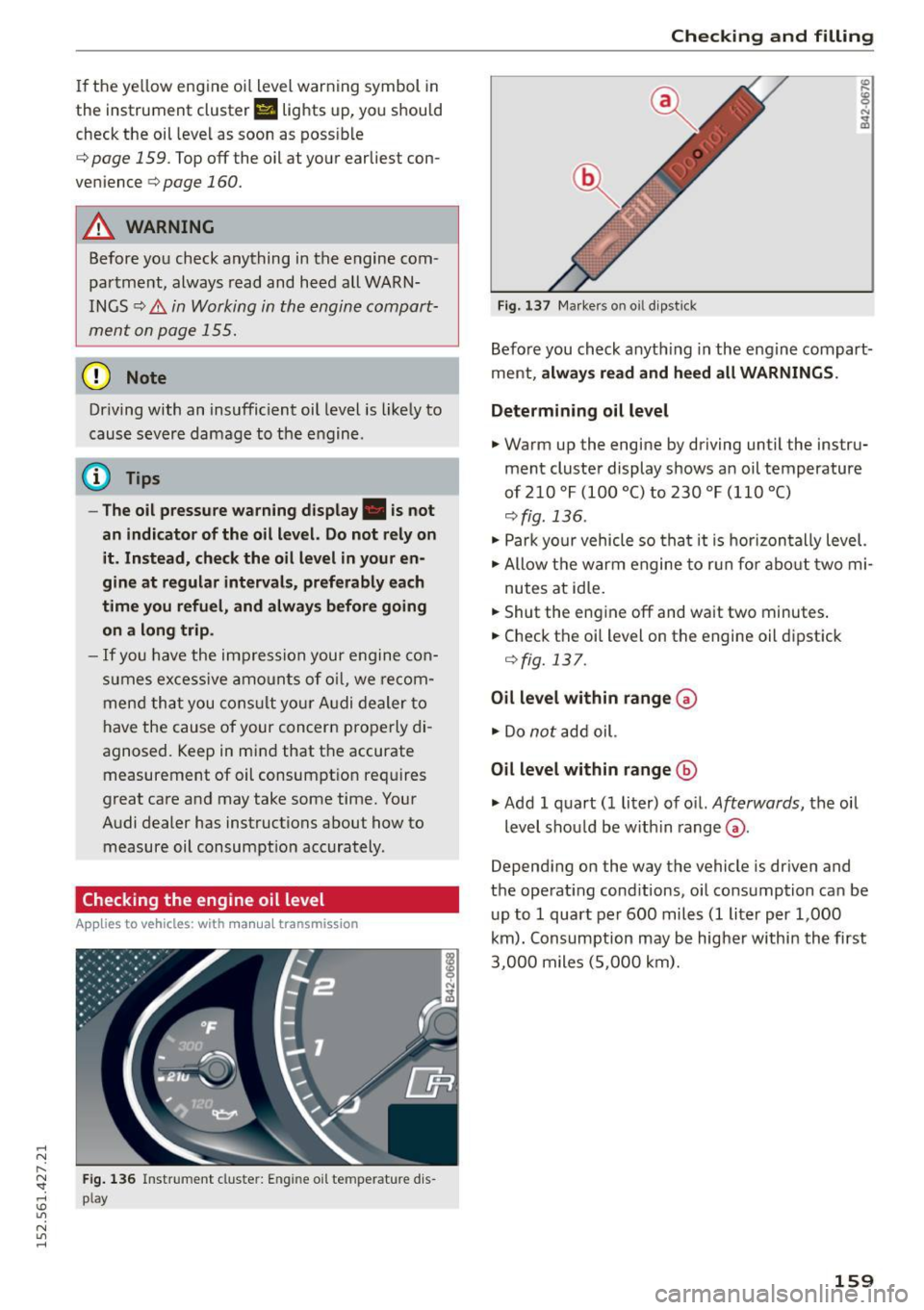
F ig . 1 36 Ins trument cluste r: Engine oil temperature dis
p lay
Chec king and filling
Fig. 137 Ma rke rs on oi l d ipst ick
Before you ch eck a nyth ing in the engine compart
ment,
alwa ys read and h eed all WARNINGS .
Determin ing
oil level
.,. Warm up the engine by driving until the instru
ment cluste r display shows an oil temperature
of 210 °F (100 °C) to 230 °F (110 °C)
¢ fig. 136 .
.,. Park your vehicle so tha t it is hor izon tally level.
.,. Allow t he warm engine to r un fo r abo ut two mi
nutes at idle.
.. Shut the engine off and wait two minutes .
.. Check the oil level on the engine oil dipst ick
¢fig. 137.
Oil level within range (v
.,. Do not add oil.
Oil level within range@
.,. Add 1 quart (1 liter) of o il. Afterwards, the oil
level shou ld be w ith in range
G) .
Depend ing on the way the vehicle is driven and
the operat ing cond itions, oil consumption ca n be
u p to 1 quart per 600 miles(! liter per 1,000
km). Consumption may be higher withi n th e first
3,0 00 miles (5,000 km) .
159
Page 162 of 232
Checking and filling
Checking the engine oil level
App lies to veh icles: w ith S tro nic
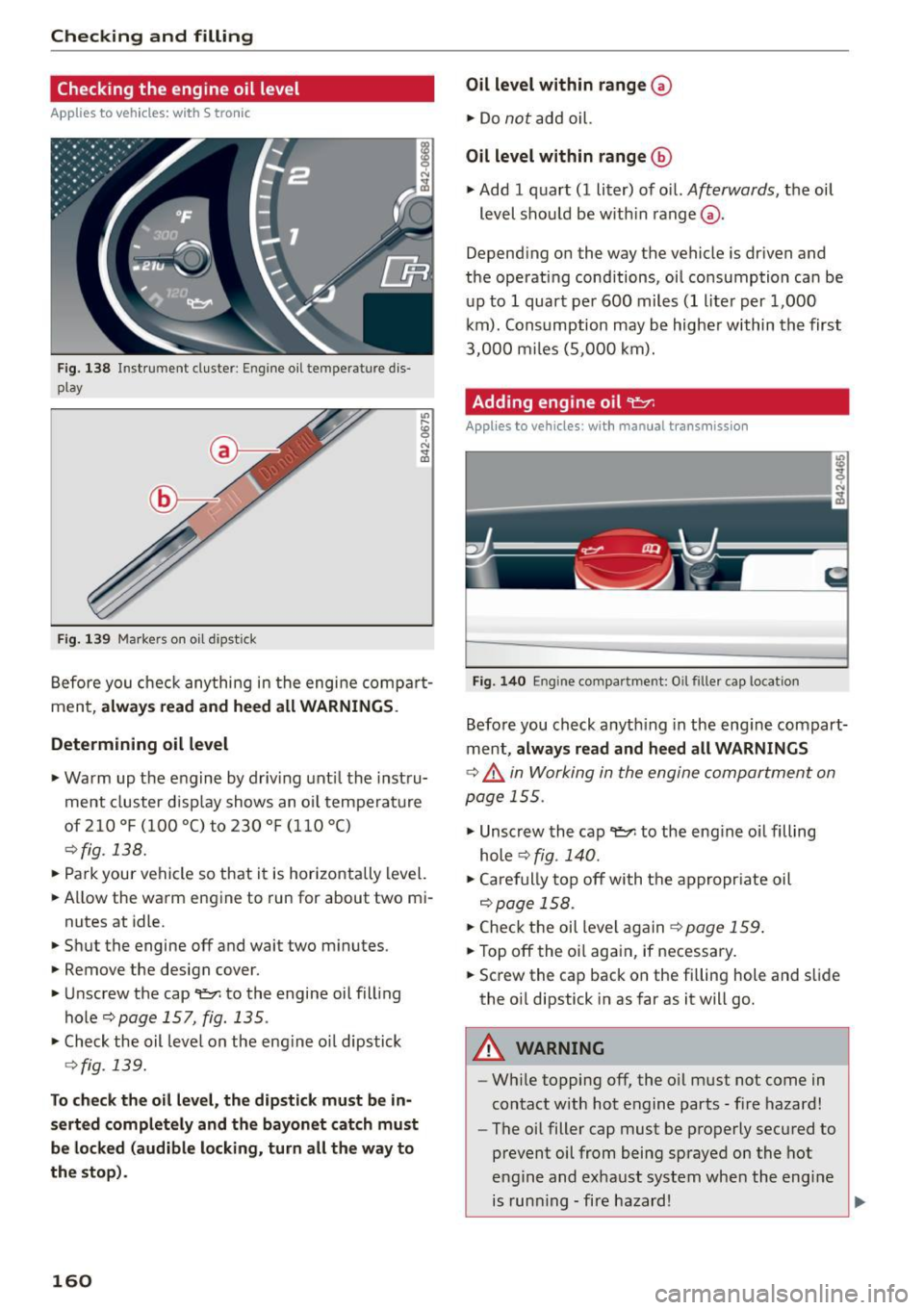
Fig. 138 Inst rumen t cl uste r: Eng ine oil temperature dis
play
Fig. 139 Markers on o il dipstic k
Before you check anything in the engine compart
ment,
always read and heed all WARNINGS .
Determining oil level
• Warm up the engine by driv ing until the inst ru
ment cluster display shows an o il temperature
of 210 ° F (100 °C) to 230 ° F (110 °C)
¢fig. 138.
"Park your vehicle so that it is horizonta lly level.
• Allow the warm engine to run for about two mi-
nutes at idle.
• Shut the engine off and wait two minutes.
• Remove the design cover.
" Unscrew the cap
'l:::,-: to the engine oil fil ling
hole¢
page 157, fig . 135 .
• Check the oil level on the engine oil dipstick
¢ fig . 139.
To check the oil level, the dipstick must be in
serted completely and the bayonet catch must
be locked (audible locking, turn all the way to
the stop).
160
Oil level within range (v
" Do not add oil.
Oil level within range@
• Add 1 quart (1 liter) of o il. A~erwards, the oil
level should be w ithin range
(v .
Depending on the way the vehicle is driven and
the operating cond itions, oil consumption can be
up to 1 quart per 600 miles (1 liter per 1,000
km). Consumption may be higher within the first
3,000 miles (5,000 km).
Adding engine oil~
Applies to vehicles: wi th manual t rans miss ion
Fig . 140 Engine compartment: Oil fille r cap location
Befo re you check anyth ing in the eng ine compart
ment,
always read and heed all WARNINGS
¢ .&. in Working in the engine compartment on
page 155.
"Unscrew the cap ce:;,, to the eng ine oi l filling
hole ¢
fig. 140 .
"Carefully top off with the appropriate oil
<=)page 158.
"Check the oil level again ¢ page 159 .
"Top off the oil again, if necessary.
" Screw the cap back on the filling hole and slide
the oi l dipstick in as far as it will go.
A WARNING
- Wh ile topping off, the o il must not come in
contact with hot engine parts - f ire hazard!
- The oil filler cap must be properly secured to
prevent oil from being sprayed on the hot
engine and exhaust system when the engine
is runn ing - fire hazard! .,._
Page 163 of 232
-If your skin has come in contact with the en
gine oil, you must subsequently cleanse it
thoroughly.
0 Note
- The oil level must not be above range
¢ page 159, fig. 137 0-danger of convert
er or engine damage! Contact an authorized
Audi dealer to draw off oil, if necessary.
- Audi does not recommend the use of oil ad
ditives. They may damage the engine and
adversely affect your New Vehicle Warranty.
@ For the sake of the environment
- Under no circumstances can the oil come in
contact with the sewage network or the soil.
- Observe and follow legal regu lations when
disposing of empty oil containers.
Adding engine oil~
Applies to vehicles: with S tron ic
0 N
-N
~
"' a,
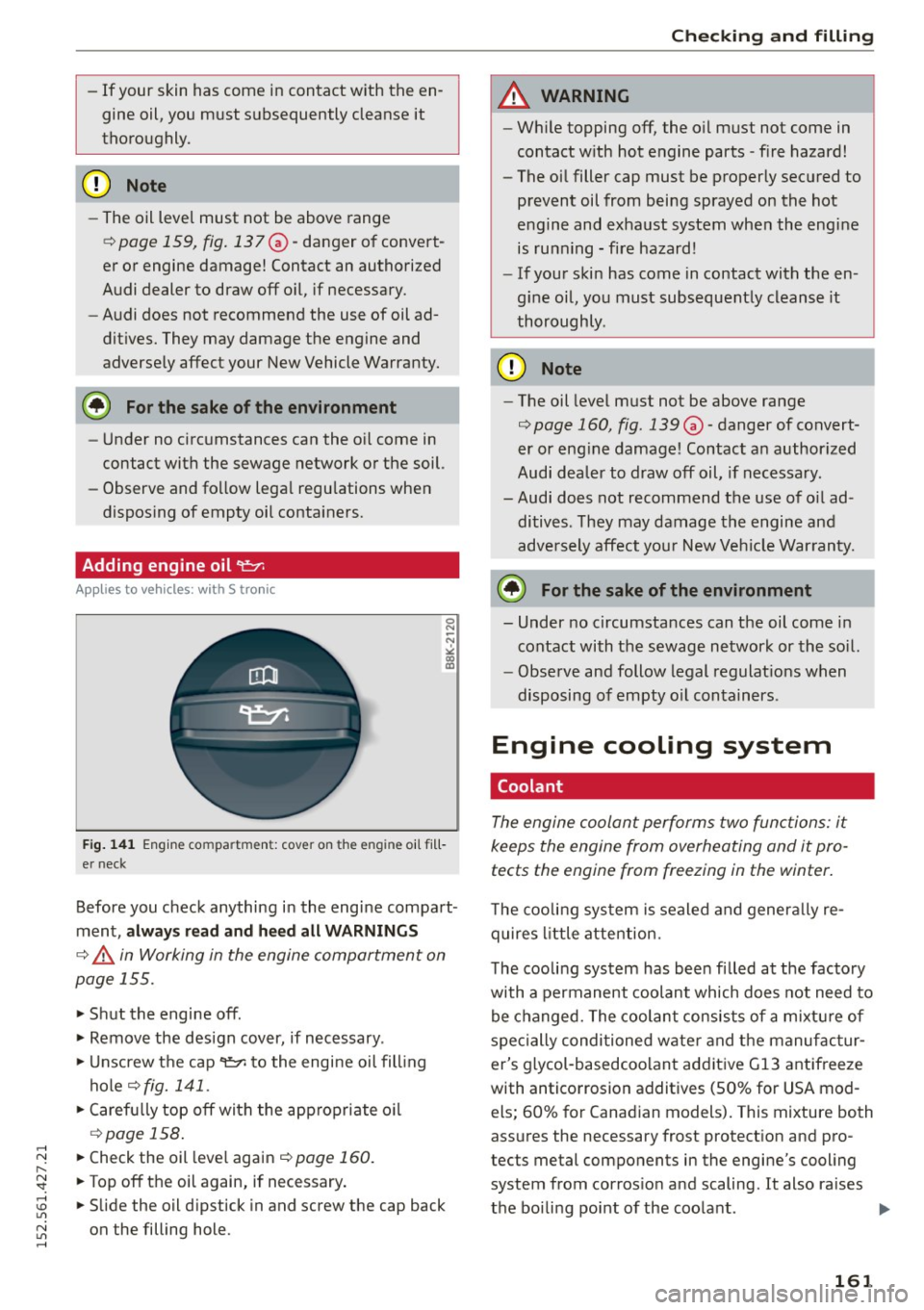
F ig . 141 Engin e co mp artm en t: cove r on t he engin e oil fi ll
er neck
Before you check anything in the engine compart
ment,
always read and heed all WARNINGS
¢.&. in Working in the engine compartment on
page 155.
.,. Shut the engine off .
.. Remove the design cover, if necessary .
.,. Unscrew the cap
'l=?1 to the engine oil fill ing
hole ¢
fig. 141 .
.. Carefully top off with the appropriate o il
¢page 158.
.. Check the oil level again ¢ page 160.
.. Top off the oil again, if necessary .
.. Slide the oil dipstick in and screw the cap back
on the filling hole.
Chec king and filling
A WARNING
- While topping off, the oil must not come in
contact with hot engine parts -fire hazard!
- The oil filler cap must be properly secured to
prevent oil from being sprayed on the hot
engine and exhaust system when the engine
is running -fire hazard!
- If your skin has come in contact with the en
g ine oil, you must subsequently cleanse it
thoroughly .
(D Note
-The oil level must not be above range
¢ page 160, fig . 139 0 -danger of convert
er or eng ine damage! Contact an author ized
Audi dea ler to draw off oil, if necessary.
- Audi does not recommend the use of oil ad
ditives . They may damage the engine and
adversely affect you r New Vehicle Warranty.
@ For the sake of the environment
- Under no circumstances can the oil come in
contact with the sewage network or the soil.
- Observe and follow legal regulations when
disposing of empty o il containers .
Engine cooling system
Coolant
The engine coolant performs two functions: it
keeps the engine from overheating and it pro
tects the engine from freezing in the winter.
T he coo ling system is sealed and genera lly re
quires little attention.
The cooling system has been filled at the factory
with a permanent coolant which does not need to
be changed. The coolant consists of a mixtu re of
specially conditioned wate r and the manufactur
er's glycol-basedcoolant additive Gl3 antifreeze
with anticorrosion additives (50% for USA mod els; 60% for Canadian models). This mixture both
assures the necessary frost protection and pro
tects metal components in the engine's cooling
system from corrosio n and scaling. It also ra ises
the boiling point of the coolant .
1111-
161
Page 165 of 232
..... N
r-N "': ..... \!) ..,.,
N ..,., .....
"' Press and ho ld the rear window switch too unti l
the convertible top moves into the service posi
t ion
r::!) fig. 142.
Opening th e cool ant e xp ansi on tank cov er
"' Stop the engine and allow it to coo l.
"' Switch the ignition off.
"' Carefu lly remove the bolts in the cover(!) using
a screwdriver and remove the cover. The cool
ant reservoir is located be low
c:> fig. 143 .
Check ing th e engine coolant l eve l
"' Place a rag or cloth on the cap of the coo lant
expansion tank and turn the cap
ca re full y to
the left (counter-clockwise)
c:> A .
"'Read the coo lant level inside the coolant expan
s ion tank
c:> fig . 143. With a co ld engine, it
must be above the "min" mark. W ith a hot en
gine, it can be a little above the ind icated
range .
To obtain an accurate read ing, the eng ine must
be switched off.
The expansion tank in your vehicle is equipped
with an electric coolant level sensor
r::!) page 14.
We still recommend you check the coolant level
from time to time .
Coolant lo ss
Coolant loss may indicate a leak in the cooling
system . In the event of coolant loss, the cooling
system should be inspected immediately by your
author iz ed Audi dealer. It is not enough merely
to add coolant.
In a
s e a led system, losses can occur only if the
boiling point of the coo lant is exceeded as a re
sult of overheat ing.
A WARNING
- The cooling system is under pressure. Do
not open the cap of the coolant expans ion
tank when the engine is hot. You risk being
sca lded.
-
- The coolant add itive, and therefore the cool
ant itself, is hazardous to health. Keep the
c oolant additive in the or igina l co ntainer out
of the re ach of children.
It is a poison haz
ard.
Ch eck ing and fillin g
(D Note
Do not add any type of radiator leak sea lant
to your vehicle's engine coolant . Add ing radia
tor repair fluid may adversely affect the func
tion and performance of your cooling system
and could result in damage not covered by
your New Veh icle Limited Warranty.
Adding coolant
Befo re you check a nyth ing in the eng ine compart
ment,
alwa ys read and he ed all WARNING S
r::!) A in Working in the engine compartment on
page 155.
"' Add coolant m ixed in the correct rat io
c:> page 161, Coolant.
"' Twist the cap on again tightly.
"'Tighten the cap(!) <::!)page 162, fig. 143 again .
Replacement engine coo lant must conform to ex
act specifications
c:> page 161, Coolant .
We recommend using only coolant add it ive Gl2+
+, G l3
or in an emergency Gl2 +. Do not use a
different additive. In an emergency use pla in wa
ter unt il you ca n get the correct add itive and can
restore the co rrect ratio . This should be done as
soon as possib le .
If you have los t a considerab le amount of cool
ant, then you shou ld add cold antifreeze and cold
water only when the engine is co ld .
Always use
new engine coo lant when refilling .
Do not fill coolant above the "max" mark. Excess
coolant will be forced out through the pressure
relief valve in the cap when the eng ine becomes
hot.
A WARNING
- The cooling system is under pressure and
can get very hot. Reduce the risk of scalding
from hot coolant by following these steps .
- Turn off the engine and allow it to cool
down .
- Protect your face, hands and arms from escaping fluid and steam by covering the
cap with a large, thick rag.
163
Page 218 of 232
Consumer Information
scope of maintenance and repairs which can be
carried out by vehicle owners .
Also , sa fety and
en vironment al
concerns place very str ict limits
on the nature of repa irs and adjustments to en
g ine and transmission parts which an owner can
perform .
Maintenance, adjustments and repairs usually re
qu ire spec ia l tools, testing devices and other
equ ipment available to specially tra ined work
shop personnel in order to assure proper per
formance, reliab ility and safety of the vehicle and
its many systems .
Improper maintenance, adjustments and repairs
can impair the operation and reliability of your
veh icle and eve n void your vehicle warranty .
Therefore, proof of servicing in acco rdance with
the ma intenance sched ule may be a condition fo r
upho ld ing a possible wa rranty claim made w ith in
the wa rranty per iod .
Above all, operational safety can be adversely af
fected, creating unnecessary risks fo r you and
your p assengers .
If in doubt about any se rv ici ng, have it done by
your author ized Audi dealer or any other properly
equ ipped and qualified workshop. We st ro ngly
urge you to give yo ur au thori zed Audi dealer the
opport unity to perform all schedu led mainte
nance and necessary repairs. Your dealer has the
facilities, original parts and trained specialists to
keep yo ur vehicle runn ing proper ly.
Performing limited mainten ance yourself
The fo llow ing pages describe a lim ited number o f
p roced ures which can be performed on you r vehi
cle with ordinary tools, sho uld the need a rise and
trained personne l be unavailab le. Before per
forming any of these procedures, always thor
oughly read all of the applicable text and careful
ly follow the instructions g iven. A lways rigorously
observe the
WARNINGS prov ided .
Before you check anything in the engine com
partment , always read and heed all WARNINGS
c> & and c> & in Working in the engine compart
ment on page 155.
216
A WARNING
-
-Ser ious personal in jury may occur as a result
of improperly performed maintenance, ad
justments o r repai rs.
- Always be extremely careful when work ing
on the vehicle . Always follow commonly ac
cepted safety pract ices and general com
mo n sense. Never r is k pe rsonal i njury.
- Do not attempt any of the mainte nance,
checks or repairs described on the following
pages if you a re not fully familiar with these
or other procedures w it h respect to the ve hi
cle, or are unce rtain how to proceed .
- Do not do any work wi thout the proper tools
an d eq uipment. H ave the necessary work
done by your au thorized Audi dealer o r an
other prope rly equippe d an d qua lified work
shop .
- Always remove the ignition key befo re any
one gets under the vehicle.
- Always support your veh icle with safety
stands if it is necessary to work underneath
the vehicle. The jack * is not adequate for
this purpose and co uld collapse causing se
r ious personal in jury.
- If you must wor k unde rneath the vehicle
w it h the wheels on t he gro und, a lways make
sure the vehicle is on level ground, that the
wheels are a lways securely blocked and that
the engine cannot be started .
- Always make sure the transmission selector
lever is in "N" (N eutral) (5 tronic) or Neutral
(ma nual transm iss ion) and the hand brake is
fi rm ly applied.
@ For the sake of the environment
- Cha ng ing the engine settings will adve rsely
affect emiss ion levels. This is detrimental to
the environment a nd increases fuel con
s u mption.
- Always observe environmenta l reg ulations
when dispos ing of old engine oil, used brake
fluid, dirty eng ine coolan t, spent ba tter ies
or worn ou t tires.
Page 224 of 232
Index
Eme rgency r elease
Fr ont lid . . . . . . . . . . . . . . . . . . . . . . . . . . . . 33
Park ing lock . . . . . . . . . . . . . . . . . . . . . . . . .
79
Eme rgency sta rting . . . . . . . . . . . . . . . . . . . 206
Eme rgency towing . . . . . . . . . . . . . . . . . . . . 208
Energy management . . . . . . . . . . . . . . . . . . 14 0
Batte ry power . . . . . . . . . . . . . . . . . . . . . . 14 1
Driver notification . . . . . . . . . . . . . . . . . . . 141
Eng ine
Coolan t . . . . . . . . . . . . . . . . . . . . . . . . . . . .
16 1
Data . ... .... .. ... .. ..... ... .. .. ... 214
Eng ine compartment lid . . . . . . . . . . . . . .
155
Starting . . . . . . . . . . . . . . . . . . . . . . . . . 66, 67
Stopping . . . . . . . . . . . . . . . . . . . . . . . . . . . . 68
Engine compartmen t . . . . . . . . . . . . . . . . . . 15 7
Safety instructions . . . . . . . . . . . . . . . . . . . 155
Engine compa rtment lid
Closing . . . . . . . . . . . . . . . . . . . . . . . . . . . .
1 56
Release lever . . . . . . . . . . . . . . . . . . . . . . . 155
Engine coolant system . . . . . . . . . . . . . . . . . 161
Malfunct io n . . . . . . . . . . . . . . . . . . . . . . . . . 14
Temperature ga uge . . . . . . . . . . . . . . . . . . . . 9
En gine oi l . . . . . . . . . . . . . . . . . . . . . . . . . . .
158
Adding .. .. .. .. ............. .. . 160,161
Addit ives. . . . . . . . . . . . . . . . . . . . . . .
160, 161
Checking the eng ine oi l level . . . . . . . 159, 160
Dry s ump lubr ication . . . . . . . . . . . . . . . . . 139
Indications and cond it ions requ iring ext ra
checking . . . . . . . . . . . . . . . . . . . . . . .
159, 160
O il c ons umption . . . . . . . . . . . . . . . . . . . . . 1 58
O il grades . . . . . . . . . . . . . . . . . . . . . . . . . . 15 8
Specification and viscos ity . . . . . . . . . . . . . 158
Temperature disp lay . . . . . . . . . . . . . . . . . . . 8
E ngi ne oi l level . . . . . . . . . . . . . . . . . . . . . . . . 17
Engine oil pressure (malfunction) . . . . . . . . . 14
Engine oi l sensor defective . . . . . . . . . . . . . .
17
Engine speed limitat ion . . . . . . . . . . . . . . . . . 17
E nvironment
Cataly tic converter . . . . . . . . . . . . . . . . . . .
142
Disposing of your vehicle batte ry . . . . . . . 165
Fue l . . . . . . . . . . . . . . . . . . . . . . . . . . . . . . . 153
Unleaded f uel ..................... .. 15 1
What should I do wi th an old batte ry? . . . 16 5
EPC
refer to Electronic power control . . . . . . . . 16
ESC (Electronic Stabilization Co ntro l)
Warning/indicator lights . . . . . . . . . . . . . . .
15
222
Event Data Recorde r (ED R) . . . . . . . . . . . . . . 134
Exhaust tail pipes Cleaning . . . . . . . . . . . . . . . . . . . . . . . . . . . 14 7
Expansion tank . . . . . . . . . . . . . . . . . . . . . . .
162
Exterior m irrors
Adjusting . . . . . . . . . . . . . . . . . . . . . . . . . . .
49
Dimming . ... .... .. .. .. .. .. .... ... .. . 50
Heating... ...... .. ............... .. . 49
F
Fan ..... .... . .. .. .. .. ... .. ..... ... .. . 62
Faste ning
Boos ter sea ts . . . . . . . . . . . . . . . . . . . . . . .
128
Convertib le child sa fety se ats . . . . . . . . . . 12 7
Infant seats
Flat bed truck
Flat tire 127
208
Changi ng . . . . . . . . . . . . . . . . . . . . . . . . . . 203
Floor mats . . . . . . . . . . . . . . . . . . . . . . . . . . . . 90
Fo ld ing master key with remo te control . . . . 27
Foot peda ls . . . . . . . . . . . . . . . . . . . . . . . . . . .
90
Fo r the sake of the environment
Gasoline fumes and t he env ironme nt . . . . 153
Letting yo ur eng ine warm up . . . . . . . . . . .
67
Ref ueling . . . . . . . . . . . . . . . . . . . . . . . . . . 153
Front a irbags
Des cription . . . . . . . . . . . . . . . . . . . . . . . . .
106
How they wor k . . . . . . . . . . . . . . . . . . . . . . 110
Frontal collis io ns and the laws of phys ics . . . 96
Front lid
Emergency release . . . . . . . . . . . . . . . . . . . . 33
light . . . . . . . . . . . . . . . . . . . . . . . . . . . . . . .
49
Power locking system . . . . . . . . . . . . . . . . . 32
Trunk escape handle . . . . . . . . . . . . . . . . . 199
Front passenger
refer to Seating position . . . . . . . . . . . . 87, 88
Front seat s . . . . . . . . . . . . . . . . . . . . . . . . . . . 56
Child rest rain ts in the fron t seat . . . . . . . . 103
Front towi ng loop . . . . . . . . . . . . . . . . . . . . . 208
Fuel
Additives.. .. .... .. .. .. ......... .. ..
151
B lended gasoline . . . . . . . . . . . . . . . . . . . . 151
Current fuel mileage . . . . . . . . . . . . . . . . . . 21
Filler neck . . . . . . . . . . . . . . . . . . . . . . . . . .
152
Fuel supply too low . . . . . . . . . . . . . . . . . . . 17
Gasoline . . . . . . . . . . . . . . . . . . . . . . . . . . .
151