battery AUDI R8 SPYDER 2015 Owner's Manual
[x] Cancel search | Manufacturer: AUDI, Model Year: 2015, Model line: R8 SPYDER, Model: AUDI R8 SPYDER 2015Pages: 232, PDF Size: 58.36 MB
Page 168 of 232
Checking and filling
(D Tips
If your vehicle is left standing for several
weeks at extremely low temperatures, the
ve
hicle battery should be removed and stored
where it will not freeze. This will prevent it
from being damaged and having to be re placed .
Working on the battery
Be especially careful when working on or near
the battery!
The battery is located in the luggage compart
ment behind a
cover. Before you work on or near
the battery ,
read and heed all WARNINGS c> &_.
Always heed the safety warnings, when working
on the vehicle battery or the vehicle electrical
system to prevent injury.
The following WARNINGS are very important
when working on the battery:
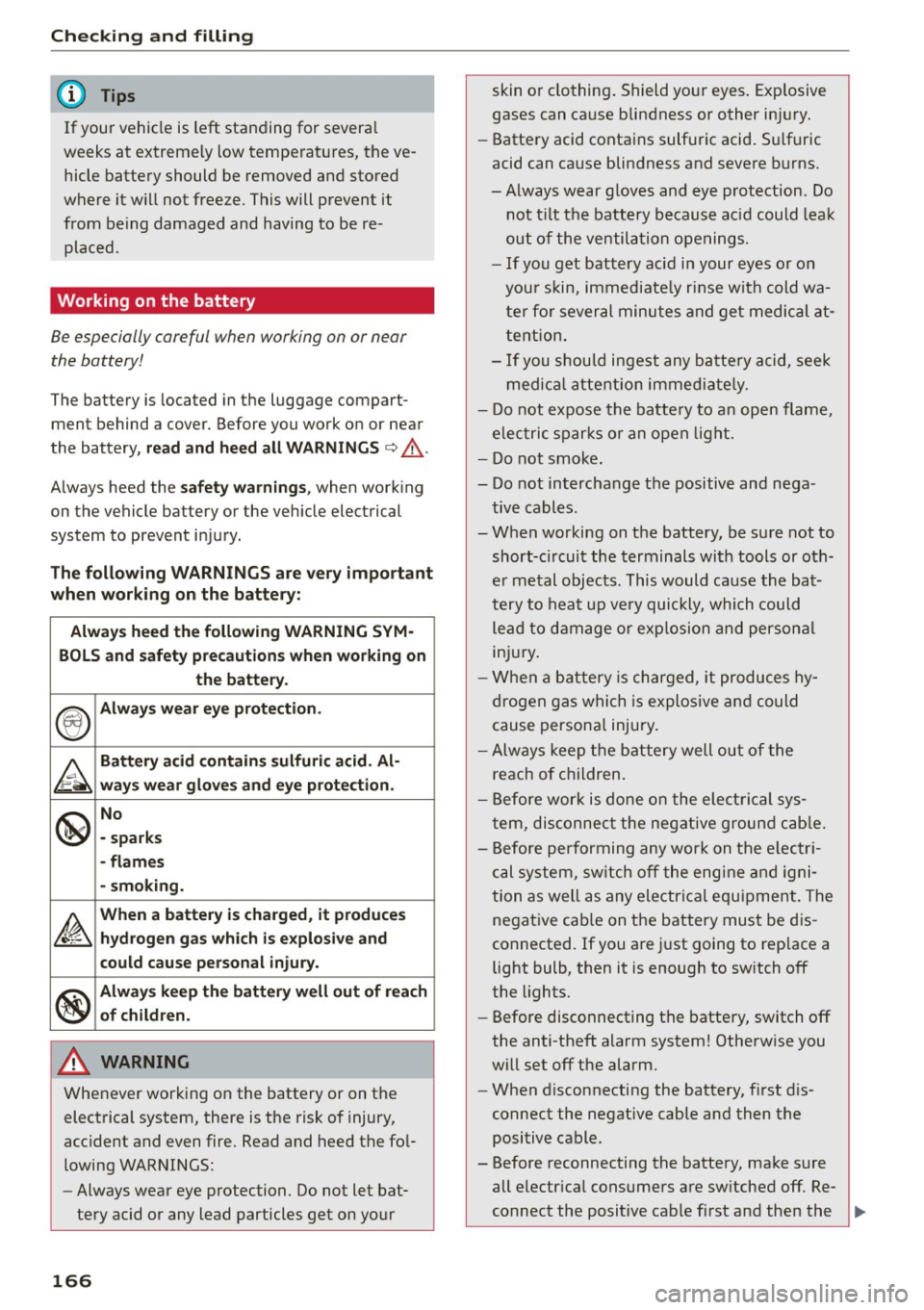
Always heed the following WARNING SYM-
BOLS and safety precautions when working on
the battery.
®
Always wear eye protection.
&
Battery acid contains sulfuric acid. Al·
ways wear gloves and eye protection.
@
No
- sparks
- flames
- smoking.
~
When a battery is charged, it produces
hydrogen gas which is explosive and
could cause personal injury.
®
Always keep the battery well out of reach
of children.
.&_ WARNING
Whenever working on the battery or on the
electrical system, there is the risk of injury,
accident and even fire. Read and heed the fol
lowing WARNINGS:
- Always wear eye protection. Do not let bat
tery acid or any lead particles get on your
166
skin or clothing. Shield your eyes. Explosive
gases can cause blindness or other injury.
- Battery acid contains sulfuric acid. Sulfuric
acid can cause blindness and severe burns.
-Always wear gloves and eye protection . Do
not tilt the battery because acid could leak
out of the ventilation openings.
- If you get battery acid in your eyes or on
your skin, immediately rinse with cold wa
ter for several minutes and get medical at
tention.
- If you should ingest any battery acid, seek
medical attention immediately.
- Do not expose the battery to an open flame,
electric sparks or an open light.
- Do not smoke.
- Do not interchange the positive and nega- tive cables.
- When working on the battery, be sure not to
short-circuit the terminals with tools or oth
er metal objects. This would cause the bat
tery to heat up very quickly, which could
lead to damage or explosion and personal
injury.
- When a battery is charged, it produces hy
drogen gas which is explosive and could
cause personal injury.
- Always keep the battery well out of the
reach of children.
- Before work is done on the electrical sys
tem, disconnect the negative ground cable.
- Before performing any work on the electri
cal system, switch off the engine and igni
tion as well as any electrical equipment. The
negative cable on the battery must be dis
connected. If you are just going to replace a
light bulb, then it is enough to switch off
the lights.
- Before disconnecting the battery, switch off
the anti-theft alarm system! Otherwise you
will set off the alarm.
- When disconnecting the battery, first dis
connect the negative cable and then the
positive cable.
- Before reconnecting the battery, make sure all electrical consumers are switched off. Re
connect the positive cable first and then the
~
Page 169 of 232
.... N
l'
N "1: .... I.O
"' N
"' ....
negative cable. Never interchange the ca
bles -this could start a fire!
- Never charge a frozen or a thawed-out bat
tery. It could explode! If a battery has fro
zen, then it must be replaced. A discharged
battery can freeze over at 32 °F (0 °C).
- Make sure the vent hose is always attached
to the opening on the side of the battery.
- Never use batteries which are damaged.
Danger of explosion! Always replace a dam
aged battery.
A WARNING
California Proposition 65 Warning:
- Battery posts, terminals and related acces
sories contain lead and lead compounds, chemicals known to the State of California
to cause cancer and reproductive problems.
Wash hands after handling .
(D Note
- Do not disconnect the vehicle battery when
the ignition is switched on or when the en
gine is running, otherwise, you will damage
electronic components in the electrical sys
tem.
- If your vehicle is going to stand for a long
period of time without being driven, protect
the battery from "freezing", otherwise it
will be damaged and will then have to be re
placed.
Charging the battery
Connections for charging the battery are located
in the luggage compartment.
--
• •
Fig. 144 Luggage compartment : ba tter y cover
Checking and filling
Fig. 145 Lug gage compar tment: connectors for a charg er
and jump start cables
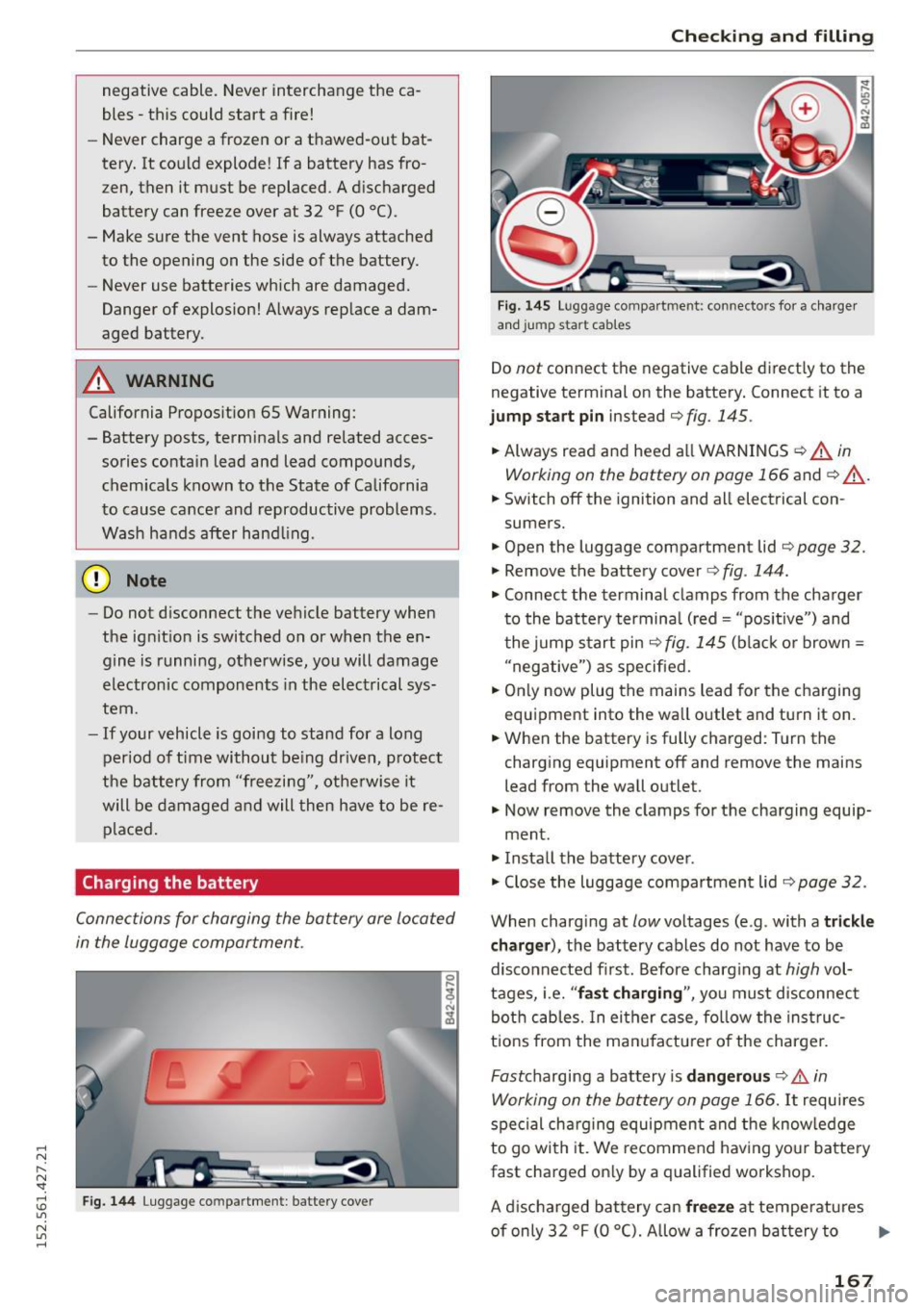
Do not connect the negative cable directly to the
negative terminal on the battery. Connect it to a
jump start pin instead¢ fig. 145 .
• Always read and heed all WARNINGS ¢ A in
Working on the battery on page 166
and ¢&_ .
• Switch off the ignition and all electrical con-
sumers.
• Open the luggage compartment lid¢
page 32.
• Remove the battery cover¢ fig. 144.
.,. Connect the terminal clamps from the charger
to the battery terminal (red= "positive") and
the jump start pin ¢
fig. 145 (black or brown =
"neg ative") as specified.
• Only now plug the mains lead for the charging
equipment into the wall outlet and turn it on.
• When the battery is fully charged: Turn the
charg ing equipment off and remove the mains
lead from the wall outlet.
.,. Now remove the clamps for the charging equip-
ment .
.,. Install the battery cover .
.,. Close the luggage compartment lid ¢
page 32.
When charging at low voltages (e.g . with a trickle
charger),
the battery cables do not have to be
disconnected first. Before charging at
high vol
tages, i .e.
"fast charging", you must disconnect
both cables. In either case , follow the instruc
tions from the manufacturer of the charger.
Fastcharging a battery is
dangerous¢.&. in
Working on the battery on page 166.
It requires
special charging equipment and the knowledge
to go with it. We recommend having your battery
fast charged only by a qualified workshop.
A discharged battery can
freeze at temperatures
of only 32
°F (0 °C). Allow a frozen battery to ..,.
167
Page 170 of 232
Checking and filling
thaw completely before attempting to charge it
c> &. . However, we recommend not us ing a
thawed battery again because the battery casing
can be cracked due to ice format ion and can leak
battery acid.
Do no t open the battery caps when charging the
battery .
A WARNING
Charging a battery can be dangerous.
- Never charge a frozen battery. It may ex
plode because of gas trapped in the ice. Al
low a frozen battery to thaw out first.
- Do not reuse batteries which were frozen.
The battery housing may have cracked and
weakened when the battery froze.
- Charge the battery in a we ll ventilated area.
Keep away from open flame or electrical
spark. Do not smoke . Hydrogen gas generat
ed by the battery is explosive .
- To reduce the danger of explosion, never
connect or disconnect charger cables while
the charger is operating .
- Fast charg ing a battery is dangerous and
should only be attempted by a competent
technician with the proper equipment .
- Battery acid that may spill during charg ing
sho uld be washed off w ith a solution of
warm water and baking soda to neutralize
the acid.
CD Note
Never use a fast charger as a booster to start
the engine. This will seriously damage sensi
tive electronic components, such as control
units, re lays, radio, etc., as well as the batte ry
charger.
@ Tips
- The vehicle battery must not be charged
with a standard small charger that plugs in
to the cigarette lighter or outl et.
- Only charge the battery through the connec
tions in the luggage compartment.
168
Windshield washer
container
Fig. 146 Lu ggage compar tment: Wind shi eld wash er fl uid
reservoir
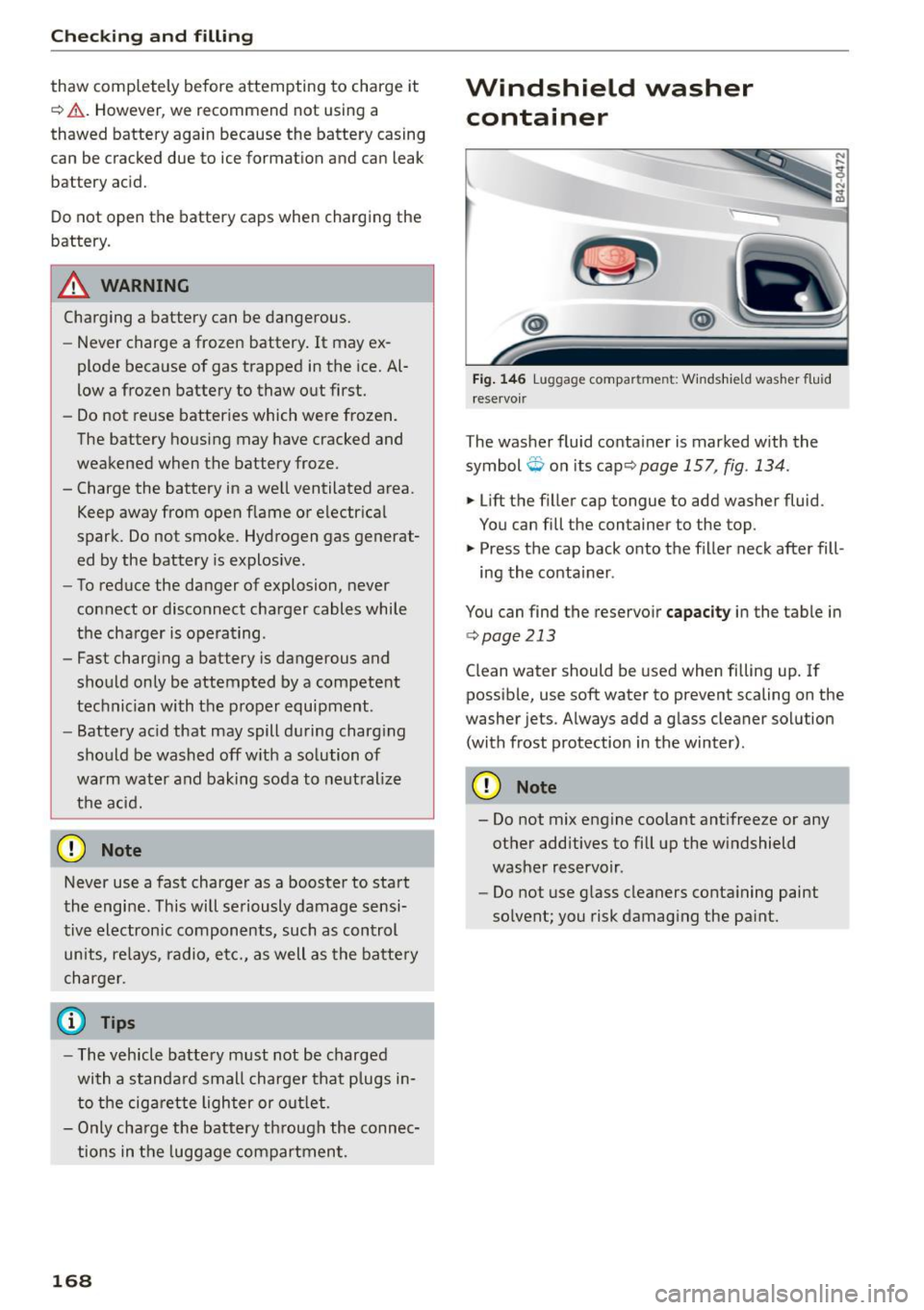
The washer fluid container is marked with the
symbol
Q on its cap c>page 157, fig . 134.
.. Lift the filler cap tongue to add washer fluid.
You can fill the container to the top .
.. Press the cap back onto the filler neck after fill -
ing the container .
You can find the reservoir capacity in the table in
¢page 213
Clean water should be used when filling up. If
possible, use soft water to prevent scaling on the
washer jets. Always add a glass cleaner solution
(with frost protection in the winter).
CD Note
- Do not mix engine coolant antifreeze or any
other additives to fill up the windshield
washer reservoir .
- Do not use glass cleaners containing paint
solvent; you risk damaging the paint.
Page 175 of 232
.... N
" N ": ... IO "? N U'> .....
Normal occupant weight
means 150 lbs. (68 kilograms)
times the number of occupants
seated in the vehicle up to the to
tal seating capacity of yo ur vehi
c le .
Occupant distribution
means distribution of occupants
in a vehicle.
Outer diameter
means the overall diameter of an
inflated new tire .
Overall width
means the linear distance be
tween the exteriors of the side
walls of an inflated tire, including elevations due to labeling, deco
rations, or protective bands or
ribs .
Ply
means a layer of rubber-coated
parallel cords .
Production options weight
means the combined weight of
those installed regular product ion
options weighing over 5 lbs. (2 .3
kg) in excess of those standard
items which they replace, not pre
viously considered in curb weight
or accessory weight, including
Tir es a nd whe els
heavy duty brakes, ride levelers,
heavy duty battery, and special
trim.
Radial ply tire
means a pneumatic tire in which
the ply cords that extend to the beads are laid at substantially
90
degrees to the centerline of the
tread.
Recommended inflation
pre ssure
see c::> page 172, Cold tire infla
tion pressure.
R einforced tire
means a tire designed to operate
at higher loads and at higher in
flation pressures than the corre
sponding standard tire. Rein
forced tires my be identified as
"X L", "xl", "EXTRA LOAD", or "RF"
on the sidewall.
Rim
means a metal support for a tire
or a tire and tube assembly upon
which the tire beads are seated.
Rim di ameter
means nominal diameter of the
bead seat. If you change your
1 73
Page 192 of 232
Tires a nd wh eels
Tire ply composition and
materials used
The number of plies indicates the
number of layers of rubber-coat
ed fabric in the tire. In general,
the greater the number of plies,
the more weight a tire can sup
port . Tire manufacturers also
must indicate the materials in the
tire, which include steel, nylon, polyester, and others .
Maximum Load Rating
This number indicates the maxi
mum load in kilograms and
pounds that can be carried by the
tire .
Tire quality grading for
treadwear , traction , and
temperature resistance
Tread wear, traction and tempera
ture grades ~
page 192.
Maximum Permissible
Inflation Pressure
This number is the greatest
amount of air pressure that
should ever be put in the tire un
der normal driving conditions .
190
Replacing tires or rims on
vehicles equipped with tire pressure monitoring sy stem
The wheels on your vehicle are
equipped with a sensor which
constantly monitors the air pres
sure inside the tire, and then
transmits this information to the
tire pressure monitoring system.
If you are go ing to replace the
wheel rims on your vehic le, make
sure the new rims also have these
sensors. The sensors must be
compatible with the tire pressure monitoring system on your vehi
cle.
If you install rims, which do not have the sensors, or have sensors
which are not compatible, then
the tire pressure monitoring sys
tem will not work properly . In this
case, the tire pressure monitoring
system would not be able to mon itor the tire pressure or warn you
if it is necessary .
-The battery inside of the tire pressure sensor has a limited
service life.
-Always drive with the valve stem caps securely mounted . We rec
ommend using factory installed ""
Page 208 of 232
What do I do now?
-Repl ace th e fl at ti re with a n ew one and h ave
it ins talled on you r vehicle as soon as
po ssible. Remount the wheel co ve r.
Until th en, driv e with extr a car e and at redu ced
s pe eds .
A WARNING
-If you are go ing to equip your vehicle with
t ires or rims which differ from those wh ich
were factory installed, then be sure to read
the informat ion¢
page 186, New tires and
replacing tires and wheels.
- Always store the tools securely in luggage
compartment . Otherwise, in an accident or
sudden maneuver they cou ld fly forward,
caus ing injury to passengers i n the vehicle .
(D Note
Do not use commercially available t ire sea l
ants. Otherwise, the electrical components of
the t ire pressure monito ring system* will no
longer wo rk properly and the sensor fo r the
tire pressure monitor ing system will have to
be rep laced by a qualified workshop.
Jump-starting
General
If necessary, the engine can be started by con
necting it to the battery of another vehicle.
-
If the engine sho uld fail to start because of a d is
charged or weak battery, the battery can be con
nected to the battery of
another vehicle, using a
pai r of jumpe r cable s to start the engine.
Both batteries must be rated at 12 vo lts. The
ca
pacit y
(Ah) of the booster battery must not be
substantially less than the capacity of the dis
charged battery.
Jump er c ables
Use only jumper cables of sufficiently large cro ss
s e ctio n
to safely carry the s tarte r cu rrent . Refer
to the manufact urer's specifications.
Use o nly jumper cables wh ich have
insulated ter
minal clamps and are p roperly marked for d is
tinction:
206
plu s(+) ca ble : in most cases colo red red
minu s(-) c abl e:
in most cases colo red bla ck
A WARNING
-
Batteries conta in e lectr ic ity, acid, and gas.
Any of these can cause very serious or fata l in
jury . Follow the instructions below for sa fe
handling of your vehicle's battery.
- Always shie ld your eyes and avoid leaning
over the battery whenever possib le .
- A discharged battery can a lready freeze at
tempera tures just below 32 °F (0 °C). Befo re
connecting a jumper cab le, the frozen bat
tery must be thawed comp lete ly, otherwise
it could exp lode.
- Do not allow battery acid to contact eyes or
skin . Flush any contacted area with water
immed iately.
- Improper use of a booster battery to start a
veh icle may cause an explosion.
- Vehicle batter ies generate explosive gases .
Keep sparks, f lame and lighted cigarettes
away from batteries.
- Do not try to jump start any vehicle with a
low acid level in the battery.
- The voltage of the booster battery must al
so have a 12 -Vo lt rat ing. The capacity (Ah)
of the booster battery should not be lower
than that of the discharged battery. Use of batter ies of different voltage or substantial
ly different "Ah" rating may cause an explo
sion and personal injury.
- Never charge a frozen battery. Gas trapped
in the ice may cause an exp losion .
- Never charge or use a battery that has been frozen. The battery case may have be weak
ened.
- Use of batter ies of different voltage or sub
stantially d iffe rent capacity (Ah) rating may
cause an exp losion and injury. The capacity
(Ah) of the booster battery sho uld not be
lower than that of the discharged battery.
- Before you check anything in the engine
compa rtment, always re ad and heed all
WARNINGS
¢page 155, Working in the en -
gine comportment. .,,.
Page 209 of 232
.... N
l'
N "1: rl I.O
"' N
"' ....
(D Note
-Applying a higher vo ltage booster battery
will cause expensive damage to sensitive electronic components, such as control
units, relays, radio, etc.
- T here m ust be no e lectrica l contact between
the vehicles as otherwise current could al
ready start to flow as soon as the pos itive
(+) terminals are connected .
@ Tips
-The discharged battery must be properly
con nected to the vehicle's electrical system.
- Switch
off any car phone, or follow the car
phone instruct ions for this situation.
Use of jumper cables
Make sure to connect the jumper coble clomps in
exa ctly the order described below!
F ig . 161 Luggag e comp artm ent: conn ectors fo r a charg er
an d jump start cab les
®
Fig . 162 Jump start using th e batte ry in a not her ve hicl e: A
• Fe male sock et, B • D isch arge
The batte ry is located in the luggage compart
ment ~
page 166 . The front lid can be opened in
a n emergency
r=;, poge 33.
What do I do no w?
Do not connect the negative cable d irect ly to the
n egat ive terminal on the battery . Connect it to a
jump start pin instead r=;, fig. 161.
Connect the po sitive cable (r e d ) to the
po sitive terminal
1. Connect one end of the red jumper cab le
r=;, fig . 162 (D to th e positive t erminal of dis
charged battery @.
2. Connect the o ther end of the red jumper ca
ble to the positive term inal @ofthe booster
battery @.
Conne ct the neg ative c able (bl ack ) to the
neg ativ e terminal
3. Connect one end of the b lack jumper cable @
to the negative term inal of the booster bat
tery @.
4. Secu re the other end to the jump start pin@
for the d isc harged battery @.
Starting the engine
"'Start the engine of the veh icle provid ing assis
tance and allow it to run at idle .
"' Now sta rt the engine of the vehicle with the
d ischa rged ba ttery.
"'I f the engine does not star t: Stop trying afte r
10 seconds and then try again after about 30
seconds .
"' Disconnect the cable while the engine is run-
ning in exact ly
reverse orde r to that described.
T he bat tery is vented to the outside to p reven t
gases from entering the vehicle interior . Make
s u re that th e jumper clamps ar e well connect ed
with their
metal ports in full contact with the
battery terminals.
A WARNING .
To avoid se rious personal injury and damage
to the veh icle , heed all warnings and ins truc
tions of the jumper cable manufacture r. If in
doubt, call for road service.
- Ju mpe r cables m ust be long eno ugh so that
the vehicles do not touch .
- When connecting jumper cables, make sure
that they can not g et caug ht in any moving
parts in the eng ine compartment. ..,.
207
Page 210 of 232
What do I do now?
- Be fo re you check a nything in t he e ngine
compartment, always read and heed all
WARNINGS
Q page 155, Working in the en
gine compartment .
CD Note
Improper hook-up of jumper cables can ruin
the generator.
- Always connect POSITIVE( +) to POSITIVE
( + ), and NEGA TIVE(-) to NEGATIV E(-)
gro und post of the battery manager control
unit.
- Check that a ll screw plugs on the battery
cells are screwed in firmly . If not, tighten
plugs prior to connect ing clamp on negat ive
battery terminal.
- Please note that the procedure for connect
i ng a jumper cable as described above ap
plies specifically to the case of your vehicle
being jump started. When you a re g iving a
ju mp sta rt to another vehicle, do
not con
n e ct the neg ative(- ) ca b le to the negative
( - ) terminal o n the discharged battery @.
Instead, se curely connect the negative(-)
cab le to either a solid metal component
that is f irm ly bolted to the engine block or
to the engine block itself . If the battery that
i s bei ng charged does not vent to the out
s ide , escap ing battery gas could ignite and
explode!
Emergency towing with
commercial tow truck
General hints
Your Audi requires special handling for towing.
The fo llow ing in formation is to be used by com
mercial tow truck operators who know how to op
erate their equipment safely .
- Never tow your A ud i, tow ing will cause damage
to the engine and transmiss ion .
- Never wrap the safety chains o r winch cables
around the b rake lines.
- To preven t un ne cessary d am age, yo ur Audi
mus t be transpor ted with a car carrier ( flat bed
t ruck) .
208
-To load the vehicle on to the flat bed , use the
tow ing loop found in the vehicle tools and at
tach to the front anchorage
Q page 208.
_& WARNING
A veh icle being towed is not safe for passen
gers. Never a llow anyone to ride in a vehicle
being towed, fo r any reason.
CD Note
The vehicle has ver y low ground clearance.
M ake sure that no damage is caused to the
underside of the vehicle when it is being load
ed onto a flat bed truck .
Front towing loop
Do not install the front towing loop un til it is
needed.
Fi g. 163 Righ t fro nt bu m per w it h ou t gr ille: Tow ing loo p
full y screwe d in
On the right front in the bumper , there is a
t h readed hole behind the air intake g rill into
which the tow ing loop is screwed .
.,. Remove the tow ing loop from the vehicle tool
kit
Q page 199 .
.,. Pull the lower part of the gr ill forward a nd out .
.,. Sc rew the tow ing loop t ightly into t he threaded
hol e as fa r as it will go
Q fig . 163 and tighten it
w ith the wheel w rench .
When it is no longer needed, unscrew the towing
l oop and put it back into the on-boa rd too lkit .
Make sure to have th e towing loop sto red in the
vehicle at all times .
When install ing the grill for the air duct, be sure
that the tabs on t he g rill a re first inserted into .,..
Page 222 of 232
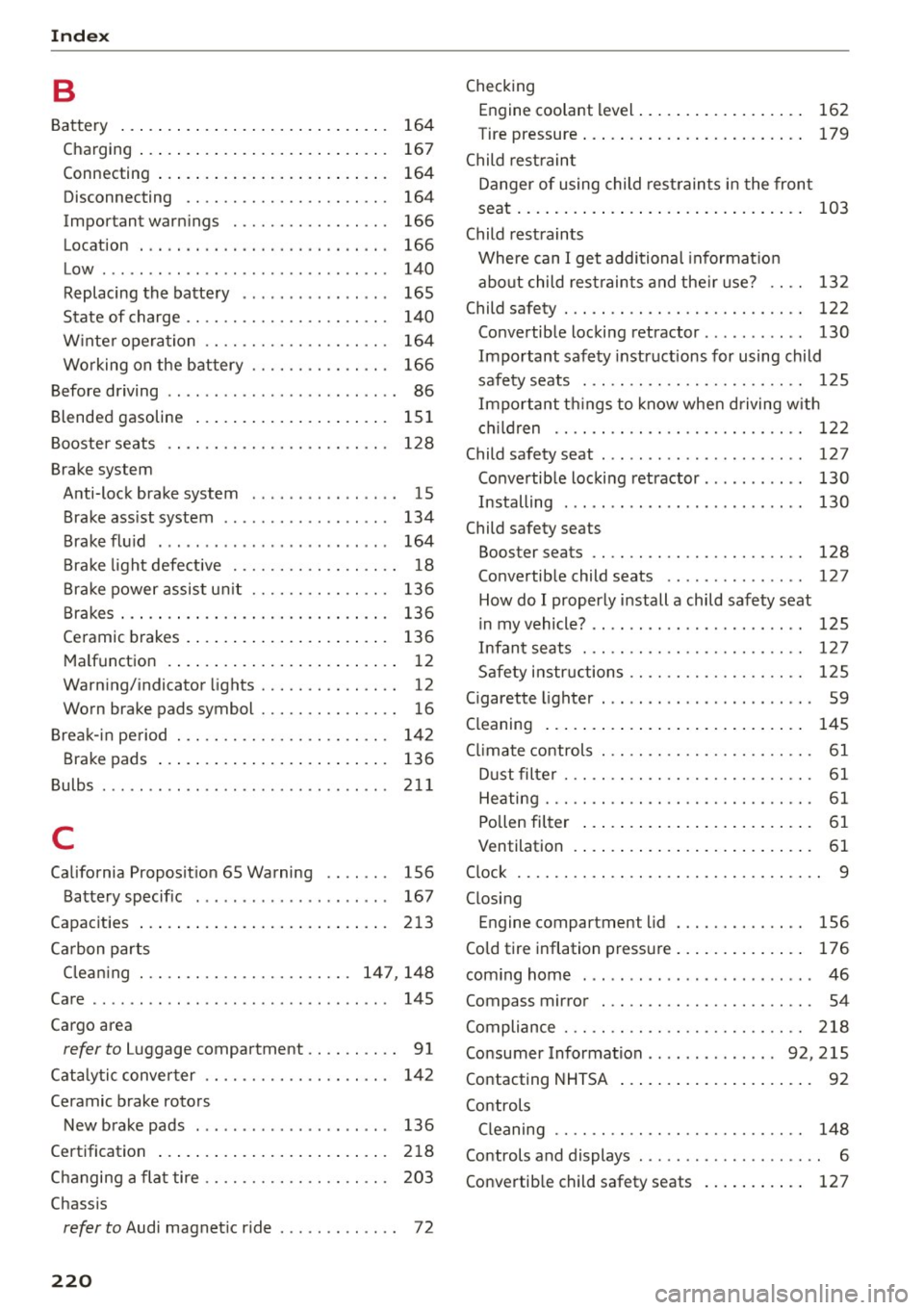
Index
B
Battery . . . . . . . . . . . . . . . . . . . . . . . . . . . . . 164
Charging . . . . . . . . . . . . . . . . . . . . . . . . . . . 167
Connecting . . . . . . . . . . . . . . . . . . . . . . . . . 164
Disconnecting . . . . . . . . . . . . . . . . . . . . . . 164
Important warnings . . . . . . . . . . . . . . . . . 166
Location . . . . . . . . . . . . . . . . . . . . . . . . . . . 166
Low ...... ... .. ................ ... . 140
Replacing the battery . . . . . . . . . . . . . . . . 165
State of charge . . . . . . . . . . . . . . . . . . . . . . 140
W inter operation . . . . . . . . . . . . . . . . . . . . 164
Working on the battery . . . . . . . . . . . . . . . 166
Before driving . . . . . . . . . . . . . . . . . . . . . . . . . 86
Blended gasoline . . . . . . . . . . . . . . . . . . . . . 151
Booster seats . . . . . . . . . . . . . . . . . . . . . . . . 128
Brake system
Anti-lock brake system . . . . . . . . . . . . . . . .
15
Brake assist system . . . . . . . . . . . . . . . . . . 134
Brake fluid . . . . . . . . . . . . . . . . . . . . . . . . . 164
Brake light defective . . . . . . . . . . . . . . . . . . 18
Brake power assist unit . . . . . . . . . . . . . . . 136
Brakes . . . . . . . . . . . . . . . . . . . . . . . . . . . . . 136
Ceramic brakes . . . . . . . . . . . . . . . . . . . . . . 136
Malfunction . . . . . . . . . . . . . . . . . . . . . . . . . 12
Warning/indicator lights . . . . . . . . . . . . . . . 12
Worn brake pads symbol . . . . . . . . . . . . . . . 16
Break-in period . . . . . . . . . . . . . . . . . . . . . . . 142
Brake pads . . . . . . . . . . . . . . . . . . . . . . . . . 136
Bulbs . . . . . . . . . . . . . . . . . . . . . . . . . . . . . . . 211
C
California Proposition 65 Warning . . . . . . . 156
Battery specific . . . . . . . . . . . . . . . . . . . . . 167
Capacities . . . . . . . . . . . . . . . . . . . . . . . . . . . 213
Carbon parts
Cleaning . . . . . . . . . . . . . . . . . . . . . . .
147, 148
Care . . . . . . . . . . . . . . . . . . . . . . . . . . . . . . . . 145
Cargo area
refer to Luggage compartment.. .. .. .. .. 91
Catalytic converter . . . . . . . . . . . . . . . . . . . . 142
Ceramic brake rotors
New brake pads . . . . . . . . . . . . . . . . . . . . .
136
C 'f ' . ert1 1cat1on ..... .............. ... .. .
Changing a flat tire ........... .. .. .. .. .
Chassis 218
203
refer to Audi magnetic ride . . . . . . . . . . . . . 72
220
Checking
Engine coolant level. . . . . . . . . . . . . . . . . .
162
Tire pressure . . . . . . . . . . . . . . . . . . . . . . . . 179
Child restraint
Danger of using child restraints in the front
seat . . . . . . . . . . . . . . . . . . . . . . . . . . . . . . .
103
Child restraints
Where can I get additional informat ion
about child restraints and the ir use? . . . .
132
Child safety . . . . . . . . . . . . . . . . . . . . . . . . . . 122
Convertible locking retractor . . . . . . . . . . . 130
Important safety instructions for using child
safety seats . . . . . . . . . . . . . . . . . . . . . . . .
125
Important things to know when driving w ith
ch ildren . . . . . . . . . . . . . . . . . . . . . . . . . . .
122
Child safety seat . . . . . . . . . . . . . . . . . . . . . . 127
Convertible locking retractor. . . . . . . . . . . 130
Installing . . . . . . . . . . . . . . . . . . . . . . . . . . 130
Child safety seats
Booster seats . . . . . . . . . . . . . . . . . . . . . . .
128
Convertible child seats . . . . . . . . . . . . . . . 127
How do I properly install a child safety seat
. h' l 7 125 in myve rc e ... .. .. .. ... ..... ... .. . .
Infant seats . . . . . . . . . . . . . . . . . . . . . . . . 127
Safety instructions . . . . . . . . . . . . . . . . . . . 125
Cigarette lighter . . . . . . . . . . . . . . . . . . . . . . . 59
Cleaning . . . . . . . . . . . . . . . . . . . . . . . . . . . . 145
Climate controls . . . . . . . . . . . . . . . . . . . . . . . 61
Dust filter . . . . . . . . . . . . . . . . . . . . . . . . . . . 61
Heating . . . . . . . . . . . . . . . . . . . . . . . . . . . . . 61
Pollen filter . . . . . . . . . . . . . . . . . . . . . . . . . 61
Ventilation . . . . . . . . . . . . . . . . . . . . . . . . . . 61
Clock . . . . . . . . . . . . . . . . . . . . . . . . . . . . . . . . . 9
Closing Engine compartment lid . . . . . . . . . . . . . .
156
Cold tire inflation pressure. . . . . . . . . . . . . . 176
coming home . . . . . . . . . . . . . . . . . . . . . . . . . 46
Compass mirror . . . . . . . . . . . . . . . . . . . . . . . 54
Compliance . . . . . . . . . . . . . . . . . . . . . . . . . . 218
Consumer Information .............. 92, 215
Contacting NHTSA . . . . . . . . . . . . . . . . . . . . . 92
Controls
Cleaning . . . . . . . . . . . . . . . . . . . . . . . . . . .
148
Controls and displays . . . . . . . . . . . . . . . . . . . . 6
Convertible child safety seats . . . . . . . . . . .
127
Page 225 of 232
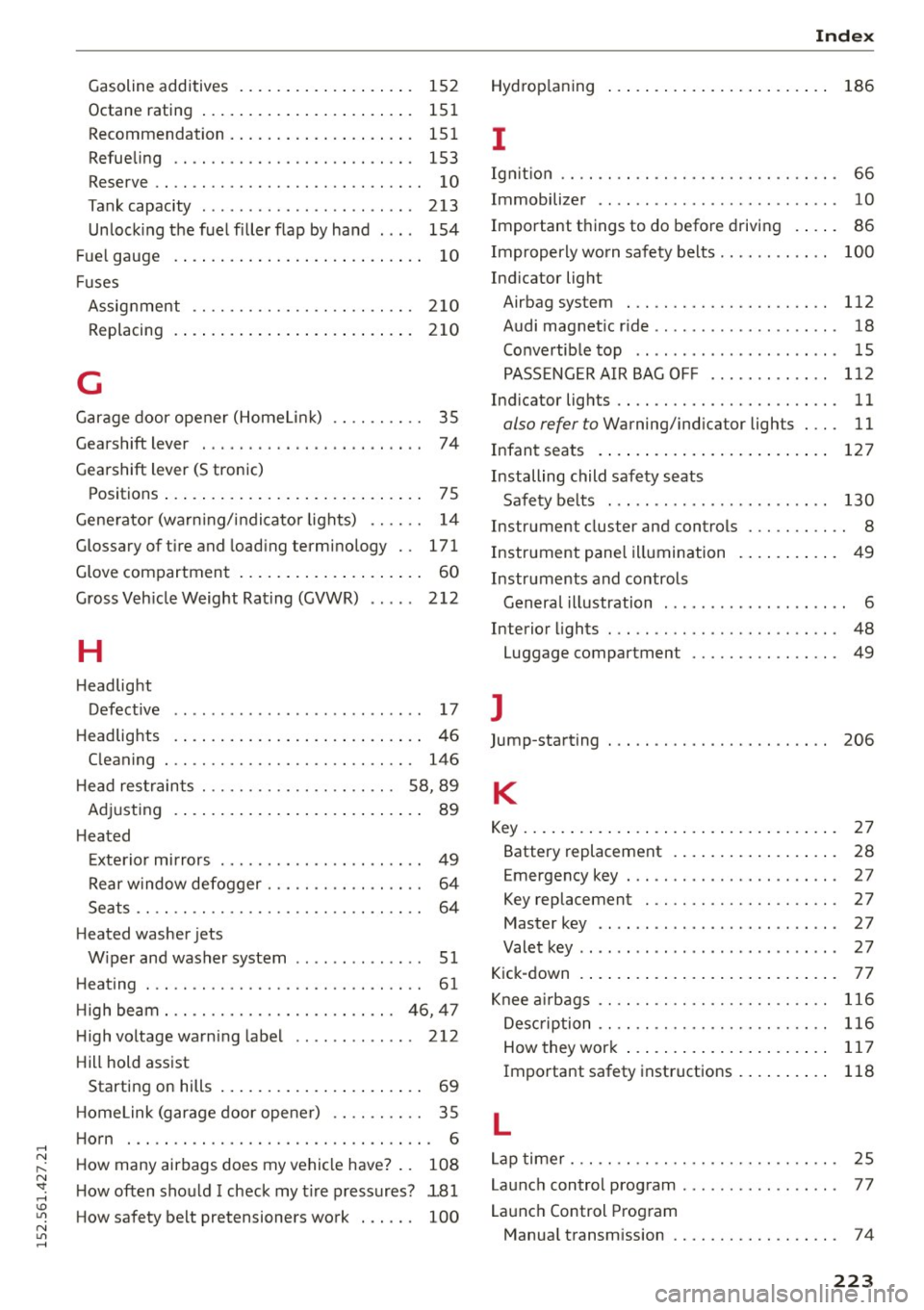
..... N
r-N "': ..... \!) 1.1"1
N 1.1"1 .....
Gasoline addit iv e s . . . . . . . . . . . . . . . . . . . 152
Octane rat ing . . . . . . . . . . . . . . . . . . . . . . . 151
Recommendation............ ... .. .. . 151
Refueling . . . . . . . . . . . . . . . . . . . . . . . . . . 153
Reserve . . . . . . . . . . . . . . . . . . . . . . . . . . . . . 10
Tank capacity . . . . . . . . . . . . . . . . . . . . . . . 213
Unlocking the fuel filler flap by hand . . . . 154
Fuel gauge . . . . . . . . . . . . . . . . . . . . . . . . . . . 10
Fu ses
Assignment . . . . . . . . . . . . . . . . . . . . . . . .
210
Replacing . . . . . . . . . . . . . . . . . . . . . . . . . . 210
G
Garage door opener (HomeLink) . . . . . . . . . . 35
Gearshift lever . . . . . . . . . . . . . . . . . . . . . . . . 7 4
Gearshift lever (5 tronic) Positions . . . . . . . . . . . . . . . . . . . . . . . . . . . . 7 5
Generator (warn ing/indicator lights) . . . . . .
14
Glossary of tire and loading terminology . . 171
Glove compartment . . . . . . . . . . . . . . . . . . . . 60
Gross Vehicle Weight Rating (GVWR) . . . . . 212
H
Headlight
Defective . . . . . . . . . . . . . . . . . . . . . . . . . . .
17
H eadlights . . . . . . . . . . . . . . . . . . . . . . . . . . . 46
Cleaning . . . . . . . . . . . . . . . . . . . . . . . . . . . 146
Head restraints . . . . . . . . . . . . . . . . . . . . . 58, 89
Adjusting . . . . . . . . . . . . . . . . . . . . . . . . . . . 89
H eated
Exterior mirrors . . . . . . . . . . . . . . . . . . . . . .
49
Rear window defogger . . . . . . . . . . . . . . . . . 64
Seats . . . . . . . . . . . . . . . . . . . . . . . . . . . . . . . 64
Heated washer jets
Wiper and washer system . . . . . . . . . . . . . .
51
Heating . . . . . . . . . . . . . . . . . . . . . . . . . . . . . . 61
H igh beam . . . . . . . . . . . . . . . . . . . . . . . . . 46, 47
High voltage warning label . . . . . . . . . . . . .
212
Hill hold assist
Starting on hills . . . . . . . . . . . . . . . . . . . . . .
69
H omeLink (garage door opener) . . . . . . . . . . 35
Horn . . . . . . . . . . . . . . . . . . . . . . . . . . . . . . . . . 6
How many airbags does my vehicle have? . .
108
How often should I check my t ire pressures? l81
How safety belt pretensioners work . . . . . . 100
Index
Hydrop laning . . . . . . . . . . . . . . . . . . . . . . . . 186
I
Ign it ion . . . . . . . . . . . . . . . . . . . . . . . . . . . . . . 66
Immobilizer . . . . . . . . . . . . . . . . . . . . . . . . . . 10
Important things to do before driving . . . . . 86
Improperly worn safety belts . . . . . . . . . . . . 100
Indicato r light
Airbag sys tem . . . . . . . . . . . . . . . . . . . . . .
112
Audi magnetic r ide . . . . . . . . . . . . . . . . . . . . 18
Convertible top . . . . . . . . . . . . . . . . . . . . . . 15
PASSENGER AIR BAG OFF . . . . . . . . . . . . . 112
Indicato r lights . . . . . . . . . . . . . . . . . . . . . . . . 11
also refer to Warning/indicator ligh ts . . . . 11
Infant seats . . . . . . . . . . . . . . . . . . . . . . . . . 127
Installing child safety seats
Safety belts . . . . . . . . . . . . . . . . . . . . . . . .
130
Instrumen t clus ter and controls . . . . . . . . . . . 8
Instrument panel illumination . . . . . . . . . . .
49
Instruments and controls
General illustration . . . . . . . . . . . . . . . . . . . . 6
Interior lights . . . . . . . . . . . . . . . . . . . . . . . . .
48
Luggage compartment . . . . . . . . . . . . . . . . 49
J
Jump -starting . . . . . . . . . . . . . . . . . . . . . . . . 206
K
Key............ .. .. ................. . 27
Battery replacement . . . . . . . . . . . . . . . . . . 28
Eme rgency key . . . . . . . . . . . . . . . . . . . . . . . 2 7
Key replacement . . . . . . . . . . . . . . . . . . . . . 27
Master key . . . . . . . . . . . . . . . . . . . . . . . . . . 27
Valet key . . . . . . . . . . . . . . . . . . . . . . . . . . . . 27
Kick -down . . . . . . . . . . . . . . . . . . . . . . . . . . . . 77
Knee air bags . . . . . . . . . . . . . . . . . . . . . . . . .
116
Description . . . . . . . . . . . . . . . . . . . . . . . . . 116
How they work . . . . . . . . . . . . . . . . . . . . . . 117
Important safety instructions . . . . . . . . . . 118
L
Lap timer. . . . . . . . . . . . . . . . . . . . . . . . . . . . . 25
Launch control program . . . . . . . . . . . . . . . . . 77
Launch Control Program Manual transmission . . . . . . . . . . . . . . . . . . 74
223