battery AUDI R8 SPYDER 2015 User Guide
[x] Cancel search | Manufacturer: AUDI, Model Year: 2015, Model line: R8 SPYDER, Model: AUDI R8 SPYDER 2015Pages: 232, PDF Size: 58.36 MB
Page 37 of 232
.... N
l'
N "1: .... I.O
"' N
"' ....
the ignition is switched off. Only when ei
ther of the front doors are opened are the power windows switched off.
- Be careful when closing the windows. Check
to see that no one is in the way, or serious injury could result!
- Always remove the ignition key whenever
you leave your vehicle .
- If you lock your vehicle from the outside, no
one, especially children, should remain in
the vehicle.
- Do not stick anything on the windows or the windshield that may interfere with the driv
er's field of vision.
(D Tips
- When the doors are opened, the windows
are automatically lowered 0.4 in (10 mm).
Reactivating the system after battery
disconnection
If the vehicle bat tery is disconnected and then
reconnected, the automati c closing and opening
function will not work until it is reactivated .
... Pull and hold the power window switch until
the window is completely closed .
.,. Release the switch and pull it again for one sec
ond .
Garage door opener
(Homelink)
Description
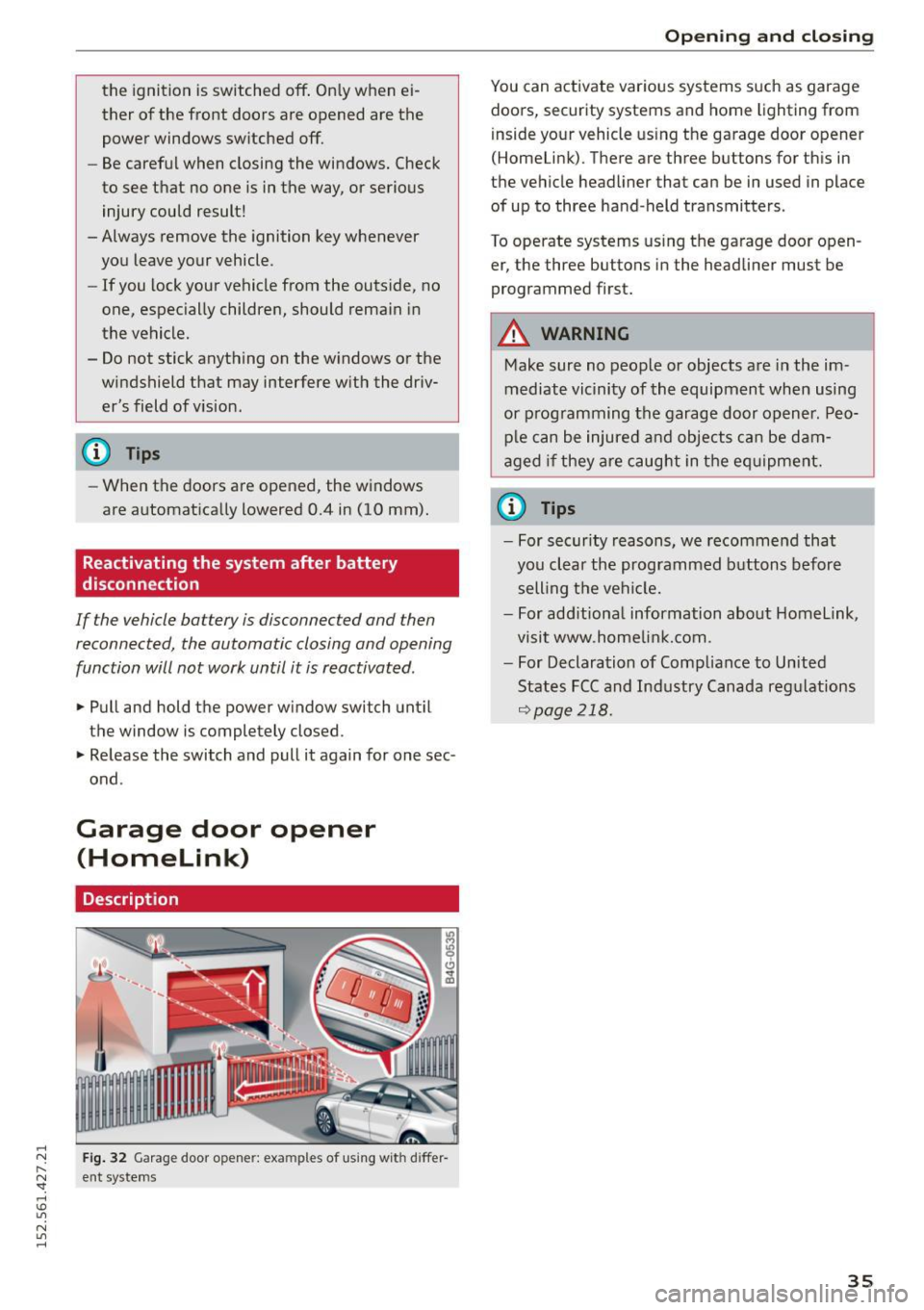
Fig. 32 Garage door opene r: exa mples of using wit h diffe r
ent sy stems
Opening and closing
You can activate various systems such as garage
doors, security systems and home lighting from
inside your vehicle using the garage door opener
(Homelink) . There are three buttons for this in
the vehicle headliner that can be in used in place of up to three hand -held transmitters .
To operate systems using the garage door open er, the th ree buttons in the headliner must be
programmed first.
A WARNING
=
Make sure no people or objects are in the im-
mediate vicinity of the equipment when using
or programming the garage door opener. Peo
ple can be injured and objects can be dam
aged if they are caught in the equipment.
@ Tips
-For security reasons, we recommend that
you clear the programmed buttons before
selling the vehicle.
- For additional information about Homelink ,
visit www .homelink.com.
- For Declaration of Compliance to United
States FCC and Industry Canada regulations
Qpage 218.
35
Page 41 of 232
..... N
r--N "': ..... \!) ..,.,
N ..,., .....
- Ma ke sure no one will be in jured by the con
vertible top supports and other moving ob
jects on the ve hicle when opening and clos
ing the top.
(D Note
To prevent damage to the convertible top:
- do not store any objects in the convertible
top storage bay .
- make sure there is enough space above the
vehicle when openi ng or closing the conver
tib le top.
(D Tips
- When the indica to r l amp f+j blinks, there is
a system ma lf u nction
¢page 15.
-The one-touch opening f unction is not avail
able when the vehicle is traveling below
4 mph (6 km/ h) o r above 31 mph (SO km/
h). If this is the case, a warn ing tone will
sound and a message will appear in the in
str ument cluster¢
page 39.
Error message in the instrument cluster
display
An error message appears if the convertible top
cannot open or close.
Severa l conditions must be met for the converti
b le top to open or close automatically .
An error message in the inst rument cluste r dis
p lay indicates i f one of the cond itions is not met
or there is a malfunction.
Soft top : Please clo se engine lid!
The engine compa rtment lid must be closed
when opening or clos ing the converti ble top . This
message appears in the instrument cluster dis
p lay if the engine compartment lid is not closed.
Soft top : Cannot be used!
This e rror message appears if the convertib le top
cannot open or close because of safety reasons or
if there is a malfunction. The following causes a re
possible:
- The vehicle is traveling too fa st: Conver tible
top operation is deactivate d for safety reasons
Con vertible top
if the vehicle is traveling too fast . A message
w ill appea r. Reduce the vehicle speed and pull
or press the switc h aga in to open or close the
convert ible top.
- The battery voltage is too low: Th e convert ible
top cannot open o r close i f the battery vo ltage
is too low. T his ensures there w ill be enough
battery voltage left to sta rt the ve hicle. The
convert ible top can be operated again after the
eng ine is s tarted.
- Overload protection is active: Operating the
convert ible top continuously fo r a long period
of t im e places stress on the hydrau lic uni t.
Ove rload p rotection is activa ted to prevent
d am age to the system. This pro te ct ive f unct ion
p reven ts the convertib le top from opening o r
close for approximate ly 15 to 30 minutes.
It
w ill function again afte r that ¢& .
-Malfun ction: Failure of sys tem components is
one poss ible cause for malf unct ion . If this hap
pens, yo u can also operate the conve rtible top
by hand
<=> page 41.
- The exterior temperature i s too low: Th e con
vertible top will not open in temperatures be
low (5 ° F) (-15 QC).
Soft top not secure
If the convertib le top is not completely open or
cl osed and the vehicle is traveling too fast, the
error message above appears and a wa rn ing tone
sounds. Reduce the veh icle speed and pull or
press the sw itch agai n to ope n or close the co n
vertib le top.
A WARNING
--
N eve r drive when the c onver tible top is not
l ocked correctly . Th e wind from driving co uld
cause the conve rtible top to open . This can re
sul t in injur ies and d amage to t he ve hicle .
39
Page 61 of 232
.... N
l'
N "1: rl I.O
"' N
"' ....
and damage your vehicle's electronic
equipment or stain the upholstery, etc.
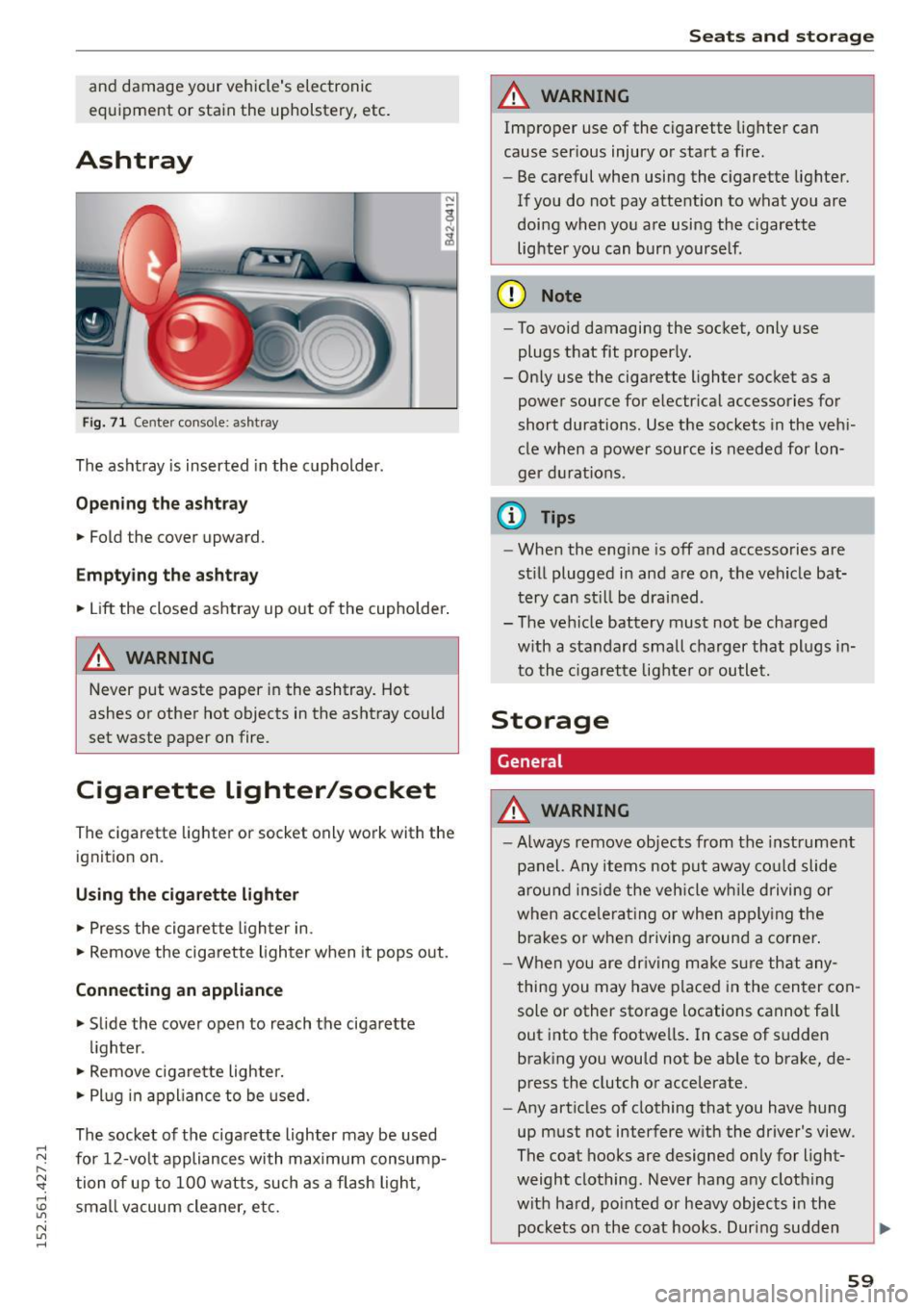
Ashtray
F ig . 71 Cen te r co nsole: ash tray
The ashtray is inserted in the cupholder.
Opening the a shtra y
• Fold the cover upward.
Emptying the ashtray
• Lift the closed ashtray up out of the cupholder .
A WARNING
-
Never put waste paper in the ashtray. Hot
ashes or other hot objects in the ashtray could
set waste paper on fire.
Cigarette lighter/socket
The cigarett e lighter o r socket only work with the
ignit ion on.
Using the cigar ett e lig hter
• Press the cigarette lighter in .
• Remove the cigarette ligh ter when it pops out.
Conn ecting an appliance
• Slide the cover open to reach the cigarette
lighter .
• Remove cigare tte lighte r.
• Pl ug in appliance to be used.
The socket of the cigarette lighter may be used
for 12-volt appliances with maximum consump· tion of up to 100 watts , such as a flash light,
small vacuum cleaner, etc.
Seats and storage
A WARNING
-Improper use of the cigarette lighter can
cause ser ious injury o r start a f ire.
- Be careful when using the c igarette Lighter.
If you do not pay attention to what you are
doing when you are using the cigarette
lighter you can bur n yourse lf .
(D Note
- To avoid damaging the socket, only use
plugs that fit proper ly.
- Only use the cigarette lighter socket as a power source for e lectr ical accessories for
short durations. Use the sockets in the veh i
cle when a power source is needed for lon·
ger d urat ions .
(i} Tips
-When the eng ine is off and accessories are
st ill plugged in and are on, the vehicle bat·
tery can st il l be drained .
- The vehicle battery must not be charged
with a standard small charger that plugs in
to the c igarette lighte r or outlet.
Storage
General
A WARNING
=
- Always remove objects from the instrument
panel. Any items not put away co uld slide
around ins ide the veh icle w hile driving or
when accele rating o r when app ly ing the
brakes or when driving around a corner .
- When you are dr iv ing make s ure that any
thing you may have placed in the center con
sole or other storage locations cannot fa ll
out into the footwe lls. I n case of sudden
braking you would not be ab le to brake, de
press the clutch or accelerate.
- Any articles of clothing that you have hung
up must not interfere with the driver's view .
The coat hooks are designed only for light·
weight clothing . Never hang any clothing
with ha rd, po inted or heavy objects i n the
pockets on the coat hooks. Dur ing sudden ..,.
59
Page 69 of 232
..... N
r-N "': ..... \!) 1.1"1
N 1.1"1 .....
leave your vehicle . This makes vehicle theft even
more difficu lt
c::> & .
Ign ition on @
After switching the ignition on, the needles move
all the way up and then down.
If it is difficult to turn the key after you have in
serted it into the ign ition lock, turn the steering
wheel back and forth. This w ill take the load off
the steering lock mechanism and you will be able
to turn the key freely and start the engine.
Starting the engine @
In this position the engine starts . Wh ile the en
g ine is starting, the power supply to the head
l ights and other elect rical consume rs is tempo ra
ri ly inte rrupted to conserve battery power . After
the engine has started, re lease the key and it will
return to position @.
Before the sta rter can be opera ted again the key
m ust be t urned back to position (!). The
n on-re
pe at lo ck
prevents you from damaging the start
er when the engine is running .
A WARNING
-Never remove the key from the ignition lock
wh ile the vehicle is mov ing. The steer ing
wheel will lock causing loss of control.
- If you have to leave your vehicle - even for
just a min ute - a lways remove the ignit ion
key and take it with you. This is espec ially
important if you are going to leave ch ildren
behind in the veh icle . The ch ildren could
start the engine o r use other veh icle con
t ro ls. Unsuperv ised use of vehicle controls
( f or example, power windows) can c ause se
rious persona l injuries .
@ Tips
If the veh icle battery has been d isconnected
and then reconnected, then yo u m ust leave
t he key in posit ion @ for abou t 5 seconds be
fore you can start the engine .
On the road
Starting and stopping
the engine
Starting the engine
The engine can only be started with your original
Audi key.
On vehicles with S tronic*, the engine can be
sta rted in the neutra l position N and in each gear
(1 - 7 and R).
.,. Set the park ing brake
c::> .&_ .
.,. On veh icles with manual transmiss ion*, fully
dep ress the clutch peda l.
.,. Press and hold the bra ke peda l.
.,. Tu rn the ignition key to posit ion @
c::> page 66,
fig. 77 -do not depress the gas pedal when
starting the engine.
.,. Let go of the key as soon as the engine starts -
the starter m ust not cont inue to run. On
veh ides with S tronic, se lect gear position N .
A cold engine may at first be loud afte r it has
been started. This is due to the hydraulic valves
building up the oil pressure. This is normal and
no need for concern .
If the engine does not start immediately, stop
trying after 10 seconds and then try to restart
the engine about 30 seconds later .
A WARNING
--
-Never start or let the eng ine run in a con
f ined or enclosed area. Exhaust fumes from
the eng ine contain carbon mo noxide, a co l
o rl ess and odo rless gas. Carbon monoxide
can be fatal if i nhaled .
- Never leave the engine id ling unattended .
A n unattended ve hicl e w ith a running en
g in e poses a dange r of pe rsonal inj ury or
theft .
- W ith the engine r unning and a gear engag
ed, you have to ho ld the vehicle wi th the
foot b rake .
(D Note
-Avo id h igh engine speeds, fast acceleration
o r heavy engi ne loads whi le the engine is
st il l c old . T his could d amage t he engine.
67
Page 142 of 232
Intelligent technology
Snow chain s
Where tire cha ins are mandatory on certai n
roads, this normally a lso applies to vehicles with
all-wheel drive
¢ page 194, Snow chains .
Replacing wheels /tires
Vehicles w ith all-whee l drive must a lways have
tires of the same si ze. Also avoid t ires with differ
ent tread depths. Fo r deta ils see page
¢ page 186, New tires and replacing tires and
wheels.
Off-Road driving?
Your Audi does not have enough ground clear
an ce to be used as an off-road veh icle.
It is there
fore best to avo id rough tracks and uneven ter
rain as m uch as possible . A lso re fer to
¢ page 142.
A WARNING
-Always adjust your driving to road and traf
fic cond itions. Do not let the extra safety af·
forded by all-whee l dr ive tempt you into tak
ing extra r isks .
- Althoug h the all-wheel dr ive is very effec
t ive, always remember that brak ing capac ity
is limited by tire tract ion. You should there
fore not dr ive at excessive speeds on icy o r
slippery road su rfaces.
- On wet road su rfaces, be careful not to drive
too fast because th e front whee ls cou ld be
gin to slide o n top of the water (aquap lan
ing).
If t his s hou ld o cc ur , you will have no
warning from a sudde n increase in engine
speed as with a front -whee l drive vehicle .
Always drive at speeds which are s uited to
the road conditions. -ris k of crash.
Energy management
Starting ability is optimized
Energy management controls the distribution of
electrical energy and thus optimizes the availa
bility of electrical energy for starting the engine.
If a vehicle w it h a conventional energy system is
not drive n for a long per iod of t ime, the battery
is discharged by idli ng cur rent consumers (e.g .
140
immob ili zer). In certain c ircumstances it can re
s ul t in the re being insufficient energy available to
start the eng ine.
I ntelligent energy managemen t in your veh icle
hand les the d istribution of electrical energy .
Starting ability is markedly improved and the life
of the battery is extended.
B asically, energy managemen t consis ts of
bat
tery diagnosi s, idling current management
and
dynamic energy management.
Battery diagnosis
Battery diagnosis continuously dete rm ines t he
st ate of the bat tery. Sensors dete rm ine battery
vo ltage, batte ry cur rent and battery tempera
ture . This de termines the current state of cha rge
and t he power of the battery.
Idling current management
Idli ng cur ren t management reduces energy con
sumption whi le the vehicle is s tanding. W it h the
i gni tion swi tched off, it contro ls the energy s up
ply to the various electrical components . Data
from battery d iagnosis is considered.
Depend ing o n the ba tte ry's st ate of ch arge, indi
vidual consumers are gradua lly tur ned o ff to pre
vent excessive discharge of the batte ry and thus
maintain starting capa bility .
Dynamic energy management
While t he ve hicle is being driven, dynamic e ne rgy
m anag eme nt dis trib utes the energy ge nerated
accord ing to the needs of the individ ua l compo
nents . It regu lates consumption, so that more
e lectrica l ene rgy is not be ing used than is being
generated and ens ures an optima l state of
c h arge for the battery.
(D Tips
- But even ene rgy management cannot neg
ate the lim its of physics. Cons ider that the
p ower and life of a batte ry are lim ited.
- If start ing ability is threa tened, you are in
formed by a warning ¢
page 141, Driver
notification in the instrument cluster dis
play.
Page 143 of 232
..... N
r-N "': ..... \!) 1.1'1
N 1.1'1 .....
What you should know
The highest priority is given to maintaining start
ing capability .
The battery is severely taxed in short-distance
driving, in city traffic and during the cold time of
year . Abundant electrical energy is required, but
only a little is generated . It is also critical if the
engine is not running and electrical components
are turned on. In this instance energy is being
consumed but none is being generated.
It is in precisely these situations that you w ill no
tice energy management actively regulating the
d istribution of ene rgy.
Vehicle stands for an extended period
If you do not drive your vehicle over a period of
several days or weeks , electr ical components are
gradually cut back or switched off . This reduces
energy consumption and maintains starting ca
pability over a longer pe riod .
Take into consideration that when you unlock
your veh icle, some convenience functions, such
as the remote key or power seat adjustment, may
not be available. The convenience functions will
be available again when you turn on the ignition
and start the engine .
With the engine turned off
If you listen to the radio, for example, with the
engine turned off, the battery is being dis
charged .
If starting capability is jeopardized due to energy
consumption, a message appears in the driver in
formation display .
You have to start the engine to charge the bat
tery .
With the engine running
Although electrical energy is generated when the
vehicle is being driven, the battery can become
discharged. This happens mostly when little en
ergy is be ing generated and a great deal con
sumed and the battery's state of charge is not
optimal.
Intelligent technology
To bring the energy balance back into equilibri
um, consumers which require especially large
amounts of energy are temporar ily cut back or
switched off. Heating systems in part icu lar re
quire a great deal of energy. If you notice, for ex
ample, that the heated seats* or the heated rear
window are not heating, they have been tempo
rarily cut back or switched off . These systems w ill
be available again as soon as the energy balance
has been restored.
You w ill also not ice that engine idle speed has
been increased slightly . This is normal and not a
cause for concern. By incr easing eng ine idle
speed the additional energy required is generated
and the battery is charged.
Driver notification in the instrument
cluster display
If battery power drops in to the range where it
can limit the ability of the engine to start, this is
shown in the instrument cluster display w ith the
following driver message :
[•] low battery charge: battery will be charged
while driving
This notification reminds you that the starting
capability of the engine may be limited. As soon
as you start driving again, the battery will be re
charged and the notificat ion will go out .
Driver notification appears and goes out
again
If this driver notification appears after the igni
tion is turned on or while driv ing and it goes out
again after a while, the battery has been ade
quately recharged .
Driver notification appears and does not go
out again
If this driver notif ication appears after the ign i
t ion is turned on or while dr iv ing and does not go
out again, the battery's state of charge is not in
t h e optimal range. Starting ability is restricted .
Have the battery checked as soon as possible by
an authorized Audi dea le r or qualified workshop.
141
Page 145 of 232
..... N
r-N "': ..... \!) ..,.,
N ..,., .....
The exclusive use of unleaded fuel is critically im
portant for the life of the catalytic converter and
proper functioning of the engine.
A WARNING
- Do not park or operate the vehicle in areas where the hot exhaust system may come in contact with dry grass, brush, fuel spill or
other material which can cause a fire .
- Do not apply additional undercoating or
rustproofing on or near the exhaust mani
fold, exhaust pipes, catalytic converter or
heat shields. During driving, the substance
used for undercoating could overheat and
cause a fire.
([) Note
-Be aware that just one tank filling with lead
ed
fuel will already seriously degrade the
performance of the catalytic converter.
- Do not exceed the correct engine oil level
~page 160.
- Do not drive until the fuel tank becomes
completely empty. The engine could misfire.
Unburned fuel could also get into the ex
haust system and this could cause the cata
lytic converter to overheat.
- Do not turn off the ignition while the vehicle
is moving.
- Do not continue to operate your vehicle un
der these conditions, as otherwise fuel can
reach the catalytic converter. This could re
sult in overheating of the converter, requir
ing its replacement.
- To assure efficient operation of the Emission
Control System:
- Have your vehicle maintained properly and in accordance with the service recommen
dations in your Warranty
& Maintenance
booklet.
- Lack of proper maintenance as well as im
proper use of the vehicle will impair the
function of the emission control system
and could lead to damage.
Driving and environment
{® For the sake of the environment
Even when the Emission Control System is op
erating properly, the exhaust gas can have a
sulfur-like exhaust gas smell under some op
erating states. This depends on the sulfur
content of the fuel being used. Using a differ
ent brand of fuel may help, or filling the tank
with lead-free super grade gasoline .
Shutting down vehicle
If you would like your vehicle to remain inopera
tive for a longer period of time , contact an Audi
or other specialized dealer. They can advise you
on necessary precautions e.g. corrosion preven
tion, maintenance and storage. Pay attention to
additional information concerning the battery.
Refer to~
page 164.
Operation and
maintenance
Fuel economy, environmental impact, and wear
on your engine, brakes and tires largely depend
on three factors:
-your personal driving style
- operating conditions
- technical limitations
By having your vehicle regularly serviced by an
authorized Audi dealer helps to ensure that it runs properly and economically. The condition of
your vehicle not only affects its safety and ability
to hold its value, it also affects
fuel consump
tion.
The amount of oil used is related to engine load
and speed.
It is normal for the oil consumption of a new en
gine to reach its lowest value after a certain mile
age has been driven.
You must drive your vehicle about 3,000 miles (5,000 kilometers) before you can properly as
sess oil consumption .
This also applies to fuel consumption and engine output . .,,.
143
Page 158 of 232
Checking and filling
-Move selector lever of S tronic to "N" (Neu
tral); put manual transmission in Neutral.
- Always let the engine cool down. Hot com
ponents will burn skin on contact .
- To reduce the risk of being burned, never
open the engine compartment lid if you see
or hear steam or coolant escaping from the
engine compartment. Wait until no steam
or coolant can be seen or heard before care
fully opening the engine compartment lid.
- Keep children away from the engine com
partment .
- Never spill fluids on hot engine compo
nents. They can cause a fire.
- Never open the coolant reservoir cap when
the engine is still warm . The coolant system
is pressurized and hot coolant could spray
out .
- Protect your face, hands and arm from
steam or hot engine coolant by placing a
thick rag over the cap when you open the coolant reservoir .
- Do not remove the engine cover under any
circumstances . This increases the risk of
burns.
- If work on the fuel system or the electrical
system is necessary :
- Always disconnect the battery.
- Never smoke or work near heaters or open
flames. Fluids in the engine compartment
could start a fire.
- Keep an approved fire extinguisher imme
diately available .
- To avoid electrical shock and personal injury
while the engine is running or being started,
never touch:
- Ignition cables
- Other components of the high voltage
electronic ignition system.
- If you must perform a check or repair with
the engine running:
- First, fully apply the parking brake, move
selector lever of S tronic to
"N" (Neutral);
put manual transmission in Neutral.
- Always use extreme caution to prevent
clothing, jewelry, or long hair from getting
caught in the radiator fan, V-belts or other
156
moving parts, or from contacting hot
parts. Tie back hair before starting, and
wear no clothing that will hang or droop into the engine.
- Minimize exposure to emission and chemi
cal hazards
¢ .&..
A WARNING
California Proposition 65 Warning:
- Engine exhaust, some of its constituents,
and certain vehicle components contain or
emit chemicals known to the State of Cali
fornia to cause cancer and birth defects and reproductive harm. In addition, certain flu
ids contained in vehicles and certain prod
ucts of component wear contain or emit
chemicals known to the State of California
to cause cancer and birth defects or other
reproductive harm.
- Battery posts, terminals and related acces
sories contain lead and lead compounds,
chemicals known to the State of California
to cause cancer and reproductive harms.
Wash hands after handling.
@ Note
When adding fluids, always make sure that
they are poured into the proper container or
filler opening, otherwise serious damage to
vehicle systems will occur.
@ For the sake of the environment
To detect leaks in time , inspect the vehicle
floor pan from underneath regularly. If you
see spots from oil or other vehicle fluids, have
your vehicle inspected by an authorized Audi
dealer .
· Closing the engine compartment lid
.. Make sure that the rear spoiler is retracted
¢page 138 .
.. Pull the engine compartment lid down until the
pressure from the struts is reduced.
.. Press the engine compartment lid closed
¢ _A . ..,
Page 166 of 232
Checking and filling
-Turn the cap slowly and very carefully in a
counter-clockwise direction while applying
light, downward pressure on the top of
the cap .
- To avoid being burned, do not spill anti
freeze or coolant on the exhaust system or hot engine parts. Under certain condi
tions, the ethylene glycol in engine cool
ant can catch fire .
- Antifreeze is poisonous. Always store anti
freeze in its original container and well out of the reach of children .
- If you drain the coolant, it must be caught
and safely stored in a proper container
clearly marked "poison".
CD Note
-Coolant pollutes the environment and could
cause an engine fire . Excess coolant will be
forced out through the pressure relief valve
in the cap when the engine becomes hot.
-If, in an emergency, only water can be add
ed, the correct ratio between water and an
tifreeze
¢ page 161 must be restored as
soon as possible.
@ For the sake of the environment
Drained coolant should not be reused. Always
dispose of used coolant while observing all
environmental regulations.
Brake fluid
Have the brake fluid changed by an experienced
technician.
Brake fluid absorbs moisture from the air. If the
water content in the brake fluid is too high, cor
rosion in the brake system may result after a peri
od of time. The boiling point of the brake fluid
will also decrease considerably and decrease
braking performance.
Therefore, the brake fluid must be changed
every
two years.
Always use new brake fluid which con
forms to Federal Motor Vehicle Standard "FMVSS
116 DOT 4".
164
Brake fluid is replaced according to the Audi
maintenance service schedule . Your authorized
Audi dealer is equipped with the necessary spe
cial tools and replacement parts, has the neces
sary expertise, and can dispose of the used fluid .
A WARNING
-Brake fluid is poisonous . It must be stored
only in the closed original container out of
the reach of children!
- Brake failure can result from old or inappro priate brake fluid. Observe these precau
tions:
- Use only brake fluid that meets SAE speci
fication
J 1703 and conforms to Federal
Motor Vehicle Standard
116. Always check
with your authorized Audi dealer to make
sure you are using the correct brake fluid .
The correct type of brake fluid is also indi cated on the brake fluid reservoir.
- The brake fluid must be new . Heavy use of
the brakes can cause a vapor lock if the brake fluid is left in the system too long.
This can seriously affect the efficiency
of
the brakes as well as your safety . This
could result in an accident.
CD Note
Brake fluid will damage the paint of your vehi
cle.
@ For the sake of the environment
Because of the problem of proper disposal of
brake fluid as well as the special tools re
quired and the necessary expertise, we rec
ommend that you have the brake fluid
changed by your authorized Audi dealer.
Battery
General information '
Your vehicle is equipped with a special battery, an
ACM battery . This battery is located in the lug
gage compartment and must be replaced with an
original equipment battery. Under normal oper
ating conditions, the battery is
maintenance-
free. ..,_
Page 167 of 232
..... N
r-N "': ..... \!) 1.1'1
N 1.1'1 .....
Have the battery checked when you take your ve
hicle in for service. You are well advised to re
place a battery that is older than 5 years .
Disconnecting the batt ery terminal s
Some vehicle funct ions (power w indow regula
tors , fo r example) are lost if the battery termi
na ls are disconnected. These functions have to be
re learned after the battery terminals are con
nected again. To prevent this , the batte ry shou ld
only be disconnected from the vehicle electrical
system when absolutely necessary for repairs.
V ehicl es not dri ven fo r lo ng p eriod s
If you do not drive your vehicle over a period of
several days or weeks , e lectrica l components are
gradually cut back or switched off. This reduces
energy consumption and maintains s tarting ca
pability over a longer period<=> page 140. Some
of the convenience funct ions may not operate ,
such as the inter ior lights or powe r seat ad just
ment. The convenience functions will be ava ilable
again when you switch on the ignition and start
the eng ine.
Wint er op erati on
During the winter months, battery capacity tends
to decrease as temperatures drop . This is because
more power is also consumed w hile start ing , and
the head lights, rear w indow defogger, etc., are
used more often.
Avoid unnecessary power consumption, part icu
l arly in city traffic o r when traveling only short
d ista nces . Let you r a utho rized Aud i dea le r check
the capacity of the vehicle battery before w inter
sets in <=> page 167. A well charged battery will
not on ly prevent starting prob lems when the
w eather is cold, but will also last longer.
R eplacing battery
The new battery mu st ha ve the same capacity,
voltage
(12 vo lts), amperage, construction and
p lug sealing, as the original battery . Specifica
tions are listed on the battery housing. Batteries
specia lly deve loped by Audi fulfill the mainte
nance, output, and safety requ irements .
Check ing and fillin g
When installing the battery, make sure the igni
tion and all electrica l consumers are switched off
<=> 0 .
We recommend that you use main tenance-free or
cycle -res istant /leak-p roof batteries according to
the standards TL
825 06 (from Apri l 2008) and
VW 7
50 73 (from Apr il 2010).
Replac ing the bat tery shou ld be carried by a
qualified workshop. Please fo llow the ins truc
tions on the battery cover .
(D Note
-All work on the battery req uires techn ica l
knowledge . Please contact an Audi dealer
ship or another authorized facility for ques
tions about the battery - danger of ac id
burns and explosion ha zard!
- The battery must not be opened! Do not try
to change the battery's liquid level, other
w ise detonating gas will escape from the
battery- exp losion hazard!
- The AGM battery in the luggage compart ment cannot leak, because the e lectrolyte
for this battery is absorbed into a special glass mat . This leak-proof battery must not
be replace with a convent ional battery.
- Make sure the ventilation hose on the side
of the battery is connected, otherwise
fumes or battery ac id can leak out.
- Battery holder and terminals always have to
be sec ured correctly .
- Before all work on the battery follow the
warnings be low <=>&. in Working on the bat
tery on page 166.
@ For the sake of the environment
Because of the prob lem of proper disposal of
a battery, we recommend your autho rized
Audi dealer change the battery for you . Bat
teries contain sulfur ic acid and lead and must
a lways be d isposed of properly in compliance
with all envi ronmental regula tions . Disposing
of vehicle batteries improperly is very danger
ous to the environment . Make sure that the
removed battery cannot overba lance, other
wise sulf uric ac id might escape!
165