key AUDI R8 SPYDER 2015 Owner's Manual
[x] Cancel search | Manufacturer: AUDI, Model Year: 2015, Model line: R8 SPYDER, Model: AUDI R8 SPYDER 2015Pages: 232, PDF Size: 58.36 MB
Page 62 of 232
Seats and storag e
braking or in an accident -especially if the
airbag is dep loyed -these objects could in
jure any passengers ins ide the vehicle.
Glove compartment
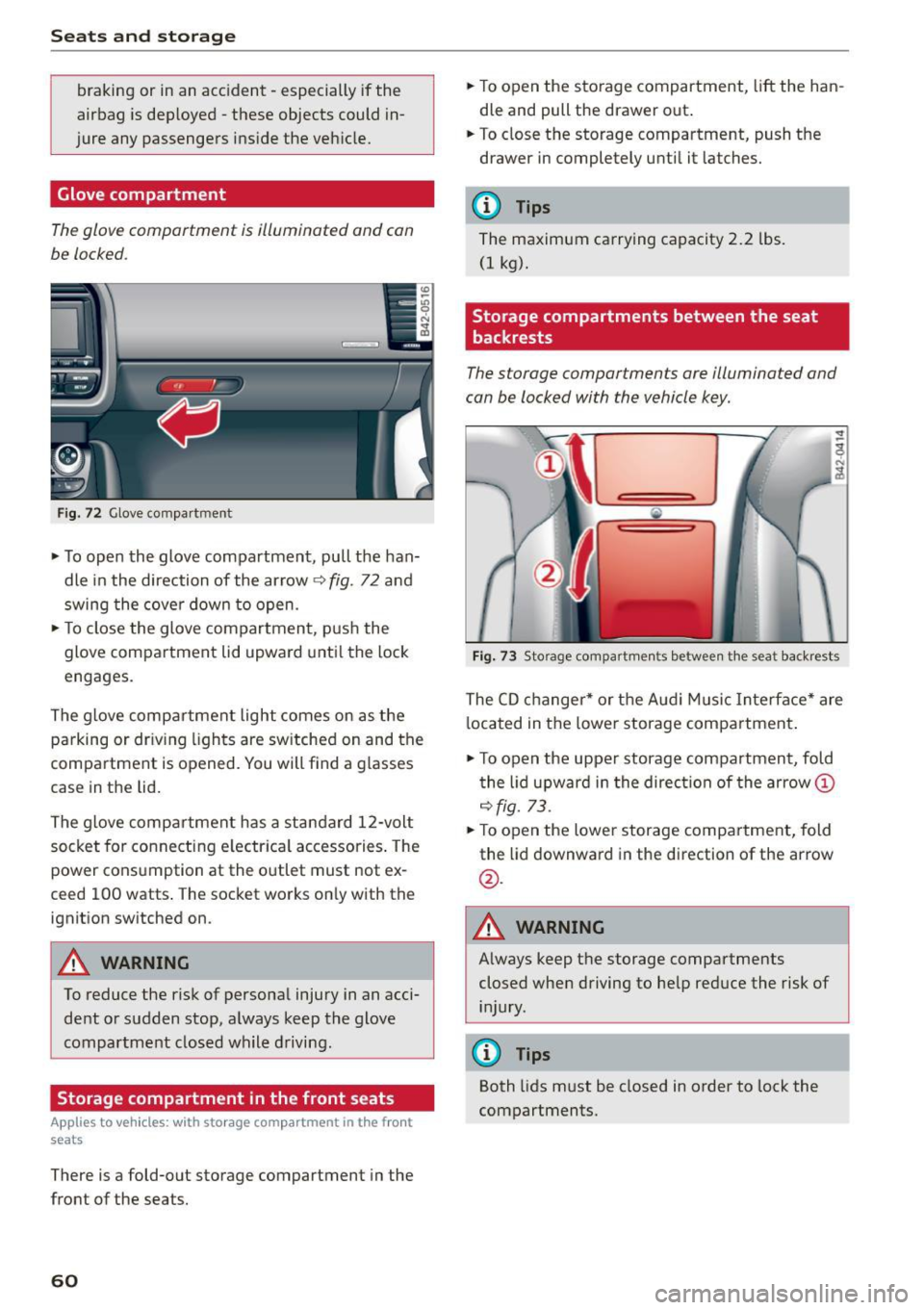
The glove comportment is illuminated and con
be locked.
F ig. 72 Glove compartment
.,. To open the glove compartment, pull the han
dle in the direction of the arrow
9 fig. 72 and
swing the cove r down to open .
.,. To close the glove compartment, p us h the
glove compartment lid upward unti l the lock
engages.
The glove compartment light comes on as the parking or dr iving lights are switched on and the
compartment is opened. You will find a g lasses
case in the lid.
The glove compartment has a standard 12-volt socket for co nnecting e lectrica l accessories . The
power cons umption at the outlet must not ex
ceed 100 watts . The socket works on ly with the
ignition switched on.
A WARNING
To reduce the risk of personal injury in an acci
dent o r sudden stop, a lways keep the glove
compartment closed wh ile driving .
Storage compartment in the front seats
Applies to veh icles: w ith storage compartment in the front
seats
There is a fold-out storage compartment in the
front of the seats.
60
.,. To open the storage compartment, lift the han
dle and pull the drawer out .
.,. To close the storage compartment, push the
drawer in completely until it latches.
(D Tips
The maximum carrying capacity 2.2 lbs.
(1 kg).
Storage compartments between the seat
backrests
The storage comportments ore illuminated and
con be locked with the vehicle key.
Fi g. 73 Storage compart men ts betwee n th e seat backrests
The CD changer * or t he A ud i M usic Interface* are
l ocated in the lowe r storage compartment .
.,. To open the upper storage compartment, fold
t he lid upward in the direc tion of the arrow@
9fig. 73 .
.,. To open the lower storage compartment, fold
the lid downward in the direction of the arrow
@ .
A WARNING -
Always keep t he storage compartments
closed when driving to help reduce the risk of i n jury.
(D Tips
Both lids m ust be closed in order to lock the
compartments.
Page 68 of 232
On the road
On the road
Steering
Adjusting the steering wheel column
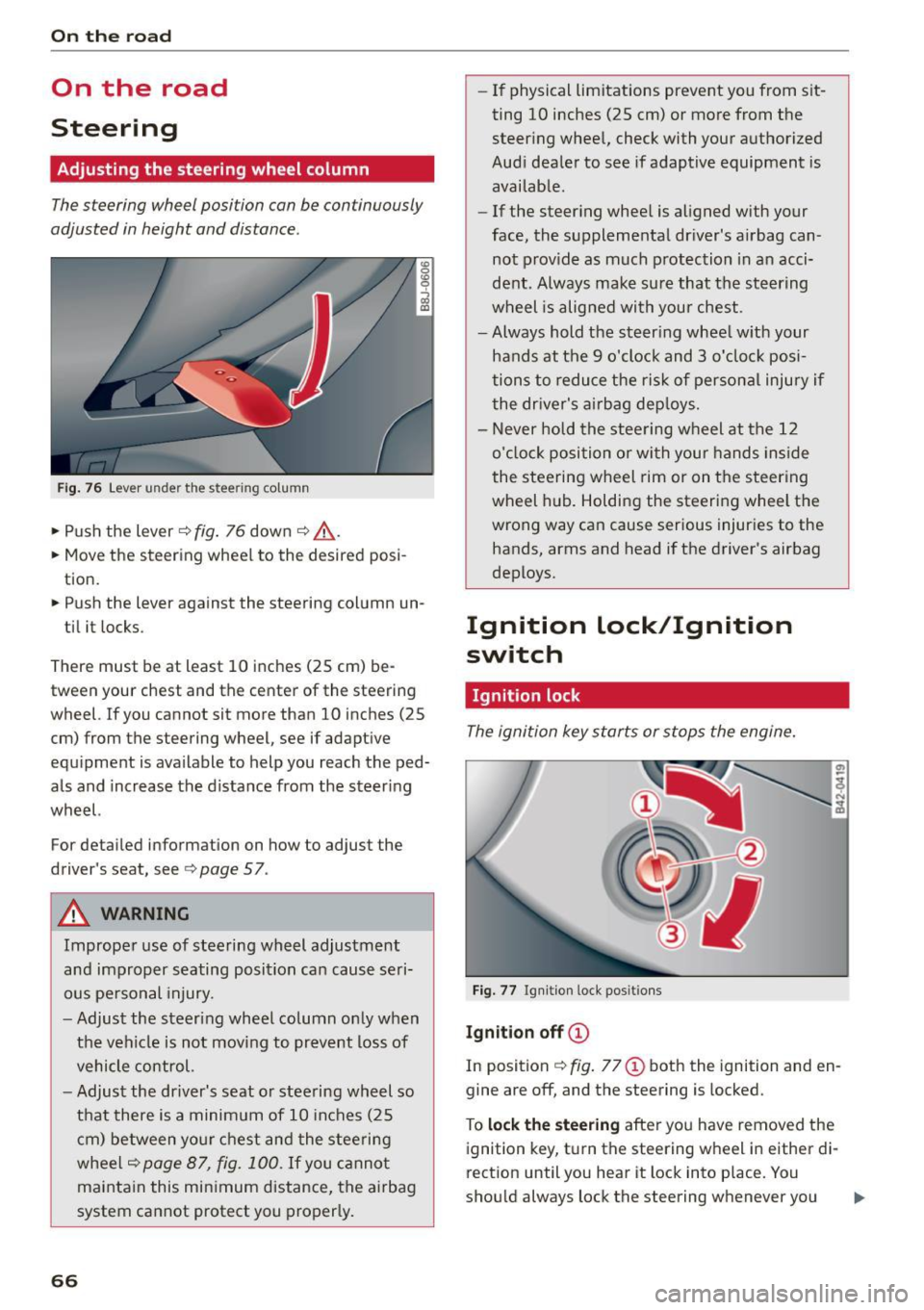
The steering wheel position can be continuously
adjusted in height and distance .
Fig. 76 Lever u nde r the stee rin g co lumn
... Push the lever ¢ fig. 76 down ¢ _&.. .
... Move the steering wheel to the desired posi
tion .
... Push the lever against the steering column un-
til it locks .
There must be at least 10 inches (25 cm) be
tween your chest and the center of the steering
wheel. If you cannot sit more than 10 inches (25
cm) from the steering wheel, see if adaptive
equipment is ava ilable to help you reach the ped
als and increase the distance from the steering
wheel.
For detailed information on how to adjust the
driver's seat, see
¢ page 57.
A WARNING
Improper use of steering wheel adjustment
and improper seating position can cause seri
ous pe rsonal injury.
- Adjust the steering wheel column only when
the vehicle is not moving to prevent loss of
vehicle control.
- Adjust the driver's seat or stee ring wheel so
that there is a minimum of 10 inches (25
cm) between your chest and the steering
wheel¢
page 87, fig. 100. If you cannot
maintain this min imum distance, the airbag
system cannot protect you proper ly.
66
- If physical limitations prevent you from sit
ting 10 inches (25 cm) or more from the steering wheel, check with your authorized
Audi dealer to see if adaptive equipment is
available.
- If the steering wheel is aligned with your
face, the supplemental dr iver's airbag can
not p rov ide as much protection in an acci
dent. Always make sure that the steering
wheel is aligned with your chest.
- Always hold the steering wheel w ith your
hands at the 9 o'clock and 3 o'clock posi
tions to reduce the risk of persona l injury if
the dr iver's airbag dep loys.
- Never hold the steering wheel at the 12 o'clock position or with your hands inside
the steering wheel rim or on the steering
wheel h ub. Holding the steering wheel the
wrong way can cause serious injuries to the hands, arms and head if the driver's airbag
deploys.
Ignition Lock/Ignition
switch
Ignition lock
The ignition key starts or stops the engine.
Fig. 77 Ign it ion lock posit ions
Ignit ion off CD
In position ¢ fig. 77 (D both the ignition and en
gine are off, and the steering is locked.
To
l ock the steering after you have removed the
ignition key, t urn the steering wheel in either di
rection until you hear it lock into place. You
should always lock the steering whenever you .,.
Page 69 of 232
..... N
r-N "': ..... \!) 1.1"1
N 1.1"1 .....
leave your vehicle . This makes vehicle theft even
more difficu lt
c::> & .
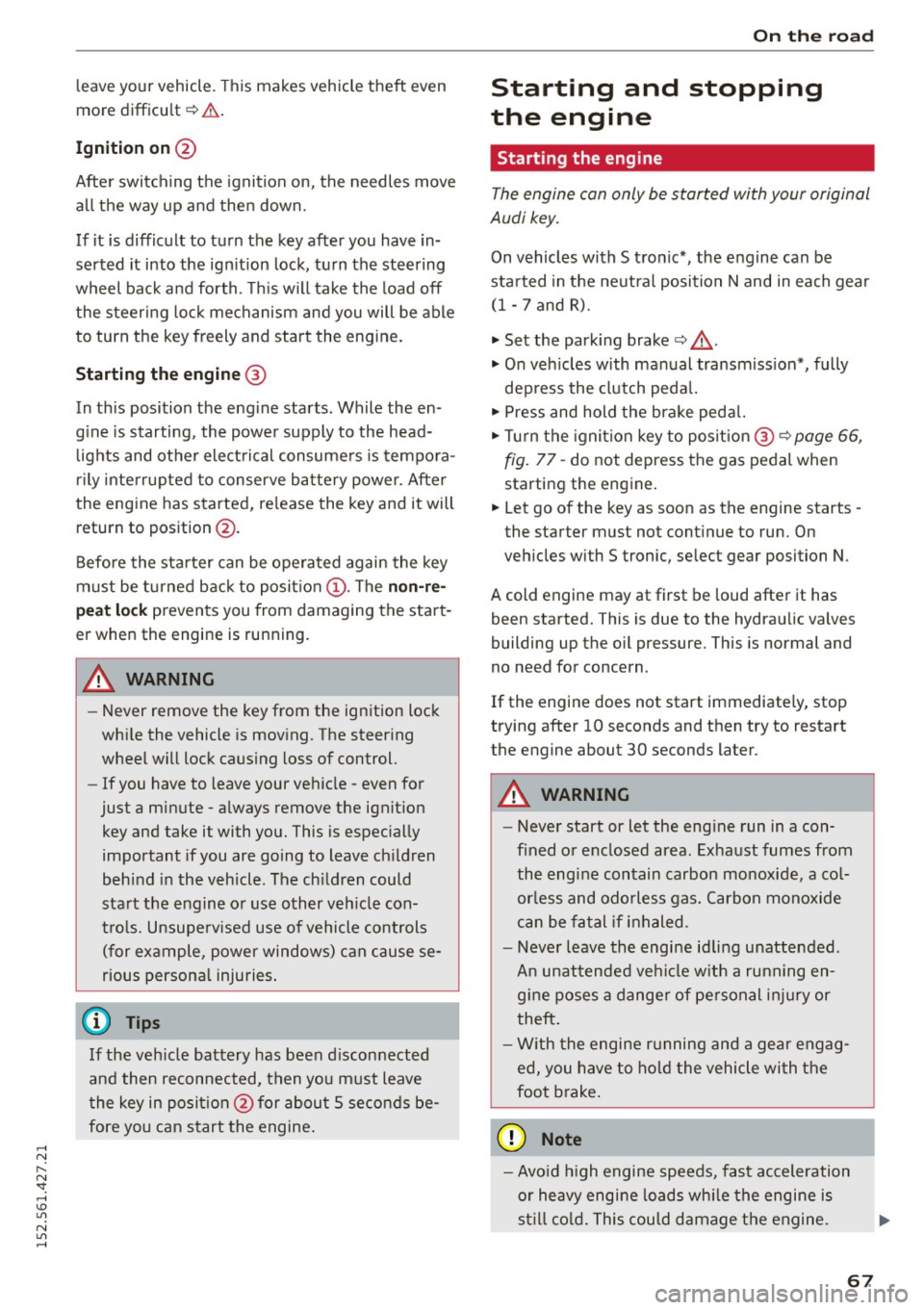
Ign ition on @
After switching the ignition on, the needles move
all the way up and then down.
If it is difficult to turn the key after you have in
serted it into the ign ition lock, turn the steering
wheel back and forth. This w ill take the load off
the steering lock mechanism and you will be able
to turn the key freely and start the engine.
Starting the engine @
In this position the engine starts . Wh ile the en
g ine is starting, the power supply to the head
l ights and other elect rical consume rs is tempo ra
ri ly inte rrupted to conserve battery power . After
the engine has started, re lease the key and it will
return to position @.
Before the sta rter can be opera ted again the key
m ust be t urned back to position (!). The
n on-re
pe at lo ck
prevents you from damaging the start
er when the engine is running .
A WARNING
-Never remove the key from the ignition lock
wh ile the vehicle is mov ing. The steer ing
wheel will lock causing loss of control.
- If you have to leave your vehicle - even for
just a min ute - a lways remove the ignit ion
key and take it with you. This is espec ially
important if you are going to leave ch ildren
behind in the veh icle . The ch ildren could
start the engine o r use other veh icle con
t ro ls. Unsuperv ised use of vehicle controls
( f or example, power windows) can c ause se
rious persona l injuries .
@ Tips
If the veh icle battery has been d isconnected
and then reconnected, then yo u m ust leave
t he key in posit ion @ for abou t 5 seconds be
fore you can start the engine .
On the road
Starting and stopping
the engine
Starting the engine
The engine can only be started with your original
Audi key.
On vehicles with S tronic*, the engine can be
sta rted in the neutra l position N and in each gear
(1 - 7 and R).
.,. Set the park ing brake
c::> .&_ .
.,. On veh icles with manual transmiss ion*, fully
dep ress the clutch peda l.
.,. Press and hold the bra ke peda l.
.,. Tu rn the ignition key to posit ion @
c::> page 66,
fig. 77 -do not depress the gas pedal when
starting the engine.
.,. Let go of the key as soon as the engine starts -
the starter m ust not cont inue to run. On
veh ides with S tronic, se lect gear position N .
A cold engine may at first be loud afte r it has
been started. This is due to the hydraulic valves
building up the oil pressure. This is normal and
no need for concern .
If the engine does not start immediately, stop
trying after 10 seconds and then try to restart
the engine about 30 seconds later .
A WARNING
--
-Never start or let the eng ine run in a con
f ined or enclosed area. Exhaust fumes from
the eng ine contain carbon mo noxide, a co l
o rl ess and odo rless gas. Carbon monoxide
can be fatal if i nhaled .
- Never leave the engine id ling unattended .
A n unattended ve hicl e w ith a running en
g in e poses a dange r of pe rsonal inj ury or
theft .
- W ith the engine r unning and a gear engag
ed, you have to ho ld the vehicle wi th the
foot b rake .
(D Note
-Avo id h igh engine speeds, fast acceleration
o r heavy engi ne loads whi le the engine is
st il l c old . T his could d amage t he engine.
67
Page 70 of 232
On the road
- The engine cannot be started by pushing or
towing the vehicle .
@I For the sake of the environment
To avoid unnecessary eng ine wear and to re
duce exhaust emissions , do not let your vehi
cle stand and warm up. Be ready to drive
off
immediately after starting your vehicle.
Stopping the engine
On vehicle s wi th S tron ic*, the engine can be
turned
off in the neutral position N and in each
gear (1 -7 and R) .
.. Tu rn the ignition key to posit ion (!) co
page 66,
fig. 77 .
A WARNING
- Never turn off the engine until the vehicle
has come to a complete stop .
- The brake booster and servotronic only work
when the eng ine is running . W ith the igni
t ion turned
off , you have to apply more force
when steering or braking. Since you cannot
steer and stop normally , this can lead to ac
c idents and serious injuries .
(D Note
-If the engine has been under heavy load for
an extended period of time, heat builds up
i n the eng ine compartment after the engine
i s switched
off -there is a r isk of damag ing
the engine . A llow the engine to continue to
run at id le for a short time or drive until it
has coo led down before you turn it off
q page 73.
-If the engine has been under heavy load for
an extended period of time, it can become
extremely hot . You should not park your ve
hicle over easily combustible objects or
areas (e .g . grass or leaves) . There is a risk of
starting a fire .
{!) Tips
After the engine has been switched off, the ra
diator fan can continue to run for up to 10 m i
nutes - even w ith the ignition switched
off . It
68
can also switch on again after some time if
the coo lant temperature rises as the result of
heat bu ildup or if the engine compartment is
heated by the sun's rays and the engine is hot .
Parking brake
Parking brake
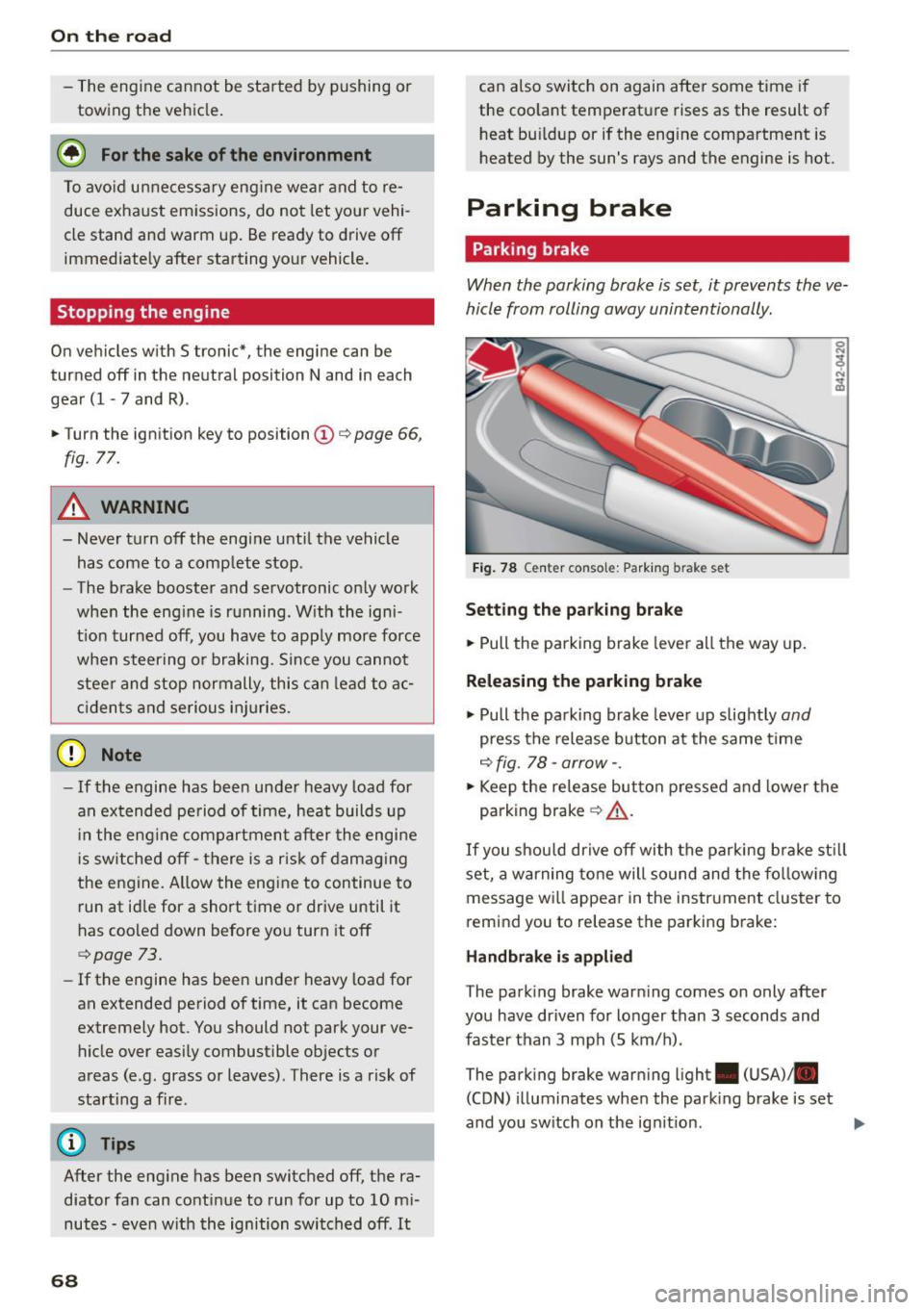
When the parking brake is set, it prevents the ve
hicle from rolling away unintentionally.
Fig . 78 C ente r co nsol e: Park ing bra ke set
S etting th e pa rking brak e
.. Pull th e parking brake lever all the way up.
Releasing the p arkin g brake
.. Pull the parking brake lever up slightly and
press the release button at the same time
c::> fig . 78 -arrow- .
.. Keep the release button pressed and lower the
parking brak e
q &_.
If you shou ld drive off with the parking bra ke st ill
set, a warning tone will sound and the fo llow ing
message wi ll appear in the instrument cluster to
r e mind you to release the parking brake:
H and brake i s appli ed
T he park ing brake warn ing comes on only after
you have driven for longer than 3 seconds and
faster than 3 mph (5 km/h) .
The parking brake warning ligh t. (USA)/ .
(CON) illuminates whe n the park ing brake is set
and you sw itch on the ign it ion .
Page 77 of 232
.... N
l'
N "1: .... I.O
"' N
"' ....
heavy loads. This can result in increased
wear .
- The Launch Control Program only funct ions
when the parking brake is released and the
vehicle speed is less than 3 mph (5 km/h).
S tronic
Description
Applies to vehicles: with S tronic
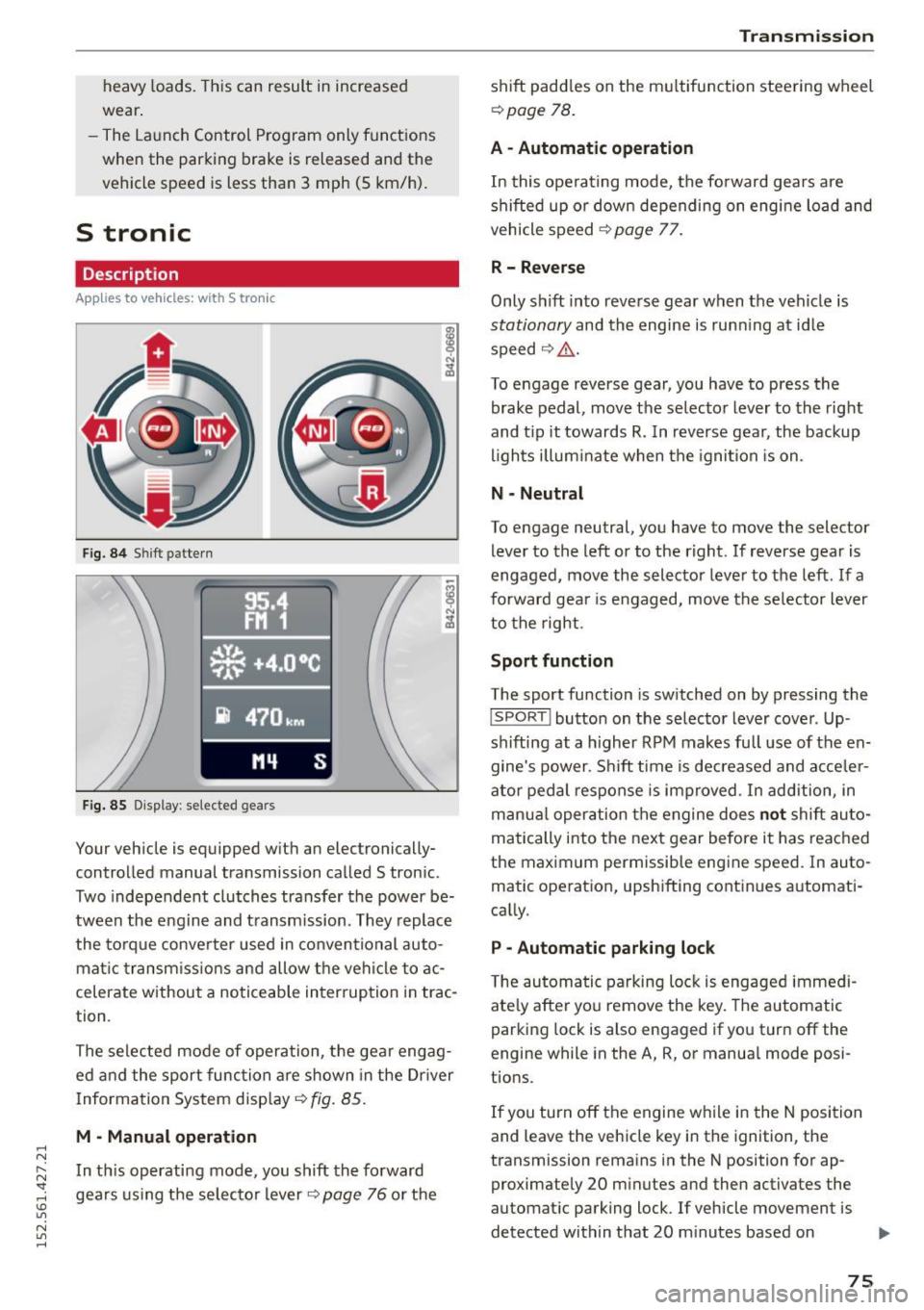
Fig. 84 Shift pattern
Fig. 85 Display : selected gea rs
Your vehicle is equipped with an electronically
controlled manual transmission called S tronic .
Two independent clutches transfer the power be
tween the eng ine and transmission. They replace
the torque converter used in conventional auto
mat ic transmissions and allow the vehicle to ac
celerate without a noticeable interruption in trac
tion .
The selected mode of operation, the gear engag ed and the sport function are shown in the Dr iver
Information System display ¢
fig. 85.
M -Manual operation
In this operating mode, you shift the forward
gears using the selector lever
r=>v page 76 or the
Transmission
shift paddles on the multifunction steering wheel
¢ page 78.
A - Automatic operation
In this operating mode, the forward gears are
shifted up or down depending on engine load and
vehicle speed
¢ page 77.
R- Reverse
Only s hift into reverse gear when the vehicle is
stationary and the engine is runn ing at idle
speed ¢
Li')...
To engage reverse gear, you have to press the
brake pedal, move the selector lever to the right
and t ip it towards
R. In reverse gear, the backup
lights illuminate when the ignition is on .
N -Neutral
To engage neutral, you have to move the selector
lever to the left or to the right . If reverse gear is
engaged,
move the selector lever to the left . If a
forward gea r is engaged, move the selector lever
to the right.
Sport function
The sport function is switched on by pressing the
I SPORT ! button on the selector lever cover . Up
shifting at a higher RPM makes full use of the en
gine's power . Shift time is decreased and acceler
ator pedal response is improved . In addition, in
manua l operation the engine does
not shift au to
matically into the next gear before it has reached
the maximum permissible engine speed. In auto
matic operation, upshifting continues automati
cally.
P -Automatic parking lock
The automatic parking lock is engaged immedi
ately after you remove the key. The automatic
parking lock is also engaged if you turn off the
engine while in the A, R, or manual mode posi
tions .
If you turn off the engine while in the N position
and leave the vehicle key in the ignition, the
transmission remains in the N position for ap proximately 20 minutes and then activates the
automatic parking lock . If vehicle movement is
detected within that 20 minutes based on
IIJI.
75
Page 78 of 232
Transmi ssio n
rotation of the whee ls, then the time wi ll in
crease a ccording ly .
A WARNING
- If a gear is engaged when the vehicle is sta
tionary, the acce lerator must not be pressed
inadvertently under any circumstances. Oth
erwise the vehicle will immed iately start to
move - sometimes even if the park ing brake
is f irmly applied.
- Before you or other persons open the engine compartment l id and work on a running en
gine, select neutral pos it ion
N and firmly
apply the handbra ke. Always read and fol
low the app licab le warn ings¢
page 155,
Working in the engine compartment.
@ Tips
- If you accidenta lly shifted into N w hile d riv
i ng, you can engage a gear in the normal
way using the selecto r lever.
- An indicator light i s displayed if a malfunc
tion occurs while in S tronic. Refer to
~page 78.
Manual mode
App lies to veh icles: w ith 5 tro nic
S tronic allows the driver to shift gears man ua lly.
Starting from a stop
.,. Press and ho ld the brake pedal.
.. Move the selecto r leve r to the left.
.. Tap the se lec tor lever forwa rd
0 -
.. Re lease the brake pedal and press the accelera -
tor pedal ¢ .&,. .
Shifting
.,. To shift up, tap the selector lever fo rward 0 -
.,. To shift down, t ap the sele ctor lever to the re ar
o.
Stopp ing temporarily
.,. Press the brake pedal to prevent the vehicle
from moving, for examp le at traff ic lights .
Par king
.. Press and ho ld the brake pedal¢.&,. .
76
.. Activate the parking brake .
.. Turn off the ignition and remove the key .
Stopping on an incline
.,. Always keep the vehicle stat ionary using the
foot brake to prevent it from " rolling back"
¢ .&,. . D o not try to p revent the vehicle from
"ro lling back" when a gear is engaged by in
creasing engine speed.
.. Activate the parking brake.
Starting on a hill
.. With a gear engaged, remove your foot from
the brake, accelerate and slowly release the
parking brake.
When acce lera ting, S tronic sh ifts i nto the nex t
gear in gea rs 1, 2, 3, 4, 5 and 6 shor tly befo re
the maximum permissib le engine speed is
r eached.
If you have se lec ted a lower gear than the current
one, S tron ic w ill shift down only when the engine
will not be ove r-revved.
You can switch to a utomat ic operation at any
time
¢ page 77.
A WARNING
-
- Never leave your vehicle with the engine
ru nning while in gear. If you must leave yo ur
vehicle with the engine r unning, set the
parking brake firmly and engage neutral
N .
- With the engine r unning and a gear engag
ed, you have to ho ld the vehicle with the
foot brake .
- Do not accelerate when you sh ift gears with
the vehicle stationary and the engine run ning.
- Before driving down a steep slope, reduce
your speed and sh ift into a lower gear with S
tronic.
- Do not ride the bra kes or press the bra ke
pedal too often or too long. Constant brak
ing causes the brakes to overheat and sub
stantially reduces brak ing performance, in
creases braking d istance or causes comp lete
fa ilu re of the brake system. ..,.
Page 81 of 232
.... N
l'
N "1: .... I.O
"' N
"' ....
(D Note
If S tronic has switched to emergency opera
tion mode, you should have the malfunction corrected as soon as possible.
Parking lock emergency release
App lies to vehicles: with S tro nic
The parking lock must be released using the
emergency release before towing the vehicle.
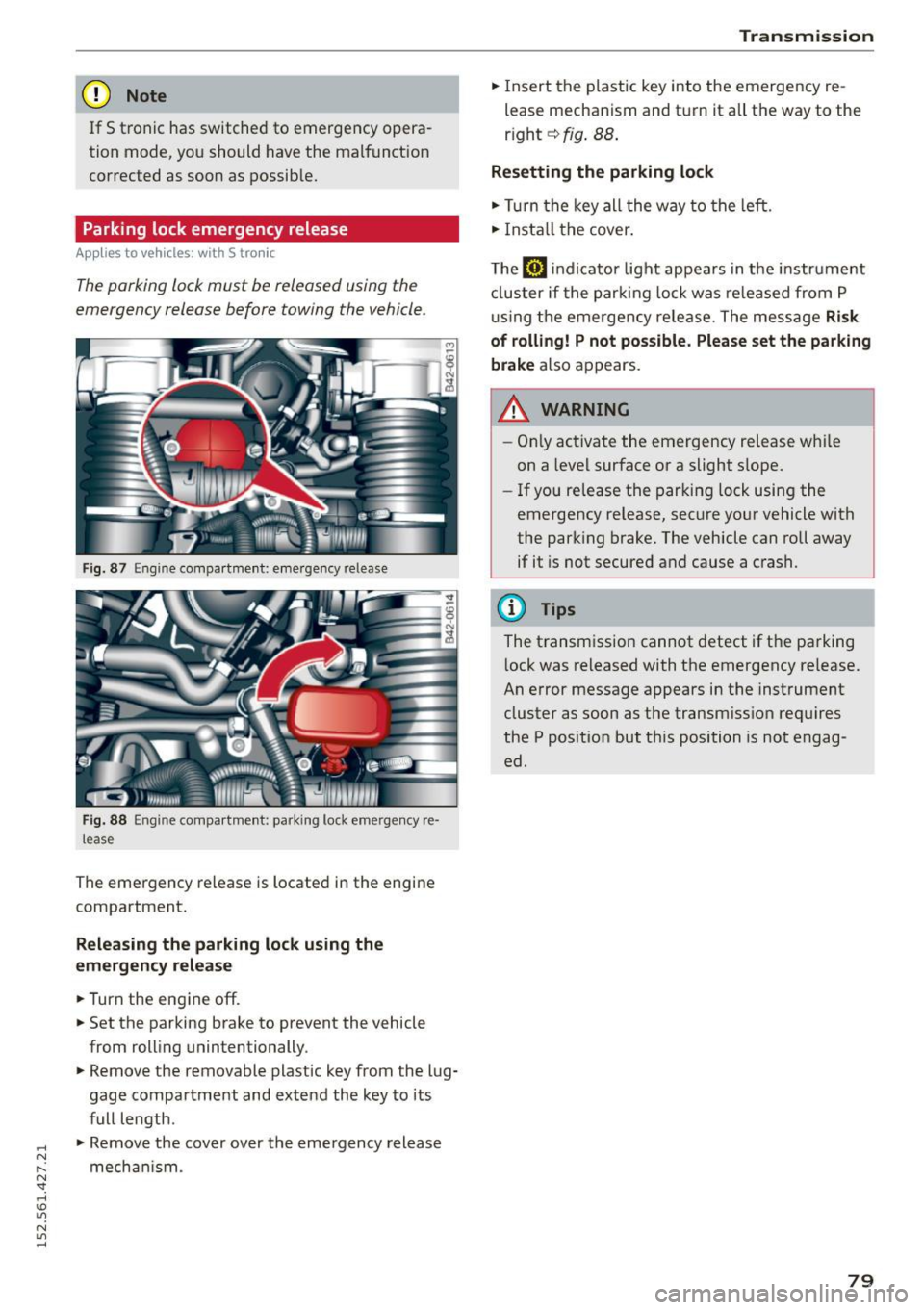
F ig. 87 Engine compart men t: emergency release
Fig. 88 Engine compa rtment: parking lock emergency re·
lease
The emergency release is located in the engine
compartment.
Releasing the parking lock using the
emergency release
.,. Turn the engine off .
.,. Set the parking brake to prevent the vehicle
from rolling unintentionally .
.,. Remove the removable plastic key from the lug
gage compartment and extend the key to its
full length .
.,. Remove the cover over the emergency release
mechan ism .
Tran smission
.,. Insert the plastic key into the emergency re
lease mechanism and turn it all the way to the
r ight ~
fig. 88.
Resetting the parking lock
.,. Turn the key all the way to the left.
.,. Install the cover.
The
[il indicator light appears in the instrument
cluster if the parking lock was released from
P
using the emergency release. The message Risk
of rolling! P not possible. Please set the parking
brake
also appears.
,&_ WARNING
- Only activate the emergency release whi le
on a level surface or a slight s lope.
- If you release the parking lock using the
emergency release, secure your vehicle with
the parking brake. The vehicle can roll away if it is not secured and cause a crash.
(D Tips
The transmission cannot detect if the parking
l ock was released with the emergency re lease.
An error message appears in the instrument
cluster as soon as the transmiss ion requires
the
P position but th is position is not engag
ed.
79
Page 100 of 232
Safety belts
-Never let any person ride with feet on the
instrument panel or stick ing out t he window
or o n the seat.
- Never remove a safety belt while the vehicle
is mov ing . Do ing so will increase your risk of
being injured or killed.
- Never wear belts twisted .
- Never wea r belts over rigid or breakable ob-
jects in or on your cloth ing, such as eye
glasses, pens, keys, etc., as these may ca use
injury.
- Never wear the shoulder part of the be lt un
der your arm or otherwise out of position .
- Several layers of heavy clothing may inter
fere w ith correct positioning of belts and re
duce the ir effectiveness.
- Always keep be lt b uckles free of anything
that may prevent the buckle from latching
sec urely .
- Never use comfort clips or devices that cre
ate slack in the shoulder belt. However, spe
c ial clips may be required for the corr ect use
of some chi ld restraint systems .
- Never allow safety be lts to become dam
aged by being caught in doo r or seat hard
ware .
- Torn or frayed safety belts can tear and
damaged belt hardware can break in an acci
dent . Inspect belts r egularly. If webb ing,
bind ings, buckles, or re tractors a re dam
aged, have belts rep laced by an au thori zed
Audi dealer or qua lified workshop .
- Safe ty belts that have been worn and l oad ed
in an accident m ust be repl aced w ith the
c orrect rep lacement sa fety belt by an a u
t h orize d Aud i dea le r o r q ualified wor ksh o p.
Replacement may be necessary even if dam
age cannot be clear ly seen. Anchorages that
were loaded must also be inspected .
- Never remove, mod ify, disassemble, or try
to repa ir the safety belts yourse lf.
- Always keep the belts clean. D irty belts may
not work properly and can impa ir the func
t ion of the inertia ree l
¢table Cleaning inte
rior on page 147.
98
Safety belts
Fastening safety belts
Seat firs t -everybody buckle up!
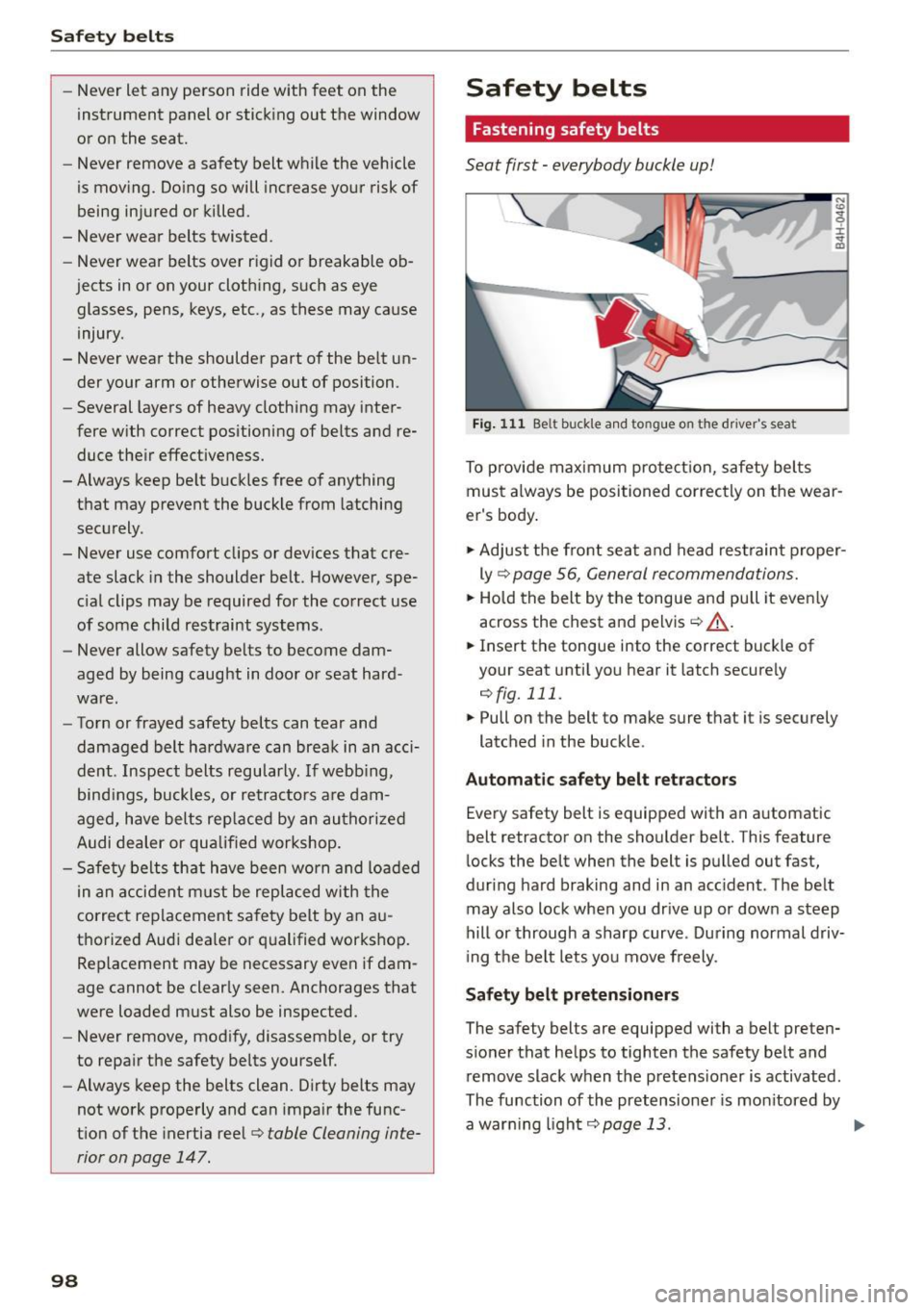
Fig. 1 11 Be lt buc kle a nd to ngue o n the drive r's seat
N
CD
~ ::i: .. a,
To p rovi de maximum pro tect ion , safety bel ts
must a lways be positioned correc tly on t he wear
er 's body .
., Ad just the fro nt sea t and head res traint p roper
ly
q page 56, General re commendations.
., Ho ld the belt by the tongue and pull it even ly
across the chest and pelvis¢&, .
., Insert th e tongue into the correct buck le of
your seat until you hear it latch secure ly
¢fig. 111.
., Pull on the belt to make sure tha t it is securely
latched in the buckle .
Automatic safe ty belt retractor s
Every safety belt is equipped with an automatic
belt retractor on the sho ulder belt. This featu re
lock s the belt when the belt is pulled out f ast ,
during h ard braking and in an acc ident . The be lt
may also lock when you dr ive up or down a steep
hill or through a sharp curve . During normal d riv
i ng the belt lets yo u move freely .
Safety belt pretensioners
The safety belts are equipped wi th a belt pre ten
s ione r that he lps to tighten the safety be lt and
remove slack when the p retens ioner is activated.
The function of the pretensione r is mon itored by
a war ning ligh t¢
page 13. ..,.
Page 101 of 232
.... N
l'
N "1: rl I.O
"' N
"' ....
Convertible locking retractor
Every safety belt except the one on the driver
seat is equipped with a convertible locking retrac
tor that
must be used when the safety belt is
used to attach a child seat. Be sure to read the
important information about this feature
c::;,page 130.
A WARNING
Improperly positioned safety belts can cause
serious injury in an accident
c::;, page 99,
Safety belt position.
- Safety belts offer optimum protection only
when the seatback is upright and belts are
properly positioned on the body.
- Never attach the safety belt to the buckle
for another seat. Attaching the belt to the
wrong buckle will reduce safety belt effec
tiveness and can cause serious personal in
jury .
- A passenger who is not properly restrained
can be seriously injured by the safety belt it
self when it moves from the stronger parts
of the body into critical areas like the abdo
men .
- Always lock the convertible locking retractor
when you are securing a child seat in the ve
hicle
c::;, page 131.
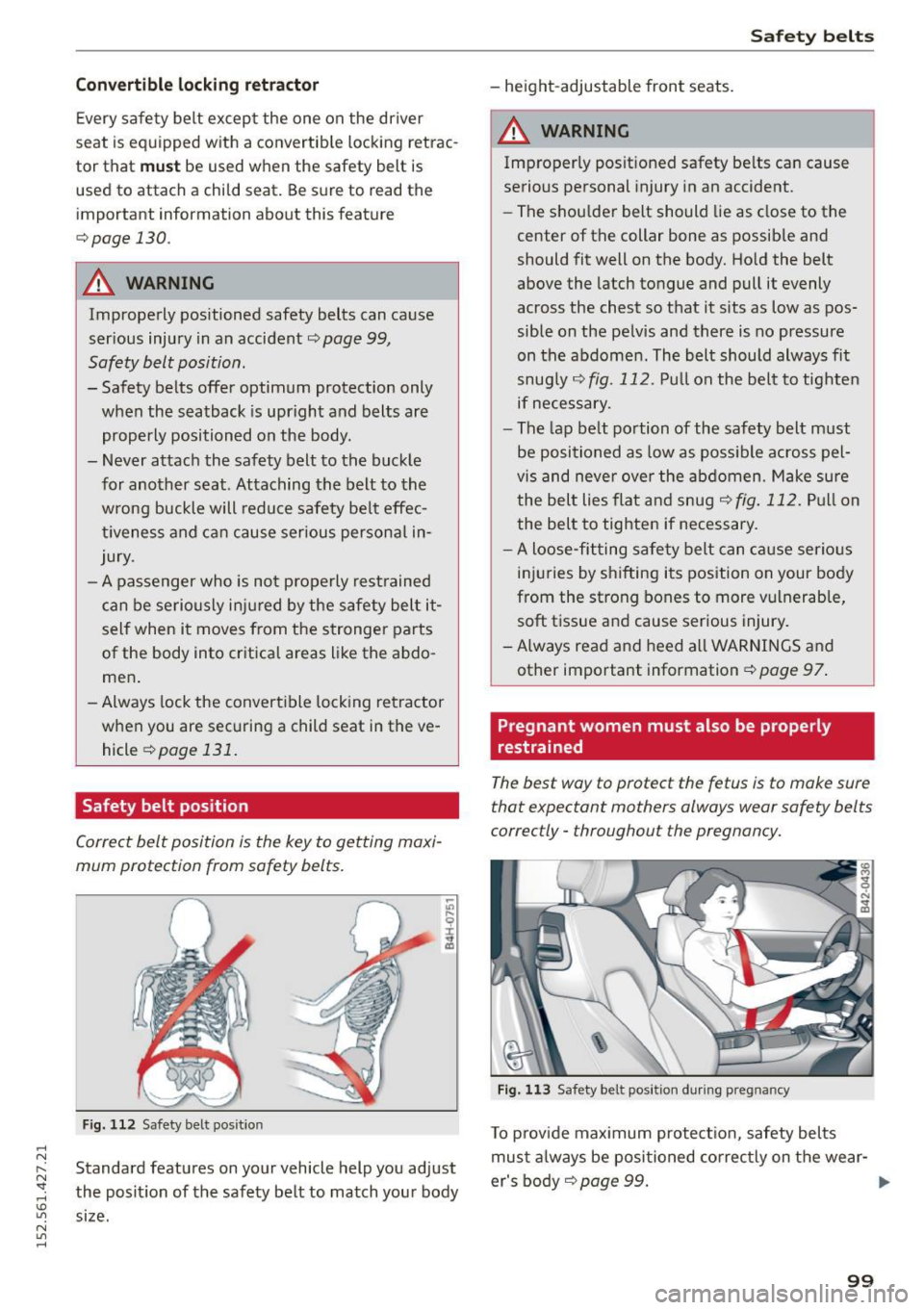
Safety belt position
Correct belt position is the key to getting maxi
mum protection from safety belts.
Fig. 112 S afety be lt pos it io n
Standard features on your vehicle help you adjust
the position of the safety belt to match your body
size .
Safety belts
-height -adjustable front seats.
A WARNING
Improperly positioned safety belts can cause
serious personal injury in an accident .
- The shou lder belt should lie as close to the
center of the collar bone as possible and
should fit well on the body. Hold the belt
above the latch tongue and pull it evenly
across the chest so that it sits as low as pos
sible on the pelvis and there is no pressure
on the abdomen. The belt should always fit
snugly
<> fig. 112. Pull on the belt to tighten
if necessary.
- The lap belt portion of the safety belt must
be positioned as low as poss ible across pel
vis and never over the abdomen. Make sure
the belt lies flat and snug
c::;, fig. 112 . Pull on
the belt to tighten if necessary.
- A loose-fitting safety belt can cause serious
injuries by shifting its position on your body
from the strong bones to more vulnerable,
soft tissue and cause serious injury.
-Always read and heed all WARNINGS and
other important information
c::;, page 97 .
Pregnant women must also be properly
restrained
Th e best way to protect th e fetus is to make sure
that expectant mothers always wear safety belts
correc tly- throughout the pregnancy.
Fig. 113 Safety be lt po sition during preg nan cy
To prov ide max imum protect ion, safety belts
must a lways be positioned correctly on the wear-
er's body
r::!;>page 99. .,.
99
Page 143 of 232
..... N
r-N "': ..... \!) 1.1'1
N 1.1'1 .....
What you should know
The highest priority is given to maintaining start
ing capability .
The battery is severely taxed in short-distance
driving, in city traffic and during the cold time of
year . Abundant electrical energy is required, but
only a little is generated . It is also critical if the
engine is not running and electrical components
are turned on. In this instance energy is being
consumed but none is being generated.
It is in precisely these situations that you w ill no
tice energy management actively regulating the
d istribution of ene rgy.
Vehicle stands for an extended period
If you do not drive your vehicle over a period of
several days or weeks , electr ical components are
gradually cut back or switched off . This reduces
energy consumption and maintains starting ca
pability over a longer pe riod .
Take into consideration that when you unlock
your veh icle, some convenience functions, such
as the remote key or power seat adjustment, may
not be available. The convenience functions will
be available again when you turn on the ignition
and start the engine .
With the engine turned off
If you listen to the radio, for example, with the
engine turned off, the battery is being dis
charged .
If starting capability is jeopardized due to energy
consumption, a message appears in the driver in
formation display .
You have to start the engine to charge the bat
tery .
With the engine running
Although electrical energy is generated when the
vehicle is being driven, the battery can become
discharged. This happens mostly when little en
ergy is be ing generated and a great deal con
sumed and the battery's state of charge is not
optimal.
Intelligent technology
To bring the energy balance back into equilibri
um, consumers which require especially large
amounts of energy are temporar ily cut back or
switched off. Heating systems in part icu lar re
quire a great deal of energy. If you notice, for ex
ample, that the heated seats* or the heated rear
window are not heating, they have been tempo
rarily cut back or switched off . These systems w ill
be available again as soon as the energy balance
has been restored.
You w ill also not ice that engine idle speed has
been increased slightly . This is normal and not a
cause for concern. By incr easing eng ine idle
speed the additional energy required is generated
and the battery is charged.
Driver notification in the instrument
cluster display
If battery power drops in to the range where it
can limit the ability of the engine to start, this is
shown in the instrument cluster display w ith the
following driver message :
[•] low battery charge: battery will be charged
while driving
This notification reminds you that the starting
capability of the engine may be limited. As soon
as you start driving again, the battery will be re
charged and the notificat ion will go out .
Driver notification appears and goes out
again
If this driver notification appears after the igni
tion is turned on or while driv ing and it goes out
again after a while, the battery has been ade
quately recharged .
Driver notification appears and does not go
out again
If this driver notif ication appears after the ign i
t ion is turned on or while dr iv ing and does not go
out again, the battery's state of charge is not in
t h e optimal range. Starting ability is restricted .
Have the battery checked as soon as possible by
an authorized Audi dea le r or qualified workshop.
141