tow AUDI R8 SPYDER 2015 Owner's Manual
[x] Cancel search | Manufacturer: AUDI, Model Year: 2015, Model line: R8 SPYDER, Model: AUDI R8 SPYDER 2015Pages: 232, PDF Size: 58.36 MB
Page 102 of 232
Safety belts
• Adjust the front seat and head restraint correct
ly
c::> page 56 , General recommendations .
• Make sure the seatback of the rear seat bench is
in upright position and secure ly latched in place
before using the belt.
• Hold the be lt by the tongue and pull it evenly
across the chest and pelvis
c::> fig . 113 , c::> _&..
• Insert the tongue into the correct buckle of
you r seat until you hea r it latch securely
c::>page 98, fig. 111 .
•Pullon the belt to make sure that it is securely
latched in the buck le .
A WARNING
-
Improperly positioned safety belts can cause
ser ious personal injury in an acc ident.
- Expectant mothers must a lways wear the
lap portion of the safety belt as low as pos
sible across the pelv is and below the round
ing of the abdomen.
- Always read and heed all WARNINGS and
other important information
c::> A in Fasten
ing safety belts on page
99 .
Unfastening safety belts
Unbuckle the safety belt with the red release
bu tton only ofter the vehicle hos stopped .
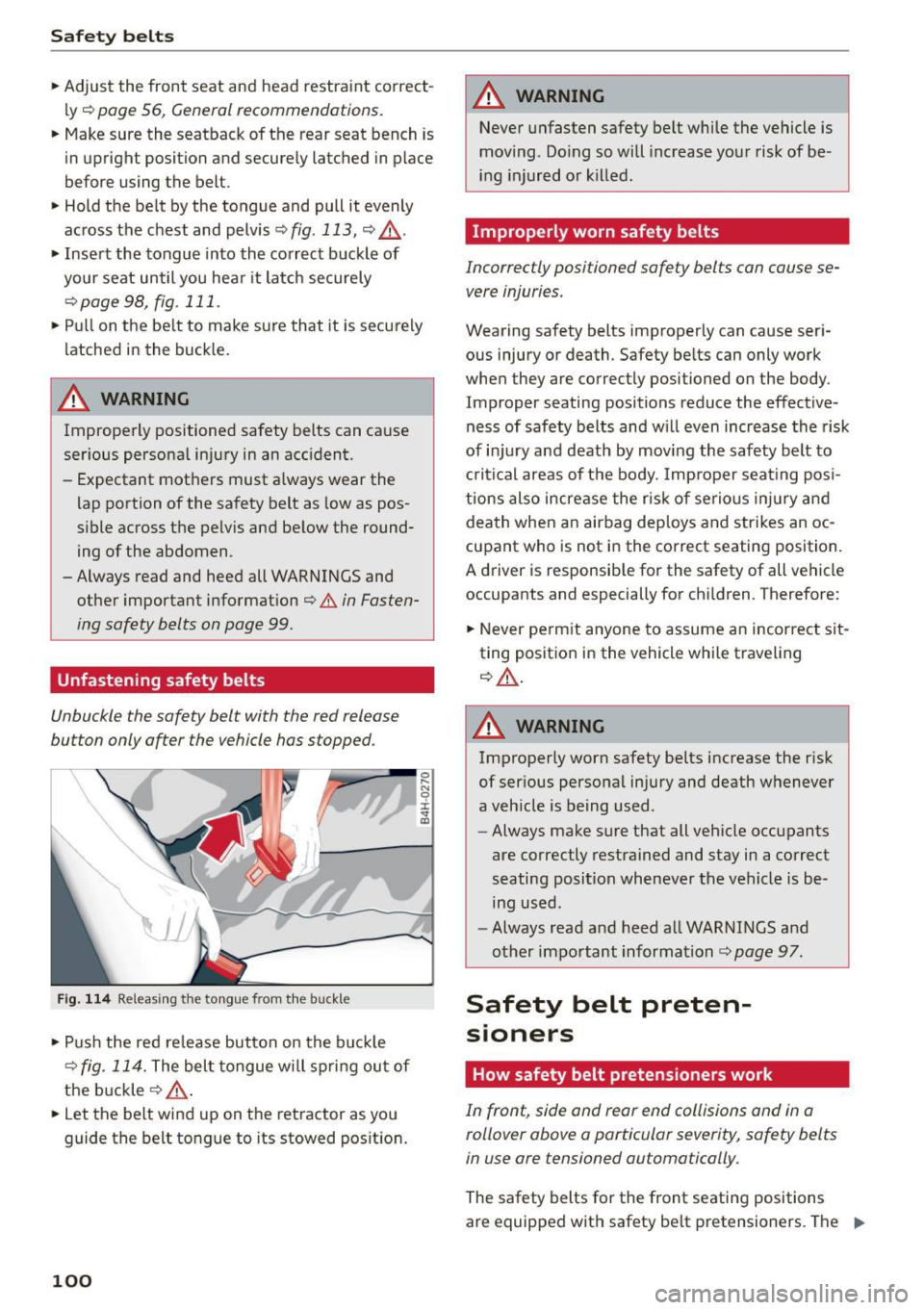
Fig. 114 Relea sing the tongue from the buckle
• Pu sh the red re lease button on the buckl e
c::> fig. 114. The belt tongue wi ll spring ou t of
the buckle
c::> ,&.
• Let the belt wind up on the retractor as you
guide the belt tongue to its stowed position .
100
0 .... N
0
:i: .,. lXl
A WARNING
Never unfasten safety be lt while the vehicle is
moving . Do ing so will increase your risk of be
ing injured or killed.
Improperly worn safety belts
Incorrectly positioned safety belts con cause se
vere injuries.
Wearing safety belts improperly can cause seri
ous injury or death . Safety belts can only work
when they are correctly positioned on the body.
Improper seating positions reduce the effective
ness of safety belts and wi ll even increase the risk
of injury and death by mov ing the safety belt to
critical areas of the body. Imp roper seat ing pos i
tions also increase the risk of serious injury and
death when an airbag deploys and strikes an oc
cupant who is not in the correct seating position.
A driver is responsible for the safety of all vehicle
occupants and especially for chi ldren . Therefore:
• Never permit anyone to assume an incorrect sit
ting positio n in the vehicle while travel ing
c::> _&. .
A WARNING
Improperly worn safety belts increase the r isk
of serious personal injury and death whenever
a veh icle is being used .
- Always make sure that all vehicle occupants
are correctly restrained and stay in a correct
seating position whenever the vehicle is be
ing used .
- Always read and heed all WARNINGS and
other important information
c::> page 97.
Safety belt preten-
.
s1oners
How safety belt pretensioners work
In front, side and rear end collisions and in a
rollover above a particular severity, saf ety belts
in use are tensioned automatically .
The safety belts for the front seating positions
are equipped with safety belt pretensioners. The ..,.
Page 111 of 232
..... N
r-N "': ..... \!) ..,.,
N ..,., .....
- An electronic control uni t, with integrated
crash sensors for front an d side impacts. The
control unit "decides" whether to fire the front
airbags based o n the information received from
the cras h sensors . The control un it also "de
c ides" whether the safety be lt pretensioners
should be activated .
- An Advanced Airbag with gas generator for the
driver inside the steering wheel hub .
- An Advanced Airbag with gas generator inside
the instrument panel for the front passenger .
- A weight-sens ing mat under the upholstery
padd ing of the front passenger seat cush ion
that measures the total we ight on the seat . The
information registered is se nt cont inuously to
the e lectronic control unit to regulate dep loy
ment of the front Advanced Airbag on the pas
se nger side.
- An a irbag monito ring system and indicator
li ght in the inst rumen t cluster
¢page 112.
-The PASSENGER AIR BAG OFF light comes on
and stays on in the cen ter of t he instrument
pane l
¢page 112, fig . 118 and te lls you when
the front Advanced Ai rbag on the passenger
side has been turned
off .
-A sensor be low the safety belt la tch for the
front seat passenger to measure the tension on
the safety be lt . The tension on the safety belt
and the weight registered by the weight-sens
ing mat help the control unit "dec ide" whether
the front airbag for the front passenger seat
shou ld be turned
off or not ¢ page 103, Child
restraints on the front seat -some important
things to know.
- A sensor in the safety belt latch for the dr iver
and for the front seat passenger that senses
whether that safety belt is latched or not and
t ransmits th is info rmation to the electronic
control unit.
~ WARNING
Damage to the front passenger seat can pre
vent the front airbag from work ing proper ly .
- Improper repair or disassembly of the front
passenger and driver seat will prevent the
Advanced Airbag System from functioning properly .
Airbag syste m
- Repairs to the front passenger seat must be
pe rformed by qualified and properly t rained
workshop personne l.
- Never remove the front passenger or driver
seat from the vehicle.
- Never remove the upho lstery from the front
passenger seat.
- Never disassemble o r remove parts from the
seat or disconnect w ires from it.
- Never carry sharp objects in yo ur pockets or
place them on the seat. If the weight-sens
ing mat in the passenger seat is punctured
it cannot work properly.
- Never carry things on your lap or carry ob
jects on the passenger seat. S uch items can
increase the we ight registered by the
weight-sens ing mat and send the w rong in
formation to the a irbag con trol unit .
- Never store items under the front passenger
seat . Pa rts of the Advanced Airbag System
under the passenger seat could be dam
aged, p reventing them and the airbag sys
tem from wo rking prope rly.
- Never p lace seat covers or rep lacement up
hols tery that have not been specifically ap
p rove d by Aud i on t he front se ats.
- Seat covers can prevent the Advanced Air
bag Sys tem from recogni zing child re
s traints or oc cupants on the front passenger
seat and prevent t he side a irbag in the seat
backrest from deploying properly.
- Never use cushions, pillows, b lan kets or
similar items on the front passenger seat .
The additional padding will prevent the
weight-sens ing mat in the seat from accu
rately register ing the child restraint or per
son on the seat and prevent the Advanced
Airbag System from functioning properly.
- If you must use a child restraint on the front
passenger seat and the child restraint man
ufacturer 's instructions require the use of a
towel, foam cushion o r some thing else to
p roperly pos ition the c hild restra int , ma ke
certain that the
PASSENGER AIR BAG OFF
light comes on an d stays on whenever the
child restraint is installed on the front pas
senger seat .
109
Page 134 of 232
Child Safety
"' You should hear a "clicking" noise as the be lt
winds back into the inertia ree l. Test the con
vertib le lock ing retractor by pulling on the belt .
You should no longer be ab le to pull the be lt
out of the retractor. The convert ible locking re
tractor is now activated.
"' Make sure that the red release button is facing
away from the ch ild restraint so that it can be
unbuckled quic kly.
"' Pull on the be lt to make sure the safety belt is
properly tight and fastened so tha t the seat
cannot move forwa rd or sideways more than
one inc h (2.5 cm).
A WARNING
Us ing the wrong child restra int or an improp
er ly installed ch ild restra int can cause serious
personal injury or death in a crash .
- Always make sure that the safety belt re
tractor is locked when installing a child safe
ty seat . An un locked safety be lt retractor
cannot hold the ch ild safety seat in place
dur ing no rma l driving o r in a crash.
- Always buckle the child safety seat firmly in
place even if a child is not s itting in it . A
loose child safety seat can fly around du ring
a sudden stop or in a crash.
- Always make sure the seat backrest to wh ich
t h e chi ld restraint is insta lled i s in an up
right posi tion. Othe rwise , the seatback wi th
the chi ld safety seat at tached to it could fly
forward in the event of an accident o r other
emergency situation.
- Always read and heed all WARN INGS when
ever using a child restrained in a vehicle is
being used
r::!) page 122. Specia l precautions
apply when installing a child safety seat on
the front passenger seat¢
page 103, Child
restraints on the front seat -some impor
tant things to know .
132
· Deactivating the convertible locking
retractor
The convertible locking retractor for child re
straints will be deactivated automatically when the belt is wound all the way back into the re
tractor.
"' Press the red button on the safety belt buckle.
T he be lt tong ue will pop out of the b uc kle .
"' Guide the safety be lt a ll the way back into its
stowed position .
Always let the safety be lt ret ract completely i nto
i ts stowed pos it ion. The safe ty belt can now be
u sed as an ordina ry safety belt without the con
vertib le locking retractor for child restraints .
If the conve rtib le locking retractor sho uld be ac
tivated inadvertent ly, the sa fety be lt mus t be un
fastened and guided comp letely back into its
stowed position to deactivate this feature .
If the
convertible locking retractor is not deactivated,
the safety belt will gradually become tighter and
uncomfortable to wear.
A WARNING
Improperly installed chi ld safety seats in
crease the risk of serious pe rsonal injury and
death in a co llision.
-
- Never unfasten the safety belt to deactivate
the convertible locki ng retractor for child re
straints while the vehicle is moving. You
wou ld not be restra ined and could be ser i
ously inj ured in an accident.
- Always read and heed all WARNINGS when
eve r using a child res trained in a vehicle is
be ing used
¢page 122. Special precaut ions
apply when installing a child sa fety seat on
the front passenger seat
¢ page 103, Child
restraints on the front seat -some impor
tant things to know.
Additional Information
Sources of information about child
. restraints and their use
There are a number of sources of additiona l infor
mation about child restraint se lection, insta lla
tion and use :
Page 139 of 232
..... N
r-N "': ..... \!) 1.1'1
N 1.1'1 .....
This can cause a temporary reduction in braking
force compared to dry brakes. You can compen
sate for this by pressing the brake pedal harder.
Cor ro sion
There may be a tendency for dirt to bui ld up on
the brake pads and corrosion to fo rm on the discs
if the car is not driven regularly or only for short
trips with little use of the brakes.
If the b rakes are not used frequently, or if corro
sion has formed on the discs, it is advisab le to
clean off the pads and discs by braking firmly a
few times from a moderately high speed
c:> &. .
Faults in the brake sy stem
If you should notice a sudden increase in brake
pedal travel, then one of the two brake circuits
may have fai led
c:> .&, .
Low brak e flu id le vel
Malfunct ions can occur in the brake system if the
brake fluid level is too low. The brake flu id leve l is
monitored e lectronically.
Br ake power assis t un it
T he brake power assist unit increases the pres
sure that you generate with the brake pedal.
It
works only when the eng ine is running .
Brak e lining wear sta tu s
Brake lining wear may be checked by visual in
spection of the condition of the brake pads
through the openings in the wheel. If necessary,
the wheel may be removed for this inspection
c:> page 203 .
.8, WARNING
-New brake pads don't have the best stop
ping power and must be "broken-in" during
the init ial 250 mi les ( 400 km) of normal city
driving. The break -in period can be consider
ably longer for vehicles with ceramic brake
rotors *. You can compensate for this by
pressing the brake pedal more firmly. This
also applies later when new pads are instal
led .
- You should perform brak ing maneuvers for
the purpose of clean ing the brake system
Int elli ge nt te chn olo gy
only if road conditions permit. Other road
users must not be put at r isk -you may
cause an accident!
- Before descending a steep grade, reduce
speed and sh ift transmission into a lower
gear or lower dr iving range. Do not ride the
brakes or hold the pedal down too long or
too often. This could cause the bra kes to get
hot and dimin ish braking effic iency .
- Do not "ride the brakes" by rest ing your foot
on the pedal when you do not intend to
brake. This may cause the brakes to over
heat, premat ure wear and increased stop
ping distance.
- Under certain cl imatic and operat ing condi
tions such as passing thro ugh water, dr iv ing
in heavy rain or after washing the vehicle,
the effectiveness of the brakes can be re
duced . In winter, ice can accumulate on the
brake pads, lin ings, discs and drums. Care
fully apply brakes for a test. Brakes will dry and ice coatings will be cleaned off after a
few careful brake applications.
- Driving for an extended period of t ime on
salt-covered roads without using your brakes can also affect braking efficiency .
Clean off accum ulated salt coating from
b rake discs and pads with a few cautious
brake applications.
- If you damage the front spoiler, or if you in
stall a different spoiler, be su re the air flow
to the front brakes is not obstructed . O ther
wise the brake system could overheat reduc
ing the effectiveness of the entire brake sys
tem .
- Fai lure of one brake circuit will impai r the
braking capability resu lting in an increased
stopping distance . Avoid driving the vehicle
and have it towed to the nearest Aud i dea ler
or qualif ied workshop.
- Never let the vehicle roll to a stop with the
engine shut off.
- If the brake booster is not working, for ex
ample when towing your veh icle, or because
the brake booster has somehow been dam
aged, the brake pedal must be pressed con
siderably harder to make up for the lack of booster assistance.
1 37
Page 141 of 232
..... N
r-N "': ..... \!) ..,.,
N ..,., .....
Power steering
When the engine is running, power steering
makes i t easier for the driver to steer.
Power steering helps the driver steer the vehicle
with litt le physical effort.
If the engine is not running, the power steering
system is also not working. In this case, you will
find it extremely difficult to turn the steering
wheel.
If you turn the steering fully to the left or right
when the vehicle is stationary, you place a very
heavy load on the power steering system. Turning
the steering wheel fully to the left or right wi ll
cause noise in the system . It also reduces engine
idle speed.
(D Note
Do not hold the steering turned fully to the
left or right for more than 10 seconds when
the engine is running. There is a risk of dam
age to the power steering system.
@ Tips
- In the event of a power steering system fail
ure, or if the engine is not running (while
being towed), you will still be able to steer
the vehicle. However, you will require more
effort to do so.
- If the power steering system has a leak or is
defective, you should immediately contact a
qualified workshop .
- The power steering system requires a spe
cial hydraul ic fluid . The power steering fluid
reservoir is located in the engine compart
ment. The correct hydraulic fluid level is im
portant for proper operation of the power
steering system. The power steering fluid
l evel is checked according to the Audi main
tenance service schedule.
Dry sump lubrication
High lateral and longitudinal forces affect the en
gine and the vehicle during sporty driving. Dry
sump lubrication ensures that your engine is sup-
Intelligent technology
plied with oil and properly lubricated even under
these conditions.
In a "norma l" vehicle the oil pump sends the oil
from the oil pan to the lubrication points in the
engine . The oil then returns to the oil pan. In ex
treme situations, the oil pump may draw in air,
wh ich results in insufficient oi l pressure .
With dry sump lubrica tion, the oil is not in the oil
pan (it is "dry"), but in a separate oi l tank. While
one pump supplies the engine with oil, a second
pump suct ions the oil out of the engine and re
turns it to the o il tank. Because the oil tank is tall
and narrow, oil pressure is constant even under
extreme conditions .
In add ition, the oi l pan in vehicles with dry sump
lubrication is noticeably shallower . This allows
the engine to be installed lower in the vehicle,
bringing down the center of gravity . This im
proves your vehicle's handling.
Driving with your quattro
With oil-wheel drive, all four wheels are driven .
General information
With all-wheel drive, power is distributed to all
four wheels . This happens automatically depend
ing on your driving style and the road conditions
at the time . See also
c:::.> page 134.
The all-whee l drive concept is designed for high
engine power . Your vehicle is exceptionally pow
erful and has excellent driving characterist ics
both under normal driving conditions and on
snow and ice. Always read and fo llow safety pre
cautions
c:::.> .&_ .
Winter tires
When driving in the winter, your vehicle with all
wheel drive has an advantage, even with regular
t ir es . In winter road condit ions it may be advisa
ble to mount winter tires (or all-season t ires) for
improved driveability and brak ing: these tires
must be mounted on
all four wheels. See also
c:::.> page 193 , Winter tires.
139
Page 144 of 232
Driving and en vironment
Driving and environment
Break-in period
A new vehicle must be broken in, and the break-in
period shou ld be 1 ,500 miles (2,500 km) . Do not
use full acceleration for the first 600 miles
(1 ,000 km) and do not exceed the maximum en
gine speed of 6,000 rpm You must also not use
full accelerat ion between 600 and 1,200 miles
(1,000 to 2,000 km) . From 1,200 to 1,500 miles
(2 ,000 to 2,500 km), you can gradually increase
maximum eng ine speed to 8,250 rpm for brief
pe riods.
During the first hours of operation, there is
greater fr iction in the eng ine and the transmis
sion than later when all the moving pa rts have
b roken in .
The way you drive during the first 1,500 miles
(2 ,500 km) affects engine quality . If you drive at
modera te engine speeds thereafter, part icu larly
when the engine is cold, yo u red uce eng ine wea r
and increase the potential mileage o f the engine.
Do not dr ive at RPMs that a re too
low. Shift down
when the engine is no longe r runni ng "smooth
ly". Extremely high RPMs are gover ned automati
cally.
Avoid damaging the
vehicle
W hen you are driving on poor roads, or over
curbs, steep ramps, etc ., make certain that low
lying parts such as spoilers and exhaust system
parts do not bottom out and get damaged .
This is especially true for vehicles with low-slung
chassis (sports chassis) and fully loaded vehicles.
Driving through water on
roads
Note the following to avoid vehicle damage when
d riving through water, for examp le on flooded
roads:
- The water must no t be any h igher than the bot
tom of the vehicle body.
142
- Do not drive faster than walk ing speed .
A WARNING
After driv ing through water, mud, s lush, etc .,
the brakes may be s low to take effect because
of wet brake rotors and pads. Dry the brakes
first by brak ing carefully to restore the full
braking effect.
(D Note
Vehicle components such as the eng ine,
transmission , suspension or e lectrical system
can be severe ly damaged by dr iv ing t hrough
water .
(D Tips
- Check the dept h of the water before driving
through it.
- Do not stop the vehicle, drive in reverse or switch the engine off when driv ing through
water.
- Keep in mind that oncoming veh icles may
create waves that raise the water level and
make it too deep for your vehicle to d rive
through safely .
- Avoid driving through salt water because it
can cause corrosion.
Catalytic converter
It is very important that your emission control
system (catalytic converter) is functioning prop
erly to ensure that your vehicle is running in an
environmen tally sound manner.
.,. Always use lead-free gasoline ~ page 151,
Fuel supply.
.,. Never r un the tank down all the way to empty.
.,. Never put too much mo tor o il in yo ur engi ne
~ page 160, Adding engine oil 'l::r..
.,. Never try to push- or tow-sta rt your vehicle .
The cata lytic converter is an effi cien t "clean -up"
device built in to the exhaust system of the vehi
cle. The cata lytic conve rter burns many of the
po llutants in the exhaust gas before they are re
l eased into the atmosphere.
-
Page 146 of 232
Driving and en vironment
CJ) Note
- Have your vehicle maintained properly and
in accordance w ith the service recommenda
tions in your Warranty
& Maintenance book
l et . Lack of proper ma intenance as well as
i mproper use of the vehicle will impair the
funct ion of the emission control system and
could lead to damage .
- Do not alter or remove any component of the Emi ssion Cont ro l System unless ap
proved by the manufacturer.
- Do not a lter or remove any dev ice, such as
heat shie lds, switches, ig nition w ires,
valves, wh ich are des igned to prote ct you r
vehicle's Emiss ion Control Sys tem and other
i mportant veh icle components.
(D Tips
The consumpt ion estimates as published by
t he ENV IRONM ENTA L PROTECTION AG ENCY
(EPA) and Transport Canada may not co rre
spond to your act ual consumption on the
road , which wi ll vary depen ding upon vehicle
load and speed, road and weather cond itions,
trip length, etc.
Trailer towing
General information
Your Audi RB Spyder is not designed to tow a
trailer.
Towing a tra iler with your Audi R8 Spyder is not
recommended and ca n cause damage to the car .
D amaged caused by tow ing a tra ile r i s not cov
e red by your Aud i War ranty .
144
Page 186 of 232
Tires and wheels
sudden deflation, causing loss
of control and a crash .
Determining correct load
limit
Use the example below to calcu
late the total weight of the pas
sengers and luggage or other
things that you plan to transport so that you can make sure that
your vehicle will not be overload ed .
Steps for Determining Correct
Load Limit
1 . Locate the statement "THE
COMBINED WEIGHT OF OCCU
PANTS AND CARGO SHOULD
NEV ER EXCEED XXX KG OR XXX
LBS"on your vehicle's placard
(tire inflation pressure label)
c:::> page 176, fig. 147.
2. Determine the combined
weight of the driver and pas
sengers that will be riding in
your vehicle .
3 . Subtract the combined weight
of the driver and passengers
from "XXX" kilograms or "XXX"
pounds shown on the sticker
c:::> page 176, fig. 147.
4 . The resulting figure equa ls the
available amount of ca rgo and
1 8 4
luggage load capacity. For ex
ample, if the "XXX" amount
equals 1400 lbs. and there will
be five 150 lbs. passengers in
your vehicle, the amount of
available cargo and luggage
load capac ity is 650 lbs .
(1400-7 SQ (5 X 150) = 650
lbs.)
5. Determine the combined
weight of luggage and cargo
being loaded on the vehic le.
That weight may not safely ex
ceed the available cargo and luggage load capacity calculat
ed in Step 4 .
6. If your vehic le w ill be towing a
trailer, load from your t railer
will be transferred to yo ur vehi
cle . Consult this manual to de
termine how this reduces the ava ilable cargo and luggage
load capacity of your vehicle.
~ check the tire sidewall
(c:::> page 186, fig. 150) to deter
mine the designa ted load rating
for a specific tire .
Page 201 of 232
What do I do now? Trunk escape handle
Appl ies to vehicles: with trunk escape handle
In case of an emergency, the front lid can be
opened from the inside using the trunk escape
handle.
.. To open the front lid pull the handle.
The trunk escape handle inside t he luggage com
partment is made of fluorescent material to glow
in the dark .
.&_ WARNING
The trunk escape handle is to be used only in
an emergency.
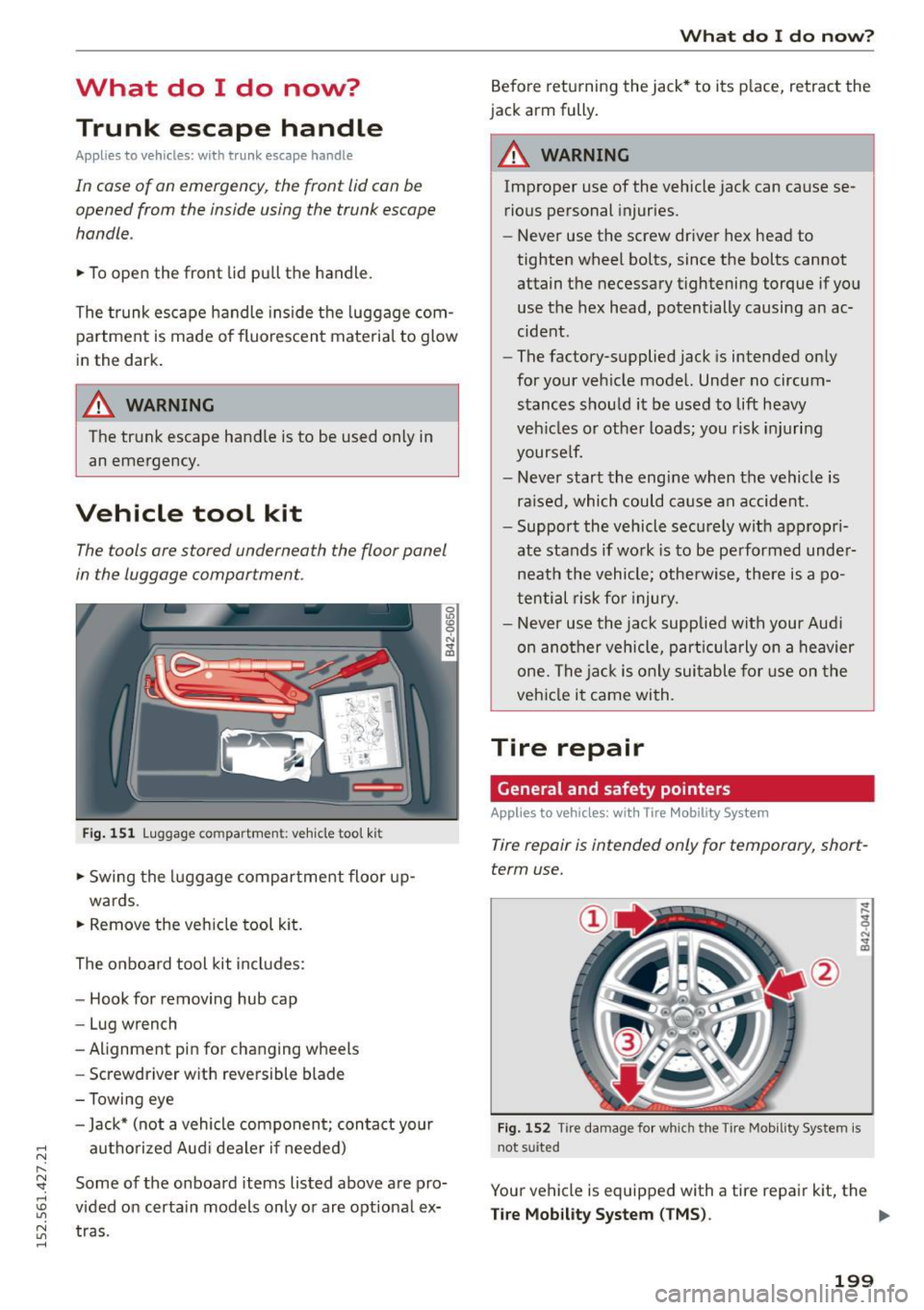
Vehicle tool kit
The tools are stored underneath the floor panel
in the luggage compartment.
Fig. 151 Luggage compartment: veh icle tool kit
"' Swing the luggage compar tment floo r up-
wards .
.. Remove the vehicle tool kit.
The onboard tool kit incl udes:
- Hook for removing hub cap
- Lug wrench
- Alignment pin for changing wheels
- Screwdr iver w ith reversible blade
- Towing eye
- Jack* (not a vehicle component; contact your
,..... authorized Aud i dealer i f needed)
N
I'-
~ Some of the on board items listed above are pro-
.... :5: vided on certa in models only or are optiona l ex-
N l/1 .... tras.
What do I do no w?
Before returning the jack* to its p lace, retract the
jack arm fully.
.&_ WARNING
-
Improper use of the vehicle jack can cause se-
rious personal injuries.
- Never use the screw driver hex head to
tighten wheel bo lts, since the bolts cannot
attain the necessary tightening torque if yo u
use the hex head, potentially causing an ac
cident.
- The factory-supplied jack is intended only
for your veh icle model. Under no circum
stances should it be used to
lift heavy
veh icles or other loads; you risk injuring
yourse lf.
- Never start the engine when the vehicle is
raised, which could cause an accident.
- Support the vehicle securely with appropri
ate stands if work is to be pe rformed under
neath the vehicle; otherwise, the re is a po
tential risk fo r injury.
- Never use the jack supplied with your Aud i
on another vehicle, part icularly on a heavier
one. The jack is only suitable for use on the
vehicle it came with.
Tire repair
General and safety pointers
Applies to vehicles: with Tire Mobility System
Tire repair is intended only for temporary, short
term use.
Fig. 152 Tire damage for which the Tire Mobility System Is
not suited
Your vehicle is equipped with a tire repa ir kit, the
T ire Mob il it y Sy stem ( TMS). .,.
19 9
Page 210 of 232
What do I do now?
- Be fo re you check a nything in t he e ngine
compartment, always read and heed all
WARNINGS
Q page 155, Working in the en
gine compartment .
CD Note
Improper hook-up of jumper cables can ruin
the generator.
- Always connect POSITIVE( +) to POSITIVE
( + ), and NEGA TIVE(-) to NEGATIV E(-)
gro und post of the battery manager control
unit.
- Check that a ll screw plugs on the battery
cells are screwed in firmly . If not, tighten
plugs prior to connect ing clamp on negat ive
battery terminal.
- Please note that the procedure for connect
i ng a jumper cable as described above ap
plies specifically to the case of your vehicle
being jump started. When you a re g iving a
ju mp sta rt to another vehicle, do
not con
n e ct the neg ative(- ) ca b le to the negative
( - ) terminal o n the discharged battery @.
Instead, se curely connect the negative(-)
cab le to either a solid metal component
that is f irm ly bolted to the engine block or
to the engine block itself . If the battery that
i s bei ng charged does not vent to the out
s ide , escap ing battery gas could ignite and
explode!
Emergency towing with
commercial tow truck
General hints
Your Audi requires special handling for towing.
The fo llow ing in formation is to be used by com
mercial tow truck operators who know how to op
erate their equipment safely .
- Never tow your A ud i, tow ing will cause damage
to the engine and transmiss ion .
- Never wrap the safety chains o r winch cables
around the b rake lines.
- To preven t un ne cessary d am age, yo ur Audi
mus t be transpor ted with a car carrier ( flat bed
t ruck) .
208
-To load the vehicle on to the flat bed , use the
tow ing loop found in the vehicle tools and at
tach to the front anchorage
Q page 208.
_& WARNING
A veh icle being towed is not safe for passen
gers. Never a llow anyone to ride in a vehicle
being towed, fo r any reason.
CD Note
The vehicle has ver y low ground clearance.
M ake sure that no damage is caused to the
underside of the vehicle when it is being load
ed onto a flat bed truck .
Front towing loop
Do not install the front towing loop un til it is
needed.
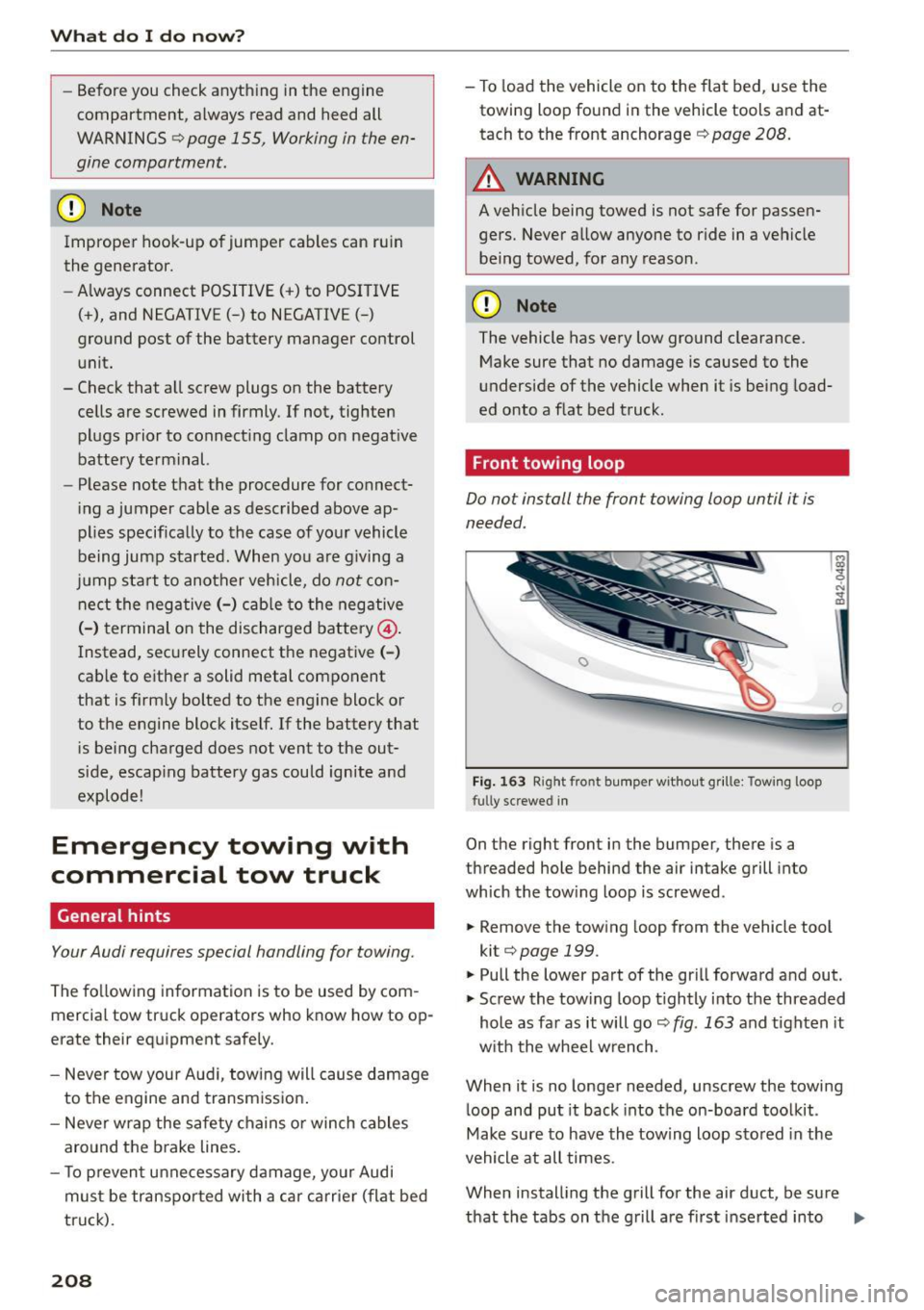
Fi g. 163 Righ t fro nt bu m per w it h ou t gr ille: Tow ing loo p
full y screwe d in
On the right front in the bumper , there is a
t h readed hole behind the air intake g rill into
which the tow ing loop is screwed .
.,. Remove the tow ing loop from the vehicle tool
kit
Q page 199 .
.,. Pull the lower part of the gr ill forward a nd out .
.,. Sc rew the tow ing loop t ightly into t he threaded
hol e as fa r as it will go
Q fig . 163 and tighten it
w ith the wheel w rench .
When it is no longer needed, unscrew the towing
l oop and put it back into the on-boa rd too lkit .
Make sure to have th e towing loop sto red in the
vehicle at all times .
When install ing the grill for the air duct, be sure
that the tabs on t he g rill a re first inserted into .,..