warning light AUDI R8 SPYDER 2015 Workshop Manual
[x] Cancel search | Manufacturer: AUDI, Model Year: 2015, Model line: R8 SPYDER, Model: AUDI R8 SPYDER 2015Pages: 232, PDF Size: 58.36 MB
Page 113 of 232
..... N
r-N "': ..... \!) ..,.,
N ..,., .....
When an airbag deploys, fine dust is released.
This is normal and is not caused by a fire in the
veh icle. This dust is made up mostly of a powder
used to lubricate the airbags as they deploy . It
could irr itate skin.
It is important to remember that while the sup
p lemental a irbag system is designed to reduce
the likelihood of serious injuries, other injur ies,
for example swel ling, bruising and minor abra
sions , can also happen when a irbags inflate . Air
bags do not protect the arms or the lower parts
of the body . Front airbags only supp lement the
three point safety belts in some frontal col lisions
in which the ve hicle deceleration is high eno ugh
to deploy the airbags .
Front airbags will not d eploy:
- i f the ignit ion is switched off when a crash oc-
curs,
- in s ide collisions,
- in rear-end collisions,
- in ro llovers,
- when the crash deceleration measured by the
airbag system is less than the minimum thresh
o ld needed for airbag deployment as registered
by the electronic control un it.
The front pa ssenger airbag will a lso not
deplo y:
- when the front passenger seat is not occupied,
- when the we ight on the front passenger seat as
sensed by the Advanced Airbag System indi
cates that the front airbag on the passenger
s ide has to be turned
off by the electronic con
trol unit (the
PA SS ENGER AIR BAG OFF light
comes on and stays on) .
A WARNING
Sitting in the wrong position can increase the
r is k of se rious injury in crashes .
- To reduce the r isk of injury when the airbags
inflate, the d river and passengers must al
ways s it in an upr ight position, must not
lean against or place any part of their body
too close to the area where the airbags are
located .
Airbag syste m
- Occupants who are unbelted, out of position
or too close to the airbag can be serio usly
injured by an airbag as it unfolds with great
force in the blink of an eye
c'.> page 103.
A WARNING
A child in a rearward-fac ing ch ild safety seat
i nstalled on the front passenge r seat w ill be
seriously inju red and can be killed if the front
a ir bag inflates -even with an Advanced Airbag
System.
- The inflating airbag will h it the c hild safety
seat o r infant ca rr ier with great force and
will sm ash the child s afety seat and child
aga inst the backrest, center arm rest, door
or roof.
- Never install a rearward facing child safety
seat on the front passenger seat unless the
PASSENGER AIR BAG OFF li ght comes on
and stays on.
If the PASSENG ER AIR BAG
OFF
li ght does not come on and stay on, the
inflating a irbag will hit the child safety seat
or infant carrier with great force and will
smash the child safety seat and child
aga inst th e backrest, door or roof. Have the
ai rbag system inspected immediately by
your author ized A udi dealer.
A WARNING
Obje cts between you and the airbag will in
crease the risk of in jury in a crash by inte rfe r
ing with the way the airbag unfolds or by be
ing p ushed into you as the airbag inflates .
- Never hold things in yo ur hands or on your
lap when the vehicle is in use .
- Never transpo rt items on or in the area of
the front passenger seat. Objects could
move into the area of the front a irbags dur
ing brak ing or other sudden maneuver and
become dangerous project iles that can
cause serious persona l injury if the a irbags
i n flate.
- Never p lace or attach accessories or other
objects (such as cup holders, telephone
b rackets, large , heavy o r bulky objects) on
the doors, over or nea r the a rea marked
-
111
Page 114 of 232
Airbag syste m
"A IRB AG" on the s teering whee l, instr u
me nt pane l, seat backrests or between
those areas and yourself. These objects could cause injury in a crash, especially
when th e airbags inflate.
- Never recline the front pass enger's seat to
transport objects. Items can also move into
the a rea of the side airbag or the front air
bag dur ing braking or in a sudden maneu
ver. Objects near the airbags can become project iles and cause injury, part icularly
when the seat is reclined .
A WARNING
The f ine dust created when a irbags dep loy can
cause breathing problems for people with a
history of asthma o r other breathing condi
tions.
- To reduce the risk of breathing problems,
those w ith asthma or other resp iratory con
ditions should get fresh air r ight away by
gett ing out of the vehicle or opening w in
dows or doors.
- If you are in a coll is ion in w hich a irbags de ·
ploy, wash your hands and face with mild
soap and water before eating .
- Be careful not to get the dust into your eyes,
or into any cuts or scratches.
- If the residue should get into your eyes,
flush them with water.
Monitoring the
Advanced Airbag System
~ Airbag monitoring indicator light
Two separate indicators monitor the function of
the Advanced Airbag System: the airbag moni
toring indicator light and the
PASSENGER AIR
BAG OFF
light.
The Advanced Airbag System (including the elec
tronic control unit, sensor circuits and system
wiring) is monitored cont inuo usly to make sure
that it is funct ion ing properly whenever the ign i
tion is on. Each time you turn on the ignition, the
ai rbag mon itor ing indicator light . will come on
for a few seconds (self d iagnostics).
112
The system must be inspected when the
indicat or light •=
-does not come on when the ignition is switched
on,
- does not go out a few seconds after yo u have
sw itched on the ignit ion, or
- comes on while driv ing.
If an airbag system malfunction is detec ted, t he
i ndica tor l igh t will fi rst start flashing to catch the
drive r's attention and then stay on cont inuo usly
to serve as a constant rem inder to have the sys
tem inspected immediately .
If a ma lfunction occurs that turns the front air
bag on the passenger side off, the
PA SSENGER
AIR BAG O FF
light will come on and stay on
whenever the ignition is on.
A WARNING
An airbag system that is not functioning prop
erly cannot provide supplemental protection
in a frontal crash.
- If the airbag ind icator light comes on, it
means that there may be something wrong
w ith the Advanced Airbag System . It is pos
sible that the airbag will inflate when it is
not supposed to, or will not inflate when it
should.
- Have the airbag system inspected immedi
ately by your Audi dealer.
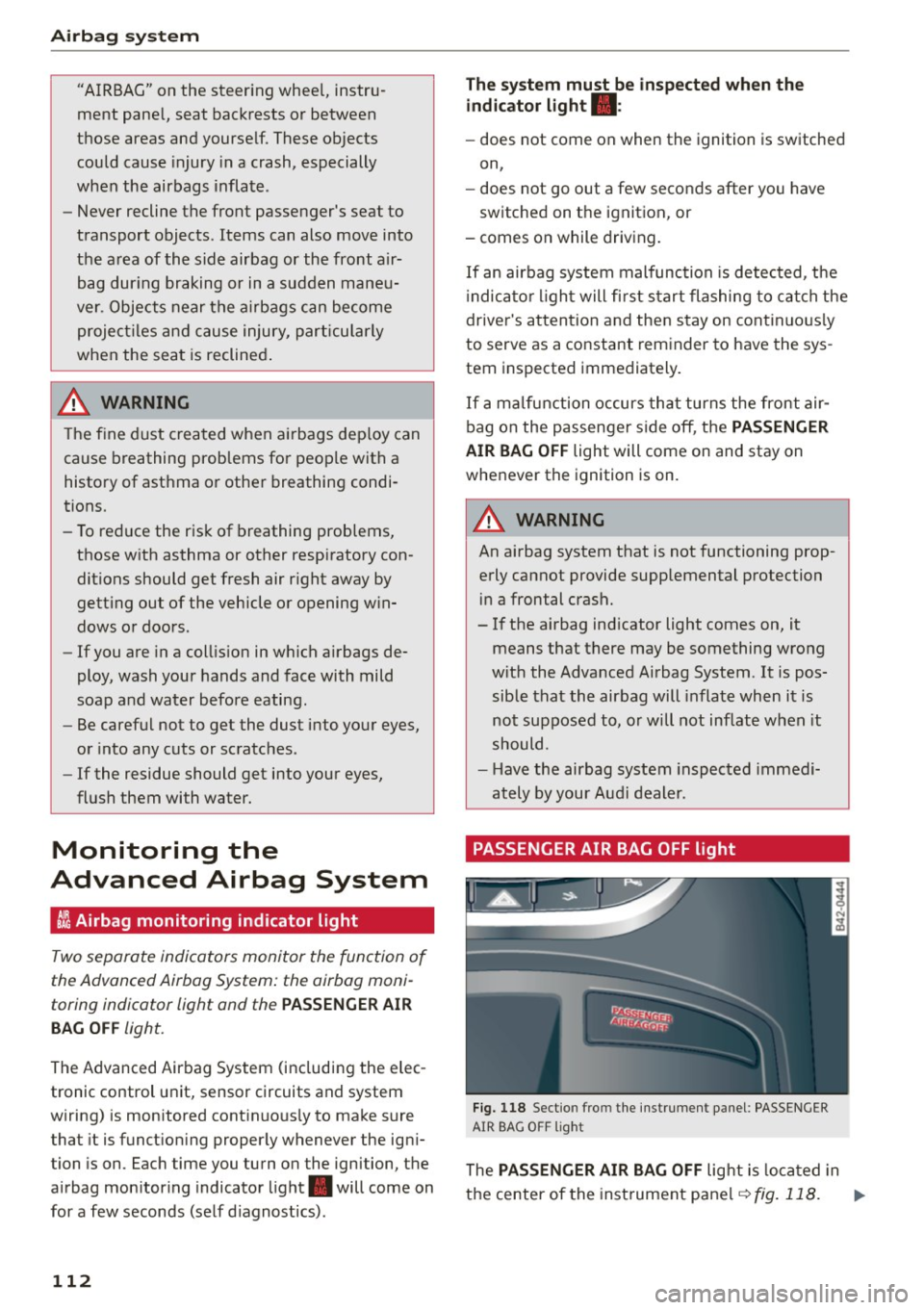
PASSENGER AIR BAG OFF light
Fi g. 118 Sect io n fro m the instru ment pa nel: PASSENGER
AIR BAG OFF light
The PAS SENGER AIR BAG OFF light is lo ca ted in
the center of the inst rument panel
r=;, fig . 118. ..,.
Page 116 of 232
Airbag syste m
backrest is not reclined ~ page 87, Proper
occupant seating positions,
- the adu lt is not taking weight off the seat by
holding on to the passenger assist handle
above the front passenger door,
- the safety belt is being properly worn and that there is not a lot of s lack in the safety belt web
bing,
- accessory seat covers or cushions or other th ings that may cause an incorrect reading or
impression on the weight-sensing mat under
the upholstery of the seat have been removed
from the front passenger seat,
- a safety be lt extender has not been left in the
safety belt latch for the front passenger seat .
In addition to the
PA SSENGER AIR BAG OF F
light in the center of the instrument panel, the
message
PA SSENGER AIR BAG OFF or PA SSEN
GER AIR B AG ON
will briefly appear in the instru
ment cluster display . Th is is to inform the driver
of the current front passenger airbag status .
Important safety instructions on
monitoring the Advanced Airbag System
A WARNING
An airbag system that is not function ing prop
erly cannot prov ide supplemental protect ion
in a frontal crash.
- If the airbag indicator light comes on, it
means that there may be someth ing wrong
with the Advanced Airbag System . It is pos
sible that the a irbag will inflate when it is
not supposed to, or will not inflate when it
sho uld.
- Have the airbag system inspected immedi
ately by your Audi dealer.
A WARNING
If the front airbag inflates, a ch ild without a
child restraint, in a rearward-facing child safe
ty seat or in a forward-facing child restraint
that has not been properly installed will be
ser iously injured and can be killed .
- Even though your veh icle is equipped with
an Advanced Airbag System, make certa in
that all ch ildren, especially 12 years and
114
younger, a lways ride proper ly restrained for
their age and size.
- If you must install a rearwa rd facing child
safety seat on the front passenger seat be
cause of exceptiona l circumstances and the
PASSENGER AIR BAG OFF light does not
appear and stay on have the a irbag system
inspected by your Audi dealer .
- A tight tether or other strap on a rearward
facing child restraint attached to the front
passenger seat can put too much pressure
on the weight-sens ing mat in the seat and
reg iste r more weight th an is actually on the
seat. The heav ier we ight registered can
make the system work as though an adult
were on the seat and deploy the Advanced
Airbag when it must be suppressed ca using
serious or even fatal injury to the child.
- If, in exceptional circumstances, you must
install a forwa rd- facing child restraint on
the front passenger seat, always move the
seat into its rearmost pos ition in the seat's
fore and aft adjustment range, as far away
from the airbag as possib le. The backrest
must be adjusted to an upr ight position.
Ma ke sure that the
PASSENGER AIR BAG
OFF
li ght comes on and stays on all the time
wheneve r the ign it ion is switched on .
A WARNING
- If the PASSENGER AIR BAG OFF light does
not go out when an adult is sitting on the
front passenge r seat after tak ing the steps
described above, have the airbag system in
spected by your Audi dealer before trans
port ing anyone on the front passenger seat.
(D Tips
If the weight-sensing mat in the front passen
ger seat detects an empty seat, the front air bag on the passenger s ide will be turned off,
and
PASSENGER AIR BAG OFF will stay on.
Repair, care and disposal of the airbags
Parts of the airbag system are installed at many
different places on your Audi . Installing, remov
i ng, se rv ic ing or repair ing a pa rt in an a rea of the ..,_
Page 119 of 232
.... N
l'
N "1: rl I.O
"' N
"' ....
Remember too, airbags will deploy only once and
only in certain kinds of accidents -your safety
be lts are a lways there to offer protection in those
accidents in which airbags are not supposed to
deploy or when they have already deployed, for
examp le when your vehicle str ikes or is struck by
another after the first collision .
This is just one of the reasons why an airbag is
not a substitute for the safety belt. The airbag
system works most effective ly when used with
the safety belts. Therefore, always wear your
safety belts correctly .
It is important to remember that while the sup
p lemental knee a irbag system is designed to re
duce the likelihood of serious injur ies, other inju
ries, for examp le, swe lling, bruising, minor ab ra
sions and fr iction burns can also occur when an
airbag inflates.
The knee airbag system basically consists of:
- The electronic control module
- Two inflatab le airbags (airbag and gas genera-
tor), one for the driver and one for the front passenger
- The airbag indicator light in the instrument
panel
The knee airbag system will not deploy:
-when the ignition is turned off
- in frontal collisions when the deceleration
measured by the contro l unit is too low
- in s ide collisions
- in rear-end collisions
- in rollovers
- in the event of a system malfunct ion (warning/
indicator light is on)
<::.>page 13 .
A WARNING
-Safety belts and the airbag system can only
provide protection when occupants are in
the proper seating position
<=> page 110.
- If the airbag indicato r light comes on when
the vehicle is being used, have the system
inspected immediately by your authorized
Audi dealer .
Airbag system
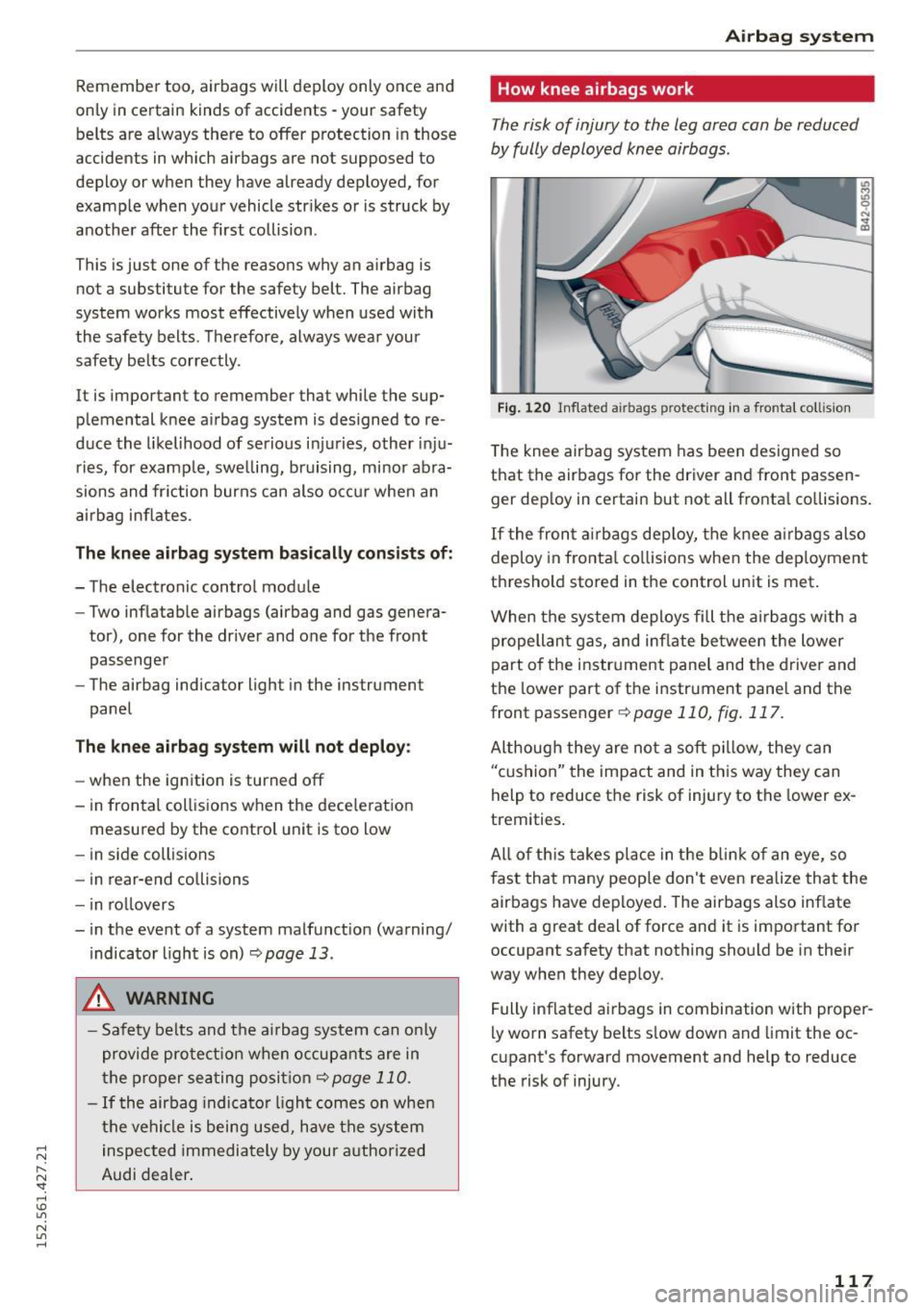
How knee airbags work
The risk of injury to the leg area can be reduced
by fully deployed knee airbags .
Fig. 120 Inflated airbags protecting in a frontal collision
The knee airbag system has been designed so
that the airbags for the driver and front passen
ger deploy in certain but not all fronta l co llisions .
If the front airbags deploy, the knee airbags also
deploy in fronta l collisions when the dep loymen t
threshold stored in the control un it is met .
When the system deploys fill the airbags with a
propellant gas, and inflate between the lower
part of the in str ument panel and the driver and
the lowe r part of the instrument panel and the
front passenger
<=> page 110, fig. 117.
Although they are not a soft pillow, they can
"cushion" the impact and in this way they can
help to reduce the risk of injury to the lower ex
tremities .
All o f this takes place in the b link of an eye, so
fa st that many people don't even realize that the
airbags have deployed . The airbags also inf late
with a great deal of force and it is important for
occupant safety that nothing should be in their
way when they dep loy.
Fully inflated airbags in combination with proper
ly worn safety belts s low down and limit the oc
cupant's forward movement and help to reduce
the risk of injury .
117
Page 120 of 232
Airbag system
Important safety instructions on the knee
airbag system
Airbags are only supplemental restraints. Always
wear safety belts correctly and ride in a proper
seating position.
There is a lot that you and your passenger must
know and do to help the safety belts and airbags
to provide supplemental protection.
,8. WARNING
An inflating knee airbag can cause serious in
jury. Wearing safety belts incorrectly and im proper seating positions increase the risk of
serious personal injury and death whenever a
vehicle is being used.
- The knee airbag system cannot protect you
properly if you are seated too close to any of
the airbag locations. When adjusting their
seat positions, it is important that both the
driver and the front passenger keep their
upper bodies and knees at the following
minimum safe distances :
- at least 10 inches (25 cm) between the
chest and the steering wheel/instrument
panel.
- at least 4 inches (10 cm) between the
knees and the lower part of the instru
ment panel.
- The risk of personal injury increases if you
lean forward or to the side, or if the seat is
improperly positioned and you are not wear
ing your safety belt . The risk increases even
more should the airbag deploy .
- Always make sure that the knee airbag can
inflate without interference . Objects be
tween you and the airbag can increase the
risk of injury in an accident by interfering
with the way the airbag deploys or by being
pushed into you as the airbag deploys.
- Never let anybody, especially children or
animals in the footwell in front of the pas
senger seat .
If the airbag deploys , this can
result in serious or fatal injuries.
- No objects of any kind should be carried in
the footwell area in front of the driver's or
passenger's seat. Bulky objects (shopping
118
bags, for example) can hamper or prevent
proper deployment of the airbag. Small
objects can be thrown through the vehicle
if the airbag deploys and injure you or your
passengers.
- Make sure there are no cracks, deep scratch
es or other damage in the area of the instru
ment panel where the knee airbags are lo
cated .
- If children are incorrectly seated, their risk
of injury increases in a collision
r::-, page 122, Child Safety .
Side airbags
Description of side airbags
The airbag system can provide supplemental
protection to properly restrained front seat occu
pants.
Fig . 121 Sid e airb ag locatio n in the driver's seat
The side airbags are located in the sides of the
front seat backrests~
fig. 121 facing the doors .
They are identified by the word "AIRBAG" .
The side airbag system basically consists of:
-the ele ctronic control module and external sid e
i mpact sensors
- the two side airbags located in the sides of the
front backrests
- the airbag warning light in the instrument clus-
t e r.
The airbag system is monitored electronically to
make certain that it is functioning properly at all
times. Each time you turn on the ignition, the air
bag system indicator light will come on for a few
seconds (self diagnostics).
II>
Page 121 of 232
.... N
l'
N "1: rl I.O
"' N
"' ....
The side airbag system supplements the safety be lts and can he lp to reduce the risk of injury to
the dr iver's and front passenger's upper torso
and head injuries on the side of the vehicle that is
struck in a side collision. The airbag deploys in
side impacts and only when the vehicle accelera
tion registered by the control u nit is high enough .
If th is rate is below the reference value program
med into the control unit, the side airbags will
n ot be triggered , even though the car may be
badly damaged as a result of the co llision.
It is
not possib le to define an airbag triggering range
that will cover every possible angle of impact, since the c ircumstances will vary considerab ly be
tween one collis ion and another. Important fac
tors include, for example, the nature (hard or
soft) of the impact ing object, the angle of im
pact, vehicle speed, etc.
9 page 120 , Important
safety instructions on the side airbag system.
Aside from their normal safety function, safety
be lts work to help keep the driver or front pas
senger in pos it ion in the event of a s ide collision
so that the s ide a irbags can provide protect ion.
The airbag system is
not a substitute for your
safety belt . Rather, it is part of the overall occu
pant restrai nt system in your vehicle . Always re
member that th e side airbag system can only
he lp to p rotect you if yo u are wear ing your safety
be lt and wearing i t properly. This is ano ther rea
son why you shou ld always wear your sa fety
be lts, not just because the law requires you to do
so
9 page 95, General notes .
It is impor tan t to remember tha t while the sup
p lemental side a irbag sys tem is designed to re
duce the likelihood of serious inj uries, other inj u
ries, for examp le, swe lling, bruising, and minor
abrasions can also be associated with deployed
side airbags. Remember too, side airbags will de
p loy only once and only in certa in kinds of acci
dents -your safety belts are a lways there to offer
protection.
Vehicle damage, repair costs or even the lack of
ve hicle damage are not necessarily an indication
of over -sens itive or fa iled a irbag activa tion . In
some coll isions, both front and s ide airbags may
i nflate. Remember too, that airbags will deploy
only once and only in ce rtain kinds of collisions -
Airb ag system
you r safety belts are always the re to offer protec
tion in those accidents in which airbags are not
s u pposed to deploy or when they have a lready
deployed.
The side airbag system w ill not deploy:
- when the ignit io n i s tu rned off
- in side co llisions whe n the a ccelera tion meas-
ured by the sensor is too low
- in re ar-end collisions
- in rollovers .
In some types of accidents the front airbags and
s ide airbags may be triggered together.
A WARNING
-- Safety belts and the airbag system will only
provide p rotection when occupants are in
the proper seating position~
page 120.
-If the ai rbag ind icator light comes on when
the vehicle is be ing used, have the system
inspected immed iate ly by yo ur autho riz ed
Aud i dea le r. T he airbag may no t wo rk prop
erly when the vehicle acceleration in a side
coll is ion is high enough to activate the air
bag .
How supplemental side airbags work
Side airbags deploy instantly and can help re
duce the risk of upper torso injuries for occu
pants who ore properly restrained.
Fi g. 122 In flated s ide airbags on left s ide of ve hicle
When the system is triggered, the a irbag is filled
with propellant gas and breaks through a seam in
the seat s urface area mark ed "A IRBAG" . It ex
pands be tween the side trim panel a nd the pas-
senger. In or der to help provide this addi tional .,.
119
Page 124 of 232
Child Safety
Child Safety
Important things to
know
Introduction
The physical principles of what happens when
your vehicle is in a crash apply also to children
c::> page 96, What happens to occupants not
wearing safety belts? .
But unlike adults and
teenagers, the ir muscles and bones are not fully
developed . In many respects children are at
greater risk of serious injury in crashes than
adu lts.
Because children 's bod ies are not fully developed,
they require restra int systems especially de
signed for their size, weight, and body structure. Many countr ies and all states of the United
S ta tes and p rov inces of Canada have laws requi r
ing the use of app roved ch ild restra int systems
for in fan ts and small children .
I n a fronta l crash at a speed of 20-35 mph
(30-56 km/ h) the fo rces acting on a 13-pound
(6 kg) infant w ill be more than 20 t imes the
weight of the child. This means the weight of the
chi ld would sudden ly be more than 260 po unds
(120 kg) . Under these conditions, only an appro
priate ch ild restraint properly used can reduce
the risk of serious injury. Ch ild restraints, like
adu lt safety be lts, must be used p roperly to be
effective . Used improperly, they can increase the
ris k of serious injury in an accident.
Consult the child safety seat manufacturer's in
structions in order to be sure the seat is r ight for
your child's size
c::> page 125, Important safety
instructions for using child safety seats .
Please
be sure to read a nd heed all of t he importa nt in
formation and WARNI NGS about c hild safety, Ad
vanced Ai rbags, and the installa tion of child re
s traints in this chapter .
There is a lot you need to know about the Ad
vanced A irbags in yo ur vehicle and how t hey work
when infants and children in child rest rain ts are
on the fron t passenger seat . Because of the large
amo unt of important informat ion, we cannot re
peat it a ll here. We urge you to read the detai led
122
i nformation in this owner 's man ua l about airbags
and the Advanced Airbag System in your vehicle
and the very important information about trans
porting children on the front passenger seat.
Please be sure to heed the WARNINGS - they are
extremely important for your safety and the safe
ty of your passengers, especially infants and
small chi ld ren .
&_ WARNING
All vehicle occupants and especially chi ld ren
must be res trained p roperly whenever r iding
in a vehicle. An unres trained or imprope rly re
strained chi ld could be inj ured by strik ing the
inte rior or by being ejected from the vehicle
during a sudden maneuver or impact. An un restra ined or improperly restrained child is al
so at greater risk of injury or death through
contact w ith an inf lating a irbag.
&_ WARNING
Children on the front seat of any car even with
Advanced Airbags can be ser iously injured or
even killed when an a irbag inflates . A child in
a re arwa rd-facing child safety seat installed
on the front passenger seat will be serio usly
injured and can be kil led if the front air bag in
f lates.
- The infla ting airbag will h it the ch ild safety
seat or in fant ca rrier with great force and
w ill smash the child safety seat and child
aga inst the backrest, door or roof.
- Never install a rearward facin g child safety
seat on the front passenger seat unless the
PASSENGER AIR BAG OFF light comes on
and stays on. If the
PASSENGER AIR BAG
OFF
li ght does not come on and stay on,
have the airbag system inspected immed i
ately by your Au di dealer .
&_ WARNING
If, in exceptiona l circumstances , you must in
stall a forwa rd-fac ing c hild restra int on the
front p assenger's seat:
Page 126 of 232
Child Safety
the safety belt for the front seat passenge r
measures the tension on the be lt . T he inp ut from
this sensor is then used w ith the weight to "de
cide", whether there is a child restra int w ith a
t ypical 1 year-old child on the front passenger
seat and whether or not the airbag must be
turned off .
Child restraints and Advanced Airbags
Regardless of the chi ld restraint that you use,
make sure that it has been ce rtified to meet Un it
ed States Federal Motor Vehicle Safety Standards
and has been certified by its manufact urer for
use with an airbag. If in exceptional circ umstan
ces yo u must use it on the front passenger seat,
caref ully read all of the information on child safe
ty and Advanced Airbags and heed all of the ap
plicable WARNINGS . Make certain that the child
restraint is correctly recognized by the we ight
sensing mat ins ide the front passenger seat, that
the front passenger a irbag is tu rned off and that
the airbag status is a lways correctly signaled by
the
PASSENGER AIR BAG OFF light .
Many types and models of c hild restra ints have
been ava ilable ove r the years, new models a re in
troduced regu larly incorporat ing new and im
p roved des igns and o lder models are taken out o f
p rod uction. Child rest raints are not standardized.
Chi ld restraints of the same type typically have
d ifferent weights and sizes and different 'foot
prints,' the si ze and shape of the bottom of the
child restraint that sits on the seat, when they
are installed on a veh icle seat . These differences
make it v irtually impossible to certify compliance
with the requ irements for advanced ai rbags with
each and eve ry child rest raint that has ever been
sold in the past or will be sold ove r the course of
the useful life of your vehicle.
For this reason, the United States Nat iona l H igh
way Traffic Safety Admin istration has p ublished a
lis t of specific type , makes and models o f chi ld
restraints that m ust be used to certify comp li
ance of the Advanced Airbag System in your vehi
cle with the suppression requirements of Federal Motor Vehicle Safety Standard 208. These chi ld
restraints are:
124
Subpart A - Car b ed child restra ints
Model Manufactured on or
after
Angel Guard Angel September 25, 2007 Ride AA2403FOF
Subpart B -Rear -facing child restraint s
Model Manufactured on or
after
Century SmartFit 4543 December 1, 1999
Cosco Arriva September 25, 2007
22 -013PAW and base
22-999WHO
Evenflo Discovery Adjust December 1, 1999
Right 2 12
E venf lo First Choice 204 December 1, 1999
Graco Infant 8457 December 1, 1999
Graco Snug ride September 25, 2007
Peg Perego Pr imo Viag- September 25, 2007
gio SIP I MUNOOUS
Subpart C - Forward-facing and convertible
child re straint s
Model Manufactured on or
after
Britax Roundabout September 25, 2007
E9L02xx
Cosco Tou riva 025 19 December 1, 1999
Cosco Summit Deluxe September 25, 2007 H igh Back Booster
22 -262
Cosco High Back Booster September 25, 2007
22-209
Evenflo Tribute V September 25, 2007
379xxxx
Evenflo Meda llion 254 December 1, 1999
E venflo Generations September 25, 2007
352xxxx
Graco ComfortSport September 25, 2007
Graco Todd ler Safety
September 25, 200 7
Seat Step 2
Graco Platinum Cargo September 25, 2007
Page 127 of 232
..... N
r-N "': ..... \!) 1.1'1
N 1.1'1 .....
A WARNING ,~
To reduce the risk of serious injury, make sure
that the
PASSENGER AIR BAG OFF light
comes on and stays on whenever a child re
straint is installed on the front passenger seat
and the ignition is switched on.
- Never install a rearward facing child safety
seat on the front passenger seat unless the
PASSENGER AIR BAG OFF light comes on
and stays on. If the
PASSENGER AIR BAG
OFF
light does not come on and stay on the
inflating airbag will hit the child safety seat
or infant carrier with great force and will
smash the child safety seat and child against the backrest, door or roof. Have the
airbag system inspected immediately by
your authorized Audi dealer.
{!) Tips
The child seats listed in categories A to C have been statically tested by Audi only for the Ad
vanced Airbag function.
Important safety instructions for using
child safety seats
Correct use of child safety seats substantially re
duces the risk of injury in an accident!
As the driver, you are responsible for the safety of
everybody in the vehicle, especially children:
.. Always use the right child safety seat for each
child and always use it properly
c;, page 127.
.. Always carefully follow the child safety seat
manufacturer's instructions on how to route
the safety belt properly through the child safe
ty seat.
.. When using the vehicle safety belt to install a
child safety seat, you must first activate the
convertible locking retractor on the safety belt
to prevent the child safety seat from moving
c;, poge 130.
.. Push the child safety seat down with your full
weight to get the safety belt really tight so that
the seat cannot move forward or sideways more
than one inch (2 .5 cm) .
.. If a strap or tether is being used to tie the child
safety seat to the front passenger seat, make
Child Safety
sure that it is not so tight that it causes the
weight-sensing mat to measure more weight than is actually on the seat.
Always remember: Even though your vehicle is
equipped with an Advanced Airbag system, a
child should always ride in the seat properly re
strained for its age and size.
A WARNING
-Not using a child safety seat, using the wrong
child safety seat or improperly installing a
child restraint increases the risk of serious personal injury and death.
- All vehicle occupants and especially children must always be restrained properly whenev
er riding in a vehicle.
- An unrestrained or improperly restrained
child can be injured or killed by being
thrown against the inside of the vehicle or
by being ejected from it during a sudden
maneuver or impact.
- An unrestrained or improperly restrained
child is at much greater risk of injury or
death by being struck by an inflating air bag .
- Commercially available child safety seats
are required to comply with U.S. Federal Mo
tor Vehicle Safety Standard (FMVSS) 213 (in
Canada CMVSS 213).
- When buying a child restraint, select one
that fits your child and the vehicle .
- Only use child restraint systems that fully
contact the flat portion of the seat cush
ion. The child restraint must not tip or
lean to either side. Audi does not recom
mend using child safety seats that rest on
legs or tube-like frames. They do not pro
vide adequate contact with the seat.
- Always heed all legal requirements per
taining to the installation and use of child
safety seats and carefully follow the in
structions provided by the manufacturer
of the seat you are using.
- Never let more than one child occupy a child
safety seat.
~
125
Page 128 of 232
Child Safety
-Never let babies or older children ride in a
vehicle while sitting on the lap of another
passenger.
- Holding a child in your arms is never a sub
stitute for a child restraint system.
- The strongest person could not hold the
child with the forces that exist in an acci
dent. The child will strike the interior of
the vehicle and can also be struck by the passenger.
- The child and the passenger can also in
jure each another in an accident.
- Never install a rearward facing child safety
seat on the front passenger seat unless the
PASSENGER AIR BAG OFF light comes on
and stays on. If the
PASSENGER AIR BAG
OFF
light does not come on and stay on the
inflating airbag will hit the child safety seat
or infant carrier with great force and will
smash the child safety seat and child
against the backrest, door or roof . Have the
airbag system inspected immediately by
your authorized Audi dealer.
- Forward-facing child safety seats installed
on the front passenger's seat can interfere
with the airbag when it inflates and cause
serious injury to the child.
- If exceptional circumstances require the use
of a forward-facing child restraint on the
front passenger's seat, the child's safety
and well-being require that the following
special precautions be taken:
- Make sure the forward-facing seat has
been designed and certified by its manu
facturer for use on a front seat with a pas senger front and side airbag.
- Always carefully follow the manufacturer's
instructions provided with the child safety
seat or carrier.
- Always move the front passenger seat into
the rearmost position of the passenger
seat's fore and aft adjustment range, and
as far away from the airbag as possible be
fore installing the child restraint.
- Always make sure that nothing prevents
the front passenger's seat from being
moved to the rearmost position in its fore
and aft adjustment range.
126
- Always make sure that the backrest is in
the upright position.
- Always buckle the child safety seat firmly in
place even if a child is not sitting in it. A
loose child safety seat can fly around during
a sudden stop or in a collision .
- Always read and heed all WARNINGS when ever using a child restrained in a vehicle is
being used
c> page 95, Safety belts,
c;:, page 102, Airbag system and
c;:, page 122, Child Safety .
A WARNING
To reduce the risk of serious injury, make sure
that the
PASSENGER AIR BAG OFF light
comes on and stays on whenever a child re
straint is installed on the front passenger seat
and the ignition is switched on.
- Never install a rearward facing child safety
seat on the front passenger seat unless the
PASSENGER AIR BAG OFF light comes on
and stays on.
If the PASSENGER AIR BAG
OFF
light does not come on and stay on the
inflating airbag will hit the child safety seat
or infant carrier with great force and will
smash the child safety seat and child
against the backrest, door or roof. Have the
airbag system inspected immediately by
your authorized Audi dealer.