warning light AUDI R8 SPYDER 2015 Repair Manual
[x] Cancel search | Manufacturer: AUDI, Model Year: 2015, Model line: R8 SPYDER, Model: AUDI R8 SPYDER 2015Pages: 232, PDF Size: 58.36 MB
Page 129 of 232
..... N
l'
N "1: ..... I.O
"' N
"' .....
Child safety seats
Infant seats
Babies and infants up to about one year old and
20 lbs. or 9 kg need special rearward -facing
child restraints that support the back, neck and
head in a crash.
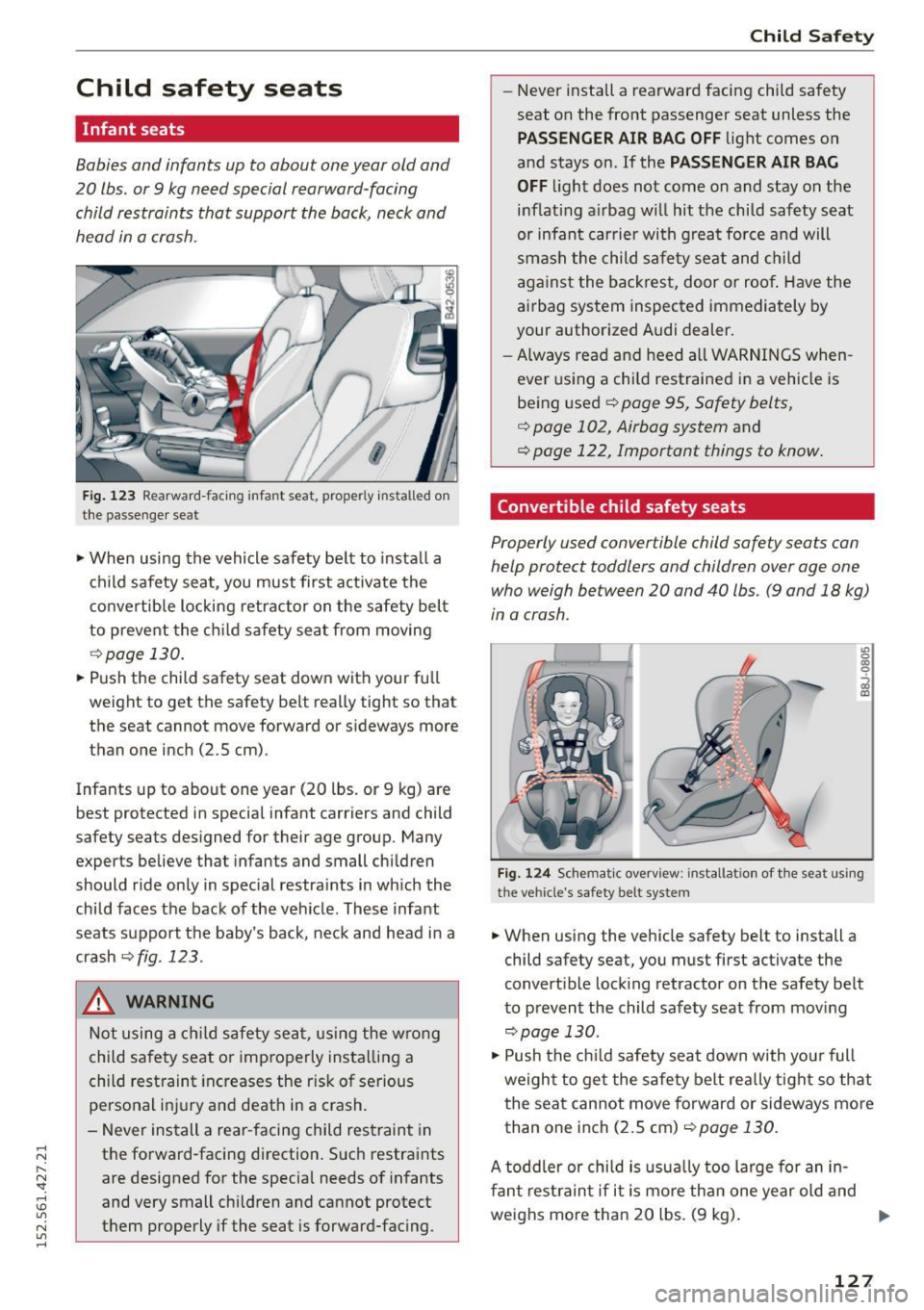
Fig. 123 Rearward-facing infa nt seat, prope rly installed on
the passenger seat
"'W hen using the vehicle safety belt to install a
child safety seat, you must first activate the
convertible locking retractor on the safety belt
to prevent the child safety seat from moving
¢page 130.
"'Push the child safety seat down with your fu ll
weight to get the safety be lt really tight so that
the seat cannot move forward or sideways more
than one inch (2.5 cm) .
Infants up to about one year (20 lbs. or 9 kg) are
best protected in special infant carriers and child
safety seats designed for their age group . Many
experts believe that infants and small children
should ride only in spec ial restra ints in wh ich the
child faces the back of the vehicle. These infant
seats support the baby's back , neck and head in a
crash
¢ fig. 123 .
A WARNING
Not using a child safety seat, using the wrong
child safety seat or improperly installing a
child rest raint increases the risk of serious
personal injury and death in a crash.
- Never install a rear -facing child restraint in
the forward-facing direction. Such restraints
are designed for the special needs of infants
and very small children and cannot protect
them properly if the seat is forward-facing.
Child Safety
- Never install a rearward facing child safety
seat on the front passenger seat unless the
PASSENGER AIR BAG OFF light comes on
and stays on.
If the PASSENGER AIR BAG
OFF
light does not come on and stay on the
inflating a irbag will hit the child safety seat
or infant carrier with great force and will
smash the child safety seat and child
against the backrest, door or roof . Have the
airbag system inspected immediately by
your authorized Audi dealer.
- Always read and heed all WARNINGS when
ever using a child restrained in a vehicle is
being used ¢
page 95, Safety belts,
¢ page 102, Airbag system and
¢ page 122, Important things to know.
Convertible child safety seats
Properly used convertible child safety seats can
help protect toddlers and children over age on e
who weigh between 20 and 40 lbs.
(9 and 18 kg)
in a crash .
.,, 0
~ -', a, m
Fig. 124 Schemat ic overv iew: instal lat io n of t he sea t usi ng
t he ve hicle's sa fety belt system
.,. When using the vehicle safety belt to install a
child safety seat, you must first activate the
convertible locking retractor on the safety be lt
to prevent the child safety seat from mov ing
¢ page 130.
"' Push the child safety seat down with your full
weight to get the safety belt really tight so that
the seat cannot move forward or sideways more
than one inch (2.5 cm)¢
page 130.
A toddler or child is usually too large for an in
fant restraint if it is more tha n one year old and
weighs mo re than 20 lbs. (9 kg). .,.
127
Page 130 of 232
Child Safety
Toddlers and children who are older than one
year up to about 4 years old and weigh more than 20 lbs. (9 kg) up to 40 lbs. (18 kg) must always
be properly restrained in a child safety seat certi
fied for their size and weight¢
fig. 124 .
A WARNING
Not using a child safety seat, using the wrong
child safety seat or improperly installing a
child restraint increases the risk of serious
personal injury and death in a collision or oth
er emergency situation.
- Children on the front seat of any car, even
with Advanced Airbags, can be seriously in
jured or even killed when an airbag inflates.
A child in a rearward-facing child safety seat
installed on the front passenger seat will be
seriously injured and can be killed if the
front airbag inflates -even with an Ad
vanced Airbag System.
- The inflating airbag will hit the child safety
seat or infant carrier with great force and
will smash the child safety seat and child
against the backrest, door or roof.
- Never install a rearward facing child safety
seat on the front passenger seat unless the
PASSENGER AIR BAG OFF light comes on
and stays on. If the
PASSENGER AIR BAG
OFF
light does not come on and stay on
have the airbag system inspected immedi
ately by your authorized Audi dealer.
- Always read and heed all WARNINGS when
ever using a child restrained in a vehicle is
being used ¢
page 95, Safety belts,
¢ page 102, Airbag system
and
¢ page 122 , Important things to know.
A WARNING
If exceptional circumstances require the use
of a forward-facing child restraint on the front
passenger's seat, the child's safety and well
being require that the following special pre
cautions be taken:
- Make sure the forward-facing seat has been
designed and certified by its manufacturer
for use on a front seat with a passenger
front and side airbag.
128
- Always follow the manufacturer's instruc
tions provided with the child safety seat or infant carrier.
- Always move the front passenger seat into
the rearmost position of the passenger seat's fore and aft adjustment range, and as
far away from the airbag as possible before installing the child restraint.
- Always make sure that nothing prevents the
front passenger's seat from being moved to
the rearmost position in its fore and aft ad
justment range.
- Always make sure the backrest is in an up
right position .
- Make sure that the
PASSENGER AIR BAG
OFF
light comes on and stays on all the time
whenever the ignition is switched on.
- If the light does not stay on, perform the
checks.
- If the
PASSENGER AIR BAG OFF light does
not come on and stay on have the airbag
system inspected immediately by your Audi
dealer.
Booster seats and safety belts
Properly used booster seats can help protect
children weighing between about 40 lbs . and 80
lbs. (18 kg and 36 kg) who are less than 4 ft. 9
in. (57 inches/1.45 meters) tall.
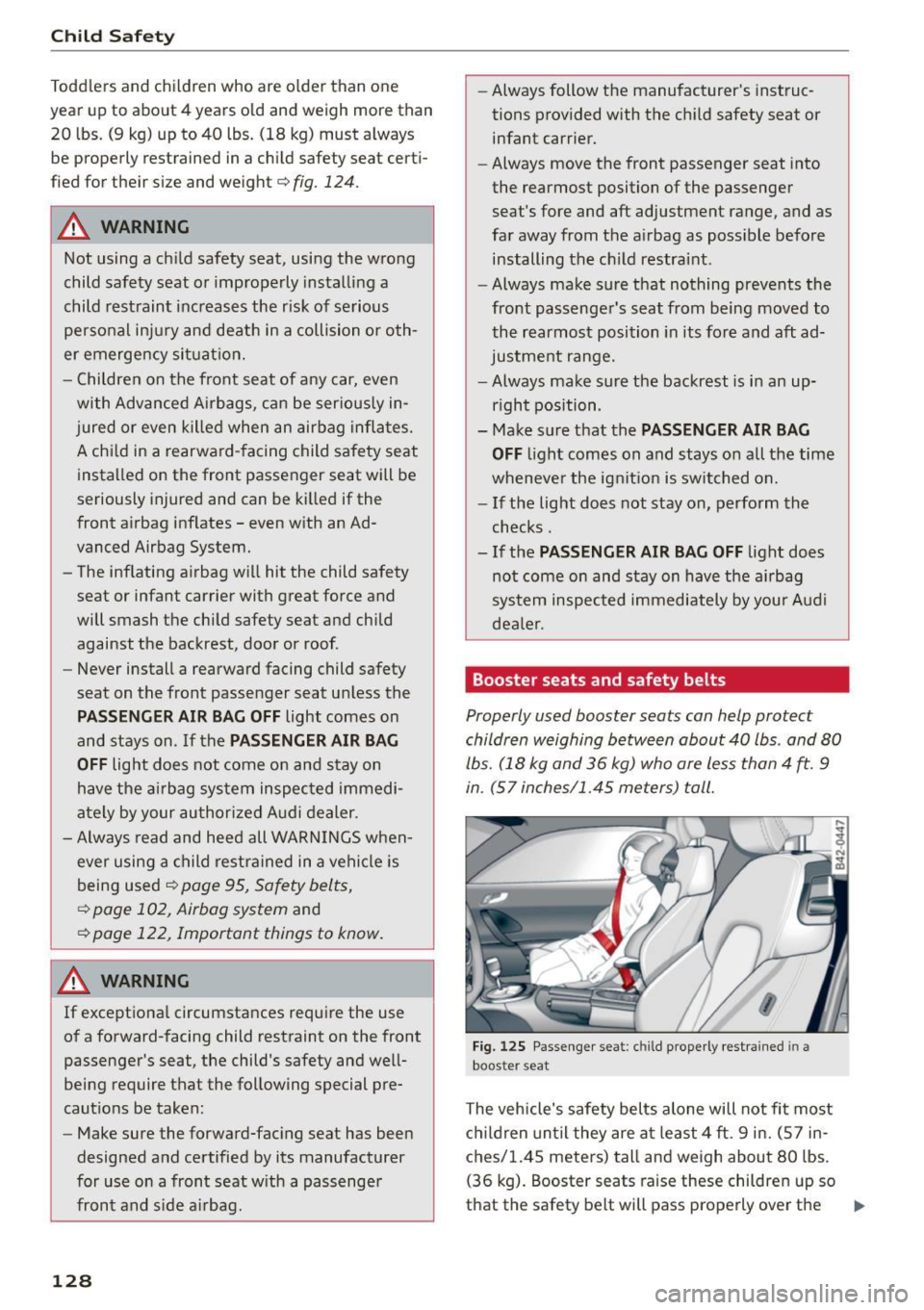
Fig. 125 Passenger seat : chil d properly restrained in a
boo ste r seat
The vehicle's safety belts alone will not fit most
children until they are at least 4 ft. 9 in. (57 in
ches/1.45 meters) tall and weigh about 80 lbs.
(36 kg). Booster seats raise these children up so
that the safety belt will pass properly over the ..,.
Page 132 of 232
Child Safety
any way during an accident can be struck by
a deploying airbag. This will result in serious personal injury or death.
- If you must install a booster seat on the
front passenger seat because of exceptional
circumstances the
PASSENGER AIR BAG
OFF
light must come on and stay on, when
ever the ignition is switched on .
- If the
PASSENGER AIR BAG OFF light does
not come on and stay on, perform the
checks described .
- If the
PASSENGER AIR BAG OFF light does
not come on and stay on whenever the igni
tion is switched on the inflating airbag will hit the child safety seat or infant carrier
with great force and will smash the child
safety seat and child against the backrest,
door or roof. Have the airbag system in
spected immediately by your Audi dealer.
- Always read and heed all WARNINGS when
ever using a child restrained in a vehicle is
being used
~ page 95, Safety belts,
¢ page 102, Airbag system
and
¢ page 122, Important things to know.
Installing a child safety
seat
Securing a child safety seat using a safety
belt
Safety belts for the front passenger can be
locked with the convertible locking retractor to
properly secure child safety seats .
The safety belts emergency locking retractors for
the front passenger's seat safety belt have a con
vertible locking retractor for child restraints . The
safety belt must be locked so that belt webbing
cannot unreel. The retractor can be activated to
lock the safety belt and prevent the safety belt
webbing from loosening up during normal driv
ing. A child safety seat can only be properly in
stalled when the safety belt is locked so that the
child and child safety seat will stay in place.
Always remember : Even though your vehicle is
equipped with an Advanced Airbag system, a
child should always ride in the seat properly re
strained for its age and size.
130
A WARNING ,.
Improperly installed child safety seats in-
crease the risk of serious personal injury and
death in a collision .
-
-Always make sure that the safety belt re
tractor is locked when installing a child safe
ty seat . An unlocked safety belt retractor
cannot hold the child safety seat in place
during normal driving or in a crash.
-Always buckle the child safety seat firmly in
place even if a child is not sitting in it. A
loose child safety seat can fly around during
a sudden stop or in a collision.
- The inflating airbag will hit the child safety
seat or infant carrier with great force and
will smash the child safety seat and child
against the backrest, door or roof.
- Forward-facing child safety seats or infant
carriers installed on the front passenger's
seat may interfere with the deployment of
the airbag and cause serious injury to the
child.
- Always read and heed all WARNINGS when
ever using a child restrained in a vehicle is being used
¢page 122. Special precautions
apply when installing a child safety seat on
the front passenger seat
¢ page 103, Child
restraints on the front seat -some impor
tant things to know.
A WARNING
Always take special precautions if you must
install a forward or rearward-facing child re
straint on the front passenger's seat in excep
tional situations:
- Whenever a forward or rearward-facing
child restraint is installed on the front pas
senger seat, the
PASSENGER AIR BAG OFF
light must come on and stay on whenever
the ignition is switched on.
- If the
PASSENGER AIR BAG OFF light does
not come on and stay on, perform the
checks described .
- If the
PASSENGER AIR BAG OFF light does
not come on and stay on whenever the igni
tion is switched on the inflating airbag will
hit the child safety seat or infant carrier .,,.
Page 133 of 232
..... N
r-N "': ..... \!) ..,.,
N ..,., .....
with great force and will smash the child
safety seat and child against the backrest,
door or roof. Have the airbag system in
spected immediately by your Audi dealer.
- Improper installation of child restraints can
reduce their effectiveness or even prevent
them from providing any protection .
- An improperly installed child restraint can
interfere with the airbag as it deploys and
seriously injure or even kill the child.
- Always carefully follow the manufacturer's
instructions provided with the child safety
seat or carrier .
- Never place additional items on the seat
that can increase the total weight registered
by the weight-sensing mat and can cause in
jury in a crash.
A WARNING
Forward-facing child restraints:
-Always make sure the forward-facing seat
has been designed and certified by its man
ufacturer for use on a front seat with a pas
senger front and side airbag.
- Never put the forward-facing child restraint
up, against or very near the instrument pan
el.
-Always move the passenger seat into its
rearmost position in the seat's fore and aft
adjustment range, as far away from the air
bag as possible before installing the for
ward-facing child restraint. The backrest must be adjusted to an upright position.
- Make sure that the
PASSENGER AIR BAG
OFF
light comes on and stays on all the time
whenever the ignition is switched on.
A WARNING
Rearward-facing child restraints:
- A child in a rearward-facing child safety seat
installed on the front passenger seat will be
seriously injured and can be killed if the
front airbag inflates - even with an Ad
vanced Airbag System .
- The inflating airbag will hit the child safety
seat or infant carrier with great force and
Child Safety
will smash the child safety seat and child
against the backrest, door or roof.
- Always be especially careful if you must in
stall a rearward facing child safety seat on
the front passenger seat in exceptional cir
cumstances.
- A tight tether strap on a rearward-facing
child restraint attached to the front passen
ger seat can put too much pressure on the
weight -mat in the seat and register a heavi
er weight in the Advanced Airbag System .
The heavier weight registered can make the
system work as though an adult were on the
seat and deploy the Advanced Airbag when
it must be suppressed causing serious or
even fatal injury to the child.
- Make sure that the
PASSENGER AIR BAG
OFF
light comes on and stays on all the time
whenever the ignition is switched on.
- Never install a rearward facing child safety
seat on the front passenger seat unless the
PASSENGER AIR BAG OFF light comes on
and stays on. If the
PASSENGER AIR BAG
OFF
light does not come on and stay on
have the airbag system inspected immedi
ately by your Audi dealer .
Activating the convertible locking retractor
Use the conver tible locking re trac tor to secure a
child restraint.
Always h eed the child safety seat manufacturer's
instructions when installing a child restraint in
your vehicle. To ac tiva te the convertible locking
retractor:
.. Place the child restraint on a seat.
.. Slowly pull the belt
all the way out .
.. Route it around or through the child restraint
belt path
c:> ,&. .
.. Push the child safety seat down with your full
weight to get the safety belt really tight.
.,. Insert the belt tongue into the buckle for that
seating position.
.. Guide the safety belt back into the retractor un
til the belt lies flat and snug on the child safety
seat. ..,.
131
Page 137 of 232
.... N
l'
N "1: .... I.O
"' N
"' ....
Anti-loc k br aking sy stem (ABS )
ABS prevents the wheels from locking up when
brak ing . T he vehicle can st ill be stee red even dur
ing hard braking. App ly steady pressure to the
brake peda l. Do not pump the peda l. A pulsing in
the brake pedal indicates that the system is help
ing you to brake the vehicle.
Brake assist sy ste m
The brake assist system can decrease braking dis
tance. It increases braking power when the dr iver
presses the brake pedal quick ly in emergency sit
uations. You must press and ho ld the brake pedal
until the situation is over.
Anti -slip regulation (ASR )
ASR reduces engine power when the drive whee ls
begin to spin and adapts the force to the road
conditions. This makes it easier to start, acceler
ate and dr ive up h ills.
Electronic diff erential lock (EDL )
The EDL brakes wheels that are spinning and
transfers the drive power to the other drive wheel or wheels if the vehicle is equipped w ith all-whee l
drive*. This function is available up to about 60
mph (100 km/h) .
I n extreme cases , EDL automatically switches off
to help keep the brake on the braked wheel from
overheating . EDL wi ll switch on again automati
cally when conditions have returned to normal.
A WARNING
- ESC, ABS, ASR and EDL cannot overcome the
laws of phys ics. Th is is especially important
on slippery or wet roads. If the syst ems be
gin act ing to stab ilize your vehicle, you
sho uld immediately cha nge your speed to
match the roa d and traffic con ditions. Do
not let the increased safety provided by
these systems tempt you to take risks . Do
ing so wi ll increase the risk of a loss of vehi
cle contro l, collis ion and serio us personal in
juries .
- Always adapt your speed to road, traffic and
weather cond it ions. The risk of losing con
tro l of the veh icle increases when driving
Int ellig ent t echnolo gy
too fast, especially through curves and on
slippery or wet roads, and when dr iving too
close to vehicles up ahead. ESC, ABS, the
brake assist system, EDL and ASR cannot
prevent coll is ions .
- Always accelerate with special care on even,
smooth surfaces such as those that are wet
or covered with ice and snow. The drive
wheels can spin even with these assistance sys tems that cannot always help to reduce
the risk of loss of veh icle control.
(D Tips
- ABS and ASR only wo rk correctly when all
four wheels are eq uipped with ident ical
tire s. Different tire s izes can lead to a reduc
t ion i n engine power.
- Yo u may hear noises when the systems de
sc ribed a re wo rking.
- If the ind icator light GJ or II (USA mod
els) ;tiJ (Canada models) appea rs, there
may be a malfunction~
page 15,
~ page 15.
Switching on/off
ESC turns on automatically when you start the
engine.
SPORT •
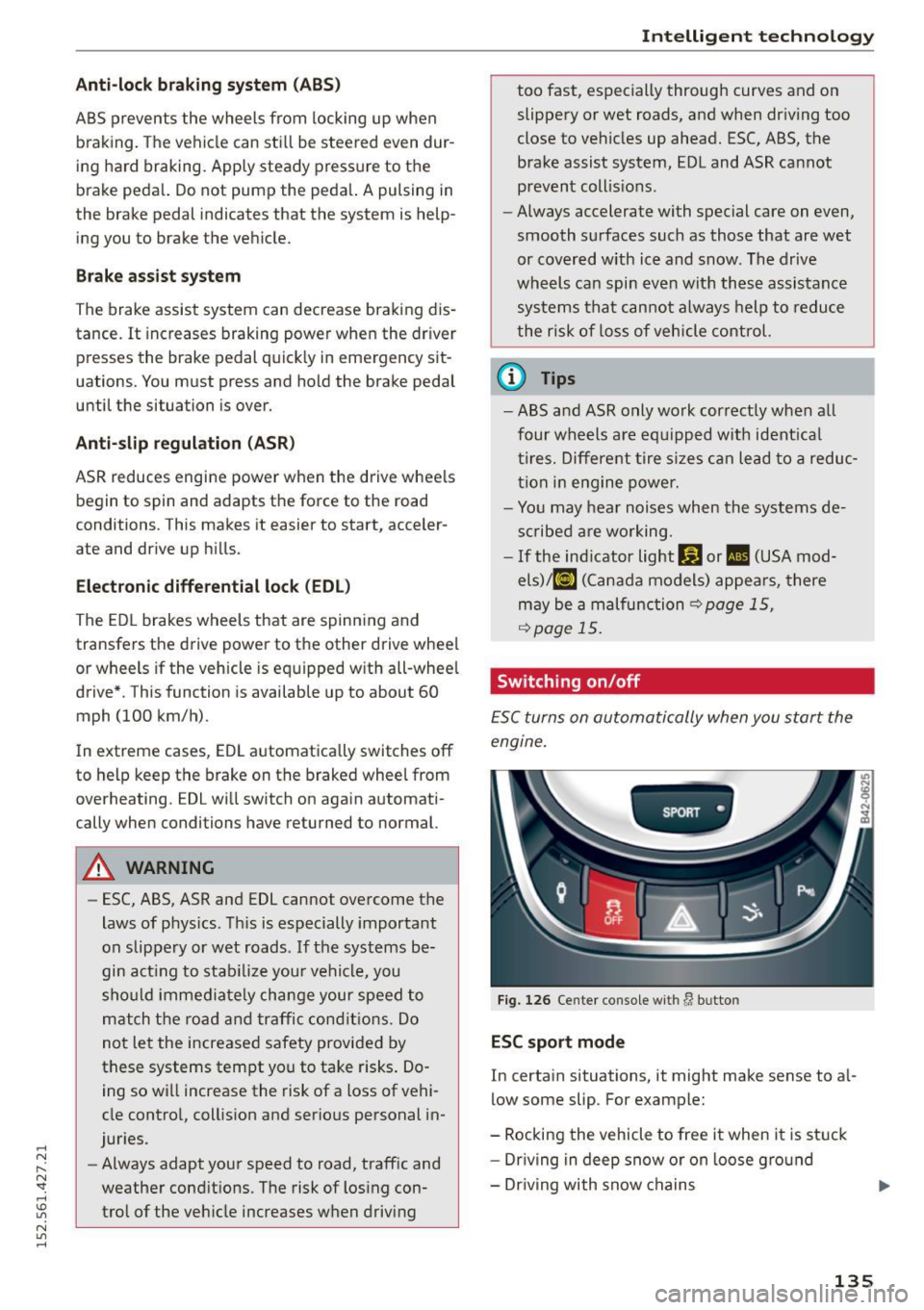
Fig . 12 6 Cente r co nsole wit h lJ bu tto n
ESC sport mode
In certain situations, it might make sense to a l
low some slip. For example:
- Rocking the vehicle to free it when it is st uck
- Driving in deep snow or on loose gro und
- Dr iving with snow chains
135
Page 138 of 232
Intelligent technology
Press the I!! button briefly¢ fig. 126 . The II in
dicator light turns on and Sport control Warn
ing! Restricted st abilit y appears in the driver in
formation system d isplay. Driving stability is lim
ited in sport mode.
Sw itch ing ESC off
Press and hold the
l!I button for three seconds .
The ESC indicator light
fl turns on and Stabil i
z atio n prog ram off appears in the display. ASR is
also switched off when ESC is sw itched off.
Sw itch ing on
Press the
l!J button again. The message Stabili
zation progr am on appears briefly in the disp lay .
_& WARNING
You should only sw itch the ESC off if your dr iv
ing ability and the traffic s ituation allow. This
could increase the risk of slipp ing.
- The stabilizing function is limited in ESC
sport mode. The driving wheels could spin and the vehicle could swerve, especially on
slick or slippery road surfaces.
- There is no vehicle stabilization when ESC is
switched off.
(D Tips
If there is a malfunction in the retractable
rear spo iler* or the A udi magnetic ride*, it
may not be possible to activate ESC sport
mode or normal mode may act ivate aga in au
tomatically.
Braking
What affects braking efficiency?
New brake pad s
During the f irst 250 miles (400 km), new brake
pads do not possess the ir full braking effect, they
have to be "broken in" first¢.&. . The break- in pe
riod can be considerab ly longer for vehicles w ith
ceramic b rake roto rs*. You can compensate for
this s light ly reduced b ra ki ng power by push ing
ha rder on the b rake peda l. Avoid heavy braking
loads during the bre ak-in period.
136
Operating conditions and driving habits
The bra kes on today's automobiles a re s till sub
j ect to wear, depend ing largely on operating con
ditions and driving habits ¢& . On vehicles that
a re either driven most ly in stop-and-go city traf
fic or are driven hard, the brake pads should be
checked by your authorized Aud i dealer more of
te n tha n specified in the Warranty
& Maint e
nance bookl et. Failure to have you r brake pads
i nspected can resu lt in reduced b rake pe rform
ance.
On steep slopes, you shou ld use the braking ef
fect of the engine . This way, you prevent un nec
essary wear on the brake system . If you must use
you r brakes, do not hold the bra kes down cont in
u o usly. Pump the brakes at in tervals.
Operating noise
Noises may occur when braki ng depending on the
speed, braking force and outs ide cond it ions such
as tempera ture and hum idity.
Due to the nature of the materia ls used i n ceram
i c brake rotors*, noises may become more appa
r ent at low speeds.
Effect of water and road salt
In certa in situations, for examp le after driv ing
through water , in heavy rain, after overnight con
densation or after washing your car, the braking
effect can be reduced by moisture or ice on the
brake rotors and brake pads . The brakes must be
dr ied fi rst w ith a few careful b rake app lications.
At higher speeds and with the windsh ield wipers
turned on, the brake pads press against the brake r otors for a short amount of time. This occurs at
r egular intervals without the dr iver not ic ing and
provides fo r be tter brake response time under
wet cond it ions.
The effect iveness of the brakes ca n be red uced
when the v ehicle is d riv en on a salt-cove red road
and the b rakes are no t used. Likewise, you clean
off a ccumula ted salt coating from b rake d iscs
and pads with a few ca utious app lications of the
brake ¢& .
D ue to the ir sur fa ce character istics, cerami c
brake ro tors * absorb moistu re in such co ndi tions . ..,.
Page 140 of 232
Intelligent technology
Rear spoiler
The rear spoiler improves vehicle handling and
enhances driver control.
SPORT •
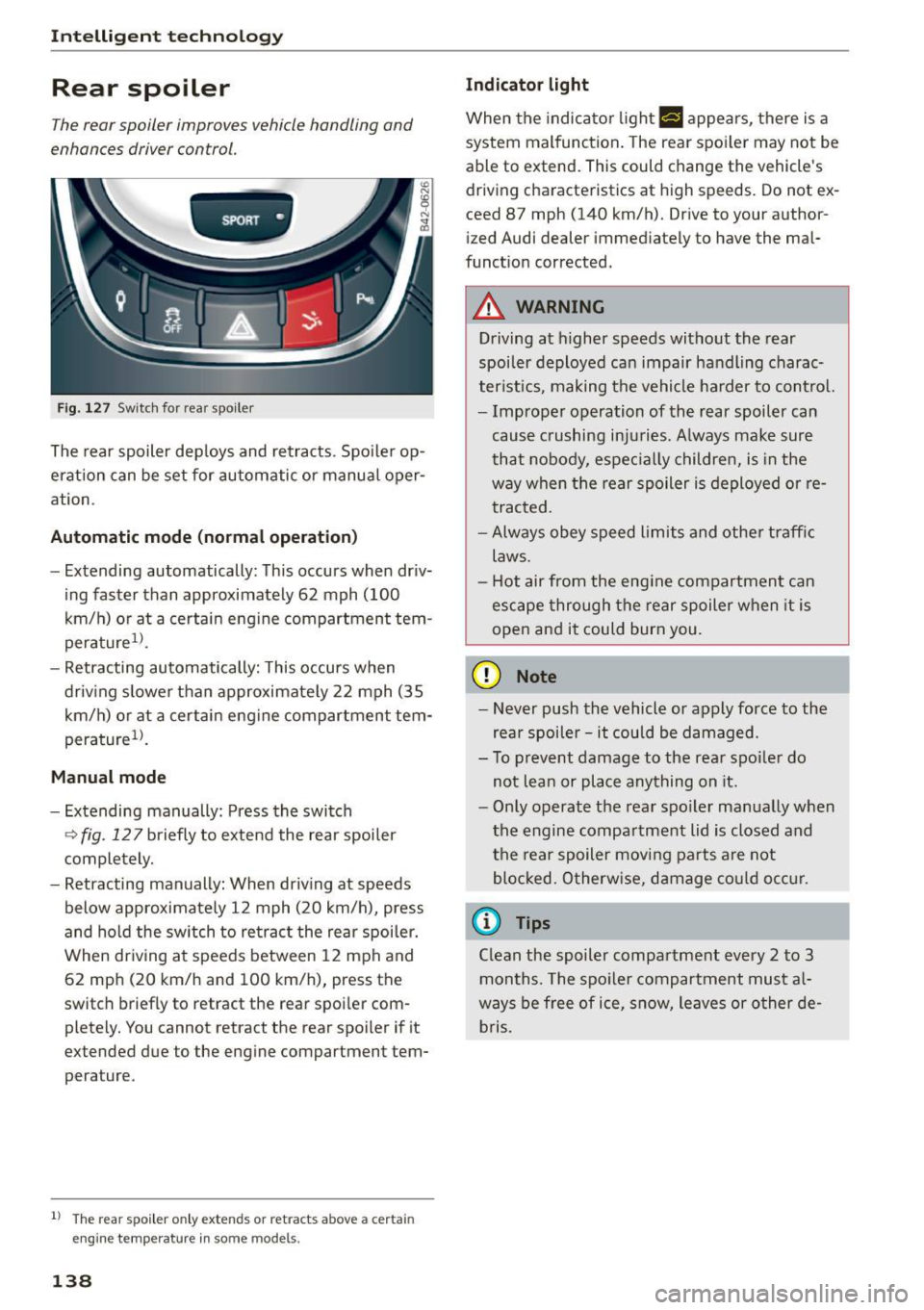
Fig. 127 Switch for rear spoiler
The rear spoiler deploys and retracts. Spo iler op
eration can be set for automatic or manual oper
ation.
Automatic mode (normal operation)
-Extending automatically: This occurs when driv
ing faster than approximately
62 mph (100
km/h) or at a certain engine compartment tem
perature1l.
- Retracting automatically: This occurs when
driv ing s lower than approximate ly
22 mph (35
km/h) or at a certain engine compartment tem
perature1l.
Manual mode
- Extending manually: Press the switch
~ fig. 12 7 briefly to extend the rear spoi ler
completely.
- Retracting manually: When dr iving at speeds
below approximately
12 mph (20 km/h), press
and hold the switch to retract the rear spoiler.
When dr iving at speeds between
12 mph and
62 mph (20 km/h and 100 km/h), press the
switch briefly to retract the rear spoiler com
pletely. You cannot retract the rear spoiler if it
extended due to the engine compartment tem
perature.
1 > The rear spoiler only extends or retracts above a certain
e ngine temperature in some mode ls.
138
Indicator light
When the indicator light I-· appears, there is a
system malfunction. The rear spoi ler may not be
able to extend. This could change the vehicle's
driving character istics at high speeds. Do not ex
ceed 87 mph
(140 km/h). Drive to your author
i zed Audi dealer immediately to have the mal
function corrected.
A WARNING
-
Driving at h igher speeds without the rear
spoiler deployed can impair handling charac
ter istics, making the vehicle harder to control.
- Improper operation of the rear spoiler can
cause crushing injuries. A lways make sure
that nobody , especial ly children, is in the
way when the rear spoiler is deployed or re
tracted.
- Always obey speed limits and other traffic
laws.
- Hot air from the engine compartment can
escape through the rear spoiler when it is
open and it could burn you.
(D Note
-Never push the vehicle or apply force to the
rear spoiler -it could be damaged.
- To prevent damage to the rear spo iler do
not lean or place anything on it.
- Only operate the rear spo iler manually when
the engine compartment lid is closed and
the rear spoiler moving parts are not
bloc ked. Otherwise, damage could occur.
(D Tips
Clean the spoiler compartment every 2 to 3
months. The spoiler compartment must al
ways be free of ice, snow, leaves or other de
bris.
Page 147 of 232
.....
Vehicle care and cleaning General information
Regular, proper care helps to maintain your vehi
cle's value.
It can a lso be a req uirement when
submitting warranty claims for corrosion damage
and paint defects on the body.
The required cleaning and care products can be
obtained from your authorized Audi dea ler or a
qualified workshop. Read and follow the instruc
tions for use on the packaging.
A WARNING
-Us ing clean ing and care products incorrectly
can be dangerous to your health.
- Always store cleaning and care products out
of reach of children to reduce the r isk of poi
soning.
@ For the sake of the environment
- Preferably use environmentally-friendly products when buying cleaning agents.
- Do not dispose of leftover cleaning and care
products with household trash.
Car washes
The longer deposits remain on the vehicle, the
more the surface can be damaged. High tempera
tures such as those caused by sunlight increase
the damaging effect .
Before washing, wet heavy deposits with plenty
of water.
Stubborn depos its such as bird droppings or tree
sap are best removed with plenty of water and a
microfiber cloth .
A lso, was h the underside of your vehicle once
road salt stops being used for the season.
Pressure washers
When washing your veh icles w ith a pressure
washer, always follow the operating instructions
"' provided with the pressure washer. This is espe-
r--
~ cially important in regard to the pressure and
; spraying distance . Do not aim the spray directly
~ at seals on side windows, doors, the engine com -,.... Vehicle care and cleaning
partment lid, the front lid
or the convertible top
or at tires, rubber hoses, insulating material
orsensors* or camera lenses *. Keep a distance of
at least 16 inches (40 cm).
Do not remove snow and ice with a pressure
washer .
Never use rotary nozzles or high pressure noz
zles.
The water temperature must not be above 140 °F
(60 °().
Automatic car washes
Spray off the veh icle before washing.
Make sure that the windows are closed and the
windshield wipers are off. Follow instructions
from the car wash operator, especially if there are
accessor ies attached to your vehicle .
If possible, use car washes that do not have
brushes .
Only use car washes where the vehicle remains
stationary and the washing equipment moves
around t he vehic le when washing and drying. Car
washes that move the vehicle through the car
wash using a chain are not recommended.
Washing by hand
Clean the vehicle starting from the top and work
ing down using a soft sponge or cleaning brush.
Use solvent-free cleaning prod ucts .
Washing vehicles with matte finish paint by
hand
To avoid damaging the paint when washing, first
remove dust and large particles from your vehi
cle. Insects, grease spots and fingerprints are
best removed with a spec ia l cleaner for matte
finish paint.
Apply the prod uct using a microfiber cloth . To
avo id damaging the paint surface, do not use too
much pressure.
Rinse the vehicle thoroughly with water. Then
c lean using a neutral shampoo and a soft micro
fiber cloth.
Rinse the vehi cle thoroughly again and let it air
dry. Remove any water residue using a sham my . .,.
145
Page 148 of 232
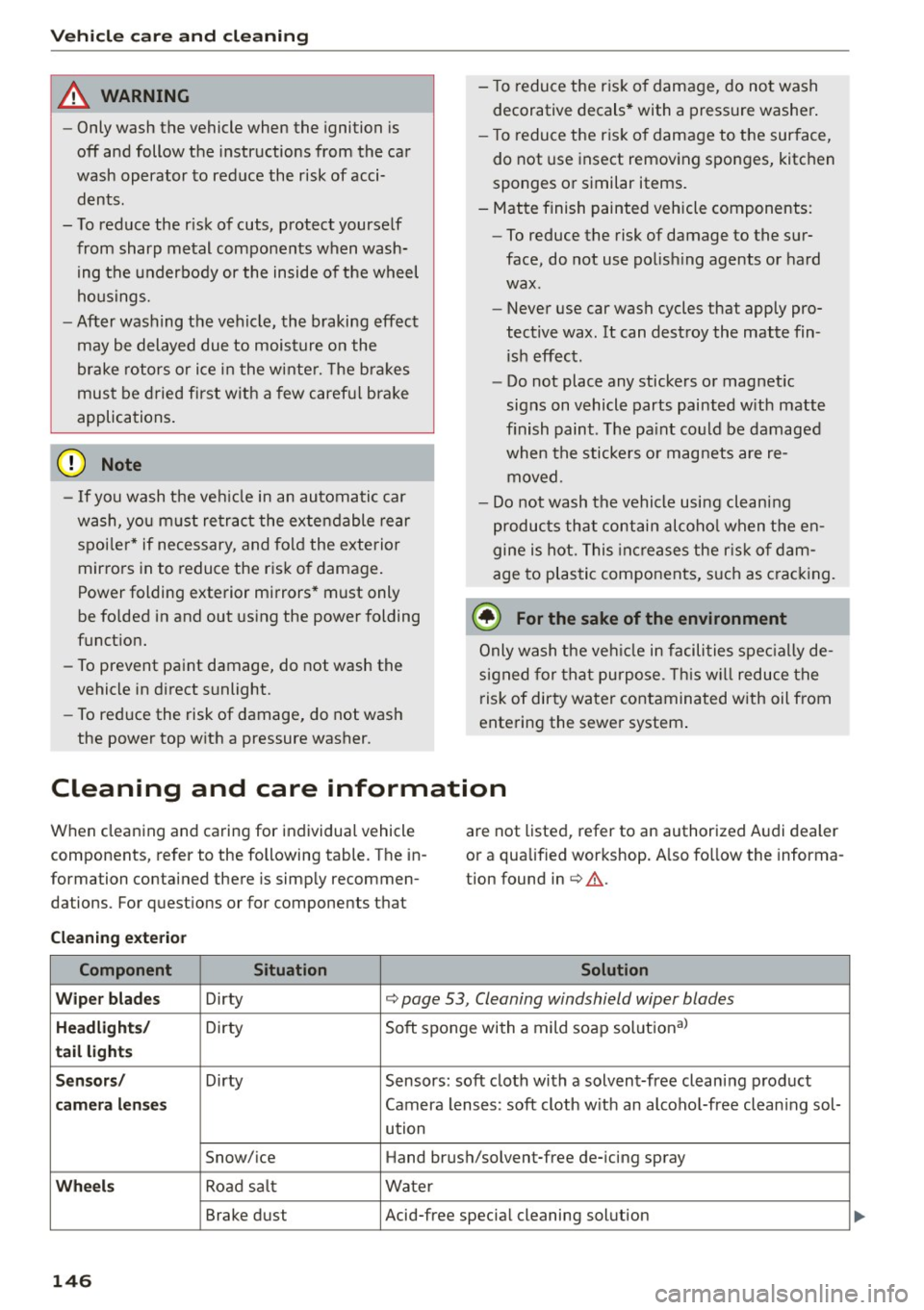
Vehicle care and cleaning
A WARNING
-Only wash the vehicle when the ignition is
off and follow the instructions from the car
wash operator to reduce the risk of acci
dents.
- To reduce the risk of cuts, protect yourself
from sharp metal components when wash ing the underbody or the inside of the wheel
housings.
- After washing the vehicle, the braking effect
may be delayed due to moisture on the
brake rotors or ice in the winter. The bra kes
must be dried first with a few caref ul brake
applications .
@ Note
-If you wash the ve hicle in an au tomatic car
wash, you must retract the extend able rear
spoi ler * if necessary, and fold the exterior
mirrors in to reduce the risk of damage .
Power folding exterior mirrors* must only
be fo lded in and out using the power folding
funct ion.
- To prevent paint damage, do not wash the
vehicle in direct sunlight.
- To red uce the risk of damage, do not wash
the power top with a pressure washer. -
To reduce the risk of damage, do not wash
decorative decals * with a pressure washer.
- T o reduce the risk of damage to the surface,
do not use insect remov ing sponges, kitchen
sponges or similar items.
- Matte finish painted vehicle components:
- To reduce the risk of damage to the sur-
face, do not use polish ing agents or hard
wax.
- Never use car wash cycles that apply pro
tective wax. It can destroy the matte fin ish effect .
- Do not place any stickers or magnet ic
signs on vehicle parts painted w ith matte
finish paint. The pa int could be damaged
when the stickers o r magnets are re
moved.
- Do not wash the vehicle using cleaning
products that contain alcohol when the en
gine is hot. This increases the risk of dam
age to plastic components, such as cracking.
@ For the sake of the environment
Only wash the vehicle in facilities spec ial ly de
signed for that purpose. This w ill reduce the
risk of dirty water contaminated with oil from
entering the sewer system .
Cleaning and care information
When cleaning and caring for individual vehicle
components, refer to the following table . The in
formation contained there is simp ly recommen
dations. For questions or for components that are not listed, refer to an authorized Audi dealer
or a qualified workshop. A
lso fo llow the informa
tion found in
¢ .&. .
Cleaning exterior
Component Situation Solution
Wiper blades
Dirty ¢ page 53, Cleaning windshield wiper blades
Headlights/ Dirty Soft sponge with a mild soap solutiona>
tail lights
Sensors
/
Dirty Sensors: soft cloth with a solvent-free cleaning product
camera lenses Camera lenses: soft cloth w ith an alcoho l-free clean ing sol-
ution
Snow/ice Hand brush/solvent-free de-icing spray
Wheels Road salt Water
Brake dust Acid-free special cleaning solution
146
...
Page 150 of 232
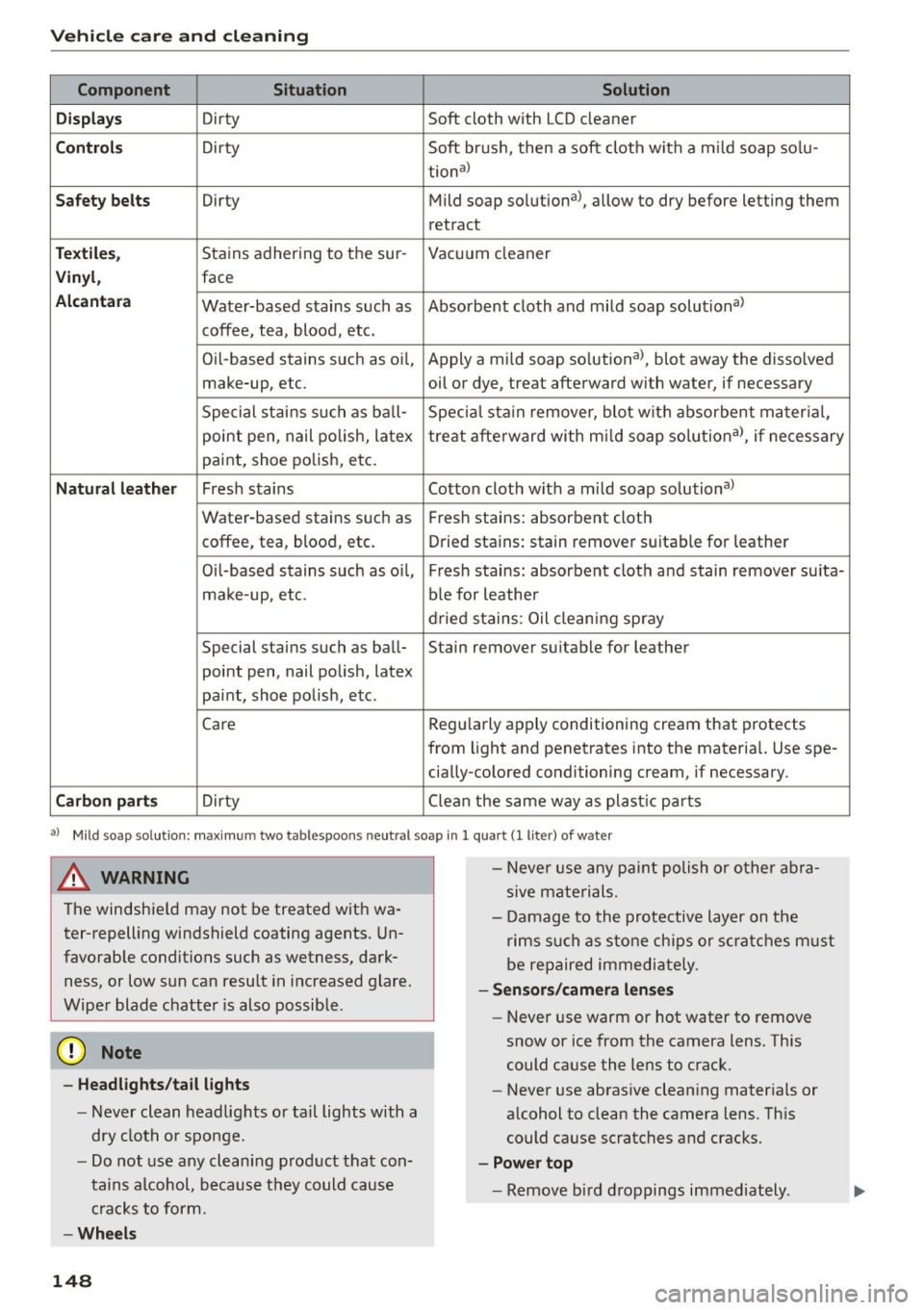
Vehicle care and cleaning
Component Situation Solution
Displays
Dirty Soft cloth with LCD cleaner
Controls Dirty Soft brush, then a soft cloth with a mild soap solu-
tional
Safety belts Dirty Mild soap solution a>, allow to dry before letting them
retr act
Textiles, Stains adhering to the sur- Vacuum cleaner
Vinyl, face
Alcantara Water-based stains such as Absorbent cloth and mild soap solutional
coffee, tea, blood, etc.
Oil-based stains such as o il, Apply a mi ld soap solutiona>, blot away the disso lved
make-up, etc. oil ori dye, treat afterward with water, if necessary
Special stains such as ball- Special stain remover, blot with absorbent material,
point pen, nail polish, latex treat afterward with mild soap solutional, if necessary
paint, shoe polish, etc.
Natural leather Fresh stains Cotton cloth with a mild soap solutional
Water-based stains such as
Fresh stains: absorbent cloth
coffee, tea, blood, etc. Dried stains: stain remover suitable for leather
Oil-based stains such as oil, Fresh stains: absorbent cloth and stain remover suita-
make-up, etc. ble for leather
dried stains: Oil cleaning spray
Special stains such as ball- Stain remover suitable for leather
point pen, nail polish, latex
paint, shoe polish, etc.
Care Reg
ula rly apply conditioning cream that protects
from light and penetrates into the materia l. Use spe-
cially-co lored conditioning cream, if necessary.
Carbon parts Dirty Clealil the same way as plastic parts
aJ Mild soap so lution: max im um two ta blespoo ns neut ral so ap in 1 quart (l lite r) of w ate r
A WARNING
Th e windshie ld may not be treated with wa
ter-repelling windshield coating agents. Un
favorable conditions such as wetness, dark
ness, or low sun ca n resu lt in increased glare.
Wiper blade chatter is also possible .
(D Note
-Headlights/tail lights
- Never clean headlights or tail lights with a
dry cloth or sponge.
- Do not use any cleaning product that con
tains alcohol, because they could cause
cracks to form.
-Wheels
148
-
- Never use any paint polish or other abra
sive materials.
- Damage to the protective layer on the
r ims such as stone chips or scratches must
be repaired immed iately.
-Sensors/camera lenses
- Never use warm or hot water to remove
snow or ice from the camera lens. This
could cause the lens to crack.
- Never use abrasive clean ing materials or
a lcohol to clean the camera lens. This
could cause scratches and cracks.
- Power top
- Remove bird droppings immediately .