ABS AUDI RS5 CABRIOLET 2013 User Guide
[x] Cancel search | Manufacturer: AUDI, Model Year: 2013, Model line: RS5 CABRIOLET, Model: AUDI RS5 CABRIOLET 2013Pages: 286, PDF Size: 71 MB
Page 133 of 286

with the vehicle interior has all the energy
they had just before the crash.
Never rely on air bags a lone for protec tion.
E ven when they deploy, airbags provide only
additional protection . Ai rbags are not sup
posed to deploy in all kinds of accidents. Al
though your Audi is equipped with a irbags, all
veh icle occupants, including the driver , must
wear safety belts correctly in order to min i
mize t he risk of severe injury or death in a
crash .
Remember too, that airbags wi ll deploy on ly
once and that your safety belts are always
there to offer protection in those accidents in
which airbags are not supposed to deploy or
when they have a lready deployed . U nbelted
occupants ca n also be thrown out of the vehi
cle whe re even mo re severe o r fa tal in ju ries
can occur .
It is also impo rtant fo r the rear passenge rs to
wear safety belts co rrec tly. Unbe lted passen
ge rs i n the rea r seats endanger no t on ly them
se lves bu t also the driver a nd o ther passen
gers
¢ fig. 145 . In a frontal collision they will
be thrown forward vio lent ly, where they can
h it and injure the dr iver and/or front seat pas
senger .
Safety belts protect
People think it 's possible to use the hands to
brace the body in a minor collision. It 's simply
not true!
F ig . 1 46 D river is correctly restra ined in a sud den bral<·
ing maneuve r
Safety belts used properly can make a big dif
ference . Safety be lts he lp to keep passengers
in their seats, gradually reduce energy levels
Safety belts 131
applied to the body in an accident, and he lp
prevent the uncontrolled movement that can
ca use serio us injuries . In addition, safety be lts
reduce the danger of being thrown out of the
vehicle.
Safety be lts attach passengers to the car and
give t hem the benefit of being s lowed down
more gently or "softly" through the "give" in
the safety belts, crush zones and other safety
features enginee red into today's vehicles. By
"absorbing" t he kinetic energy over a longer
per iod of t ime, the safety be lts make the
fo rces on the body more "tolerable" and less
li kely to ca use inju ry.
Althoug h these examples a re based o n a fron
ta l co llision, safety belts can a lso substantia l
l y red uce the risk of in jur y in other kinds of
cr ashes. So, whethe r you're on a long trip o r
just going to the co rner store, a lways buckle
u p and make sure others do, too . Accident sta
tistics show that vehicle occupants properly
wearing safety belts have a lower risk of be ing
i njured and a much better chance of surviving
an accident. Properly using safety belts also
greatly increases the ability of the supplemen
ta l airbags to do the ir job in a collision . Fo r
th is reason, wearing a safety belt is legally re
quired in mos t coun tries including much of
t he United States and Canada.
Althoug h your Aud i is equipped wi th a irbags,
you st ill have to wear the safety be lts p rov id
ed . Front airbags, fo r example, a re activa ted
o nly in some frontal collisions. The fron t air
bags are not act ivated in a ll fron tal coll isions,
in s ide and rear co llisions, in roll ove rs or in
cases where t here is not eno ugh deceleration
through impact to the front of the veh icle.
The same goes for the other a irbag systems in
your Audi . So, always wear your safety belt
and make su re everybody in your veh icle is
properly restrai ned!
Page 143 of 286
-Never place additional items on the seat
that can increase the total weight regis
tered by the weight-sensing mat and can
cause injury in a crash.
Front airbags
Description of front airbags
The airbag system can provide supplemental
protection to properly restrained front seat o ccupan ts.
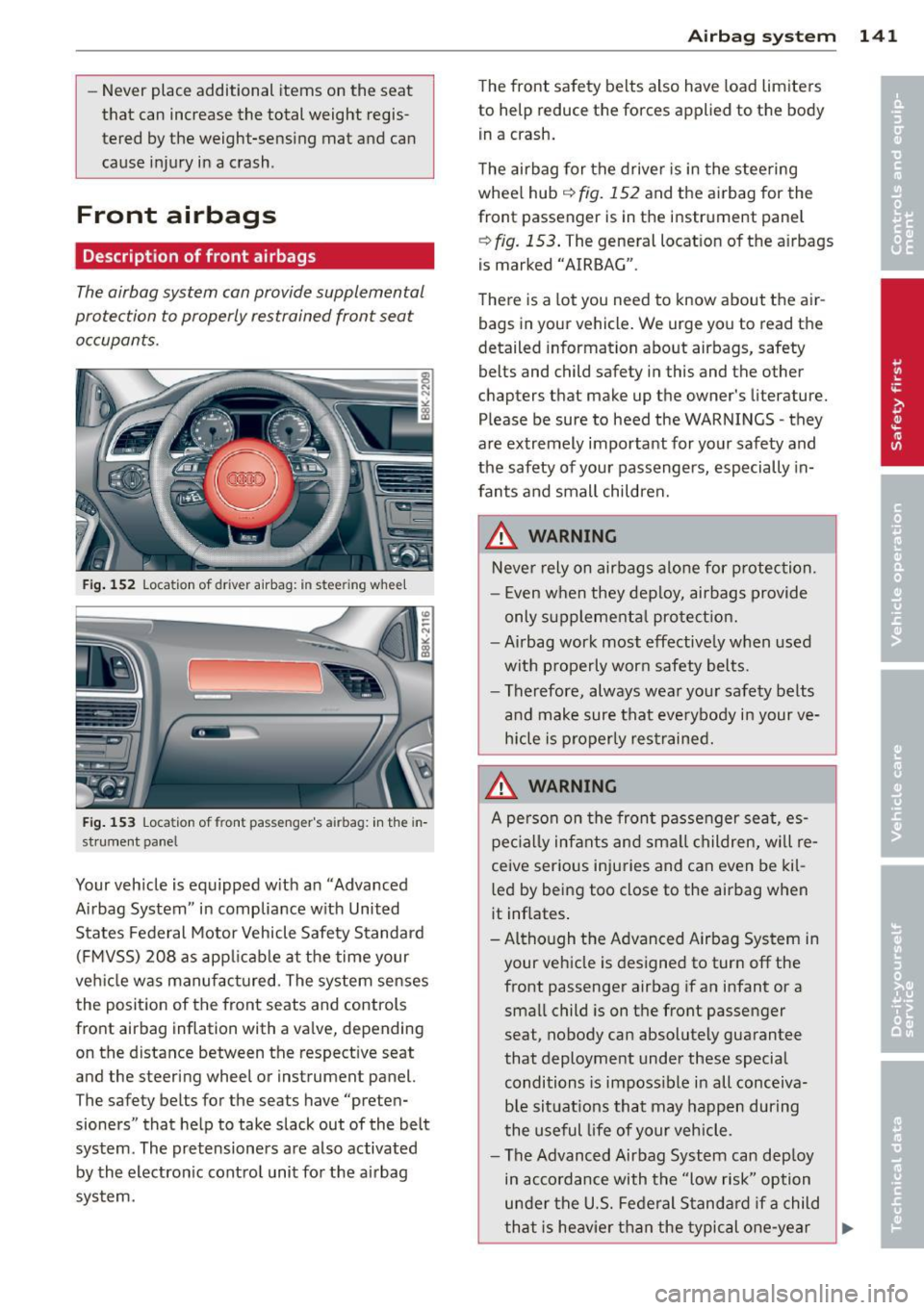
F ig . 15 2 Location of driver airbag: in steer ing whee l
Fig. 153 Location of front passenger's airbag: in the in
st rument panel
Your veh icle is equipped w ith an "Advanced
Ai rbag System" in compliance with United
States Federal Motor Vehicle Safety Standard (F MVSS) 208 as app licab le at the time your
ve hicle w as manufac tured. The system senses
the position of the front seats and controls
front airbag inflation with a va lve, depending
on the distance between the respect ive seat
and the steering wheel or instrument panel.
The safety belts for the seats have "preten
sioners" that he lp to take slack out of the belt
system . The pretensioners are also activated
by the electron ic contro l unit for the airbag
sys tem.
A irba g sy stem 141
The front sa fety belts also have load limiters
to help reduce the forces applied to the body
in a crash .
T he airbag for the drive r is in the stee ring
whee l hub
q fig. 152 and the airbag for the
front passenger is in the instrument panel
~fig. 153 . The general locat ion of the a irbags
is marked "AIRBAG".
There is a lot you need to know about the ai r
bags in your vehicle . We urge you to read t he
detailed information about airbags, safety
belts and child safety i n this and the other
chapters that make up the owner's literature. Please be sure to heed the WARNINGS -they
are extremely important for your safety and
the safety of yo ur passengers, especially in
fants and small children.
_&. WARNING
N ever rely on airbags alone for protec tion.
- E ven w hen they deploy, airbags provide
only s uppleme nta l pro tect ion .
- Airbag work most effective ly when used
wit h properly wor n safety belts.
- Therefore, always wea r you r safe ty belts
and make sure that eve rybody i n your ve
hicle is p rope rly res trained.
_&. WARNING
A pe rson on the fron t passe nger seat, es
pe cial ly infants and sma ll children, will re
ceive serious injuries and can even be kil l ed by being too close to the airbag when
it inflates .
- Altho ugh the Advanced Airbag System in
your veh icle is designed to tur n off the
front passenge r airbag if an infant or a
small child is on the front passenger
seat, nobody can absolutely guarantee
that deployment under these specia l
conditions is imposs ible in all conceiva
b le sit uat ions that may happen during
t he useful life of your vehicle.
- The Advanced Airbag System can dep loy
in acco rdance with the "low risk" option
un der the U.S. Fede ral Standa rd if a child
that is he avie r than the typical one-year
-
..
Page 145 of 286
Fo r exa mple, the airbag may depl oy if:
- a small child that is heavier than a typical 1
year-o ld child is on the front passenger seat
(regardless of whether the child is in one of
the chi ld safety seats listed
¢ page 160),
-a ch ild who has outgrown child rest raints is
on the front passenger seat.
I f the front passenger airbag is turned off , the
PA SSENGER AIR B AG OFF light in the center
of the inst rument panel w il l come on and stay
on.
The front a irbag on the passenger side may
not deploy (the PASSENGER AIR BAG OFF
light does not illuminate and stay lit) if:
- a small adult or teenager is on the front pas
senger seat
- a passenger who is not sitt ing upr ight w ith
their back against a non-reclined backrest
with their feet on the veh icle floo r in front
of the sea t is on the front passenge r seat.
If the front passenger airbag deploys, the
Federal Standard requires the airbag to meet
the " low risk " deployment criteria to help re
duce the risk of inj ury through in teraction
with the airbag . "Low risk" deployment occurs
in those crashes that take place at lower de
celerations as defined in the electronic control unit.
¢ page 148
Alway s remember : Even though you r vehicle
is equipped with Advanced Airbags, the safest
p lace for children is properly restrained on the
back seat . Please be sure to read the impor
tant information in the sect ions that follow
and be sure to heed all of the WARNINGS.
_&. WARNING
To reduce the risk of injury when an airbag
inflates, always wear safety belts properly .
- If you are unrestrained, lean ing forward,
sitting sideways or out of position in any
way, your risk of injury is much highe r.
- You w ill also receive serious injuries and
could even be killed if you are up against
the a irbag or too close to it when it in-
A irbag system 143
flates - even with an Advanced Ai rbag
¢page 137 .
_&. WARNING
A child in a rearward-fac ing ch ild safety
seat installed on the front passenger seat
will be ser ious ly injured and can be killed if
the front airbag inflates - even with an Ad
vanced A irbag System .
-Although the Advanced Airbag System in your veh icle is designed to turn off the
front airbag when a rearward-facing child restraint has been instal led on the
front passenge r seat, nobody can abso
lutely guaran tee that dep loymen t is im
possible in all conceivable situations that
may happen during the usefu l life of your
veh icle.
- The inflating airbag will hit the child
safety seat or infant carrier with great
force and will smash the child safety seat
and child against the backrest, center
armrest, door, or roof .
-Always install rearward -facing chi ld re
straints in the back seat.
- If you must install a rearward fac ing
child safety seat on the front passenger
seat because of exceptional c ircumstan
ces and the
PASSENGER AIR BAG OFF
light does not come on and stay on, im
mediately insta ll the rear-fa cing ch ild
safety seat in a rear seating position and
have the airbag system inspected by your
author ized Audi dealer .
A WARNING
-=
If, in exceptiona l circumstances, you must
install a forward-facing child restraint on
the front passenger's seat:
- Always make s ure the forward-facing
seat has been designed and certified by its manufacturer for use on a front seat
with a passenger front and s ide a irbag.
- Never put the forward-facing child re
straint up against or very near the instru-
ment panel.
~
•
•
Page 154 of 286

152 Airbag system
dealer is familiar with these re quirements
and we recommend that you have your
dea ler perform this serv ice for you.
Other things that can affect Advanced
Airbag performance
Changing the vehicle's suspension system can
change the way that the Advanced Airbag Sys
tem pe rforms in a crash. For example, us ing
tire-r im combinations not app roved by Aud i,
lowering the vehicle, changing the stiffness of
the suspension, incl uding the springs, suspen
sion struts, shock absorbers etc. can change
the forces that are measured by the airbag
sensors and sent to the electronic control
un it. Some suspension changes can, for exam
ple, increase the force levels measured by the
sensors a nd make the airbag system deploy in
crashes in w hich it would not dep loy if the
changes had not been made . Other kinds of
changes may reduce the force levels meas
ured by the sensors and prevent the airbag
from deploying when it should .
The sensors in the safety belt buckle fo r the
d river and front passe nger seat tell the elec
tronic control module if the safety belt is
latched or not.
If the safety belt is being used,
the front airbag will deploy at a slightly high
er rate of vehicle deceleration than if the safe
ty belt is not being used. Therefore, in a par
ticular collision, it is poss ible that an a irbag
will not deploy at a seating position whe re the
safety belt is being used but will inflate at the
position whe re the safety belt is not bei ng
used. It is important tha t noth ing inte rfe re
with the safety belt buckles so t hat the sen
sors can send the correct information a bout
safety belt use to the electronic contro l unit.
A WARNING
Changing the vehicle 's suspension includ
ing use of unapproved tire-rim c ombina
tions can change Advanced Airbag per
formance and increase the risk of ser ious
personal i njur y in a crash.
- Never install suspension components
that do not have the same performance characterist
ics as the components origi
na lly installed on your vehicle.
- Never use tire-rim com binations that
have not been approved by Audi.
A WARNING
= -
Items stored between the safety be lt
b uckle and the center console can cause
the sensors in the buckle to send the
wrong information to the e lectronic con
trol module and prevent the Advanced Air bag System from wo rking prope rly.
- Always make s ure that nothing can inter
fe re with the safety belt buckles and that
they are not obstructed.
Knee airbags
Description of knee airbags
Applies to vehicles: with knee airbags
The knee airbag system can provide supple
mental protection to properly restrained
front seat occupants .
Fig. 1 56 Dr iver 's k nee a irbag
The driver knee airbag is in the instrument
panel underneath the steering wheel
Q fig . 156, the knee a irbag for the passenger
is at about the same height in the inst rument
pane l underneath the g love compar tme nt.
The knee airbag offers additional p rotection
to the driver 's and passenger's knees and up
per and lowe r th igh a reas and suppleme nts
the p rotec tion provided by t he safety be lts.
If the front a irbags dep loy, the knee a irbags
also dep loy in fron tal coll is io ns w hen the de
ployment th reshol d sto red in the control un it ..,,
Page 179 of 286

ESC includes and/or works together with the
anti-lock brake system (ABS), brake assist sys
tem, anti -slip regulation (ASR) , e lectronic dif
ferential lock (EDL), dynamic steering* and se lective wheel torque control*. ESC is switched
on all the time. In certa in situations when you
need less t raction, you can sw itch off ASR by
p ress ing the button
ij] Q page 178, fig . 169
or ~ page 178, fig. 170. Be sure to sw itch
ASR on again when you no longer need less
traction.
Anti -lock braking system (ABS)
ABS prevents the wheels from locking up
when braking. The veh icle can still be steered
even du ring ha rd b raking . Apply steady pres
sure to the brake pedal. Do not pump the ped
al. A pulsing in the brake peda l indicates that
the system is he lping you to brake the vehicle .
Brake ass ist system
The brake assist system can decrease braking
d istance.
It increases braking power when the
driver presses the brake pedal qu ic kl y in eme r
gency situations . You must p ress and ho ld the
brake peda l until the situation is over. In
vehicles with adaptive cruise control*, the
brake assist system is more sensit ive if the
d istance detected to the vehicle ahead is too
small.
Anti- slip regulati on (ASR )
ASR reduces engine power when the drive
wheels begin to spin and adapts the force to the road condit ions. This makes it eas ier to
start, accelerate and drive up hills.
El ectronic diffe rential lock (EDL )
The ED L brakes wheels that are spinning and
transfers the drive power to the other wheels .
This function is available up to about 60 mph
(100 km/h).
I n extreme cases, ED L automatically switches
off to help keep the brake on the braked whee l
from overheating.
EDL wi ll switch on again au
tomatically when conditions have returned to normal.
Int ellig ent technolog y 177
Dynamic steering *
On vehicles with dynam ic steering*, ESC he lps
stabilize the steering in crit ica l sit uations.
Select ive wheel torque control*
The select ive wheel torque control operates
when d riving through curves. The front wheel
on the inside of the curve o r both wheels on
the ins ide of the c urve a re bra ked select ively
as needed. This minimizes sliding in the front
whee ls and allows for more precise driv ing
through curves. The app licable system may
not act ivate when dr iving in wet or snowy con
ditions.
A WARNING -
- ESC, ABS, ASR, EDL dynam ic steering*
and the select ive wheel torque control*
cannot ove rcome the laws of physics.
This is especially important on slippery
or wet roads.
If t h e systems beg in acting
to stabilize your veh icle, yo u should im
mediately change your speed to match
the road and traffic conditions . Do not
let the increased safety provided by
these systems tempt you to take r isks.
Doing so will increase the risk of a loss of
veh icle contro l, collision and ser ious per
sonal injur ies.
- Always adapt your speed to road, traffic
a nd weather conditions. The risk of Los-
ing contro l of the vehicle i ncreases when
driving too fast, espec ially through
curves and on slippery or wet roads, and
when dr iv ing too close to vehicles up
ahead. ESC, ABS, the brake assist sys
tem, ASR, ED L dynamic steering * and the
selective whee l torque control * cannot
prevent coll is ions.
- Always accelerate with spec ial care on
even, smooth surfaces such as those that
are wet or covered with ice and snow.
The drive wheels can spin even with
these assistance systems that can not al
ways he lp to red uce the risk of loss of ve
hicle control.
•
•
Page 180 of 286

178 Intelligent technolog y
@ Tips
-ABS and ASR on ly work correctly when
a ll four wheels are eq uipped w ith identi
ca l tires . Different tire s iz es can lead to a
r educt io n in engine power .
- You may hear no ises w hen the systems
described are wo rking.
- If the indicato r light
DJ or 11:11 (U SA
models) 1i] (Canada models) appears,
there may be a malf unct io n ¢
page 19,
c> page 19.
Switching on/off
ESC turns on au toma tically when you s tart
the engine.
Fig . 16 9 Ver sio n A : low er c ente r co nso le,~ OFF bu t·
to n
Fig . 17 0 Ve rsio n B: u ppe r ce nter conso le, ~ OFF but
to n
Switching sport mode on
Press the I;; OF F I button ¢ fig. 169 o r
c::> fig. 170 quickly. The act ions taken by the
E SC and ASR stabilize the vehicle a re limited .
T he
IJ ES C in dicator light tu rns on and the
me ssage
Stabilization control (ESC) : Sport .
Warning! Restricted stability
appe ars in the
d river info rmation disp lay
c::> A .
The following e xamp les are unusual situa
t io ns whe re it may ma ke sense to switch s port
mode on in order to allow the wheels to sp in:
- Ro cking the vehicle to free i t when i t is s tuck
- Dr iv ing in deep snow o r on loose g round
- Dr iving with snow chains
Sport mode can be sw itched on at a ny speed .
Switching ESC/ASR off
Press a nd ho ld the I~ OFF I but ton for three
secon ds. The
lfil•)H and fl indicator lights
turn on and the message
Stabilization con
trol (ESC) : off. Warni ng! Restricted stability
appears in the driver information display.
AS R is also switched off when ESC is switched
off . The stabilizat ion function is not ava ilable
c> A .
Switching on
Press the !.i, O FF I button ag ain to sw itch the
ESC back on . The
I indicator lig ht tu rns off
and the message
Stabilization control (ESC ):
On appears in the display.
A WARNING ,-
- Drive whee ls can sp in and you can lose
control of t he vehicle mo re eas ily w hen
ASR and ESC are in sport mode , especial
ly whe n the road is slippe ry .
- Sw itch to sport mode only when your
driving skills, traffic an d weather condi
tions per mit.
@ Tips
You cannot sw itch sport mode on whe n
adaptive c ruise co ntrol* is w ork in g.
Braking
What affects braking efficiency?
New brake pads
D uring the first 250 mi les (400 km), new
brake pad s do not possess the ir full b rak ing
effect, they have to be "broken in" first¢ &.
The break- in period can be considerably lon-
-
ger for ve hicles w ith ceram ic b rake rotors* . ll>
Page 181 of 286

You can compensate for th is sligh tly re duced
brak ing power by push ing harder on the brake
pedal. Avoid heavy braking loads d uring the
break-in per iod.
Operating condit ion s and d riv ing hab it s
The brakes on today's automobi les are st ill
subject to wear, depend ing largely on operat
ing conditions and driving habits¢.&. . On
vehicles that are either driven mostly in stop and-go city traffic or are driven hard, the brake pads should be checked by your author
i zed Audi dealer more often than specified i n
the
Warranty & Maint enan ce booklet . Failure
to have your brake pads inspected can result
in reduced b rake performance.
On steep slopes, you should use the brak ing
effect of the engine . Th is way, you prevent un
necessary wea r on the brake system. If you
must use you r brakes, do not hold the brakes
down continuously. P ump the b rakes a t inter
va ls.
Operating noise
Noises may occur when braking depending on
the speed, braki ng force and outside condi
tions such a s tempe ratu re a nd h umidity .
Due to the nature of the materials used i n ce
ramic brake rotors*, nois es may become more
apparent at low speeds.
Effect of w ater and ro ad s alt
In certain situat ions, for example after driving
through water, i n heavy ra in, after over night
condensation or after washing your car, the
b rak ing effect can be reduced by moistu re or
i ce on the bra ke roto rs and b rake pads . The
b ra kes must be dried fi rs t w it h a few caref ul
b ra ke app lications.
At h igher speeds and with the w indshield w ip
e rs turned on, the brake pads p ress against
the brake rotors for a short amount of time.
This occurs a t reg ular in tervals wi tho ut the
d river noticing and provides for better brake
response time un der wet conditions.
The effectiveness of the brakes can be reduced
when the vehi cle is dr iven o n a salt -cove re d
Int ellig ent technolog y 179
road and the b ra kes are no t used. Likewise ,
you clean off acc umulated salt coating from
brake d iscs and pads with a few cautio us ap
plications of the brake
9 ,&. .
Due to the ir sur face character istics, ceramic
brake rotors* absorb moisture i n such condi
tions. T his can cause a tempo rary reduction in
braking force compared to dry brakes. Yo u can
compensate for this by pressing the brake
pedal harder .
Corrosio n
There may be a tendency for dirt to b uild up
on the brake pads and corros ion to form on
the d iscs if the car is not driven regularly or
o nly for short trips w ith litt le use of the
brakes .
If the brakes are not used frequently, or if cor
ros ion has formed on the discs, i t is adv isable
to clean off the pads a nd d iscs by braking
firmly a few times from a moderately high
speed
9 &. .
Fault s in the brake sy stem
If you shou ld notice a sudden increase in
brake pedal travel, then one of the two b rake
c ircui ts may have failed ¢&. .
Lo w brake fluid lev el
Malfunctions can occ ur in the brake system if
the brake fluid level is too low. The brake fluid
level is monitored electronica lly.
Brake booster
T he br ake booster inc reases the pressure tha t
yo u gene rate with t he brake peda l. It works
o nl y when t he engine is running .¢
&
Brake lining wear status
B ra ke lining wear may be checked by visual in
spe ction o f the condition of the bra ke pads
th rough the open ings in the wheel. If neces
sary, the wheel may be removed for t his in
spection ¢
page 245, Changing a wheel.
•
•
Page 199 of 286
dampened with dish detergent and water is recommended.
(D Note
- To avoid sc ratch ing the disp lay, yo u
shou ld never clean it dry.
- To preven t damage, ma ke s ure fl uids do
not enter the controls .
Aluminum trim
Use only neutral-pH products to remove spots
and depos its from alum inum s urfaces.
C hrome care products and alkaline cleaners
will attack alum inum surfaces and can dam
age them over time .
A WARNING
Always read and heed all WARNINGS and
other information ~
page 189.
Fabrics and fabric coverings
Fab rics and fabr ic coveri ngs (e.g . seats, doo r
tr im panels, etc.) should be cleaned at reg ula r
i nte rva ls wi th a vac uum cleaner . Thi s removes
sur face dirt particles which could become em
bedded in the fabr ic through use . Steam
cleane rs shou ld not be used, because the
steam tends to push the dirt deeper into the
fabric and lock it there.
Normal cleaning
Generally, we recommend using a soft sponge
or a lint-free microfiber cloth to the clean fab ric. Brushes should on ly be used for carpets
and floor mats, s ince other fabric surfaces
could be harmed by brushes.
Normal surface sta ins can be cleaned using a
commercia lly available foam cleaner. Spread
the foam on the surface of the fabric with a
soft sponge and work it in gently. Do not sat u
rate the fabric. Then pat the foam d ry using
absorbent, dry cloths (e .g . microfibe r cloth)
and vacuum it afte r it has dr ied comp lete ly .
Cleaning and protec tion 197
Cleaning sta ins
Stains caused by bever ages (e.g . coffee, fr uit
ju ice, etc.) can be treated with a mild deter
gent solution. Apply the detergent so lution
with a sponge. In the case of stubborn stains, a detergent paste can be applied directly to
the stain and worked into the fabric . After
wards, use copious amounts of clean water to
remove the rema ining deterge nt. Apply the
water wit h a damp cloth or sponge and pat
t h e fabric dry with an abso rbent, dry clot h.
Stai ns from choco late or makeup should have
detergent paste rubbed i nto them . After
wards, remove the soap w ith water (damp
sponge).
A lcohol can be used to treat stai ns from
grease, o il, lipstick or a ballpoint pen . M elted
grease or dye must be patted off using ab
sorbent mater ial. It may be necessa ry to re
t reat the areas with de tergent pas te and wa
te r.
In the case of gene ral soiling of the uphols
tery a nd cover material, we recommend hir ing
a speci alist t hat h as the eq uipment to clean
t h e se at cove rs and othe r fabr ic surfaces by
shampooing and spray extraction.
A WARNING
A lways read and heed all WARNINGS and
the information
~ page 189.
(D Tips
Open Ve lcro fas teners on yo ur clothing can
damage the seat cover . Please make sure
that Ve lcro fasteners are closed .
Plastic parts and instrument panel
Always use a clean cloth moistened in clear
water to clean these areas. For persistent d irt
use a n Aud i approved
solvent-free p lastic
clea ner/protectant .
•
•
Page 201 of 286
preservative cream that contains UV
blockers and that works into the leather .
This cream w ill nourish and mo istur ize
the leather, he lp ing it to breathe and
stay supple. It also helps to build up a
protective coating on the surface.
- Clean the leather every 2 - 3 months,
and clean any areas that get soiled.
- Remove fresh marks made by ballpoint pens, ink, lipst ick, shoe polish, etc. as
soon as possib le.
- Preserve the color of the leather as need
ed by using a special colored leather care
cream to touch up areas of uneven color.
Cleaning and caring for leather
upholstery and trim
Applies to vehicles: with natural leather
Natural leather requires special care and at
tention.
Norm al cleaning
.,. Clean soiled areas with a slightly mo istened
cotton or woolen cloth.
Mor e stub born dir t
.,. More stubborn dirt can be removed using a
cloth saturated with a m ild soap so lution (2
tablespoons m ild liquid soap) .
.,. Never allow the soap solution to saturate
the leather, and make certa in that no water
soaks into the seams .
.,. Wipe off the soap solution with a soft, dry
cl oth.
Cleaning spots
.,. Remove fresh w ater -b ased spots (such as
coffee, tea, ju ices, blood) w ith an absorbent
cloth or paper towel.
.,. Remove fresh
grea se or oil -based spot s
(such as butter, mayon naise , chocolate) wi th
an absorbent cloth or paper towe l, or use
the cleaner from the leat her ca re kit i f the
spot has not yet penetrated into the s urface
of the leather .
.,. Use an oil/grease dissolv ing spray, if
oil /
grease spots h ave d ried on.
Cleaning and protec tion 199
.,. Remove specific kinds of spots (ballpoint
pe n, fe lt marker, fingernai l polish, water
based pa int, shoe po lish, etc .) with a spot
remover specifically formu lated for leather.
L e ather care
.,. Every half yea r use an approved leather care
product (available from your authorized
Audi dea ler) to ca re for the leather .
.,. App ly the product very spar ingly.
.,. Wipe it off w ith a damp cloth.
If you have any q uestions about cleaning and
caring for the leather in your vehicle, it is best
to contact your authorized Audi dealer, who
will be glad to help you and tell you about our
full range of leather care products, such as :
- Leather cleaning and care kit
- Creams to ca re fo r colored leather
- Spot removers for ballpoin t pens, shoe pol-
ish, etc.
- Oil/grease d issolving spray
- New and upcom ing products .
.&_ WARNING
Always read and heed all WARN INGS and
other in formation
r:!) page 189 .
(D Note
- Never use chem ica l so lvents (e .g . lighte r
fluid, tu rpe nti ne), waxes, s hoe polish o r
simi la r prod ucts on the lea ther surfaces
i n yo ur Audi .
- To avoid damage, have stubbo rn sta ins
removed by a comme rcial clean ing spe
c ialist .
Cleaning Alcantara ® (synthetic suede)
Applies to vehicles: with Alcantara® upholste ry
R emoving du st and dirt
.,. Moisten a cloth, squeeze out excess water
and wipe down the seat surfaces .
Removing stains
.,. Moisten a cloth with lukewa rm wate r or
w ith di luted
ethyl (rubbing ) alc ohol.
•
•
Page 219 of 286
If the brake fluid level falls considerably be
l ow the "MIN" mark, the brake warning/indi
cator light (U.S . mode ls:
1111 . Canad ian
models: .) will come on
¢ page 15. Do not
continue to operate the vehicle. The complete brake system should be thoroughly checked
by an authorized Audi dealer or qualified
workshop and the cause co rrected . If the
b rake fluid level is too low, the brake warn ing/
in dicator light w ill illuminate. Contact an a u
thor ized Audi dealer
imm ediatel y.
@ Tips
The brake fluid rese rvoir is located unde r
neath the cover.
Changing brake fluid
Hove the broke fluid changed by on experi
enced technician .
Brake fluid absorbs moistu re from the a ir. If
the water content in the brake fluid is too
hi gh , corrosion in the b rake system may resul t
after a per iod of t ime . The bo iling po int of t he
b rake fluid w ill also decrease considerably and
decrease braking performance.
Therefore, the brake flu id must be changed
e ver y two year s. Always use new b rake fluid
which conforms to Federal Motor Vehicle
Standard "FMVSS 116 DOT 4".
The brake flu id rese rvoi r ca n be difficult to
r eac h, therefore , we recommend th at yo u
h ave the brake f luid changed by yo ur autho r
ized
Audi dealer . Your deale r has the correct
too ls, the right brake fluid and the know -how
to do th is for you.
A WARNING
- Brake fluid is po isonous . It must be stor
ed only in the closed orig inal container
out of the reac h of children!
- Brake fa ilure can result from old or inap
propr iate brake fluid . Observe these pre
caut ions:
- Use on ly bra ke fluid that meets SAE
specification
J 1 7 03 and conforms to
Checkin g and fillin g 217
Federa l Moto r Ve hicle Standard 1 16 .
Always check with your authorized Audi
dealer to make sure you are using the correct brake fluid . The correct type of
brake flu id is also ind icated on the
brake f luid rese rvoir .
- The brake fluid must be new . Heavy use
of the brakes ca n cause a vapo r lock if
the b rake fluid is left i n the system too
l ong. This can se riou sly affect the effi
c iency of the brakes as well as your
safe ty . T his co uld resu lt in an accident.
(D Note
B ra ke fluid wi ll damage the paint o f you r
vehicle.
@ For the sake of the environment
Because of the p rob lem of proper disposal
of bra ke fluid as well as the spec ial too ls
r equired and the necessary expertise, we
r ecomme nd th at yo u have the br ake fl uid
changed by yo ur autho rized Aud i dea le r.
Battery
General information
Un der normal operating cond itions , the bat
te ry in you r Audi does not need any ma inte
nance . With
high outside temperatures o r
long da ily d rives we recommend that you have
t h e e lectrolyte leve l chec ked by an au thori zed
A udi dealer or qualified workshop . The elec
trolyte leve l should also be checked each time
the batte ry is charged
¢ page 219.
Have the battery checked when yo u take your
vehicle in for se rvice. You are well advised to
replace a battery that is older than 5 years.
Wi th cer tain types of airbag deployment, the
ba ttery is disconnected from the veh icle elec
trical system for safety reasons¢.&
in Re
pair, core and disposal of the airbags on
page 151.
~
•
•