ABS AUDI RS5 CABRIOLET 2013 Owner's Manual
[x] Cancel search | Manufacturer: AUDI, Model Year: 2013, Model line: RS5 CABRIOLET, Model: AUDI RS5 CABRIOLET 2013Pages: 286, PDF Size: 71 MB
Page 220 of 286
218 Check ing and filling
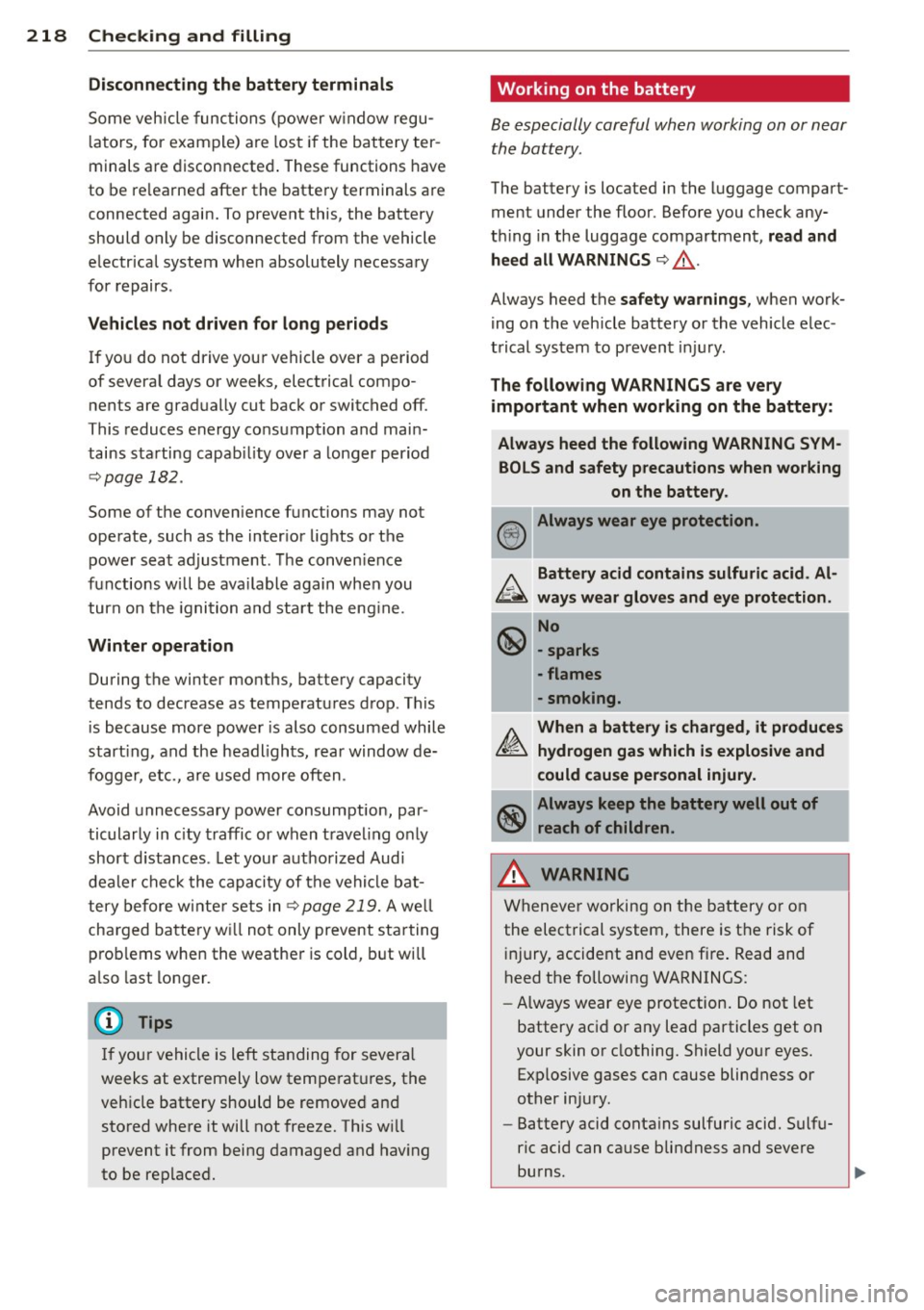
Di sconnect ing the batt ery terminal s
Some vehicle functions (power window regu
l ators, for example) are lost if the battery ter
minals are disconnected . These functions have
to be re learned after the battery terminals are
connected again. To prevent this, the battery
should only be disconnected from the vehicle
electrical system when absolutely necessary
for repairs .
Vehicles not dri ven fo r lo ng period s
If you do not drive your vehicle over a period
of several days or weeks, electrical compo
nents are gradually cut back or switched off.
This reduces energy consumption and main
tains starting capab ility over a longer period
~ page 182.
Some of the conven ience functions may not
operate, such as the inter ior lights or the
power seat adjustment . The conven ience
functions will be ava ilable again when you
turn on the ignition and start the eng ine.
Winter operati on
During the winter months, battery capacity
tends to decrease as temperatures drop . This
is because more power is also consumed while
start ing, and the headlights, rear window de
fogger, etc., are used more often .
Avoid unnecessary power consumption, par
ticularly in c ity traffic or when traveling only
short d istances . Let you r authorized Audi
dealer check the capacity of the vehicle bat
tery before winte r sets in
~ page 219. A well
charged battery w ill not only prevent starting
prob lems when the weather is cold, but wi ll
a lso last longer .
(D Tips
If your vehicle is left standing for severa l
weeks at extremely low temperat ures, the
veh icle battery should be removed and
stored where it will not freeze. This w ill
prevent it from being damaged and hav ing
to be replaced.
Working on the battery
Be especially careful when working on or near
the battery.
The battery is located in the luggage compart ment under the floor. Before you check any
th ing in the luggage compartment,
read and
h ee d all WARNINGS
~ ,&,
Always heed the safet y warnings , when work
ing on the vehicle battery or the vehicle e lec
trical system to prevent injury.
The following WARNINGS are ve ry
i mportant wh en wor king on the battery :
Alway s heed the following WARNING S YM
BOLS and safety prec autions when working
on the battery .
® Always wear eye protection .
b.. Battery acid contains sulfuric acid . Al
~ ways wear gloves and e ye protect ion.
-No
~ -sparks
-flames
--
-smoking.
A When a battery i s charged , it produ ce s
~ hy drogen gas which is e xplosi ve and
could cau se pe rsonal injur y.
--Always keep the battery well out of
® reach of children .
_& WARNING
=
Whenever working on the battery or on
the electrical system, there is the risk of i njury, accident and even fire . Read and
heed the following WARNINGS:
- Always wear eye protection. Do not let
battery acid or any lead particles get on
your skin or clothing. Shield your eyes. Exp losive gases can cause blindness or
other injury . -
-Battery acid conta ins sulfuric acid. Sulfu
ric acid can cause blindness and severe
burns.
Page 243 of 286

replacement or alternate tires and wheels a l
l ow the TPMS to continue to function proper
l y.
Tire pressure indicator appears
Applies to vehicles: with tire pressure monitoring system
The tire pressure indicator in the instrument
cluster informs you if the tire pressure is too
low or if there is a system malfunction.
F ig. 190 Display: underinflatio n warn ing
Using the ABS sensors , the t ire pressure mon i
toring system compa res the t ire tread circum
fe rence and v ibration characteristics of the in
d iv idual tires. If the pressure decreases in one
or mo re tires, th is is indicated in the instru
ment cluster with a
ti] warn ing symbol and a
message ¢
fig. 190. The driver message in the
disp lay goes out after S seconds. The driver
message can be d isplayed again by pressing
the
! S ET ! button. If only one tire is affected,
the display will indicate its pos ition .
T he t ire pressure monitoring system must be
reset via radio or MMI* each t ime the pres
sures are adjusted (e.g . when sw itching be
tween partia l and full load pressure) or after
changing o r replacing a t ire on your vehicle
¢
page 242. The TPMS indicator only moni
tors the tire p ressure that you have prev iously
stored . Yo u ca n find the recommended tire
p ress ures for you r vehi cle on the labe l on dr iv
er's side B -pi llar ¢
page 226 .
T ire tread c ircumfe rence and vibration c harac
ter ist ics can ch ange and ca use a ti re pressure
warn ing if:
- the tire pressure in one o r more t ires is too
low,
Tire s an d wheel s 241
- the t ire has struc tural damage,
- t he t ire press ure w as c hanged, wheels ro ta t-
ed or rep laced but the TPMS was not reset
¢ page 242.
Warning symbols
ti] Loss of pressure in at least one tire¢& .
Check the t ire o r tires and rep lace or repa ir if
necessary. The
ti] indi ca to r li ght in the inst ru
ment cluster a lso illuminates
¢ page 13.
Check/cor rect the press ures of all fo ur tires
and reset TPMS via radio or MMI*.
11il~1 (T ir e Pressure Monitoring System) Tire
pre ssure: Sy stem m alfunction!.
IfllilB appears after switching the ignition
o n or while d rivi ng and the
ti] ind icator l ight
i n the instr ument cluster blinks for app roxi
mately one minute and then stays on, there is
a system malfunct ion .
Attempt to sto re the co rrect tire pressu re
¢
page 242. If the ind ic a tor lig ht does not
turn off or i f it turns on sho rtly the rea fter, im
med iate ly dr iv e your vehicle to an authorized
A udi dealer or authorized repair faci lity to
have the malfunct ion corrected.
A WARNING
- If the tire pressure ind icator appears in
the instrument cluster display, one or more of your t ires is sign ificant ly unde r
inflated . Reduce you r speed immediately
a nd avoid any hard steer ing or b rak ing
maneuvers. Stop as soon as possib le and
check the tires and their pressu res . In
f late the tire pressure to the prope r pres
sure as indicated o n the vehicle's tire
pressure labe l
¢page 226. D riving on a
sign ificantly under-inflated tire causes
the t ire to overheat and can lead to tire
fa ilure. Under-inflation also is likely to
impair the vehicle's ha ndling and stop
ping ab ility .
- The drive r is responsib le for maintaini ng
the co rrect tire pressures . You must
check the tire pressures regu larly. .,..
•
•
Page 244 of 286

242 Tires and wheels
-Under certain conditions (such as a spor
ty driving style, winter conditions or un
paved roads), the pressure monitor indi
cator may be delayed.
- Ask your authorized Audi dealer if run
flat tires may be used on your vehicle.
Your vehicle registration becomes invalid
if you use these tires when not permit
ted. Damage to your vehicle or accidents
could also result.
@ Tips
-The tire pressure monitoring system
stops working when there is an ESC/ABS
malfunction.
- Using snow chains may result in a system malfunction .
- The tire pressure monitoring system on
your Audi was developed using tires with the
"ROl" identification on the tire side
wall ~
page 233. We recommend using
these tires.
Reset tire pressure monitoring system
Applies to vehicles: with tire pressure monitoring system
If the tire pressure is adjusted, wheels are ro
tated or chang ed, the
TPMS must be reset via
radio or
MM!* .
.. Before resetting the TPMS, the current pres
sures of all four tires must correspond to
the specified values. Adjust the tire pressure and reset the pressure in the tire pressure
monitoring system according to the load
you are carrying
~ page 226 .
.. Turn on the ignition .
.. Select : the
ICAR I function button > Tire pres
sure monitoring > Store now .
Or
.. Select : the ICA RI function button > Car sys
tems*
control button > Servicing & checks>
Tire pressure monitoring > Store tire pres
sures.
@ Tips
Do not store the ti re pressure if there a re
snow chains on the tire.
Page 254 of 286

252 Fuses a nd bulb s
No.
5 Sound actuator/exhaust
sound tun
ing
6 Headlight range control sys-
tern/cornering light
7 Headlight (cornering light)
Control modules (electro
-
mechanical parking brake,
8 shock absorber, quattro
I
sport, trailer hitch), DCDC
converter
9 Adaptive cru ise control
10 Shift gate
11 Side ass ist
12 Headlight range control,
parking system
13 Airbag
14 Rear wiper (allroad)
15 Auxi
liary fuse (instrument
panel)
16 Auxiliary fuse terminal 15
(engine area)
Fu
se pa nel@ (b ro w n)
2 Brake light sensor
3 Fuel pump
4
5 Left seat heating with/with-
out seat vent
ilat ion
6 E5C
7 Horn
-Front left door (window reg·
8 ulator, central locking, mir-
ror, switch, lighting)
9 Wiper moto r
1 0 ESC
Two-door models: rear left
window regu lator, Fo ur-door
11 mode
ls: rear left door (win-
dow regu lator, central lock-
ing, switch, lighting)
12 Rain and light sensor
Fu se panel © (red)
3 Lumbar support
Amps
5/ 15
5/7,5 7,5
5
5
5
5
5
5
15
10
40
5
25
5
15/30
5
15
30
30
25
30
5
10
No . Consumer
4 Dynamic steering
6
7
8
9
Interior lighting (Cabriolet)
Windshield washer system ,
headlight washer system
Vehicle electrical system
control module 1
Vehicle electrical system
control module 1 Left rear window regulator
motor (Cabriolet)/sunroof
10 Vehicle e
lectr ical system
con trol module 1
11 Right rear window regulator
(Cabriolet)/sun shade motor
12 Anti-theft alarm warning
system
Right cockpit fuse assignment
Amps
35
5
35
20
30
7,5/20
30
7,5/20
5
Fig. 202 R ight cockpi t: fuse pane l wit h plast ic cl ip
No. Con sumer Amps
F u se panel @ (black )
5 Steering column switch
5
module
7 Term
inal 15 diagnos tic con-
nector 5
•
....
Page 282 of 286
280 Index
Unlocking/ locking
atth elockcylinder ..... ... .. .. .... .. 36
by remote contro l . . . . . . . . . . . . . . . . . . 34
with the central locking switch .. ...... 35
with the convenience key ... .. .. .... .. 35
Upper cabin heating . . . . . . . . . . . . . . . . . . 72
Use of jumper cables ........ ... .. ... 256
V
Valet parking ........... ...... ... .. .. 40
Vanity mirrors ................ ..... .. 57
Vehicle-care products ..... .. .. .. .. .. . 189
Vehicle elec trical system . . . . . . . . . . . . . . 17
Vehicle Identification Number (VIN) ... . 261
Vehicle jack .. .......... ...... ... .. . 248
Vehicle key .. ................ ..... .. 32
Vehicle literature . . . . . . . . . . . . . . . . . . . . . 5
Vehicle tool kit . . . . . . . . . . . . . . . . . . . . . 243
Ventilation . ................. ..... .. 69
w
Warn ing/ indicator lights . . . . . . . . . . 10, 13
Airbag system ............ ... .... .. 20
Anti-lock braking system (ABS) . . . . . . . . 19
Brake system ................ .... .. 15
E lectromechanica l parking brake .. .... 16
Electronic power control . . . . . . . . . . . . . 20
Electronic Stabili zation Control (ESC) ... 19
Generator . . . . . . . . . . . . . . . . . . . . . . . . . 17
Malfunction Indicator Lamp (MIL) . . . . . 20
Safety belt . . . . . . . . . . . . . . . . . . . . . . . . 17
Safety systems . . . . . . . . . . . . . . . . . . . . . 20
Turn signa ls ............. .. .. .... .. 22
Warranty coverages ......... ... .. .. . 264
Washer reservoir ................... 221
Washing .. ............... .. .. .... . 189
Automatic car wash ..... .. .. .. .. .. . 190
by hand .. ... ............ .. .. .. .. . 190
General information ....... ... .... . 189
Matte finish paint ............ .... . 192
Power top cleaning ....... .. .. .... . 192
with a power washer ...... .. .. .. .. . 191
Waxing . .. .. .. . .......... .. .. .. .. . 193
Wear indicator ................ .. .. . 232
Weights ..... ................ ..... . 261 What happens if you wear your safety belt
too
loose? . ..... .. .. .............. . 134
What happens to unbelted occupants? .. 130
What impairs driving safety? ...... .... 119
What should I do after changing a
whee l? ............................ 229
What should I do after replacing wheels? 229
Wheel bolts Torque .... .... .. ............. .... 239
Wheels ... ..... .. .. .............. . 222
Cast alloy ..... .. ............. .... 195
Checking tire pressure .............. 228
Cold tire inflation pressure ...... .. .. 226
General notes .. ... .............. .. 222
Glossary of tire and loading terminolo-
gy . .. ... ... .. .. .. _ .... ...... .. .. 223
New tires and wheels ............... 233
T ires and veh icle load limits ..... .... 230
When must a safety belt be replaced? .. 132
When must the airbag system be inspect- ed? ......... ... .. .. ............... 148
When should I adjust the tire pressures? 229
When should I check the tire pressures? . 229
Where can I find the tire pressures for my car? .............................. 228
Why safety belts? . . . . . . . . . . . . . . 129, 130
Wind deflector .. .. ............. .... . 46
Cleaning .. .. .. .. ............. .. .. 193
Windows Cleaning . ..... .. .. .............. . 195
defrosting ..... .. .. .............. .. 71
Windsh ield
Cleaning .. .. .. .. .. ... ........ .... . 57
defrosting ..... .. .. .............. .. 71
Windsh ield washer fluid
Low leve l .. ... ... .. .............. .. 21
Windshield washer system ....... .. .. . 57
Windsh ie ld wipers
Folding up ...... ................ .. 58
Indicator light ... ................ .. 21
Replac ing windsh ield wiper blades . ... . 58
Switching on/off . ............. .... . 57
Washer reservoir 221
Winter operation
Battery . . . . . . . . . . . . . . . . . . . . . . . . . . 217
Coolant system . ................. . 214
Defrosting windows .............. .. . 71