brakes AUDI RS5 CABRIOLET 2013 User Guide
[x] Cancel search | Manufacturer: AUDI, Model Year: 2013, Model line: RS5 CABRIOLET, Model: AUDI RS5 CABRIOLET 2013Pages: 286, PDF Size: 71 MB
Page 98 of 286
96 Audi adaptive cruise control and braking guard
Interrupting cruise control
Applies to vehicles: with Audi adaptive cruise control
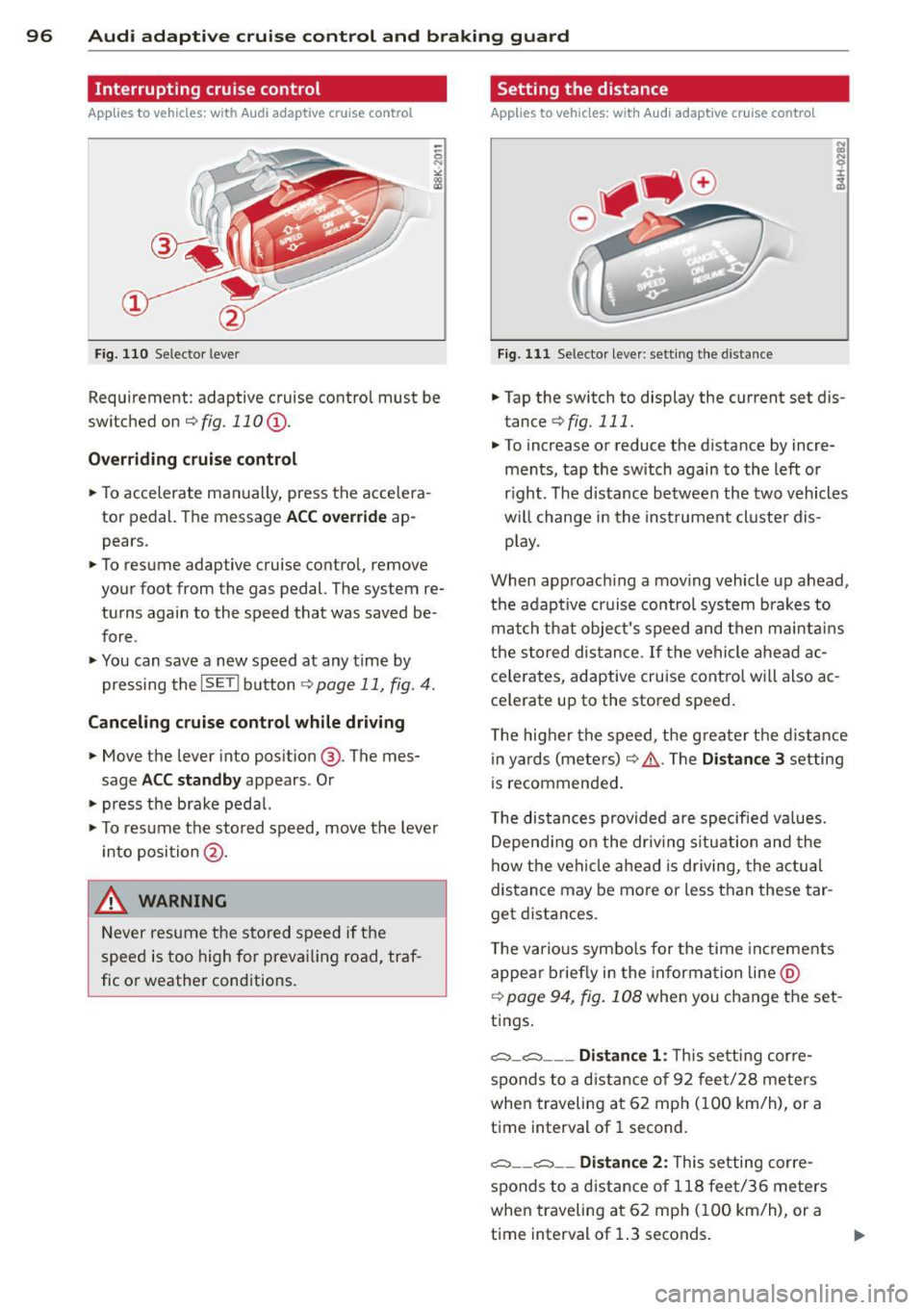
Fig. 110 Selector leve r
Requirement : adaptive cruise contro l must be
switched on
¢fig.110 (i).
Overriding cruise control
.. To accelerate ma nually, press the accelera
tor pedal. The message
ACC override ap
pears .
.. To resume adaptive cruise control, remove
your foot from the gas pedal. The system re
turns again to the speed that was saved be
fore .
.. You can save a new speed at any time by
pressing the
I SETI button ¢ page 11, fig. 4.
Canceling cruise control while driving
.. Move the lever into posit ion @. The mes
sage
ACC standby appears . Or
.. press the brake pedal.
.. To resume the stored speed, move the lever
into position @.
&_ WARNING
Never resume the stored speed if the
speed is too high for prevailing road, traf
fic or weather cond itions.
Setting the distance
Applies to vehicles: wit h Audi adapt ive cr uise contro l
Fig. 111 Selector lever : sett ing the distance
.. Tap the switch to display the current set dis
tance
¢ fig. 111 .
.. To increase or reduce the distance by incre
ments, tap the switch again to the left or
r ight. The distance between the two vehicles
w ill change in the instrument cluster dis
play .
When approach ing a moving vehicle up ahead,
the adaptive cruise control system brakes to
match that object's speed and then maintains
the stored dis tance. If the vehicle ahead ac
ce le rates, adaptive cruise control will also ac
ce lerate up to the stored speed.
T he higher the speed, the greater t he distance
in yards (meters)
c:::> /1.. Th e Distan ce 3 setting
is recommended .
T he distances provided are specified va lues .
Depending on the driv ing situation and the
how the veh icle ahead is driving, the actual
distance may be more or less than these tar
get distances.
T he various symbols for the time inc reme nts
appear briefly in the information line @
¢ page 94, fig. 108 when you change the set
tings.
c::::,_c::::, ___ Distance 1: Th is setting corre-
sponds to a distance of 92 feet/28 meters
when traveling at 62 mph (100 km/h), or a
time interval of 1 second.
c::::, __ c::::, __ Distance 2: This setting corre
sponds to a distance of 118 feet/36 meters
when traveling at 62 mph (100 km/h), or a
time interval of 1.3 seconds.
Page 100 of 286

98 Audi adaptive cruise control and braking guard
Audi braking guard
Descript ion
Applies to vehicles: with Audi adaptive cruise control
F ig . 11 3 Instrumen t cl uste r: approach warn ing
Braking guard uses a radar sensor. It also
functions within the limits of the system
when adaptive cruise cont ro l is switched off .
What can Audi braking guard do?
When detected i n time, the system ca n assess
situations when a vehicle ahead brakes sud
denly or if your own veh icle is traveling at a
hi gh speed and approachi ng a ve hicle up
a head that is moving more slowly . Brak ing
guard does not react if i t can not detect the
situation.
The system advises you of various situations :
- The
distance warning is g iven if you are too
close to t he vehicle ahead for a long time . If
the vehicle ahead b rakes sharply, you w ill
not be ab le to avoid a c oll is io n. The indicator
li ght
I in the display comes on .
- The
approach warning is g iven when a de
tected vehicle up ahead in yo ur lane is mov
i ng much more slowly than you are or if it
brakes sha rply . W hen th is wa rning is given,
i t may only be possib le to avoid a collisio n
b y swerving or br aki ng sha rply . Th e in dicator
l igh t
I and indi ca tor in the disp lay will wa rn
yo u about t he d anger
¢ fig. 113 . Yo u will al
so hear an acoustic signa l.
I f yo u do not reac t fas t enoug h or do not reac t
a t all t o the si tuation , Br aking gu ard will in-
ll Thi s is not ava ilable in some co un tri es .
tervene by br aki ng and the message braking
guard intervention
w ill appea r.
- If a coll is ion is imm inent, the sy stem wi ll
fi rst provide an
acute warning by br iefly and
sharply a pplying the brakes.
- If you do no t re act to the acu te wa rning,
bra king g uard can brake w it hi n the lim its of
the system. This red uces the vehicle speed
in the event of a collision .
- At speeds un der 20 m ph (3 0 km/h), the sys
tem can initiate a comp lete deceleration
short ly before a co llision .
1
).
- If the bra king g uard senses that yo u are not
bra king hard enough w hen a co llision is im
m inent, it can inc rease the brak ing force.
Which functions can be controlled?
You can swi tch braki ng gu ard and t he dis
tance/ap proa ch warn ing on or off in the rad io
o r MM I
¢ page 99, Settings in the radio/
MMI.
A WARNING
-Lack of attention can cause collisions , oth
e r accidents and serio us pe rsonal injuries.
The braking gua rd is an assist system and
ca nnot preve nt a collision by itself. Th e
dr ive r must alway s intervene. Th e dr ive r is
al ways res po nsib le for braki ng a t the co r
r e ct t ime .
- Always pay close attent io n to traffic,
eve n when the br aking gu ard is swi tched
o n . B e rea dy t o int erve ne and be re ad y to
t ake com plete contro l w he never nece ssa
ry. Always keep the safe and legal dis
tance between your ve hicl e an d veh icles
up ahead.
- Braking gua rd wo rks within limits and
will not res po nd outside the system lim
its, for examp le w hen approachi ng a
sto pped veh icle o r stati onary o bstacle
(end of a t raffic jam or ve hicle that has
b roken dow n in t ra ff ic).
Page 179 of 286

ESC includes and/or works together with the
anti-lock brake system (ABS), brake assist sys
tem, anti -slip regulation (ASR) , e lectronic dif
ferential lock (EDL), dynamic steering* and se lective wheel torque control*. ESC is switched
on all the time. In certa in situations when you
need less t raction, you can sw itch off ASR by
p ress ing the button
ij] Q page 178, fig . 169
or ~ page 178, fig. 170. Be sure to sw itch
ASR on again when you no longer need less
traction.
Anti -lock braking system (ABS)
ABS prevents the wheels from locking up
when braking. The veh icle can still be steered
even du ring ha rd b raking . Apply steady pres
sure to the brake pedal. Do not pump the ped
al. A pulsing in the brake peda l indicates that
the system is he lping you to brake the vehicle .
Brake ass ist system
The brake assist system can decrease braking
d istance.
It increases braking power when the
driver presses the brake pedal qu ic kl y in eme r
gency situations . You must p ress and ho ld the
brake peda l until the situation is over. In
vehicles with adaptive cruise control*, the
brake assist system is more sensit ive if the
d istance detected to the vehicle ahead is too
small.
Anti- slip regulati on (ASR )
ASR reduces engine power when the drive
wheels begin to spin and adapts the force to the road condit ions. This makes it eas ier to
start, accelerate and drive up hills.
El ectronic diffe rential lock (EDL )
The ED L brakes wheels that are spinning and
transfers the drive power to the other wheels .
This function is available up to about 60 mph
(100 km/h).
I n extreme cases, ED L automatically switches
off to help keep the brake on the braked whee l
from overheating.
EDL wi ll switch on again au
tomatically when conditions have returned to normal.
Int ellig ent technolog y 177
Dynamic steering *
On vehicles with dynam ic steering*, ESC he lps
stabilize the steering in crit ica l sit uations.
Select ive wheel torque control*
The select ive wheel torque control operates
when d riving through curves. The front wheel
on the inside of the curve o r both wheels on
the ins ide of the c urve a re bra ked select ively
as needed. This minimizes sliding in the front
whee ls and allows for more precise driv ing
through curves. The app licable system may
not act ivate when dr iving in wet or snowy con
ditions.
A WARNING -
- ESC, ABS, ASR, EDL dynam ic steering*
and the select ive wheel torque control*
cannot ove rcome the laws of physics.
This is especially important on slippery
or wet roads.
If t h e systems beg in acting
to stabilize your veh icle, yo u should im
mediately change your speed to match
the road and traffic conditions . Do not
let the increased safety provided by
these systems tempt you to take r isks.
Doing so will increase the risk of a loss of
veh icle contro l, collision and ser ious per
sonal injur ies.
- Always adapt your speed to road, traffic
a nd weather conditions. The risk of Los-
ing contro l of the vehicle i ncreases when
driving too fast, espec ially through
curves and on slippery or wet roads, and
when dr iv ing too close to vehicles up
ahead. ESC, ABS, the brake assist sys
tem, ASR, ED L dynamic steering * and the
selective whee l torque control * cannot
prevent coll is ions.
- Always accelerate with spec ial care on
even, smooth surfaces such as those that
are wet or covered with ice and snow.
The drive wheels can spin even with
these assistance systems that can not al
ways he lp to red uce the risk of loss of ve
hicle control.
•
•
Page 181 of 286

You can compensate for th is sligh tly re duced
brak ing power by push ing harder on the brake
pedal. Avoid heavy braking loads d uring the
break-in per iod.
Operating condit ion s and d riv ing hab it s
The brakes on today's automobi les are st ill
subject to wear, depend ing largely on operat
ing conditions and driving habits¢.&. . On
vehicles that are either driven mostly in stop and-go city traffic or are driven hard, the brake pads should be checked by your author
i zed Audi dealer more often than specified i n
the
Warranty & Maint enan ce booklet . Failure
to have your brake pads inspected can result
in reduced b rake performance.
On steep slopes, you should use the brak ing
effect of the engine . Th is way, you prevent un
necessary wea r on the brake system. If you
must use you r brakes, do not hold the brakes
down continuously. P ump the b rakes a t inter
va ls.
Operating noise
Noises may occur when braking depending on
the speed, braki ng force and outside condi
tions such a s tempe ratu re a nd h umidity .
Due to the nature of the materials used i n ce
ramic brake rotors*, nois es may become more
apparent at low speeds.
Effect of w ater and ro ad s alt
In certain situat ions, for example after driving
through water, i n heavy ra in, after over night
condensation or after washing your car, the
b rak ing effect can be reduced by moistu re or
i ce on the bra ke roto rs and b rake pads . The
b ra kes must be dried fi rs t w it h a few caref ul
b ra ke app lications.
At h igher speeds and with the w indshield w ip
e rs turned on, the brake pads p ress against
the brake rotors for a short amount of time.
This occurs a t reg ular in tervals wi tho ut the
d river noticing and provides for better brake
response time un der wet conditions.
The effectiveness of the brakes can be reduced
when the vehi cle is dr iven o n a salt -cove re d
Int ellig ent technolog y 179
road and the b ra kes are no t used. Likewise ,
you clean off acc umulated salt coating from
brake d iscs and pads with a few cautio us ap
plications of the brake
9 ,&. .
Due to the ir sur face character istics, ceramic
brake rotors* absorb moisture i n such condi
tions. T his can cause a tempo rary reduction in
braking force compared to dry brakes. Yo u can
compensate for this by pressing the brake
pedal harder .
Corrosio n
There may be a tendency for dirt to b uild up
on the brake pads and corros ion to form on
the d iscs if the car is not driven regularly or
o nly for short trips w ith litt le use of the
brakes .
If the brakes are not used frequently, or if cor
ros ion has formed on the discs, i t is adv isable
to clean off the pads a nd d iscs by braking
firmly a few times from a moderately high
speed
9 &. .
Fault s in the brake sy stem
If you shou ld notice a sudden increase in
brake pedal travel, then one of the two b rake
c ircui ts may have failed ¢&. .
Lo w brake fluid lev el
Malfunctions can occ ur in the brake system if
the brake fluid level is too low. The brake fluid
level is monitored electronica lly.
Brake booster
T he br ake booster inc reases the pressure tha t
yo u gene rate with t he brake peda l. It works
o nl y when t he engine is running .¢
&
Brake lining wear status
B ra ke lining wear may be checked by visual in
spe ction o f the condition of the bra ke pads
th rough the open ings in the wheel. If neces
sary, the wheel may be removed for t his in
spection ¢
page 245, Changing a wheel.
•
•
Page 182 of 286

180 Intelligent technology
8_ WARNING
-New brake pads don't have the best stop
ping power and must be "broken -in" dur
ing the initial 100 to 150 miles (150 to
200 kilometers) of normal city driving .
The break-in period can be considerably
longer for vehicles with ceramic brake ro
tors*. You can compensate for this by pressing the brake pedal more firmly.
This also applies later when new pads are
installed.
- You should perform braking maneuvers
for the purpose of cleaning the brake
system only if road conditions permit.
Other road users must not be put at risk -
you may cause an accident!
- Before descending a steep grade, reduce
speed and shift transmission into a lower
gear or lower driving range. Do not ride
the brakes or hold the pedal down too
long or too often. This could cause the
brakes to get hot and diminish braking
efficiency .
- Do not "ride the brakes" by resting your
foot on the pedal when you do not intend
to brake . This may cause the brakes to
overheat, premature wear and increased
stopping distance.
- Under certain climatic and operating
conditions such as passing through wa
ter, driving in heavy rain or after washing
the vehicle, the effectiveness of the
brakes can be reduced. In winter, ice can
accumulate on the brake pads, linings,
discs and drums . Carefully apply brakes
for a test . Brakes will dry and ice coat
ings will be cleaned
off after a few care
ful brake applications.
- Driving for an extended period of time on
salt-covered roads without using your
brakes can also affect braking efficiency.
Clean
off accumulated salt coating from
brake discs and pads with a few careful
brake applications.
- If you damage the front spoiler, or if you
install a different spoiler, be sure the air
flow to the front brakes is not obstruct- ed
. Otherwise the brake system could
overheat reducing the effectiveness of
the entire brake system.
- Failure of one brake circuit will impair
the braking capability resulting in an in
creased stopping distance. Avoid driving
the vehicle and have it towed to the near
est authorized Audi dealer or qualified
workshop.
- Never let the vehicle roll to a stop with
the engine shut off.
- If the brake booster is not working, for
example when towing your vehicle, or
because the brake booster has somehow
been damaged, the brake pedal must be
pressed considerably harder to make up
for the lack of booster assistance.
Electro-mechanical
power assist, dynamic
steering
The electro-mechanical power assist helps
the driver when steering .
Power steering adapts electronically based on
the vehicle speed.
Indicator lights and messages
• Steering defective! Do not drive vehicle!
If this indicator light turns on and stays on
and this message appears, the power steering
may have failed.
Do
not continue driving . See your authorized
Audi dealer or other qualified repair facility
for assistance .
''!'Y Dynamic steering: System fault! You can
continue driving
If the indicator light turns on and the mes
sage appears, the steering may be more diffi
cult to
move or more sensitive than usual. The
steering wheel may also be at an angle when
driving straight .
Drive slowly to your authorized Audi dealer or
qualified workshop to have the malfunction
corrected. .,..
Page 187 of 286

A WARNING ,~
After driving through water, mud, slush,
etc., the brakes may be slow to take effect
because of wet brake rotors and pads. Dry
the brakes first by braking carefully to re
store the full brak ing effect.
([) Note
Vehicle components such as the engine,
transmiss ion, suspension or electrical sys
tem can be severely damaged by driving
through wate r.
@ Tips
- Check the depth of the water before dr iv
i ng through it.
- Do not stop the veh icle, dr ive in reverse
or switch the engine off when driving
th rough water.
- Keep in mind that oncoming vehicles may create waves that raise the water
level and make it too deep for you r vehi
cle to drive through safely.
- Avoid dr iving through salt water because
i t can cause corrosion.
Warming up and
cooling down
By carefully warming up and cooling down
your vehicle, you can he lp ensure that it is not
overstressed unnecessarily during sporty driv ing.
When warming up, the vehicle is driven at a maximum engine speed of 6000 RPM in order
to raise the engine oil temperature to a mini mum of 140 °F (60 °C) . The tires also only
reach their full road holding capability once
they have warmed up .
The cooling fan can continue to run in your ve h icle after the engine is switched off. Howev
er, driving the vehicle to cool it down is part ic
ularly important . Du ring sporty driving, the
engine and brakes, the exha ust system, and
the transm ission all become ext remely hot.
Before you park the vehicle, you shou ld drive
Dri vin g and en vironm ent 185
it for a few miles/kilometers at light load in
the low rpm range to allow it to cool down.
Catalytic converter
It is very important that your emission con
trol system (catalytic converter) is function
ing properly to ensure that your vehicle is run
ning in on environmentally sound manner.
"" Always use lead-free gasoline c> page 202,
Fuel supply.
"" Never run the tank down all the way to emp
ty.
"" Never put too much motor o il in your engine
<=> page 212, ~ Adding engine oil .
""Never try to push- or tow-sta rt you r vehicle.
The catalyt ic converter is an efficient "clean
up" device bui lt into the exhaust system of
the ve hicl e. The cata lytic conve rter bu rns
many of t he pollutants in the exha ust gas be
fo re t hey are re leased into the atmosphere.
The exclusive use of unleaded fue l is critically
important for the life of the catalyt ic convert
er and proper funct ion ing of the engine.
A WARNING ~
- The temperature of the exhaust system
is high, both when driving and after stop
ping the engine.
- Never touch the exhaust tail pipes once they have become hot . This could result
in burns .
- Do not park or operate the vehicle in areas where the hot exha ust system may
come in contact with dry grass, brush,
fuel spill or other material wh ich can
cause a fire.
- Do not apply additional undercoating or rustproof ing on or near the exhaust
manifold, exhaust pipes, catalytic con
verter or heat shields . Dur ing driving, the
substanc e used fo r undercoating could
overheat and cause a fire. •
•
Page 188 of 286
186 Driving and en vironm ent
-Be aware that just one tank fi lling with
le a ded fuel will already seriously de
grade the performance of the catalytic
converter.
- Do not exceed the correct engine oil leve l
qpage 212.
-Do not drive until the fuel tank becomes
completely empty. The eng ine could mis
fire. Unburned fuel could also get into
the exhaust system and this could cause
t h e catalyt ic converte r to overheat.
- Do not turn off the ignition while the ve
hicle is moving.
- Do not continue to operate your vehicle
under these conditions, as otherw ise fuel
can reach the catalytic converter. This
could result in overheat ing of the co n
ve rter, req uiring its repla ceme nt.
- To assure efficient operation of the Emis
s ion Control System:
- Have your veh icle maintained properly
and in accordance with the service rec
ommendations in your Warranty
&
Ma intenance booklet.
- Lack o f proper maintenance as well as
improper use of the vehicle will impa ir
the funct ion of the emission control
system and cou ld lead to damage.
@) For the sake of the environment
Even when the Emission Control System is
operati ng properly, the exhaust gas can
have a sulfur-like exhaust gas smell under
some operating sta tes. This depends on
t he s ulfur content of the fue l being used .
Using a differe nt brand of fuel may help,
or filling the t ank w it h lead-free super
grade gaso line .
Operate your vehicle
economically and
minimize pollution
General
Your personal style of driving will determine
the economy of your vehicle, as well as ex
haust and noise levels.
F uel economy, environmenta l impact, and
wear on your engine, brakes and tires largely
depend on three factors:
- your personal driving s tyle
- oper ating conditions
- technical limitat ions
If you ant ic ipate what you need to do next and
drive economica lly, you can easily cut your
fuel consumpt ion by 10-15 percent . This sec
t ion w ill give you some tips on how you can
help the env ironment and your po cketbook.
@ Tips
The consumption estimates as published
by ENVIRON MENTAL PROTEC TION AG ENCY
( EP A) and Transpo rt Canada may no t corre
s pon d to your actual consump tion on the
r oad, which will va ry depending upon vehi
cle load and speed, road and weather con
dit ions, trip length, etc.
Drive smoothly and keep a lookout
ahead
Vehicles use the most fuel when they ore ac
celerating.
.,. Avoid unnecessary accelerating and brak ing.
Vehicles use the mos t fu el when they are ac
ce le rat ing. If yo u ant icipate what is going to
happen next, you will need to brake less and,
t hu s, acce le rate less . Let the vehicle coast
whenever possible -for examp le when you see
t h at the next traff ic light is red.
Page 191 of 286
Cleaning and protect ion
General information
Regular core preserves vehicle value.
Any automobile is exposed to industrial
fumes , corrosive road salt, etc. A well cared
for Audi can look like new many years after
purchase . Regu lar and correct care w ill con
tr ibute to maintaining the beauty and value of
your Aud i.
F u rth ermor e, good c are may be a conditi on
for subs tantiati ng a w arrant y claim sho uld
c orrosion d amag e or paint d efects oc cur.
Your authorized Audi dealer has a variety of
dedic ated veh icle-car e products and can ad
vise which ones to use for cleaning the exter i
or and interior of your vehicle.
Whether you use products recommended by
Aud i or other commercially available clean ing
agents, please make sure you apply them cor
rectly .
A WARNING
-Cleaning agents may be poisonous. Keep
them out of the reach of children.
- Heed all caut ion labels.
- Always read directions on the container
before using any product. Follow the di
rect ions carefu lly.
- Most chemical cleaners are concentrated
and have to be diluted .
- Use spot removing fluids only in well
ventilated areas.
- Do not use gasoline, kerosene, d iesel
fuel, nail polish remover or other volatile
fluids. They may be toxic, flammab le or
haza rdous in other ways. Do not wash,
wax or dry the vehicle with the ign it ion
on or the engine running.
- Do not clean the undersides of chassis,
fenders, wheel covers, e tc. w ithout pro
tecting your hands and arms. You may c u t yourself on sharp -edged metal parts .
Cleaning and protec tion 189
- Moisture and ice on brakes may impair
brak ing effic iency¢
page 178. Test the
brakes carefully each time you wash the
veh icle.
@) For the sake of the environment
Select on ly environmentally friend ly clean
i ng products . Leftover cleaning products
should not d isposed of in the household
waste.
Care of exterior
Washing
Frequent washing protects the vehicle .
The best protection against environmental i n
fluences is
frequent washing and waxing . How
often t his is required depends on:
- How much the veh icle is used
- Where the veh icle is parked (garage, in the
open under trees, etc.)
- The seasonal and weather conditions
- Environmental infl uences
T he longer b ird droppings, insects, tree resin,
road and indus tria l gr ime, ta r, soot, road salt
and other materials remain on the vehicle
body, the more lasting their destructive ef
fects wi ll be . High temperatures caused by ex
posure to intense sun light intens ify the corro
s ive effect, particularly when humid ity is high
as well.
Under certain circumstances,
weekl y washing
may be necessary. Under other cond itions, a
monthly washing and waxing may be ade
quate .
After the winter, the underside of the vehicle
should be thoroughly washed, preferab ly in a
professional car wash .
Vehicles with matte finish paint¢
page 192 .
A WARNING
Always read and heed all WARNINGS and
other information¢
page 189.
•
•
Page 198 of 286
196 Cleaning and protection
Use only special acid -free cleaners form ulated
for a lloy rims. Safe products are available at
your author ized Audi dealer . Never leave the
cleaner on the rims longer than specified on
the label.
If no t rinsed off promptly, the acid
contained in some cleaners can attack the
threads on the wheel bolts .
Never use abras ive or metal polishing clean
ing agents. If the protective coating has been
chipped, e .g . by k icked up road dirt, touch it
up as soon as poss ible.
A WARNING
- Moist ure and ice on brakes may affect
braking efficiency ~
page 178. Test the
br ake s ca refully each time you wash the
vehicle.
- Always read and heed all WARNI NGS and
other informa tion ~
page 189.
Body cavity sealing
-
The body cavity sealing does not need to be
checked.
A ll body cavities wh ich could be affected by
corrosion have been thoroughly protected at
the facto ry.
T his sea ling does not require any inspection or
addit io nal treatment. If any wax should seep
out of the cav ity when the ambient tempera
ture is high, it can be removed w it h a plastic
scrape r and a su itab le so lven t.
A WARNING
So lvents can be dange rous.
- B enzine is flammable and t oxic.
If you
use benzine for removing the w ax, keep
spar ks, flame and lighted cigaret tes
away. Never dump benzine on t he
ground, into open streams or down sew
age drains.
- Be sure to observe all safety and env iron
menta l regulations . Follow all instruc
t ions on the container.
- Always read and heed all WAR NIN GS and
other information
¢ page 189. Chassis
Have the undercoating checked for damage
from time to time.
The lower body shell of your Aud i is also thor
oughly protected against cor ros io n.
Any damage to the unde rcoating ca used by
road ha zards should be repaired prompt ly.
A WARNING ....__
Too much undercoating in the wrong p la
ces can cause a fire.
- Do not app ly additional undercoating or
r u stp roof ing on or near the exhaust
manifold, exhaust pipes, catalytic con
ver ter or heat shields. While driving, the
substance used fo r undercoating could
overhea t and cause a fire.
- Always read and heed all WAR NINGS and
o ther info rmation ¢
page 189.
Exhaust tail pipes
Road salt and o ther co rrosive materials w ill
damage the mate ria l in the e xhaus t ta il pipes
i f they are not cleaned regular ly . Do not clean
the tail pipes with w hee l cleaner, pa int polish,
c h rome polish or other ab rasive cleane rs .
Clean the tail pipes with car care products
t h at are suitable for sta inless steel.
Your a uthorized Audi dea ler can prov ide clean
ing products that have been tested and ap
proved for your vehicle .
Care of interior
Infotainment components
The Rad io/MM !* disp lay may be cleaned w ith
a soft cloth and comme rcially-ava ilable "LCD
cl eaner". The clot h should be coated lightly
whe n the cleaning solution w hen clea ning t he
display.
T he M MI* con trols m ust be clean ed first wi th
a b rush so tha t dirt does not en ter the uni t or
enter between the buttons an d the housing.
The n wiping the controls with a cloth ..,.
Page 219 of 286
If the brake fluid level falls considerably be
l ow the "MIN" mark, the brake warning/indi
cator light (U.S . mode ls:
1111 . Canad ian
models: .) will come on
¢ page 15. Do not
continue to operate the vehicle. The complete brake system should be thoroughly checked
by an authorized Audi dealer or qualified
workshop and the cause co rrected . If the
b rake fluid level is too low, the brake warn ing/
in dicator light w ill illuminate. Contact an a u
thor ized Audi dealer
imm ediatel y.
@ Tips
The brake fluid rese rvoir is located unde r
neath the cover.
Changing brake fluid
Hove the broke fluid changed by on experi
enced technician .
Brake fluid absorbs moistu re from the a ir. If
the water content in the brake fluid is too
hi gh , corrosion in the b rake system may resul t
after a per iod of t ime . The bo iling po int of t he
b rake fluid w ill also decrease considerably and
decrease braking performance.
Therefore, the brake flu id must be changed
e ver y two year s. Always use new b rake fluid
which conforms to Federal Motor Vehicle
Standard "FMVSS 116 DOT 4".
The brake flu id rese rvoi r ca n be difficult to
r eac h, therefore , we recommend th at yo u
h ave the brake f luid changed by yo ur autho r
ized
Audi dealer . Your deale r has the correct
too ls, the right brake fluid and the know -how
to do th is for you.
A WARNING
- Brake fluid is po isonous . It must be stor
ed only in the closed orig inal container
out of the reac h of children!
- Brake fa ilure can result from old or inap
propr iate brake fluid . Observe these pre
caut ions:
- Use on ly bra ke fluid that meets SAE
specification
J 1 7 03 and conforms to
Checkin g and fillin g 217
Federa l Moto r Ve hicle Standard 1 16 .
Always check with your authorized Audi
dealer to make sure you are using the correct brake fluid . The correct type of
brake flu id is also ind icated on the
brake f luid rese rvoir .
- The brake fluid must be new . Heavy use
of the brakes ca n cause a vapo r lock if
the b rake fluid is left i n the system too
l ong. This can se riou sly affect the effi
c iency of the brakes as well as your
safe ty . T his co uld resu lt in an accident.
(D Note
B ra ke fluid wi ll damage the paint o f you r
vehicle.
@ For the sake of the environment
Because of the p rob lem of proper disposal
of bra ke fluid as well as the spec ial too ls
r equired and the necessary expertise, we
r ecomme nd th at yo u have the br ake fl uid
changed by yo ur autho rized Aud i dea le r.
Battery
General information
Un der normal operating cond itions , the bat
te ry in you r Audi does not need any ma inte
nance . With
high outside temperatures o r
long da ily d rives we recommend that you have
t h e e lectrolyte leve l chec ked by an au thori zed
A udi dealer or qualified workshop . The elec
trolyte leve l should also be checked each time
the batte ry is charged
¢ page 219.
Have the battery checked when yo u take your
vehicle in for se rvice. You are well advised to
replace a battery that is older than 5 years.
Wi th cer tain types of airbag deployment, the
ba ttery is disconnected from the veh icle elec
trical system for safety reasons¢.&
in Re
pair, core and disposal of the airbags on
page 151.
~
•
•