change wheel AUDI RS5 CABRIOLET 2013 User Guide
[x] Cancel search | Manufacturer: AUDI, Model Year: 2013, Model line: RS5 CABRIOLET, Model: AUDI RS5 CABRIOLET 2013Pages: 286, PDF Size: 71 MB
Page 226 of 286
224 Tires and wheels
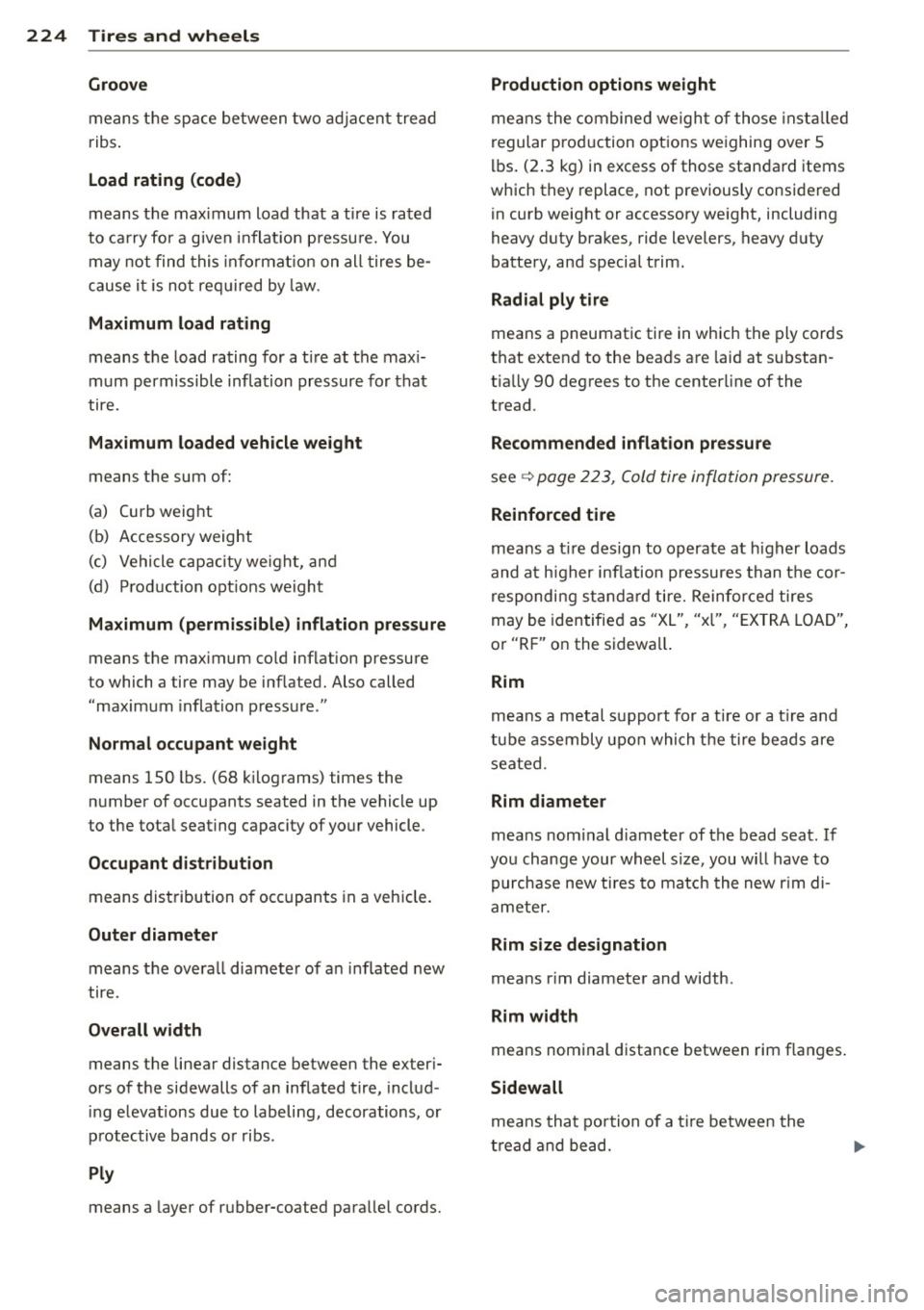
Groove
means the space between two adjacent tread
ribs .
Load rating (code)
means the maximum load that a tire is rated
to carry for a given inflation pressure. You
may not find this informat ion on all tires be
cause it is not req uired by law.
Maximum load rating
means the load rating for a t ire at the max i
mum permissible inflation pressure for that
tire.
Maximum loaded vehicle weight
means the sum of:
(a) Curb weight
(b) Accessory weight
(c) Vehicle capacity we ight, and
(d) Production options weight
Maximum (permissible) inflation pressure
means the maximum cold inflation pressure
to which a tire may be inflated. Also called
"maximum inflation pressure ."
Normal occupant weight
means 150 lbs. (68 kilograms) times the
number of occupants seated in the vehicle up
to the total seating capacity of your vehicle .
Occupant distribution
means distribution of occupants in a vehicle.
Outer diameter
means the overa ll diameter of an inflated new
tire.
Overall width
means the linear distance between the exteri
ors of the sidewalls of an inflated tire, includ
ing elevations due to labeling, decorations, or
protective bands o r ribs .
Ply
means a layer of rubber-coated parallel cords.
Production options weight
means the combined weight of those insta lled
regular production options weighing over 5
lb s. (2 .3 kg) in excess of those standard items
which they replace, not previously considered
in curb weight or accessory we ight, including
heavy duty brakes, ride levelers, heavy duty
battery, and special trim.
Radial ply tire
means a pneumat ic tire in which the ply cords
that extend to the beads are laid at substan
t ia lly 90 degrees to the center line of the
tread .
Recommended inflation pressure
see<=> page 223, Cold tire inflation pressure.
Reinforced tire
means a t ire design to operate at higher loads
and at h igher inflation pressures than the cor
responding standa rd tire. Reinforced tires
may be identified as "XL" "xl" "EXTRA LOAD"
' ' '
or "RF" on the sidewa ll.
Rim
means a metal support for a tire or a tire and
tube assembly upon which the tire beads are
seated.
Rim diameter
means nom inal diameter of the bead seat. If
you change your wheel s ize, you will have to
purchase new tires to match the new rim di
ameter.
Rim size designation
means r im diameter and width .
Rim width
means nominal distance between rim flanges.
Sidewall
means that portion of a tire between the
t read and bead.
Page 229 of 286
Tires an d wheel s 22 7
you have stored. The system does not recog
nize the load condition of your vehicle.
The effectiveness of the ti re pressu re monitor
ing sys tem* will be impaired if you store nor
mal load pressures but then operate the vehi
cle at its maximum load¢,& .
See the illustration ¢
fig. 185 for the location
of the label on dr iver's side B-pillar (co lor of
the actual labe l and exact location on the ve
hicle wi ll vary slig htly) .
Note that the fo llowing tab le is accurate a t
the t ime o f go ing to press and is subject to
Tire designation
change. In the event of discrepancies, the ti re
pressure label is located on the driver's side B
pillar always takes precedence .
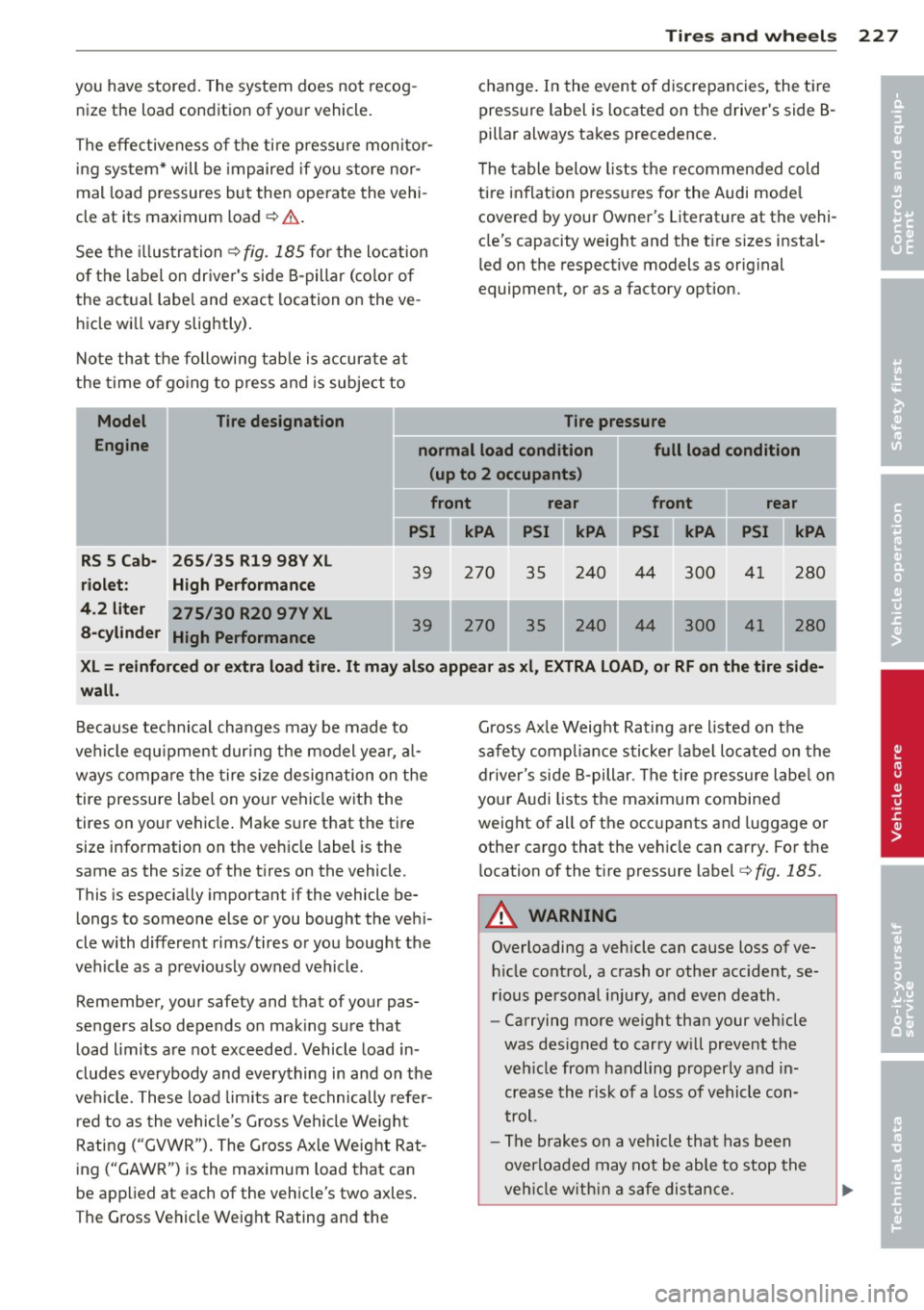
T he table below lists the recommended cold
ti re inflation pressures for the Audi mode l
covered by your Owner's Literat ure at the vehi
cle's capacity weight and the t ire sizes instal
l ed on the respective models as orig inal
equipment, or as a factory option.
Tire pressure
Model
Engine normal load condition full load condition
(up to 2 occupants)
front rear front rear
PSI
kAA ~I kAA ~I kAA ~I kAA
RS 5 Cab- 265 /35 R19 98V X L
riol et: High Performan ce
39 270 35 240 44 300 41
280
4.2 liter 275 /30 R20 97V XL
a -cyl inder
270 35 240 44 300 4 1 280
XL= reinf orc ed or extra lo ad tire. It ma y al so appear a s xl , EXTRA LOAD, or RF on the tire side
w all .
Because tec hnical changes may be made to
ve hicl e equ ipment dur ing the model yea r, a l
ways compare the tire s ize designation on the
tire pressure label on your vehicle w ith the
tires on your vehicle . Make s ure that the tire
size information on the vehicle label is the
same as the s ize of the t ires on the vehicle.
This is especially important if the vehicle be
longs to someone else or you bought the veh i
cle with different rims/tires or you bought the
veh icle as a previously owned vehicle.
Remember, your safety and that of your pas
sengers also depends on mak ing sure that
load limits are not exceeded . Vehicle load in
cludes everybody and everything in and on the
ve hicl e. These load limits are technically refer
r ed to as the vehicle's G ross Vehicle We ight
Rating ("GVWR"). The Gross Ax le Weight Rat
ing ("GAWR") is the maximum load that can
be applied at each of the vehicle's two axles .
The Gross Vehicle We ight Rating and the G
ross Ax le Weig ht Rating are listed on the
sa fe ty comp liance sticke r label lo cated on the
dr iver's side B-pillar . The tire pressu re labe l on
your A udi lists the maximum combined
weight of all of the occ upants and luggage o r
other cargo that the veh icle can carry. For the
location of the t ire pressure label ¢
fig. 185.
A WARNING
-Overloading a vehicle can cause loss of ve-
h icle contro l, a crash or other accide nt, se
rious personal injury, and even death.
- Carrying more we ight than your veh icle
was des igned to carry will prevent the
veh icle from handling properly a nd in
crease the risk of a loss of vehicle con
trol.
- The brakes on a vehicle that has been
overloaded may not be able to stop the
veh icle w ith in a safe distance.
•
•
Page 231 of 286

-Read the requir ed tire pressure from the tire
pressure label. The tire pressure label is lo
cated on the driver's side B-pillar. The tire
pressure label lists the recommended cold
t ire inf lation pressures for the vehicle at its
maximum capacity weight and the tires that
were on your vehicle at the time it was man
ufactured . For recommended tire pressures
for normal load conditions, please see chap
ter ~
page 226.
- Turn the valve stem cap counter-clockwise
to remove it from the tire valve.
- Place the air pressure gauge on the valve .
- The tire pressures should only be checked
and adjusted when the tires are cold . The
slightly raised pressures of warm tires must
not be reduced.
- Adjust the tire pressure to the load you are
carry ing.
- Reinstall the valve stem cap on the valve .
When should I check the tire pressure?
The correct tire pressure is especially impor
tant at high speeds. The pressure should
therefore be checked at least once a month
and always before starting a journey .
When should I adjust the tire pressures?
Adjust the tire pressure to the load you are
carry ing. After changing a wheel
or replacing
wheels you have to adjust the tire pressures
on all wheels. In addition, you must then initi
alize the new tire pressures in the tire pres
sure monitoring system*~
page 240.
A WARNING
Incorrect tire pressures and/or underinfla
tion can lead sudden tire failure, loss of
control, collision, serious personal injury
or even death.
- When the
[9] warning symbol appears in
the instrument cluster, stop and inspect
the tires.
- Incorrect tire pressure and/or underinfla
tion can cause increased tire wear and
can affect the handling of the vehicle and
stopping ability.
Tires and wheels 229
- Incorrect tire pressures and/or underin
flation can also lead to sudden tire fail
ure, including a blowout and sudden de
flation, causing loss of vehicle control.
- The driver is responsib le for the correct
tire pressures for all tires on the vehicle.
The applicable pressure values are locat
ed on a sticker on the driver's side B-pil lar.
- Only when all tires on the vehicle are fil
led to the correct pressure, the tire pres
sure monitoring system* can work cor
rectly.
- The use of incorrect tire pressure values
can lead to accidents or other damage.
Therefore it is essential that the driver
observe the specified tire pressure values
for the tires and the correct pressures for
the function of the tire pressure monitor ing system*.
- Always inflate tires to the recommended
and correct tire pressure before driving
off.
- Driving with underinflated tires bend
more, letting them get too hot resulting
in tread separation, sudden tire failure
and loss of control.
- Excessive speed and/overloading can
cause heat build-up, sudden tire failure
and loss of control.
- If the tire pressure is too low or too high,
the t ires will wear prematurely and the
vehicle will not handle well.
- If the tire is not flat and you do not have
to change a wheel immediately , drive at
reduced speed to the nearest service sta
tion to check the tire pressure and add
air as required.
(D Note
Driving without valve stem caps can cause
damage to the tire valves. To prevent this,
always make sure that factory installed
valve stem caps on all wheels are securely
mounted on the valve.
•
•
Page 248 of 286

24 6 What do I do no w?
• Engage the par king br ake to prevent your
vehicle from rolling unintentionally
c> _&..
• Move the sel ector le ver to the P po sition.
• Take the jack c> page 243 out of the luggage
compartment.
A WARNING
You or your passengers could be injured
wh ile cha nging a wheel if you do not fol
low these safety precautions:
- If you have a flat t i re, move a safe dis
tance off the road . Turn off the engine,
tu rn the emergen cy flashers on and use
other wa rning dev ices to alert other mo
torists.
- Make su re that passengers wait i n a safe
pla ce away from the vehicle and well
away from the road and traff ic.
- T o help prevent the veh icle from mov ing
sudden ly and possibly slipping off the
jack, a lways fully set the parking brake
and block the whee l diagona lly opposite
the whee l being changed with the fo ld
ing chocks or other objects. When one
front whee l is lifted off the ground, plac
ing the Automat ic Transmiss ion in "P"
(Pa rk) w ill
not prevent the vehicle from
moving.
- Before you change a wheel, be sure the ground is level and firm . If necessary,
use a sturdy board unde r the jack.
- Always store the vehicle tool kit, the
jack* and the replaced tire in the luggage
compartment
c> page 124.
(D Note
If you are chang ing the wheel on a steep
incline, use a rock or similar object to
b loc k the opposite wheel to prevent the
veh icle from mov ing.
Obey all laws.
-
Changing a wheel
When you change a wheel, follow these
quence described below step-by-step and in
exactly that order .
l. Remove the wheel bolt caps* . For more
details see also
c> page 247, Wheels with
wheel bolt caps.
2. Loosen the wh eel bolts c>page 247.
3. Locate the p roper mounting point fo r the
ja ck a nd align the jack below that point
c>page248 .
4. Lift the car with the jack c> page 248 .
5. Remove the wheel with the flat tire and
then insta ll the other wheel
c> page 249.
6. Tighten all wheel bolts lightly.
7.
Lower the vehicle with the jack .
8. Use the wheel bolt w rench and
firmly
t ighten all wheel bolts in a crisscross pat
te rn
c> page 247.
9. Replace the wheel bolt cap s*.
A WARNING
Always read and fo llow all WARN INGS and
informat ion c> .&. in Raising the vehicle on
page 248
and c> page 250 .
After changing a wheel
A wheel change is not comple te without the
doing the following .
• Always store the vehicle tool kit, the jack*,
and the rep laced tire in the luggage com
partment
c> page 124.
• As soon as possib le, have the t ightening
torque s
on all whee l bolts checked with a
torque wrench. The correct tightening tor
que is 90 ft lbs. (120 Nm).
• Have the flat tire
re plac ed as soon as possi
ble.
(D Tips
- If you not ice that the wheel bolts are
corroded and difficult to turn while
chang ing a tire, they should be replaced
before you check the tightening torque .
Page 250 of 286

248 What do I do now?
down on the end of the wheel bolt
wrench with
one foot only . As you do so,
hold on to the car to keep your balance
and take care not to slip.
Raising the vehicle
The vehicle must be li~ed with the jack first
before the wheel can be removed.
Fig. 196 Sill panels: mark ings
Fig. 197 Sill: posit ion ing t he veh icle jack
The location of the jack point is indicated by
an indentat io n on the underside of the vehicle
~ fig. 196 .
• Activate the parking brake to prevent the
vehicle from rolling unintentionally.
• Move the selector lever to posit ion P.
• Find the
marking on the si ll that is nearest
the wheel that w ill be changed
<=>fig. 196 .
Behind the marking, there is a lifting point
on the sill for the vehicle jack.
• Turn the
vehicle jack located under the lift
ing point on the si ll to raise the jack until
the jaw
r::> fig. 19 7 @ covers the notch on
the vehicle<=> &<=>CD .
• Align the vehicle jack so the jaw@ covers
the notch and the base p late @ is flat on
the floor . The base plate@ must be
vertical
under the lifting point @. •
Install the rod on the vehicle jack : Insert the
rod into the opening on the handwheel. Turn
the rod left or r ight to secure it.
• Continue raising the jack with the rod unt il
the wheel lifts off the ground slightly.
Position the vehicle jack
only under the desig
nated lifting points on the si ll
<=>fig. 196.
There is exactly one location for each wheel.
The jack must not be positioned at any other
location <=> .&. <=>CD .
Soft ground under the jack can cause the ve
hicle to slip off the jack. Always place the jack
on firm ground. Use a flat, stable support if
necessary. Use a non -slip surface such as a
rubber mat on a
slippery surface such as tile .
.&, WARNING
-You or your passengers could be inju red
while changing a wheel if you do not fo l
low these safety precautions:
- Position the vehicle jack only at the designated lifting points and align the
jack. Otherwise, the vehicle jack could
slip and cause an injury if it does not
have sufficient hold on the vehicle.
-A soft or unstable surface under the jack may cause the vehicle to slip off
the jack. Always provide a firm base for
the jack on the ground. If ne cessa ry,
us e a sturdy board under the jack.
- On hard, slippery su rface (such as tiles)
u se a rubber mat or similar to prevent
the jack from slipping.
- To help prevent injury to yourself and
your passengers:
- Do not raise the vehicle until you are
sure the jack is securely engaged.
- Passengers must not remain in the ve
hicle when it is jacked up.
- Make sure that passengers wait in a
safe place away from the veh icle and
well away from t he road and traffic.
- Make sure jack position is correct, ad
ju st as necessary and then continue to
raise the jack. .,_