lock AUDI RS5 CABRIOLET 2013 Repair Manual
[x] Cancel search | Manufacturer: AUDI, Model Year: 2013, Model line: RS5 CABRIOLET, Model: AUDI RS5 CABRIOLET 2013Pages: 286, PDF Size: 71 MB
Page 168 of 286
166 Child Safety
belts, ¢page 137, Airbag system and
c:> page 158, Important things to know.
A WARNING
If exceptional circumstances require the
use of a forward-facing child restraint on
the front passenger's seat, the child's safe
ty and well-being require that the follow ing special precautions be taken :
- Make sure the forward -facing seat has
been designed and certified by its manu
facturer for use on a front seat with a
passenger front and side airbag.
-Always follow the manufacturer's in
structions provided with the child safety
seat or infant carrier.
- Always move the front passenger seat in
to the rearmost position of the passen
ger seat's fore and aft adjustment range,
and as far away from the airbag as possi
ble before installing the child restraint .
- Always make sure that nothing prevents
the front passenger's seat from being
moved to the rearmost position in its
fore and aft adjustment range.
- Always make sure the backrest is in an
upright position.
- Make sure that the
PASSENGER AIR BAG
OFF
light comes on and stays on all the
time whenever the ignition is switched on .
- If the light does not stay on, perform the
checks ¢
page 148, Monitoring the Ad ·
vanced Airbag System.
- Take the child restraint off the front pas
senger seat and install it properly at one
of the rear seat positions if the
PASSEN
GER AIR BAG OFF
light does not stay on
whenever the ignition is switched on .
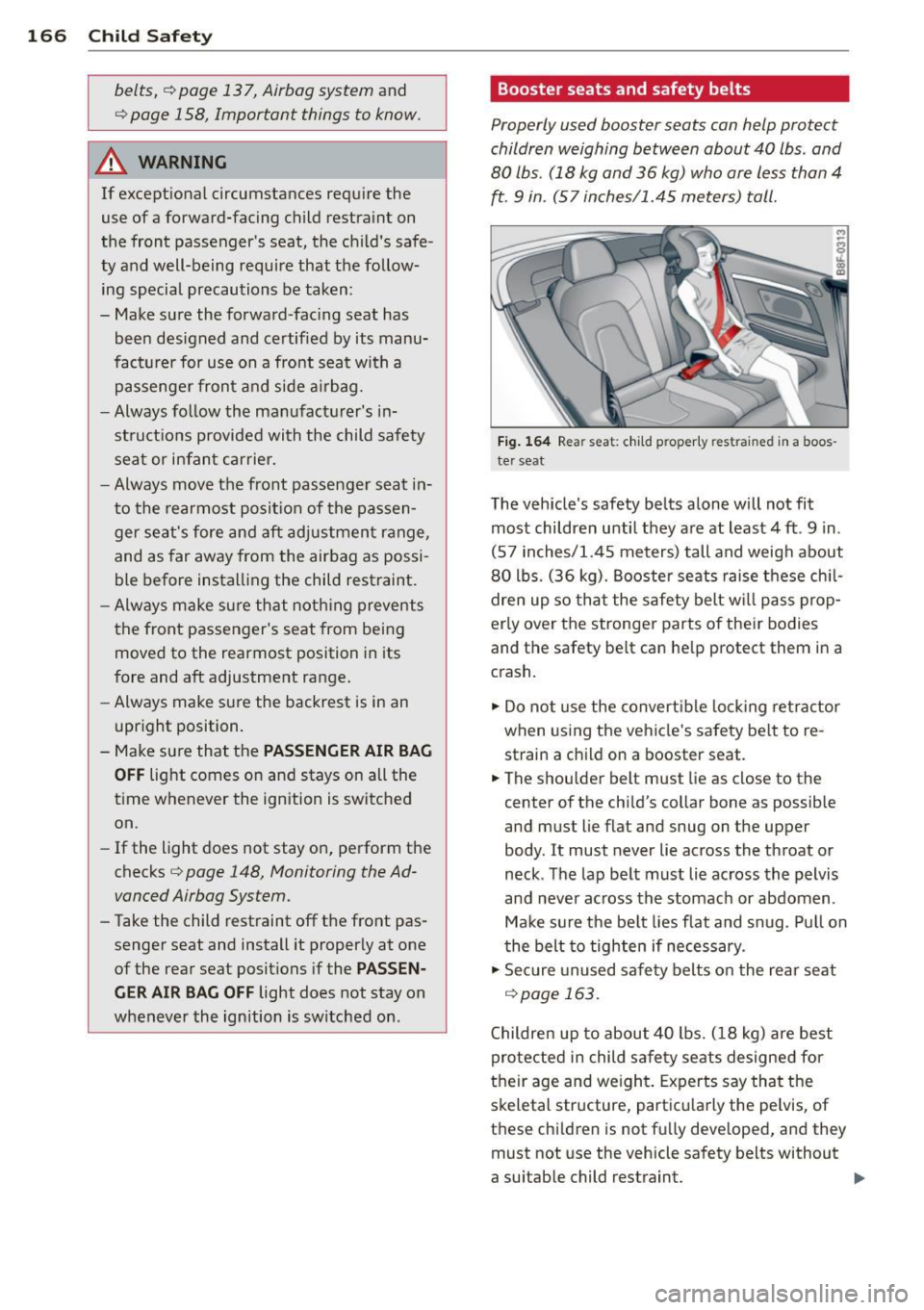
Booster seats and safety belts
Properly used booster seats can help protect
children weighing between about 40 lbs . and
80 lbs . (18 kg and 36 kg) who are
less than 4
ft. 9 in. (57 inches/1.45 meters) tall.
Fig. 164 Rea r seat : child p rop erly r estrained in a boo s
te r se at
The vehicle's safety belts alone will not fit
most children until they are at least 4
ft . 9 in .
(57 inches/1.45 meters) tall and weigh about
80 lbs.
(36 kg). Booster seats raise these chil
dren up so that the safety belt will pass prop
erly over the stronger parts of their bodies
and the safety belt can help protect them in a
crash.
.. Do not use the convertible locking retractor
when using the vehicle's safety belt to re strain a child on a booster seat.
.. The shoulder belt must lie as close to the
center of the child 's collar bone as possible
and mu st lie flat and snug on the upper
body.
It must never lie across the throat or
neck . The lap belt must lie across the pelvis
and never across the stomach or abdomen .
Make sure the belt lies flat and snug . Pull on
the belt to tighten if necessary .
.. Secure unused safety belts on the rear seat
c::>page 163.
Children up to about 40 lbs. (18 kg) are best
protected in child safety seats designed for
their age and weight. Experts say that the
skeletal structure, particularly the pelvis, of
these children is not fully developed, and they must not use the vehicle safety belts without
a suitable child res traint.
...
Page 170 of 286
168 Child Saf ety
- If the PASS ENGER AIR BAG O FF li ght
does not come on and stay on, perform
the checks described
c:> page 148, Moni
toring the Advanced Airbag System .
-Take the child restraint off the front pas
senger seat and install it properly at one
of the rear seat positions if the
PASSEN
GER AIR BAG OFF
light does not stay on
whenever the ignition is switched on.
- Always read and heed all WARNINGS whenever using a child rest rained in ave
hicle is being used
c:> page 129, Safety
belts, c:>page
137, Airbag sy st em and
<:?v page 158, Important things to know.
Installing a child safety
seat
Securing a child safety seat using a
safety belt
Safety belts for the rear seats and the front
pas senger 's seat can be locked with the con
vertible locking retractor to properly secure
child safety seats.
The safe ty belts eme rgency lock ing re tractors
fo r the re ar seats safe ty belts and for the
fro nt passenger's seat safety belt have a con
vertible locking retracto r fo r child restraints.
The safety belt must be locked so that belt
webbing cannot unree l. The retractor can be
activated to lock the safety be lt and prevent
the safety belt webbing from loosening up
during normal driving . A child safety seat can
only be properly installed when the safety belt
i s locked so that the child and child safety
seat will stay in place.
A lways remember: Even thoug h your veh icle is
eq uipped w it h an Advanced A irbag system, all
ch ildren , espec ia lly those 12 yea rs and yo ung
e r, should always ride in the ba ck seat proper
l y res traine d for thei r age and weig ht.
_& WARNING
Imprope rly insta lled child sa fe ty seats in
crease the risk of ser ious personal inju ry
and death in a collision. -
Always make sure that the safety belt re
tractor is locked when insta lling a child
safety seat. An unlocked safety belt re
tractor cannot hold the child safety seat in place dur ing no rma l dr iving o r in a
crash .
- Always buckle the child safety seat firmly in place even if a ch ild is not sitt ing in it .
A loose child safety seat can fly aroun d
du ring a s udden st op or in a colli sion.
- I f the backrest is not securely la tched,
the child and the child restraint will be
throw n forward toge ther with t he ba ck
rest and will strike par ts of the vehicle
interior. The child can be se riously in
jured or killed.
- Never inst all rearward-facing child safety
seats or infant ca rr iers on the front pas
senger seat . A child will be serious ly in
jured and can be killed when the passen
ger airbag i nflates.
- The inflating airbag will h it the ch ild
safety seat or infant carrier with great
force and will smash the child safety seat
and child aga inst the back rest , center
armrest, doo r or roof.
- Always install rearward-facing ch ild safe
ty seats or infa nt carriers on the rea r
seat .
- Forwa rd-facing child safety seats or in
fant car riers installed on the front pas
senger's seat may interfere with t he de
p loyment of t he a irbag and cause serious
i njur y to the child .
-It is safer to ins tall a forward-facing
child safety seat on the rear seat.
- Always read and heed all WAR NIN GS
whe neve r using a child restrai ned in ave
h icle i s being u sed
c:> page 158. Special
p reca utions apply when ins tal ling a child
safety seat on the fron t passenger seat
c:> page 138, Child restraints on the front
seat -some important things to know.
_& WARNING
--
Always take specia l precautions if you
must install a forwa rd or rearward-facing
Page 172 of 286
1 70 Child Safety
Activating the convertible locking retractor
Use the convertible locking retractor to se
cure a child restraint.
Always heed the child safety seat manufactur
er's instructions when installing a child re
straint in your vehicle. To activate the conver
tible locking retractor:
• Place the child restraint on a seat, prefera
bly on the rear seat.
• Slowly pull the belt
all the way out.
• Route it around or through the child re
straint belt path¢.&_ .
• Push the child safety seat down w ith your
full weight to get the safety belt really tight.
• Insert the belt tongue into the buckle for
that seating position.
• Guide the safety belt back into the retractor
until the belt lies flat and snug on the child
safety seat .
• You should hear a "clicking " noise as the
belt winds back into the inertia reel. Test the
convertible locking retractor by pulling on
the belt. You should no longer be able to
pull the belt out of the retractor. The con
vertible locking retractor is now activated.
• Make sure that the red release button is fac
ing away from the child restraint so that it
can be unbuckled quickly .
•Pullon the belt to make sure the safety belt
is properly tight and fastened so that the
seat cannot move forward or sideways more
than one inch (2.5 cm).
.&_ WARNING
Using the wrong child restraint or an im
properly installed child restraint can cause
serious personal injury or death in a crash.
- Always make sure that the safety belt re-
tractor is locked when installing a child
safety seat. An unlocked safety belt re
tractor cannot hold the child safety seat in place during normal driving or in a
crash .
- Always buckle the child safety seat firmly
in place even if a child is not sitting in it.
-
A loose child safety seat can fly around
during a sudden stop or in a crash.
- Always make sure the seat backrest to
which the child restraint is installed is in
an upright position and securely latched
into place and cannot fold forward. Oth
erwise, the seatback with the child safety
seat attached to it could fly forward in
the event of an accident or other emer
gency situation.
- Always read and heed all WARNINGS
whenever using a child restrained in ave
hicle is being used
¢page 158. Special
precautions apply when installing a child
safety seat on the front passenger seat
¢ page 138, Child restraints on the front
seat -some important things to know.
'
Deactivating the convertible locking
retractor
T he convertible locking retractor for child re
strain ts will be deactiva ted automatically
when the bel t is wound all the way back in to
the retractor .
• Press the red button on the safety belt buck
le . The belt tongue will pop out of the buck
le .
• Guide the safety belt all the way back into
its stowed position .
Always let the safety bel t retract completely
into its stowed position . The safety belt can
now be used as an ordinary safety belt with
out the convertible locking retractor for child
restraints.
If the convertible locking retractor should be
activated inadvertently, the safety belt must be unfastened and guided completely back in
to its stowed position to deactivate this fea
ture. If the convertible locking retractor is not
deactivated , the safety belt will gradually be-
come tighter and uncomfortable to wear.
11>-
Page 173 of 286
A WARNING ,~
Improperly installed child safety seats in
crease the risk of ser ious personal injury
and death in a collision .
- Never unfasten the safety belt to deacti
vate the convert ible lock ing retractor for
child restraints while the veh icle is mov
ing. You would not be restrained and
c ou ld be ser iously injured in an accident.
- Always read and heed all WARN INGS
whenever using a child rest rained in ave
hicle is being used
~ page 158. Special
precautions apply when installing a ch ild
safety seat on the front passenger seat
~ page 138, Child restraints on the front
seat -some important things to know.
Child Sa fet y 1 71
• .
•
Page 176 of 286
174 Child Saf ety
Installing a child restraint with LATCH
lower anchorages
Whenever you install a child restraint always
follow the child restraint manufacturer's in
structions.
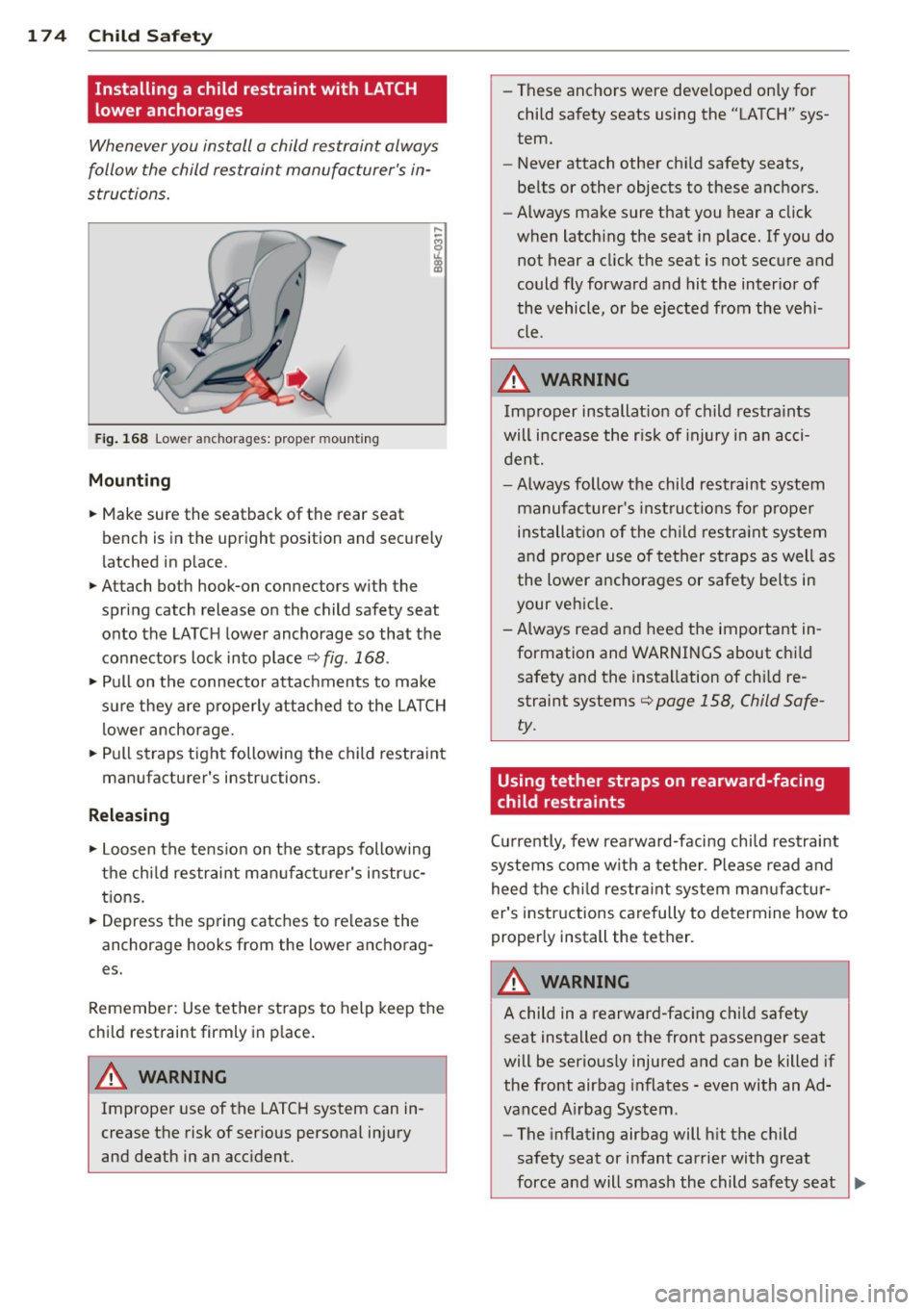
Fig . 168 Lower a nch orages: p roper moun ting
Mounting
.. Make sure the seatback of the rear seat
bench is in the upright position and sec urely
l atched in place.
.. Attach both hook-on connectors w ith the
spring catch release on the child safety seat onto the LATC H lower anchorage so that the
connectors lock into p lace
r:::;, fig. 168 .
.. Pull on the connecto r attachments to make
s u re they a re properly attached to the LA TCH
l ower anchorage.
.. Pull st raps tight following the child restraint
manufacturer's instructions .
Releasing
.. Loosen the te nsion on the straps following
the chi ld res traint ma nufactu re r's instr uc
t ions.
.. Depress the sp ring catc hes to re lease the
anchorage hooks from the lower anc horag
es.
Remember: Use tether st raps to help keep the
chi ld restraint firmly in p lace .
A WARNING
Improper use of the LATC H system can in
crease the risk of ser ious personal inj ury
and death in an acc ident. -
These anchors were deve loped only for
child safety seats using the "LATCH" sys
tem.
- Never attach other ch ild safety seats,
be lts or other objects to these a nchors.
- Always make sure that you hear a click
when latch ing the seat in p lace. If you do
not hear a cl ick t he seat is not sec ure and
could fly forward and hit the inter ior of
the vehicle, or be ejected from the vehi
cle .
A WARNING
=
Imp roper installat io n of child restra ints
will i ncrease the r isk of injury i n an acci
d ent.
- Always follow the chi ld restraint system
manufac turer's inst ru ct ions for p roper
installa tion of the c hild restr aint system
a nd pro per use of te t her s traps as well as
the lower anchorages or safety belts in
your ve hicle.
- A lways read and heed the important in
formation and WA RNI NGS about ch ild
safety and the insta llation of ch ild re
straint systems
c:> page 158, Child Safe
ty .
Using tether straps on rearward-facing
, child restraints
-
C ur rently, few rea rward-facing chi ld restraint
systems come w it h a tet her. P lease read and
heed the ch ild restra int system m anufactu r
er's instr uctions carefully to determine how to
properly install the tether.
A WARNING
= -
A child in a rearward-fac ing c hild safety
seat installed on the front passenger seat
will be ser ious ly injured and can be killed if
the front airbag inflates -even with an Ad
vanced A irbag System .
- The inflating airbag will h it the c hild
safety seat or infant carrier with great
force and will smash the child safe ty seat _..
Page 179 of 286

ESC includes and/or works together with the
anti-lock brake system (ABS), brake assist sys
tem, anti -slip regulation (ASR) , e lectronic dif
ferential lock (EDL), dynamic steering* and se lective wheel torque control*. ESC is switched
on all the time. In certa in situations when you
need less t raction, you can sw itch off ASR by
p ress ing the button
ij] Q page 178, fig . 169
or ~ page 178, fig. 170. Be sure to sw itch
ASR on again when you no longer need less
traction.
Anti -lock braking system (ABS)
ABS prevents the wheels from locking up
when braking. The veh icle can still be steered
even du ring ha rd b raking . Apply steady pres
sure to the brake pedal. Do not pump the ped
al. A pulsing in the brake peda l indicates that
the system is he lping you to brake the vehicle .
Brake ass ist system
The brake assist system can decrease braking
d istance.
It increases braking power when the
driver presses the brake pedal qu ic kl y in eme r
gency situations . You must p ress and ho ld the
brake peda l until the situation is over. In
vehicles with adaptive cruise control*, the
brake assist system is more sensit ive if the
d istance detected to the vehicle ahead is too
small.
Anti- slip regulati on (ASR )
ASR reduces engine power when the drive
wheels begin to spin and adapts the force to the road condit ions. This makes it eas ier to
start, accelerate and drive up hills.
El ectronic diffe rential lock (EDL )
The ED L brakes wheels that are spinning and
transfers the drive power to the other wheels .
This function is available up to about 60 mph
(100 km/h).
I n extreme cases, ED L automatically switches
off to help keep the brake on the braked whee l
from overheating.
EDL wi ll switch on again au
tomatically when conditions have returned to normal.
Int ellig ent technolog y 177
Dynamic steering *
On vehicles with dynam ic steering*, ESC he lps
stabilize the steering in crit ica l sit uations.
Select ive wheel torque control*
The select ive wheel torque control operates
when d riving through curves. The front wheel
on the inside of the curve o r both wheels on
the ins ide of the c urve a re bra ked select ively
as needed. This minimizes sliding in the front
whee ls and allows for more precise driv ing
through curves. The app licable system may
not act ivate when dr iving in wet or snowy con
ditions.
A WARNING -
- ESC, ABS, ASR, EDL dynam ic steering*
and the select ive wheel torque control*
cannot ove rcome the laws of physics.
This is especially important on slippery
or wet roads.
If t h e systems beg in acting
to stabilize your veh icle, yo u should im
mediately change your speed to match
the road and traffic conditions . Do not
let the increased safety provided by
these systems tempt you to take r isks.
Doing so will increase the risk of a loss of
veh icle contro l, collision and ser ious per
sonal injur ies.
- Always adapt your speed to road, traffic
a nd weather conditions. The risk of Los-
ing contro l of the vehicle i ncreases when
driving too fast, espec ially through
curves and on slippery or wet roads, and
when dr iv ing too close to vehicles up
ahead. ESC, ABS, the brake assist sys
tem, ASR, ED L dynamic steering * and the
selective whee l torque control * cannot
prevent coll is ions.
- Always accelerate with spec ial care on
even, smooth surfaces such as those that
are wet or covered with ice and snow.
The drive wheels can spin even with
these assistance systems that can not al
ways he lp to red uce the risk of loss of ve
hicle control.
•
•
Page 193 of 286
(D Note
-Never try to remove dirt, mud or dust if
the surface of the vehicle is dry. Never
use a dry cloth or sponge, since this
could scratch your vehicle's pa int or w in
dows .
- Never wash your car in bright sunlight.
Drops of water act as magnifying lenses
and may damage your paint.
- When you wash your car in the w inter: if
you r inse your vehicle w ith a hose, be
careful not to aim the stream of water
direct ly at locks, or at door or hatch
openings - they can free ze shut.
- Never use sponges des igned to remove
i nsects, or any kitchen scouring sponges
or similar products. They can damage
you r paint finish.
- Never use a dry cloth o r sponge to clean
the headligh ts. On ly use we t cloths or
sponges to prevent scratches.
It i s best
to use soapy wate r.
- You sho uld remove debris (su ch as in
sects) from the head ligh t lenses on a
r egular basis, for example when refuel
ing your vehicle . Never use a dry cloth or
sponge to clean the head lights. Only use
wet cloths or sponges to prevent
scratches.
It is best to use soapy water.
@ For the sake of the environment
On ly wash the vehicle in facilit ies specially
designed for that purpose. Th is w ill reduce
the risk of d irty water contaminated with
oil from entering the sewer system. In
some areas, wash ing vehicles outs ide of
these facilit ies is prohib ited.
Washing your vehicle with a power
washer
Cleaning the exterior of your car with a high
pressure power washer is safe as long as you observe a few simple rules .
~ Before us ing the powe r washe r, make sure
yo u have re ad an d u nderstood the WARN-
Cleaning and protec tion 19 1
INGS ¢ A in General information on
page 189 .
~ Always follow the operating instr uctions for
the power washer.
~ Make sure that the jet on the spray hose pro
duces a "fan shaped sp ray" .
~ Do not hold the sp ray nozzle too close to
soft mater ials .
Never use a pow er washer to clean the power
top itself.
Keep a distance from soft materia ls s uch as
rubber hoses or insulating material as well as
sensors and camera lenses.
When cleaning the vehicle with a power was h
er
always follow the operating instructions .
This applies part icu larly to the operating pres
sure and the spraying d istance. Do not point
the spray d irectly at the seals around the s ide
windows, around the doo rs, on the rea r lid or
o n the powe r top. Likewise, do not po int it di
re ct ly at tires, rubbe r hoses, insulat io n ma te
ria l or senso rs
¢ page 193. Hold the spray
nozzle at leas t 1.3 ft (0. 4 m) away from the
vehicle.
Do no t use a high-p ressu re power was her to
remove snow and i ce .
Do not use a jet which sprays water in a d irect
stream o r one that has a rotat ing jet.
Water temperature should not exceed 140 °F (60
°() .
A WARNING
Neve r wash t ires with a jet t hat sprays wa
ter in a direct stream . Thi s could cause in
v isi ble d amage to the t ire s and weaken
them, even if the spr ay is from a re lative ly
l ong dis tance and for a sho rt time. Dam
aged and weakened tires can fail and cause
accidents and personal in jury.
([) Note
- Never use a power washer to clean the
powe r top itse lf .
•
•
Page 199 of 286
dampened with dish detergent and water is recommended.
(D Note
- To avoid sc ratch ing the disp lay, yo u
shou ld never clean it dry.
- To preven t damage, ma ke s ure fl uids do
not enter the controls .
Aluminum trim
Use only neutral-pH products to remove spots
and depos its from alum inum s urfaces.
C hrome care products and alkaline cleaners
will attack alum inum surfaces and can dam
age them over time .
A WARNING
Always read and heed all WARNINGS and
other information ~
page 189.
Fabrics and fabric coverings
Fab rics and fabr ic coveri ngs (e.g . seats, doo r
tr im panels, etc.) should be cleaned at reg ula r
i nte rva ls wi th a vac uum cleaner . Thi s removes
sur face dirt particles which could become em
bedded in the fabr ic through use . Steam
cleane rs shou ld not be used, because the
steam tends to push the dirt deeper into the
fabric and lock it there.
Normal cleaning
Generally, we recommend using a soft sponge
or a lint-free microfiber cloth to the clean fab ric. Brushes should on ly be used for carpets
and floor mats, s ince other fabric surfaces
could be harmed by brushes.
Normal surface sta ins can be cleaned using a
commercia lly available foam cleaner. Spread
the foam on the surface of the fabric with a
soft sponge and work it in gently. Do not sat u
rate the fabric. Then pat the foam d ry using
absorbent, dry cloths (e .g . microfibe r cloth)
and vacuum it afte r it has dr ied comp lete ly .
Cleaning and protec tion 197
Cleaning sta ins
Stains caused by bever ages (e.g . coffee, fr uit
ju ice, etc.) can be treated with a mild deter
gent solution. Apply the detergent so lution
with a sponge. In the case of stubborn stains, a detergent paste can be applied directly to
the stain and worked into the fabric . After
wards, use copious amounts of clean water to
remove the rema ining deterge nt. Apply the
water wit h a damp cloth or sponge and pat
t h e fabric dry with an abso rbent, dry clot h.
Stai ns from choco late or makeup should have
detergent paste rubbed i nto them . After
wards, remove the soap w ith water (damp
sponge).
A lcohol can be used to treat stai ns from
grease, o il, lipstick or a ballpoint pen . M elted
grease or dye must be patted off using ab
sorbent mater ial. It may be necessa ry to re
t reat the areas with de tergent pas te and wa
te r.
In the case of gene ral soiling of the uphols
tery a nd cover material, we recommend hir ing
a speci alist t hat h as the eq uipment to clean
t h e se at cove rs and othe r fabr ic surfaces by
shampooing and spray extraction.
A WARNING
A lways read and heed all WARNINGS and
the information
~ page 189.
(D Tips
Open Ve lcro fas teners on yo ur clothing can
damage the seat cover . Please make sure
that Ve lcro fasteners are closed .
Plastic parts and instrument panel
Always use a clean cloth moistened in clear
water to clean these areas. For persistent d irt
use a n Aud i approved
solvent-free p lastic
clea ner/protectant .
•
•
Page 201 of 286
preservative cream that contains UV
blockers and that works into the leather .
This cream w ill nourish and mo istur ize
the leather, he lp ing it to breathe and
stay supple. It also helps to build up a
protective coating on the surface.
- Clean the leather every 2 - 3 months,
and clean any areas that get soiled.
- Remove fresh marks made by ballpoint pens, ink, lipst ick, shoe polish, etc. as
soon as possib le.
- Preserve the color of the leather as need
ed by using a special colored leather care
cream to touch up areas of uneven color.
Cleaning and caring for leather
upholstery and trim
Applies to vehicles: with natural leather
Natural leather requires special care and at
tention.
Norm al cleaning
.,. Clean soiled areas with a slightly mo istened
cotton or woolen cloth.
Mor e stub born dir t
.,. More stubborn dirt can be removed using a
cloth saturated with a m ild soap so lution (2
tablespoons m ild liquid soap) .
.,. Never allow the soap solution to saturate
the leather, and make certa in that no water
soaks into the seams .
.,. Wipe off the soap solution with a soft, dry
cl oth.
Cleaning spots
.,. Remove fresh w ater -b ased spots (such as
coffee, tea, ju ices, blood) w ith an absorbent
cloth or paper towel.
.,. Remove fresh
grea se or oil -based spot s
(such as butter, mayon naise , chocolate) wi th
an absorbent cloth or paper towe l, or use
the cleaner from the leat her ca re kit i f the
spot has not yet penetrated into the s urface
of the leather .
.,. Use an oil/grease dissolv ing spray, if
oil /
grease spots h ave d ried on.
Cleaning and protec tion 199
.,. Remove specific kinds of spots (ballpoint
pe n, fe lt marker, fingernai l polish, water
based pa int, shoe po lish, etc .) with a spot
remover specifically formu lated for leather.
L e ather care
.,. Every half yea r use an approved leather care
product (available from your authorized
Audi dea ler) to ca re for the leather .
.,. App ly the product very spar ingly.
.,. Wipe it off w ith a damp cloth.
If you have any q uestions about cleaning and
caring for the leather in your vehicle, it is best
to contact your authorized Audi dealer, who
will be glad to help you and tell you about our
full range of leather care products, such as :
- Leather cleaning and care kit
- Creams to ca re fo r colored leather
- Spot removers for ballpoin t pens, shoe pol-
ish, etc.
- Oil/grease d issolving spray
- New and upcom ing products .
.&_ WARNING
Always read and heed all WARN INGS and
other in formation
r:!) page 189 .
(D Note
- Never use chem ica l so lvents (e .g . lighte r
fluid, tu rpe nti ne), waxes, s hoe polish o r
simi la r prod ucts on the lea ther surfaces
i n yo ur Audi .
- To avoid damage, have stubbo rn sta ins
removed by a comme rcial clean ing spe
c ialist .
Cleaning Alcantara ® (synthetic suede)
Applies to vehicles: with Alcantara® upholste ry
R emoving du st and dirt
.,. Moisten a cloth, squeeze out excess water
and wipe down the seat surfaces .
Removing stains
.,. Moisten a cloth with lukewa rm wate r or
w ith di luted
ethyl (rubbing ) alc ohol.
•
•
Page 202 of 286

200 Cleaning and protec tio n
• Dab at the stain . Start at the outside and
work inwards .
• Once the stain is no longer visib le, use a soft
dry cloth or tissue to soak up the moisture.
Do not use leather cleaning products on Al
cantara ®.
You may use a suitable shampoo for remov ing
dust and dirt .
Dust and grit in the pores and seams can
scratch and damage the surface. If the car is
l eft stand ing in the sun for long periods, the
A lcantara ® should be protected against direct
sunlight to prevent it from fading. Slight color
variations will develop in normal use and are
not an indication of material deterioration .
@ Note
-Never use chemical solvents (e.g . lighter
fl uid, turpentine), waxes, shoe polish or
similar products on Alcantara ® surfaces .
- To avoid damage, have stubborn stains
removed by a commercial cleaning spe
cia list.
- Do not use brushes, stiff sponges or sim
ilarly abrasive cleaning aids.
Safety belts
Only well-maintained safety belts work relia
bly when needed .
• Keep be lts clean .
• For cleaning, use a mild soap and water sol
ution . Let be lts dry thoroughly and away
from direct sunlight.
• Do not allow inertia reel safety belts to re
tract before they are completely dry.
• Check the condition of your safety belts
reg
ularly .
Heavily soiled safety belts may not retract
properly .
A WARNING
Damaged safety belts can break in a crash.
-Anything that might damage your safety belts could mean that you and your pas
sengers would not be adequate ly pro
tected in an accident.
- Safety belt performance depends on cor
rect insta llation. Never remove be lts
from the veh icle to clean them .
- Do not use chemical clean ing agents,
bleach or dyes. T hey have corrosive prop
erties which weaken the webb ing .
- When clean ing your safety belts, inspect
them for damage. If you discover dam
age, see your authorized Audi dealer .
-Always read and heed all WARNINGS and other information
Q page 189 .
Engine compartment
Be especially careful when cleaning the en
gine compartment.
Al ways s witch off the ign it ion befo re clea n
ing the engine ¢ Li:::,..
Plenum panel
Remove leaves from the plenum panel in front
of the windshield under the engine hood . This
prevents the water drain holes from becoming
blocked, and it prevents debris from enter ing
the vehicle interior through the heating and
ventilat ion ducts.
Corro sio n p rot ection
T he engine compartment and transmission
have been corrosion-protected at the factory .
Good anti- co rrosion treatmen t is very impor
tant, particu larly in the w inte r.
If the vehicle
is frequently driven on salt treated roads, the
entire engine compartment and plenum panel
shou ld be thoroughly cleaned at the end of
winter and retreated to prevent salt damage.
At the same time, the underside of the vehicle
should be washed as well. .,..