steering AUDI RS5 CABRIOLET 2015 Owner's Manual
[x] Cancel search | Manufacturer: AUDI, Model Year: 2015, Model line: RS5 CABRIOLET, Model: AUDI RS5 CABRIOLET 2015Pages: 284, PDF Size: 69.56 MB
Page 126 of 284

124 Safet y belt s
Why safety belts?
Frontal collisions and the law of physics
Frontal crashes create very strong forces for
people riding in vehicles .
Fig. 139 Unbelted occupants in a ve hicle heading for a
wall
Fig . 140 The vehicle c ras hes into the wall
The physical principles are simple. Both the
vehicle and the passengers possess energy
which varies with vehicle speed and body
weight . Engineers call this energy ''kinetic en
ergy ."
The higher the speed of the vehicle and the
greater the vehicle's weight, the more energy
that has to be "absorbed" in the crash .
Vehicle speed is the most significant factor . If
the speed doubles from 15 to 30 mph (25 to
50 km/h), the energy increases 4 times!
Because the passengers of this vehicle are not
using safety belts
c::> fig. 139, they will keep
moving at the same speed the vehicle was
moving just before the crash, until something
stops them -here, the wall
c::> fig . 140 .
The same principles apply to people sitting in
a vehicle that is involved in a frontal collision .
Even at city speeds of 20 to 30 mph (30 to
50 km/h), the forces acting on the body can reach
one ton (2,000 lbs. or 1,000 kg) or
more. At greater speeds, these forces are
even
higher.
People who do not use safety belts are also
not attached to their vehicle. In a frontal colli
sion they wi ll also keep moving forward at the
speed their vehicle was travell ing just before
the crash. Of course, the laws of physics don't
just apply to frontal collisions, they determine what happens in all kinds of accidents and col
lis ions .
What happens to occupants not wearing
safety belts?
In crashes unbelted occupants cannot stop
themselves from flying forward and being in
jured or killed . Always wear your safety belts!
Fig. 141 A d river not wea ring a safety belt is violen tly
th rown fo rwa rd
Fig . 142 A rear passenger not wearing a safety belt
will
fl y fo rwa rd and strike the drive r
Unbelted occupants are not able to resist the
tremendous forces of impact by holding tight
or bracing themselves. Without the benefit of
safety restraint systems, the unrestrained oc
cupant will slam violently into the steering
wheel , instrument panel, windshield, or what
ever else is in the way c::> fig. 141. This impact .,..
Page 133 of 284

M N
er
u..
co ,...., \!) 1.1'1 ,...., 1.1'1 ,....,
Airbag system Important things to know
Importance of wearing safety belts and
sitting properly
Airbags are only supplemental restrain ts . For
airbags to do their job , occupants m ust al
ways properly wear their safety belts and be
in a proper seating position.
F or your safety and the safety of your passen
gers, before driving off, always:
"" Adjust the dr iver's sea t and steeri ng wheel
p roperly
¢ page 113,
"" Adjust the front passenger's seat properly
¢ page 61,
""Wear safety be lts properly ¢ page 126,
"" Always properly use the proper child re-
stra int to protect ch ildren
r::::> page 152.
In a collision airbags must inflat e within th e
blink of an eye and with considerable force .
The supplementa l airbags can cause injuries if
the dr iver or the front seat passenger is not
seated properly . T herefore in order to help the
a irbag to do its job, it is important, both as a
driver and as a passenge r to s it properly at all
times.
By keep ing room between your body and the
steer ing whee l and the front of the passenge r
compartment, the airbag can inflate fully and
comp lete ly and provide supp lemen tal protec
tion in ce rtain frontal collisions
r::::> page 113,
Proper occupant seating positions .
For deta ils
on the operation of the seat adjustment con
trols
¢ page 61.
It's espe cially important that children a re
p roperly restrained
r::::> page 15 2.
There is a lot that the d river and the passen
gers ca n and must do to help the individua l
safety features ins talled in your A ud i work to
gether as a system.
P rope r seat ing pos ition is important so that
the front airbag on the dr iver s ide ca n do its
job. If yo u have a physical impa irment or con-
A irbag system 13 1
dition that prevents yo u from sitting properly
o n the driver seat with the safety belt properly
fastened and reach ing the peda ls, spec ial
modifications to yo ur vehicle may be necessa
ry.
Contact your a uthorized Audi dea ler, or call
Audi C ustome r Re lations at 1-800 -822-2834 .
When the airbag system dep loys, a gas gene r
ator will fi ll the ai rbags, break open the pad
ded covers, and inf late between t he steering
whee l and the dr iver and between the instru
ment panel and the front passenger. The air
bags will deflate immediately after deploy
ment so that the front occupa nts can see
t hr ough the w indshield aga in witho ut inter
ruption .
All of th is takes place in the blink of an eye, so
fast that many people don't even realize that
the a irbags have deployed . The airbags also
inflate wi th a g reat dea l of force and noth ing
shou ld be in their way when they deploy.
Fron t airbags in combin ation wi th properly
worn safety belts slow down and lim it the oc
cupan t's forward movement. Together they
help to prevent the driver and front seat pas
senger from hitting parts of the inside the ve hicle while reducing the forces acting on the
occupant dur ing the crash. In this way they
help to reduce t he risk of injury to the head
and upper body i n the c rash . A irbags do not
protect the a rms o r the lower parts of the
body .
Both front a irbags w ill not inflate in all fronta l
collisions . The t riggering of the a irbag system
depends on the vehicle dece le rat ion rate
ca used by the co llision and registered by the
ele ctron ic co ntro l unit. If thi s rate is below
t he reference value programmed into the con
trol unit, the airbags will not be trigge red,
even though the car may be bad ly damaged as
a resu lt of the co llision . Veh icle damage, re
pair costs or even the lack of ve hicle damage
is no t necessarily an indication of whether an
airbag s hou ld inflate o r not .
It is not possib le to define a range of vehicle
speeds that w ill cover every possib le kind and ..,.
•
•
Page 134 of 284

132 Airbag sys te m
angle of im pact that will always trig ger the
airbags, since the circumstances wi ll vary con
siderably between one collision and another.
Important factors include, for example, the
nature (hard or s oft) of the object which the
car h its, the angle of impact, vehicle speed,
etc. The front airbags will also not inflate in
side or re ar collisions, or in roll-overs .
Always remember : Airbags will deploy only
once, and only in certa in kinds of collisions .
Your safety belts are always there to offe r pro
tection in those s ituations in which airbags
a re not supposed to deploy , or when they have
a lready deployed; for example , when yo ur ve
h icle strikes or is st ruck by another after the
first collision .
This is just one of the reaso ns why an a irbag is
a supplementary restra int and is not a s ubst i
tute for a safety be lt. The airbag system
works most effective ly when used with the
safety be lts. Therefore, always properly wear
you r safety belts ¢
page 123 .
A WARNING
Sitting too close to the steer ing wheel or
instrument panel will decrease the effec
tiveness of the airbags and will increase
the risk of pe rsonal injury in a collision .
- Never sit closer than 10 inches (25 cm)
to the stee ring wheel or instr ument pan
el.
- If you cannot sit more than 10 inches
(25 cm) from t he steer ing wheel, investi
gate whethe r adaptive equipment may
be available to help you reach the pedals
and incre ase your sea ting dis tance from
the steering wheel.
- If you are unrestr ained, lean ing fo rward,
s itting sideways or out of posi tion in any
way, your risk of injury is much higher.
- Yo u w il l a lso receive serio us in juries and
co uld even be killed if you are up against
the airbag or too close to it when it in
flates -even with an Advanced Airbag.
- To reduce the r is k of i njury when an air
bag inf lates, a lways wear safety belts
properly
c::> page 126, Safety belts .
-Always make certain that ch ild ren age 12
or younger always ride in the rear seat. If
children are not properly restrained, they
may be severe ly injured or killed when an
airbag inflates .
- Never let c hildren ride unrestrained or
improperly restrained in the vehicle . Ad
just the front seats prope rly .
- Never ride with the back rest reclined.
- Always sit as far as possible from the
steer ing whee l or the instrument pane l
¢page 113.
-Always sit upright with your back against
the backrest of your seat.
- Never p lace your feet on the instrument
panel or on the seat. Always keep both
feet on the floor in front of the seat to
he lp prevent serious in ju ries to the legs
and h ips if the airbag inflates .
- Never recline the front passenger 's seat
to transport objects . Items can a lso
move i nto the a rea of the s ide airbag or
the front a irbag d uring br akin g or in a
sudden maneuve r. Obje cts ne ar the air
bags can become projec tiles and cause
inj ury when an airbag inflates.
.&, WARNING
A irbags that have deployed in a crash must
be replaced.
- Use on ly original eq uipment airbags ap
proved by Audi and installed by a trained
technician who has the necessary too ls
and d iagnost ic equipment to properly re
p lace any airbag in your vehicle and as
sure system effectiveness i n a crash .
- Never permit salvaged or recycled air
bags to be installed in your vehicle .
Child restraints on the front seat - some
important things to know
.,. Be s ure to read the importa nt information
and head the WAR NINGS for important de
t ails about children and Advanced A irbags
c::> page 152. ..,.
Page 137 of 284

"' N
a: LL co
rl I.O
"' rl
"' rl
-Never place additional items on the seat
that can increase the total weight regis
tered by the weight-sensing mat and can
cause injury in a crash.
Front airbags
Description of front airbags
The airbag system can provide supplemental
protection to properly restrained front seat
o ccupan ts.
F ig . 149 Location of driver airbag: in steering wheel
Fig. 150 Location of front passenger's airbag: in the in
st rument panel
Your veh icle is equipped w ith an "Advanced
Ai rbag System" in compliance with United
States Federal Motor Vehicle Safety Standard (F MVSS) 208 as app licab le at the time your
ve hicle w as manufac tured. The safety be lts
for the seats have "pretensione rs" that help
to take slack out of the belt system . The pre
tensioners are a lso activated by the electronic
contro l unit for the airbag system.
The front safety belts a lso have load limiters
to help reduce the forces applied to the body
in a crash.
The airbag fo r the driver is in the s teer ing
wheel hub
~ fig. 149 and the airbag for the
A irba g sy stem 135
front passenger is in the instr ument panel
~ fig. 150 . The general location of the airbags
is marked "AIRBAG".
T he re is a lot you need to know about t he a ir
bags in your vehicle . We urge you to read the
detailed information about airbags, safety
belts and child safety in this and the other
chapters that make up the owner's literature.
Please be sure to heed the WARNINGS - they
are extremely important for your safety and
the safety o f your passengers, especially in
fants and small children .
.&_ WARNING
Neve r rely on airbags alone for p rotec tion.
- Even w hen they deploy, airbags provide
only suppleme nta l protect ion.
- Airbag work most effectively w hen used
with p roperly worn safety belts.
- Therefore, always wear your safety belts and make sure that eve rybody in your ve
hicle is p rope rly r est rained .
.&_ WARNING
A person on the front passenger seat, es
pe cially infants and sma ll children, w ill re
ceive ser io us i njuries and can even be kil
led by being too close to the airbag when it inflates .
- Altho ugh the Advan ced A irbag Sys tem in
your veh icle is designed to turn off the
fro nt passenge r airbag if a n infant or a
sma ll child is on the front passenger
seat , nobody can absolutely gua rantee
that deployment under these special conditions is impossible i n all conceiva
ble sit uat ions that may happen during
the useful life of your vehicl e.
- The Advanced Airbag System can dep loy
in acco rdance with the "low risk" option
un der the U.S . Fede ral S tanda rd if a child
that is heavie r th an the typical one-yea r
old child is on the front passenge r seat
a nd the ot her condit ions for a irbag de
ployment are met .
-
Page 138 of 284

136 Airbag sys te m
- Accident statistics have shown that chi l
dren are generally safer in the rear seat
area than in the front seating posit ion.
- For their own safety, all children, espe
cially 12 years and younger, should al
ways ride in the back properly restrained
for their age and size.
Advanced front airbag system
Your veh icle is equipped with a front Advanced
A irbag System in compl iance with Un ited
States Federal Motor Vehicle Safety S tandard
208 as applicable a t the t ime yo ur vehicle was
manufactured .
The front Advanced Airbag System supple ments the safety belts to provide addit ional
protection fo r the driver's and front passeng
er 's heads and upper bodies in fronta l crashes.
The airbags inflate only in fronta l impacts
when the vehicle dece leration is high enough .
The front Advanced Airbag System for the
front seat occupants is not a substitute for
your safety be lts. Rather, it is part of the over
all occupant restraint system in your vehicle .
A lways remember that the airbag system can
only help to protect you, if you are s itting up
right, wear ing you r safety belt and wearing it
properly . This is why you and your passenge rs
must always be properly restra ined, not just
because the law requires you to be .
The Advanced Airbag System in your veh icle
has been certified to meet the " low r isk" re
qu irements for 3 and 6 year-o ld children on
the passenge r side and very small adu lts on
the dr iver side. The low ris k deploymen t crite
ria are intended to he lp red uce the risk of in
ju ry through interaction with the front airbag
that can occur, for example , by being too
close to the steering whee l and instrument
panel when the airbag inflates.
I n addition, the system has been certif ied to
comp ly w ith the "suppression" requi rements
of the Safety Standard, to turn
off the front
a irbag for infants 12 months old and yo unger
who are restra ined on the front passenger seat in child restrain
ts that are listed in the
Standard
¢ page 154, Child restraints and
Advanced Airbags.
"Suppress ion" requires the fron t airbag on the
passenger side to be turned
off if :
- a child up to about one year of age is re
s trained on the front p assenger sea t in one
of the rear -fac ing or fo rward -facing infan t
restraints listed in Federal Motor Vehicle
Safety Standard 208 with which the Ad
vanced Airbag System in your veh icle was
cert ified. For a listing of the child restraints
that were used to certify your vehicle's com
plia nce w ith the US Safety Standard
¢page 154,
-weight less than a thresho ld level stored in
the control unit is detected on the front pas
senger seat .
When a person is detected on the front pas
senger seat, weighing more than the total
we ight of a ch ild that is about
1 year old re
stra ined in one of the rear-facing o r forward
facing infant restraints ( listed in Fede ral Mo
tor Vehicle Sa fety Standa rd 208 w it h which
t h e Advan ced Airbag Sys tem in yo ur vehicle
was certif ied), the front airbag on the passen
ger side may or may not deploy .
T he
PASSENGER AIR BAG OFF light comes on
when the electro nic contro l unit de tects a to
ta l we ight on the front passenger seat that re
quires the front airbag to be t urned
off . If the
PASSENGER AIR BAG OFF light does not
come on, the front a irbag on the passenger
s ide has not been t urned
off by the contro l
unit and ca n dep loy if the control u nit senses
an impact that meets the cond itions stored in
its memory.
If the total weight on the front passenger
seat is more than that of a typical 1 year-old, but less than the we ight of a small adult, the
front a irbag on the passenger side may dep loy
(the
PAS SENG ER AIR BAG OFF light does not
come on) .
For example, the airbag may deploy if: ..,_
Page 143 of 284

M N
er
u..
co ,...., \!) 1.1'1 ,...., 1.1'1 ,....,
-Occ upants who are unbelted, out of posi
t ion or too close to the airbag can be
seriously injured by an airbag as it un
folds with great force in the blink of an
eye
¢ page 132.
A WARNING
-
A child in a rearward-facing child safety
seat insta lled on the front passenger seat
w ill be seriously injured and can be k illed if
the front a irbag in flates - even with an Ad
vanced Airbag System .
- The inflating a irbag w il l hit the child
sa fety sea t or infant carrier w ith g reat
f orce and w ill smash the ch ild safety seat
and child against the backrest , cente r
armrest, door or roof .
- Always install rear -facing child sa fety
seats on the rear seat .
- If you mus t install a rearward facing
child safety seat on the front passenger
seat because of exceptional circ umstan
ces and the
PASSENGER AIR BAG OFF
light does not come on and stay on, im
med iately install the rear-facing child
safety seat in a rear seating position a nd
have the a irbag system inspected by you r
authori zed Au di dealer .
A WARNING
Objects betwee n you and t he a irbag will
increase the risk of in jury in a crash by in
t erfering wi th the way the air bag un folds
or by being pushed into you as the a irbag
inflates.
- Never hold th ings in your hands or on
yo ur lap when the vehicle is in use.
- Never transport i tems on or in the area
of the front passenge r seat . Objects
cou ld move into the area of the front air
bags dur ing braking or other s udden ma
neuver and become dangerous projec
t il es that can cause serious personal in
jury if the airbags inflate .
- Never place or attach accessories or oth
er objects (such as cupholders, te le
phone brackets, large, heavy or b ulky ob -
-
Airbag system 141
jects) on the doors, ove r o r near the area
marked "AIRBAG" on the steering wheel,
instrument panel, seat backrests or be
tween those areas and yourself . These
objects could cause in ju ry in a c rash , es
pecia lly when the airbags infla te .
- Never recline the front passenger 's sea t
to transport objects. Items can a lso
move into the area of the s ide a irbag or
the front a irbag du ring bra king or in a
sudden maneuve r. O bje cts ne ar the air
bags can become projec tiles and cause
in jur y, partic ula rly when the seat is re
clined .
A WARNING
The fine dust create d when air bags deploy
can cause breathing prob lems for people
with a history of asthma or other breath ing cond itions .
- To reduce the risk of breath ing problems,
those with asthma or other respiratory conditions shou ld get fresh air r ight
away by getting o ut o f the veh icle or
open ing windows or doors.
- If you are in a collision in which airbags
deploy, was h your hands and face with
mild soap and wate r before ea ting.
- Be ca reful not to get the dust into your
eyes, o r into any c uts or sc ratches .
- If the resid ue should get into your eyes,
f lush them w ith wate r.
Monitoring the
Advanced Airbag
System
Airbag monitoring indicator light
T wo separate indicators monitor the function
of the Advanced Airbag System: the airbag
monitoring indicator light and the
PASSEN·
GER AIR BAG OFF
light.
T he Advanced A irbag System ( incl uding the
electron ic co ntro l unit , se nsor circu its and sys
tem wir ing) is mo nitore d continuously to
m ake su re that it i s fu nc tioni ng properly •
•
Page 147 of 284
M N
er
u..
co ,...., \!) 1.1'1 ,...., 1.1'1 ,....,
-Never attach any objects such as cu
pholders or telephone mountings to the
surfaces covering the airbag units.
- For cleaning the horn pad or instrument
panel, use only a soft, dry cloth or one
moistened with plain water. Solvents or
cleaners could damage the airbag cover
or change the stiffness or strength of the
material so that the airbag cannot de
ploy and protect properly.
- Never repair, adjust, or change any parts
of the airbag system.
-All work on the steering wheel, instru
ment panel, front seats or electrical sys
tem (including the installation of audio
equipment , cellular telephones and CB
radios, etc.) must be performed by a
qualified technician who has the training
and special equipment necessary.
- For any work on the airbag system, we
strongly recommend that you see your
authorized Audi dealer or qualified work
shop.
- Never modify the front bumper or parts
of the vehicle body .
- Always make sure that the side airbag
can inflate without interference:
- Never install seat covers or replace
ment upholstery over the front seat backs that have not been specifically
approved by Audi.
- Never use additional seat cushions that
cover the areas where the side airbags
inflate.
- Damage to the original seat covers or
to the seam in the area of the side air
bag module must always be repaired
immediately by an authorized Audi
dealer.
- The airbag system can be activated only
once. After an airbag has inflated, it must be replaced by an authorized Audi
dealer or qualified technician who has
the technical information, training and
special equipment necessary.
- The airbag system can be deployed only
once. After an airbag has been deployed,
it must be replaced with new replace-
Airbag system 145
ment parts designed and approved espe
cially for your Audi model version . Re
placement of complete airbag systems
or airbag components must be per
formed by qualified workshops only. Make sure that any airbag service action
is entered in your Audi Warranty
& Main
tenance booklet under
AIRBAG REPLACE
MENT RECORD.
- In accidents when an airbag is deployed,
the vehicle battery separates the alterna
tor and the starter from the vehicle elec
trical system for safety reasons with a pyrotechnic circuit interrupter.
- Work on the pyrotechnic circuit inter
rupter must only be performed by a
qualified dealer -risk of an accident!
- If the vehicle or the circuit interrupter
is scrapped, all applicable safety pre
cautions must be followed.
@ For the sake of the environment
Undeployed airbag modules and preten
sioners might be classified as Perchlorate
Material -special handling may apply, see
www .dtsc.ca.gov/hazardouswaste/per-
ch lorate. When the vehicle or parts of the
restraint system including airbag modules
safety belts with pretensioners are scrap
ped, all applicable laws and regulations
must be observed. Your authorized Audi
dealer is familiar with these requirements
and we recommend that you have your
dealer perform this service for you.
Other things that can affect Advanced
Airbag performance
Changing the vehicle's suspension system can
change the way that the Advanced Airbag Sys
tem performs in a crash. For example, using
tire-rim combinations not approved by Audi ,
lowering the vehicle, changing the stiffness of
the suspension, including the springs, suspen
sion struts, shock absorbers etc. can change
the forces that are measured by the airbag
sensors and sent to the electronic control unit. Some suspension changes can, for
•
•
Page 148 of 284
146 Airbag system
example, increase the force levels measured
by the sensors and make the airbag system
deploy in crashes in which it would not deploy if the changes had not been made. Other
kinds of changes may reduce the force levels
measured by the sensors and prevent the air
bag from deploying when it should.
A WARNING ,.
Changing the vehicle's suspension includ
ing use of unapproved tire-rim combina
tions can change Advanced Airbag per
formance and increase the risk of serious
personal injury in a crash.
- Never install suspension components
that do not have the same performance
characteristics as the components origi
nally installed on your vehicle.
- Never use tire-rim combinations that have not been approved by Audi.
~ WARNING
-
Items stored between the safety belt
buckle and the center console can cause
the sensors in the buckle to send the
wrong information to the electronic con
trol module and prevent the Advanced Air
bag System from working properly .
- Always make sure that nothing can inter-
fere with the safety belt buckles and that
they are not obstructed.
Knee airbags
Description of knee a irbags
Applies to vehicles: with knee airbags
The knee airbag system can provide supple
mental protection to properly restrained
front seat occupants .
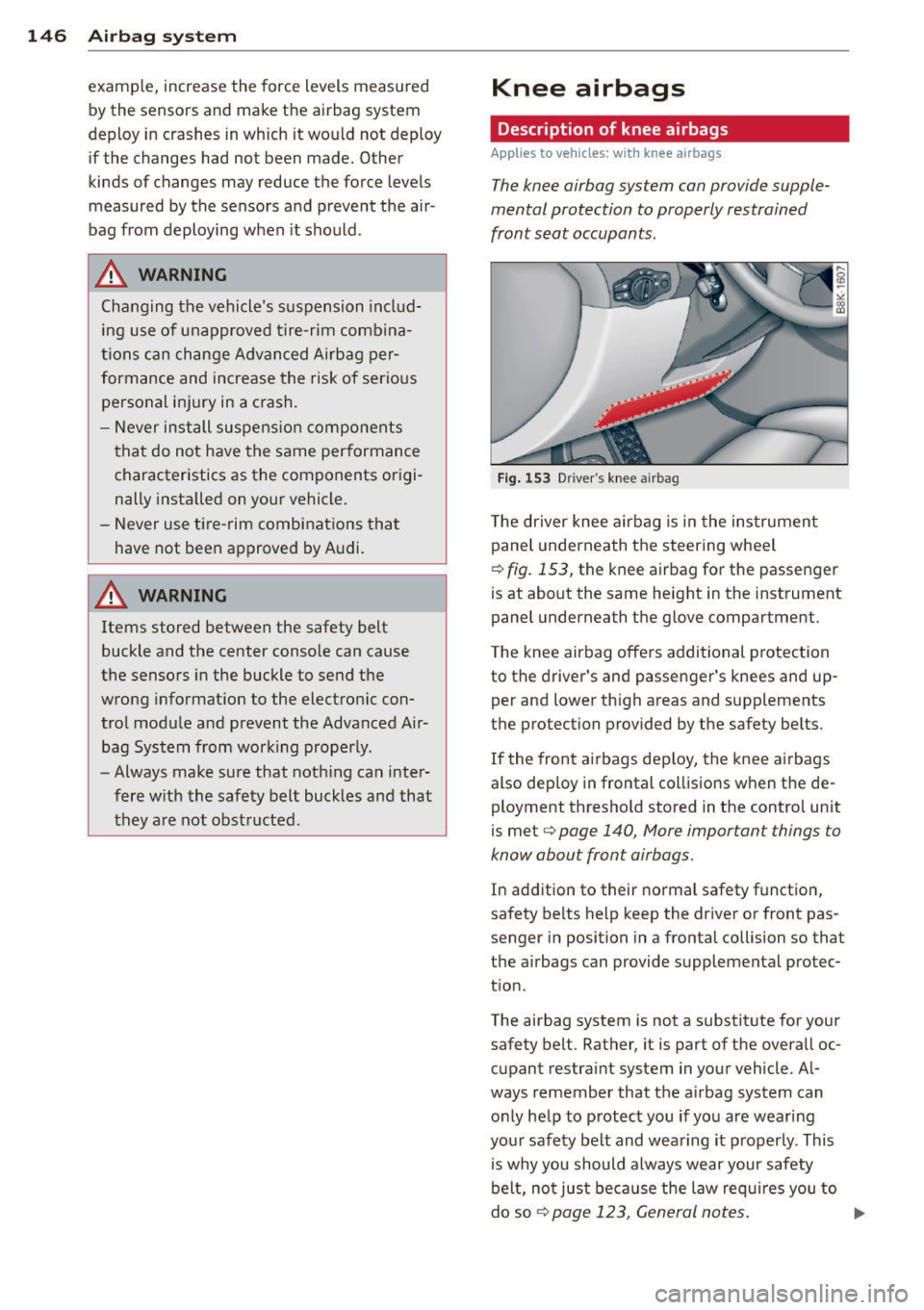
Fig. 153 Driver 's knee airbag
The driver knee airbag is in the instrument
panel underneath the steering wheel
¢ fig. 153, the knee airbag for the passenger
is at about the same height in the instrument
panel underneath the glove compartment.
The knee airbag offers additional protection
to the driver 's and passenger's knees and up
per and lower thigh areas and supplements
the protection provided by the safety belts.
If the front airbags deploy, the knee airbags
also dep loy in frontal collisions when the de
ployment threshold stored in the control unit
is met
¢ page 140, More important things to
know abou t front airbags .
In addition to their normal safety function,
safety belts help keep the driver or front pas
senger in position in a frontal collision so that
the airbags can provide supplemental protec
tion.
The airbag system is not a substitute for your
safety belt . Rather, it is part of the overall oc
cupant restraint system in your vehicle. Al
ways remember that the airbag system can
only help to protect you if you are wearing
your safety belt and wearing it properly . This
is why you should always wear your safety
belt, not just because the law requires you to
do so
r::!;> page 123, General notes. ..,.
Page 150 of 284

148 Airbag system
Fully inflated airbags in combination with
properly worn safety belts slow down and lim
it the occupant's forward movement and help
to reduce the risk of injury.
Important safety instructions on the
knee airbag system
Applies to vehicles: with knee airbags
Airbags are only supplemental restraints. Al
ways wear safety belts correctly and ride in a
proper seating position.
There is a lot that you and your passengers
must know and do to help the safety belts and
a ir bags to provide supplemental protection .
A WARNING
An inflating knee airbag can cause serious
injury. Wearing safety belts incorrectly and
improper seating positions increase the
r isk of serious personal injury and death
whenever a vehicle is being used.
- The knee airbag system cannot protect
you properly if you are seated too close
to any of the airbag locations. When ad
justing their seat positions, it is impor
tant that both the driver and the front
passenger keep their upper bodies and
knees at the following minimum safe
distances:
- at least 10 inches (25 cm) between the
chest and the steering wheel/instru
ment panel.
- at least 4 inches (10 cm) between the
knees and the lower part of the instru
ment panel.
- T he risk of personal injury increases if
you lean forward or to the side, or if the
seat is improperly positioned and you are
not wearing your safety belt. The risk in
creases even more should the airbag de
ploy.
-Always make sure that the knee airbag
can inflate without interference. Objects
between you and the airbag can increase
the risk of injury in an accident by inter
fering with the way the airbag deploys or by being
pushed into you as the airbag
deploys.
- Never let anybody, especially children
o r anima ls ride in the footwell in front
of the passenger seat. If the airbag de
ploys, this can result in serious or fatal
injuries.
- Never carry objects of any kind in the
footwell area in front of the dr iver's or
passenger's seat. Bulky objects (shop
ping bags, for example) can interfere
with or prevent proper deployment of
the airbag. Small objects can be
thrown through the vehicle if the air bag deploys and injure you or your pas
sengers.
- Make sure there are no cracks, deep
scratches or other damage in the area of
the instrument panel where the knee air
bags are located.
- If ch ildren are incorrectly seated, their
risk of injury increases in a collision
~page 152, Child Safety.
Side airbags
Description of side airbags
The airbag system can provide supplemental
protection to properly restrained occupants.
Fig. 155 Sid e airbag location in the driver's seat
The side airbags are located in the sides of the
front seat backrests¢
fig. 155. They are iden
tified by the word "AIRBAG".
The side airbag system basically consists of:
-the electronic contro l module and external
side impact sensors ..,.
Page 155 of 284

-If you must install a rearward facing
child safety seat on the front passenger
seat in exceptional circumstances and
the
PASSENGER AIR BAG OFF light does
not come on and stay on, immediately
install the rearward-facing child safety
seat in a rear seating position and have
the airbag system inspected immediately by your authorized Audi dealer.
,& WARNING
If, in exceptional circumstances, you must
install a forward-facing child restraint on
the front passenger's seat:
- Always make sure the forward-facing
seat has been designed and certified by
its manufacturer for use on a front seat
with a passenger front and side airbag.
- Always follow the manufacturer's in
structions provided with the child safety
seat or carrier.
- Always move the passenger seat into its
rearmost position in the seat's fore and
aft adjustment range, as far away from
the airbag as possible before installing
the child restraint. The backrest must be adjusted to an upright position .
- Always make sure that the
PASSENGER
AIR BAG OFF
light comes on and stays
on all the time whenever the ignition is
switched on.
@ Tips
Always replace child restraints that were
installed in a vehicle during a crash. Dam
age to a child restraint that is not visible
could cause it to fail in another collision
situation.
Advanced front airbag system and children
Your vehicle is equipped with a front "Ad
vanced Airbag System" in compliance with
M N United States Federal Motor Vehicle Safety er
~ Standard (FMVSS) 208 as applicable at the ,....,
~ time your vehicle was manufactured .
,....,
"' ,....,
Child Safety 153
The Advanced Airbag system in your vehicle
has been certified to meet the "low-risk" re
quirements for 3- and 6-year old children on
the passenger side and small adults on the driver side. The low risk deployment criteria
are intended to reduce the risk of injury
through interaction with the airbag that can
occur, for example, by being too close to the
steering wheel and instrument panel when
the airbag inflates. In addition, the system
has been certified to comply with the "sup
pression" requirements of the Safety Stand
ard, to turn off the front airbag for infants up
to 12 months who are restrained on the front passenger seat in child restraints that are list
ed in the Standard.
Even though your vehicle is equipped with an
Advanced Airbag system, all children, espe
cially those 12 years and younger, should al
ways ride in the back seat properly restrained
for their age and size . The airbag on the pas
senger side makes the front seat a potentially
dangerous place for a child to ride . The front
seat is not the safest place for a child in a for
ward-facing child safety seat. It can be a very
dangerous place for an infant or a larger child
in a rearward-facing seat.
Advanced Airbags and the weight
sensing mat in the front seat
The Advanced Airbag System in your vehicle
detects the presence of an infant or child in a
child restraint on the front passenger seat us
ing the weight-sensing mat in the seat cush
ion and the sensor below the safety belt latch
on the front passenger seat that measures the
tension on the safety belt.
The weight-sensing mat measures total
weight of the child and the child safety seat
and a child blanket on the front passenger
seat. The weight on the front passenger seat
is related to the design of the child restraint
and its "footprint", the size and shape of the
bottom of the child restraint as it sits on the
seat. The weight of a child restraint and its "footprint" vary for different kinds of child re -
straints and for the different models of the ..,. •
•