steering AUDI RS5 CABRIOLET 2015 Owner's Guide
[x] Cancel search | Manufacturer: AUDI, Model Year: 2015, Model line: RS5 CABRIOLET, Model: AUDI RS5 CABRIOLET 2015Pages: 284, PDF Size: 69.56 MB
Page 173 of 284

M N
a! u.. co ,...., \!) ..,.,
,...., ..,., ,....,
@ Tips
Your vehicle may be equipped with Audi
connect. Your use of certain Aud i connect
features req uires wireless serv ices that are
provided by a third party wireless telecom
municat ions provider. For details regard
ing how information obtained through
Aud i connect is collected, processed,
transmitted, used, and shared, please see
your contra ct w ith the wire less telecom
municat ions provider and the "About A udi
connect" tab in your vehicle's MMI*:
!MENU ! button> Audi connect > About
Audi con nect .
Electronic Stabilization
Control (ESC)
Description
ESC helps to improve road holding and vehicle
dynamics to help reduce the probability of
skidd ing and loss of veh icle control. It works
only when the eng ine is running. ESC detects
certain difficult driv ing situations, including
when the vehicle is beginning to spin (yaw) out of cont ro l and he lps you to get the vehicle
back under control by select ively b rak ing the
wheels, and/or red ucing engine power and
p roviding steering assistance to help hold the
ve hicle on the driver's intended course . The in
dicator light
DJ in the instrument cluster
blinks when ESC is taking action to help you
control the vehicle.
ESC has limitations.
It is important to remem
ber that ESC cannot overcome the laws of
phys ics. It will not a lways be able to help out
under all conditions you may come up against.
For example, ESC may not always be able to
help you master situat ions where there is a
sudden change in the coefficient of fr iction of
the road surface. When there is a sect io n of
d ry road that is s udden ly cove red with water,
slush o r snow, ESC canno t perform the same
way it would on the dry su rface.
If the vehicle
hydroplanes (rides on a c ush ion of water in
stead of the road surface), ESC wi ll not be
ab le to he lp you steer the veh icle because con-
Int ellig ent technolog y 171
tact with the pavement has been interrupted
and the vehicle cannot be braked or steered .
D uring fast corner ing, particular ly on wind ing
roads, ESC cannot always deal as effectively
with difficult dr iv ing s ituations than at lower
speeds. When towing a trailer, ESC is not able
to help you regain control as it would if you
were not tow ing a trailer.
Always adjust your speed and driving style to road, traffic and weather conditions . ESC can
not override the vehicle's physical lim its, in
crease the availab le tract ion, or keep a veh icle
o n the road if road departu re is a result of
driver ina ttent io n. Instead , ESC imp roves the
poss ibility of keep ing the vehicle under con
trol and on the road during extreme maneu
vers by using the driver's steering i nputs to
help keep the vehicle go ing in the intended di
rect ion. If you are traveling at a speed that
causes you to run off the road before ESC can
provide any assistance, you may not experi
ence the benefits of ESC.
ESC is switched on all the time. In certain sit
uat ions when you need less traction, you can
switch off ASR by pressing the butto n
[ill
~ page 173, fig. 166 or~ page 173,
fig. 167. Be sure to sw itch ASR on aga in when
you no lo nger need less traction.
The following systems are integrated in the
ESC:
Anti-lock bra king sy stem (ABS )
ABS prevents the whee ls from locking up
when brak ing. T he vehicle can st ill be steered
even dur ing hard braking. App ly steady pres
su re to the brake peda l. Do not pump the ped
al. A pulsing in the brake pedal ind icates that
the system is helping you to brake the veh icle .
Brake assi st system
The brake ass ist system can decrease braking
distance. It increases brak ing power when the
drive r presses the brake peda l quickly in emer
gency s ituations. You must press and hold the
brake pedal unti l the s ituation is over. In
vehicles with adaptive c ruise control*, the
brake assis t system is more sensitive if the
•
•
Page 174 of 284

172 Intelligent technology
distance detected to the vehicle ahead is too
smal l.
Anti-slip regulation (ASR )
ASR reduces eng ine power when the drive
wheels begin to spin and adapts the fo rce to
the road condit ions. This makes it eas ier to
start, accelerate and drive up hills .
Electronic differential lock (EDL )
The EDL brakes wheels that are spinn ing and
transfers the d rive powe r to the other wheels.
This f unct ion is available up to abo ut 60 mph
(100 km/h) .
In extreme cases, ED L automat ica lly switches
off to help keep the brake on the braked whee l
from ove rheating. EDL wi ll switch on aga in a u
tomatically when conditions have returned to
norma l.
Steering recommendation
The ESC helps to stabilize the ve hicle by
changing the steering to rque.
In vehicles with dynam ic steeri ng*, ESC also
helps to stabilize the stee ring in critical s itua
tions.
Select ive wheel torque control
Selective whee l torque control is used when
driving on curves . The front wheel on the in
side of the curve or both wheels on the inside
of the curve are braked selective ly as needed.
This a llows mo re prec ise d riving in curves. The
appl icable system may no t activate when d riv
i ng in wet or snowy condi tions.
A WARNING
- The ESC and its integrated systems can
not overcome the laws of physics. This is especia
lly important on slippery o r wet
roads. If the systems begin acting to sta
bilize your veh icle, you should immedi
ately change your speed to match the
road and traffic cond itions. Do not let
the increased safety provided by these
systems tempt you to take risks. Do ing
so will in crease the r is k of a loss of vehi
cle control, collision and serious person al
in juries.
- Always adap t your speed to road, traffi c
and weather conditions . The risk of los
ing control of the vehicle increases when
driving too fast, especially through
curves and on slippery or wet roads, and
when dr iv ing too close to vehicles up
ahead. The ESC and its integrated sys
tems cannot a lways p revent collisions -
there is still a risk of acc idents!
- Always accelerate with special care on
even, smooth s urfaces such as those that
are wet or covered with ice and snow.
T he drive w heels can spin even w ith
these assistance sys tems that cannot al
ways he lp to re duce the risk of loss of ve
h icle control.
(D Tips
- ABS and ASR o nly wo rk correctly when
a ll four wheels are equipped wi th iden ti
c al tires. D ifferen t tire sizes can lead to a
reduction in engine powe r.
- Yo u may hear noises when the systems
descr ibed are workin g.
-If the ind icator light DJ or Ea (USA
mode ls)/ lCOj
~ page 18,
<=>page 19.
Page 177 of 284

M N
er
u..
co ,...., \!) ..,.,
,...., ..,., ,....,
Brake lining w ear sta tus
Brake lining we ar may be che cked by visual in
spection of the condition of the brake pads
through the openings in the whee l. If neces
sary, the wheel may be remove d for this in
spection
c> page 244, Changing a wheel.
.&_ WARNING
- New brake pads do n't have the best sto p
ping power and must be "broken-in" dur
ing the init ial 100 to 1 50 m iles (150 to
200 k ilometers) of normal city driving.
T he break-in period can be considerably
longer for veh icles with ceram ic br ake ro
tors*. You can compensate for this by pressing the brake pedal more firmly.
T his also applies later when new pads are
installed .
- You should perform braking maneuvers
for the purpose of cleaning the brake
system on ly if road condit ions permit.
Other road users must not be put at r isk -
you may cause an acc ident!
- Before descending a steep grade, reduce
speed and shift transmiss ion into a lower
gear or lower driving range. Do not ride
the brakes or hold the pedal down too
long or too ofte n. This cou ld cause the
brakes to get hot and d imin ish b raking
efficiency.
- Do not "r ide the brakes" by resting your
foot on the pedal when you do not inte nd
t o brake. Th is may cause the b rakes to
overheat, prema ture wear and inc reased
stopping distance .
- Under certa in climat ic and operating
conditions such as passing through wa
ter, driving in heavy rain or after wash ing
the vehicle, the effectiveness of the brakes can be reduced. In winter, ice can
accumulate on the brake pads, linings,
discs and drums. Carefully apply brakes
for a test. Brakes will dry and ice coat ings will be cleaned off after a few ca re
ful brake applications.
- Driv ing fo r an extended pe riod of time on
salt-covered roads w ithout using you r
Intellig ent technolog y 175
brakes can a lso affect braking efficiency .
Clean off accum ulated salt coating from
brake discs and pads with a few careful
brake applications.
- If you damage the front spoiler, or if you
install a different spoiler , be sure the air
f low to the front brakes is not obstruct
ed. Otherw ise the brake system could
overheat reducing t he effectiveness of
the entire brake system.
- Failure of one b rake circuit will impa ir
the braking capab ility result ing in an in
creased s topping distance. Avoid driving
the vehicle and have it towed to the near
est a utho rized Audi dea le r or q ualified
workshop.
- Never let the vehi cle roll to a stop with
the engine shut off.
- If the b ra ke booste r is no t working, the
brake peda l must be p ressed considera
b ly harder to make up for the lack of
booster assistance .
Electro-mechanical
power assist, dynamic
steering
The electro-mechanical power assist helps
the driver when steering.
Power steer ing adapts electronically based on
t he ve hicl e speed.
Indicator lights and messages
• Steering defect ive! Do not drive vehicle!
If this indicator light turns on and stays on
and this message appears, the power steer ing
may have failed.
Do
not continue driving. See your authorized
Audi dealer or a qualified repair facility for as
s istance.
E!'Y D ynamic stee ring: System fault! You can
continue dri ving
If the indica tor ligh t turns on and the mes-
sage appears, the stee ring may be more diffi
cu lt to move o r more sensit ive than usual. The ..,.
•
•
Page 178 of 284

176 Intellig ent technolog y
steering wheel may also be at an angle when
driving straig ht.
Drive s low ly to your author ized Audi dealer or
q ua lified workshop to have the malfunction
corrected.
l ;:r- ij Dyn am ic s te ering : initi alizing
If th is driver message appears and the ind ica
tor light is flashing on the instrument panel ,
dynam ic steering* is be ing reinitialized. After
start ing the engine, the steer ing whee l w ill
move slightly . Re-in itia lizat ion m igh t be nec
essary if the steering wheel was moved hard
to the left and right while the vehicle was not moving. The disp lay goes out as soon as i niti
alization is complete .
.&_ WARNING
Have the dynamic steering* system mal
function repaired as soon as poss ible by an
authorized Audi dealer or qualified work
shop -risk of accident!
(D Tips
- If the . or@ indicator light only stays
on for a short t ime, you may continue
driving .
- The dynamic steering* stability systems
are not available in the event of a system
malfunction .
- For additional informat ion on dynamic
steering*, refer to
c::> page 102 .
Driving with your
quattro
-
With all-wheel drive, all four wheels are driv
en.
General information
W ith all-whee l drive , power is distributed to
a ll four w heels . This happens automatically
depending on your dr iving sty le and the road
conditions at the t ime. See a lso
c::> page 171.
A center different ial d istr ibutes the dr iv ing
power var iably to the front and rear axle.
It
wo rks together wi th se lective wheel torque control, which activates when driving thro
ugh
c u rves
c::> page 172. With the sport differen
t ia l*, power distr ibut ion to the rear wheels is
variable and can be adjusted w ith drive se lect
c::> page 102.
The all-whee l drive concept is designed for
high eng ine power. Your veh icle is except ion
ally powerful and has excellent driving charac
teristics both under normal driv ing cond itions
and on snow and ice . Always read and follow
safety precaut ions
c::> ,& .
Winter tir es
When d riving in the winter, yo ur vehicle with
all-wheel drive has an advantage, even with regular tires. In winter road conditions it may
be advisable to mount winter tires (or all -sea
son tires) for improved dr iveability and brak
ing : these tires must be mounted on
a ll four
wh eels.
See also c::> page 236, Winter tires.
Tire ch ains
Where tire chains are mandatory on cer tain
roads, this normally also applies to vehicles
with all-wheel drive c::> page 23 7, Snow
chains .
Replacing whee ls / tire s
Vehicles with all-wheel drive must always
have tires of the same s ize . A lso avoid tires
with different tread depths. For deta ils see
page
c::> page 230, New tires and replacing
tires and wheels.
Off-Road dr iving ?
Your Audi does not have enough ground clear
ance to be used as an off -road vehicle. It is
therefore best to avoid roug h tracks a nd un
even terra in as much as poss ib le . Also refer to
c::> page 179.
.&_ WARNING
A lways adj ust yo ur dr iv ing to road and t ra f
f ic conditions . Do not let the extra safety
afforded by all-wheel drive tempt you into
taking extra risks.
-Although the a ll-wheel d rive is very ef
fective, always remember that braking
Page 214 of 284
212 Tires and wheels
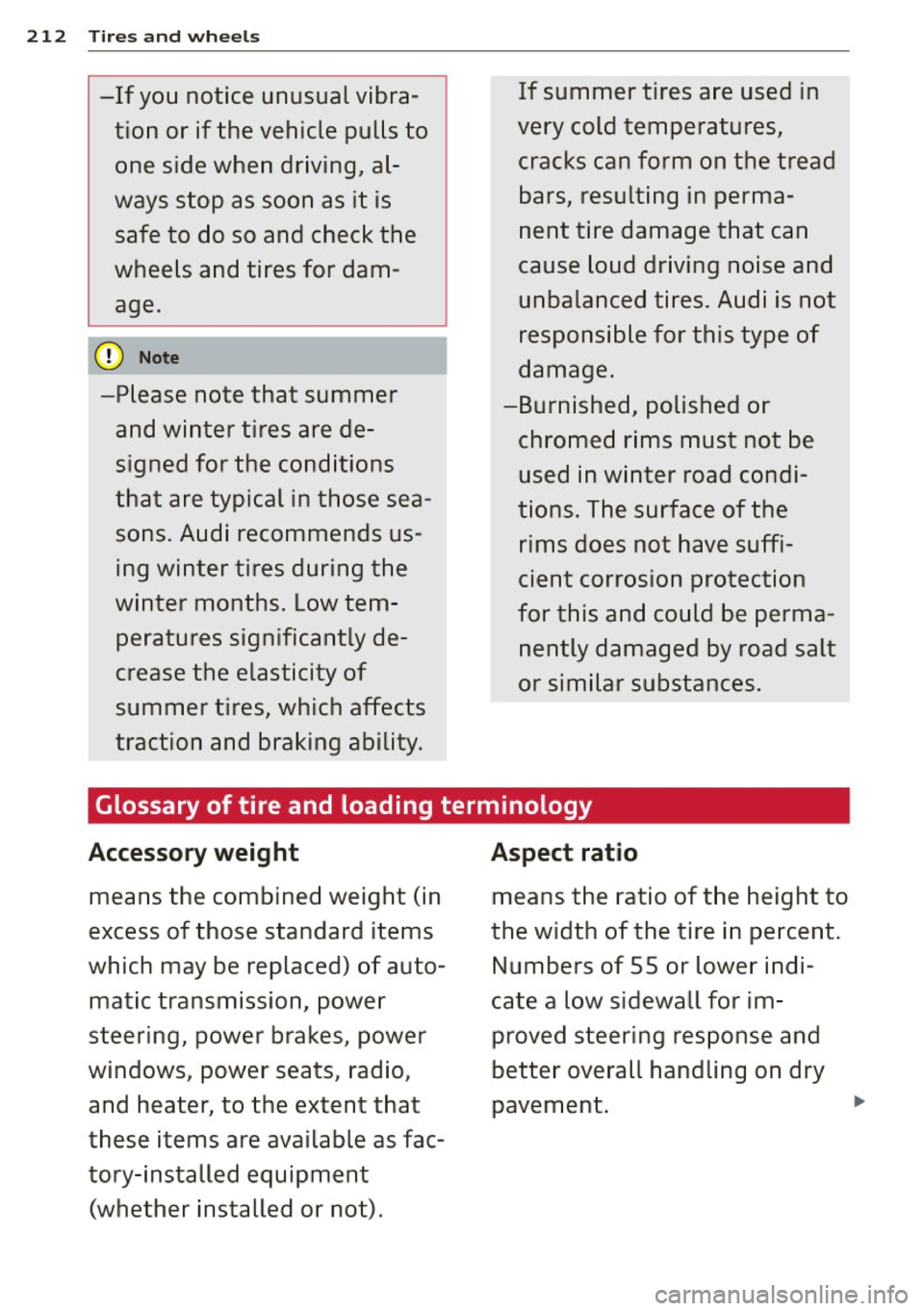
-If you notice unusual vibra
tion or if the vehicle pulls to
one side when driving, al
ways stop as soon as it is
safe to do so and check the
wheels and tires for dam
age.
0 Note
-Please note that summer and winter tires are de
signed for the conditions
that are typical in those sea
sons. Audi recommends us
ing winter tires during the
winter months. Low tem peratures significantly de
crease the elasticity of
summer tires, which affects
traction and braking ability. If summer tires are used
in
very cold temperatures, cracks can form on the tread
bars, resulting in perma
nent tire damage that can
cause loud driving noise and
unbalanced tires. Audi is not
responsible for this type of
damage.
-Burnished, polished or chromed rims must not be used in winter road condi
tions. The surface of the
rims does not have suffi
cient corrosion protection
for this and could be perma
nently damaged by road salt
or similar substances.
Glossary of tire and loading terminology
Accessory weight
means the combined weight (in
excess of those standard items
which may be replaced) of auto matic transmission, power
steering, power brakes, power
windows, power seats , radio,
and heater, to the extent that
these items are available as fac
tory-installed equipment (whether installed or not).
Aspect ratio
means the ratio of the height to
the width of the tire in percent.
Numbers of 55 or lower indi
cate a low sidewall for im
proved steering response and
better overall handling on dry
pavement.
...
Page 231 of 284

M N
er
u..
co ,...., \!) 1.1'1 ,...., 1.1'1 ,....,
wear on steering, suspension and tires. A wheel must also be
rebalanced when a new tire is
installed.
Incorrect wheel alignment
Incorrect wheel alignment can
cause excessive tire wear, im
pairing the safety of the vehi
cle. If tires show excessive
wear, have the wheel alignment checked by an authorized Audi
dealer or qualified workshop.
All wheel drive
Vehicles with quattro must al
ways have tires of the same
size, construction and tread
type. For details see
¢page 176.
A WARNING
Sudden tire failure can lead
to loss of control, a crash and serious personal injury!
-Never drive a vehicle when the tread on any tire is worn down to the wear indica
tors.
-Worn tires are a safety haz
ard, they do not grip well on
wet roads and increase your risk of "hydroplaning" and
loss of control.
Tires and wheels 229
-Always keep chemicals that can cause tire damage, such
as grease, oil, gasoline and
brake fluid away from tires.
-Tires age even if they are not being used and can fail
suddenly, especially at high speeds. Tires that are more
than 6 years old can only be used in an emergency and
then with special care and
at lower speeds.
-Never mount used tires on your vehicle if you are not sure of their "previous histo
ry." Old used tires may have
been damaged even though
the damage cannot be seen
that can lead to sudden tire
failure and loss of vehicle
control.
•
•
'
Page 243 of 284
![AUDI RS5 CABRIOLET 2015 Owners Guide M N
er
u..
co ,...., \!) ..,.,
,...., ..,., ,....,
Warning symbol s
ti] Loss of p ressure in at least one tire c::> ,&. .
Check the tire or tires and replace o r repair if
necessary](/img/6/57644/w960_57644-242.png "AUDI RS5 CABRIOLET 2015 Owners Guide M N
er
u..
co ,...., \!) ..,.,
,...., ..,., ,....,
Warning symbol s
ti] Loss of p ressure in at least one tire c::> ,&. .
Check the tire or tires and replace o r repair if
necessary")
M N
er
u..
co ,...., \!) ..,.,
,...., ..,., ,....,
Warning symbol s
ti] Loss of p ressure in at least one tire c::> ,&. .
Check the tire or tires and replace o r repair if
necessary . The indicator light
ti] in the instru
ment cluster also illuminates
c::> page 13.
Check/correct the pressures of all four tires
and reset TPMS v ia radio or MMI*.
liif:I ( T ire Pressure Monitoring System) Ti re
p ressu re : Sys tem malfun ction !.
Ifffi:m appears after sw itching the ign ition on
or while driving and the indicator light
ti] in
the instrument cluster blinks for approxi
mate ly one min ute and then stays on, there is
a system malfunction. Attempt to store the
correct t ire pressure
c::> page 241. If the ind i
cator light does not turn off or if it turns on
shortly thereafter, immediately drive your ve h icle to an authorized Audi dealer or author
i zed repair facility to have the malfunction
corrected.
_& WARNING
- If the t ire pressure indicator appea rs in
the instrument cl uster display, one or
more of you r tires is significantly under
inflated. Reduce your speed immediately
and avoid any hard steering or braking
maneuvers. Stop as soon as possible and
check the t ires and the ir pressures . In
flate the tire pressure to the proper pres sure as indicated on the vehicle's t ire
pressure label
c::> page 217. Driving o n a
signific antly under-inflated tire ca uses
the tire to overhea t and can lead to tire
f ailure. Under-inflation also is likely to
impair the vehicle's handling and stop
ping ability.
- The driver is responsible for maintaining
the correct tire pressures . You must
check the t ire pressures regular ly.
- Under certain cond itions (such as a spor
ty driving style, w inter condit ions or un
paved roads), the pressure monitor ind i
cator may be de layed.
-Ask your authorized Audi dealer if run flat tires may be used on your veh icle.
Tire s an d wheel s 241
(D Tips
-The tire pressure monitor ing system may
stop working when there is an ESC ma l
function.
- Using snow c hains may res ult in a system
ma lf u nction.
- The tire pressure mon itoring system on
your Audi was deve loped using tires with
the "ROl" identificat ion on the tire side
wall
c::> page 230. We recommend using
these tires.
Reset tire pressure monitoring system
App lies to vehicles : wit h tire p ress ure mo nitor ing system
If the tire pressure is adjusted, wheels ore ro
tated or changed, the TPMS must be reset via
radio or MM!*.
.,. Before storing the new t ire pressures, check
that the current pressures on all four tires
correspond to the specified va lues and
adapt the pressures to the current load
c::> page 217 .
.,. Switch on the ignition.
.,. Select: the
I CARI fu nct ion button > Tir e pre s
sure monitoring
> Store now . Or
.,. Select: the
I CAR I fu nction button > Car s ys
tem s*
contro l butto n > Servicing & checks >
Tire p ressure monitoring > Sto re tire pres
sures
> Yes , store now .
(D Tips
Do not store the tire pressure if there are
snow cha ins on the tire. Otherwise, a sys
tem malfunction may occur.
•
•
Page 252 of 284

250 Fuses and bulbs
Fuses and bulbs
Fuses
Replacing a fuse
Fuses that have blown will have metal strips
that have burned through.
Fig. 197 Left cockpit: fuse panel cover
The fuses are located at the front left and
right of the cockpit and behind the trim on
the right side of the luggage compartment.
•Turnoff the ignit ion and the affected electri-
cal consumers.
• Check the following table to see which fuse
belongs to the consumer.
• Remov e the appropriate cover ¢
fig. 197 or
¢page 193, fig. 170.
• To remove the purple plastic clip if necessa
ry
1l, hold onto it at the small side and pull
it out of the fuse panel
c:> page 250,
fig .
198 .
• Remove the clamp from the rear side of the
fuse cover <>
fig. 197.
• Remove the fuse using the clamp and re
place the blown fuse w ith an ident ical new
one.
A WARNING
Do not repair fuses and never replace a
blown fuse with one that has a higher amp
rating. This can cause damage to the elec
trical system and a fire.
ll You can dis pose of the p last ic clip afte r re moving it.
(D Note
If a new fuse burns out again after shortly
have you have installed it, have the electri
cal system checked by your authorized
Audi dealer .
(D Tips
-The following table does not list fuse lo
cations that are not used.
- Some of the equipment items listed are
optional or only available on certain
model configurations.
Left cockpit fuse assignment
Fig. 198 Left cockpi t: fu se pane l with plastic clip
Fuse panel ® (black)
No. Consumer Amps
1 Dynamic steering s
2
E lectronic Stabilization Con-
s tr ol (module)
Page 253 of 284
M N
er
u..
co ,...., \!) 1.1'1 ,...., 1.1'1 ,....,
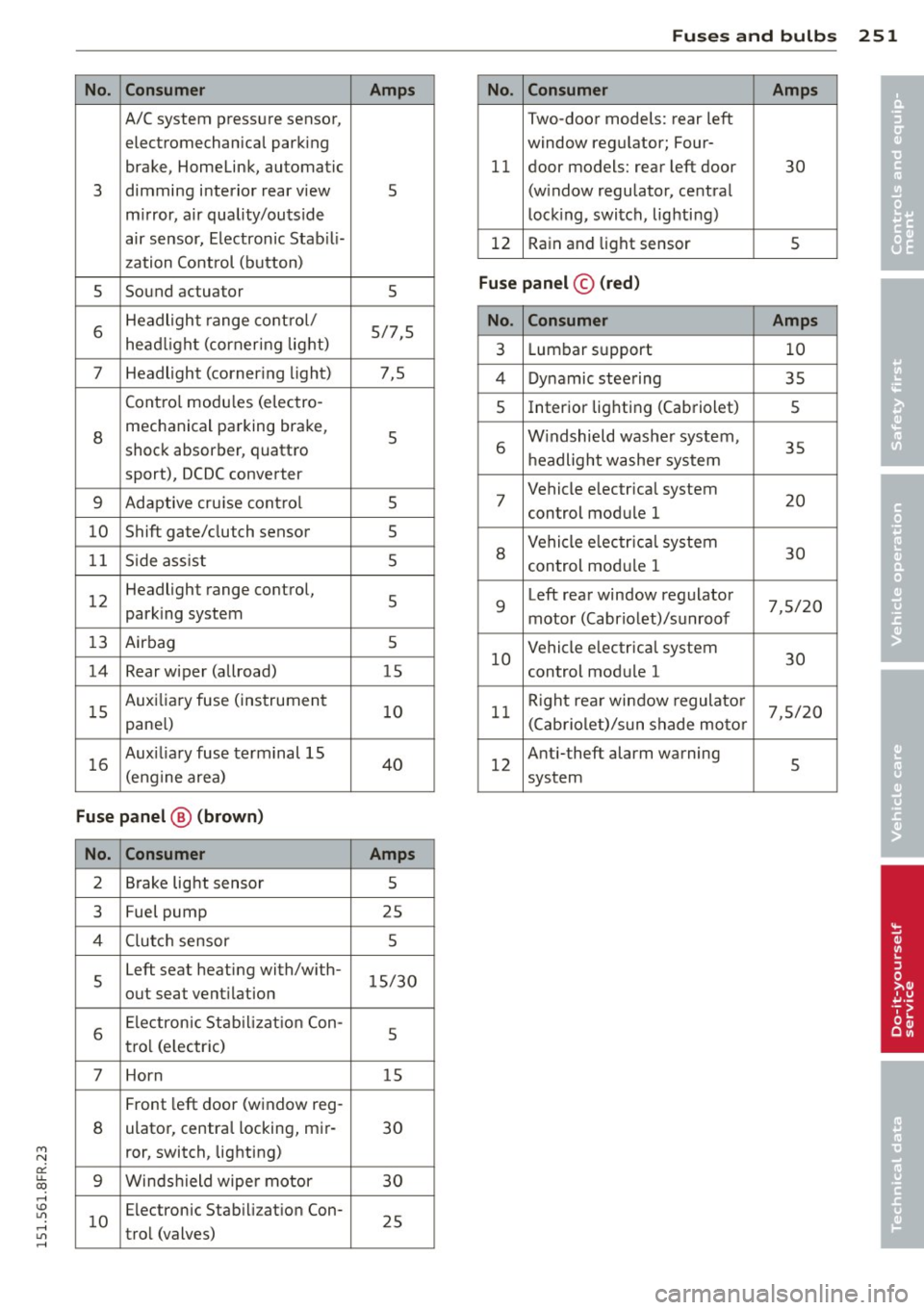
No. Consumer
A/C system pressure sensor,
electromechanical parking
brake, Homelink, automatic
3 dimming interior rear view
m
irror, air quality/outside
air sensor, Electronic Stab ili-
zation Control (button)
5 Sound
actuator
6 Headlight
range cont rol/
head light (cornering light)
7 Headlight (corner
ing light)
Contro l modu les (e lectro-
8 mechanical parking brake,
shock absorber, quattro
sport), DCDC converter
9 Adaptive cru ise contro l
10 Shift gate/clutch
sensor
1 1 Side ass ist
1 2 Headlight range
control,
park ing system
13 Airbag
14 Rear wiper (allroad)
1 5 Auxi
liary fuse (instrument
pane l)
16 Aux
iliary fuse terminal 15
(engine area)
Fuse p anel @ (brown )
No. Con sumer
2 Brake light sensor
3 Fuel
pump
4 Clutc h sensor
5 Left
seat heating with/w ith-
out seat vent ilation
6 Electronic Stab
il iz at ion Con-
tro l (e lectric)
7 Horn
Front left door (window reg-
8 ulator, centra
l locking, mir-
ror, switch, lighting)
9 Winds hield wipe r motor
1 0 Electronic
Stabilizat ion Con-
trol (valves)
Fuses and bulb s 251
Amp s No. Consumer Amps
•
Two-door models: rear left
• window regulator; Four-
11 door models:
rear left door
30
5 (window regulator, central
lock
ing, switch, lighting)
12 Rain and light sensor
5
5
Fuse pan el© (r e d )
5/7,5 No . Consumer Amps
3 Lumbar support 10
7,5 4 Dynamic steering 35
s Interior lighting (Cabriolet)
5
5 6 W
indshield washer system,
35
h eadlight washe r system
5 7 Vehicle electrical
system
20
control module 1
5
5
8
Vehicle e lectr ica l system
30
control module 1
5 9 Left rear window regulator
7,5/20
motor (Cabriolet)/sunroof
5
15 10 Vehicle e
lectrical system
30
control module 1
10 11 R
ight rea r window regulato r
7,5/20
(Cabriolet)/sun shade motor
40 12 Anti-theft
alarm warning
5
system
Amps
5
25 5
15/30
5
15
30
30
25
Page 254 of 284
252 Fuses and bulbs
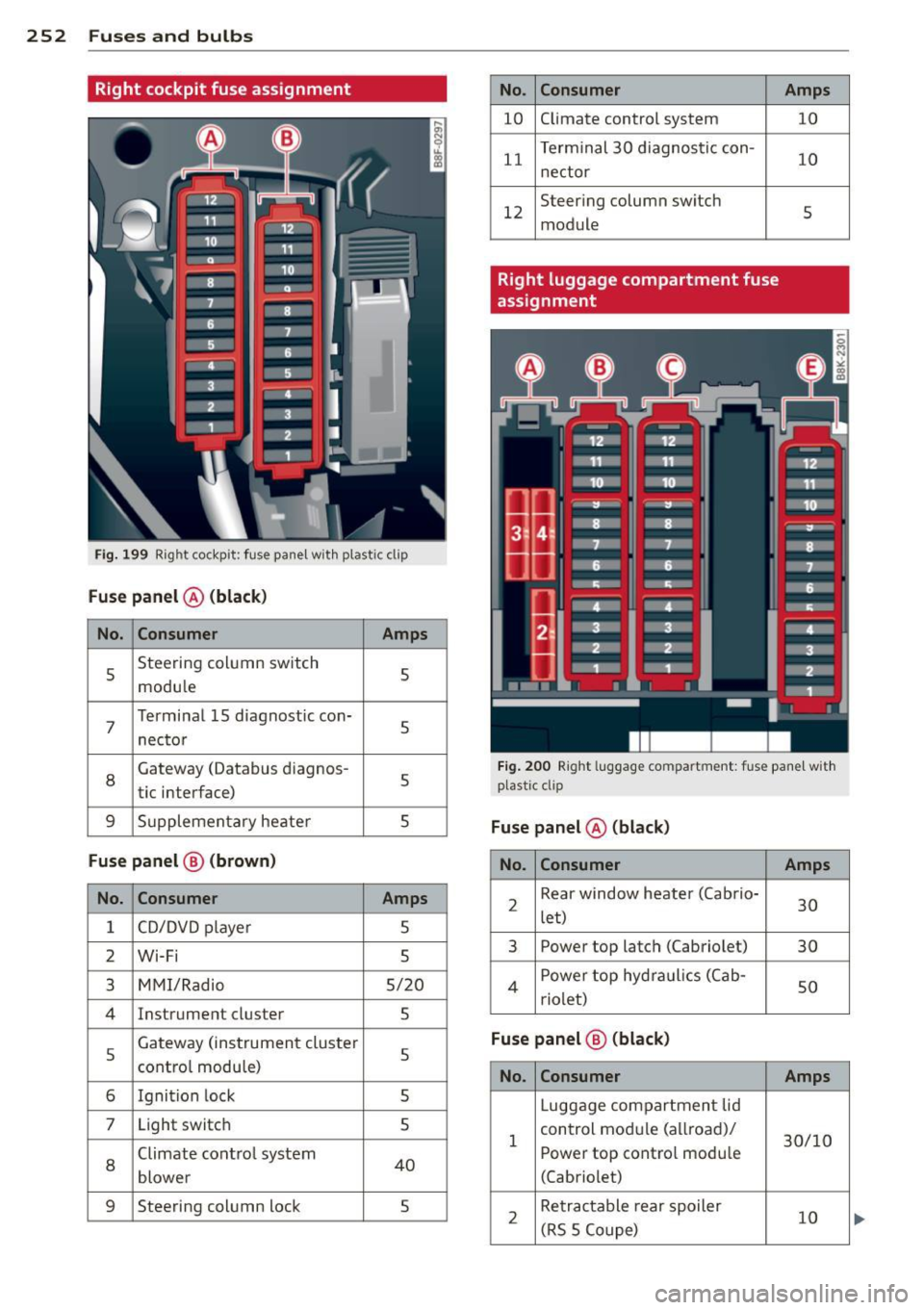
Right cockpit fuse assignment
Fi g. 199 Right cockpit: f use pane l w it h plastic clip
Fuse panel @ (black )
No. Consumer Amps
5 Steering col
umn switch
5
modu le
7
Terminal 15 d iagnostic con-
nec tor 5
8
Gateway (Databus d
iagnos -
5
tic interface)
9 S u pplemen tary heate r 5
Fuse panel @ (brown )
No. Consumer
Amps
1 CD/DVD p laye r 5
2 Wi·Fi 5
3
M MI/Radio 5/20
4 Instrume nt cluster
5
5
Gateway (ins trumen t cluster
5 contro l modu le)
6 Igni tion lock
5
7 Light switch
5
8
Climate contro l system 40
blowe r
9 Steering column lock 5
No . Consumer
10 C
limate control system
11 T
erm inal 30 diagnosti c con-
n ectar
12 Steer
ing column switch
module
Right luggage compartment fuse
assignment Amps
10
10
5
F ig . 2 00 Right lu ggage compartment: fu se pane l w it h
plast ic clip
Fuse panel @ (black)
No . Consumer Amps
2 Rear window heater (Ca b
rio-
30
let)
3 Power
top latch (Cabriolet)
30
4 Power top hyd ra ulics ( Cab-
so rio let)
Fuse panel @ (black)
No. Consumer Amps
Luggage compartmen t lid
1 control mod
ule (a llroad)/
30/10
Power top contro l modu le
(Cabriolet)
2 Re
tra ctable rear spoiler
10
( R S 5 Coupe)