battery AUDI RS5 COUPE 2015 User Guide
[x] Cancel search | Manufacturer: AUDI, Model Year: 2015, Model line: RS5 COUPE, Model: AUDI RS5 COUPE 2015Pages: 254, PDF Size: 64.12 MB
Page 177 of 254

M N
0:: loo ,...., \!) 1.1'1
N 1.1'1 ,....,
Winter tires
When driving in the w inter, your vehicle w ith all
wheel drive has an advantage, even with regular
tires. In winter road conditions it may be advisa
ble to mount winter tires (or all-season tires) for
improved driveability and braking: these tires
must be mounted on
all four wheels. See also
c:> page 211, Winter tires .
Tire chains
Where tire chains are mandatory on certain
roads, th is normally also applies to vehicles with
all-wheel drive
c:> page 211, Snow chains.
Replacing wheels/tires
Vehicles w ith all-wheel drive must a lways have
tires of the same size . Also avoid tires with differ
ent tread depths. For details see page
c:> page 203, New tires or wheels.
Off-Road driving?
Your Audi does not have enough ground clear
ance to be used as an off-road vehicle. It is there
fore best to avoid rough tracks and uneven ter
rain as much as possible . Also refer to
c:>page 177.
A WARNING
Always adjust your driving to road and traffic
conditions. Do not let the extra safety afford
ed by all-wheel drive tempt you into tak ing
extra risks .
- Although the all-wheel drive is very effec
tive, always remember that braking capac ity
is limited by tire traction. You should there
fore not drive at excessive speeds on icy or
slippery road surfaces.
- On wet road surfaces, be careful not to drive
too fast because the front wheels could be
gin to slide on top of the water (aquaplan
ing). If this should occur, you will have no
warning from a sudden increase in engine speed as with a front-whee l drive vehicle .
Always drive at speeds which are suited to
the road conditions -risk of crash .
Smart Technology
Energy management
Starting ability is optimized
Energy management controls the distribution of
electrical energy and thus optimizes the availa
bility of electrical energy for starting the engine.
If a vehicle with a conventional energy system is
not driven for a long period of time, the battery
is d ischarged by idling current consumers (e.g .
immobilizer). In certain circumstances it can re
su lt in there being insufficient energy available to
sta rt the eng ine .
Intelligent energy management in your vehicle
hand les the distribution of electrical energy .
Starting ability is markedly improved and the life
of the battery is extended.
Basically, energy management consists of
bat
tery diagnosis , idling current management
and
dynamic energy management .
Battery diagnosis
Battery diagnosis continuously determines the
state of the battery . Sensors determine battery
voltage, battery current and battery tempera
ture . T his determines the current state of charge
and the power of the battery.
Idling current management
Idling current management reduces energy con
sumption while the vehicle is standing . With the
ignition switched off, it controls the energy sup
ply to the various electrical components. Data
from battery d iagnosis is considered.
Depend ing on the battery's state of charge, indi
vidual consumers are gradually turned off to pre
vent excessive discha rge of the batte ry and thus
mainta in starting capability.
Dynamic energy management
While the vehicle is being driven, dynamic energy
manageme nt distr ibutes the energy gene rated
accord ing to the needs of the individual compo
nents.
It regu lates consumption, so that more
elect rical energy is not being used than is be ing
generated and ensures an optima l state of
charge for the battery. ..,.
175
Page 178 of 254

Smart Technolog y
(D Tips
-But even energy management cannot neg
ate the limits of physics. Consider that the power and life of a battery are limited.
- If starting ability is threatened, the indica
tor light (•)appears
Qpage 16.
What you should know
The highest priority is given to maintaining start
ing capability.
The battery is severely taxed in short-distance
driving, in city traffic and during the co ld time of
year . Ab undant electrical energy is required, but
only a little is generated. It is also critical if the
engine is not runn ing and electrical components
are turned on. In this instance energy is being
consumed but none is being generated.
It is in precisely these situat ions that you wi ll no
tice energy management actively regulating the
d istr ibut io n of energy.
Vehicle s tand s for an exte nded p eriod
If you do not drive your vehicle over a period of
several days or weeks, e lectrica l components are
gradually cut back or switched off. This reduces
energy consumption and maintains starting ca
pability over a longer period. Some of the con
ven ience funct ions may not operate, such as the
interior lights or the powe r seat adjustment. The
conven ience functions will be ava ilable again
when you sw itch on the ign it io n and start the en
g ine.
With th e engine turned off
If you listen to the radio, for example, with the
engine turned off or use other MMI funct ions,
the battery is being discha rged .
If starting capability is jeopardized due to energy
consumption, a message appears in the MMI dis p lay . The message ind icates that the system will
be sw itched off automat ica lly in a moment. If
you wish to cont inue using the functions , you
have to start the engine .
176 With the en
gine running
Although elec trical energy is generated when the
vehicle is being d riven, the battery can become
discharged . This happens mostly when litt le en
ergy is being generated and a great deal con
sumed and the battery's state of charge is not
optimal.
T o bring the energy ba lance back into equilibri
u m, consumers whic h req uire especially large
amounts of energy are temporari ly cut back or
switched off. Heating systems in part icular re
quire a great deal of energy. If you notice, for ex
ample, that the heated seats* o r the heated rear
window are not heating, they have been tempo
r ari ly cut back o r switched off . Th ese systems w ill
be ava ilable again as soon as the ene rgy ba lance
has been res tored.
You w ill also notice that engine id le speed has
been increased slightly . Thi s is normal and not a
ca use for concer n. By increasing eng ine idle
speed the addi tional energy required is gene rated
and the battery is charged.
Page 181 of 254

M N
0:: loo ,...., \!) ..,.,
N ..,., ,....,
-Have your veh icle maintained properly and
in accordance with the service recommen
dations in your Warranty
& Maintenance
book let.
- Lack of proper maintenance as well as im
proper use of the vehicle will impair the
function of the emission control system and could lead to damage.
@ For the sake of the environment
Even when the Emission Control System is op
erating properly, the exhaust gas can have a
sulfur-like exhaust gas smell under some op
erating states. This depends on the sulfur
content of the fuel being used . Using a differ
ent brand of fuel may help, or filling the tank
w ith lead-free super grade gasoline.
Shutting down vehicle
If you wou ld like your vehicle to remain inopera
tive for a longer period of time, contact an Audi
or other specialized dealer. T hey can advise you
on necessary precautions e.g. corrosion preven
tion, maintenance and storage. Pay attention to
additional information concerning the battery. Refer to
c:;, page 196.
Economical and environ
mentally-friendly driving
General
Your personal style of driving will determine the
economy of your vehicle, as well as exhaust and
noise levels.
Fu el economy, environmental impact , and wear
on your engine, brakes and tires largely depend
on three factors:
- your personal driving style
- operating conditions
- technical limitations
If you anticipate what you need to do next and
drive economically, you can easily cut your fue l
consumption by 10-15 percent. This sect ion will
give you some tips on how you can help the envi
ronment and your pocketbook .
Driving and the environment
(D Tips
The consumption estimates as published by
ENVIRONMENTAL PROTECTION AGENCY (EPA)
and Transport Canada may not correspond to
your actual consumption on the road, which
will vary depending upon vehicle load and
speed, road and weather conditions, tr ip
l ength, etc.
Drive smoothly and keep a lookout ahead
Vehicles use the most fuel when they are acceler
ating .
.. Avoid unnecessary accelerating and braking .
Vehicles use the most fuel when they are acceler
ating. If you anticipate what is going to happen next, you will need to brake less and , thus, accel
erate less. Let the veh icle coast whenever possi
ble -for example when you see that the next traf
fic light is red.
Avoid full throttle
Driving at moderate speeds saves fuel and im
proves your mileage .
.. Try and keep well below your car's maximum
speed.
Acce lerating gently reduces fue l consumption,
engine wear, and does not disturb the environ
ment .
Fuel consumpt ion, exhaust emiss ions and engine
noise increase disproportionately at high speeds.
If you drive at approximate ly three quarters of
top speed, fue l consump tion will be reduced by
one half. Never drive faster than the posted
speed l imit and weather cond itions permit .
Reducing unnecessary idling
Even when your car is just idling it burns up fuel.
.. Shut the eng ine off when you are not driving
the vehicle.
.. Do not warm up the vehicle by letting the en-
gine run at idle .
ll>
179
Page 190 of 254
Checking and Filling
compartment. Wait until no steam or cool
ant can be seen or heard before carefully
opening the hood.
- Keep children away from the engine com
partment.
- Never spill fluids on hot engine compo
nents. They can cause a fire.
- Never touch the radiator fan. The auxiliary
electric fan is temperature controlled and
can switch on suddenly.
- Never open the coolant reservoir cap when
the engine is still warm . The coolant system
is pressurized and hot coolant could spray
out .
- Protect your face, hands and arm from
steam or hot engine coolant by placing a
thick rag over the cap when you open the coolant reservoir .
- Do not remove the engine cover under any
circumstances . This increases the risk of
burns .
- If work on the fuel system or the electrical
system is necessary :
= Always disconnect the battery.
- Never smoke or work near heaters or open
flames. Fluids in the engine compartment
could start a fire.
- Keep an approved fire extinguisher imme
diately available.
- To avoid electrical shock and personal injury
while the engine is running or being started,
never touch:
- Ignition cables
- Other components of the high voltage
electronic ignition system.
- If you must perform a check or repair with
the engine running:
- First, fully apply the parking brake, move
selector lever of automatic transmission
to "P" (Park) .
- Always use extreme caution to prevent
clothing, jewelry, or long hair from getting
188
caught in the radiator fan, V-belts or other
moving parts, or from contacting hot
parts. Tie back hair before starting, and do
not wear clothing that will hang or droop
into the engine.
- Minimize exposure to emission and chemi
cal hazards
¢ A .
A WARNING
California Proposition 65 Warning:
- Engine exhaust, some of its constituents,
and certain vehicle components contain or
emit chemicals known to the State of Cali
fornia to cause cancer and birth defects and
reproductive harm. In addition, certain flu
ids contained in vehicles and certain prod
ucts of component wear contain or emit
chemicals known to the State of California
to cause cancer and birth defects or other
reproductive harm.
- Battery posts, terminals and related acces
sories contain lead and lead compounds,
chemicals known to the State of California
to cause cancer and reproductive harms.
Wash hands after handling.
([) Note
When adding fluids, always make sure that
they are poured into the proper container or
filler opening, otherwise serious damage to
vehicle systems will occur.
@ For the sake of the environment
To detect leaks in time, inspect the vehicle
floor pan from underneath regularly. If you
see spots from oil or other vehicle fluids, have
your vehicle inspected by an authorized Audi dealer .
Page 198 of 254
Checking and F ill in g
Changing brake fluid
Have the brake fluid changed by an experienced
technician .
Brake fluid absorbs moisture from the a ir. If the
water content in the brake fluid is too high, cor
rosion in the brake system may result after a peri
od of time. The boiling point of the brake fluid
will also dec rease conside rably and dec rease
b ra ki ng perfo rman ce.
Therefore, the brake flu id must be changed
e ve ry
two y ear s.
Always use new b rake fluid wh ic h con
forms to Fede ral Motor Vehicle Standard " FMVSS
1 16 DOT 4".
The brake fluid reservoir can be difficult to reach,
therefo re , we recommend that yo u have the
b rake fluid changed by your authori zed
Audi
dealer . Your dealer has the cor re ct too ls , the
righ t brake fluid an d the know-how to do t his for
you.
A WARNING
- Brake fluid is po isonous. It must be stored
only in the closed orig inal container out of
the reach of children!
- Brake fai lure can result from old o r inappro
pr iate bra ke fluid . Observe these p recau
t ions:
- Use on ly bra ke fluid t hat meets SA E speci
fication
J 17 03 and confo rms to Fede ral
M otor Vehicle S tand ard 116 . Always check
wit h your author ized Audi dea ler to make
sure yo u are using the correct brake f lui d.
The cor rect type of b rake fluid is a lso indi
cated on the bra ke fluid reservo ir.
- The brake fluid m ust be new. Heavy use of
the bra kes can cause a va por l ock if the
brake fluid is left in the system too long.
This ca n ser iously affect the effic iency of
the brakes as we ll as your safety . This
co uld res ult in an accident.
@ Note
Brake f lu id will damage the paint of y our vehi
cle.
196
® For the sake of the environment
Because of t he prob lem of prope r disposal of
brake fluid as well as the special tools re
q uired and the necessary expert ise, we rec
ommend that yo u have the brake f lu id
changed by your autho rized Aud i dea le r.
Battery
General information
Under normal operating conditions, the battery
i n your A ud i does not need any maintenance .
With
high outside temperatures or long dai ly
drives we recommend that you have the e lectro
l yte level checked by an aut horized Aud i dea ler or
qualified workshop . The e lectrolyte leve l should
also be chec ked each time the batte ry is cha rged
¢ page 198.
Have the battery checked when you take your ve
hicle i n for service . You are well adv ised to re
place a battery that is older than 5 years .
With certain types of airbag deployment, the bat
tery is disco nnected from the ve hicle elect rical
system for safety reasons
¢ A in Repair , care
and disposal of the airbags on page 141 .
Disconnecting the battery terminals
Some vehicle functions (power window reg ula
tors, for example) are lost if the battery te rm i
nals are d isconnected . These funct ions have to be
r elearned after the battery t ermina ls are con
nected again . To prevent t his, the battery sho uld
o nl y be disconnected from the ve hicle e lectr ica l
system when absolute ly necessary fo r rep airs.
Vehicles not driven for long periods
If you do not drive your vehicle ove r a period of
several days or weeks, electrical components are gradua lly cut back or sw itched off . T his reduces
energy cons umption and mainta ins start ing ca
pabili ty ove r a longer period¢
page 175.
Some of the convenience funct ions may not ope r
ate, such as the inter ior lights or the power s eat
adjus tment . The conve nien ce f unct io ns w ill be
ava ila ble again when you tu rn on the ig nition an d
star t the eng ine. ..,..
Page 199 of 254

M N
0:: loo ,...., \!) 1.1'1
N 1.1'1 ,....,
Winter ope rati on
During the winter months, battery capacity tends
to decrease as temperatures drop. This is because
more power is also cons umed w hile starting, and
the headlights, rear window defogger, etc., are used more often.
Avoid unnecessary power consumption, particu l arly in city traffic or when traveling only short
distances. Let your authorized Audi dea ler check
the capacity of the vehicle battery before winter sets inc:>
page 198. A well charged battery will
not only prevent starting problems when the
weather is cold, but will also last longer .
@ Tips
If your vehicle is left standing for several
weeks at extremely low temperatures, the ve
hicle battery should be removed and stored
where it will not freeze. This will prevent it
from being damaged and having to be re
placed.
Working on the battery
Be especially careful when working on or near
the battery.
The battery is located in the luggage compart
ment under the floor. Before you check anything
in the luggage compa rtme nt,
re ad and heed all
WARN ING S
c:> .&_.
Always heed the saf ety warn ing s, when work ing
on the vehicle battery or the veh icle electrical
system to prevent injury.
The following WARNIN GS are v ery i mport ant
when working on the battery:
Alw ays heed the follow ing W ARNING SYM-
BOLS and safety pr ecaution s when work ing on
th e batt ery .
®
Alw ay s we ar eye p rotectio n.
A
Batter y acid conta in s s ulfu ric acid . Al-
ways wear gl oves and e ye prote cti on.
Checking and Fillin g
@
No
- sp ark s
- fl ame s
- smoking .
~
When a battery is charged, it produ ce s
. hydrogen ga s which is e xplo sive and
could cause p ersonal in jury.
®
Alw ay s ke ep the b attery well out of r each
of child ren .
_& WARNING
--
Whenever working on the battery or on the
electr ica l system, there is the risk of injury,
accident and even f ire. Read and heed the fol
low ing WARNINGS:
- Always wear eye protection. Do not let bat
tery ac id or any lead particles get on your
skin or clothing. Shield you r eyes . Explosive
gases can cause blindness or other injury.
- Battery acid conta ins sulfuric acid. Sulfuric
acid can cause blindness and severe burns .
- Always wear g loves and eye protection. Do
not tilt the battery because acid could leak
out of the ventilation openings.
- If you get battery acid in your eyes or on your skin, immediate ly rinse with cold wa
ter for several minutes and get medical at
tent ion.
- If you shou ld ingest any battery acid, seek
medica l attent ion immed iate ly.
- Do not expose the battery to an open flame,
electric sparks or an open light .
- Do not smoke .
- Do not interchange the positive and nega-
tive cables .
- When working on the battery, be s ure not to
short-circuit the terminals wi th tools or oth
er metal objects . This would cause the bat
tery to heat up very quickly, which could lead to damage or exp losion and personal
injury.
- When a battery is charged, it produces hy
drogen gas which is explos ive and could
cause personal injury.
- Always keep the battery well out of the
reach of children.
197
Page 200 of 254
Checking and Filling
-Before work is done on the electrical sys
tem, disconnect the negative ground cable .
- Before performing any work on the electri
cal system, switch off the engine and igni
tion as well as any electrical equipment. The
negative cable on the battery must be dis
connected . If you are just going to replace a
light bulb, then it is enough to switch off
the lights.
- Before disconnecting the battery, switch off
the ant i-theft alarm system! Otherwise you
will set off the alarm.
- When disconnecting the battery, first dis
connect the negative cable and then the
positive cable.
- Before reconnecting the battery, make sure
all electrical consumers are switched off. Re
connect the positive cable first and then the
negative cable. Never interchange the ca
bles -this could start a fire!
- Never charge a frozen or a thawed-out bat
tery. It could explode! If a battery has fro
zen, then it must be replaced. A discharged
battery can freeze over at 32°F (0°C) .
- Make sure the vent hose is always attached
to the opening on the side of the battery.
- Never use batteries which are damaged.
There is the danger of an explosion! Always
replace a damaged battery.
A WARNING
California Proposition 65 Warning:
- Battery posts, terminals and related acces
sories contain lead and lead compounds,
chemicals known to the State of California
to cause cancer and reproductive problems.
Wash hands after handling.
(D Note
- Do not disconnect the vehicle battery when
the ignition is switched on or when tile en
gine is running, otherwise, you will damage
electronic components in the electrical sys
tem.
- If your vehicle is going to stand for a long
period of time without being driven, protect
the battery from "freezing", otherwise it
198
will be damaged and will then have to be re
placed.
Battery charging
Starting the engine requires a well charged bat
tery.
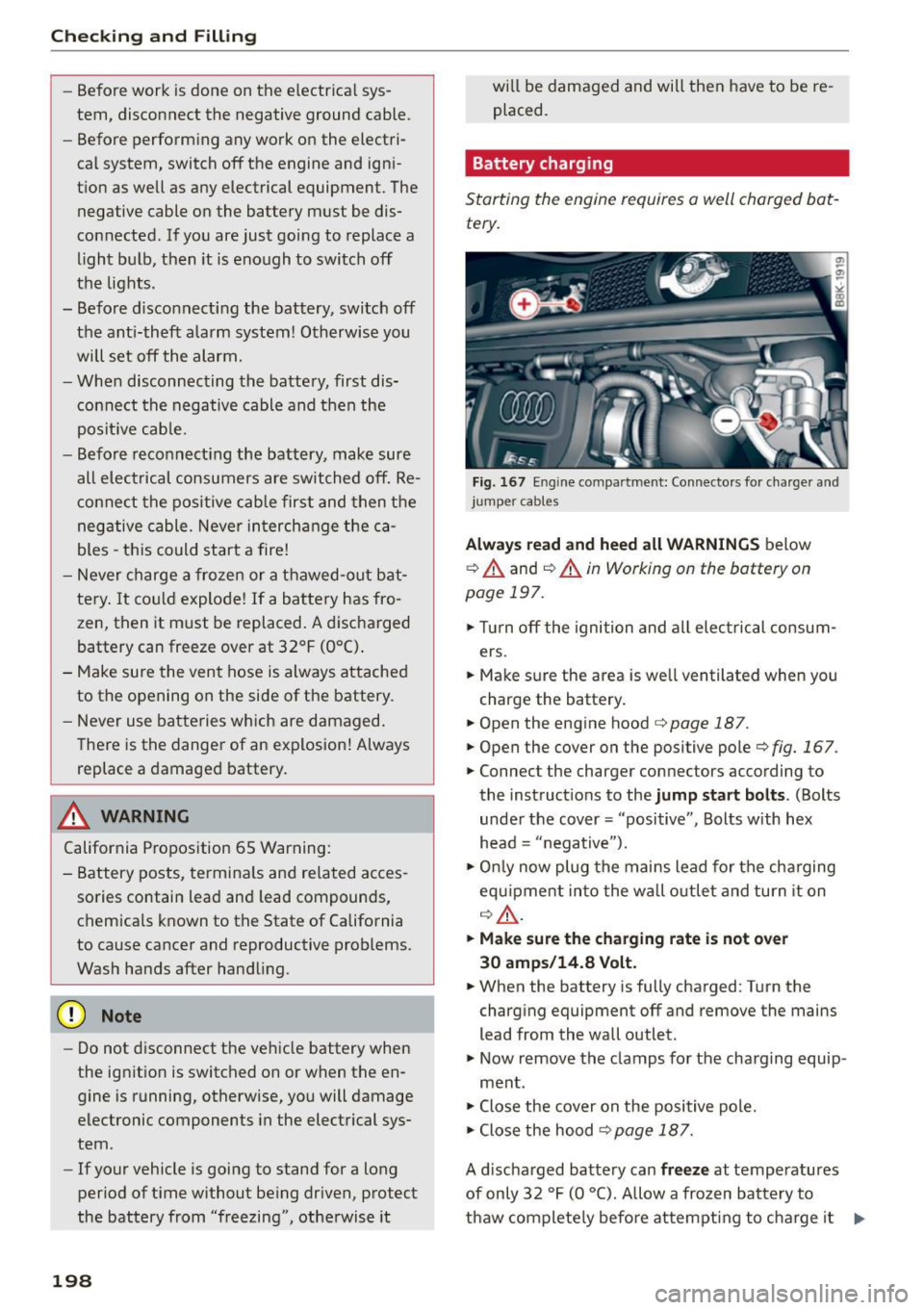
Fig. 167 Eng ine compartment: Connectors for charger and
jumper cables
Always read and heed all WARNINGS below
¢
A and ¢ A in Working on the battery on
page 197.
.,. Turn off the ignition and all electrical consum
ers.
.,. Make sure the area is well ventilated when you
charge the battery.
.,. Open the engine hood
¢ page 187.
.,. Open the cover on the positive pole¢ fig. 167.
.,. Connect the charger connectors according to
the instruct ions to the
jump start bolts . (Bolts
under the cover= "positive", Bolts with hex
head = "negative").
.,. Only now plug the mains lead for the charging
equipment into the wall outlet and turn it on
¢ &, .
.,. Make sure the charging rate is not over
30 amps/14.8 Volt.
.,. When the battery is fully charged : T urn the
charging equipment off and remove the mains
lead from the wall outlet.
.,. Now remove the clamps for the charging equip -
ment .
.,. Close the cover on the positive pole.
.,. Close the hood¢
page 187.
A discharged battery can freeze at temperatures
of only 32 °F (0 °C). Allow a frozen battery to
thaw completely before attempting to charge it
Ill>
Page 201 of 254
M N
0:: loo ,...., \!) 1.1'1
N 1.1'1 ,....,
q &.. However, we recommend not using a
thawed battery again because the battery casing
can be cracked due to ice formation and can leak
battery acid.
Batt ery chargi ng (Maximum cha rging rate of
30 amp s/14 .8 Volt )
When charging at
low voltages (e.g. with a trickl e
cha rger ), the battery cables do not have to be
d isconnected first. The battery caps shou ld
not
be opened when charg ing a battery.
It is not necessary to remove the battery from
the luggage compartment.
Fast charging th e battery (char ging rat e
above 14 .8 Vo lt s)
For technical reasons do not use a battery charg
er that uses voltage greater than 14.8 Volts to
charge your vehicle's battery.
A WARNING
Charging a battery can be dangerous.
- Always follow the operating instructions
provided by the battery charger manufactur
er when charging your battery.
- Never charge a frozen battery. It may ex
plode because of gas trapped in the ice. Al
low a frozen battery to thaw out first.
- Do not reuse batteries which were frozen.
The battery hous ing may have cracked and
weakened when the battery froze.
- Charge the battery in a well ventilated area.
Keep away from open flame or electrical
spark. Do not smoke. Hyd rogen gas generat
ed by t he battery is explos ive.
- To reduce the danger of explosion, never
co nnect or disconnect cha rger cables while
the cha rger is operating.
- Fast charg ing a battery is dangerous and
should only be attempted by a competent
tec hnician with the p roper equipment.
- Battery acid that may spill du ring charg ing
sho uld be washed off w ith a so lution of
wa rm w ater and baking soda to ne utralize
the acid .
Checking and Fillin g
(D Note
Never use a fast charger as a booster to start
the engine . This will ser iously damage sensi
tive electronic components, s uch as control
units, relays, radio, etc., as well as the battery
charger.
Battery replacement
The new battery must hove the some specifica
tions and dimensions as the original equipment
battery.
Intelligent energy management in your vehicle is
responsible for distributing the electrical energy
t h roughout your vehicle
q page 175. The intelli
gent energy management system w ill keep the
engine battery charged better then vehicles with
out this system. To make s ure the addit ional elec
t rical energy is ava ilab le once again afte r yo u
have changed the battery, we recommend that
you install batteries of the same type and man u
facture on ly (the same as those insta lled at the
t ime yo ur vehicle was delivered). Specifications
are listed on the battery hous ing. Your author
ized Audi dealer must code the battery in the en
ergy management system to enab le you to use
the e nergy management fu nctions correctly after
replacing the battery.
If it is not possib le to use a battery of this type,
the new battery must have the same capac ity,
voltage ( 12-volts), amperage, construction and
plug sealing.
When installing the battery, make sure the igni
t ion and all electr ica l consumers are turned off.
(D Note
Make sure the ventilat ion hose on the side of
the battery is connected, otherwise fumes or
battery acid can leak out.
@ For the sake of the environment
Because of the prob lem of proper disposal of
a battery, we recommend your authorized
Audi dealer change the battery for you. Bat
teries contain sulfur ic acid and lead and must
a lways be d isposed of properly in compliance ..,.
199
Page 230 of 254
Emerg enc y s it uat ion s
Emergency situations
General
T his c hapt er is inte nded fo r tra ined e merg ency
c rews a nd worki ng p ers onn el w ho h ave the nec
e ssa ry tool s and equipm ent t o perf orm the se
op era tion s.
Starting by pushing or
towing
CD Note
Vehicl es with an automa tic tra nsmission
c annot be st arted by pushing or towing .
Starting with jumper
cables
If necessary, the engine con be started by con
necting it to the battery of another vehicle .
If the engine should fail to start because of a d is
charged or weak battery, the battery can be con
nected to the battery of
another vehicle, us ing a
p air of j umpe r cables to start the engine.
Jump er c abl es
Use only jumper cab les of sufficiently largec ross
sec tion
to carry the starter current safely. Refer
to the manufacturer's specifications.
Use on ly jumper cables with
insulated term inal
clamps which are d istinctly mar ked:
plus (+ ) cabl e in most cases co lored re d
minu s(-) cable
in most cases colored black .
A WARNING
Batteries contain electricity, ac id, and gas.
Any of these can cause very ser ious or fatal in
jury . Fo llow the inst ruct ions be low for safe
hand Ling of your veh icle's battery.
- Always shield your eyes and avoid leaning
over the battery whenever possible.
- A discharged battery can freeze at tempera
tures just below 32 °F (0 °C). Before con
nect ing a jumper cab le, you must thaw the
228
frozen battery completely, otherwise it
could explode.
- Do not allow battery acid to contact eyes or
skin. Flush any contacted area with water immed iately.
- Improper use of a booster battery to start a
veh icle may cause an explosion.
- Vehicle batteries generate explosive gases .
Keep sparks, flame and lighted cigarettes
away from batteries.
- Do not try to jump start any vehicle with a
low acid level in the battery.
- The voltage of the booster battery must al
so have a 12-Volt rat ing . The capacity (Ah)
of the booster battery should not be lower
than that of the discharged battery. Use of batter ies of different voltage or substantial
ly different "Ah" rating may cause an explo
sion and personal injury .
- Never charge a frozen battery . Gas trapped
in the ice may cause an explosion .
- Never charge or use a battery that has been
frozen . The battery case may have be weak
ened .
- Use of batter ies of different voltage or sub
stantially d ifferent capacity (Ah) rating may
cause an explosion and injury. The capacity
(Ah) of the booster battery sho uld not be
lowe r than that of the discharged battery.
- Before you check anything in the engine
compartment, always read and heed a ll
WARNINGS
qpoge 187.
CD Note
-App lying a higher voltage booster battery
wi ll cause expensive damage to sensitive
elec tronic components, such as control
units, re lays, radio, etc.
- T here must be no electrical contact between
the vehicles as otherwise cu rrent cou ld al
ready start to flow as soon as the positive
(+) termina ls are connected.
@ Tips
The discharged battery must be properly con-
nected to the vehicle's electrical system. .,.
Page 231 of 254

"' N
0:: loo
rl I.O
"' N
"' rl
When jump starting or charging the battery,
never connect the negative ground cable to
the battery negat ive post because the battery
manager system must be able to detect the
battery's state of charge. Always connect the
negative g round cab le to the negative ground
post of the battery manager control unit.
Use of jumper cables
Make sure to connect the jumper cable clamps in
exactly the order described below!
Fig. 187 Engine compa rtment: Connectors for jumper ca
b les and c harger
Fig. 188 Ju m p sta rting with the battery of anot her veh icle :
@ boos te r ba ttery, @ discharged veh icle battery
The procedure described below for connecting
jumper cables is intended to provide a jump start
for your vehicle.
Vehicle with discharged battery :
.. Turn
off lights and accessories, move lever of
automatic transmission to N (Ne utra l) or P
(Park) and set parking brake.
Connect POSITIVE(+) to POSITIVE(+) (red)
.. Remove the cover above the jump start connec
t ion.
.. Open the cover on the posit ive pole ¢
fig. 187.
Emergency situations
1. Connect one end of the red positive cable on
the jump start bolt~
fig. 188 (D (Bolts un
der cover= "positive") of the vehicle to be
started @.
2. Connect the other end to the positive termi- nal@of the booster battery @.
Connect NEGATIVE (-) to NEGATIVE(-)
(black)
3. Connect one end of the black negative cable
to the negative terminal ® of the booster
battery @.
4 . Connect the other end to the jump start bolt
@ (Bolts with hex head= "negative") of the
vehicle to be started @.
Starting the engine .. Start the engine of the veh icle with the booster
battery @. Run the eng ine at a moderate
speed .
.. Start engine with discharged vehicle battery @
in the usual manner.
.. If the engine fails to start: do not keep the
starter cranking for longer than 10 seconds.
Wait for about 30 seconds and then try again .
.. With engine running, remove jumper cables
from both vehicles in the exact
reverse order .
.. Close the cover on the positive pole.
The battery is vented to the outside to prevent
gases from entering the vehicle inter ior. Make
sure that the jumper clamps are well connected
with their
metal parts in full contact with the
batte ry terminals.
A WARNING
To avoid serious personal injury and damage
to the vehicle, heed all warnings and instruc
tions of the jumper cable manufacturer. If in
doubt, call for road service.
- Jumper cables must be long enough so that
the vehicles do not touch .
- When connecting jumper cables, make sure
that they cannot get caug ht in any moving
parts in the eng ine compartment.
- Do not bend over the batteries -danger of
chemi cal burns!
229