lights AUDI RS5 COUPE 2015 Owner's Guide
[x] Cancel search | Manufacturer: AUDI, Model Year: 2015, Model line: RS5 COUPE, Model: AUDI RS5 COUPE 2015Pages: 254, PDF Size: 64.12 MB
Page 113 of 254
M N
0:: loo ,...., \!) ..,.,
N ..,., ,....,
Driving safety
Basics
Safe driving habits
Please remember -safety first!
This chapter contains important information,
tips, instructions and warnings that you need to
read and observe for your own safety, the safety
of your passengers and others . We have summar
ized here what you need to know about safety
belts, airbags , chi ld restraints as well as child
safety. Your safety is for us
priority number 1. Al
ways observe the informat ion and warn ings in
this section - for your own safety as well as that
of your passengers .
The information in this section app lies to all
model ve rsions of your vehicle . Some of the fea
tures described in this sections may be standard
equipment on some models, or may be optional
eq uipment on others .
If you are not sure, ask
your authorized Audi dealer.
A WARNING
- Always make sure that you follow the in
struct ions and heed the WARNINGS in this
Manual. It is in your interest and in the in
terest of your passengers.
- Always keep the complete Owne r's Litera
ture in your Aud i when you lend or sell your
vehicle so that this important info rmation
will always be ava ilable to the driver and
passenge rs.
-
- Always keep the Owner's literature handy so
that you can find it easily if you have ques
tions.
Safety equipment
The safety features are part of the occupant re
straint system and work together to help reduce
the risk of injury in a wide variety of accident sit
uations.
Your safety and the safety of your passenge rs
should not be left to chance. Advances in tec h
nology have made a var iety of fea tures available
to help reduce the r isk o f injury in an accident.
Dr ivin g sa fet y
The following is a list of just a few of the sa fety
features in your A udi:
- sophisticated s afety be lts fo r drive r and a ll pas-
senger seat ing pos itions,
- be lt fo rce limi ters for the front seats,
- belt pretensioners for the seats,
- head restra ints for each seating posit ion,
- front airbags,
- side airbags in the front seats,
- side curtain a irbags,
- specia l LATCH anchorages for child rest raints,
- adjustab le steering colum n.
These ind iv idual safety features, can work to
gether as a system to help protect you and your
passengers in a w ide range of accidents . T hese
features cannot wo rk as a system if they are not
always cor rect ly adjusted and co rrectly used.
Saf ety is ev erybody' s re sponsibility!
Important th ings to do before driving
Safety is everybody 's job! Vehicle and occupant
safety always depends on the informed and care
ful driver .
For your safety and the safety of your passen
gers,
befor e driv ing alway s:
.. Make sure that all lights and signals are operat
ing correctly.
.. Make sure that the tire pressure is correct.
.. Make sure that all w indows are clean and afford
good vis ibility to the outs ide .
.. Secure all luggage and other items carefully
Q page59.
.. Ma ke s ure that nothing can interfere with the
pedals .
.. Adjust front seat, head restraint and mirrors
correctly for your height.
.. Instruct rear seat passengers to adjust the
head restra ints according to their he ight.
.. Make sure to use the r ight child restraint cor
rectly to protect ch ildren
Q page 150, Child
safety .
.. Sit p rope rly in your seat and make su re that
your passengers do the same
Q page 53, Seats
and storage. .,.
111
Page 122 of 254
Safety belt s
Safety belts
General information
Always wear safety belts!
Wearing safety belts correctly saves lives!
This chapter explain s why safety be lts are neces
sary, how they work and how to adjust and wear
them correctly.
.. Read all the information that fo llows and heed
all of the instructions and WARNINGS.
&_ WARNING
Not wearing safety belts or wearing them im
properly increases the risk of serious personal
injury and death.
- Safety belts are the single most effective
means available to reduce the risk of serious
injury and death in automobile accidents.
For your protection and that of your passen
gers, always correct ly wear safety belts
when the vehicle is moving.
- Pregnant women, injured, or physically im
paired persons must also use safety belts.
L ik e all veh icle occupants, they are more
likely to be seriously injured if they do not
wear safety be lts . The best way to protect a
fetus is to protect the mother - throughout
the ent ire pregnancy.
Number of seats
Your Audi has a total of four seating positions:
two in the front and two in the rear. Each seating
position has a safety belt .
&_ WARNING
Not wearing safety belts or wearing them im
properly increases the risk of serious personal
injury and death.
- Never strap more than one person, includ
ing small ch ildren, into any belt. It is espe
cially dangerous to place a safety belt over a
child sitting on your lap.
- Never let more people ride in the vehicle
than there are safety belts available.
120
-Be sure everyone riding in the vehicle is
properly restrained with a separate safety
belt or child restraint.
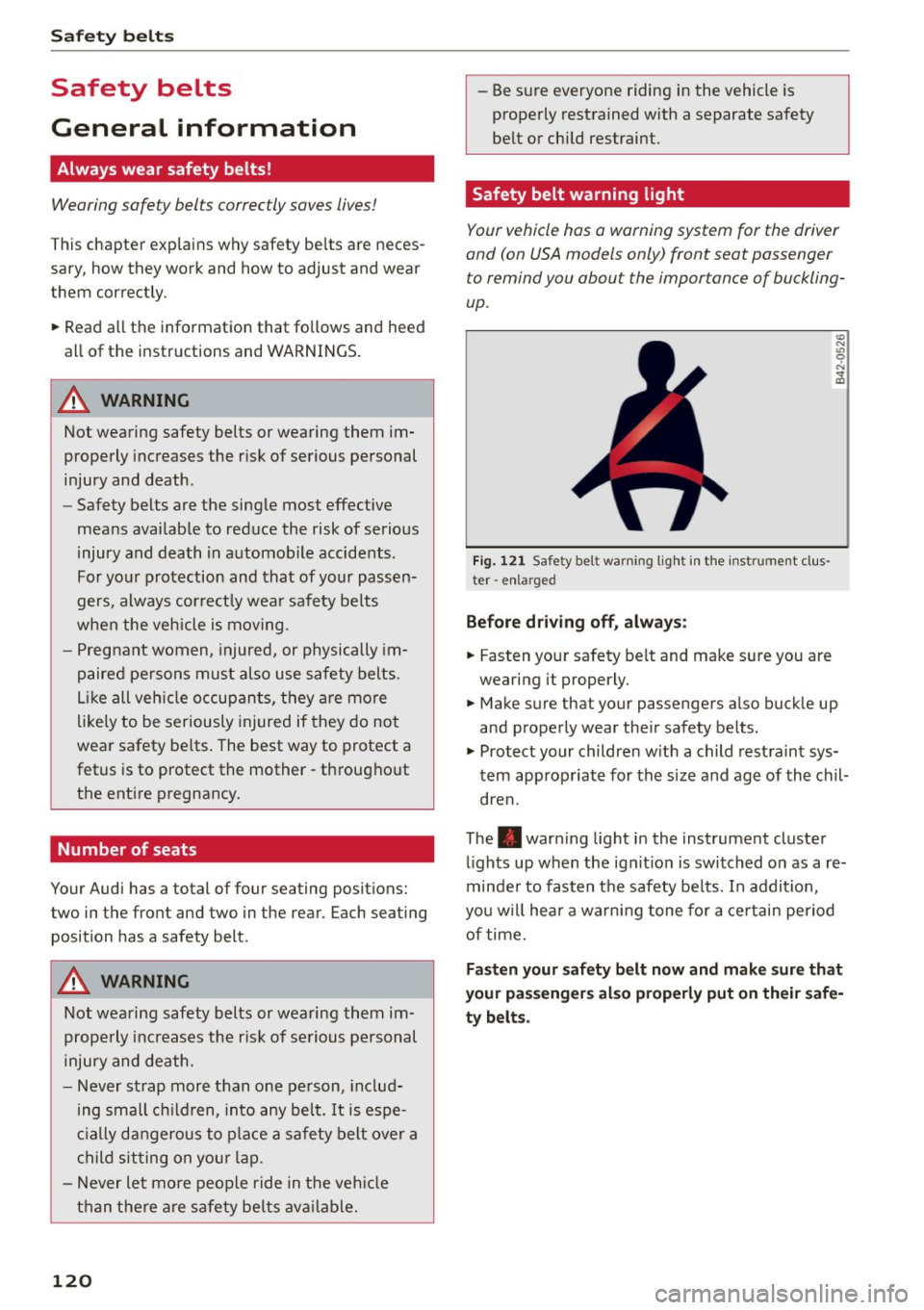
Safety belt warning light
Your vehicle has a warning system for the driver
and (on USA models only) front seat passenger
to remind you about the importance of buckling
up .
Fig. 121 Safety belt warning light in the instrument cl us
ter -enlarged
Before driving off, always:
.. Fas ten your safety belt and make sure you are
wearing it properly.
(0
"'
"' 0 N
and properly wear the ir safety belts .
.. Protect your children w ith a child restraint sys
tem appropriate for the siz e and age of the chil
dren.
The . warn ing light in the instrument cluster
lights up when the ign it ion is switched on as a re
minder to fasten the safety be lts. In addit io n,
you w ill hear a warning tone for a certain period
of time.
Fasten your safety belt now and make sure that
your passengers also properly put on their safe
ty belts.
Page 173 of 254

"' N
0:: loo
rl I.O
"' N
"' rl
The following situations are exceptions where it may be useful to switch on sport mode to allow
the wheels to spin:
Smart Technology
- Rocking the vehicle to free it when it is stuck
- Dr iving in deep snow or on loose ground
- Dr iving with snow chains
Sport mode on ESC/ASRoff Sport mode off or
ESC/ASR on
Behavior
The ESC and ASR stabiliza- The stabilization funct ion is The full stabilization func-
t ion funct ions are limited not available
¢ &.. ESC and tion of the ESC and ASR is
¢&_ . ASR are switched off. available again.
Operation Press the I!> OF FI button Press and hold the I.!> OFFI Press the I.$ OF F! button
briefly. button longer than
3 sec- again .
onds .
Indicator II turns on. • and lf'll•U~ turn on . II turns off or. and
lights lf'll•l~~ turn off .
Driver mes- Stabilization control (ESC ): Stabilization control (ESC): Stabilization control
sages Sport. Warning! Restricted off. Warning! Restricted (
ESC) : On
stability stability
A WARNING -
You should only switch sport mode on or
sw itch ESC/ASR off if your driving ab ilities and
road conditions permit.
- The stabilization function is limited when
sport mode is switched on. The dr iving
wheels could spin and the vehicle could
swerve, especially on slick or slippery road
surfaces.
- There is no vehicle stabilization when ESC/
ASR are sw itched off.
(D Tips
- ESC/ASR cannot be switched off or sport
mode cannot be sw itched on when cr uise
control or adaptive cruise control* is switch
ed on.
- Malfunctions in the rear spoiler may make it
i mpossible to switch the ESC/ASR off or to
switch sport mode on.
Rear spoiler
Applies to vehicles: with retractable rear spoiler
The rear spoiler improves vehicle handling and
enhances driver control.
Fig. 154 Center console: button fo r the rear spo ile r
The rear spo iler deploys and retracts. Spoiler op
eration can be set for automat ic or manual oper
ation.
Automatic mode (normal operation)
-Extends automatically: when the vehicle speed
exceeds approx imately 75 mph (120 km/h).
- Retracts automatically: when the vehicle speed
drops below approx imately 50 mph (80 km/h).
Manual mode
- Manual deployment: Tapping briefly on the
switch ~ fig. 154 deploys the rear spoiler.
171
Page 176 of 254
Smart Technolog y
-If y ou dama ge the front spo iler, or if you in
sta ll a di fferent spoile r, be sure the air flow
to the front brakes is not obstructed . Other
wise the brake system co uld overheat reduc
ing the effectiveness o f the enti re brake sys
tem .
- Failure of one brake c ircuit will impair the
braking capab ility r esult ing in a n increased
stopp ing distance. Avoid driving the veh icle
and have it towed to the nearest au thorized
Audi de aler or qualified workshop.
- Never let the vehicle ro ll to a stop with the
engine shut off .
-If the brake booster is not work ing, the
brake pedal must be pressed considerably
harder to make up for the lack of booste r as
sistance .
Electro-mechanical
power assist, dynamic
steering
The electro-mechanical power assist helps the
driver when steering .
Power steering adapts electronically based on
the vehicle speed .
Indicator lights and me ss a ges
• Steering defe cti ve! Do not dri ve vehicle!
If th is indicator light tu rns on and stays on and
this message appears, the power steering may
have fa iled .
D o
n ot co ntinue driving. See yo ur authorized
Audi dealer or a qua lified repair fac ility for assis
tance.
l;r-ij Dynamic steering : System fault! You can
c on tinu e drivin g
If the indicator light tu rns on and the message
appears, the steer ing may be more difficult to
move or mo re sensitive than usual. The steer ing
wheel may a lso be at an ang le when dr iv ing
straight.
Drive s low ly to your author ized Audi dealer or
qua lified wor kshop to have the malfunction cor
rected.
174
':r-ij Dynamic stee ring: initializing
If this drive r message appears and the indicator
li gh t is flashing on the instr ument pane l, dynam
i c s teer ing* is being rein itia lized. After sta rting
the engine, the steering wheel w ill move slightly.
Re-initialization might be necessary if the steer
i ng whee l was moved hard to the left and right
while the vehicle was not moving. The display goes out as soon as initialization is comp lete.
A WARNING
H ave the dynamic steering* system malfunc
tion repaired as soon as possible by an author ized A udi dealer or qualified wo rkshop -risk
of accident!
@ Tips
- If the . or ':rfl indicator light only stays on
for a sho rt time, you may cont inue driving.
- The dynamic steering* stab ility systems are
not availab le in the event of a system mal
function.
- For add itiona l information on dynamic
steering*, refer to~ page 101.
Driving with your quattro
With all-wheel drive, all four wheels are driven .
General information
With all-wheel drive, power is distributed to all
four wheels . This happens automatically depend
i ng on your driving style and the road conditions
at the t ime . See also ~ page 169.
A center d ifferential distributes the driving power
variably to the front and rear axle. It works to
gether w ith select ive whee l torque control, which
activates w hen d rivi ng throug h curves
~ page 170 . With the spo rt diffe rential*, power
dist ribution to the rear wheels is variab le and can
be adjusted with drive select~ page 101.
The all-whee l dr ive concept is des igned for hig h
engine power . Yo ur vehicle is exceptiona lly pow
e rfu l and has excellen t drivi ng cha racte rist ics
both unde r normal d riving condi tions and o n
snow and ice . Always read and follow sa fe ty pre-
ca utions ~& .
1111>
Page 178 of 254

Smart Technolog y
(D Tips
-But even energy management cannot neg
ate the limits of physics. Consider that the power and life of a battery are limited.
- If starting ability is threatened, the indica
tor light (•)appears
Qpage 16.
What you should know
The highest priority is given to maintaining start
ing capability.
The battery is severely taxed in short-distance
driving, in city traffic and during the co ld time of
year . Ab undant electrical energy is required, but
only a little is generated. It is also critical if the
engine is not runn ing and electrical components
are turned on. In this instance energy is being
consumed but none is being generated.
It is in precisely these situat ions that you wi ll no
tice energy management actively regulating the
d istr ibut io n of energy.
Vehicle s tand s for an exte nded p eriod
If you do not drive your vehicle over a period of
several days or weeks, e lectrica l components are
gradually cut back or switched off. This reduces
energy consumption and maintains starting ca
pability over a longer period. Some of the con
ven ience funct ions may not operate, such as the
interior lights or the powe r seat adjustment. The
conven ience functions will be ava ilable again
when you sw itch on the ign it io n and start the en
g ine.
With th e engine turned off
If you listen to the radio, for example, with the
engine turned off or use other MMI funct ions,
the battery is being discha rged .
If starting capability is jeopardized due to energy
consumption, a message appears in the MMI dis p lay . The message ind icates that the system will
be sw itched off automat ica lly in a moment. If
you wish to cont inue using the functions , you
have to start the engine .
176 With the en
gine running
Although elec trical energy is generated when the
vehicle is being d riven, the battery can become
discharged . This happens mostly when litt le en
ergy is being generated and a great deal con
sumed and the battery's state of charge is not
optimal.
T o bring the energy ba lance back into equilibri
u m, consumers whic h req uire especially large
amounts of energy are temporari ly cut back or
switched off. Heating systems in part icular re
quire a great deal of energy. If you notice, for ex
ample, that the heated seats* o r the heated rear
window are not heating, they have been tempo
r ari ly cut back o r switched off . Th ese systems w ill
be ava ilable again as soon as the ene rgy ba lance
has been res tored.
You w ill also notice that engine id le speed has
been increased slightly . Thi s is normal and not a
ca use for concer n. By increasing eng ine idle
speed the addi tional energy required is gene rated
and the battery is charged.
Page 182 of 254
Driving and th e environment
It makes sense to shut off the engine in traffic
jams, when waiting for trains to pass at rai lroad
crossings, or at traff ic lights that have long waits
on red. Turning the eng ine off for just 30-40 sec
onds saves more fuel than is burned starting the
engine again .
It takes a long time for the engine to warm up
fully when it is running at idle. However, wear
and nox ious em issions are especially h igh when
the engine is warm ing up. So you should dr ive
away as soon as you start the engine and avoid running at high rpms while the engine is still
warming up.
{[) Note
Do not leave engine idling unattended after
starting. If warning lights should come on to
indicate improper operation, they would go
unheeded. Extended id ling a lso produces
heat, wh ich co uld resu lt in overheating or ot h
er damage to the vehicle or other property .
Regular maintenance
A badly tuned engine unnecessarily wastes a lot
of fuel.
~ Have you r vehicle se rv iced at regular i nte rva ls.
By having your vehicle regularly serviced by an
author ized Audi dealer helps to ensure that it
r u ns p roperly and economically. The condition of
your veh icle not only affe cts its safety and ability
to hold its va lue, i t also affects
fue l con sump
tion.
Ch eck your oil each tim e you fill your tank .
The amount of oil used is related to engine load
and speed .
It is normal for the oil consumption of a new en
g ine to reach its lowest value after a certain mile
age has been driven.
You must drive yo ur vehicle about 3,000 miles
(5,000 ki lometers) before you can properly as
sess o il consumption .
This a lso applies to fuel consumption and engine
output .
180
(D Note
-Have your veh icle ma intained properly and
in accordance with the service recommenda
tions in your Warranty
& Maintenance book
let. Lack of proper maintenance as well as
improper use of the vehicle will impair the
function of the emission control system and cou ld lead to damage .
- Do not alter or remove any component of the Emission Control System unless ap
proved by the manufacturer.
- Do not alter or remove any device, such as
heat shields, sw itches, ignit ion wires,
valves, which a re des igned to p rotect your
vehicle's Emission Control System and other
impo rtant vehicle components.
Fewer short trips
Fuel consumption will always be relatively high
on short trips.
~ Tr y to avoid dr iv ing sho rt distances w ith a co ld
eng ine .
The eng ine and cata lytic converter have to reach
their opt imal
op erat ing temperature to reduce
fuel consumpt io n and noxious em issions effec
tive ly.
Just after starting, a co ld eng ine in a mid -s ize car
o nly achieves a fuel economy of 6-8 m iles per
gallon (30-40 l/100 km). After about a half a
mile, fuel economy climbs to 12 mpg ( 20 l/100
k m). After about
2.5 mi les ( 4 km) , the eng ine is
at i ts p roper operating tempera ture and fuel
economy has reached a normal level. So you can
see that yo u should avo id short trips whenever
poss ib le.
The
outside temperature is also cr itical in th is re
gard. Your car cons umes more fuel in the winter
than in the summer.
Page 192 of 254
Checking and F ill in g
Using the proper engine o il is important for the
functionality and service life of the engine. Your
engine was factory-fi lled w ith a high-quality o il
which can usually be used throughout the ent ire
year.
@) Note
Your L imited New Vehicle Warranty does not
cover damage or malfunctions due to failure
to follow recommended ma intenance and use
requ irements as set forth in the Audi Ow ne r's
Manual and Wa rranty
& Ma intenance booklet .
- Use only a high quality eng ine oil t hat ex-
pressly comp lies w ith the Audi o il quality
standard specified for your vehicle's e ngine .
Using a ny other oil can cause se rious engine
damage.
- Do not mix any lubricants o r othe r addit ives
i nto the engine oil. Doing so can cause en
g ine damage.
(D Tips
If you need to add oil and there is none availa
ble that meets the Audi o il quality standard
y o ur eng ine requires, you m ay add a total of
no more than 0.5 quart/li ter o f a h igh-quali ty
"synthet ic"oil that meets the fo llowing speci
fications .
- V ehicles wi th gasoline engine: AC EA A3 o r
API SM with a viscosity grade of SAE 0W- 30,
SAE SW -30 or SAE SW-40 .
- Fo r more informa tion abo ut engine oi l that
has been approved for your vehicle, please
contact either you r a uthorized Aud i dea ler
or Audi Customer Relations at
1 (800) 822-2834 or visit o ur web site at
www .aud iusa.com or www .aud icanada .ca .
Engine oil consumption
The engine in your vehicle depends on an ade
quate amount of oil to lubricate and cool all of
its moving parts .
In order to provide effective lubrication and cool
i n g of in ternal engine components, all interna l
combustion engines consume a certai n amount
of oil. O il consumption var ies from engine to en
g ine and may change significant ly ove r the life of
190
the engine. Typically, eng ines with a specif ied
break-in period (see
¢ page 177) consume mo re
o il dur ing the b reak -in per iod than they consume
after oil consumption has stabili zed.
U nder normal cond itions , the rate of oi l con
s u mption depends on t he qu ality and viscosity of
the oil, the RPM (revolutions per minute) at
which the engine is operated, the ambient tem
perature and road condit ions. Further factors are
the amount of o il di lution from water condensa
tion or fuel residue and the ox idat ion level of the
o il. As any engine is s ubject to wear as mileage
builds up, t he oil consump tion may inc rease ove r
t ime unt il rep lacement of wo rn component s may
become necessary.
With a ll these va riab les coming into p lay, no
sta ndard ra te of oil consumpt ion can be estab
li shed or spe cified . There i s no altern ative to reg
u la r and freq uent checking o f the oil leve l, see
Note .
If the yellow e ngine oi l leve l wa rning symbo l El
in the instr ument cluster lights up, yo u should
chec k the o il level as soon as possible
¢ page 191 . Top off the oil at your ear liest con
venience ¢page 191.
A WARNING
Before you chec k anything in the eng ine com
partment, always read and heed a ll WARN
INGS¢ .&. in Working in the engine compart
ment on page 187 .
@ Note
Driving with an insufficient oi l level is likely to
cause severe damage to the engine.
(D Tips
- The oil pressu re warning display. is not
an indicator of the oil level. Do not rely on
it . Instead, check the oil level in your en
gine at regular intervals, preferably each
time you refuel, and always before going on a long trip.
- If you have the impression yo ur engine con
sumes excessive amounts of oil, we r ecom-
mend that yo u consult an au tho rized Audi .,.
Page 198 of 254
Checking and F ill in g
Changing brake fluid
Have the brake fluid changed by an experienced
technician .
Brake fluid absorbs moisture from the a ir. If the
water content in the brake fluid is too high, cor
rosion in the brake system may result after a peri
od of time. The boiling point of the brake fluid
will also dec rease conside rably and dec rease
b ra ki ng perfo rman ce.
Therefore, the brake flu id must be changed
e ve ry
two y ear s.
Always use new b rake fluid wh ic h con
forms to Fede ral Motor Vehicle Standard " FMVSS
1 16 DOT 4".
The brake fluid reservoir can be difficult to reach,
therefo re , we recommend that yo u have the
b rake fluid changed by your authori zed
Audi
dealer . Your dealer has the cor re ct too ls , the
righ t brake fluid an d the know-how to do t his for
you.
A WARNING
- Brake fluid is po isonous. It must be stored
only in the closed orig inal container out of
the reach of children!
- Brake fai lure can result from old o r inappro
pr iate bra ke fluid . Observe these p recau
t ions:
- Use on ly bra ke fluid t hat meets SA E speci
fication
J 17 03 and confo rms to Fede ral
M otor Vehicle S tand ard 116 . Always check
wit h your author ized Audi dea ler to make
sure yo u are using the correct brake f lui d.
The cor rect type of b rake fluid is a lso indi
cated on the bra ke fluid reservo ir.
- The brake fluid m ust be new. Heavy use of
the bra kes can cause a va por l ock if the
brake fluid is left in the system too long.
This ca n ser iously affect the effic iency of
the brakes as we ll as your safety . This
co uld res ult in an accident.
@ Note
Brake f lu id will damage the paint of y our vehi
cle.
196
® For the sake of the environment
Because of t he prob lem of prope r disposal of
brake fluid as well as the special tools re
q uired and the necessary expert ise, we rec
ommend that yo u have the brake f lu id
changed by your autho rized Aud i dea le r.
Battery
General information
Under normal operating conditions, the battery
i n your A ud i does not need any maintenance .
With
high outside temperatures or long dai ly
drives we recommend that you have the e lectro
l yte level checked by an aut horized Aud i dea ler or
qualified workshop . The e lectrolyte leve l should
also be chec ked each time the batte ry is cha rged
¢ page 198.
Have the battery checked when you take your ve
hicle i n for service . You are well adv ised to re
place a battery that is older than 5 years .
With certain types of airbag deployment, the bat
tery is disco nnected from the ve hicle elect rical
system for safety reasons
¢ A in Repair , care
and disposal of the airbags on page 141 .
Disconnecting the battery terminals
Some vehicle functions (power window reg ula
tors, for example) are lost if the battery te rm i
nals are d isconnected . These funct ions have to be
r elearned after the battery t ermina ls are con
nected again . To prevent t his, the battery sho uld
o nl y be disconnected from the ve hicle e lectr ica l
system when absolute ly necessary fo r rep airs.
Vehicles not driven for long periods
If you do not drive your vehicle ove r a period of
several days or weeks, electrical components are gradua lly cut back or sw itched off . T his reduces
energy cons umption and mainta ins start ing ca
pabili ty ove r a longer period¢
page 175.
Some of the convenience funct ions may not ope r
ate, such as the inter ior lights or the power s eat
adjus tment . The conve nien ce f unct io ns w ill be
ava ila ble again when you tu rn on the ig nition an d
star t the eng ine. ..,..
Page 199 of 254

M N
0:: loo ,...., \!) 1.1'1
N 1.1'1 ,....,
Winter ope rati on
During the winter months, battery capacity tends
to decrease as temperatures drop. This is because
more power is also cons umed w hile starting, and
the headlights, rear window defogger, etc., are used more often.
Avoid unnecessary power consumption, particu l arly in city traffic or when traveling only short
distances. Let your authorized Audi dea ler check
the capacity of the vehicle battery before winter sets inc:>
page 198. A well charged battery will
not only prevent starting problems when the
weather is cold, but will also last longer .
@ Tips
If your vehicle is left standing for several
weeks at extremely low temperatures, the ve
hicle battery should be removed and stored
where it will not freeze. This will prevent it
from being damaged and having to be re
placed.
Working on the battery
Be especially careful when working on or near
the battery.
The battery is located in the luggage compart
ment under the floor. Before you check anything
in the luggage compa rtme nt,
re ad and heed all
WARN ING S
c:> .&_.
Always heed the saf ety warn ing s, when work ing
on the vehicle battery or the veh icle electrical
system to prevent injury.
The following WARNIN GS are v ery i mport ant
when working on the battery:
Alw ays heed the follow ing W ARNING SYM-
BOLS and safety pr ecaution s when work ing on
th e batt ery .
®
Alw ay s we ar eye p rotectio n.
A
Batter y acid conta in s s ulfu ric acid . Al-
ways wear gl oves and e ye prote cti on.
Checking and Fillin g
@
No
- sp ark s
- fl ame s
- smoking .
~
When a battery is charged, it produ ce s
. hydrogen ga s which is e xplo sive and
could cause p ersonal in jury.
®
Alw ay s ke ep the b attery well out of r each
of child ren .
_& WARNING
--
Whenever working on the battery or on the
electr ica l system, there is the risk of injury,
accident and even f ire. Read and heed the fol
low ing WARNINGS:
- Always wear eye protection. Do not let bat
tery ac id or any lead particles get on your
skin or clothing. Shield you r eyes . Explosive
gases can cause blindness or other injury.
- Battery acid conta ins sulfuric acid. Sulfuric
acid can cause blindness and severe burns .
- Always wear g loves and eye protection. Do
not tilt the battery because acid could leak
out of the ventilation openings.
- If you get battery acid in your eyes or on your skin, immediate ly rinse with cold wa
ter for several minutes and get medical at
tent ion.
- If you shou ld ingest any battery acid, seek
medica l attent ion immed iate ly.
- Do not expose the battery to an open flame,
electric sparks or an open light .
- Do not smoke .
- Do not interchange the positive and nega-
tive cables .
- When working on the battery, be s ure not to
short-circuit the terminals wi th tools or oth
er metal objects . This would cause the bat
tery to heat up very quickly, which could lead to damage or exp losion and personal
injury.
- When a battery is charged, it produces hy
drogen gas which is explos ive and could
cause personal injury.
- Always keep the battery well out of the
reach of children.
197
Page 200 of 254
Checking and Filling
-Before work is done on the electrical sys
tem, disconnect the negative ground cable .
- Before performing any work on the electri
cal system, switch off the engine and igni
tion as well as any electrical equipment. The
negative cable on the battery must be dis
connected . If you are just going to replace a
light bulb, then it is enough to switch off
the lights.
- Before disconnecting the battery, switch off
the ant i-theft alarm system! Otherwise you
will set off the alarm.
- When disconnecting the battery, first dis
connect the negative cable and then the
positive cable.
- Before reconnecting the battery, make sure
all electrical consumers are switched off. Re
connect the positive cable first and then the
negative cable. Never interchange the ca
bles -this could start a fire!
- Never charge a frozen or a thawed-out bat
tery. It could explode! If a battery has fro
zen, then it must be replaced. A discharged
battery can freeze over at 32°F (0°C) .
- Make sure the vent hose is always attached
to the opening on the side of the battery.
- Never use batteries which are damaged.
There is the danger of an explosion! Always
replace a damaged battery.
A WARNING
California Proposition 65 Warning:
- Battery posts, terminals and related acces
sories contain lead and lead compounds,
chemicals known to the State of California
to cause cancer and reproductive problems.
Wash hands after handling.
(D Note
- Do not disconnect the vehicle battery when
the ignition is switched on or when tile en
gine is running, otherwise, you will damage
electronic components in the electrical sys
tem.
- If your vehicle is going to stand for a long
period of time without being driven, protect
the battery from "freezing", otherwise it
198
will be damaged and will then have to be re
placed.
Battery charging
Starting the engine requires a well charged bat
tery.
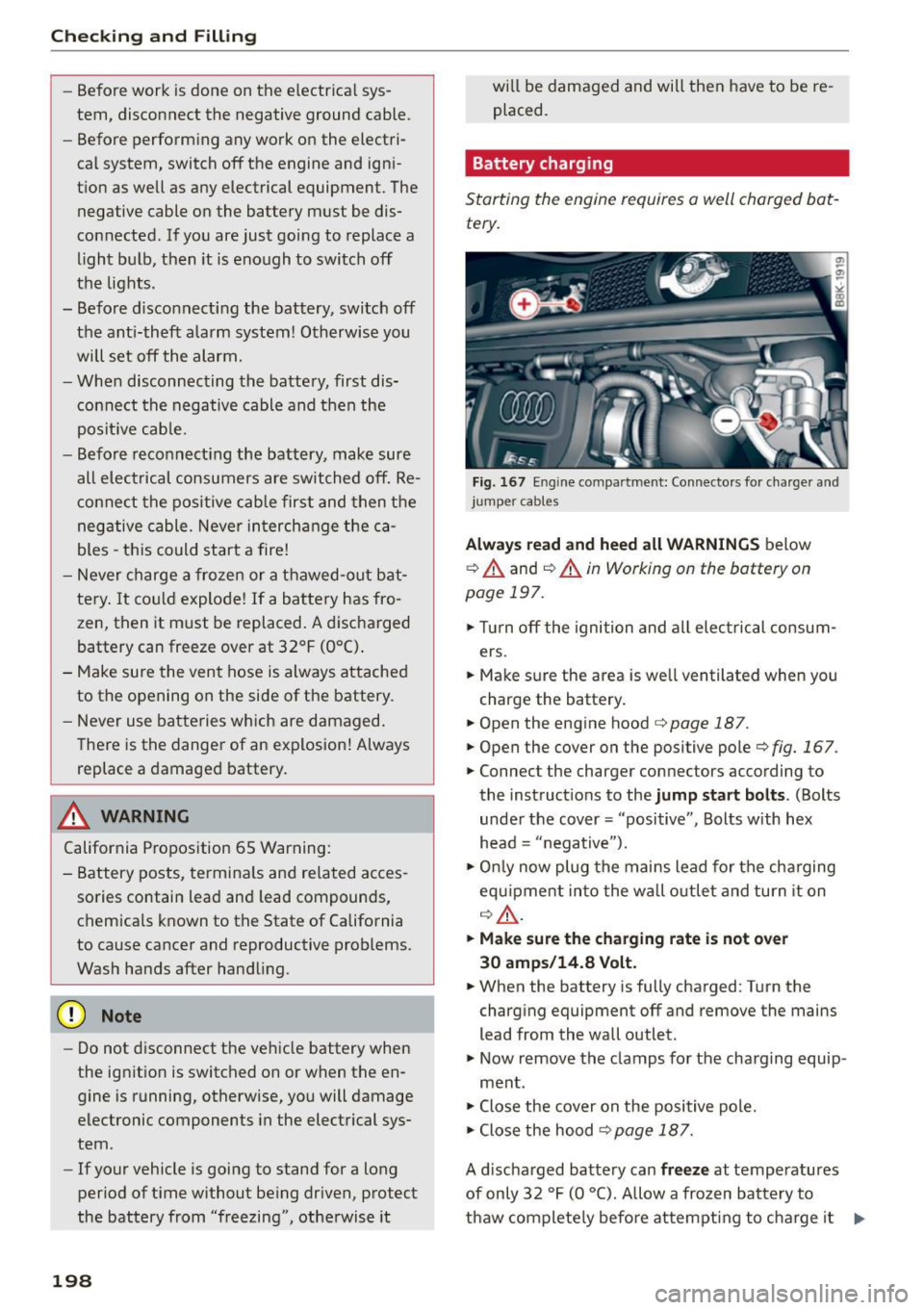
Fig. 167 Eng ine compartment: Connectors for charger and
jumper cables
Always read and heed all WARNINGS below
¢
A and ¢ A in Working on the battery on
page 197.
.,. Turn off the ignition and all electrical consum
ers.
.,. Make sure the area is well ventilated when you
charge the battery.
.,. Open the engine hood
¢ page 187.
.,. Open the cover on the positive pole¢ fig. 167.
.,. Connect the charger connectors according to
the instruct ions to the
jump start bolts . (Bolts
under the cover= "positive", Bolts with hex
head = "negative").
.,. Only now plug the mains lead for the charging
equipment into the wall outlet and turn it on
¢ &, .
.,. Make sure the charging rate is not over
30 amps/14.8 Volt.
.,. When the battery is fully charged : T urn the
charging equipment off and remove the mains
lead from the wall outlet.
.,. Now remove the clamps for the charging equip -
ment .
.,. Close the cover on the positive pole.
.,. Close the hood¢
page 187.
A discharged battery can freeze at temperatures
of only 32 °F (0 °C). Allow a frozen battery to
thaw completely before attempting to charge it
Ill>