steering AUDI RS5 COUPE 2015 Owner's Guide
[x] Cancel search | Manufacturer: AUDI, Model Year: 2015, Model line: RS5 COUPE, Model: AUDI RS5 COUPE 2015Pages: 254, PDF Size: 64.12 MB
Page 171 of 254

M N
0:: loo ,...., \!) 1.1"1
N 1.1"1 ,....,
shared, please see your contract with the
wireless telecommunications provider and the
"About Aud i connect" tab in your vehicle's
MMI*:
IMENU I button> Audi connect > About
Audi connect .
Electronic Stabilization
Control (ESC)
Description
ESC helps to improve road holding and vehicle
dynamics to help reduce the probability of skid
ding and loss of vehicle control. It works only
when the engine is running. ESC detects certain
d ifficu lt driving situations, including when the ve
hicle is beginn ing to spin (yaw) out of control and
helps you to get the vehicle back under control by
selectively braking the whee ls, and/or reducing
engine power and prov iding steer ing ass istance
to help hold the vehicle on the driver's intended
course. The indicator light
Bl in the instrument
cluster blinks when ESC is taking action to help
you control the veh icle.
ESC has limitations.
It is important to remember
that ESC cannot overcome the laws of physics. It
will not always be able to help out under all con
ditions you may come up against. For example, ESC may not always be able to help you master
situations where there is a sudden change in the
coefficient of frict ion of the road surface . Whe n
there is a section of dry road that is suddenly cov
ered with water, slush or snow, ESC cannot per
form the same way it wou ld on the dry surface. If
the vehicle hydroplanes (rides on a cushion of wa
ter instead of the road surface), ESC will not be
ab le to he lp you steer the vehicle because contact
with the pavement has been interrupted and the
vehicle cannot be braked or steered . During fast
cornering, particularly on winding roads, ESC
cannot always deal as effectively with difficult
driving situations than at lower speeds. Whe n
tow ing a trailer, ESC is not able to help you regain
con trol as it wou ld if you were no t towing a trail
er .
A lways adjust your speed and dr iving sty le to
road, traffic and weather conditions. ESC cannot
override the vehicle's physical limits, increase the
Smart Technology
available traction, or keep a vehicle on the road i f
road departure is a result of driver inattention.
Instead, ESC improves the possibility of keeping
the vehicle under control and on the road dur ing
extreme maneuvers by using the driver's steering
inputs to help keep the vehicle go ing in the in
tended direction. If you are traveling at a speed
that causes you to run off the road before ESC
can prov ide any assistance, you may not expe ri
ence the benefits of ESC.
ESC is switched on all the time . In certain situa
t ions when you need less traction, you can switch
off ASR by pressing the button
[ru ~ page 170,
fig. 152 or ~page 170, fig . 153. Be sure to
switch ASR on again when you no longer need
less traction.
T he following systems are integrated in the ESC:
Anti-lock braking system (ABS)
ABS prevents the wheels from locking up when braking. The vehicle can still be steered even dur
i ng hard braki ng. Apply steady pressure to the
brake pedal. Do not pump the pedal. A pulsing in
the brake pedal indicates that the system is he lp
ing you to brake the vehicle.
Brake assist system
The brake ass ist system can decrease braking dis
tance . It increases braking power when the driver
presses the brake peda l quickly in emergency sit
u at ions. You must press and hold the brake pedal
until t he situat ion is over. In vehicles with adap
tive cruise control*, the brake assist system is
more sensitive if the distance detected to the ve
hicle ahead is too sma ll.
Anti-slip regulation (ASR)
ASR red uces eng ine power when the drive wheels
begin to spin and adapts the force to the road
conditions. This makes it easier to start, acce le r
ate and drive up hills.
Electronic differential lock (EDL)
T he EDL brakes whee ls that are spinning and
transfers the drive power to the other wheels.
T his function is available up to about 60 mph
(100 km/h).
169
Page 172 of 254
Smart Technology
In extreme cases, EDL automatically switches off
to help keep the brake on the braked wheel from
overheating. EDL will switch on again automati
cally when conditions have returned to normal.
Steering recommendation
The ESC helps to stabilize the vehicle by changing
the steering torque.
I n vehicles with dynamic steering*, ESC also
he lps to stabilize the steering in critical situa
tions .
Selective wheel torque control
Select ive wheel torque control is used when driv
ing on c urves . The front wheel on the inside of
the curve or both whee ls on the inside of the
curve are braked selectively as needed. This al
lows more precise driving in curves . Th e applica
b le system may not activate when driving in wet
or snowy conditions .
A WARNING
- The ESC and its integrated systems cannot
overcome the laws of physics. This is espe
c ially important on slippery or wet roads. If
the systems beg in acting to stabilize your
vehicle, you should immediately change
your speed to match the road and traffic
Switching on/off
conditions . Do not let the increased safety
provided by these systems tempt you to
take risks. Doing so will increase the risk of a
loss of vehicle control, collision and serious
personal injuries.
- Always adapt your speed to road, traffic and
weather conditions. The risk of losing con
trol of the vehicle increases when dr iving
too fast, especially through curves and on
slippery or wet roads, and when driv ing too
close to vehicles up ahead. The ESC and its
integ rated systems cannot always prevent
collisio ns -there is sti ll a risk of accidents!
- Always accelerate with special care on even,
smooth surfaces such as those that are wet
or covered with ice and snow. The drive
wheels can spin even with these assistance
systems that cannot always help to reduce
the risk of loss of vehicle control.
@ Tips
-ABS and ASR only work correctly when all
four wheels are equ ipped w ith identical
t ires. Different tire s izes can lead to a reduc
t ion in engine power.
- You may hear noises when the systems de scribed are working.
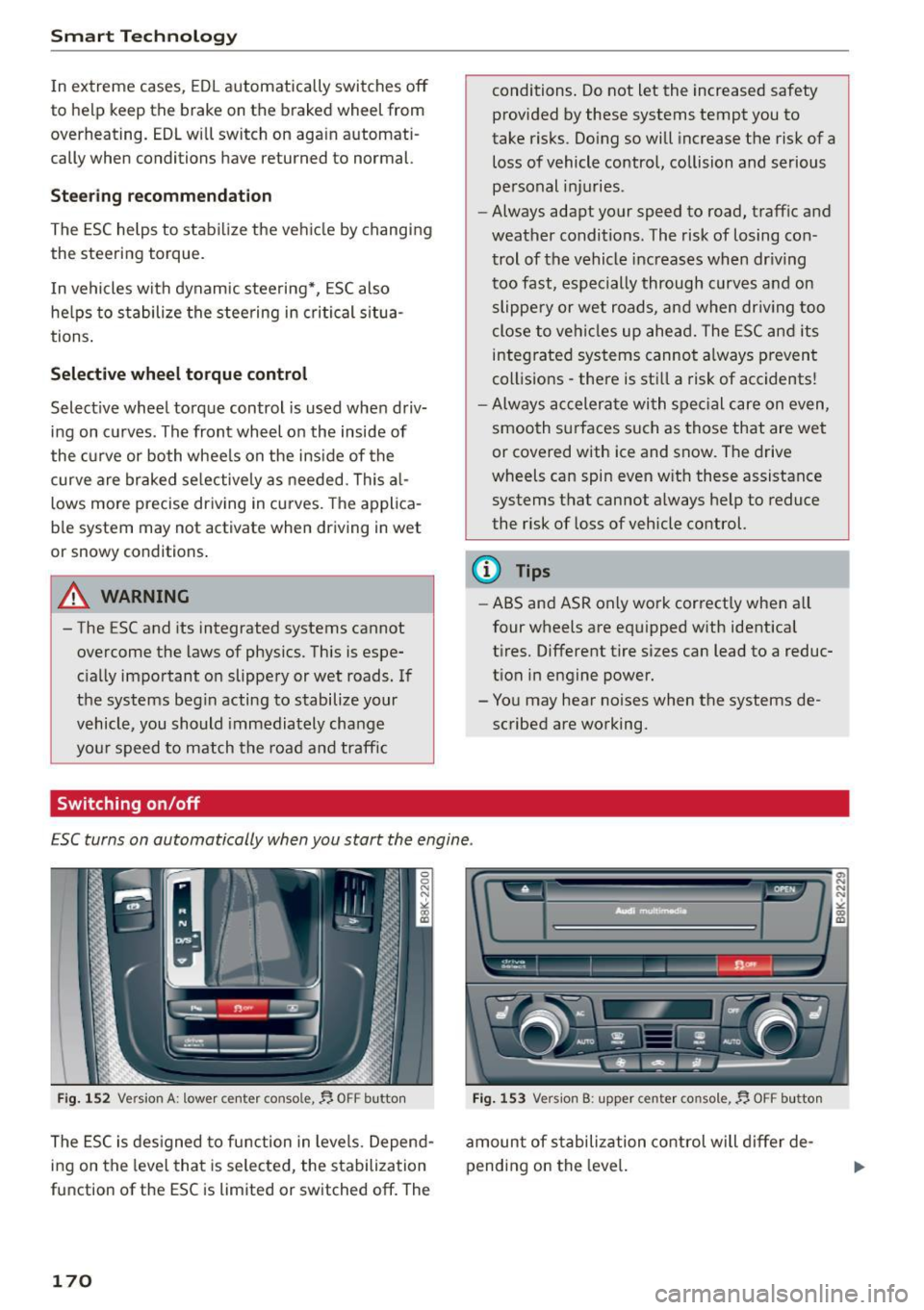
ESC turns on automatically when you start the engine .
Fig. 152 Version A : lower center console,~ OFF button
The ESC is designed to function in levels. Depend
ing on the level that is selected, the stabilization
function of the ESC is limited or switched off. The
170
Fig. 153 Version B: upper center console,~ OFF butto n
amount of sta bilization control will differ de
pending on the level.
Page 176 of 254
Smart Technolog y
-If y ou dama ge the front spo iler, or if you in
sta ll a di fferent spoile r, be sure the air flow
to the front brakes is not obstructed . Other
wise the brake system co uld overheat reduc
ing the effectiveness o f the enti re brake sys
tem .
- Failure of one brake c ircuit will impair the
braking capab ility r esult ing in a n increased
stopp ing distance. Avoid driving the veh icle
and have it towed to the nearest au thorized
Audi de aler or qualified workshop.
- Never let the vehicle ro ll to a stop with the
engine shut off .
-If the brake booster is not work ing, the
brake pedal must be pressed considerably
harder to make up for the lack of booste r as
sistance .
Electro-mechanical
power assist, dynamic
steering
The electro-mechanical power assist helps the
driver when steering .
Power steering adapts electronically based on
the vehicle speed .
Indicator lights and me ss a ges
• Steering defe cti ve! Do not dri ve vehicle!
If th is indicator light tu rns on and stays on and
this message appears, the power steering may
have fa iled .
D o
n ot co ntinue driving. See yo ur authorized
Audi dealer or a qua lified repair fac ility for assis
tance.
l;r-ij Dynamic steering : System fault! You can
c on tinu e drivin g
If the indicator light tu rns on and the message
appears, the steer ing may be more difficult to
move or mo re sensitive than usual. The steer ing
wheel may a lso be at an ang le when dr iv ing
straight.
Drive s low ly to your author ized Audi dealer or
qua lified wor kshop to have the malfunction cor
rected.
174
':r-ij Dynamic stee ring: initializing
If this drive r message appears and the indicator
li gh t is flashing on the instr ument pane l, dynam
i c s teer ing* is being rein itia lized. After sta rting
the engine, the steering wheel w ill move slightly.
Re-initialization might be necessary if the steer
i ng whee l was moved hard to the left and right
while the vehicle was not moving. The display goes out as soon as initialization is comp lete.
A WARNING
H ave the dynamic steering* system malfunc
tion repaired as soon as possible by an author ized A udi dealer or qualified wo rkshop -risk
of accident!
@ Tips
- If the . or ':rfl indicator light only stays on
for a sho rt time, you may cont inue driving.
- The dynamic steering* stab ility systems are
not availab le in the event of a system mal
function.
- For add itiona l information on dynamic
steering*, refer to~ page 101.
Driving with your quattro
With all-wheel drive, all four wheels are driven .
General information
With all-wheel drive, power is distributed to all
four wheels . This happens automatically depend
i ng on your driving style and the road conditions
at the t ime . See also ~ page 169.
A center d ifferential distributes the driving power
variably to the front and rear axle. It works to
gether w ith select ive whee l torque control, which
activates w hen d rivi ng throug h curves
~ page 170 . With the spo rt diffe rential*, power
dist ribution to the rear wheels is variab le and can
be adjusted with drive select~ page 101.
The all-whee l dr ive concept is des igned for hig h
engine power . Yo ur vehicle is exceptiona lly pow
e rfu l and has excellen t drivi ng cha racte rist ics
both unde r normal d riving condi tions and o n
snow and ice . Always read and follow sa fe ty pre-
ca utions ~& .
1111>
Page 207 of 254
"' N er .... "!
Tire wear
Check the tires regularly for wear.
-Inflation pressure that is too low
or high can increase tire wear
considerably.
-Driving quickly through curves, rapid acceleration and heavy
braking increase tire wear.
-Have an authorized Audi dealer or authorized repair facility
check the wheel alignment if
there is unusual wear.
-Have the wheels rebalanced if an
imbalance is causing noticeable
vibration in the steering wheel.
If you do not, the tires and other
vehicle components could wear more quickly.
Treadwear indicator
Original equipment tires contain
treadwear indicators in the tread pattern, which are bars that are 1/16 inch (1.6 mm) high and are
spaced evenly around the tire per
pendicular to the running direc
tion
c:> fig. 170. The letters "TWI"
or triangles on the tire sidewall
indicate the location of the tread
wear indicators.
;;; l) Obey any applicable regulations in your "?
~ country . .....
Wheels
The tires have reached the mini
mum tread depth
l) when they
have worn down to the treadwear
indicators. Replace the tires with
new ones
c:> .&. .
Wheel rotation
Rotating the wheels regularly is
recommended to ensure the tires
wear evenly . To rotate wheels, in
stall the wheels from the rear
axle on the front axle and vice ver
sa. This will allow the tires to
have approximately the same
length of service life.
For unidirectional tires, make sure
the tires are installed according to
the running direction indicated on
the tire sidewall
c:> page 223.
Hidden damage
Damage to tires and rims can of
ten occur in locations that are hid
den. Unusual vibrations in the ve
hicle or pulling to one side may
indicate that there is tire damage.
Reduce your speed immediately.
Check the tires for damage. If no
damage is visible from the out
side, drive slowly and carefully to
the nearest authorized Audi
205
Page 216 of 254

Wheels
Your vehicle has also been equipped with a TPMS
malfunction indicator to indicate when the sys
tem is not operating properly. The TPMS mal
function indicator is combined with the low tire
pressure telltale. When the system detects a
malfunction, the telltale will flash for approxi
mately one minute and then remain continuously
illuminated . This sequence will continue upon
subsequent veh icle start-ups as long as the mal
function ex ists.
When the malfunct ion indicator is illuminated,
the system may not be able to detect or signal low tire pressure as intended. TPMS malfunctions
may occur for a variety of reasons, incl uding the
installation of rep lacement or a lternate tires or
wheels on the vehicle that prevent the TPMS
from functioning properly. Always check the
TPMS malfunction tellta le after replacing one or
more tires or wheels on your vehicle to ensure
that the replacement or alternate tires and
wheels allow the TPMS to continue to function properly.
If the Tire Pressure Monitoring System
indicator appears
A pp lies to veh icles: w ith tire pressure moni toring sys te m
The tire pressure indicator in the instrument
cluster informs you if the tire pressure is too low
or if there is a system malfunction.
Fig. 173 In stru ment cluste r: indicator light with message
Using the ABS sensors, the tire pressure monitor
ing system compares the tire tread circumference
and vibration characteristics of the individual
tires . If the pressure changes in one or more
tires, this is indicated in the instrument cluster
d isp lay w ith an ind icator light
RE and a message.
214
If only one tire is affected, the location of that
tire will be indicated .
The tire pressures must be stored in the Infotain
ment system again each time the pressures
change (switching between partial and full load
pressure) or after changing or rep lacing a tire on
your vehicle ¢
page 215. The tire pressure moni
toring system on ly monitors the tire pressure you
have stored. Refer to the tire pressure label for
the recommended tire pressure for your vehicle
¢ page 206, fig. 172 .
Tire tread circumference and vibration character
istics can change and cause a tire pressure warn
ing if:
- the t ire pressure in one or more tires is too low .
- the tire has structural damage.
- the tir e was replaced or the tire pressure was
changed and it was not stored
¢ page 215.
Indicator lights
RE loss of pressure in at least one tire¢&. .
Check the tires and replace or r epair if necessary .
Check/correct the pressures of all four tires and
store the press ure again in the Infotainment sys
tem
¢ page 215.
mn:J (T ire Pr essure Mon itoring System) Tire pres
sure: System malfunction!. If@m
appears after
switching the ignition on or while driving and the
RE indicator light in the instrument cluster
blinks for approximately one minute and then
stays on, there is system malfunction. Try to
store the correct tire pressures
¢ page 215. If
the indicator light does turn off or turns on aga in
after a short period of time, drive to your author
i zed Audi dealer or qualified repair facility imme
diately to have the ma lfunct ion corrected.
,&. WARNING
- If the tire pressure ind icator appears in the
display, reduce yo ur speed immediately and
avoid any hard steering or braking maneu
vers. Stop as soon as possible and check the
tires and their pressure .
- The driver is responsible for maintaining the
correct tire pressure. You must check the
tire pressure regu larly. .,..
Page 227 of 254
"' N
0:: loo
rl I.O
"' N
"' rl
Fu se pa nel @ (black )
No. Consumer
1 Dynamic steering
2 Electron ic Stabilization Control (module)
A/C system pressure sensor, electrome-
chanical parking brake, HomeLink, auto-
3 mat
ic dimming interior rear view mirror,
air quality/outside air sensor, Electron ic
Stabilization Control (button)
s Sound actuator
6 Headlight range control/headl
ight (corner-
ing light)
7 Headlight (cornering light)
Control modu les (electromechanical park-
8 ing brake, shock absorber, q uattro sport),
DCDC converte r
9 Adaptive
cruise control
10 Shift gate/clutch sensor
11 Side assist
1 2 Headlight range cont ro l, parking system
13 Airbag
14 Rear
wiper (a llroad)
15 Auxiliary fuse (instrument panel)
16 Auxiliary
fuse termina l 15 (engine area)
Fuse p anel @ (brown )
No. C onsumer
2 Brake light sensor
3 Fuel pump
4 Clutch sensor
5
Left seat heating with/without seat venti-
lation
6 Electronic Stabilization Control (electric)
7 Ho rn
8
Front left door (window regulator, central
locking, mirror, switch, lighting)
9 Windshield wiper motor
10 Electronic Stabilization Control (valves) Fu
ses a nd bulb s
No. Consumer
Two-door mode ls: rear left window regula-
11 tor; Four-door
models: rear left door (win-
dow regulator, central locking, switch,
light ing)
12 Rain and l
ight sensor
Fuse panel © (r e d )
No . Con sumer
3 Lumbar support
4 Dynamic steering
5 Inter
ior l ight ing (Cabriolet)
6 Windshie
ld washer system, headlight
washer system
7 Vehicle electrica l system control module 1
8 Vehicle electr ica l system control module 1
9 Left rear
window regulator motor (Ca brio-
let)/su nroof
10 Vehicle electr ica l system co ntrol module 1
11 Right rear
window regulator (Cabriolet)/
sun shade motor
12 Anti-theft
alarm warning system
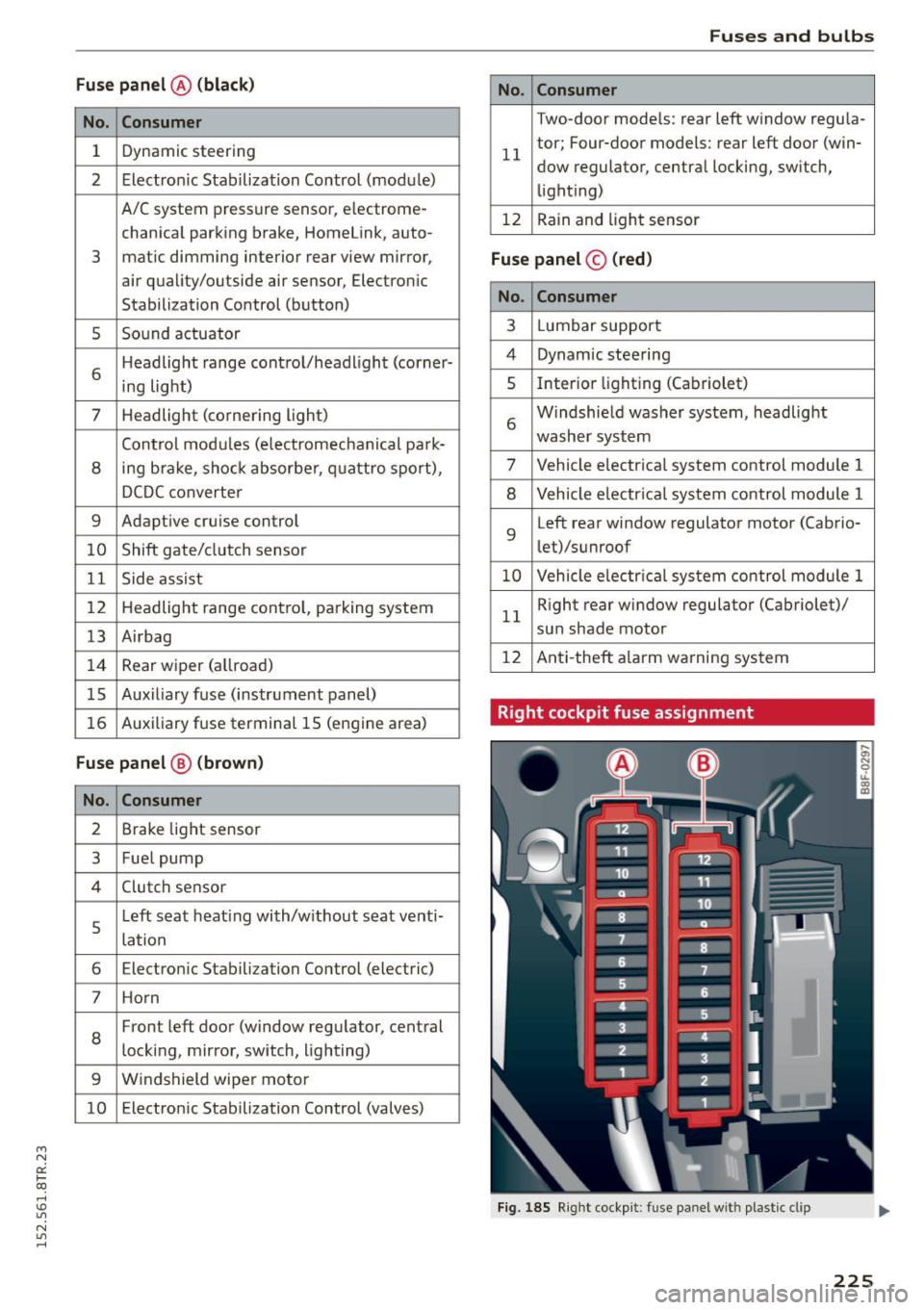
Right cockpit fuse assignment
Fig. 185 Right cockpit: fu se panel with plastic cl ip
225
Page 228 of 254
Fuses and bulbs
Fuse panel @ (black )
No. Consumer
5 Steering col
umn switch module
7 Term inal 15 d iagnost ic connector
8 Gateway (Databus diagnostic interface)
9 Supplementary heater
Fuse panel@ (brown )
No. Consumer
1 CD/ DVD p laye r
2 Wi-Fi
3 M
MI/Radio
4 Instrument cluster
5
Gateway (ins trument cluster co ntrol mod-
ule)
6 Ignition lock
7 Ligh t swi tch
8 Climate control system blower
9 Steering col umn lock
10 Climate contro l system
1 1 Te
rm inal 30 d iagnost ic connector
12 Steer ing column sw itch module
226
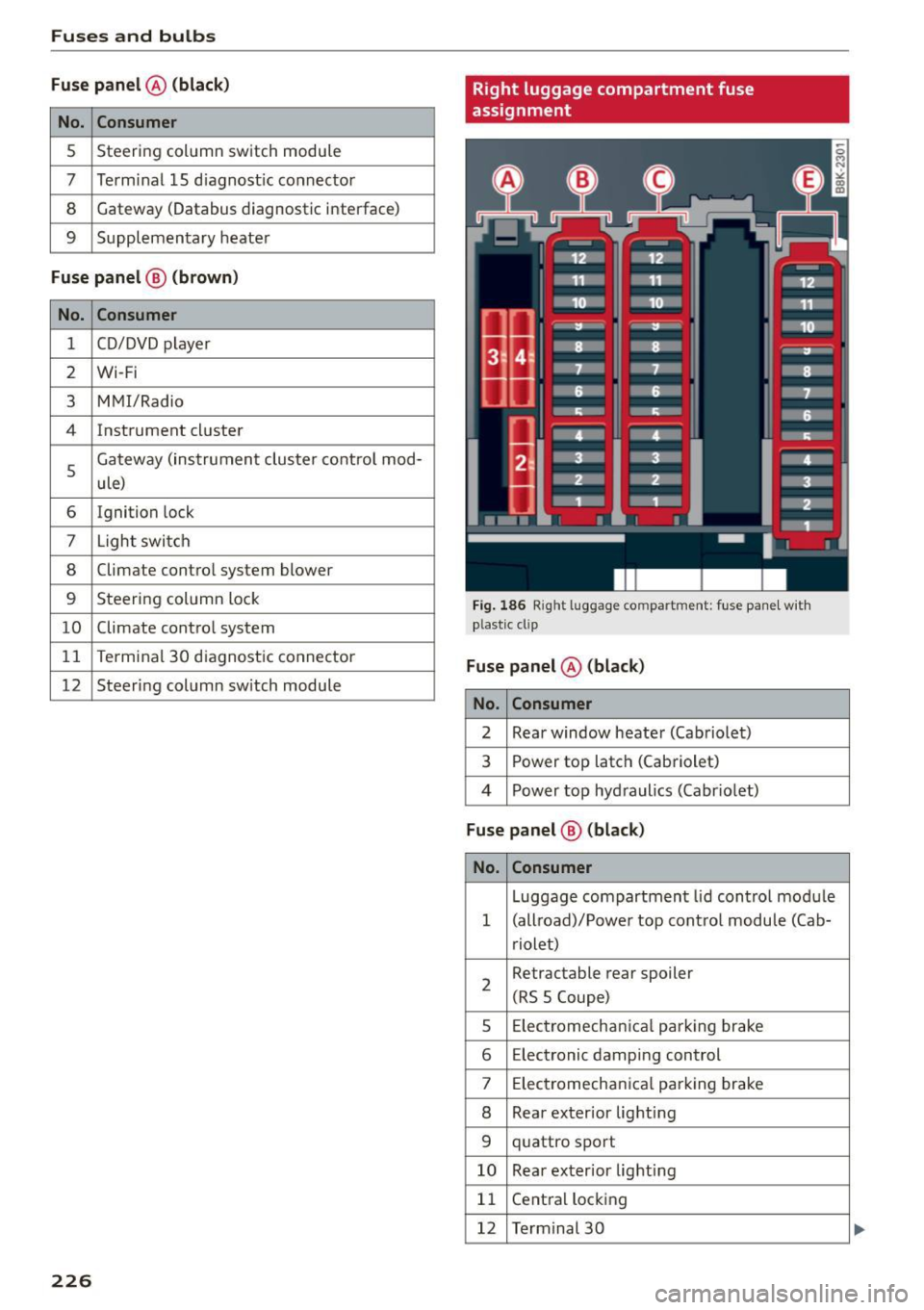
Right luggage compartment fuse
assignment
Fig. 186 Right lu ggage compartment: f use pane l w it h
plast ic clip
Fuse panel @ (black )
No . Consumer
2 Rea r window heater (Cabriole t)
3 Power top latch (Cabriolet)
4 Power top hyd raulics (Cabr io let)
Fuse panel @ (black)
No . Consumer
Luggage compartment lid con trol mo dule
1 (all road)/Powe r top cont ro l modu le (Cab-
r iolet)
2 Retractable rear
spoiler
(RS 5 Coupe)
5 Elec tromechan ica l pa rking brake
6 Electronic damping control
7 Elec tromech anica l par king brake
8 Rear exterior lig hti ng
9 qu attro sport
10 Rear exter ior lighting
1 1 Cent
ral locking
12 Term inal 30
Page 242 of 254
Index
A
A/C (automatic climate control) . . . . . . . . . . 68
Accessories . . . . . . . . . . . . . . . . . . . . . . . . . . 238
Adaptive c ruise control. . . . . . . . . . . . . . . . . . 88
Messages . . . . . . . . . . . . . . . . . . . . . . . . . . . 95
Reques t for driver intervention . . . . . . . . . . 93
Sett ing the driving program . . . . . . . . . . . . 93
Adaptive light . . . . . . . . . . . . . . . . . . . . . . . . . 43
Adapt ive Light (defective) . . . . . . . . . . . . . . . 2 1
Adding Eng ine coolant ... ... .... ..... .... .. .
Engine oil .. ... ............... ... .. .
W indshield washer fluid ........ ..... .
Addit ional accessories
Addit ives
Engine oil .... .. .............. ... .. .
Adjustable steering column ....... ..... . .
Adjusting 193
1 91
200
238
191 71
Air distribution (automatic climate control) 69
Instrument illumination . . . . . . . . . . . . . . . 46
Steering column .... ... ... .... .. .. .. .. 71
Temperature (automatic climate control) . 69
Airbag . . . . . . . . . . . . . . . . . . . . . . . . . . . . . . 128
Warning/indicator lights . . . . . . . . . . . . . . . 19
Airbag system . . . . . . . . . . . . . . . . . . . . . . . . 146
Advanced Airbag-System . . . . . . . . . . . . . . 132
Advanced Airbag System components . . . 134
Car e. . . . . . . . . . . . . . . . . . . . . . . . . . . . . . . 141
Chi ldren . . . . . . . . . . . . . . . . . . . . . . . . . . . 1 51
Child restraints . . . . . . . . . . . . . . . . . . . . . . 152
Components (front airbags) . . . . . . . . . . . 1 34
Danger of fitting a child safety seat on the
front passenger seat . . . . . . . . . . . . . . . . . 129
Disposal . . . . . . . . . . . . . . . . . . . . . . . . . . . 141
Front airbags . . . . . . . . . . . . . . . . . . . 132, 133
How do the front a irbags work? . . . . . . . . 136
How many airbags does my vehicle have? 134
How the Advanced Airbag Syst em compo-
nents work together . . . . . . . . . . . . . . . . . 136
Important information . . . . . . . . . . . . . . . 128
Important sa fety ins tructions on the knee
airbag system . . . . . . . . . . . . . . . . . . . . . . . 144
Indicator light . . . . . . . . . . . . . . . . . . . . . . 138
Knee airbags . . . . . . . . . . . . . . . . . . . . . . . . 142
Monitoring . . . . . . . . . . . . . . . . . . . . . . . . . 138
PASSENGER AIR BAG OFF light . . . . . . . . . 138
Repai rs 141
240
Safety instructions . . . . . . . . . . . . . . . . . . . 140
Side airbags . . . . . . . . . . . . . . . . . . . . . . . . 144
Side curtain airbags . . . . . . . . . . . . . . . . . . 147
Weight -sensing mat . . . . . . . . . . . . . . . . . 151
When must the system be inspec ted? . . . 138
all-wheel drive .... .. .. .............. . 174
All season ti res . . . . . . . . . . . . . . . . . . . . . . . 211
Alternator
refer to Generator . . . . . . . . . . . . . . . . . . . . 16
Anti-freeze
refer to Engine coolant system . . . . . . . . . 192
Ant i-lock brak ing system
Warning/indicator lights . . . . . . . . . . . . . . . 18
Anti-Lock Braking System . . . . . . . . . . . . . . 169
Anti-slip regu lation
Warning/indicator lights . . . . . . . . . . . . . . . 18
Ant i-Slip Regulation . . . . . . . . . . . . . . . . . . . 169
Anti-theft alarm system . . . . . . . . . . . . . . . . . 30
Ant i-theft systems
E lectronic immobilizer. . . . . . . . . . . . . . . . . 36
Armrest ........... ................... 56
Ashtray . . . . . . . . . . . . . . . . . . . . . . . . . . . . . . 58
Audi braking guard
refer to braking guard . . . . . . . . . . . . . . . . . 88
Audi drive select . . . . . . . . . . . . . . . . . . . . . . 101
Description . . . . . . . . . . . . . . . . . . . . . . . . . 101
Dynam ic steering . . . . . . . . . . . . . . . . . . . . 101
Setting the driving mode . . . . . . . . . . . . . . 102
Sport differential . . . . . . . . . . . . . . . . . . . . 101
Audi Service Repair Manuals and Literature 236
AUTO Automati c climate control . . . . . . . . . . . . . . 69
Automatic headlights . . . . . . . . . . . . . . . . . 43
Automatic belt retractor . . . . . . . . . . . . . . . 123
Automatic climate control Air vents . . . . . . . . . . . . . . . . . . . . . . . . . . . . 69
Operation . . . . . . . . . . . . . . . . . . . . . . . . . . . 68
Setup . . . . . . . . . . . . . . . . . . . . . . . . . . . . . . 70
Automat ic transmiss ion . . . . . . . . . . . . . . . . . 81
Emergency release . . . . . . . . . . . . . . . . . . . . 87
Removal lock (ign ition key) . . . . . . . . . . . . . 71
also refer to S tronic transmission . . . . . . . 81
Automa tic wipers . . . . . . . . . . . . . . . . . . . . . . 49
Auto Safety Hotline . . . . . . . . . . . . . . . . . . . 118
Average speed . . . . . . . . . . . . . . . . . . . . . . . . . 24
Avoid damaging the vehicle . . . . . . . . . . . . . 177
Page 249 of 254
M N
0:: loo ,...., \!) ..,.,
N ..,., ,....,
Parking system p lus with rear view camera
Parking mode
1 . . . . . . . . . . . . . . . . . . . . . 108
Park ing mode 2 . . . . . . . . . . . . . . . . . . . . . 109
Safety p recautions . . . . . . . . . . . . . . . . . . . 106
Switching on/off . . . . . . . . . . . . . . . . . . . . 107
Switching rear view camera on/off . . . . . . 110
Parts replacement . . . . . . . . . . . . . . . . . . . . 238
Pass-through . . . . . . . . . . . . . . . . . . . . . . . . . . 64
PASS ENGER AIR BAG OFF light . . . . . . . . . . 138
Pedals . . . . . . . . . . . . . . . . . . . . . . . . . . . . . . 116
Physical principles of a frontal collision 121
Pollutant filter (automatic A/C system) . . . . 67
Power
seat adjustment . . . . . . . . . . . . . . . . . . . . . .
54
Windows . . . . . . . . . . . . . . . . . . . . . . . . . . . 37
Power locking system
Emergency locking . . . . . . . . . . . . . . . . . . . .
35
Panoramic tilting sunroof . . . . . . . . . . . . . . 38
Power windows . . . . . . . . . . . . . . . . . . . . . . 38
Rear lid . . . . . . . . . . . . . . . . . . . . . . . . . . . . . 36
Selective unlock feature . . . . . . . . . . . . . . . 35
Settings . . . . . . . . . . . . . . . . . . . . . . . . . . . . 35
Power steering
refer to Electro-mechanical power assist 174
Power window
Conven ience opening/closing . . . . . . . . . . .
38
Power windows
Malfunctions . . . . . . . . . . . . . . . . . . . . . . . .
38
Pregnant women
Special considerations when wearing a safe-
ty belt . . . . . . . . . . . . . . . . . . . . . . . . . . . . .
125
Pressure (tires) . . . . . . . . . . . . . . . . . . . . . . . 214
Proper occupant seating positions . . . . . . . 112
Proper safety belt position . . . . . . . . . . . . . . 124
Proper seating position
Front passenger . . . . . . . . . . . . . . . . . . . . .
113
Occupants .. .... ........... .. .. .. .. . 112
Rear passengers . . . . . . . . . . . . . . . . . . . . . 114
Q
Quartz clock . . . . . . . . . . . . . . . . . . . . . . . . . . 12
quattro
refer to all-wheel drive . . . . . . . . . . . . . . . 174
Question
What happens to unbelted occupants? . .
121
Index
R
Radiator fan . . . . . . . . . . . . . . . . . . . . . . . . . 195
Rain/light sensor
Headlights . . . . . . . . . . . . . . . . . . . . . . . . . .
43
Intermittent (w indshield w ipers) . . . . . . . . 49
Sensor defective . . . . . . . . . . . . . . . . . . . . . . 21
Raising the vehicle . . . . . . . . . . . . . . . . . . . . 232
Reading lights . . . . . . . . . . . . . . . . . . . . . . . . . 46
Rear fog lights . . . . . . . . . . . . . . . . . . . . . . . . 43
Rear lid
Escape handle ..... .... .... ... .. .. .. .
37
Opening and closing . . . . . . . . . . . . . . . . . . 36
Rear light
Defective . . . . . . . . . . . . . . . . . . . . . . . . . . .
21
Rear spo iler . .. .. .. ......... .... .. .. .. 171
Rear view camera
Parking mode 1
Parking mode 2
108
109
Rear view mirror . . . . . . . . . . . . . . . . . . . . . . . 47
Rear window heating . . . . . . . . . . . . . . . . . . . 69
Rear window sun shade . . . . . . . . . . . . . . . . . 48
Recirculation mode (automatic climate con-
trol) . . . . . . . . . . . . . . . . . . . . . . . . . . . . . . . . . 69
Refuell ing . . . . . . . . . . . . . . . . . . . . . . . . . . .
185
Release lever for hood . . . . . . . . . . . . . . . . . 187
Remote control
Garage door op ener (Homelink) . . . . . . . . .
40
Remote control key . . . . . . . . . . . . . . . . . . . . . 31
Personalizing . . . . . . . . . . . . . . . . . . . . . . . . 31
unlocking/locking . . . . . . . . . . . . . . . . . . . . 33
Remote rear lid release . . . . . . . . . . . . . . . . . 36
Repair manuals . . . . . . . . . . . . . . . . . . . . . . . 236
Repairs
Airbag system . . . . . . . . . . . . . . . . . . . . . .
141
Replacement key . . . . . . . . . . . . . . . . . . . . . . 31
Replacing bulbs . . . . . . . . . . . . . . . . . . . . . . 227
Replacing wiper blades . . . . . . . . . . . . . . . . . SO
Reporting Safety Defec ts ......... ..
118, 119
Reset button . . . . . . . . . . . . . . . . . . . . . . . . . . 12
Retractor . . . . . . . . . . . . . . . . . . . . . . . . . . . . 123
Right hand drive . . . . . . . . . . . . . . . . . . . . . . . 45
Rims . . . . . . . . . . . . . . . . . . . . . . . . . . . . . . . 210
Roof rack . . . . . . . . . . . . . . . . . . . . . . . . . . . . . 6 1
Roof load . . . . . . . . . . . . . . . . . . . . . . . . . . . 62
Roof weight . . . . . . . . . . . . . . . . . . . . . . . . . 62
247
Page 251 of 254
M N
0:: loo ,...., \!) 1.1'1
N 1.1'1 ,....,
Side curtain airbags . . . . . . . . . . . . . . . . . . . 147
Description . . . . . . . . . . . . . . . . . . . . . . . . . 147
How they work . . . . . . . . . . . . . . . . . . . . . . 148
Safety instructions . . . . . . . . . . . . . . . . . . . 149
Side marker lights . . . . . . . . . . . . . . . . . . . . . 43
Ski sack . . . . . . . . . . . . . . . . . . . . . . . . . . . . . . 64
Snow chains .................. .. .. ... 211
Sound system display . . . . . . . . . . . . . . . . . . . 23
Sources of information about child restra ints
and their use . . . . . . . . . . . . . . . . . . . . . . . . . 167
Speedometer . . . . . . . . . . . . . . . . . . . . . . . . . 12
Speed warn ing system . . . . . . . . . . . . . . . . . . 77
Sport differential . . . . . . . . . . . . . . . . . . . . . 101
Indicator lamp . . . . . . . . . . . . . . . . . . . . . . . 21
START ENGINE STOP button (convenience key) . . . . . . . . . . . . . . . . . . . . . . . . . . . . . . . . . 74
START ENGINE STOP button (Conven ience
key) . . . . . . . . . . . . . . . . . . . . . . . . . . . . . . . . . 73
Starting from rest . . . . . . . . . . . . . . . . . . . . . . 76
Starting the engine ................. 71, 73
Steer ing
L ock ing the steering . . . . . . . . . . . . . . . . . . 71
also refer to Electro -mechanical power as-
sist . . . . . . . . . . . . . . . . . . . . . . . . . . . . . . . 174
Steering wheel Adjusting steering co lumn . . . . . . . . . . . . . 71
I ndicator light ........... .. .. .. .. 17 , 174
Steps for determining correct load limit . . . 209
Stopping the engine . . . . . . . . . . . . . . . . . 73, 74
Storage . . . . . . . . . . . . . . . . . . . . . . . . . . . . . . 59
Storage compartments . . . . . . . . . . . . . . 60, 65
S tron ic . . . . . . . . . . . . . . . . . . . . . . . . . . . . . . 81
S tronic transmission Automatic Sh ift Lock (ASL) . . . . . . . . . . . . . 82
Driving information . . . . . . . . . . . . . . . . . . . 83
Emergency mode . . . . . . . . . . . . . . . . . . . . . 86
Emergency release . . . . . . . . . . . . . . . . . . . . 87
K ick -down . . . . . . . . . . . . . . . . . . . . . . . . . . . 85
Launch Control Program . . . . . . . . . . . . . . . 85
Selector lever position . . . . . . . . . . . . . . . . . 81
tiptronic . . . . . . . . . . . . . . . . . . . . . . . . . . . . 85
Sunroof
refer to Panoram ic tilting sunroof . . . . . . . 39
Sun shades Emergency closing (roof) . . . . . . . . . . . . . . . 39
Rear window . . . . . . . . . . . . . . . . . . . . . . . . . 48
Index
Sun visors . . . . . . . . . . . . . . . . . . . . . . . . . . .. 48
Symbols
refer to Warn ing/ indicator lights . . . . . . . . 13
T
Tachometer . . . . . . . . . . . . . . . . . . . . . . . . . . . 11
Technical data . . . . . . . . . . . . . . . . . . . . . . . . 233
T echnical modifications . . . . . . . . . . . . . . . . 238
Tether anchors . . . . . . . . . . . . . . . . . . . . . . . 16S
T ether strap . . . . . . . . . . . . . . . . . . . . . . . . . 165
Tie-down s . . . . . . . . . . . . . . . . . . . . . . . . 64, 118
tiptronic S tronic transmission . . . . . . . . . . . . . . . . . . 8S
T ire repair set . . . . . . . . . . . . . . . . . . . . . . . . 216
Tires . . . . . . . . . . . . . . . . . . . . . . . . . . . . . . . . 201
Low aspect ratio tires . . . . . . . . . . . . . . . . . 212
Repair set . .... .. ............. .... .. 216
Replac ing . . . . . . . . . . . . . . . . . . . . . . . . . . 218
Service life . . . . . . . . . . . . . . . . . . . . . . . . . 204
Tire pressure ..... ............... 206, 21S
Ti re pressure monitoring system ... 213, 214
Tire pressure table . . . . . . . . . . . . . . . . . . . 207
Treadwear indicators . . . . . . . . . . . . . . . . . 204
Uni directional. . . . . . . . . . . . . . . . . . . . . . . 203
Uniform tire quality grading ........... 212
T ires and wheels
Tires and vehicle load limits . . . . . . . . . . . 208
T oo lkit .... .... .. ............. .... .. 216
Torn or frayed safety belts
Towing 122
Front eyelet . . . . . . . . . . . . . . . . . . . . . . . . 230
Rear eyelet . . . . . . . . . . . . . . . . . . . . . . . . . 231
Tow trucks . . . . . . . . . . . . . . . . . . . . . . . . . 230
TPMS (tire pressure monitoring system) . . . 214
Transmission malfunction (indicator light) . . 86
Transport Canada . . . . . . . . . . . . . . . . . . . . . 119
Travel mode . . . . . . . . . . . . . . . . . . . . . . . . . . 45
Tr ip compute r
Fuel consumption . . . . . . . . . . . . . . . . . . . . 24
Mileage ............................ . 24
S ingle-trip memory . . . . . . . . . . . . . . . . . . . 24
T ota l-trip memory . . . . . . . . . . . . . . . . . . . . 24
Tr ip odometer . . . . . . . . . . . . . . . . . . . . . . . . . 12
T runk
refer to Luggag e compartment. . . . . . 62, 117
Trunk escape handle ............. .... .. . 37
249