water pump AUDI RS5 COUPE 2015 Owners Manual
[x] Cancel search | Manufacturer: AUDI, Model Year: 2015, Model line: RS5 COUPE, Model: AUDI RS5 COUPE 2015Pages: 254, PDF Size: 64.12 MB
Page 171 of 254

M N
0:: loo ,...., \!) 1.1"1
N 1.1"1 ,....,
shared, please see your contract with the
wireless telecommunications provider and the
"About Aud i connect" tab in your vehicle's
MMI*:
IMENU I button> Audi connect > About
Audi connect .
Electronic Stabilization
Control (ESC)
Description
ESC helps to improve road holding and vehicle
dynamics to help reduce the probability of skid
ding and loss of vehicle control. It works only
when the engine is running. ESC detects certain
d ifficu lt driving situations, including when the ve
hicle is beginn ing to spin (yaw) out of control and
helps you to get the vehicle back under control by
selectively braking the whee ls, and/or reducing
engine power and prov iding steer ing ass istance
to help hold the vehicle on the driver's intended
course. The indicator light
Bl in the instrument
cluster blinks when ESC is taking action to help
you control the veh icle.
ESC has limitations.
It is important to remember
that ESC cannot overcome the laws of physics. It
will not always be able to help out under all con
ditions you may come up against. For example, ESC may not always be able to help you master
situations where there is a sudden change in the
coefficient of frict ion of the road surface . Whe n
there is a section of dry road that is suddenly cov
ered with water, slush or snow, ESC cannot per
form the same way it wou ld on the dry surface. If
the vehicle hydroplanes (rides on a cushion of wa
ter instead of the road surface), ESC will not be
ab le to he lp you steer the vehicle because contact
with the pavement has been interrupted and the
vehicle cannot be braked or steered . During fast
cornering, particularly on winding roads, ESC
cannot always deal as effectively with difficult
driving situations than at lower speeds. Whe n
tow ing a trailer, ESC is not able to help you regain
con trol as it wou ld if you were no t towing a trail
er .
A lways adjust your speed and dr iving sty le to
road, traffic and weather conditions. ESC cannot
override the vehicle's physical limits, increase the
Smart Technology
available traction, or keep a vehicle on the road i f
road departure is a result of driver inattention.
Instead, ESC improves the possibility of keeping
the vehicle under control and on the road dur ing
extreme maneuvers by using the driver's steering
inputs to help keep the vehicle go ing in the in
tended direction. If you are traveling at a speed
that causes you to run off the road before ESC
can prov ide any assistance, you may not expe ri
ence the benefits of ESC.
ESC is switched on all the time . In certain situa
t ions when you need less traction, you can switch
off ASR by pressing the button
[ru ~ page 170,
fig. 152 or ~page 170, fig . 153. Be sure to
switch ASR on again when you no longer need
less traction.
T he following systems are integrated in the ESC:
Anti-lock braking system (ABS)
ABS prevents the wheels from locking up when braking. The vehicle can still be steered even dur
i ng hard braki ng. Apply steady pressure to the
brake pedal. Do not pump the pedal. A pulsing in
the brake pedal indicates that the system is he lp
ing you to brake the vehicle.
Brake assist system
The brake ass ist system can decrease braking dis
tance . It increases braking power when the driver
presses the brake peda l quickly in emergency sit
u at ions. You must press and hold the brake pedal
until t he situat ion is over. In vehicles with adap
tive cruise control*, the brake assist system is
more sensitive if the distance detected to the ve
hicle ahead is too sma ll.
Anti-slip regulation (ASR)
ASR red uces eng ine power when the drive wheels
begin to spin and adapts the force to the road
conditions. This makes it easier to start, acce le r
ate and drive up hills.
Electronic differential lock (EDL)
T he EDL brakes whee ls that are spinning and
transfers the drive power to the other wheels.
T his function is available up to about 60 mph
(100 km/h).
169
Page 174 of 254
Smart Technolog y
-Manua l retraction: At speeds up to about
10 mph (20 km/h) , retract the rear spoiler by
pressing and holding the switch. At speeds be
tween 10 mph (20 km/h) and 75 mph (120 km/h), retract the rear spoiler by tapping
on the switch
Ind icat or light
- Rear sp oile r: sy st em m alfu ncti on
The rear spoiler may not have extended due to a
malfunct ion . This cou ld change the vehicle's driv
ing characteristics at high speeds . Do not drive at
speeds above 85 mph (140 km/h) . Drive to the
nearest authorized Audi dealer or qualified repair
facility to have the malfunction corrected.
A WARNING
Dr iv ing at higher speeds w ithout the rear
spoiler deployed can impa ir handling charac
teristics, mak ing the veh icle harder to co ntrol.
- Always make sure that the spoiler is de-
ployed when driving at speeds over 85 mph
(140 km/h) . If the rear spoiler warn ing/ indi
c ator light in t he instrument cluster comes
on, the rear spoi ler may not have deployed .
- Never dr ive at speeds highe r than 85 mph
(140 km/ h) if the spoiler is not deployed.
Have the spo iler inspected as soon as possi
ble by an author ized Audi dealer or qualif ied
workshop.
- Always obey speed limi ts and o ther traffic
laws .
A WARNING ,.__.__
Improper ope ration of the rear spoiler can
cause crushing injuries .
- Always make sure that nobody, espec ia lly
children, is in the way when the rear spo iler
is deployed or retracted .
(D Note
Never push the vehicle or apply fo rce to the
rea r spo ile r - i t cou ld be damaged.
(D Tips
Clean the spo ile r compartment every 2 to 3
months. The spoiler compartment m ust al-
172
-
ways be free of ice, snow, leaves or other de bris .
Braking
What affects braking efficiency?
New brake pads
During the first 250 miles (400 km), new brake
pads do not possess their full braking e ffect, they
have to be "broken in" first¢.&. . The break -in pe
riod can be considerably longe r for vehicles with
ceramic brake rotors*. You can compensate for
th is slightly reduced braking power by pushing
harder on the brake pedal. Avoid heavy braking
loads during the b reak-in period.
Op era ting condition s and dri ving h abit s
The brakes on today's automobiles are still sub
j ect to wear, depending largely on operating con
dit ions and driving habits ¢.&, . On vehicles that
are either dr iven most ly in stop-and-go city traf
fic or are driven hard, the brake pads should be
checked by yo ur autho rized Aud i dealer more of
ten than specified in the
Warranty & Mainte·
nan ce bookl et.
Fail ure to have you r brake pads
i nspected c an resu lt in red uced b rake pe rform
ance.
On steep slopes, you shou ld use the braking ef
fect of the engine. This way, you prevent unnec
essary wear on the bra ke system. If yo u must use
you r brakes, do not hold the brakes down contin
u ously. Pump the brakes at intervals .
Operating noise
Noises may occur when brakin g depending on the
speed, braking force and ou ts ide cond itions su ch
as tempera ture and hum idity.
Due to the nature of the materials used in ceram
i c bra ke roto rs*, noises may become mo re appa
r ent at low speeds.
Effect of water and road salt
In certa in situations, for examp le after driv ing
through water, in heavy rain, after overnight con
densation or after washing your car , the braking
effect can be redu ced by moistu re or ice on the
1111>
Page 219 of 254
"' N
0:: loo
rl I.O
"' N
"' rl
TMS can be used at temperatures down to -4 °F
(- 20 °C).
A WARNING
Take the following precautions after repairing
the tire:
- Do not drive faster than 50 mph (80 km/ h)!
- Avoid full -throttle acceleration, heavy brak -
ing and fast corner ing.
- T he ve hicle's road behavior can be affec ted.
- T ir es sealed w ith
TMS a re intended only for
temporary , short-t erm use. Damaged t ires
must be replaced. D rive carefully to the nex t
professional repair facility .
- After using the tire sea lant the tire pressure
monitoring system may no longer work
properly . Drive ca refully to the next profes
sional repair facility.
- TMS must NOT be used,
- for cuts or punctures in the tire which a re
larger than 0.16 inch (4 mm)
- for damage to the rim
- if you have been driv ing with very low tire
pressures or tires with no air
- Seek profess ional assistance if it is not pos
sible to repair the tire with the tire sealant.
- The tire sealant must not come into contact
with skin, eyes or clothing.
- If you get any tire sealant in your eyes or
come into contact with it, rinse the affected
area thoroughly with clean water. F ind a
physician immediately!
- Change any cloth ing contaminated with t ire
sealant immediately.
- Do not inhale the vapor!
- If you have swallowed tire sealant, rinse
yo ur mouth thorough ly right away and drink
plenty of water.
- Do not induce vomiting! F ind a phys ic ian
immed iate ly!
- If you have allergic reactions, find a physi
cian immediately.
- Keep the t ire sealant away from chi ldren.
(D Note
Do not use commerc ia lly available tire sea l
ants. The electrical components of the tire
Em erg en cy ass is tan ce
press ure monitoring system w ill no longe r
work properly .
@ For the sake of the environment
Used sealant bottles ca n be dropped off a t a
recycling fac ility.
© Tips
- If sea la nt has run o ut, allow i t to d ry. Then
yo u ca n pee l it off.
- Have the tire sea lant rep laced eve ry 4 years
at a de alership.
Making a tire repair
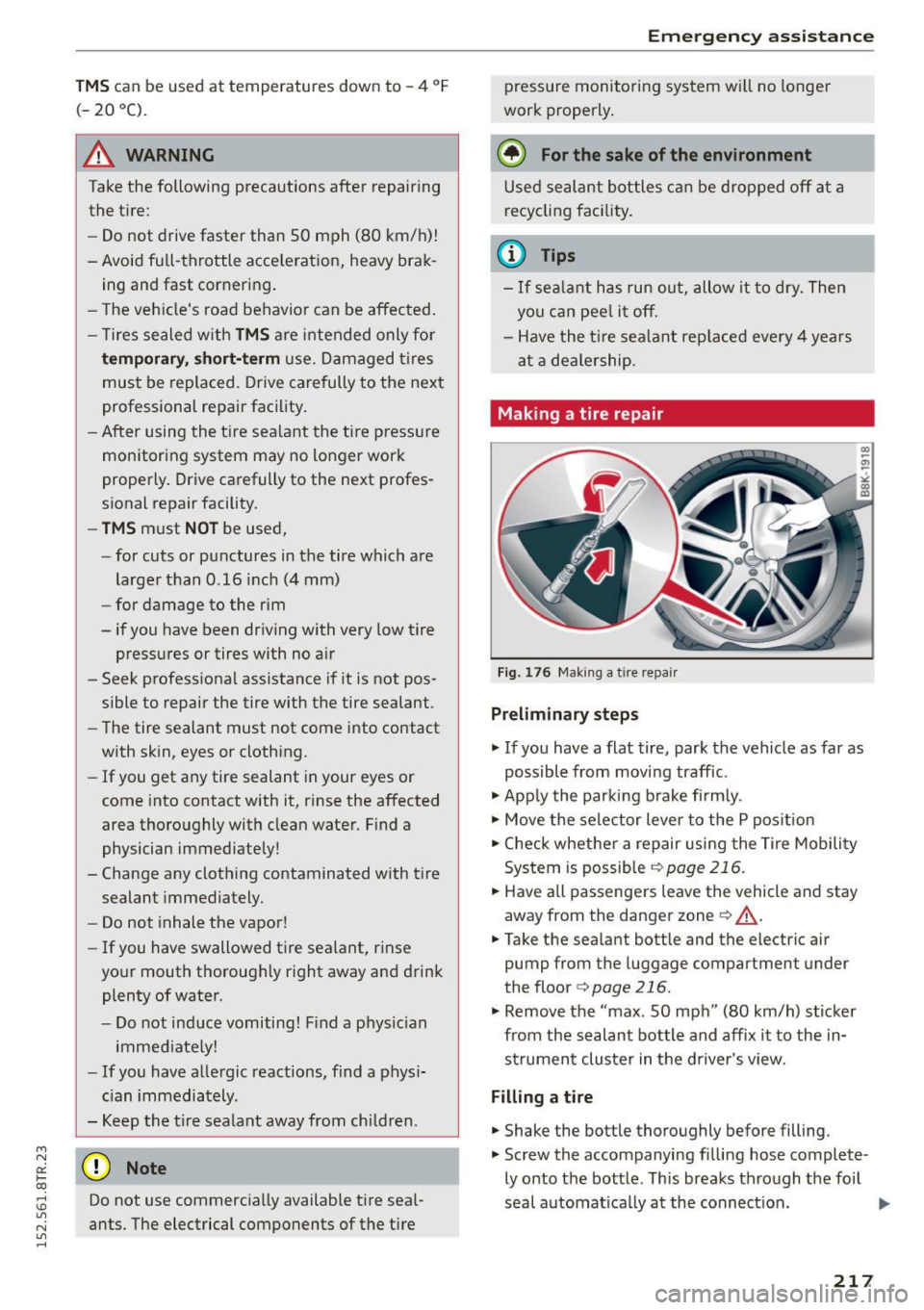
Fig. 176 Maki ng a t ire repair
Pr eliminary steps
"' If you have a flat tire, park the vehicle as far as
possible from moving traffic .
"' App ly the parking b rake firmly.
"' Move the selector lever to the P pos ition
"' Check whether a repair using the Tire Mobility
System is possib le
~ page 216.
"' Have all passengers leave the vehicle and stay
away from the danger zone
Q _A .
"'Take the sea lant bottle and the electric air
pump from the luggage compartment under
the floor <=>
page 216.
"' Remove the "max . 50 mph" (80 km/h) sticker
from the sealant bottle and aff ix it to the in
s trument cluster in the driver 's view.
Filling a tire
"' Shake the bott le thoroughly before filling.
"' Screw the accompanying fi lling hose complete-
ly onto the bottle . This breaks through the foil
s e al automat ica lly a t the connect ion.
217