wheel AUDI RS5 COUPE 2015 Workshop Manual
[x] Cancel search | Manufacturer: AUDI, Model Year: 2015, Model line: RS5 COUPE, Model: AUDI RS5 COUPE 2015Pages: 254, PDF Size: 64.12 MB
Page 217 of 254

M N
0:: loo ,...., \!) 1.1'1
N 1.1'1 ,....,
-Under certain cond itions (such as a sporty
dr iv ing style, winter cond itions or unpaved
roads), the t ire pressure monitoring system
indicator may be delayed .
- Do not use run-flat tires on your veh icle. Us
ing them when not permitted can lead to
vehicle damage or accidents.
(D Tips
- The t ire pressure monitoring system can al
so stop work ing when there is an ESC ma l
funct ion.
- Using snow chains may result in a system
malfunction.
- The t ires with the ident ificat ion "RO"
c:> page 203 have been matched with your
Audi tire pressure monitoring system. We
recommend that you use these tires.
Storing tire pressures
App lies to vehicles: with tire pressure monitoring system
If the tire pressure changes or a tire is replaced,
it must be confirmed in the Infotainment sys
tem .
.. Make sure before storing that the tire pressures
of all four t ires meet the specified va lues and
are adapted to the load
c:> page 206 .
.. Switch the ign ition on .
.. Se lect: the
ICARI function button > Tire pres
s ur e m onitoring
control button. Or
.. Se lect: the
I CAR I function button > Car Sy s
tem s*
control button > Servici ng & check s >
Tir e p re ss ure monitorin g.
@ Tips
Do not store the t ire press ures if snow cha ins
are installed.
Wheels
215
Page 218 of 254

Emergency assistance
Emergency assistance
Vehicle tool kit
The tools ore stored underneath the floor panel
in the luggage comportment.
Fig . 174 Luggage compartme nt: too l kit
W hen you need access to the veh icle tool k it or
jack*, you will need to ta ke o ut the cover.
The vehicle tool kit includes :
- Tire repa ir kit (Tire Mobility System)
- Plastic clip for removing wheel bolt caps*
- Alignment pi n for cha nging the whee l
- Screwdr iver w ith reve rsible blade
- Too l for chang ing light bu lbs
- Reversible bit (reversible Torx bit for changing
light bu lbs)
- Rod for jack
- Jack*
- Lug wrench
-Towing eye
Some of the ve hicle items listed above are p rovid
ed on ce rtai n models only or a re optional extras.
Before return ing the jack * to its place, retract the
jack arm fully.
_& WARNING
-
- Never use t he screw d river hex head to
t ig ht en whee l bol ts, s in ce the bolts c annot
atta in the necessary tightening tor que if you
use the hex head, potentia lly ca us ing an ac
c ident.
- The factory -supp lied jac k is intended only
for yo ur vehicle model. Under no c ircum
stances should it be used to lift heavy
216
veh icles o r othe r loads; you risk i njuring
yourse lf.
- Never start the engine when the vehicle is
raised, which could cause an accident.
- Support the vehicle securely w ith appropri
ate stands if work is to be performed under
neath the vehicle; otherwise, there is a po
tential risk for injury.
Tire repair set
General and safety pointers
Tire repair is intended only for temporary, short
term use .
Fig . 1 75 Tire damage for which the Tire Mobility System is
not su ited
Your vehicle is equipped with a tire repa ir kit, the
Tire Mobility System (TMS) .
In the event of a tire fail ure, the TMS is in the
l uggage compartment under the floor. It consists
of the t ire sealant and an electric air pump.
Using
TMS , tire damage caused by foreign bodies
u p to abo ut
0.16 inch (4 mm ) in diameter can be
sealed reliably .
The foreign object must stay in the tire.
The tire sealant must not be used:
- for cu ts or pu nctures in the tire w hich a re larger
than 0 .16 inch (4 mm)
r=;,fig.175 @
-for d amage to the rim @
- if yo u h ave been drivi ng with very low t ire pres-
sures o r ti res wit h no air @
Using the
TMS is descr ibed in the section
¢page 217.
Page 220 of 254
Emerg enc y ass is tance
"' Remove the valve cap from the tire valve and
unscrew the valve insert using the accompany
ing valve insert tool¢
fig. 176.
"'Lay the valve insert on a clean surface.
"' Remove the sealing plug from the filling hose
and connect the hose to the tire valve .
"' Hold the bottle w ith the bottom facing upward
and empty the ent ire contents into the tire .
"'T hen pull out the hose and screw the valve in
sert t ight ly back into the tire va lve.
Inflating a ti re
"' Screw the filling hose for the electric air pump
onto the tire valve and insert the connector into
the cigarette lighter .
"' Inflate the tire between 2.0 and 2.5 ba r and
read the pressure from the ga uge .
"' If this tire pressu re is not reached, drive your
vehicle approximate ly 10 meters forward or
backward so that the sea lant can be redistribut
ed inside the tire. If at this time the required air
pressure st ill cannot be reached, the tire is too
badly damaged and cannot be repa ired with the
ti re sealant.
F in al ch eck
"' After driving for about 10 minutes, stop and
check the tire press ure.
"' If tire pressure is less than 1.3 bar, the tire is
too severely damaged . Do not cont inue to
drive. Seek professional assistance .
A WARNING
- Turn on the eme rgency flashers and set up
the emergen cy tr iangle if you have flat tire
wh ile in moving traffic. Th is is for yo ur pro
tection and the for the safety o f other driv
ers.
- Have all passengers leave the vehi cle and
stay away from the danger zone (for exam
ple, behind a guard rail).
- Read and fo llow the manufacturer's safety
precautions on the compressor and in the
instructions on the bottle of sealant!
- If a t ire pressure of 2.0 bar cannot reached
after inflating for six minutes, then the tire is too severe ly damaged . Do not contin ue
dr iv ing !
218
-Obtain qua lified help i f it is not possible to
perform the repair w ith the t ire sea lant.
- If the tire pressure is less than 1 .3 bar after
10 minutes of driving, then the the t ire is
too severe ly damaged. Do not continue driv
ing. Seek professional assistance.
(D Note
Partic ular care is necessary if you are mak ing
a tire repa ir on a steep incl ine.
(D Tips
- Do not operate the electric air pump for
more than 6 minutes witho ut stopp ing, oth
erwise it can overheat. When the air pump
has cooled down, you can continue to use it.
- If sea lant has spilled out, let it dry and then
you can remove it by peeling it away like a
foil.
- Remember to obtain a new bott le of sealant
from your authorized Audi dealer after re pairing a tire. After this, the functionality of
the tire repair set is restored .
- Obey all laws.
Replacing wheels
Before changing a wheel
Observe the following precautions for your own
and your passenger's safety when changing a
wheel.
"' After you experience a t ire failure, pull the ca r
well away from mov ing traffic and t ry to reac h
l e vel ground before you stop
~ ,&.
"' All passengers should leave the car and move
to a safe location ( for ins tance , behind the
guardrail) ¢,& .
"' Engage the parking brake to prevent your ve hi
cle from ro lling unintent iona lly ¢ ,& .
"' Move the selector le ver to the P position .
"' Take the jack
¢page 216 out of the luggage
compartment .
Page 221 of 254
M N
0:: loo ,...., \!) 1.1'1
N 1.1'1 ,....,
A WARNING 1=
You or your passengers cou ld be injured while
chang ing a wheel if you do not follow these
safety precautions:
- If you have a flat t ire, move a safe distance
off the road . Turn off the engine, turn the
emergency flashers on and use other warn
ing devices to alert other motorists.
- Make sure that passengers wait in a safe
place away from the vehicle and well away
from the road and traff ic.
- To help prevent the veh icle from mov ing
sudden ly and possibly slipping off the jac k,
always fully set the pa rking brake and block
the whee l diagona lly opposite the w heel be
ing changed with the folding chocks or oth
er objects. When one front wheel is lifted
off the ground, placing the Automatic Trans
mission in "P" (Park) will
not prevent the ve
hicle from moving.
- Before you change a wheel, be sure the
ground is level and firm. If necessary, use a
sturdy board under the jack.
- Always store the vehicle tool kit, the jack *
and the replaced tire in the luggage com
partment
c> page 117.
(D Note
If you are changing the wheel on a steep in
cline, use a rock or sim ilar object to block the
opposite whee l to prevent the vehicle from
mov ing.
{!) Tips
Obey a ll laws.
Changing a wheel
When you change o wheel, follow the sequence
described below step-by-step and in exactly that
order.
1. Remove the wheel bolt caps*. F or more de
tails see also ¢
page 220 , Wheels with
wheel bolt caps .
2. Loosen the wheel bolts¢ page 220.
Emerge ncy ass is tanc e
3. Locate the proper mounting point for the
jack and alig n the jack below that point
¢ page 221 .
4. Lift the car with the jack¢ page 221.
5. Remove the wheel with th e fla t tire and then
install the other wheel¢
page 222 .
6. Tighten all whee l bolts lightly.
7 .
Lower the vehicle with the jack .
8. Use the wheel bolt wrench and
firmly t ighten
all wheel bo lts in a crisscross pattern
¢page 220.
9. Replace the wheel bolt cap s* .
A WARNING
A lways read and fo llow all WARNINGS and in
formation
¢ &. in Raising the vehicle on
page221
and ¢page 223.
After changing a wheel
A wheel chonge is not complete without the do
ing the following.
.. Always store the vehicle tool kit, the jack*, and
the replaced tire in the luggage compartment
¢ page 117.
.. As soon as possib le, have the t ightening tor
ques
on all wheel bolts checked with a torque
wrench . The correct t ightening to rque is 90 ft
lbs. (120 Nm) .
.. Have the flat tire
replaced as soon as possible .
(D Tips
-If you not ice that the wheel bo lts a re cor
roded and difficult to tur n while changing a
tire, they should be replaced before you
check the tigh tening torque.
- Dr ive at reduced speed until you have the
tightening to rques che cked.
219
Page 222 of 254
Emergency assistance
Wheels with wheel bolt caps
Applies to veh icles: w ith whee l bolts w it h caps
The cops must be removed first from the wheel
bolts before the bolts con be unscrewed .
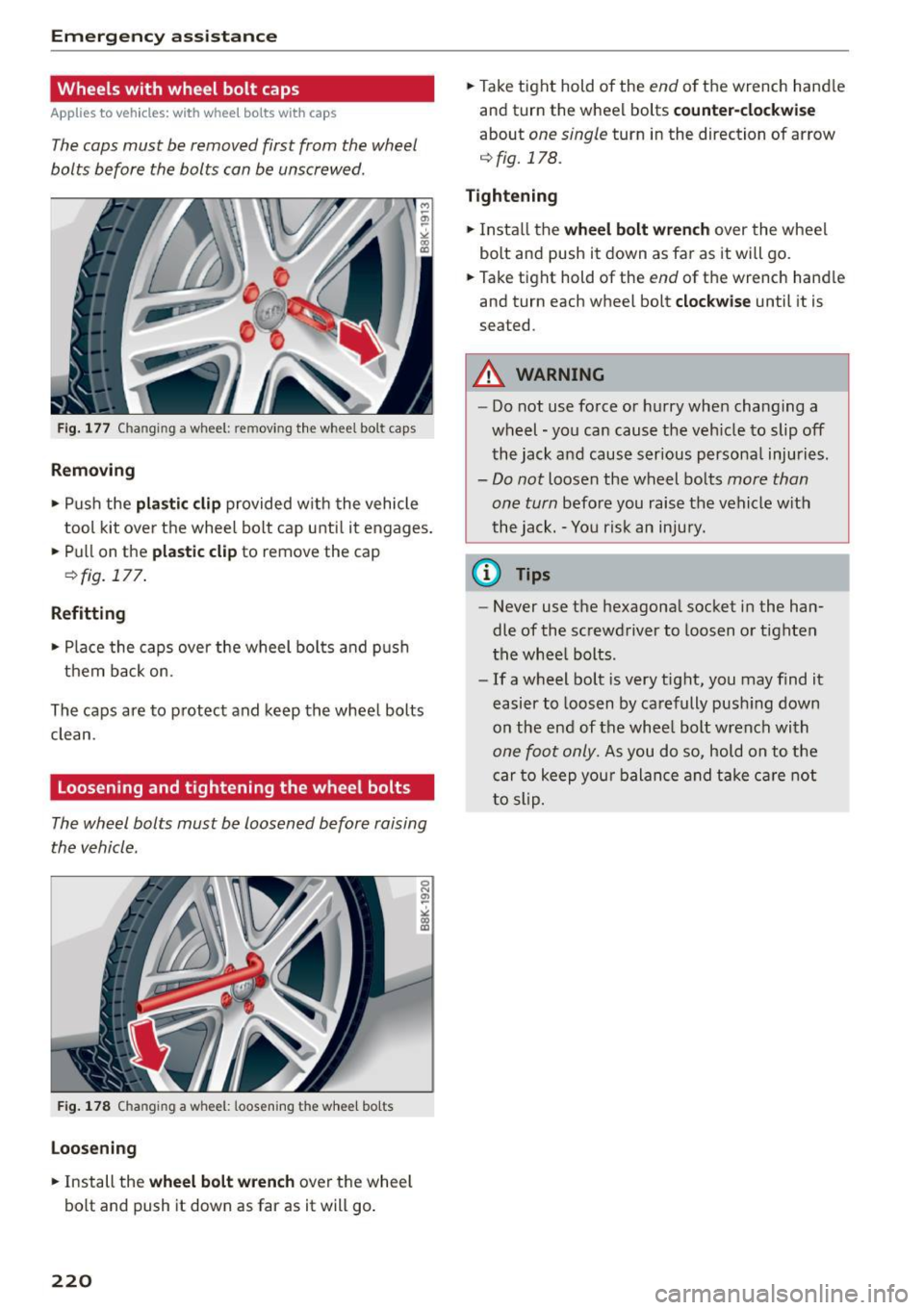
Fig. 1 77 Changing a wheel: removing th e wheel bolt caps
Removing
• Push the pla stic clip provided w ith the vehicle
tool kit over t he wheel bolt cap unti l it engages .
• Pu ll on the
pla stic clip to remove the cap
¢fig. 177.
Refitting
• Place the caps over the wheel bo lts and p ush
them back on.
The caps are to p rotect and keep the whee l bolts
clean.
Loosening and tightening the wheel bolts
The wheel bolts must be loosened before raising
the vehicle.
F ig. 17 8 Chang ing a w heel: l oosening the whee l bo lts
Loosening
• Install the wheel bolt w rench over the whee l
bolt and push it down as far as it will go .
220
• Take tight hold of the end of th e wrench hand le
and turn the wheel bolts
counter -cloc kwis e
about one single turn in the direction of arrow
qfig. 178.
Tightening
• Insta ll the wheel bolt wren ch over the wheel
bolt and push it down as fa r as it will go .
• Take tight hold of the
end of the wrench hand le
and turn each wheel bo lt
clo ckwise until it is
seated.
A WARNING
- Do not use force or h urry whe n cha nging a
wheel - you can cause the veh icle to slip off
th e jack a nd cause serious persona l injuries .
-Do not loosen the wheel bo lts more than
one turn
befo re you raise the vehicle with
th e jack. - Yo u risk an injury.
(D Tips
- Never use th e hexagona l socket i n the han
dle of the sc rewd river to loosen or tighten
t h e whee l bolts .
- If a wheel bolt is very tight , you may find it
e asier to loosen by carefully push ing down
on the end of the whee l bolt wrench with
one foot only. As you do so, hold on to t he
car to keep you r bala nce and t ake ca re no t
t o slip.
Page 223 of 254
"' N
0:: loo
rl I.O
"' N
"' rl
Raising the vehicle
The vehicle must be li~ed with the jack first be
fore the wheel can be removed .
-
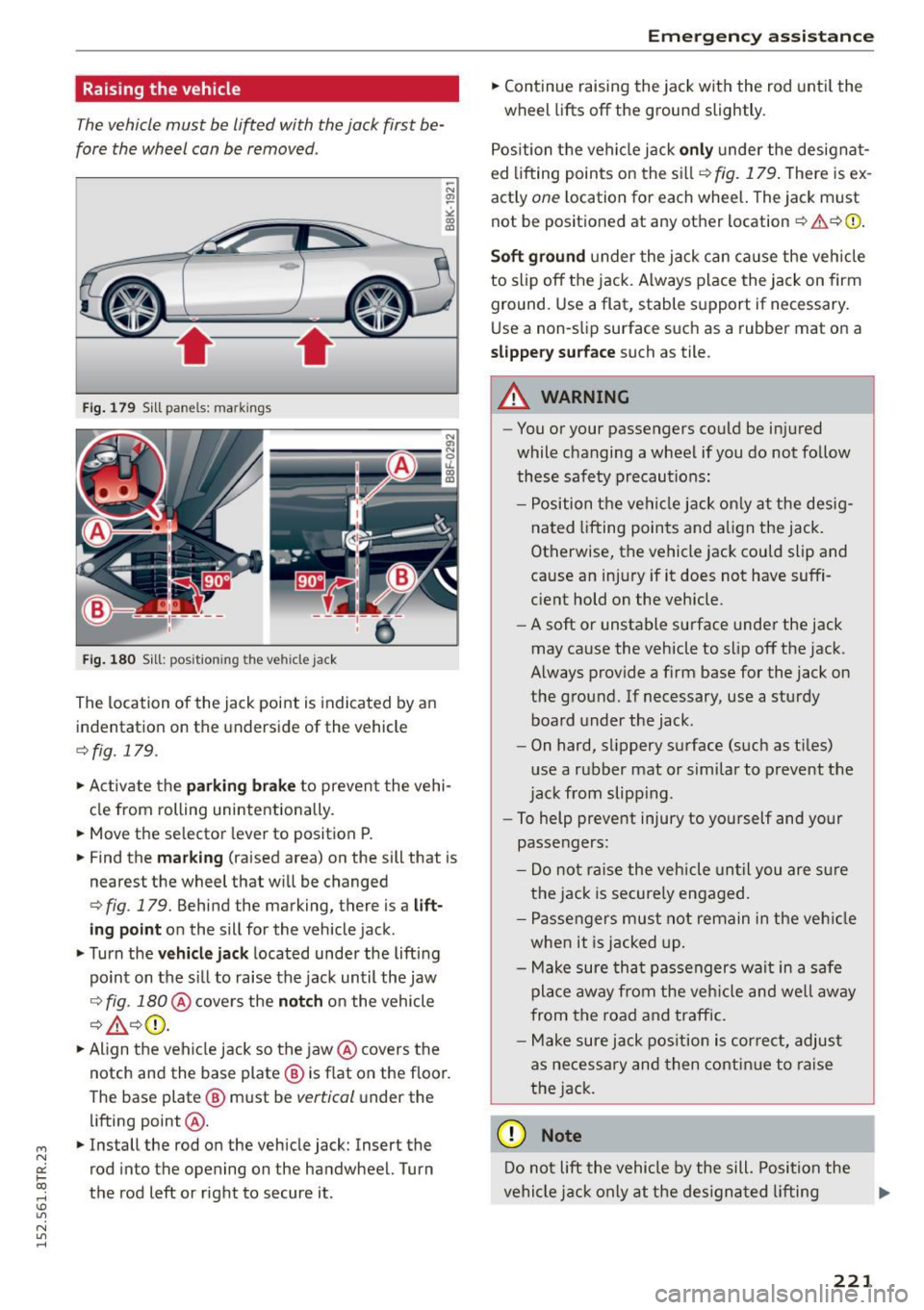
Fig. 179 Sill panels: marking s
Fig. 180 Sill: posit ion ing the vehicl e jack
The location of the jack point is indicated by an
indentation on the underside of the vehicle
¢ fig. 179.
.,.. Activate the pa rkin g brake to prevent the vehi
cle from rolling unintentionally .
.,.. Move the se lector lever to position P .
.,.. Find the
m ar king (raised area) on the sill that is
nearest the wheel that wi ll be changed
<=> fig . 179. Behind the marking, there is a lift
ing point on the sill for the vehicle jack .
.,.. Turn the
vehicl e jack located under the lifting
point on the si ll to raise the jack until the jaw
<=> fig. lBO @cove rs the n o tch on the vehicle
r=> ,& ¢0.
.,.. Align the vehi cle jack so the jaw @covers the
notch and the base plate @ is f lat on the floor.
The base plate @ must be
vertical under the
lifting point @.
.,.. Install the rod on the veh icle jack: Insert the
rod into the opening on the handwheel. Turn
the rod left or right to secure it.
Em erg en cy ass is tan ce
.,.. Continue raising the jack wit h the rod unt il the
wheel lifts off the ground slightly.
Position t he vehicle jack
only under the designat
ed lifting points on the si ll
r:1>fig. 179. The re is ex
actly
one l ocation fo r each wheel. The jack must
not be posit ioned at any other location
r=> ,& r:=>0 .
Soft ground under the jack can cause the veh icle
to s lip off the jack. A lways place the jack on firm
ground. Use a flat, stable support if necessary.
Use a non-slip surface suc h as a rubber mat on a
slipper y surface such as tile.
_& WARNING
--You or your passengers could be injured
while changing a wheel if you do not follow
these safety precautions:
- Position the vehi cle jack on ly at the desig
nated lifting points and a lign the jack.
Otherwise, the vehicle jack could slip and
cause an injury if it does not have suffi
cient hold on the vehicle.
- A soft or unstable surface under the jack
may cause the vehicle to slip off the jack .
Always provide a f irm base for the jack on
the g round. If necessary, use a sturdy
board under the jack.
- On hard, slippery surface (such as tiles)
use a rubber mat or similar to prevent the
jack from slipp ing .
- To help prevent injury to yourself and your
passengers:
- Do no t ra ise the vehicle until you are s ure
the jack is secure ly engaged.
- Passengers must not remain in the veh icle
when it is jacked up .
- Make sure tha t passengers wait in a safe
pla ce away from the veh icle and we ll away
from the road and traffic.
- Make sure jack pos ition is cor rect, adjus t
as necessary and then contin ue to raise
the jack .
(D Note
Do not lift the vehicle by the sill. Posi tion the
vehicle j ack only at the des igna ted lifting
221
Page 224 of 254
Emergency assistance
points on the sill. Otherwise, your vehicle will
be damaged.
Taking the wheel off/installing a wheel
Follo w these instructions step-by-step for chang
ing the wheel.
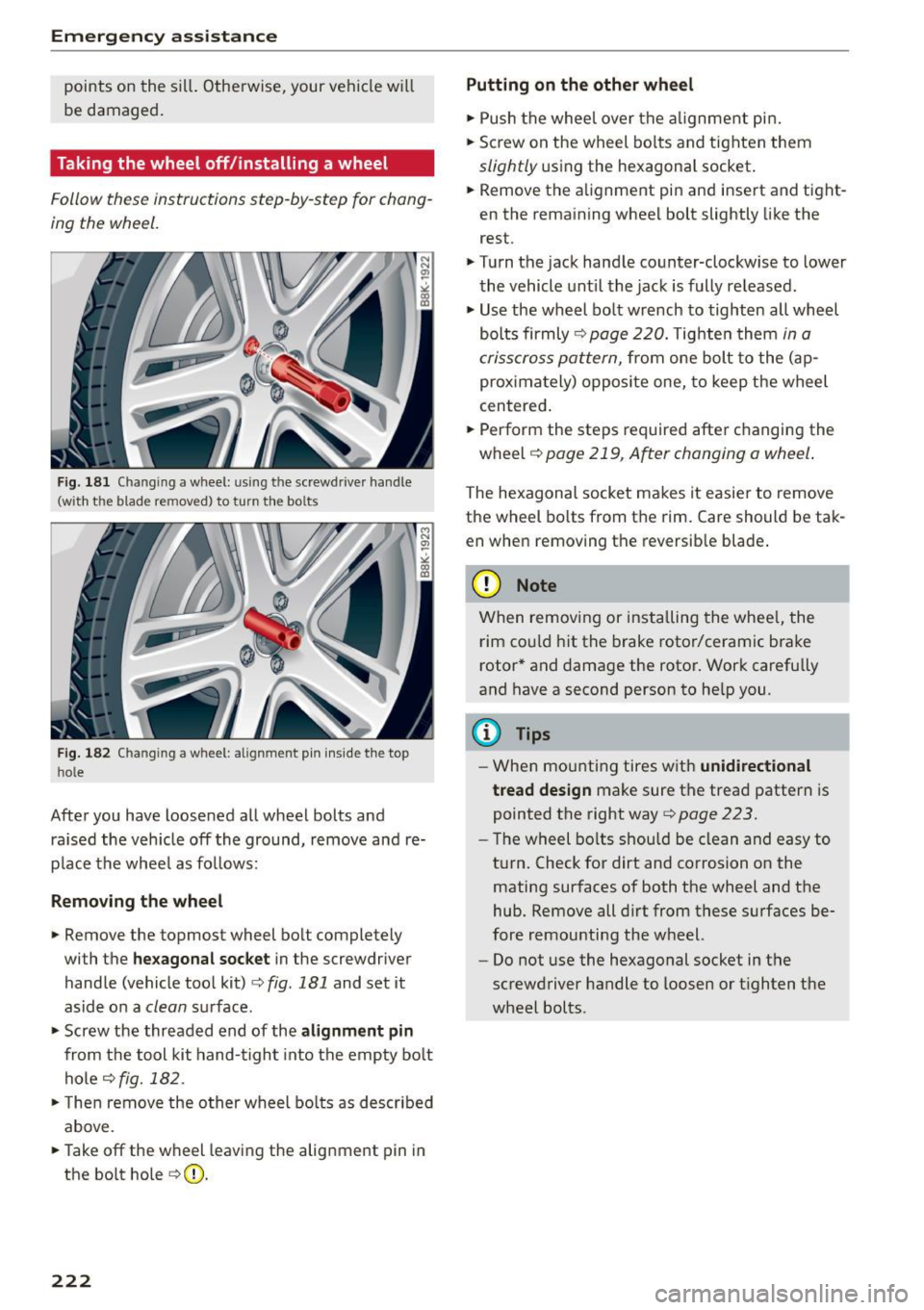
Fig. 181 Changing a wheel: using the screwdrive r handle
(with the blade removed) to turn the bolts
Fig. 182 Changing a wheel: alignment pin insid e the top
hole
After you have loosened all wheel bolts and
raised the vehicle off the ground, remove and re
place the wheel as follows:
Removing the wheel
.. Remove the topmost wheel bolt completely
with the
hexagonal socket in the screwdriver
handle (vehicle tool kit)
¢fig . 181 and set it
aside on a
clean surface.
.. Screw the threaded end of the
alignment pin
from the tool kit hand-tight into the empty bolt
hole
¢fig. 182 .
.. Then remove the other wheel bolts as described
above .
.. Take off the wheel leaving the alignment pin in
the bolt hole
c::;, (D.
222
Putting on the other wheel
.. Push the wheel over the alignment pin .
.. Screw on the wheel bolts and tighten them
slightly using the hexagonal socket .
.. Remove the alignment pin and insert and tight
en the remaining wheel bolt slightly like the
rest .
.. Turn the jack hand le counter-clockwise to lower
the vehicle until the jack is fully released .
.. Use the wheel bolt wrench to tighten all wheel
bolts firmly
c::;, page 220. Tighten them in a
crisscross pattern,
from one bolt to the (ap
proximately) opposite one, to keep the wheel
centered .
.. Perform the steps required after changing the
wheel
c::;, page 219, A~er changing a wheel.
The hexagonal socket makes it easier to remove
the wheel bolts from the rim. Care should be tak
en when removing the reversible blade.
(D Note
When removing or installing the wheel, the
rim could hit the brake rotor/ceramic brake
rotor* and damage the rotor. Work carefully
and have a second person to help you.
(D Tips
- When mounting tires with unidirectional
tread design
make sure the tread pattern is
pointed the right way
c::;, page 223.
- The wheel bolts should be clean and easy to
turn. Check for dirt and corrosion on the
mating surfaces of both the wheel and the
hub. Remove all dirt from these surfaces be
fore remounting the wheel.
- Do not use the hexagonal socket in the
screwdriver handle to loosen or tighten the
wheel bolts .
Page 225 of 254
M N
0:: loo ,...., \!) 1.1"1
N 1.1"1 ,....,
Tires with unidirectional tread design
Tires with unidirectional tread design must be
mounted with their tread pattern pointed in the
right direction.
Using a replacement tire with a tread pattern
intended for use in a specific direction
When using a replacement tire with a tread pat·
tern intended for use in a specific direction,
please note the following:
- The direction of rotation is marked by an
arrow
on the side of the tire .
-If the replacement tire has to be installed i n
the inco rrect direction, use the tire only tempo·
rarily since the tire will not be able to achieve
its optimum performance characteristics with
regard to aquaplaning, noise and wear.
- We recommend that you pay particular atten·
tion to this fact during wet weather and that
you adjust your speed to match road condi
tions .
- Replace the flat tire with a new one and have it
installed on your vehicle as soon as possible to
restore the handling advantages of a unidirec
t ional tire.
Notes on wheel changing
Please read the information ¢ page 203, New
tires or wheels
if you are going to use a replace
ment tire which is different from the t ires on your
vehicle.
After you change a tire:
- Check the tire pressure on the replacement
tire immediately after installation.
- Have the wheel bolt tightening torque
checked with a torque wrench as soon as pos
sible by your authorized Audi dealer or quali
fied workshop.
- With steel and alloy wheel rims, the wheel
bolts are correctly tightened at a torque of 90
ft lbs . (120 Nm).
- If you notice that the wheel bolts are corroded
and difficult to turn while changing a tire,
they should be replaced before you check the
tightening torque.
Emergency assistance
- Replace the flat tire with a new one and have
it installed on your vehicle as soon as possi
ble. Remount the wheel cover.
Until then, drive with extra care and at reduced
speeds.
_& WARNING
- If you are going to equip your vehicle with
tires or rims which differ from those which
were factory installed, then be sure to read
the information¢
page 203, New tires or
wheels.
- Always make sure the damaged wheel or
even a flat tire and the jack and tool kit are properly secured in the luggage com part·
ment and are not loose in the passenger
compartment.
- In an accident or sudden maneuver they
could fly forward, injuring anyone in the ve·
hide.
-Always store damaged wheel, jack and tools
securely in the luggage compartment. 0th·
erwise, in an accident or sudden maneuver
they could fly forward, causing injury to pas
sengers in the vehicle.
(D Note
Do not use commercially available tire seal·
ants. Otherwise, the electrical components of
the tire pressure monitoring system* will no
longer work properly and the sensor for the
tire pressure monitoring system* will have to b e replaced by qualified workshop.
.
223
Page 232 of 254

Emergency situation s
-The ba ttery ce ll lockin g screws must be
t ightened securely .
- Before you check anyt hing in the engine
compartment, always read and heed all
WARNINGS
c> page 187.
(D Note
Improper hook -u p of jumper cables can r uin
the generator .
- A lways connect POS ITIV E(+ ) to POS ITIV E
( + ), and NEGATIVE( -) to NEGATIVE( -)
gro und post of the battery manager control
unit .
- Check that a ll screw plugs o n the batte ry
ce lls are screwed in firmly . If not, tighten
pl ugs prior to connect ing clamp on negat ive
battery te rminal.
- Please note that the procedure for connect
i ng a jumper cable as desc ribed above ap
plies specifica lly to the case of yo ur vehicle
being jump started . W hen you a re g iving a
j u mp sta rt to another vehicl e, do
not co n
ne ct the negative ( -) cab le to the negative
( -) t erminal o n the di scharged battery @
c> fig. 18 8 . In stea d, secure ly co nn ect the
nega tive ( -) cab le to either a solid me tal
com ponent that is f irm ly bolted to the en
gine block o r to t he engine bloc k itself. I f
the battery that is being charged does not
vent to the outside , escap ing battery gas
could ignite and exp lode!
Towing with a tow truck
General hints
Y o ur Audi requires special handling for towing.
The fo llow ing information is to be used by com
mercia l tow truck operato rs who know how to op
erate their eq uipment safe ly .
- Never tow your Audi, towing will cause dam
age to the engine and transmiss ion.
- Never wrap the safety chains or winch cables
around the brake lines .
- To pre vent unnecessary damage, your Audi
must be transported with a flat bed truck.
230
- To load the vehicle on to the flat bed , use the
towing loop found in the vehicle tools and at·
tach to the front or rear anchorage
c> page 230 and c:>page 231.
A WARNING
A veh icle being towed is not safe f or passe n
gers . Never a llow anyone to ride in a ve hicle
be ing towed, fo r any reason .
Front towing loop
Do not install the front towing loop until it is
needed .
Fig. 18 9 Fro nt b um per: remov ing t he cove r cap
Fig. 190 Front b umper: sc rew ing in t he tow ing loop
The towing loo p fits in to the threade d hole locat
ed on the right side o f the front bum per and cov
e red by a small cover when not in use .
.,. Remove the tow ing loop fr om the vehicle tool
ki t
c> page 216.
... Take ho ld of the bot tom edge o f the cover cap
and pull it out of the bumpe r
9fig . 189 .
... Sc rew the tow ing loop t ightly into the threaded
hole as far as it will go
c> fig. 190 and t ighten it
with the wheel wrench . ..,.
Page 233 of 254

"' N
0:: loo
rl I.O
"' N
"' rl
When it is no longer needed, unscrew the towing
loop and put it back into the vehicle toolkit. Be
sure to have the towing loop stored in the vehicle
at all times .
A WARNING
If the towing loop is not screwed in as far as it
w ill go, the thread can pull out when the vehi
cle is towed -potential risk of an accident .
Rear towing loop
Do not install the rear towing loop until it is
needed.
0
0
Fig. 191 Rear bumper: cover
Fig. 192 Rear bumpe r: Screw ing in towing loop
.,.
-0
0
I-'-0) Ill
On the r ight side of the rear bumper there is a
threaded hole for the towing loop. The threaded
hole is protected by a cover.
• Remove the towing loop from the vehicle too l
kit
r::!;>page 216.
• Press the cover in by applying short strong
pressure to the bottom part to re lease it from
the bumper
r::!;> fig . 191.
• Screw the towing loop tight ly into the threaded
hole as far as it will go
r::!;> fig. 192 and tighten it
with the wheel wrench .
Emergency situations
Unscrew the towing loop again afte r use and in
stall the cover in the bumper. Install the cover in
the bumper . Return the tow ing loop to the tool
k it. Be sure to have the towing loop stored in the
vehicle at all times.
A WARNING
-If the tow ing loo p is not screwed in as far as it
will go, the thread can pull out when the vehi
cle is towed - potential risk of an accident.
Loading the vehicle onto a flat bed truck
Fig . 193 Vehicle on flat bed t ruck
Front hook up
.... 0) II> -' lit
l8
• Align the vehicle with the centerline of the car
carrier ramp.
"' Attach the winch hook to the front towline eye
prev ious ly installed .
Rear hook up
"'Align the vehicle with the centerline of the car
carrier ramp.
"' Attach the winch hook to the rear towline eye
previously installed .
@ Tips
Check carefully to make sure the hook-up is
secure before moving the car up the flatbed
truck ramp.
231