steering AUDI RS7 SPORTBACK 2014 Service Manual
[x] Cancel search | Manufacturer: AUDI, Model Year: 2014, Model line: RS7 SPORTBACK, Model: AUDI RS7 SPORTBACK 2014Pages: 292, PDF Size: 73.56 MB
Page 152 of 292
150 Airbag sys te m
backrest must be adjusted to an uprigh t
posit ion.
- Always make sure that there is nothing
on the front passenger seat that will
cause the capacitive passenger detection
system in the seat to s ignal to the A irbag
System that the seat is occupied by a
person when it is not, or to signal that it
is occupied by someone who is heavier
than the pe rson actually s itting on t he
seat. The presence of additiona l objects
cou ld cause the passenger front airbag
to be t urned on w hen it sho uld be off, or
cou ld cause the airbag to work in a way
that is different from the way it wou ld
have worked without the object on the
seat.
- Make sure that the
PASSENGER AIR BA G
OFF
light comes on and stays on all the
t ime w henever the ignition is switched
on.
Advanced Airbag System components
The front passenger seat in you r veh icle has a
l ot of very important pa rts of the Advanced
A irbag System in it . These parts include the
capacitive passenge r de tect ion sys tem, wir
ing, brac kets, and more . The cont ro l uni t
monitors the system on the front passenger
seat when the ignition is switc hed on and
turns the airbag indicato r light on when a
malfunction in the one of the system compo
nents is detected
c::;, page 155 . Because the
fro nt passenge r seat contains important pa rts
of the Advanced Airbag System , you must
take ca re to p revent it from being damaged.
Da mage to the seat may preven t the Ad
vanced A irb ag System for the fron t passenger
seat from doing i ts job in a c rash .
The front Advanced Airbag System
consists of the following:
-Crash sensors in the front o f the veh icle tha t
measure veh icle acceleration/dece le ration
to provide information to the Advanced Air bag System about the severity of the crash. -
An elect ronic contro l unit, with integrated
crash sensors for front and sid e impacts .
T he control un it "decides" whether to fire
the front a irbags based on the inform at ion
received from the crash sensors. The control
unit also "decides" whether the safety belt prete nsioners shou ld be act ivated .
- An Advanced A irbag w ith gas generator and
contro l valve for the driver inside the steer
ing wheel hub .
- An Advanced A irbag w ith gas generator and
contro l valve inside the inst rument panel for
the front passenger .
- A capacit ive passenger detection system u n
de rneath the front passenger seat cover .
This system measures the elec trical capac i
t ance of the perso n in t he seat. The informa
t ion regis tered is se nt cont inuo usly to the
electronic con trol un it to regu late deploy
ment of the front Advanced Airbag on the
passenger side.
- An airbag monitoring system and indicator
light in the instr ument cluster
c::;, page 154.
- A senso r in each front seat regis ters the dis
tance between the respective seat and the
steering whee l or instrument panel. The in
formation registered is sent cont inuo usly to
the electron ic contro l uni t to regulate de
ployment of the front Adv a need A irbags .
- The
PASSENGER AIR BAG OFF light comes
on and stays on in the center of the instr u
ment panel
c::;, page 155, fig . 162 and tells
you when the front Advanced Airbag on the
passenger side has been t urned off.
- A sensor in the safety belt latch for the driv
er and fo r the front seat passenger that
senses w hether t hat safety belt is latched or
no t and transmi ts this information to t he
elec tronic con trol un it.
A WARNING
D amage to the fron t passenger seat can
prevent the front airbag from working
p roperly.
- Imp roper repai r or disassembly of the
front passenge r and dr iver seat will pre
vent the Advanced Airbag System from
functioning properly .
-
Page 154 of 292
152 Airbag system
things on the sea t cushion can have the
same effect. If the front passenger fron tal airbag is turned on, the
PASSENGER
AIR BAG OFF
light light will go out .
How the Advanced Airbag System
components work together
The front Advanced Airbag System and the
side airbags supplement the protection of
fered by the front three -point safety be lts
with pretensioners and load limiters and the
adj ustab le head restraints* to help reduce the
risk of inju ry in a wide range of accident and
crash situa tions. Be sure to re ad the impor
tan t information abou t safe ty and heed the
WARNINGS in this chapter .
Dep loyment of the Advanced Airbag System
and the activat ion of the safety bel t preten
sioners depend on the decelera tion measured
by the crash sensors and registered by the
e lectronic control un it . The amount of i nfla
tion of the front airbags can also be adapted to the front sea t position , depend ing on the
d istance between t he respective front seat
and the steering wheel o r instrument pa nel as
registered by sensors in the seats. Crash se
ver ity depends on speed and dec elerat ion as
well as the mass and st iffness of the vehicle
or objec t invo lved in the crash .
On the passenge r side, regard less of safety
be lt use, the front passenger fronta l a irbag
will be turned off if the e lectrical capacitance
measured by the capac itive passenger de tec
tion system on the front passenger seat is less
than the amount programmed in the electron
i c co ntrol unit . The front passenger frontal air
bag will a lso be turned off if the capa cita nce
measured by the system for the front passen
ge r seat eq ua ls tha t of an infant of abo ut one
yea r of age in one o f the child sea ts that was
used to cert ify the Advanced Airbag System
under Federal Motor Vehicle Safety Standard
208. The
PASSENGER AIR BAG OFF li ght
comes on and stays on to tell you when the
front Advanced A irbag System on the passen
ge r side has been turned off~
page 155 .
A WARNING
-To reduce the risk of injury w hen an a irbag
in flates, always wear safety be lts p roperly.
- If you are unrestra ined, leaning fo rward,
sitt ing s ideways or out of pos ition in any
way, your risk of injury is much h igher .
- You will a lso receive se rious injuries and
could even be killed if you a re up aga inst
the airbag o r too close to it when it in
flates - even w ith an Advanced A irb ag
r:::> page 1 4 2 .
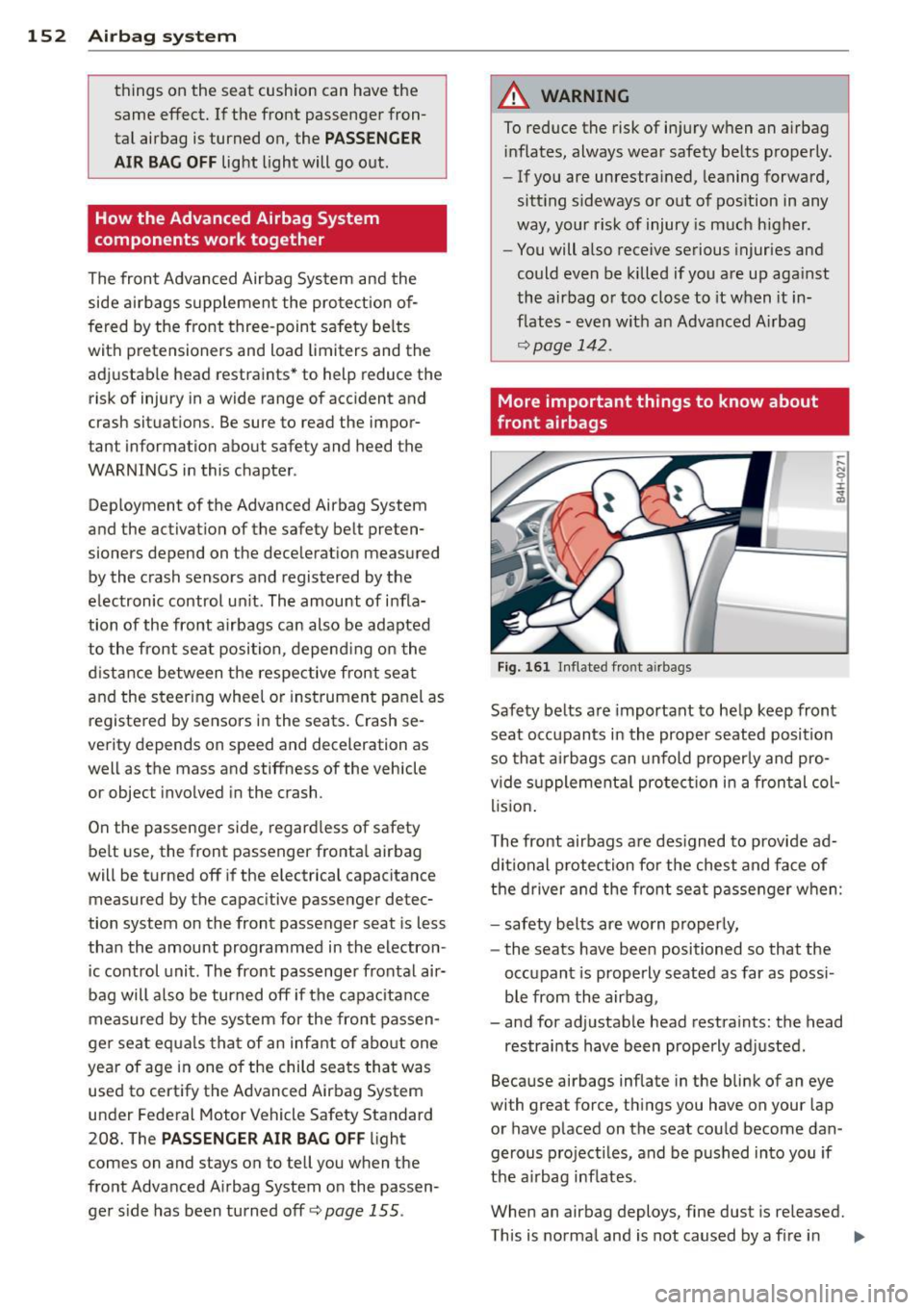
More important things to know about
front airbags
Fig . 1 61 In flated fro nt a irbags
Safety belts a re important to he lp keep front
seat o ccupants in the proper seated position
so that a irbags can unfold properly and pro
v ide s upplementa l pro te cti on in a fron tal col
li sion .
T he front airbags are des igned to provide ad
di tional p rotection fo r the ches t and face of
the driver a nd the front seat passenger w hen:
- safety belts are worn properly,
- the seats have bee n positioned so that the
occupant is properly seated as far as poss i
b le from the airbag ,
- and for ad justab le head restra ints: the head
restrai nts have been properly ad justed.
Beca use airbags inflate in the blink of an eye
with great force, th ings you have on your lap
or have p laced on the seat cou ld become dan
gerous projecti les, and be p ushed in to you if
t h e a irbag inflates .
When an airbag deploy s, fine dust is re leased.
This is norma l and is not caused by a f ire in ..,.
Page 160 of 292
158 Airb ag sys te m
- Have the airbag system inspected by
your Audi dealer before transporting
anyone on the front passenger seat.
If the capacitive passenger detection sys
tem determines that the front passenger seat is empty, the frontal airbag on the
passenger side will be turned off, and the
P ASS ENGER AIR BA G OFF light w ill stay
on .
Repair, care and disposal of the airbags
Parts of the a irbag system are installed at
many different pla ces on your Audi . Installing,
removing, servicing or repairing a part in an
area of the vehicle can damage a part of an
airbag system and prevent that system from
working properly in a co llision.
There are some important things you have to know to make sure that the effectiveness of
the system will not be impaired and that dis
carded components do not cause injury or po l
lute the environment.
A WARNING
Improper care, servicing and repair proce
dures can increase the risk of personal in
jury and death by preventing an airbag from deploy ing when needed or deploying
an airbag unexpectedly:
- Never cover, obstruct, or change the
steering wheel ho rn pad or airbag cover
or the instrument pane l or modify them
in any way .
- Never attach any objects such as cup
holders or telephone mountings to the
surfaces covering the airbag uni ts.
- For cleaning the horn pad or instrument
pane l, use only a soft, dry cloth or one
moistened w ith plain water. Solvents or
cleaners co uld damage the airbag cover
or change the stiffness or strength of the
material so that the airbag cannot de
ploy and protect properly. -
Never repair, adjust, or change any parts
of the a irbag system.
- All work on the steering wheel, instru
ment panel, front seats or e lectr ica l sys
tem (including the installation of audio
equ ipment, cellu lar telephones and CB
radios, etc.) must be performed by a
qualified technic ian who has the training
and specia l equipment necessary.
- For any wo rk on the airbag system, we
strongly recommend that yo u see your
author ized Audi dealer or qualified work
shop.
- Never modify the front bumper or parts
of the vehicle body.
- Always make sure that the s ide airbag
can inf late without inte rfe rence:
- Never install seat covers or rep lace
ment upholstery over the front seat
backs that have not been specifically
approved by Audi.
- Never use additional seat c ushions that
cover the areas where the side a irbags
inflate.
- Damage to the orig inal seat covers or
to the seam in the area of the side a ir
bag module must a lways be repaired
immediately by an author ized Audi
dealer .
- The airbag system can deploy on ly once .
After an a irbag has been deployed, it
must be replaced w ith new replacement
pa rts des igned and app roved es pecially
for your Aud i mo del ve rsion. Replace
ment of comple te airbag systems or air
bag components must be performed by
qualified wor kshops only . Make sure that
any airbag service action is entered in
your Audi Warranty
& Maintenance book
let under
AIRBAG REPLACEMENT RE
CORD .
-For safety reasons in severe accidents,
the alternator and starter a re sepa rated
from the veh icle battery with a pyrotech
n ic circuit inte rrupte r.
- Work on the pyrotechnic circuit inter
rupter must only be performed by a
qualified technicians who have the
llll-
Page 161 of 292
experience, informat ion a nd specia l
too ls necessary to perform the work
safely.
- If the veh icle or the circuit interrupter
is scrapped, all applicable safety pre
cautions must be followed.
@ For the sake of the environment
Undep loyed airbag modu les and preten
sioners might be classified as Perchlorate Material - special handling may apply, see
www.dtsc.ca .gov/hazardouswaste/per
chlorate. When the vehicle or parts of the
restraint system including airbag modules
and safety belts w ith pretens ioners are
scrapped, all applicable laws and regula
tions must be observed. Your author ized
Aud i dea ler is familiar with these requi re
ments an d we recommend that yo u have
your dea ler perform this se rvice for you .
Other things that can affect Advanced
Airbag performance
Changing the vehicle's suspension system can
change the way that the Advanced A irbag Sys
tem pe rforms in a crash. For example, us ing
tire -r im combinations not app rove d by Aud i,
l owering the vehicle, changing the stiffness o f
the suspension, incl uding the springs, s uspen
sion struts, shock absorbers etc. can change
the forces that a re measured by the airbag
sensors and sent to the elect ronic control
u ni t. Some suspension changes can, for exam
p le, increase the force levels measured by the
se nsors and make the airbag system deploy in
crashes in wh ich it would not dep loy if the
changes had not been made . Ot her k inds of
change s may reduce the force levels meas
u red by the sensors and prevent the a irbag
from deploying when it shou ld .
The sensors in the safety belt buckle fo r the
d river and front passenger sea t tell the elec
tronic control module if the safety belt is
l atched or not . If the safety belt is be ing used,
the front airbag will dep loy at a slightly high
er rate of vehicle deceleration than if the safe
ty belt is not being used. Therefore, in a pa r-
A irba g sy stem 159
ticular coll is io n, it is possible t hat an airbag
w ill not deploy at a seating position where the
safety belt is be ing used b ut w ill inflate at the
position where the safety belt is not be ing
used . It is important that nothing interfere
with the safety be lt buckles so that the sen
sors can send the cor rect info rmation about
safe ty be lt use to the electronic control un it .
A WARNING .
Changing the vehicle's suspension includ
i ng use of unapp roved tire-r im combin a
tions can cha nge Advanced Airbag per
formance and increase the risk of se rious
personal injury in a crash.
- Never install s uspension componen ts
that do not have the same performance characteristics as the components origi
na lly installed on your vehicle.
- Never use tire -rim combinations that
have not been approved by Audi .
Knee airbags
Description of knee airbags
Applies to vehicles: wit h knee airbags
The knee airbag system can provide supple
mental protection to properly restrained
front seat occupants .
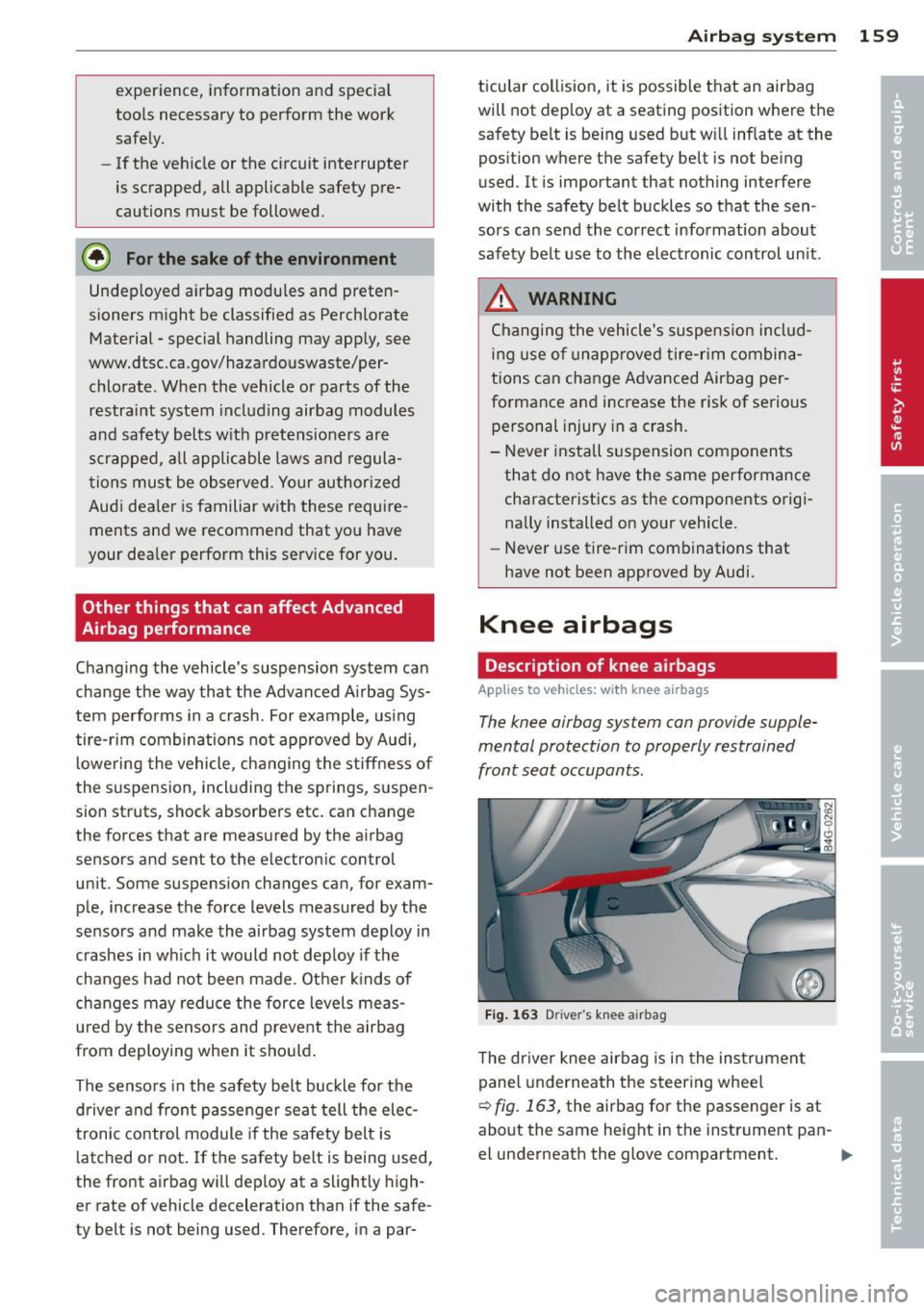
Fig. 1 63 Driver 's k nee airbag
T he driver knee airbag is in the ins trumen t
pane l underneath the steering wheel
r:::> fig. 163, the airbag for t he passenger is at
about the same height in the instrument pan-
el underneath the glove compartment. ..,.
Page 163 of 292
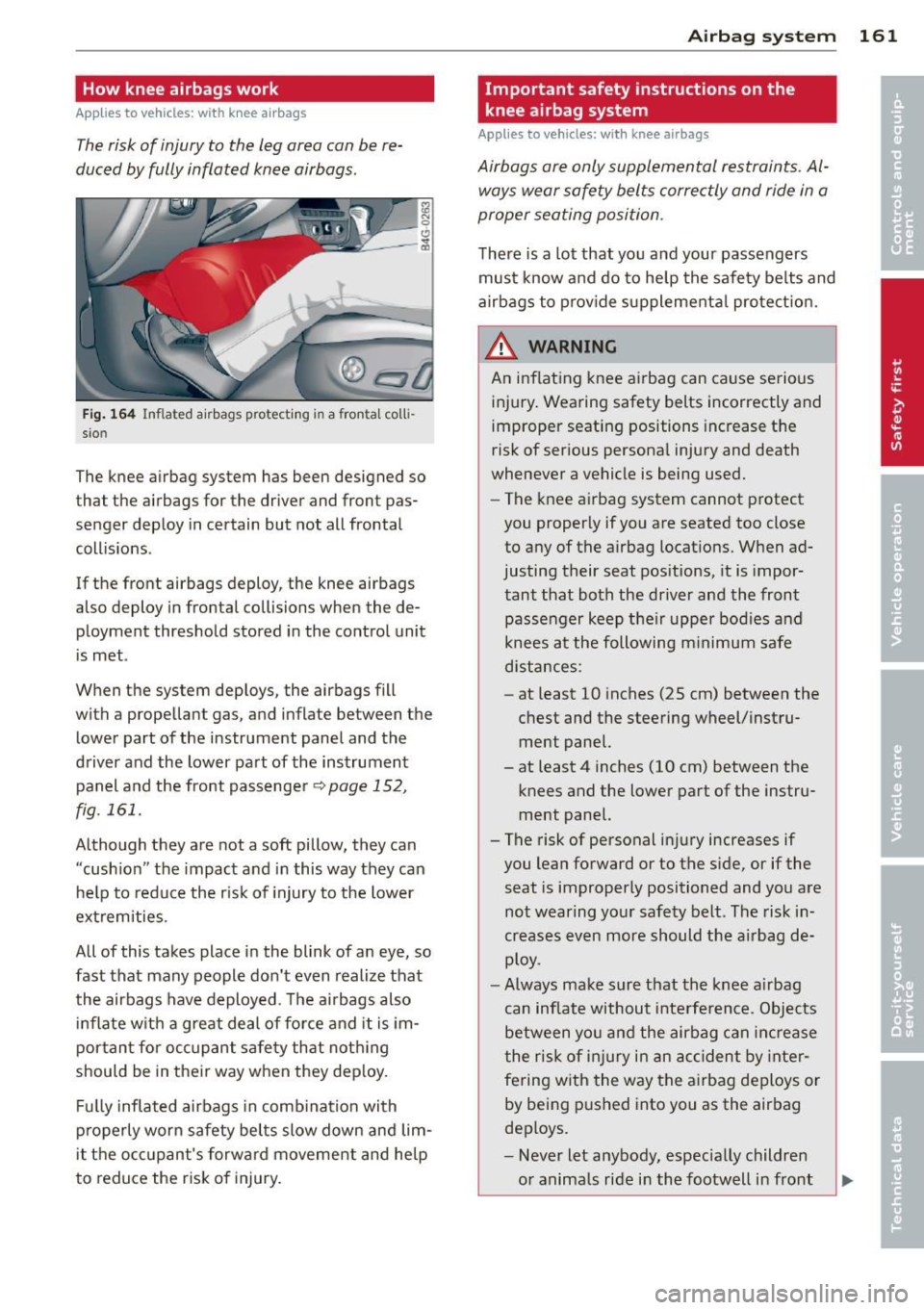
How knee airbags work
Applies to vehicles: with knee airb ags
The risk of injury to the leg area can be re
duced by fully inflated knee airbags.
Fig. 164 Inflated airbags protecting in a frontal coll i
sio n
The knee airbag system has been designed so
that the airbags for the driver and front pas
senger deploy in certain but not all frontal
collisions .
If the front airbags deploy, the knee airbags
also deploy in frontal collisions when the de ployment threshold stored in the control unit
is met .
When the system deploys, the airbags fill
with a propellant gas, and inflate between the lower part of the instrument panel and the
driver and the lower part of the instrument panel and the front passenger¢
page 152,
fig. 161.
Although they are not a soft pillow, they can
"cush ion" the impact and in this way they can
help to reduce the risk of injury to the lower
extremities.
All of this takes place in the blink of an eye, so
fast that many people don't even realize that
the airbags have deployed . The airbags also
inflate with a great deal of force and it is im
portant for occupant safety that nothing
should be in their way when they deploy.
Fully inflated airbags in combination with
properly worn safety belts slow down and lim
it the occupant's forward movement and help
to reduce the risk of injury.
Airbag system 161
Important safety instructions on the
knee airbag system
Applies to vehicles: wit h knee airbags
Airbags are only supplemental restraints . Al
ways wear safety belts correctly and ride in a
proper seating position.
There is a lot that you and your passengers
must know and do to help the safety belts and
airbags to provide supplemental protection.
_&. WARNING .. -
An inflating knee airbag can cause serious injury. Wearing safety belts incorrectly and
imprope r seating positions increase the
risk of serious personal injury and death
whenever a vehicle is being used.
- The knee airbag system cannot protect
you properly if you a re seated too close
to any of the airbag locations. When ad
justing their seat positions, it is impor
tant that both the driver and the front passenger keep their upper bodies and
knees at the following minimum safe
distances:
- at least 10 inches (25 cm) between the
chest and the steering wheel/instru
ment panel.
- at least 4 inches (10 cm) between the
knees and the lower part of the instru
ment panel.
- The risk of personal injury increases if
you lean forward or to the side, or if the seat is improperly positioned and you are
not wearing your safety belt . The risk in
creases even more should the airbag de
ploy.
- Always make sure that the knee airbag
can inflate without interference. Objects
between you and the airbag can increase
the risk of injury in an accident by inter
fering with the way the airbag deploys or
by being pushed into you as the airbag
deploys.
- Never let anybody, especially children
or animals ride in the footwell in front
Page 172 of 292
1 70 Child Safety
-Always read and heed all WARNINGS
whenever using a child restraint in ave
hicle
q page 133, Safety belts,
q page 142, Airbag system and
q page 168, Important things to
know.
(D Tips
Always replace child restraints that were
installed in a vehicle during a crash. Dam
age to a child restraint that is not visible
could cause it to fail in another collision
situation.
Advanced front airbag system and children
Your vehicle is equipped with a front "Ad
vanced Airbag System" in compliance with United States Federal Motor Vehicle Safety
Standard (FMVSS) 208 as applicable at the
time your vehicle was manufactured.
The Advanced Airbag system in your vehicle
has been certified to meet the "low-risk" re
quirements for 3- and 6-year old children on
the passenger side and small adults on the
driver side. The low risk deployment criteria
are intended to reduce the risk of injury
through interaction with the airbag that can
occur, for example, by being too close to the
steering wheel and instrument panel when
the airbag inflates . In addition, the system
has been certified to comply with the "sup
pression" requirements of the Safety Stand
ard, to turn
off the front airbag for infants up
to 12 months who are restrained on the front
passenger seat in child restraints that are list
ed in the Standard .
Even though your vehicle is equipped with an
Advanced Airbag system, all children, espe
cially those 12 years and younger, should al
ways ride in the back seat properly restrained
for their age and size. The airbag on the pas
senger side makes the front seat a potentially
dangerous place for a child to ride. The front
seat is not the safest place for a child in a for
ward -facing child safety seat. It can be a very dangerous place
for an infant or a larger child
in a rearward-facing seat.
The vehicle's Advanced Airbag System has a
capacitive passenger detection system in the
front passenger seat cushion that can detect
the presence of a baby or a child in a child re
straint system on this seat.
The capacitive passenger detection system
registers the changes that result in an electri
cal field when a child, a child restraint, and a
baby blanket are on the front passenger seat .
The change in the measured capacitance due
to the presence of a child, a child restraint,
and a baby blanket on the front passenger
seat is related to the child restraint system
resting on the seat. The measured capacitance
of a child restraint system varies depending
on the type of system and specific make and
model.
The electrical capacitance of the various
types, makes, and models of child restraints
specified by the U.S.National Highway Traffic
Safety Administration (NH TSA) in the relevant
safety standard are stored in the Advanced
Airbag System control unit together with the capacitances typical of infants and a 1-year
old child. When a child restraint is used on the
front passenger seat with a typical 1 year-old infant, the Advanced Airbag System compares
the capacitance measured by the capacitive passenger detection system with the data
stored in the electronic control unit. Child restraints and Advanced front
airbag system
Regardless of the child restraint that you use,
make sure that it has been certified to meet
United States Federal Motor Vehicle Safety
Standards and has been certified by its manu
facturer for use with an airbag. Always be sure
that the child restraint is properly installed at
one of the rear seating positions. If in excep
tional circumstances you must use it on the
front passenger seat, carefully read all of the
information on child safety and Advanced Air-
bags and heed all of the applicable .,..
Page 191 of 292
Intelligent technology Notice about data
recorded by vehicle
control modules
Your vehicle is not equipped with an Event Da
ta Recorder (EDR), installed by some manu
facturers for the express purpose of capturing
data for retrieval after an accident or crash
event. EDR's are sometimes called "crash re
corders".
Some state laws restrict the retr ieval or down
loading of data stored by EDR's that were in
stalled in a vehicle for the express purpose of
retrieving data after an accident or crash
event without the owner's consent.
Although your vehicle is not equipped with an
EDR, it is equipped with a number of electron
ic control modules for various vehicle systems
such as, for examp le, engine function, emis
sion control, as well as for the airbags and
safety belts.
These electronic control modules also record
vehicle-related data during norma l vehicle op
eration for diagnostic and repair purposes.
The recording capacity of the electronic con
trol modules is limited to data (no sound is re
corded) and only a small amount of data is ac
tually recorded over a very limited period of
time and stored when a system fault or other
condition is sensed by a control unit. Some of
the data then stored may relate to vehicle
speed, direction, braking as we ll as restraint
system use and performance in the event of a
crash or other condition. Stored data can only be read and downloaded with special equip
ment.
Electronic Stabilization
Control (ESC)
Description
ESC helps to improve road holding and vehicle
dynamics to help reduce the probability of
skidding and loss of veh icle control. It works
only when the engine is running. ESC detects
Intelligent technology 189
certain difficult driving situations, including
when the vehicle is beginning to spin (yaw)
out of control and helps you to get the veh icle
back under control by se lectively braking the
wheels, and/or reducing engine power and
providing steering ass istance to help hold the
vehicle on the driver's intended course. The in
dicator light
JjJ in the instrument cluster
blinks when ESC is taking action to help you
control the vehicle.
ESC has limitations .
It is important to remem
ber that ESC cannot overcome the laws of
physics.
It will not always be able to help out
under all conditions you may come up against.
For example, ESC may not always be able to
help you master situations where there is a
sudden change in the coefficient of friction of
the road surface. When there is a section of dry road that is suddenly covered with water,
slush or snow, ESC cannot perform the same
way it would on the dry surface. If the vehicle
hydroplanes (rides on a cushion of water in
stead of the road surface), ESC will not be
able to help you steer the vehicle because con
tact with the pavement has been interrupted
and the vehicle cannot be braked or steered .
During fast cornering, particularly on winding
roads, ESC cannot always deal as effectively
with difficult driving situations than at lower
speeds.
Always adjust your speed and driving style to
road, traffic and weather conditions. ESC can
not override the vehicle's physical limits, in
crease the available traction, or keep a vehicle
on the road if road departure is a result of
driver inattention. Instead, ESC improves the
poss ibility of keeping the vehicle under con
trol and on the road dur ing extreme maneu
vers by usin g the driver 's steering inputs to
help keep the vehicle going in the intended di
rection. If you are traveling at a speed that
causes you to run off the road before ESC can
provide any assistance, you may not experi
ence the benefits of ESC.
ESC includes and/or works together with the
anti- lock brake system (ABS), brake assist sys -
tem, anti-slip regu lation (ASR), electronic
Ill>
•
•
Page 192 of 292
190 Intelligent technology
differential lock (EDL), dynamic steering* and
selective whee l torque control. ESC is switch
ed on all the t ime. In certa in situations when
you need less traction, you can switch off ASR
by pressing the button
[ill c> page 191,
fig. 180. Be sure to switch ASR on again when
you no longe r need less traction .
Anti-loc k br ak ing system (ABS)
ABS prevents the wheels from locking up
when braking. The vehicle can still be steered
even during hard brak ing. Apply steady pres
sure to the brake pedal. Do not pump the ped
al. A puls ing in the brake pedal ind icates that
the system is he lp ing you to b rake the vehicle.
B rake as sist sys tem
The brake assist system can decrease braking
d istance. It increases braking power when the
driver presses the brake pedal quick ly in emer
gency situations. You must p ress and hold the
b rake pedal until the situation is over. I n
vehicles w ith adaptive cru ise cont rol*, the
b rake assist system is more sens it ive if the
d istance detected to the vehicle ahead is too
smal l.
Anti-slip regulation (ASR)
ASR reduces engi ne power when the d rive
wheels begin to spin and ad apts the fo rce to
the road condit ions. This makes i t easier to
start, accelerate and drive up hills .
Electronic differential lock (EDL)
The EDL brakes wheels that are spinning and
transfers the d rive powe r to the other d rive
wheel o r whee ls if the vehi cle is equipped wi th
a ll-w hee l drive* . This function is available up
to about 75 mph (120 km/h).
I n extreme cases, ED L automat ica lly swit ches
off to help keep the brake o n the braked whee l
from overheating . EDL wi ll switch on again au
tomatically when conditions have returned to
norma l.
Dynamic steering*
On vehi cles w ith dy namic stee ring*, ESC helps
stabilize the steering i n critical s ituations.
Selective wheel torque control
T he sele ctive whee l torq ue con trol ope rates
when driving through c urves . The front whee l
on the inside of th e curve o r both wheels on
the inside of the curve are braked selectively
as needed. This minimizes sliding in the front
whee ls and allows for more precise driving
t hr ough curves. The appl icable system may
not act ivate when dr iv ing in wet or snowy con
ditions .
,&. WARNING
-ESC, ABS, ASR, EDL, dy namic steeri ng*
and the select ive wheel torq ue con trol
c a nnot ove rcome the laws of physics.
T his is especially important on slippery
or wet roads.
If the systems begin acting
to stabilize your veh icle, yo u should im
mediately change your speed to match
the road and traffic conditions. Do not
let the increased safety provided by
these systems tempt you to take r isks.
Doing so will increase the risk of a loss of
veh icle cont ro l, collision and ser ious per
sonal injur ies.
- Always adapt your speed to road, traffic
and wea ther conditions. The risk of los
ing con trol of t he vehicle increases when
d riving too fast, espec ially through
curves and on slippery or wet roads, and
when dr iving too close to vehicles up
ahead. ESC, ABS, the brake assist sys
tem, ASR, EDL, dynam ic steering* and
the selective wheel torque contro l can
not prevent collisions .
- Always accelerate with special care on
even, smooth su rfaces such as those that
are wet or covered with ice and snow .
The drive wheels can spin eve n w ith
these assistan ce systems that cannot al
ways he lp to re duce the risk of loss of ve
h icle control.
(D Tips
- ABS and ASR o nly wo rk correctly when
all four wheels are equipped with identi
cal tires. D iffe ren t tire si zes can lead to a
reduction in engine power.
-
...
Page 196 of 292
194 Intelligent technology
overheat, premature wear and increased
stopping distance.
- Under certain climatic and operating
condit ions such as passing through wa
ter, driving in heavy ra in or after wash ing
the vehicle, the effect iveness of the
brakes can be reduced. In winter, ice ca n
accumulate on the brake pads, linings ,
discs and d rums . Carefully apply brakes
for a test . B rakes wi ll dry a nd ice coat
ings will be cleaned off after a few c are
f ul brake app lications .
- Driv ing fo r an ex tende d pe riod of time on
salt-covere d roads w ithout us ing yo ur
brakes can also affect braking efficiency.
Clean off accumulated salt coating from
brake discs and pads w ith a few caref ul
brake applicat ions.
- If you damage the front spoiler, or if you
install a different spoiler, be sure the air
flow to the front brakes is not obstruct ed. Otherwise the brake system could
overheat reducing the effectiveness of
the ent ire brake system .
- Failure of one brake c ircuit will impair
the braking capability res ulting in an in
creased stopp ing distance. Avoid driv ing
the vehicle and have it towed to t he near
est Au di dea le r o r q ualified w ork sh o p.
- Never let the vehicle ro ll to a stop w ith
the e ngine shu t off.
- If the brake booster is not working, the
bra ke pedal must be p ressed conside ra
bly harder to make up for the la ck of
booster assistance.
Electro-mechanical
power assist, dynamic
steering
The electro-mechanical power assist helps
the driver when steering .
Power steering adapts electronically based on
the vehicle speed .
Indicator lights and messages
• Steering defective! Stop the vehicle
If this indicato r light turns on and stays on
and t his message appears, the power steering
may have failed.
D o
not con tinue dr iv ing . See your author ized
Audi dealer or other qualified repair facility
for assistance .
'I-lj Steering: Sy stem fault You can continue
driving
If the indicato r light turns on and the mes
sage appea rs, the stee ring may be more diffi
cul t to move o r more sens itive th an usua l. The
stee ring wheel may a lso be at an ang le when
driving straight .
D rive slowly to you r authorized Aud i dea le r or
qualified wo rkshop to have the ma lf u nct ion
corre cted.
(:rij Dynamic st eering: Initializing
If this driver message appears and the indica
tor light is f lashing on the instrument panel,
dynam ic steer ing* is being rei nitia lized . Afte r
sta rting the engine, the stee ring wheel will
move s ligh tly. Re- ini tiali zation mig ht be ne c
essa ry if the stee ring wheel w as moved h ard
to the left and r ight wh ile the vehicle was not
moving . The display goes out as soon as initi
alization is complete.
D rive slowly to you r authorized Audi de aler or
qualified wo rkshop to have the ma lf u nct ion
corrected.
_& WARNING
Have t he dynamic stee ring * system mal
f u nction repa ired as soon as possible by an
a uthorized Audi dea ler or qua lified wor k
shop - risk of acc ident !
(D Tips
If the . or (:rij indicator light on ly stays
on for a short time, yo u may continue driv
i ng.
- The dynamic steering * stab ility systems
are not avai lab le in the event of a system
ma lf u nction.
- For add itiona l information on dynamic
steering *, refer to
c> page 96.
Page 231 of 292
-Never mount used tires on yo ur vehicle if
yo u are not sure of their "previous histo
ry." Old used tires may have been dam
aged even though the damage cannot be
seen that can lead to sudden tire failure
and loss of vehicle control.
- If you notice unusual vibration or if the
vehicle pulls to one side when d riving, al
ways stop as soon as it is safe to do so
and check the wheels and tires for dam
age .
(D Note
Please note that summe r and wi nte r tires
are designed for the cond itions that are
Glossary of tire and loading terminology
Accessory weight means the comb ined weight (in excess of
those sta ndard items which may be rep laced)
of au toma tic transmission, power steer ing ,
power brakes, power windows, power seats,
radio, and heater, to the extent that these
items are availab le as factory-installed equip
ment (whether installed or not) .
Aspect ratio
means the rat io o f the height to the w idth of
the tire in percent . Numbers of 55 or lower in
dicate a low sidewall for improved steering re
sponse and better overa ll handling on dry
pavement .
Bead
means the part of the t ire t hat is made o f
steel wires, wrapped or reinforced by ply cords
and that is shaped to fit the r im.
Bead separation
means a b reakdown of the bond between
components in the bead .
Cord means the strands forming the plies in the
tire.
Tire s an d wheel s 229
typica l in those seasons . Aud i recommends
using winter tires during the winter
months . Low temperatures signif icant ly
dec rease the e lasticity of summer t ires,
which affects tract ion and brak ing ability.
If summer t ires are used i n very co ld tem
peratures, cracks ca n form o n the tread
bars , res ulting in perma nen t tire damage
that can cause loud driving noise and un
bala nced ti re s. Audi i s not respon sible for
th is type of damage .
Cold tire inflation pressure
means the t ire p ress ure recommended by t he
vehicle manufacture r fo r a tire o f a des ignated
s ize t hat has not bee n driven for more than a
coup le o f miles (k ilometers) at low speeds in
the three hour period before the tire press ure
is m easured or adjusted.
Curb weight
me ans the we ight of a motor ve hicle with
st andard equipmen t incl ud ing the max imum
capacity of fuel, oi l, and coolant, air condi
tioning and additional weig ht of optiona l
equipment.
Extra load tire
means a t ire design to oper ate a t higher load s
and at higher inflation pressures than the cor
responding standa rd tire . Extra load tires may
be identified as "XL", "x l", "EXTRA LOAD", o r
"RF" on the sidewal l.
Gross Axle Weight Rating ("GAWR")
me ans the load-ca rry ing capac ity of a single
axle system , measured at the tire -ground in
te rfaces.
Gross Vehicle Weight Rating ( "GVWR ")
mea ns the maximum total loaded we ight of
the ve hicl e. .,..
•
•