ECO mode AUDI RS7 SPORTBACK 2015 Owner's Manual
[x] Cancel search | Manufacturer: AUDI, Model Year: 2015, Model line: RS7 SPORTBACK, Model: AUDI RS7 SPORTBACK 2015Pages: 302, PDF Size: 74.76 MB
Page 170 of 302
168 Child Saf ety
WARNINGS. Make certain that the ch ild and
child restraint are correct ly recognized by the
capacitive passenger detect ion system in the
front passenger seat, that the front passenger
a irbag is turned off, and that the airbag status
is always correct ly signa led by the
PAS SEN
GER AIR BAG OFF
l ight .
Many types and models of child restra ints
have been ava ilable over the years, new mod
e ls are introduced regular ly incorporating new
and improved designs a nd older models are
taken out of production . Child rest raints are
not standardi zed. C hild restra ints of the same
type typi cally have differen t weights and s izes
and d ifferent "footprints", the size and shape
of the bottom o f the child restraint that sits
on the seat, when they are installed on a vehi
cle seat. These differences make it virtually
imposs ible to certify compliance w ith the re
qu irements for advanced a irbags w ith each
and every child restraint that has ever been
sold in the past or will be sold over the course
of the useful life of you r vehicle .
For this reason, the United States Nat ional
H ighway Traffic Safety Admin istration has
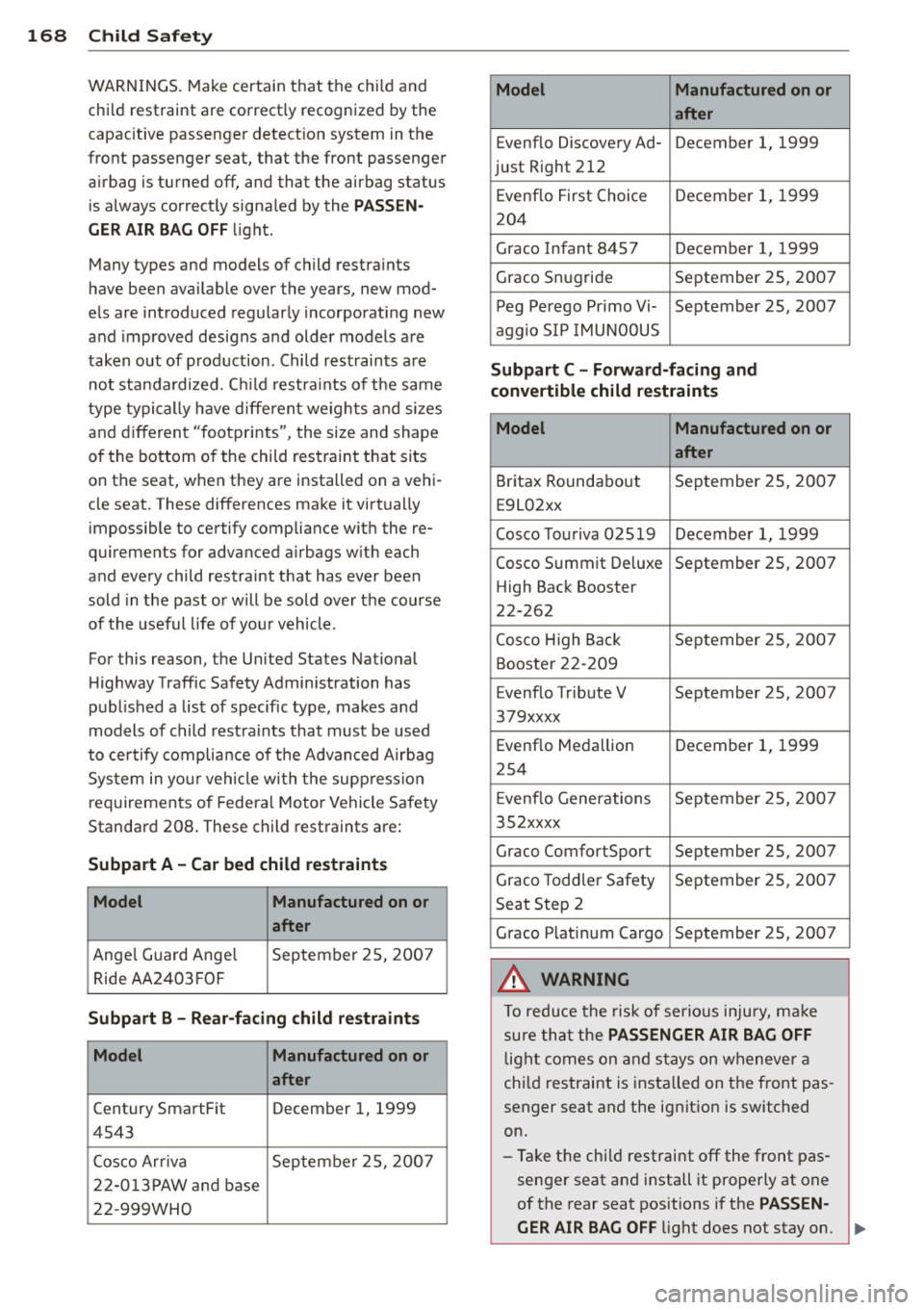
published a list of specific type, makes a nd
models of child rest ra ints that must be used
to certify complia nce of the Advanced Airbag
Sys tem in yo ur vehicle with the suppress io n
requiremen ts of Federal Motor Vehicle Safety
Standard 208 . These child restraints are:
Subpart A -Car bed child restraints
Model Manufactured on or
after
Angel Guard Ange l September 2S, 200 7
Ride AA2403 FOF
Subpart B -Rear -facing child restraints
Model Manufactured on or
after
Century SmartFit December 1, 1999
4543
Cosco Arriva September 2S, 2007
22 -0 13PAW an d base
22-999WHO
Model Manufactured on or
after
Evenflo Discovery Ad- December 1, 1999
just Right 212
E venflo First Choice December 1, 1999
204
Graco Infant 8457 December 1, 1999
Graco Snugride September 25 , 2007
Peg Perego Pr imo Vi- September 25, 2007
aggio SIP IMUNOOUS
Subpart C - Forward-facing and
convertible child restraints
Model Manufactured on or
after
Britax Roundabout September 25, 2007
E9L02xx
Cosco Touriva 02S19 December 1, 1999
Cosco Summit De luxe September 2S, 2007
High Back Booster
22-262
Cosco H igh Back September 2S , 2007
Booste r 22-209
Evenflo Tribute V September 25, 2007
379xxxx
Evenflo Meda llion December 1, 1999
254
E venflo Generations September 25 , 200 7
352xxxx
Graco ComfortSport September 25, 2007
Graco Todd ler Safety September 25, 2007
Seat Step 2
Graco Platinum Cargo September 25, 2007
A WARNING
To reduce the risk of serious inju ry, ma ke
sure that the
PASSENGER AIR BAG OFF
l ight comes on and stays on whenever a
chi ld restraint is installed on the front pas
senger seat and the ignition is switched
on.
- Take the chi ld restraint off the front pas
senger seat and install it properly at one
of the rear seat positions if the
PA SSEN -
GER AIR BAG OFF
light does not stay on. ...
Page 190 of 302
188 Intelligent technology
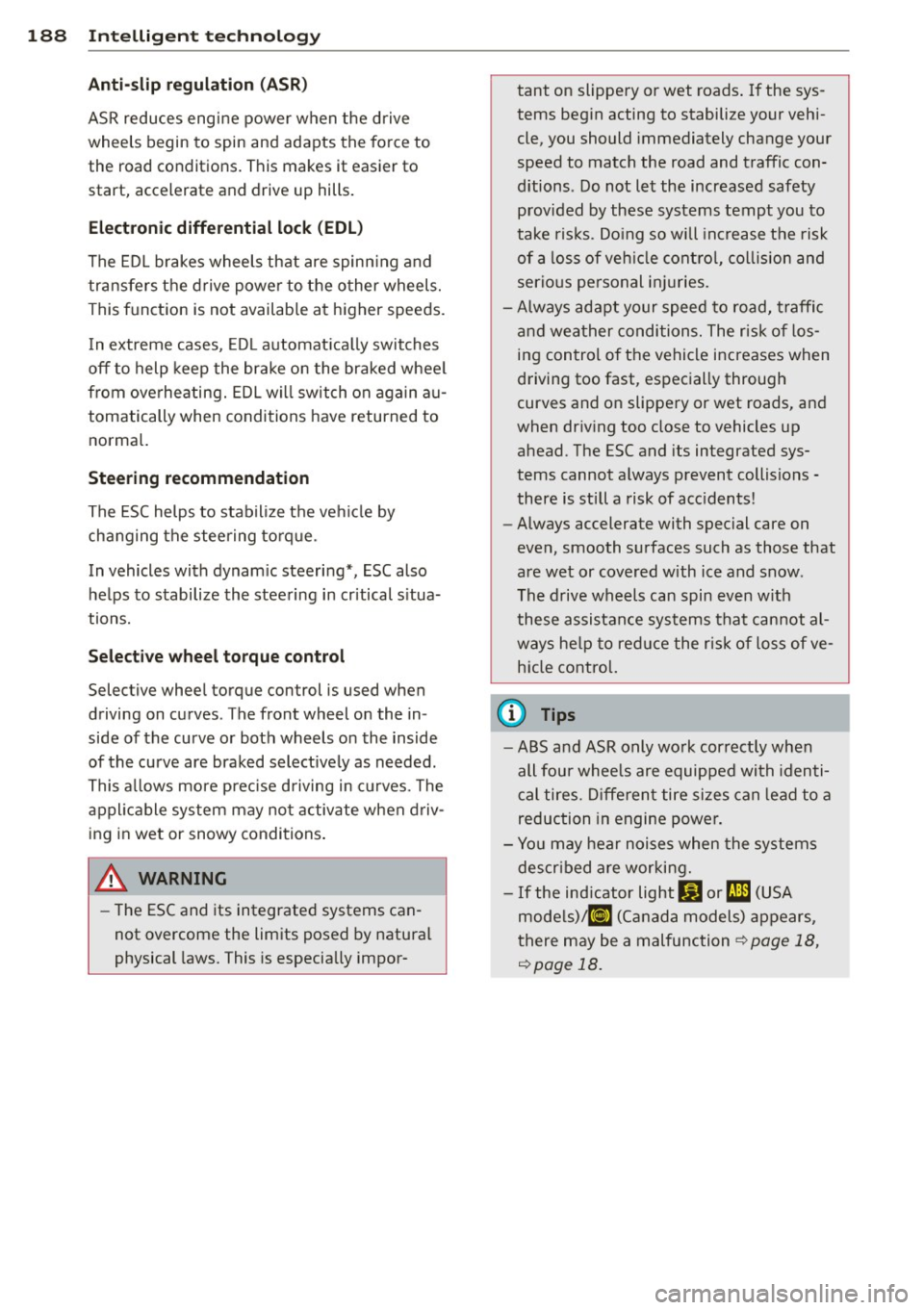
Anti-slip regulation (ASR )
ASR reduces engine power when the drive
wheels begin to spin and adapts the force to
the road conditions. This makes it easier to
start, accelerat e and drive up hills .
Electronic differential lock (EDL )
The ED L brakes wheels that are spinn ing and
transfers the drive powe r to the o ther wheels.
This function is not availab le at higher speeds.
I n extreme cases , ED L automat ica lly switches
off to help keep the brake on the braked whee l
from ove rheating. EDL wi ll sw itch on aga in au
tomatically when conditions have returned to
norma l.
Steering recommendation
The ESC helps to stabilize the ve hicle by
changing the steering to rque.
In vehicles with dynam ic steering*, ESC also
he lps to stabilize the stee ring in critical s itua
tions.
Selective wheel torque control
Selective wheel torque control is used when
driving on curves . The front wheel on the in
side of the curve o r both wheels on the inside
of the curve are braked selective ly as needed.
This a llows more prec ise driving in curves. The
appl icable system may no t activ ate when driv
ing in wet or snowy condi tions .
A WARNING
- The ESC and its integrated systems can
not overcome the lim its posed by natural
physical laws. This is especia lly impor- tant on slippery or wet roads
. If the sys
tems beg in acting to stabilize your vehi
cle, you should immediately change your
speed to match the road and traffic con
ditions . Do not let the increased safety
provided by these systems tempt you to
take risks. Do ing so will increase the risk
of a loss of veh icle contro l, collision and
serio us pe rsonal inj uries.
- Always ad apt your speed to road, traffic
a nd wea ther conditions. The risk of los
ing con trol of the vehicle increases when
driving too fast, especially through
curves and on slippe ry or wet roads, and
when dr iv ing too close to vehicles up
ahead . The ESC and its integrated sys
tems cannot a lways prevent collisions -
there is still a risk of acc idents!
- Always accelerate with special care on
even, smooth su rfaces such as those that
are wet or covered with ice and snow.
The drive wheels can spin even w ith
these assistan ce sys tems that cannot al
ways he lp to re duce the risk of loss of ve
h icle control.
(D Tips
- ABS and ASR o nly wo rk correctly when
all four wheel s are equipped with identi
c al tires . D iffe ren t tire sizes can lead to a
reduction in engine power.
- Yo u may hear noises when the systems
descr ibed are working.
- If the ind icator lig ht
BJ or rJlll (USA
mode ls)/ l§J (Can ada models) appears,
t here may be a malfunction ¢
page 18,
r:!>page 18.
Page 201 of 302
M N
0:: <.J 'SI: ,...., \!) 1.1'1 ,...., 1.1'1 ,....,
@ Tips
The consumption estimates as published by ENVIRONMENTAL PROTECTION AGENCY (EPA) and Transport Canada may not corre
spond to your actual consumption on the
road, which will vary depending upon vehi
cle load and speed, road and weather con
ditions, trip length, etc.
Drive smoothly and keep a lookout
ahead
Vehicles use the most fuel when they are ac
celerating.
~ Avoid unnecessary accelerating and braking.
Vehicles use the most fuel when they are ac
celerating. If you anticipate what is going to happen next, you will need to brake less and,
thus , accelerate less . Let the vehicle coast
whenever possible -for example when you see
that the next traffic light is red.
Avoid full throttle
Driving at moderate speeds saves fuel and
improves your mileage.
~ Try and keep well below your car's maximum
speed.
Accelerating gently reduces fuel consump
tion, engine wear, and does not disturb the
environment .
Fuel consumption, exhaust emissions and en
gine noise increase disproportionately at high
speeds . If you drive at approximately three
quarters of top speed, fuel consumption will
be reduced by one half. Never drive faster
than the posted speed limit and weather con
ditions permit.
Reducing unnecessary idling
Even when your car is just idling it burns up
fuel .
~ Shut the engine off when you are not driving
the vehicle.
Driving and environment 199
~ Do not warm up the vehicle by letting the
engine run at idle.
It makes sense to shut off the engine in traffic
jams , when waiting for trains to pass at rail
road crossings, or at traffic lights that have
long waits on red. Turning the engine off for
just 30 -40 seconds saves more fuel than is
burned starting the engine again.
It takes a long time for the engine to warm up
fully when it is running at idle. However, wear
and noxious emissions are especially high
when the engine is warming up. So you should
drive away as soon as you start the engine and
avoid running at high rpms while the engine is
still warming up .
(D Note
Do not leave engine idling unattended af
ter starting . If warning lights should come
on to indicate improper operation, they
would go unheeded. Extended idling also
produces heat, which could result in over
heating or other damage to the vehicle or
other property.
Regular maintenance
A badly tuned engine unnecessarily wastes a
lot of fuel.
~ Have your vehicle serviced at regular inter-
vals.
By having your vehicle regularly serviced by an
Audi dealer helps to ensure that it runs prop
erly and economically. The condition of your
vehicle not only affects its safety and ability to
hold its value, it also affects
fuel consump
tion.
Check your oil each time you fill your tank.
The amount of oil used is related to engine
load and speed .
It is normal for the oil consumption of a new
engine to reach its lowest value after a certain
mileage has been driven .
IIJ,,
•
•
Page 219 of 302
"' N
a:: I.J "". rl I.O
"' rl
"' rl
Engine cooling system
Coolant
The engine coolant performs two functions: it
keeps the engine from overheating and it pro
tects the engine from freezing in the winter .
The cooling system is sealed and generally re
qu ires little attention .
The cooling system has been filled at the fac
tory with a permanent coolant which does not need to be changed. The coolant consists of a
mixture of specially conditioned water and the
manufacturer's glycol-based coolant addi-
tive G13 antifreeze with anticorros ion addi
tives (50% for USA models; 60% for Canadian models) . This mixture both assures the neces
sary frost protection and protects metal com
ponents in the engine's cooling system from
corrosion and scaling.
It also raises the boil
ing point of the coolant.
Do not reduce the concentration of the coo l
ant in the summer by adding plain water .
The
proportion of coolant additive must be at
least 50% but not more than 60%
to main
tain antifree ze protection and cooling efficien
cy. If the coolant frost protection is too low,
the coolant could freeze and damage the vehi
cle heating and eng ine cooling system .
For year-round driving, antifree ze is added at
the factory for temperatures down to:
- -31°F(-35°C)USA
- -40 ° F ( - 40 °C) Canada.
I f you must add coo lant, use a mixture of wa
ter and coolant addit ive. Mixing the coolant
additive with distilled water is recommended.
& WARNING
Before you check anything in the engine
compartment, always read and heed all
WARNINGS ~.&.
in Working in the engine
compartment on page 211.
(D Note
- Before winter sets in, have the coolant
checked to see if the coolant additive in
Checkin g and fillin g 217
your vehicle is sufficient to meet the cli
mate conditions. This is especia lly impor
tant if you live in a region where the win
ter is extremely co ld. If necessary, in
crease the proportion of coolant additive
to 60% .
- When adding coolant additive to your
cooling system, remember :
- We recommend using only coolant ad
ditive G12++ or G13 (check the label)
for your vehicle . This coolant additive is
avai lable at authorized Audi dealers .
Other types of antifreeze can signifi
cantly reduce corrosion protection. The resulting corrosion can cause a loss of
coolant and serious engine damage.
- Do not add any type of radiator leak seal
ant to your vehicle's engine coolant.
Adding radiator repair fluid may adverse
ly affect the function and performance of
your cooling system and could result in
damage not covered by your New Veh icle
Limited Warranty.
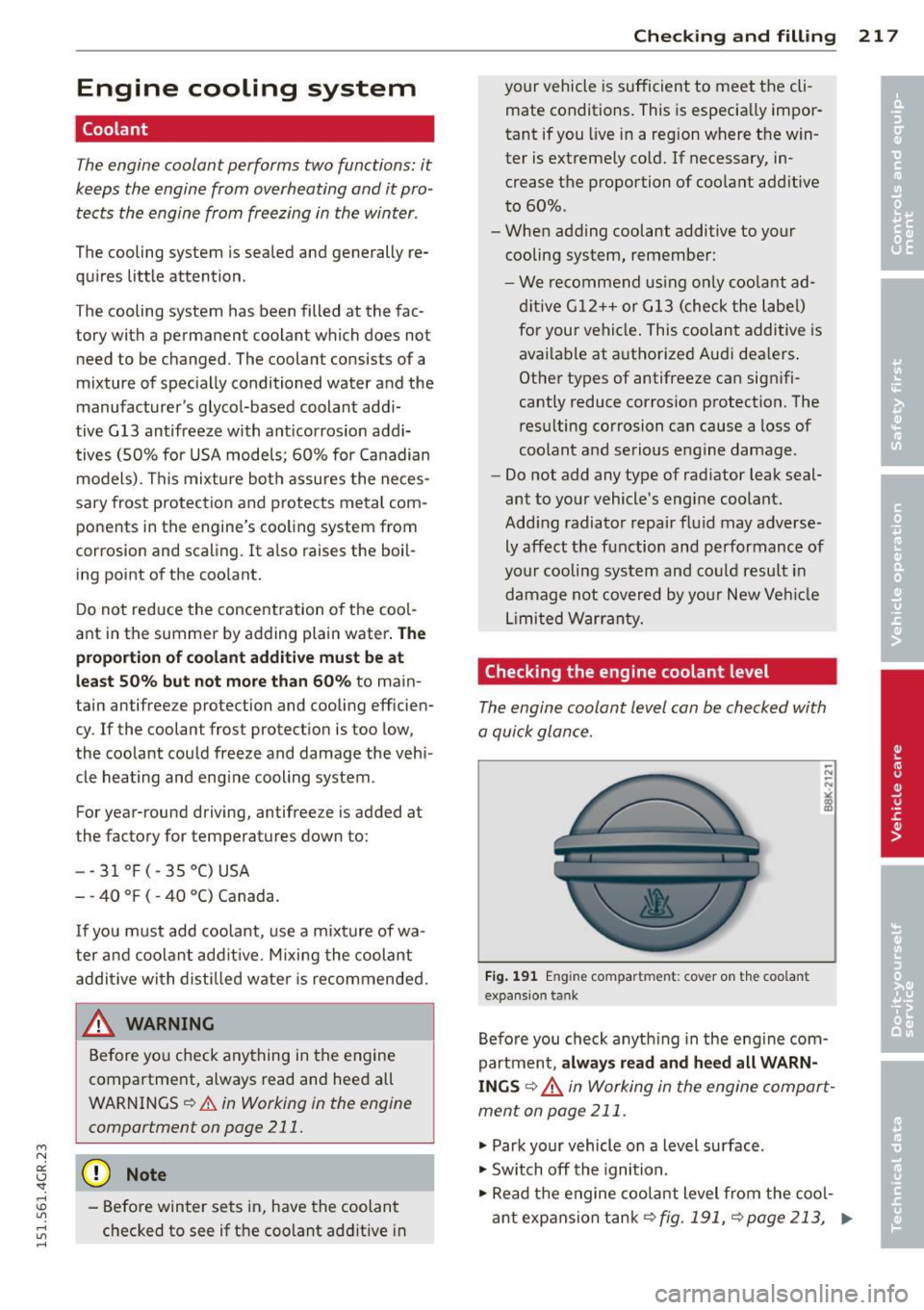
Checking the engine coolant level
The engine coolant level can be checked with
a quick glance.
Fig. 191 En gin e compar tment: cover on the coo lant
expansio n tan k
Before you check anyth ing in the eng ine com
partment,
always read and heed all WARN
INGS¢.&, in Working in the engine compart
ment on page 211 .
"'Park your vehicle on a level surface .
"' Sw itch off the ignition.
"' Read the engine coolant level from the cool
ant expansion tank ¢
fig. 191, ¢ page 213, Ill>-
Page 222 of 302
220 Checking and filling
Brake fluid
Checking brake fluid level
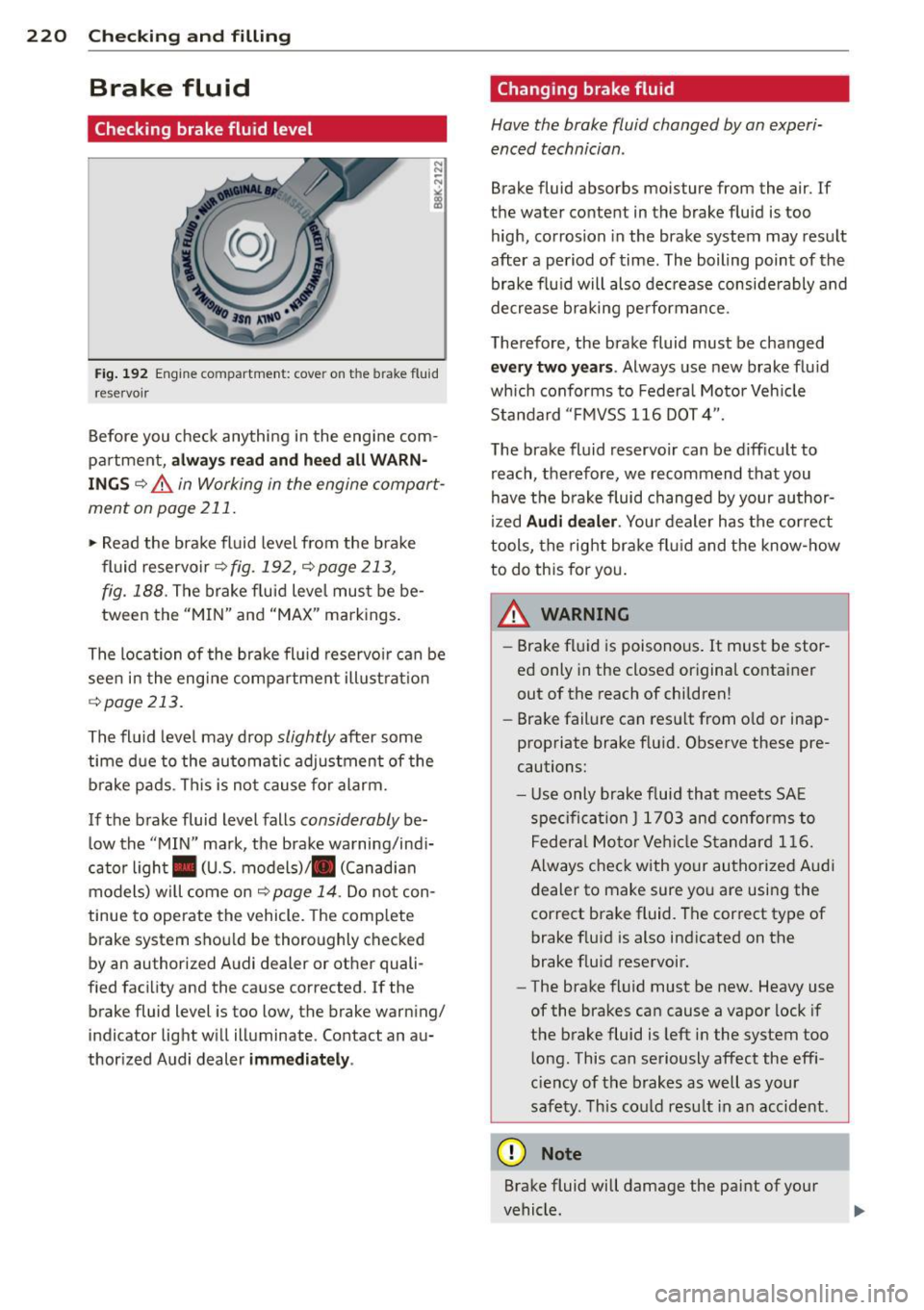
Fig . 192 Engine compar tment: cove r on the brake fl uid
reservo ir
Before you check anything in the engine com
partment,
always read and heed all WARN
INGS ¢&. in Working in the engine compart
ment on page 211.
,.. Read the brake fluid level from the brake
fluid reservoir¢
fig . 192, ¢ page 213,
fig. 188 .
The brake fluid level must be be
tween the "MIN" and "MAX" markings.
The location of the brake flu id reservoir can be
seen in the engine compartment illust rat ion
¢ page 213.
The fluid level may drop slightly after some
time due to the automatic adjustment of the
brake pads. This is not cause for alarm.
If the brake fluid level falls
considerably be
low the "MIN" mark, the brake warning/indi
cator light . (U.S. models)/ . (Canadian
models) will come on ¢
page 14. Do not con
tinue to operate the vehicle. The comp lete
brake system shou ld be thoroughly checked
by an authorized A udi dealer or other quali
fied facility and the cause corrected.
If the
brake fluid level is too low, the brake warning/
indic ator light will illuminate. Contact an au
thorized Audi dealer
immediately .
Changing brake fluid
Have the brake fluid changed by an experi
enced technician .
Brake fluid absorbs moisture from the air. If
t he water content in the brake fluid is too
high, corrosion in the brake system may result
after a period of time . The boiling point of the
brake flu id will also decrease conside rably and
decrease braking pe rformance.
Therefore, the brake fluid must be changed
every two years . Always use new brake flu id
which conforms to Federal Motor Vehicle
Standard "FMVSS 116 DOT 4".
The brake fluid reservoir can be difficult to
reach, therefore, we recommend that you
have the brake fluid changed by your author
ized
Audi dealer. Your dealer has the correct
tools, the right brake fluid and the know-how
to do this for you.
A WARNING
- Brake fluid is poisonous . It must be stor
ed only in the closed original container
out of the reach of children!
- Brake failure can resu lt from o ld or inap
propriate brake fluid. Observe these pre
cautions:
- Use only brake fluid that meets SA E
specification
J 1703 and conforms to
Federal Motor Vehicle Standard 116.
Always check with your authorized Audi
dealer to make sure you are using the
correct brake fluid. The correct type of
brake f luid is also indicated on the
brake fluid reservoir.
- The brake fluid must be new. Heavy use
of the brakes can cause a vapor lock if
the brake fluid is left in the system too
long . This can seriously affect the effi
c ie ncy of the brakes as well as your
safety. This could resu lt in an accident.
(D Note
Brake fluid will damage the paint of your
vehicle .
Page 237 of 302
Tires and wheels 235
If you wish to improve comfort
when operating the vehicle at
normal load (up to 2 occu
pants), you can adjust tire
pressures to those specified
for normal vehicle load. Before
operating the vehicle at maxi mum load, you must increase
the tire pressures to those
specified for maximum vehicle
load
c> .&. .
Bear in mind that the tire pres
sure monitoring system can on
ly monitor the tire pressures
you have stored. The system does not recognize the load
condition of your vehicle.
The effectiveness of the tire p ressure monitoring system
will be impaired if you store normal load pressures but then
operate the vehicle at its maxi
mum load
c> .&. .
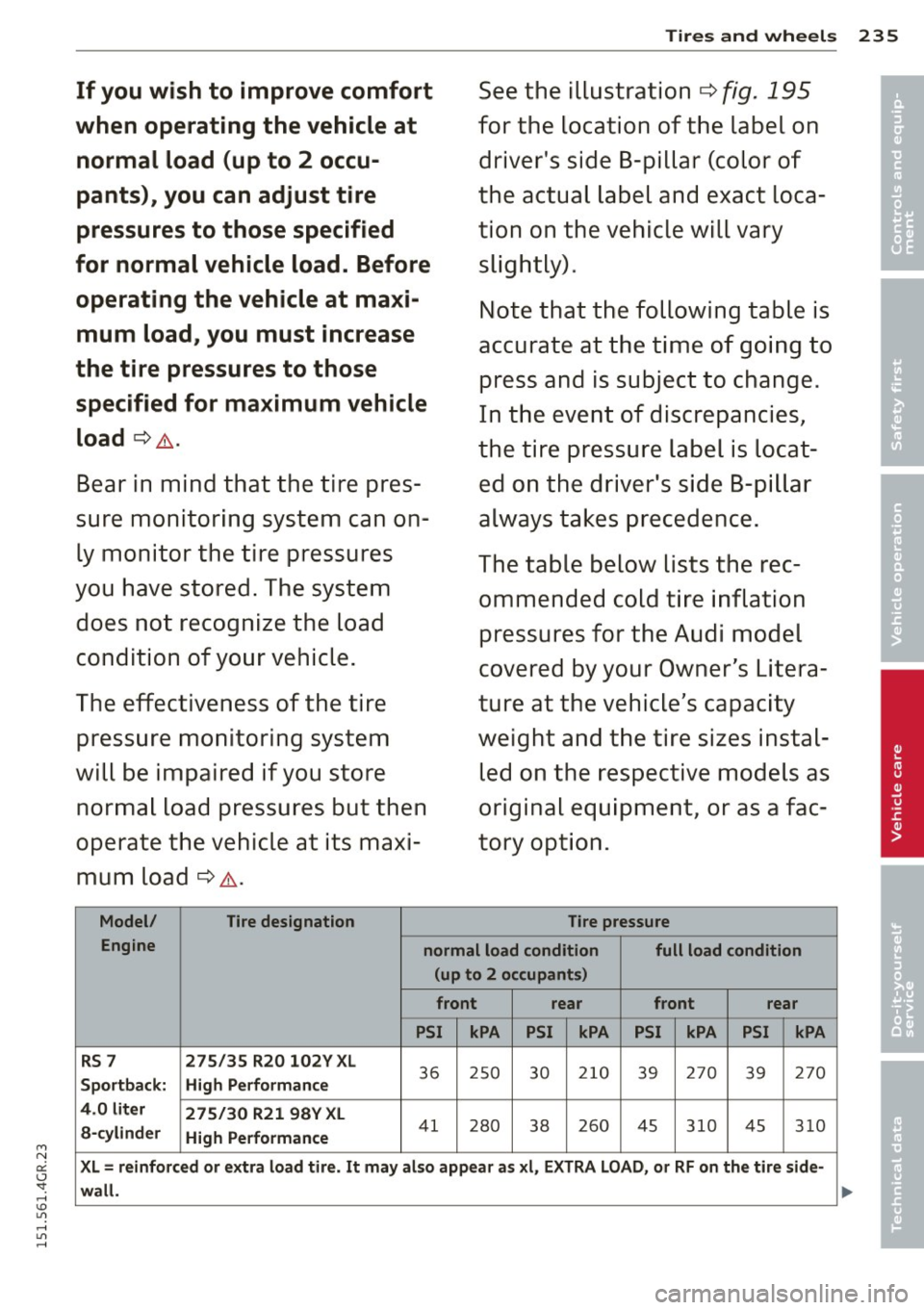
Model/ Tire designation
See the illustration c> fig. 195
for the location of the label on
driver's side B-pillar (color of
the actual label and exact loca
tion on the vehicle will vary slightly).
Note that the following table is
accurate at the time of going to
press and is subject to change.
In the event of discrepancies,
the tire pressure label is locat ed on the driver's side B-pillar
always takes precedence.
The table below lists the rec ommended cold tire inflation pressures for the Audi model
covered by your Owner's Litera
ture at the vehicle's capacity
weight and the tire sizes instal
led on the respective models as
original equipment , or as a fac
tory option.
Tire pressure
Engine normal load condition full load condition
(up to 2 occupants)
front rear front rear
PSI kPA PSI kPA PSI kPA PSI kPA
RS 7 275/35 R20 102V XL
3 6 250 30 210 39 270 39 270 Sportback: High Performance
4.0 liter 275/30 R21 98V XL
a -cylinder
High Performance
41 280 38 26
0 4 5 310 45 310
XL= reinforced or extra load tire. It may also appear as xl, EXTRA LOAD, or RF on the tire side-
wall.
•
•
'
Page 256 of 302
254 Tire s and wheel s
Wheel bolts
Wheel bolts must always be tightened to the
correct torque .
The design of wheel bolts is matched to the
factory installed rims. If different rims are fit
ted, the correct wheel bolts with the r ight
length and correctly shaped bolt heads must
be used. This ensures that wheels are fitted
secure ly and that the brake system funct ions
correctly .
In ce rtain circumstances, you may not use
wheel bolts from a different vehicle -even if it
i s the same mode l
~page 284.
_& WARNING
Improperly tig htened o r maintained whee l
bolts can become loose ca using loss of
contro l, a co llision and serious persona l in
jury.
- Always keep the wheel bolts and the
threads in the wheel hubs clean so the
wheel bolts can turn easily and be prop
erly t ightened.
- Never grease or oil the wheel bo lts and
the threads in the wheel hubs. They can
become loose while driving if greased or
oiled, even if tightened to the specif ied
torque.
- Only use wheel bolts that belong to the
rim being installed.
- Never use different wheels bolts on your
vehicle.
-Always maintain the correct tighten ing
torque for the wheel bo lts to reduce the
risk of a wheel loss. If the tightening tor
que of the wheel bolts is too low, they
can loosen and come out when the veh i
cle is moving. If the tightening torque is
too high, the whee l bolts and threads
can be damaged and the wheel can be
come loose.
@ Note
The spec ified torque fo r the wheel bo lts is
90 ft lb (120 Nm) w ith a tolerance of± 7,4
ft lb(± 10 Nm). Torque wheel bo lts diago- nally
. After changing a whee l, the torque
must be checked as soon as possible with a
torque wrench -preferably by an author
i zed Audi dealer or qualified workshop.
Low aspect ratio tires
Your Audi is factory-equ ipped w ith low aspect
ratio tires . These tires have been thoroughly
tested and been selected specifically fo r your
model for their superb perfo rmance, road fee l
and hand ling under a variety of d riving cond i
tions . As k your au thor ized A udi dealer for
more details .
T he low aspect ratio of these tires is ind icated
by a numera l of
55 or less in the tire's s ize
designation. The numera l represen ts the ratio
of the tire's sidewall height in relation to its
tread width expressed in percentage . Conven
tiona l tires have a height/width ratio of 60 or
more.
The perf orm ance of low- aspect-r atio tire s is
p ar ticu larly s ensitive to improper infl ati on
press ure . It is t here fore im portant that low
as pect rat io tires are infl ated to the spe cified
pre ssure and that the infl ation pressu re is
r e gularl y che ck e d and mainta in ed. Tire pre s
su res should b e check ed at least onc e a
month and alwa ys bef ore a long trip
~page 237, Checking tire pressure.
What you can do to a void tire and rim
damage
Low aspect ratio tires can be damaged more
easily by impact w it h potholes, curbs, gull ies
o r r idges on the road, pa rticularly if the tire is
u nderinfla ted .
In order to minimize the occurrence of impact
damage to the tires of you r vehicle, we recom
mend that you observe the follow ing p recau
tions:
- Always ma inta in recommended inflation
pressures. Check your tire pressure eve ry
2,000 miles (3,000 km) and add air if neces
sary .
- Dr ive carefully on roads with potholes, deep
gullies o r ridges. The impact from dr iv ing ..,.
Page 259 of 302
"' N
a:: I.J "". rl I.O
"' rl
"' rl
Note that the tire pressure also depends on
the tempe rature of the tire . Every 50 °F
(10 °C) increase in tire temperature results in
the tire pressure increasing by approximately
0 .1 bar. The tire pressure increases as the en
g ine becomes warmer while drivi ng .
A WARNING
Read and follow the impo rtant informa
tion and notes
c::> page 2 56.
(D Tips
The tire pressure or temperature are not disp layed i n adaptation mode . Dashes --,-
are show n in p lace o f the pressure and
t em peratur e.
(J) Tire pressure loss
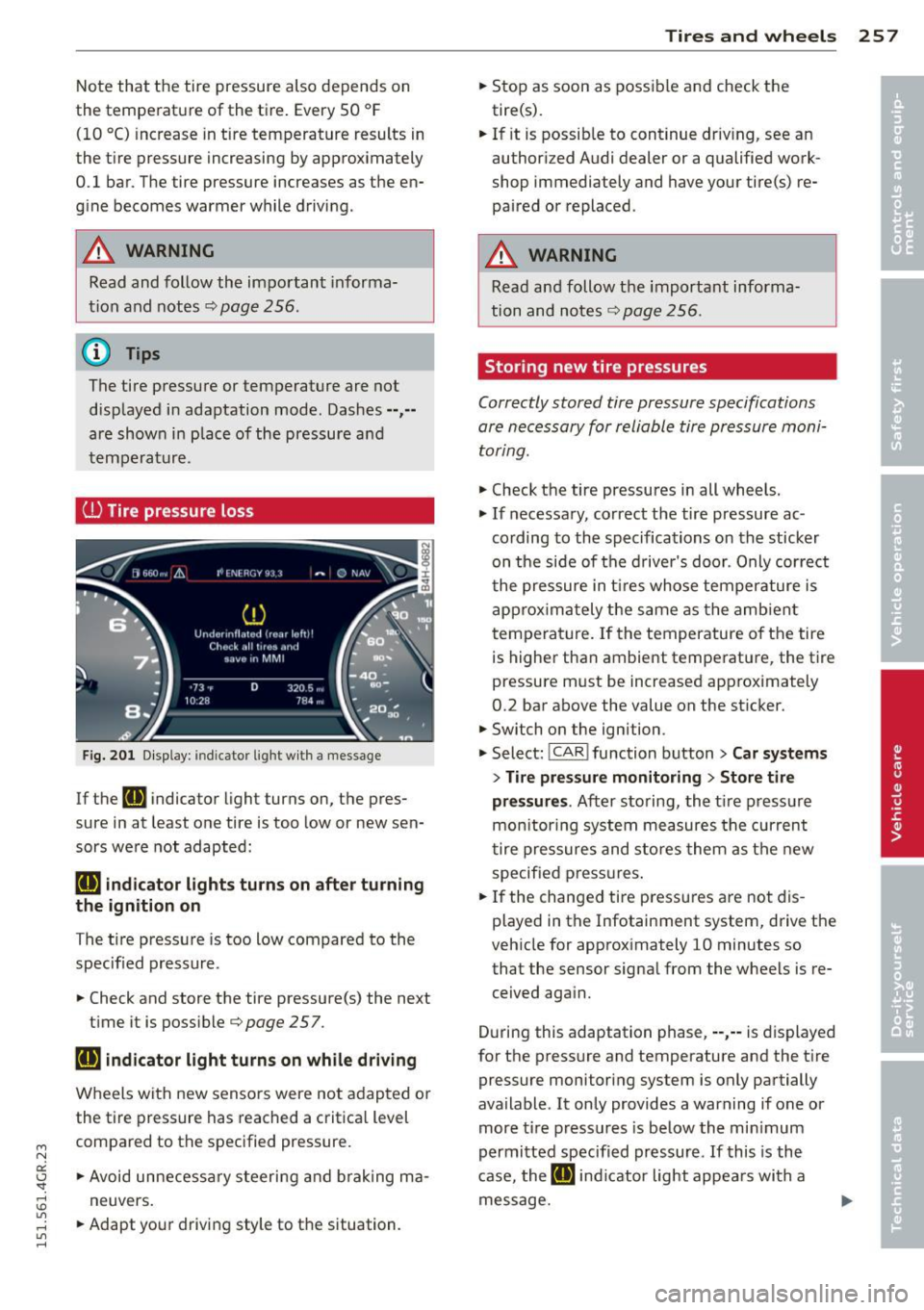
Fig. 201 D isp lay : in dicato r light w it h a message
If the [I] indicator light turns on, t he pres
sure in at least one tire is too low or new sen
sors were not adapted:
[I] indicator lights turns on after turning
the ignition on
The ti re pressu re is too low compared to the
specified pressure .
.. Check and store t he tire pressure(s) the next
time it is poss ible
c::> page 257.
[I] indicator light turns on while driving
Wheels with new senso rs were no t adap ted o r
the tire pressure has reached a critica l level
compared to the specified pressure.
.. Avoid unne cess ary steeri ng and braking m a
neuvers.
.. Adapt yo ur driving style to the s ituation.
Tires and wheels 25 7
.. Stop as soon as poss ible and check the
tire(s) .
.. If it is possib le to continue driv ing, see an
author iz ed Audi dealer or a qualified work
shop immediately and have your tire(s) re
paired or replaced .
A WARNING
Read and follow t he important informa
tion and notes
c::> page 256 .
Storing new tire pressures
-
Correctly stored tire pressure specifications
are necessary for reliable tire pressure moni
toring .
.. Check t he tire pressures in all wheels.
.,. If necessary, correct the tire pressure ac
cording to the specifications on the sticker
on t he side of the d rive r's door . Only correct
t he pressure in t ires whose temperature is
app rox im ately the s ame as th e amb ient
t emperat ure. If the temperature o f the tire
is highe r than ambient tempe rat ure, the t ire
pressure m ust be increased approximately
0.2 bar above the value on the st icker .
.. Switch on the ignition .
.,. Select:
!CAR ! function butt on> Car systems
> Tire pressure mon itoring > Store tire
pressures .
After storing, th e tir e p ress ure
m oni tor ing system measures the cur ren t
t ire pre ssures and st ores them a s the new
specified press ures .
.. If the changed ti re pressu res a re not dis
played in the Infotainment system, drive t he
veh icle for approximately 10 minutes so
that the sensor signa l from the wheels is re
ceived aga in .
D uring this adaptation phase, ··,·· is displayed
for the pressure and temperature and the t ire
pressure monitoring system is only partially
available . It only provides a warning if one or
more t ire press ures is be low the min imum
permi tted specified pr essure . If this is the
case, the
[I] ind ic a tor light appea rs with a
message.
Page 276 of 302
2 7 4 Emergency situations
@ Tips
The discharged battery must be properly
connected to the vehicle's electrical sys
tem. When jump starting or charging the
battery, never connect the negative
ground cable to the battery negative post
because the batte ry manager system must
be able to detect the battery 's state of
charge. Always connect the negative
ground cab le to the negative ground post
of the battery manager control unit.
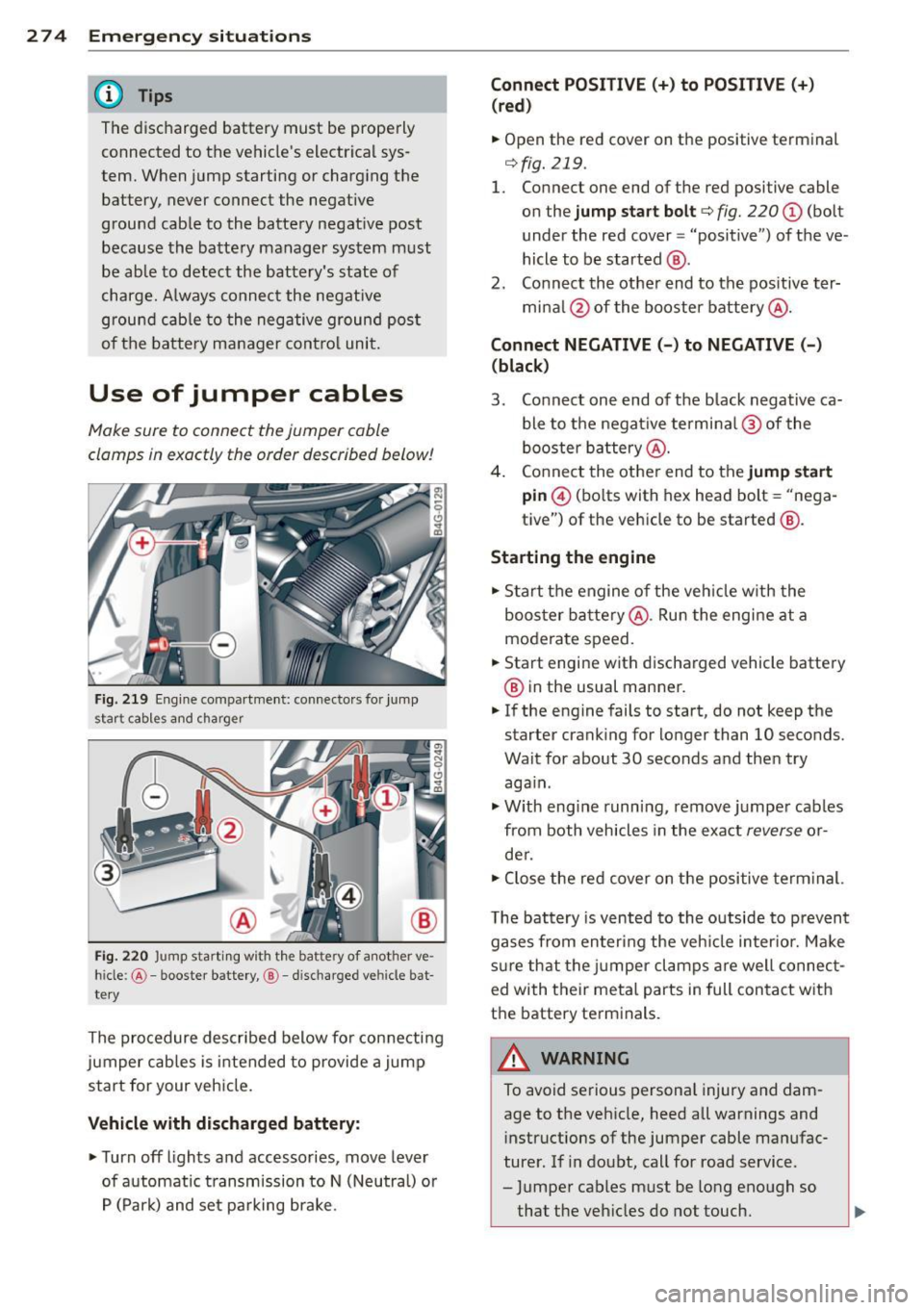
Use of jumper cables
Make sure to connect the jumper cable
clamps in exactly the order described below!
Fig. 219 Engine compartment: connecto rs for jump
start cables and charger
Fig. 220 Jump start ing with the battery of another ve·
hide: @-booster battery, @-discharged ve hicle bat
tery
The procedure described below fo r connecting
jumper cables is intended to provide a jump
start for your vehicle.
Vehicle with discharged battery:
.,. Turn off lights and accessories, move lever
of automatic transmission to N (Neutral) or
P (Park) and set parking brake.
Connect POSITIVE(+) to POSITIVE(+)
(red)
.,. Open the red cover on the positive terminal
¢fig. 219.
1. Connect one end of the red positive cable
on the
jump start bolt c::;, fig. 220 @ (bolt
under the red cover = "positive") of the ve
hicle to be started @.
2. Connect the other end to the positive ter-
mina l@ of the booster battery@.
Connect NEGATIVE (-) to NEGATIVE (-)
(black)
3. Connect one end of the black negative ca
ble to the negat ive terminal @ of the
booster battery @.
4. Connect the other end to the
jump start
pin © (bolts with hex head bolt= "nega
tive") of the vehicle to be started @.
Starting the engine
.,. Start the engine of the veh icle w ith the
booster battery@. Run the engine at a
moderate speed .
.,. Start engine with discharged vehicle battery
@ in the usual manner.
.,. If the engine fails to start, do not keep the
starter cranking for longer than 10 seconds.
Wait for about 30 seconds and then try aga in .
.,. With engine running, remove jumper cables
from both vehicles in the exact
reverse o r
de r .
.,. Close the red cover on the positive term inal.
T he battery is vented to the outside to prevent
gases from entering the veh icle inter ior. Make
sure that the jumper clamps are well connect
ed with their metal parts in full contact with
the battery terminals.
_& WARNING
To avoid serious personal injury and dam
age to the vehicle, heed all warnings and
instructions of the jumper cable manufac
turer. If in doubt, call for road service .
- Jumper cables must be long enough so
that the veh icles do not touch.
-
Page 284 of 302
282 Consumer Information
Consumer Information
Warranty coverages
You r Audi is covered by the following war
ranties:
- New Vehicle Limited Warranty
- Limited Warranty Against Corrosion Perfo-
ration
- Emissions Control System Warranty
- Emissions Performance Warranty
- California Emissions Control Warranty (USA
vehicles only)
- California Emissions Performance Warranty
(USA vehicles only)
Detailed information regarding your warran
ties can be found in your
Warranty & Mainte
nance booklet .
Operating your vehicle
outside the U.S.A. or
Canada
Government regu lations in the United States
and Canada require that automobiles meet
specific emission regulations and safety
standards. Therefore, veh icles built for the
U.S.A . and Canada differ from vehicles sold in
other countries .
If you p lan to take your vehicle outside the
continental limits of the United States or Can
ada, there is the possibility that:
- unleaded fuels for vehicles with cata lytic
converter may not be available;
- fuel may have a considerably lowe r octane
rating. Improper fuel may cause engine
damage ;
- service may be inadequate due to lack of
proper service facilities, tools or testing
equipment ;
- replacement pa rts may not be readily availa
ble.
- Navigation systems for vehicles built for the
U.S.A. and Canada will not necessar ily work
in Europe, and may not work in other coun
tries outside North America .
(D Note
Audi cannot be responsible for mechanical
damage that could result from inadequate
fuel, service or parts availability.
Audi Service Repair Manuals and Literature
Audi Official Factory Service Manuals and Lit
erature are published as soon as possible after
model introduction. Service manuals and lit
erature are available to order from the Audi
T echnical Literature Ordering Center at:
www.audi.techliterature.com
Maintenance
General
Your vehicle has been designed to help keep
maintenance requirements to a minimum.
However, a certain amount of regular mainte
nance is still necessary to assure your vehicle's
s afety, economy and rel iability. For detailed
vehicle maintenance consult your Warranty &
Maintenance booklet.
Under difficult operating conditions, for ex
ample at extremely low outside temperatures,
i n very dusty regions , etc., some service work
should be performed between the intervals
specified. This applies particularly to:
- oil changes, and
- cleaning or replacing the air filter.
@ For the sake of the environment
By regularly maintaining your vehicle, you
help make sure that emission standards
are maintained, thus minimizing adverse
effects on the environment .
' Important considerations for you and
your vehicle
T he increasing use of electron ics , soph isticat
ed fuel injection and emission control sys
tems, and the generally increasing technica l
complexity of today's automobiles, have
liJJ,