flat tire AUDI RS7 SPORTBACK 2015 Owner's Manual
[x] Cancel search | Manufacturer: AUDI, Model Year: 2015, Model line: RS7 SPORTBACK, Model: AUDI RS7 SPORTBACK 2015Pages: 302, PDF Size: 74.76 MB
Page 258 of 302
256 Tire s and wheel s
Description
The tire pressure monitoring system monitors
th e pressure in the four tir es when driving .
The system uses sensors that measure the
temperature and pressure in the tires. Theda
ta is sent from these sensors to the control
module by rad io frequency .
The tire pressure monitoring system shows
the current pressures and temperatures
of the
tires in the Infotainment system
c:> page 256 .
It also compares the current tire pressures
with the sto red press ures and gives a warn ing
in the dr iver information system if the t ire
p ressu re is different from what is sto red
<=:> page 257.
The system does not detect if the sto red ti re
p ressu res matc h the recommended tire pres
sures . Yo u must resave the tire p ress ures
<=:> page 257:
- every time the tire pressures change, for ex
amp le when the load in the veh icle changes,
- after replac ing a tire, or
- i f wheels with new wheel sensors are used .
.,&. WARNING
- The tire pressure mo nitor ing system as
sists t he d rive r in monito ring t ire pres
s ur es. The dr iver is responsible fo r having
the tires in flated t o the co rrec t press ure.
- Do not change t he tire pressu re when the
t empe rat ure of the ti re is high. This
cou ld resul t in ser io us damage to the ti re
and even cause t he tire to burst, increas
ing th e risk of an accident.
- A tire with low pressure flexes more . This
heats the tire up too much. This could
cause the tread to separate and even
cause the tire to burst, increasing the
risk
of a n accident.
- The tire pressure mon itor ing system
does not warn about damage or defects
in the tire construct ion that could ca use
the tire to b urst, for examp le . Inspect
yo ur t ires regularly .
{® For the sake of the environment
Low tire pressure increases fuel consump
tion and tire wear .
(D Tips
- If tires are replaced, the senso rs/valves
do not need to be removed o r replaced.
Just replace the va lve stem and, if neces
sary, the valve and the whee l electronics .
If you have questions, see your a uthor
ized Aud i dea ler o r a qualified workshop .
- Us ing the tire mob ility kit can results in
an incorrect display or a ma lfunction in
t he tire pressure monito ring system .
Have the sensors replaced by an a uthor
ized Aud i dea le r o r a qua lified workshop.
Display tire pressures/temperatures
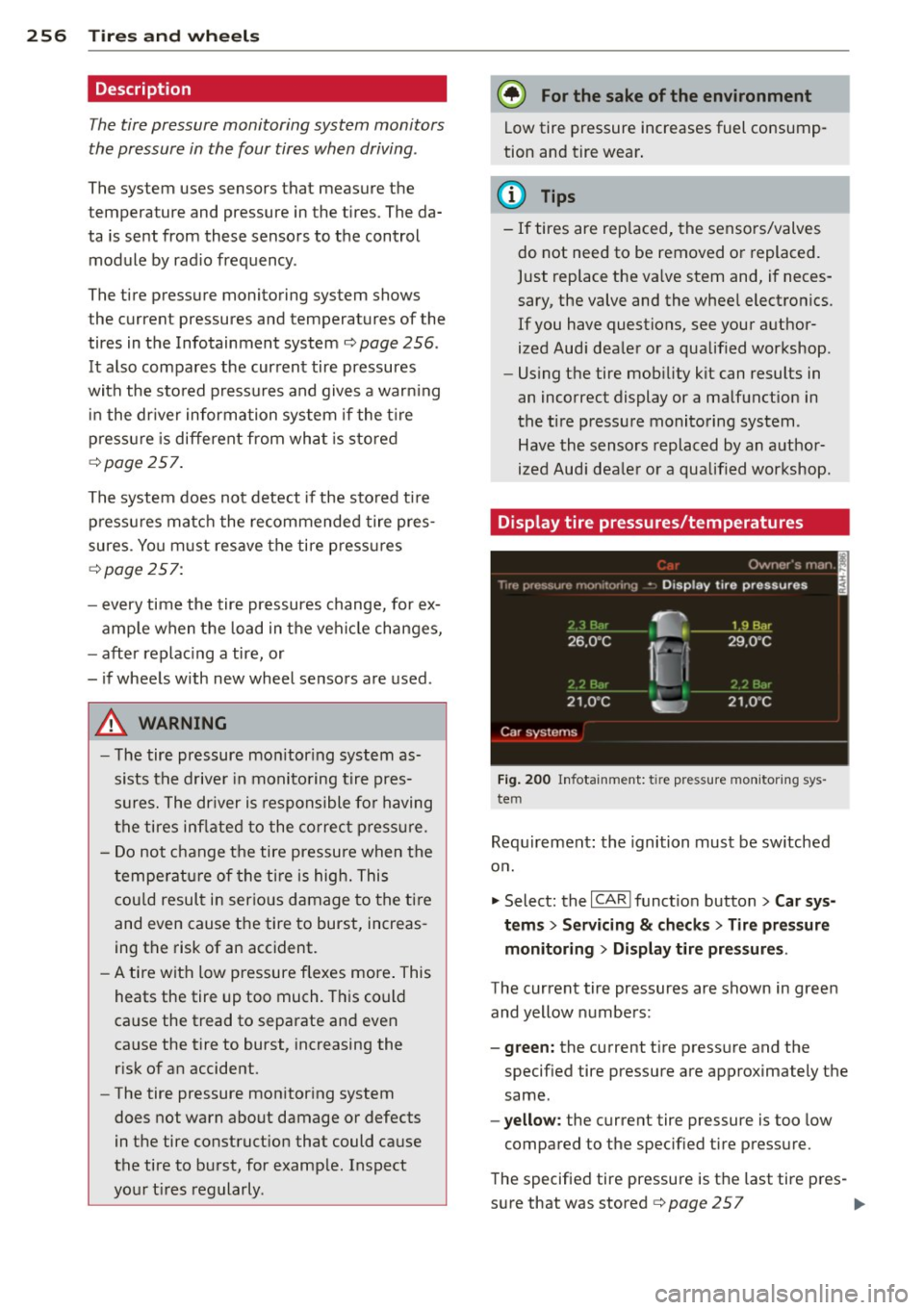
Fi g. 2 00 In fotainme nt: t ire press ure moni tor ing sys
tem
Requ irement : the ignition must be sw itched
o n .
.,. Select: the
I CAR I funct io n button > Car sy s
tem s
> Servicing & ch eck s > Tire pressure
monitoring
> Disp lay tire pr essures .
The current tire pressures are shown in green
and yellow numbers:
- green: the current tire press ure and the
specified tire pressure are approximately the
same .
-yellow : the current tire pressure is too low
compared to the specified tire pressu re.
The specified tire pressure is th e last tire pres -
s u re that was stored
c:> page 2 5 7 ..,
Page 263 of 302
"' N
a:: I.J "". rl I.O
"' ,....,
"' rl
(D Note
Do not use commercially available tire
sealants . The electrical components of the
tire pressure monitoring system will no
longer work properly.
@ For the sake of the environment
Used sealant bottles can be dropped off at
a recycling facility.
(D Tips
- If sealant has run out, allow it to dry.
Then you can peel it off.
- Have the tire sealant replaced every 4 years at a dealership .
Preliminary steps
Some preliminary steps ore necessary for tire
repair.
• If you have a f lat ti re, park the veh icle as far
as possib le from moving traffic.
• Apply the
parkin g br ake firmly.
• Move the
selector le ve r to the P po sit io n.
• Check whether a repair using the Tire Mob ili
ty System is possible
Q page 260, General
and safety pointers.
• Have all passengers le ave the vehicle and
stay away from the danger zone
q &_ .
• Take the sealant b ottle and the e le ctri c air
pump
from the luggage compar tment un
der the floo r
Q page 259, fig. 204.
• Remove the "max. 50 mph" (80 km/h) stick
er from the sealant bottle and affix it to the
instrument cluster in the driver's view .
A WARNING
-Turn the hazard flashers on and set up
the warning triang le* if you have a flat
t ire in moving traffic. In this way you pro
tect you rs elf and other road users .
- Make sure that all passengers are in a
safe place, out of the dange r zone (for
example, behind a guard ra il).
-
What do I d o now ? 261
(D Note
Partic ular care is necessary if you are mak
i ng a tire repair on a steep incl ine.
(D Tips
Obey all laws.
Making a tire repair
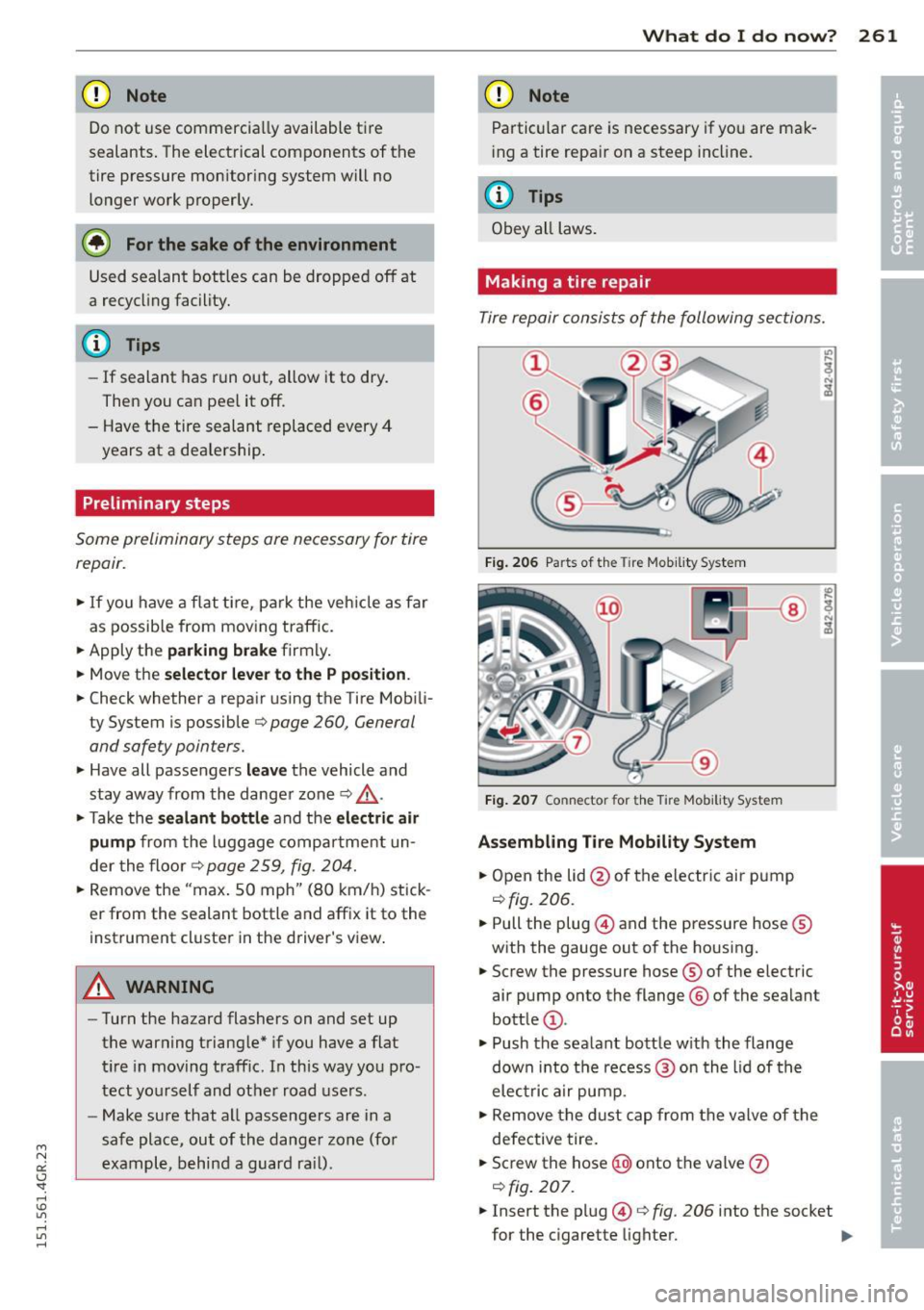
Tire repair consists of the following sections.
Fig . 206 Pa rts of t he Tire Mob ility System
Fi g. 207 Co nnector for the Tire Mobility System
A ssem bling Ti re Mobility Syst em
• Open the lid@ of the electric air pump
qfig. 206.
• Pull the plug© and the pressure hose ®
with the gauge out of the housing.
• Screw the pressure hose ® of the electric
air pump onto the flange ® of the sealant
bott le (!) .
• Push the sealant bottle w ith the flange
down into the recess @ on the lid of the
electric air pump.
• Remove the dust cap from the valve of the
defective tire.
• Screw the hose @onto the va lve
0
q fig. 207.
• Insert the plug© Q fig. 206 into the socket
for the c igarette lighter. .,.
Page 264 of 302
262 What do I do now?
• Switch on the ignition.
Inflating tire
• Move the switch @~ fig. 207 on the elec
tric a ir pump
ll to posit ion I. After 5 mi
nutes, tir e pressure must have reached at
least 1.8 bar.
• Switch the electric air pump off -switch in
position
0. If the required tire pressure of at
l east 1.8 bar has not been reached, follow
the instructions in the section
Re-inflating
tire.
Re-inflating tire
• Remove the hose from the valve and pull the
plug out of the socket.
• Drive the vehicle slow ly 33 feet (10 meters)
backward or forward. This helps to distrib
ute the sealant better.
• Remove the empty inflation bottle and
screw the hose®~
fig. 206 from the elec
t ric pump directly onto the va lve.
• Insert the plug@~
fig. 206 into the socket
for the cigarette lighter.
• Switch on the ignition.
• Move the switch @~
fig. 207 on the e lec
tric air pump
ll to position I. After 5 mi
nutes, tire pressure must have reached at
least 1.8 bar.
• Switch the electric air pump off -switch in
pos it ion
0 . If the requ ired tire pressure of at
least 1.8 bar has not been reached, it is not
poss ible to make a repa ir with the tire seal
ant. Seek professional assistance.
Disassembling Tire Mobility System
• Remove the hose from the valve and pull the
plug out of the socket.
• Screw the dust cap onto the valve .
• Place the empty sealant bottle back in the
original packaging and clip it in place under
the floor so that no tire sealant can run out
into the vehicle.
• Place the electric air pump in the luggage
compartment for the time being.
1l The electr ic air p ump sho uld never ru n fo r long er than
6 minut es.
• Start driving right away so that the sealant
is distributed in the tire .
A WARNING
=
- Follow the manufacturer 's safety instruc-
tions on the decal for the air pump and
the sealant bottle.
- If a tire pressure of 1.8 bar cannot be
achieved after pumping for 5 minutes,
the t ire is too severely damaged. Do not
continue to dr ive .
- Seek professional ass istance if it is not
possible to repa ir the tire w ith the tir e
sealant.
(D Tips
- Do not operate the electric air pump for
more than 6 minutes without stopping,
otherwise it can overheat . When the air
pump has cooled down, you can continue
to use it.
- If sealant has escaped, allow it to dry,
then you can pee l it off.
Final check
After driving for a short distance, tire pressure must be checked
• After driving for about 10 min utes, stop and
check the tire pressure.
• If tire pressure is sti ll at least 1.3 bar, in
flate the tire to specif ied pressure (see driv
er's side B-pillar), drive to the next repair
shop and have the tire and the sealant bot
tle replaced .
• If tire pressure is less than 1.3 bar, the tire
is too severely damaged . Do not continue to
drive. Seek professional assistance.
A WARNING
If tire pressure is less than 1.3 bar after
driving for 10 minutes, the tire is too se
verely damaged. Do not continue to drive.
Seek professional ass istance .
-
Page 265 of 302
M N
0:: <.J 'SI: ,...., \!) ..,.,
,...., ..,., ,....,
@ Tips
After a tire repair, have the sealant bottle replaced at a dealership. This restores full
functionality to the Tire Mobility System.
Changing a wheel
Before changing a wheel
Observe the following precautions for your
own and your passenger's safety when chang
ing a wheel .
.. After you experience a tire failure, pull the
car well away from moving traffic and try to
reach
level ground before you stop c:> &, .
.. All passengers should leave the car and
move to a safe location (for instance, behind
the guardrail)
c:> &, .
.. Engage th e parking brake to prevent your
vehicle from rolling unintentionally
c:> &, .
.. Move selector lever to position Pc:> &, .
.. Take the jack out of the luggage compart
ment
c> page 259.
A WARNING
You or your passengers could be injured
while changing a wheel if you do not fol
low these safety precautions:
- If you have a flat tire, move a safe dis
tance off the road. Turn off the engine,
turn the emergency flashers on and use
other warning devices to alert other mo
torists.
- Make sure that passengers wait in a safe
place away from the vehicle and well
away from the road and traffic.
- To help prevent the vehicle from moving
suddenly and possibly slipping off the
jack, always fully set the parking brake
and block the wheel diagonally opposite
the wheel being changed . When one
front wheel is lifted off the ground, plac ing the Automatic Transmission in P
(Park) will
not prevent the vehicle from
moving.
What do I do now? 263
- Before you change a wheel, be sure the
ground is level and firm. If necessary,
use a sturdy board under the jack.
- Always store the vehicle tool kit, the jack
and the replaced tire in the luggage com
partment
c:>page 126.
([) Note
If you are changing the wheel on a steep
incline, use a rock or similar object to
block the opposite wheel to prevent the
vehicle from moving .
(l) Tips
- Before changing the wheel, you must ac
tivate the jacking mode, so that the au
tomatic controls for the Adaptive Air
Suspension* do not make it more diffi
cult to lift the vehicle with the jack
c:>page265 .
-Obey all laws .
Changing a wheel
When you change a wheel , follow these
quence described below step -by -step and in
exactly that order.
l. Activate the vehicle jack mode"
c:>page 265.
2. Remove the wheel bolt caps* . For more
details see also
c:> page 264, Wheels with
wheel bolt caps.
3. Loosen the wheel bolts c:>page 264.
4. Locate the proper mounting point for the
jack and align the jack below that point
c:> page 2 65.
5. Raise the car with the jack r::> page 265.
6. Remove the wheel with the flat tire and
t hen in stall the other wheelr::>
page 267 .
7. Tighten all wheel bolts lightly .
8.
Lower the vehicle with the jack .
9 . Use the wheel bolt wrench and
firmly
tighten all wheel bolts c:> page 264.
10. Replace the wheel bolt caps*.
•
•
Page 266 of 302
26 4 What do I do n ow ?
11. Deactivate the vehicle jack mode* in the
MMI:
! CARI funct ion button> (Ca r)* sys
tems
control button > S er vicing & checks
> A ir su sp. : ja ck mode > Off.
The vehicle jack mode* switches off automati
cally at speeds above 6 mph (10 km/h).
A WARNING
Always read and follow all WARNINGS and information
Q A in Raising the vehicle on
page 266
and Q page 268 .
After changing a wheel
A wheel change is not complete without the
doing the following.
• Always store the vehicle tool kit, the jack *
and the replaced tire in the luggage com
partment
Q page 126.
• As soon as possible, have the tighten ing
torques
on all wheel bolts checked with a
torque wrench . The correct tightening tor
que is 90 ft lb ( 120 Nm) .
• Have the flat tire
re pl ac ed as soo n as poss i
ble .
@ Tips
- If you notice that the wheel bolts are
corroded and difficult to t urn w hile
changing a t ire, they should be replaced
before yo u check the tighten ing torque .
- Drive at reduced speed unt il you have the
tightening torques checked.
- After changing a wheel, t he tire pressure
i n a ll four tires must be checked/cor re ct
ed and the tire pressure mon itoring indi
cator must be stored in the MM I
¢page 257.
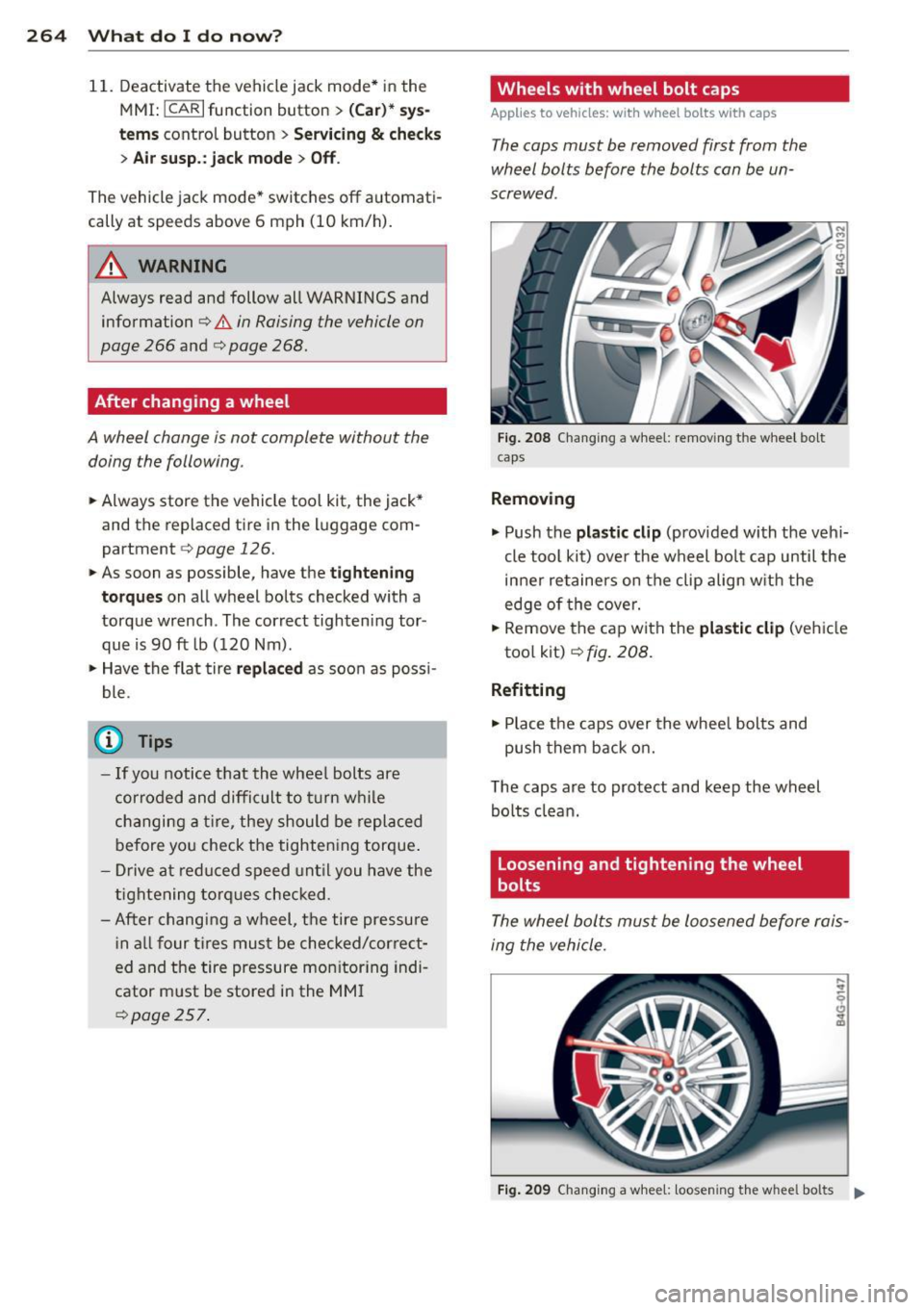
' Wheels with wheel bolt caps
Applies to vehicles: with wheel bolts with caps
The caps must be removed first from the
wheel bolts before the bolts can be un
screwed .
Fig. 208 Cha nging a whee l: removing t he wheel bo lt
c aps
Removing
.. Push the
pla st ic clip (prov ided with the veh i
cle tool kit) over the wheel bo lt cap until the
inner retainers on the clip align w ith the
edge of the cover.
• Remove the cap with the
pl as tic clip (vehicle
too l kit)
~ fig. 208.
Refitting
.. Place the caps over the whee l bolts and
push them back on.
The caps are to protect and keep the wheel bolts clean.
Loosening and tightening the wheel
bolts
The wheel bolts must be loosened before rais
ing the vehicle.
F ig . 209 Chang ing a whee l: loosening t he w hee l bolts .,.
Page 270 of 302
268 What do I do now?
Tires with unidirectional tread design
Tires with unidirectional tread design must be
mounted with their tread pattern pointed in the right direction .
Using a replacement tire with a tread
pattern intended for use in a specific
direction
When using a re p la cemen t tir e wi th a tread
pattern inte nded for use in a speci fic dire c
tion, please note the fo llow ing :
- T he direction of rotation is marked by a n ar
row on the side o f the tire .
-If the r eplacement tire has to b e insta lled in
t h e inc orre ct direction, use the rep la ce m ent
tir e on ly tempor arily s ince the t ire will not
be able to a chieve its op timum perfo rm ance
characteris tics with regard to aqua planing,
noise and wear .
- W e recommend that you pay particular a t
tent io n to this fact du ring wet weat her and
t h at you adjust your spee d to matc h roa d
condit ions .
- Repl ace the flat tire w ith a new one and
have it installed on your veh icle as soon as
poss ible to resto re the handling advantages
of a unid irect iona l tire .
Notes on wheel changing
Please read the information 9 pag e 245, New
tires and replacing tires and wheels
i f you are
go ing to use a rep lacemen t tire w hich is dif
feren t fro m th e tires on you r veh icle.
After you cha nge a t ire :
-Check the t ire pressure on the replacement
tire immediately after installation.
- Have the wheel bolt tightening torque
checked with a torque wrench as soon as
possible by your authorized Audi dealer or
a qualified service station .
- With steel and alloy wheel rims , the wheel
bolts are correctly tightened at a torque of
90 ft lb (120 Nm) .
- If you notice that the wheel bolts are cor
roded and difficult to turn while changing a tire
, they should be replaced before you
check the tightening torque.
- Replace the flat tire with a new one and
have it installed on your vehicle as soon a s
possible. Remount the wheel cover.
Until then , drive with extra care and at re
duced speeds.
A WARNING
- If yo u are going to e quip your ve hicl e
wit h tires or rims which differ from those
which were factory installed, then be sure to read the information
9 page 245,
New tires and replacing tires and
wheels .
-Always make sure the damaged wheel o r
even a flat tire a nd the jack a nd tool kit
ar e prope rly secu red in the luggage com
pa rtment an d are no t loose in the pas
s e nge r compa rtm en t.
- In an accid ent or sudde n man euver they
co uld f ly forw ard, inju ring anyo ne in the
ve hicl e.
- Always s to re damaged wh eel, jack a nd
t oo ls se curely in the luggage co mpa rt
men t. Ot he rwi se, in an a ccident or sud
d en maneuve r they co uld f ly forw ard,
causing inj ury to p assen gers in the ve hi
cle.
(D Note
Do not use comm erc ia lly availabl e tire
se alant s. Oth erwise, the e lec trical co mpo
nen ts of the tire press ure moni to ring sys
tem will no longer work p rope rly a nd t he
senso r fo r the tire pressure mon itor ing
system w ill have to be rep lace d by quali
fied workshop.
Page 279 of 302
"' N
a:: I.J "". rl I.O
"'
@ Tips
Check carefully to make sure the hook-up
is secure before moving the car up the flat
bed truck ramp.
Vehicle transport
Whenever you hove your vehicle transported,
be sure to note the following:
(D Note
Mount the tie-down chains/cables over the
running surface (circumference) of the
tires. Never secure the vehicle by the axle,
the suspension struts or the front or rear
towline eye. For technical reasons, the
pressure in the suspension struts may
change du ring the transport and this will
adve rsely affect vehicle handling.
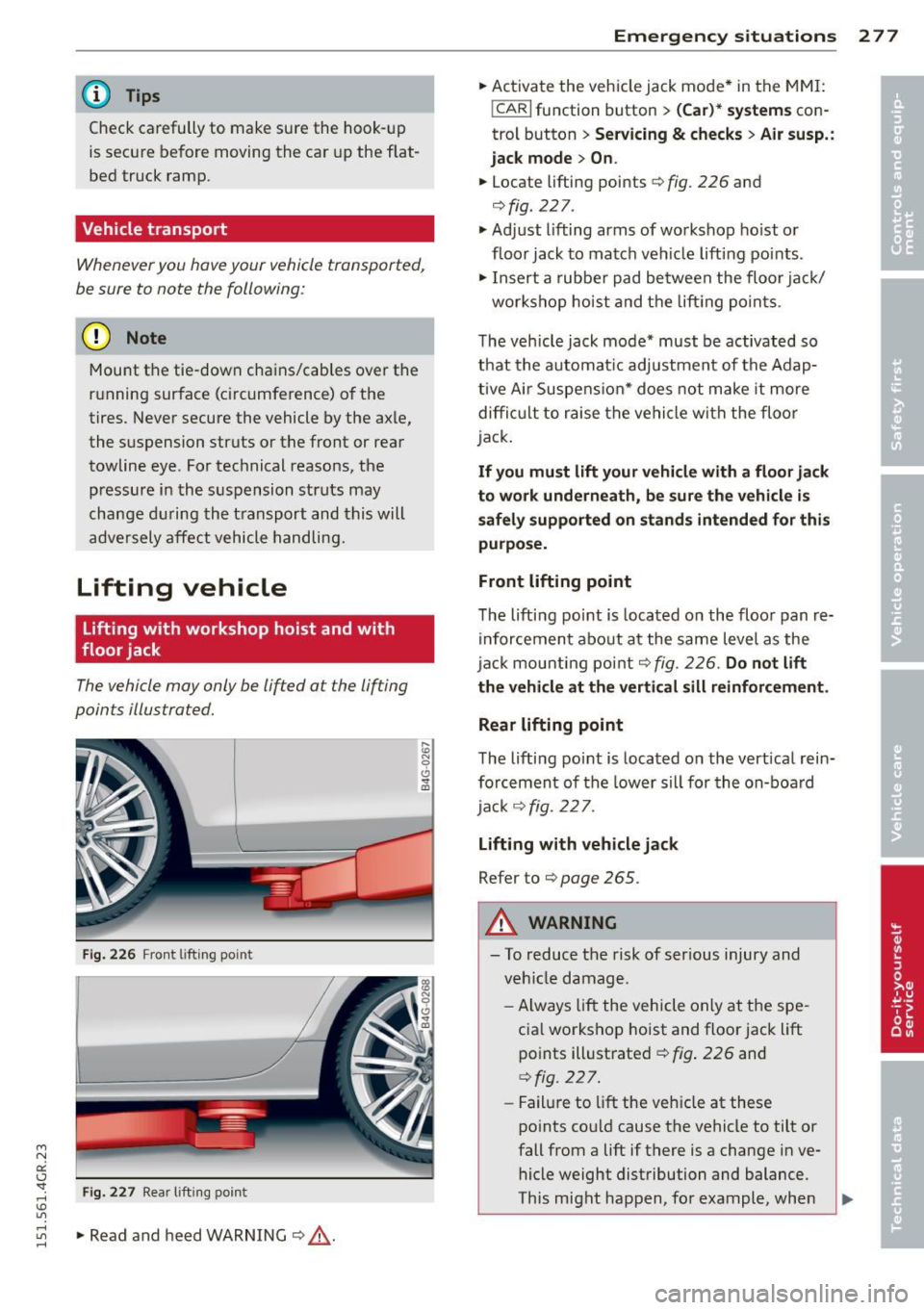
Lifting vehicle
Lifting with workshop hoist and with
floor jack
The vehicle may only be li~ed at the lifting
points illustrated.
Fig. 226 Front l ift ing po int
Fig. 22 7 Rea r lifti ng point
:;:; N 0 6 ., a,
5 .. Read and heed WARNING Q ,&..
Emergenc y situ ation s 2 77
.. Activate the vehicle jack mode* in the MM I:
!CARI function button > ( C ar)* s ystem s con
trol button>
S e rv ic ing & check s> Air su sp. :
jac k m od e> On .
.. Locate lifting points Q fig. 226 and
Qfig. 227.
.. Adjust lifting arms of workshop hoist or
floor jack to match veh icle lifting points.
.. Insert a rubber pad be tween the floor jack/
workshop hoist and the lift ing po in ts.
The vehicle jack mode* must be activated so
that the automat ic adjustment of the Adap
tive Ai r Suspens ion* does not make it more
diffi cult to raise the vehicle with the floor
jack.
If yo u must lift your v ehi cle with a floor jack
t o wo rk und ern eath , be sure th e vehicle i s
s af ely s upported on s tands intended for thi s
purpo se.
Front lifting point
The lifting po int is located on the floor pan re
inforcement abo ut at the same leve l as the
jac k mounting point
Q fig. 226. Do n ot lift
t h e ve hicle at th e verti cal sill reinforc em ent .
Re ar lifting point
The lifting point is located on the vert ical rein
forcement of the lower sill for the on-boa rd
ja ck
c::> fig. 22 7 .
Lifting with veh icle j ack
Refer to Q page 265 .
A WARNING
-To reduce the risk of ser ious injury and
veh icle damage.
- Always lift the veh icle only at the spe
cia l workshop hoist and floor jack lift
po ints illust rated
c::> fig . 226 and
<=:> fig. 227.
-Failu re to lift the vehicle at these
po ints could cause the vehicle to tilt or
fall from a lift if there is a change in ve
hicle weight distribution and balance.
This might happen, for example, when
-
Page 290 of 302
288 Index
Child restra int system anchors ....... . 179
Ch ild safety .. ................ ... ... 165
Conve rtible locking retracto r .. .. .... . 176
Important safety instructions for u sing
chi ld safety seats ..................
169
Important things to know when driving
with children .... ....... ... .. .... .
165
Tether anchors . . . . . . . . . . . . . . . . . . . . 182
Tether straps . . . . . . . . . . . . . . . . . . . . . 182
Ch ild safety lock
Rear doors ............... ... .... .. 40
Ch ild safety seats ............... ....
17 1
Booster seats . . . . . . . . . . . . . . . . . . . . . 17 4
Conve rtible child seats ............. 172
Convertible locking retractor .. .. .... . 176
How do I properly install a child safety
seat in my vehicle? ......... ... .... .
169
Infant seats .............. ... .... . 171
Installing .... ............. ...... . 176
Installing a child restraint using the
LATCH system .... ..... .... ... ... ..
181
LATCH system ................. .... 181
Lower anchorages ................. 180
Mount ing and releasing the ancho rage
hook .. .. .. ... .......... ...... .. .
181
Safety instructions ............ .... . 169
Unused safety belts on the rear seat .. 171
C igarette lighter . . . . . . . . . . . . . . . . . . . . . 59
C leaning .. ................. .. .... . 201
C limate control (four-zone)
Operation . . . . . . . . . . . . . . . . . . . . . . . . .
70
Clock .. .... ................... ... .. 26
C losing
Rear lid .. ............... ........ ..
37
Sliding/tilting sunroof ....... .. .. .. . . 41
Cold ti re inflation pressure .... ... .... . 233
Com ing home ... .... ...... .. .. .. .. ..
46
Compartments ............ .. .. .. .. .. 60
Compl iance ........................ 285
Consumer Information . . . . . . . . . . 128, 282
Consumption (fue l) ..... ... .. .. .... .. 24
Contact ing NH TSA .................. 128
Controls
Cleaning . .. ..................... . 203 Convenience key
... ... ....... ... ... .. 35
Starting the engine ............ .. .. .
74
Stopping the eng ine (START ENGINE
STOP button) ......................
75
Switching the ignition on ............ 74
Unlocking and locking vehicle ....... .. 35
Convertib le child safety seats . . . . . . . . .
172
Convertib le locking retractor
A ctivating . .... .. ............. ....
178
Deact ivat ing . ................. .. .. 178
Using to secure a child sa fety seat l.76, 178
Coolant
refer to Eng ine coolant ............. 217
Cooling mode (automat ic climate control) 70
Cruise cont ro l
Changing speed .. ... .. ..... ... .. .. . 80
Presetting your speed .. ..... ... .. .. . 80
Switching off ...................... 80
Switching on . . . . . . . . . . . . . . . . . . . . . . .
79
Warning/ind icator lights ............ . 22
(upholder .. .... .. .. ... ..... ... .. .. . 60
Curve light ........ .. .............. .. 96
Cylinder management
refer to Cylinder on demand System .. . 24
Cylinder on demand System . . . . . . . . . . .
24
D
Data recorde r ... .. ............. .... 186
Date d isp lay .. ...... .............. .. 26
Daytime running lights . .. ..... ... .. .. . 44
Declarat ion of compliance
Adaptive cruise control .............
285
Audi side ass ist .. ............. .. .. 285
Cell phone package . . . . . . . . . . . . . . . . 285
Convenience key . ... ... ......... ... 285
E lectronic immobilizer ... .... ... .. .. 285
Garage door opener (Homelink) ...... 285
Remote control key . . . . . . . . . . . . . . . . 285
Tire pressure monitoring system ..... 285
Decorative parts/trim
Cleaning . ..... .. ... .. ..... ... .. .. 203
D EF
What does this mean when it appears in
the tr ip odometer display? ...........
25
Defective light bulb warni ng ......... .. 21
Page 298 of 302
296 Index
Temperature indicator Engine oil . .... . ...... ... .. .. .... .. 28
Tet he r anchors . ........... .... .... . 18 2
Tether strap . . . . . . . . . . . . . . . . . . . . . . . 182
Textiles Cleaning ... ... .. ..... ... .. .. .... . 204
The first 1,000 m iles (1,500 km) and after-
wards . .. .. .... ........... .. .. .... . 196
Tie-downs . . . . . . . . . . . . . . . . . . . . . 66, 127
Tips fo r the env ironment
Saving fue l . . . . . . . . . . . . . . . . . . . . . . . . 63
tiptronic (automatic tra nsmission) 103, 107
T ire mobility system ........ .. .. .. .. . 260
T ire pressure .. .. .. ..... ... .. .. .... . 23 7
T ire pressure monitor ing system .. .. .. . 255
Tire repair kit . ... ...... ... .. .. .... . 260
T ires .. .. ...... ........... .. .. .... . 226
Service life . . . . . . . . . . . . . . . . . . . . . . . 24 3
Speed rating letter code ... .. .. .. ... 248
Tire man ufacturing date ... .. .... .. . 247
Tire specifications ..... ... .. .. .... . 247
Tread depth ............. .. .. .. .. . 243
Uniform tire quality grading .. .. ..... 251
W inter t ires .......... .... ... .. .. . 252
Tires/Wheels Tire mobility system . ... .. .. ... ... . 260
Tire repair kit ............ .. .. .... . 260
Ti res and vehicle load lim its .. .. .. .. .. . 240
Tires and whee ls
C heck ing ti re pressu re . .. .. .. .. .. .. . 237
Cold t ire i nflat ion p ressu re . .. .. .. .. . 233
Di mensions .............. .. .. .... . 24 5
G eneral notes . ......... .. .. .. .. .. . 226
Glossary of tire and load ing te rmino lo -
gy . .. ... ... .. .. ..... ... .. .. .... . 228
L ow aspect ratio ti res . ... .. .. ... ... . 254
N ew tires and wheels ........ .. .... . 245
Replacing ............... .. .. .... . 246
Snow chains ... .. ..... ... .... .. .. . 253
Tires and vehicle load lim its .. .. .. ... 240
Wheel bo lts ... .... ...... .. .. .. .. . 254
W inter t ires ... .......... .. .. .. .. . 25 2
T ire serv ice life . ........... .. .. .... . 243
Tools ... .... .. .. ...... ... .. .. .... . 259
Torn or frayed safety belts ....... .. ... 133
Towing Tow tr uck procedures .......... .. .. . 275 T
PMS
In dicator light
258
Tire pressure monitoring system ... .. 255
T rai n (tr ansport ing you r vehi cle) . .. .. .. 277
Transmission .. .. .. .. .. ...... ... .. .. 103
T ransmission malfunction ( indicator
li ght) . ... .. .... .. .. ... ..... ... .. .. 107
T ranspo rt Canada .. ............. .... 1 28
Transporting your vehicle ......... .... 277
T rea d Wea r Ind icator (TWI) .... ... .. .. 2 43
T rip odometer ..... ................ .. 25
What does it mean when D EF appears in
t h e tr ip odometer display? .... .. .... . 25
Trunk
refer to Luggage compartment . ...... . 64
T ru nk pass-through . .... ..... ... .. .. . 68
T urn s ignals . .. .. . .............. .. .. . 46
W arning/ind icator lights ........ .. .. . 22
u
Un fastening safety b elts
U nidirectional tires . ... .......... .. . .
Unif orm tire qu ality gradi ng ........ . .
Un locking 135
227
251
Power loc king switc h ........ .... ... . 36
Remote cont rol . . . . . . . . . . . . . . . . . . . . 34
U si ng the key .. .. ............. .. .. . 36
V
Vale t pa rking .. .. .. .......... ...... .. 41
Vanity mirro rs ...................... . 48
Vehicle ca re/clean ing .... .. .... .... ... .. .. 201
Vehicle control modules .. .. ... ..... .. 186
Vehicle electrical system . . . . . . . . . . . . . . 16
Vehicle identification label ...... .. .. .. 279
Vehicle Ident ificat ion Number (VIN) .. .. 279
Vehicle jack . . . . . . . . . . . . . . . . . . . 259, 265
Vehicle lite ratu re ............... .. .. .. 5
Vehicle shutt-down ... ........... .. .. 198
Vehicle transport . ... .... .... ... .. .. 2 77
Ventila tion . . . . . . . . . . . . . . . . . . . . . . . . . 69
Vinyl Cleaning .. .... .. ............. .... 204
Page 299 of 302
M N
0:: <.J 'SI: ,...., \!) 1.1'1 ,...., 1.1'1 ,....,
w
Warning/indicator lights . ... .. .. .. .. .. 11
Airbag system . .. ..... ... .. .. .. .. .. 1 8
Ant i-lock braking system (ABS) . ... .. .. 18
Brake system ............ .... .. .... 14
Cruise control . . . . . . . . . . . . . . . . . . . . . . 22
Electromechan ical park ing brake ...... 15
Electronic power control . .. ... .. ... .. 19
Elect ronic Stabilization Control (ESC) . . . 18
Ge ne rato r .. .... ......... .. .. .. .... 16
I ns trumen t cluste r ........ .. .. .. .. .. 10
M alfu nct io n I ndica to r Lamp (M IL) . .. .. 20
Safety belt ... .... .... ... .. .. .. .... 1 6
Turn signa ls . .... ..... ... .. .. .. .... 22
War ning/Ind icator lights
A irbag system . . . . . . . . . . . . . . . 15 1, 15 2
P ASSENG ER AIR BAG O FF .. .. .. .. .. . 152
Warranty coverages ........... .... .. 282
Washer reservoir .. ..... ... .. .. .. .. . 224
Wear ind icator ............ .. .. .. .. . 24 3
Weights ... .. .. .. ......... .. .. .. ... 279
What happens if you wear yo ur sa fety be lt
too loose? ... .. .... .... ... .. .. .. ... 134
What happens to unbelted occupants? . . 13 1
What impairs driving safety? . .. .. .. .. . 121
What should I do after chang ing a
wheel? . ..... .. .. .. .... ... .. .. .. ... 239
What should I do after rep lacing wheels? 239
Wheel bolts Torque ... .. ............. .... .. ... 254
Wheels ..... .. ... ..... ... .. .. .. ... 226
C hec kin g tire pressure .. ... .. .. .. .. . 23 7
C leaning ... .. .... .... ... .. .. .. ... 202
Cold tire inflat ion pressure . .. .. .. .. . 233
General notes ............ .. .. .. .. . 226
Glossary of t ire and load ing termi nolo-
gy ...... ... ...... ............. .. 228
New tires and wheels ...... .. .. .. .. . 24 5
T ires and vehicle load lim its .. .. .. .. . 24 0
When must a safety belt be rep laced? . . 133
When must the airbag system be inspect-
ed? ... .. .. .. .. .. .. .. .... ... .. .. ... 151
When shou ld I ad just the tire p ressu res? 239
When shou ld I check the tire pressures? . 239
Where are lower anchor ages located? .. . 180
Inde x 297
Where can I find the t ire pressures for my
ca r? .. ... .. .. .. .... .. .. ...... ... .. 237
Why safety belts? . . . . . . . . . . . . . . 130, 131
Windows Cleaning/removing ice . .. .... ... .. .. 203
defrosting (automatic climate control) 71
Windshie ld
Cleaning .. .. .. .. .... ............. . 48
defrosting (automatic climate control) . 71
Windshie ld washer system .... ... .. .. . 48
Washer fl uid leve l .. . .. .. ..... ... .. . 20
Washe r reservo ir ... . .. .. ..... ... .. 224
Windsh ie ld w ipers
Cleaning .. .. .. .. .. .. ........... .. . 49
F olding up . ... .. .. .. ... ..... ... .. . 49
Ind icator lig ht ... ... .. .. ..... ... .. . 21
Replacing windshield wiper b la d es . ... . 49
Switching on/off . ............. .... . 48
Win ter operation
B attery ... .. .. .. .. . .. ... .... ... .. 2 21
Car washes . ... .... . ... ...... ... .. 201
Cooling system . . . . . . . . . . . . . . . . . . . . 217
Defrost ing windows (automatic climate
control) ... .. .. .. .. .. ........... .. . 71
Removing ice from windows ......... 203
Seat heating (automat ic climate control) 71
Steering w heel heat ing . .. .. ... ... .. . 72
T ires ........ ... .. ............... 193
Winter tires . .. .. .. ... ............ .. 252
All-wheel drive . .. ............. .... 252
•
•