inflation pressure AUDI RS7 SPORTBACK 2015 Owners Manual
[x] Cancel search | Manufacturer: AUDI, Model Year: 2015, Model line: RS7 SPORTBACK, Model: AUDI RS7 SPORTBACK 2015Pages: 302, PDF Size: 74.76 MB
Page 129 of 302
A WARNING ,~
To help prevent poisonous exhaust gas
from being drawn into the vehicle, always
keep the rear lid closed while driving .
- Never transport objects larger than
those fitting completely into the luggage
area because the rear lid cannot be fully
closed.
- If you absolutely must drive with the rear
lid open, observe the following notes to
reduce the risk of poisoning:
- Close all windows,
- Close the power roof*,
- Open all air outlets in the instrument
panel,
- Switch off the air recirculation,
- Set the fresh air fan to the highest
speed.
A WARNING
Always make sure that the doors, all win dows, the power roof* and the rear lid are
securely closed and locked to reduce the
risk of injury when the vehicle is not being
used.
- After closing the rear lid, always make
sure that it is properly closed and locked.
- Never leave your vehicle unattended es
pecially with the rear lid left open. A
child could crawl into the vehicle through
the luggage compartment and close the
rear lid becoming trapped and unable to
get out. Being trapped in a vehicle can
lead to serious personal injury.
- Never let children play in or around the
vehicle .
- Never let passengers ride in the luggage
compartment. Vehicle occupants must
always be properly restrained in one of
the vehicle's seating positions.
Gj) Tips
-Air circulation helps to reduce window fogging. Stale air escapes to the outside
through vents in the trim panel. Be sure
to keep these slots free and open .
-
Driving Safely 127
-The tire pressure must correspond to the
load. The tire pressure is shown on the
tire pressure label. The tire pressure la
bel is located on the driver's side B-pillar.
The tire pressure label lists the recom
mended cold tire inflation pressures for
the vehicle at its maximum capacity
weight and the tires that were on your
vehicle at the time it was manufactured. For recommended tire pressures for nor
mal load conditions, please see chapter
I:!) page 233.
Tie-downs
The luggage compartment is equipped with
four tie-downs to secure luggage and other
items.
Use the tie-downs to secure your cargo prop
erly<>
page 126, Loading the luggage com
partment.
In a collision, the laws of physics mean that
even smaller items that are loose in the vehi
cle will become heavy missiles that can cause
serious injury. Items in the vehicle possess en
ergy which vary with vehicle speed and the
weight of the item. Vehicle speed is the most
significant factor.
For example , in a frontal collision at a speed
of 30 mph (48 km/h), the forces acting on a 10-lb (4.5 kg) object are about 20 times the
normal weight of the item. This means that
the weight of the item would suddenly be about 200 lbs. (90 kg) . You can imagine the
injuries that a 200 lbs . (90 kg) item flying
freely through the passenger compartment
could cause in a collision like this.
A WARNING
Weak, damaged or improper straps used
to secure items to tie-downs can fail dur
ing hard braking or in a collision and cause
serious personal injury.
-Always use suitable mounting straps and properly secure items to the tie-downs in
'
•
•
Page 231 of 302
Bead
means the part of the tire that
is made of steel wires, wrapped
or reinforced by ply cords and
that is shaped to fit the rim .
Bead separation
means a breakdown of the bond
between components in the
bead.
Cord
means the strands forming the
plies in the tire.
Cold tire inflation pressure
means the tire pressure recom
mended by the vehicle manu
facturer for a tire of a designat
ed size that has not been driven
for more than a couple of miles (kilometers) at low speeds in
the three hour period before
the tire pressure is measured or
adjusted.
Curb weight
means the weight of a motor
vehicle with standard equip
ment including the maximum
capacity of fuel, oil, and cool
ant, air conditioning and addi
tional weight of optional equip
ment.
Tires and wheels 229
Extra load tire
means a tire design to operate
at higher loads and at higher inflation pressures than the
corresponding standard tire. Extra load tires may be identi
fied as "XL", "xl", "EXTRA
LOAD", or "RF" on the sidewall.
Gross Axle Weight Rating ("GAWR")
means the load-carrying capaci
ty of a single axle system,
measured at the tire-ground in
terfaces.
Gross Vehicle Weight Rating ("GVWR")
means the maximum total
loaded weight of the vehicle.
Groove
means the space between two
adjacent tread ribs.
Load rating (code)
means the maximum load that
a tire is rated to carry for a giv
en inflation pressure. You may
not find this information on all
tires because it is not required by law.
•
•
'
Page 232 of 302
230 Tires a nd whee ls
Ma ximum load rating
means the load rating for a tire
at the maximum permissible in
flation pressure for that tire.
Maximum loaded vehicle
weight
means the sum of:
(a) Curb weight
(b) Accessory weight
(c) Vehicle capacity weight, and
(d) Production options weight
Maximum (permissible)
inflation pressure
means the maximum cold infla
tion pressure to which a tire
may be inflated. Also called
"maximum inflation pressure."
Normal occupant weight
means 150 lbs. (68 k ilograms)
times the number of occupants seated in the vehicle up to the
total seat ing capac ity of your
vehicle.
Occupant distribution
means distribution of occu
pants in a vehicle .
Outer diameter
means the overall diameter of
an inflated new tire.
Overall width
means the linear distance be
tween the ex teriors of the side
walls of an inflated tire, includ
ing elevations due to labeling,
decorations, or protect ive
bands or ribs .
Ply
means a layer of rubber -coated
parallel cords .
Production options weight
means the comb ined we ight of
those installed regular produc
tion op tions weighing over 5
lbs . (2. 3 kg) in excess of those
standard items which they re
place, no t prev iously consid
ered in curb weight or accessory
weight , incl uding heavy duty
brakes, ride leve lers, roof rac k,
heavy duty bat tery, and spec ial
trim.
Radial ply tire
means a pneumatic tire in
wh ich the p ly c ords that extend
t o the beads are laid at sub
stantially 90 degrees to the
centerline of the t read .
Page 233 of 302
Recommended inflation
pressure
see¢ page 229J Cold tire infla
tion pressure.
Reinforced tire
means a tire design to operate
at higher loads and at higher
inflation pressures than the
corresponding standard tire. Reinforced tires may be identi
fied as "XL", "xl", "EXTRA
LOAD", or "RF" on the sidewall.
Rim
means a metal support for a
tire or a tire and tube assembly
upon which the tire beads are
seated.
Rim diameter
means nominal diameter of the
bead seat. If you change your
wheel size, you will have to pur chase new tires to match the
new rim diameter.
Rim size designation
means rim diameter and width.
Rim width
means nominal distance be
~ tween rim flanges.
0:: <.J 'SI: ,...., \!) 1.1'1 ,...., 1.1'1 ,....,
Tires and wheels 231
Sidewall
means that portion of a tire be
tween the tread and bead.
Speed rating (letter code)
means the speed at which a tire
is designed to be driven for ex
tended periods of time. The rat ings range from 93 mph (150
km/h) to 186 mph (298 km/h)
¢
page 248. You may not find
this information on all tires be cause it is not required by law.
The speed rating letter code,
where applicable, is molded on
the tire sidewall and indicates
the maximum permissible road speeds ¢
A in Winter tires on
page 252.
Tire pressure monitoring system
means a system that detects
when one or more of a vehicle's tires are underinflated and illu
minates a low tire pressure
warning telltale.
Tread
means that portion of a tire
that comes into contact with
the road.
•
•
'
Page 235 of 302
"' N
a:: I.J "". rl I.O
"' rl
"' rl
Vehicle maximum load on the tire
means that load on an individu
al tire that is determined by
distributing to each axle its
share of the maximum loaded
vehicle weight and dividing by two.
Vehicle normal load on the tire
means that load on an individu
al tire that is determined by
Tires and wheels 233
distributing to each axle its
share of the curb weight, acces
sory weight, and normal occu
pant weight (distributed in ac
cordance with table below
¢ page 233) and dividing by
two.
Occupant loading and distribution for vehicle normal load for
various designated seating capacities
Designated seating Vehicle normal load, Occupant distribu-
capacity, number of number of occupants tion in a normally
occupants loaded vehicle
4 2 2 in front
Cold tire inflation pressure
Tire pressure affects the overall
handlingJ performance and safety
of a vehicle.
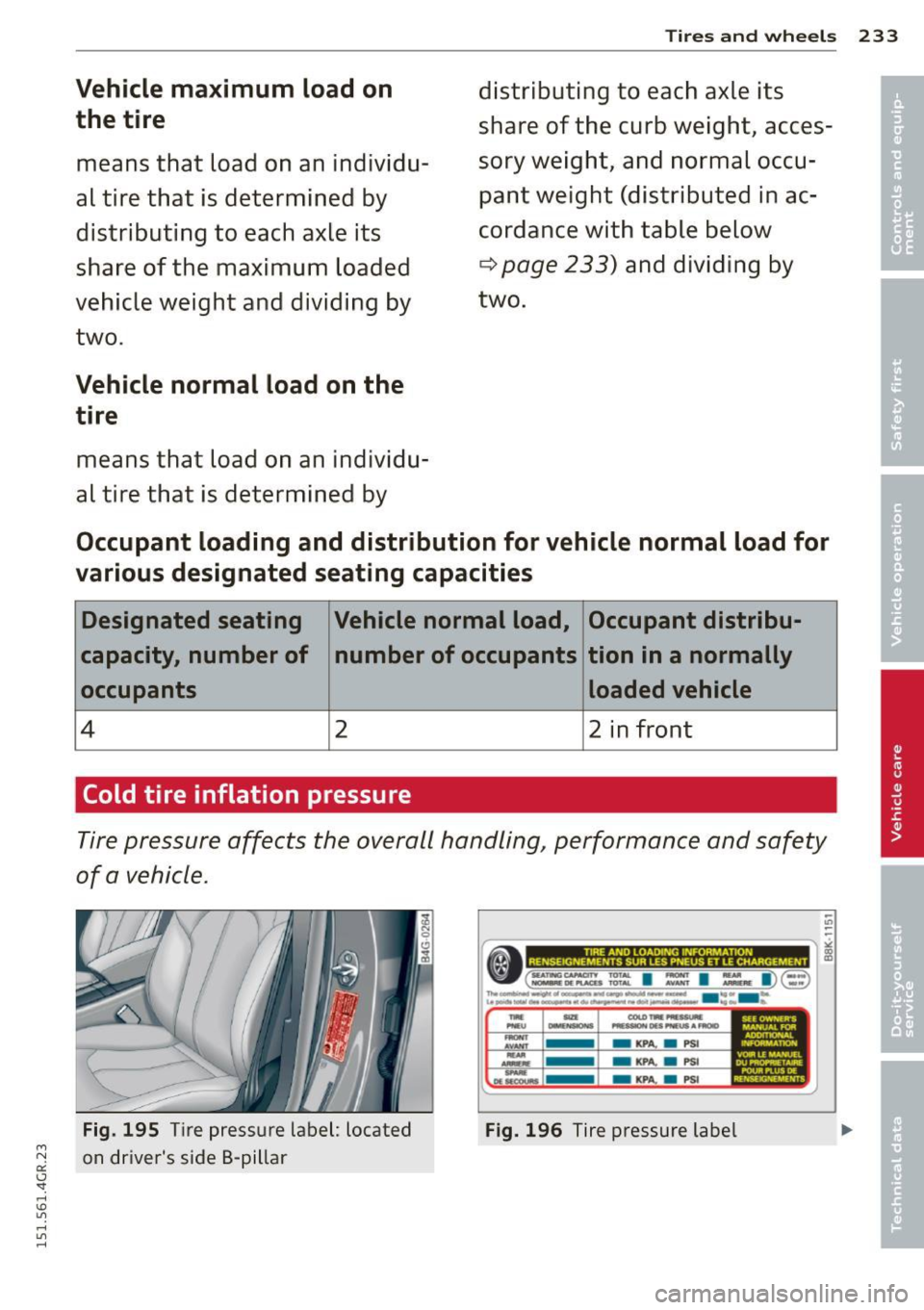
Fig. 195 Tire pressure label: located
on driver's side B -pillar
-"' ---------------.... ,;,
& =-=====c=-=============== ::l
Ve=~= • = • =-1)§ -n,,......,..__.................................... • .... _ .. .................................... ___...,._ .. . -
- KPA, . PSI
- KPA. . PSI
- KPA. . PSI
Fig. 196 Tire pressure label
Page 236 of 302
234 Tir es a nd whee ls
Ti re pressure generally refers to tant things you can do to help
the amount of a ir in a tire that avoid sudden tire failure . Un-
it needs it to do its job and derinflated tires are a major
safely carry the combined load cause of sudden ti re fa ilu re .
of the en tire vehicle and its con-
Keeping t ires at the right pres-
tents . Tire press ure is measured sure is also important for safe
i n ki lopascals (kPa), the inter- and responsive vehic le han-
national measuring unit and in dling , traction, braking and
pounds pe r square inch (PSI). load carryi ng .
Tire pressures
Ti re pressure is based in part on are particularly important
the vehicle's design and load when the vehicle is being driv-
lim it - the greatest amount of en at higher speeds, and then
weight that the vehicle can car -especially when heavily loaded
ry safely and the tire size. The even within the permissible
p rope r tire pressure is frequent -load-carrying capacities ap-
ly referred to as the " recom-proved for your vehicle.
mended cold tire inflation pres-
The recommended tire pres-
sure." Air in the tires expands
sures for your Audi depend on
when the tire heats up because the kind of tires on your vehicle
of internal friction when it flex-
and the number of passengers
es in use . The ti re pressure is
and/or amount of luggage you
h igher when the tire has
will be transpor ting.
warmed up than when it is The tire pressure labe l is locat-
"cold." It is the inflation p res-
ed on the driver's side 8 -pi llar .
sure in a "cold " tire that counts .
Therefore, you should never let The tire pressure label lists the
recommended cold t ire in fla-
air o ut of a warm tire to match
"cold tire inflation pressure" tion pressures for the vehicle at
its max imum capacity weight
recommendations . The tires
would t hen be underinflated and tires that were on your ve
-
a nd cou ld fai l suddenly . hicle at t
he time it was man u-
f actured .
...
Maintaining proper tire p res-
sure is one of the most impor-
Page 237 of 302
Tires and wheels 235
If you wish to improve comfort
when operating the vehicle at
normal load (up to 2 occu
pants), you can adjust tire
pressures to those specified
for normal vehicle load. Before
operating the vehicle at maxi mum load, you must increase
the tire pressures to those
specified for maximum vehicle
load
c> .&. .
Bear in mind that the tire pres
sure monitoring system can on
ly monitor the tire pressures
you have stored. The system does not recognize the load
condition of your vehicle.
The effectiveness of the tire p ressure monitoring system
will be impaired if you store normal load pressures but then
operate the vehicle at its maxi
mum load
c> .&. .
Model/ Tire designation
See the illustration c> fig. 195
for the location of the label on
driver's side B-pillar (color of
the actual label and exact loca
tion on the vehicle will vary slightly).
Note that the following table is
accurate at the time of going to
press and is subject to change.
In the event of discrepancies,
the tire pressure label is locat ed on the driver's side B-pillar
always takes precedence.
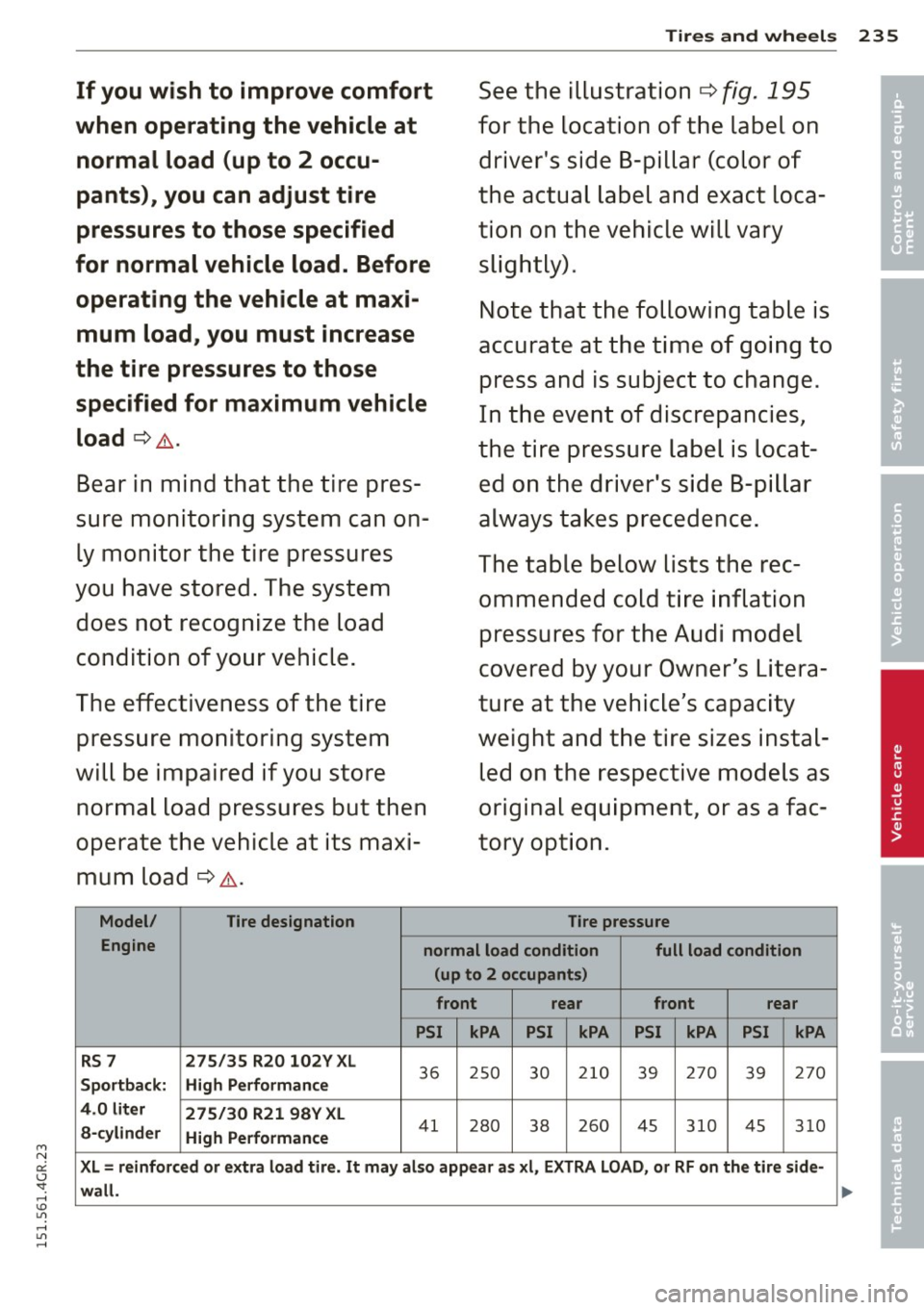
The table below lists the rec ommended cold tire inflation pressures for the Audi model
covered by your Owner's Litera
ture at the vehicle's capacity
weight and the tire sizes instal
led on the respective models as
original equipment , or as a fac
tory option.
Tire pressure
Engine normal load condition full load condition
(up to 2 occupants)
front rear front rear
PSI kPA PSI kPA PSI kPA PSI kPA
RS 7 275/35 R20 102V XL
3 6 250 30 210 39 270 39 270 Sportback: High Performance
4.0 liter 275/30 R21 98V XL
a -cylinder
High Performance
41 280 38 26
0 4 5 310 45 310
XL= reinforced or extra load tire. It may also appear as xl, EXTRA LOAD, or RF on the tire side-
wall.
•
•
'
Page 239 of 302
heavier than the vehicle's
Gross Vehicle Weight Rat
ing.
& WARNING
-Incorrect tire pressures and/or underinflation can lead to a serious or fatal ac
cident.
-Incorrect tire pressures and/or underinflation cause increased tire wear and can
affect the handling of the
vehicle.
-Incorrect tire pressures and/or underinflation can
also lead to sudden tire fail
ure, including a blowout
and sudden deflation, caus ing loss of vehicle control.
Checking tire pressure
The correct tire pressure for the
tires originally installed on
your vehicle is listed on the tire
pressure label located on driver's side 8-pillar.
The recommended tire pressures are on the tire pressure
label and in the table
¢ page 233, Cold tire inflation
pressure .
This means that the
pressure must be checked and
Tires and wheels 237
adjusted when the tire has not been driven for more than a
couple of miles (kilometers) at low speeds during the previous
three hours. Air in the tires ex pands when the tire heats up as
a result of internal friction as it
flexes in use. The tire pressure
is higher when the tire has
warmed up than when it is "cold."
It is the inflation pressure in a
"cold" tire that counts. There
fore, you should never let air out of a warm tire to match
"Cold tire inflation pressure"
recommendations ¢
page 233.
The tires would then be under
inflated and could fail sudden
ly.
The tire pressure label on your
Audi lists the recommended cold tire inflation pressures at maximum capacity for the new,
original equipment tires that
were on your vehicle at the time
it was manufactured . For the
location of the label
¢ page 233, fig . 195.
Most tires lose air naturally
over time. They can also lose
some air if you drive over a
•
•
'
Page 240 of 302
238 Tires and wheels
pothole or hit a curb while park
ing. It is usually not possible to
see whether the radial tires
used today are underinflated
just by looking at them.
Therefore, be sure to check tire
pressures at least once a month
and always before going on a
long trip. Make sure to take the
number of people and the
amount of luggage into ac
count when adjusting tire pres
sure for a trip -even one that
you would not consider to be "long ." See ¢
page 240, Tires
and vehicle load limits
for more
important information.
Always use an accurate tire pressure gauge when checking
and adjusting inflation pres
sures . Check all of the tires. If
the pressure in any tire is too high when the tire is "cold," let
air out of the t ire slowly with
the edge of the tire gauge and keep checking the pressure un
til you reach the pressure that is correct for the load (passen
gers and luggage) and kind of
driving you plan to do .
If the pressure in any tire is too
low, note the difference be- tween the pressure
in the cold
tire and the pressure you need
and add the air that you need to reach the correct pressure for
the vehicle load (passengers
and luggage) for the tires on
your vehicle as listed on the on
your vehicle and in this manual and the kind of driving you plan
to do.
Never exceed the maximum in
flation pressure listed on the
tire sidewall for any reason.
Remember that the vehicle
manufacturer , not the tire man
ufacturer, determines the cor
rect tire pressure for the tires
on your vehicle.
It is important to check the tire
pressure when the tires are
cold .
-Read the required tire pres sure from the tire pressure la
bel. The tire pressure label is
located on the driver's side 8-
pillar.
-Turn the valve stem cap coun ter -clockwise to remove it
from the tire valve.
-Place the air pressure gauge on the valve .
Page 241 of 302
Tires and wheels 239
-The tire pressures should only sudden tire failure, loss of •
be checked and adjusted when control, collision, serious per-• '
the tires are cold. The slightly
sonal injury or even death.
raised pressures of warm tires -When the warning symbol
must not be reduced.
[I] appears in the instru-
-Adjust the tire pressure to the ment cluster, stop and in-
load you are carrying. spect the tires.
-Reinstall the valve stem cap -Incorrect tire pressure and/
on the valve. or underinflation can cause
When should I check the tire increased tire wear and can
pressure? affect the handling of the
vehicle and stopping ability.
The correct tire pressure is es -
-Incorrect tire pressures
pecially important at high
and/or underinflation can
speeds. The pressure should
also lead to sudden tire fail-
therefore be checked at least
ure, including a blowout
once a month and always be-
and sudden deflation, caus-
fore start ing a journey.
ing loss of vehicle control.
When should I adjust the -The driver is responsible for
ti re pressures?
the correct tire pressures for
Adjust the tire pressure to the all tires on the vehicle. The
load you are carrying. After applicable pressure values
changing a wheel
or replacing are located on a sticker on
wheels you have to adjust the the driver's side B-pillar.
tire pressures on all wheels. In -Only when all tires on the
addition, you must then store vehicle are filled to the cor-
the new tire pressures in the rect pressure, the tire pres-
tire pressure monitoring sys- sure monitoring system can
tern¢
page 255. work correctly.
A WARNING -The use of incorrect tire
pressure values can lead to
M
Incorrect tire pressures and/ N
0::
accidents or other damage. <.J
or underinflation can lead 'SI: ....
Therefore it is essential that ~ \!) 1.1'1
.... 1.1'1 ....