ESP AUDI RS7 SPORTBACK 2015 Repair Manual
[x] Cancel search | Manufacturer: AUDI, Model Year: 2015, Model line: RS7 SPORTBACK, Model: AUDI RS7 SPORTBACK 2015Pages: 302, PDF Size: 74.76 MB
Page 199 of 302
Avoid damaging the
vehicle
When you are driving on poor roads, or over
curbs, steep ramps, etc., make certain that
low-lying parts such as spoilers and exhaust
system parts do not bottom out and get dam
aged.
T his is especially true for vehicles with low
slung chassis (sports chassis) * and fully load
ed veh icles .
Driving through water
on roads
Note the following to avoid vehicle damage
when driving through water, for example on
flooded roads:
- T he water must not be any h igher than the
bottom of the veh icle body.
- Do not d rive faster than wa lking speed.
..&, WARNING
After driving through wate r, m ud, slush,
etc., the brakes may be slow to take effect
because o f wet brake rotors and pads . Dry
the brakes first by braking carefully to re
store the full braking effect.
(D Note
- Vehicle components such as the eng ine,
transmission, suspension or e lectrical
system can be severely damaged by driv ing through water.
- Check the depth o f the water before driv
ing through it.
- Do not s top the veh icle, drive in reverse
or switc h the engine off when driving
through water.
- Keep in mind that oncoming vehicles may create waves that raise the water
level and make it too deep for your vehi
cle to drive through safely.
- Avoid driving thro ugh sa lt water because
-
~ it can ca use corrosion. ,....,
Dri vin g and en vironm ent 197
Warming up and
cooling down
By carefully warming up and cooling down
your vehicle, you can help ensure that it is not
overstressed unnecessar ily during sporty dr iv
ing.
When warming up, the vehicle is dr iven at a
maximum engine speed of 6000 RPM in order
to raise the engine o il temperature to a mini
mum of 140
°F (60 °() . The t ires a lso on ly
reach the ir full road holdi ng capabi lity on ce
they have warmed up.
The cooli ng fan can cont inue to run in your ve
hicle after the engine is switched off . Howev
er, driving the veh icle to coo l it down is pa rti c
ul arly important. Dur ing spo rty driving , the
engine and b rakes, the exhaust system, and
the transmission a ll become extremely hot.
Before you park the vehicle, you should drive
it for a few miles/kilometers at light load in
the low rpm range to allow it to cool down .
Catalytic converter
App lies to vehicles: wi th gaso line e ngi ne
It is very important that your emission con
trol system (catalytic converter) is function
ing properly to ensure that your vehicle is run
ning in an environmentally sound manner.
"' Always use lead-free gasoline c:> page 206,
Fuel supply .
"' Never run the tank down all the way to emp
ty.
"' Never put too much mo to r o il in yo ur eng ine
c:> page 21 S, Adding engine oil "t:::r..
"' Never try to push -or tow -start you r vehicle .
T he catalytic co nve rter is an efficient "clean
u p" dev ice bui lt into t he exhaus t system of
the ve hicle . The cata lytic converter bu rns
many of the pollutants in the exha ust gas be
fore they are re leased into the atmosphere.
T he exclus ive use of unleaded fuel is c ritical ly
i mportant for the life of the catalyt ic convert -
er and proper functioning of the engine .
Iii>
•
•
Page 201 of 302
M N
0:: <.J 'SI: ,...., \!) 1.1'1 ,...., 1.1'1 ,....,
@ Tips
The consumption estimates as published by ENVIRONMENTAL PROTECTION AGENCY (EPA) and Transport Canada may not corre
spond to your actual consumption on the
road, which will vary depending upon vehi
cle load and speed, road and weather con
ditions, trip length, etc.
Drive smoothly and keep a lookout
ahead
Vehicles use the most fuel when they are ac
celerating.
~ Avoid unnecessary accelerating and braking.
Vehicles use the most fuel when they are ac
celerating. If you anticipate what is going to happen next, you will need to brake less and,
thus , accelerate less . Let the vehicle coast
whenever possible -for example when you see
that the next traffic light is red.
Avoid full throttle
Driving at moderate speeds saves fuel and
improves your mileage.
~ Try and keep well below your car's maximum
speed.
Accelerating gently reduces fuel consump
tion, engine wear, and does not disturb the
environment .
Fuel consumption, exhaust emissions and en
gine noise increase disproportionately at high
speeds . If you drive at approximately three
quarters of top speed, fuel consumption will
be reduced by one half. Never drive faster
than the posted speed limit and weather con
ditions permit.
Reducing unnecessary idling
Even when your car is just idling it burns up
fuel .
~ Shut the engine off when you are not driving
the vehicle.
Driving and environment 199
~ Do not warm up the vehicle by letting the
engine run at idle.
It makes sense to shut off the engine in traffic
jams , when waiting for trains to pass at rail
road crossings, or at traffic lights that have
long waits on red. Turning the engine off for
just 30 -40 seconds saves more fuel than is
burned starting the engine again.
It takes a long time for the engine to warm up
fully when it is running at idle. However, wear
and noxious emissions are especially high
when the engine is warming up. So you should
drive away as soon as you start the engine and
avoid running at high rpms while the engine is
still warming up .
(D Note
Do not leave engine idling unattended af
ter starting . If warning lights should come
on to indicate improper operation, they
would go unheeded. Extended idling also
produces heat, which could result in over
heating or other damage to the vehicle or
other property.
Regular maintenance
A badly tuned engine unnecessarily wastes a
lot of fuel.
~ Have your vehicle serviced at regular inter-
vals.
By having your vehicle regularly serviced by an
Audi dealer helps to ensure that it runs prop
erly and economically. The condition of your
vehicle not only affects its safety and ability to
hold its value, it also affects
fuel consump
tion.
Check your oil each time you fill your tank.
The amount of oil used is related to engine
load and speed .
It is normal for the oil consumption of a new
engine to reach its lowest value after a certain
mileage has been driven .
IIJ,,
•
•
Page 203 of 302
M N
0:: <.J 'SI: ,...., \!) ..,.,
,...., ..,., ,....,
Vehicle care and clean ing
General information
Regular, proper care helps to maintain your
vehicle 's value. It can also be a requirement
when submitting warranty claims for corro
sion damage and paint defects on the body .
The required cleaning and care products can
be obtained from your authorized Audi dealer
or a qualified workshop . Read and follow the
instructions for use on the packaging.
A WARNING
-Us ing clean ing and care products incor
rectly can be dangerous to your hea lth.
- Always store cleaning and care products
out of reach of children to reduce the risk
of poisoning.
@) For the sake of the environment
-Preferably use environmentally-friendly
products when buying cleaning agents.
- Do not d ispose of leftover cleaning and
care products with household trash .
Car washes
-
The longer that deposits such as insects, bird
droppings, tree sap or road salt remain on the
vehicle, the more the surface can be dam
aged. High temperatures such as those
caused by sunlight increase the corrosive ef
fect.
Before washing, wet heavy deposits w ith plen
ty of water.
Also, wash the underside of your vehicle once road salt stops be ing used for the season.
Pressure washers
When washing your vehicles with a pressure
washer, always follow the operating instruc
tions provided w ith the pressure washer . Th is
is especially important in regard to the pres
sure and spraying distance. Do not aim the
spray directly at seals on side w indows, doors,
Vehicle care and cleaning 201
the hood, the rear lid or the sunroof* or at
tires, rubber hoses, insulating material, sen sors* or camera lenses* . Keep a distance of at
least 16 inches (40 cm).
Do not remove snow and ice with a pressure
washer.
Never use rotary nozzles or high pressure noz
zles.
The water temperature must not be above
140 °F (60 °C) .
Automatic car washes
Spray off the vehicle before washing.
Make sure that the windows and roof* are
closed and the windshield wipers are
off. Fol
low instructions from the car wash operator,
especially if there are accessories attached to
your vehicle.
If possible, use car washes that do not have
brushes .
Only use car washes where the vehicle re
mains stat ionary and the wash ing equipment
moves around the vehicle when washing and
drying. Car washes that move the vehicle
through the car wash using a chain are not
recommended.
Washing by hand
Clean the vehic le starting from the top and
working down using a soft sponge or cleaning
brush. Use solvent-free cleaning products .
Washing vehicles with matte finish paint
by hand
To avoid damaging the paint when washing,
first remove dust and large particles from
your vehicle. Insects, grease spots and finger
pri nts are best removed w ith a special cleaner
for matte finish paint .
Apply the product using a microfiber cloth. To
avoid damaging the paint surface, do not use
too much pressure.
Rinse the vehicle thoroughly with water. Then
clean using a neutral shampoo and a soft mi-
crofiber cloth. ..,.
•
•
Page 205 of 302
M N
0:: <.J 'SI: ,...., \!) Ll'I ,...., Ll'I ,....,
Vehicle care and cleaning 203
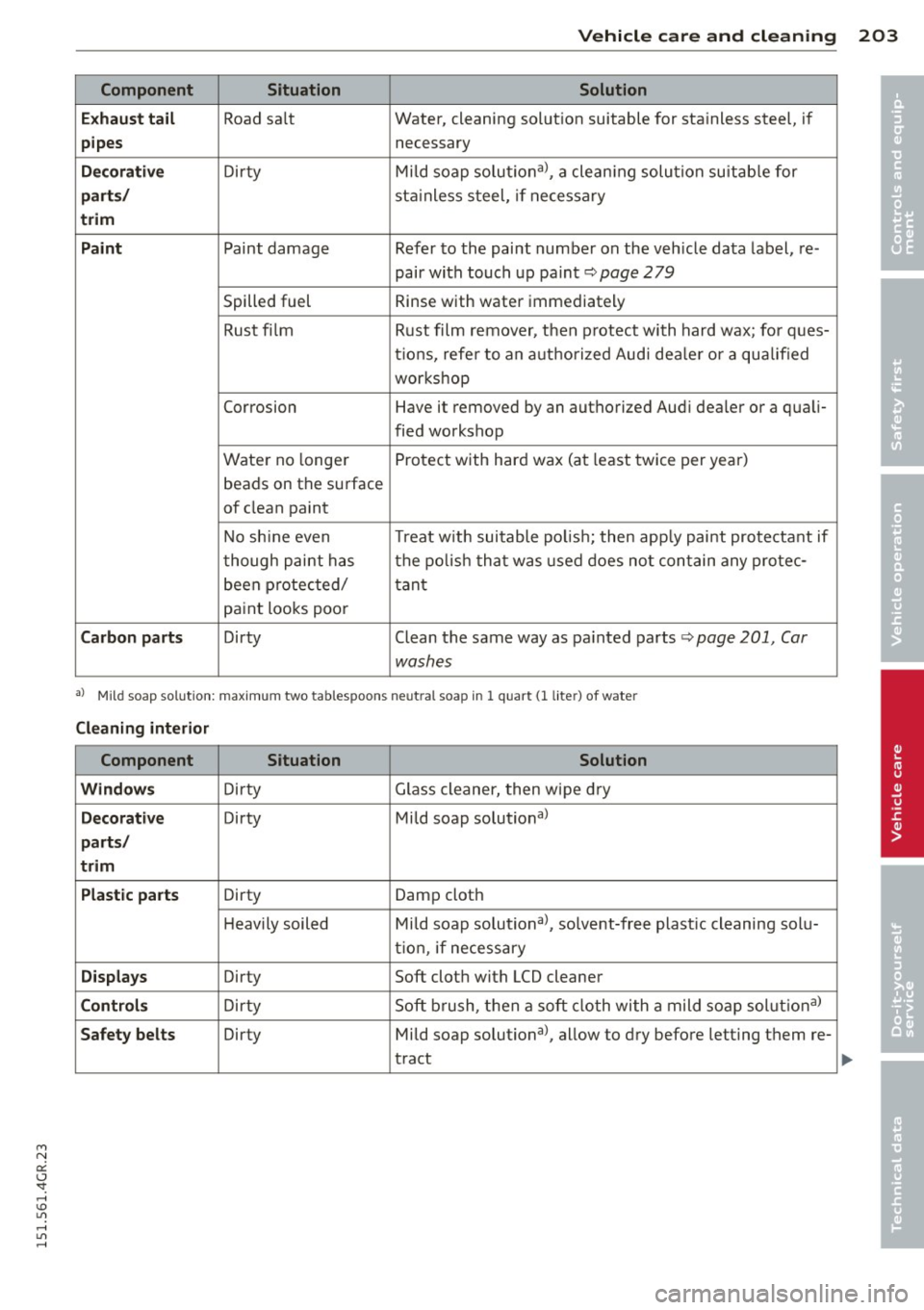
Component Situation Solution
Exhaust tail
Road sa lt Water,
cleaning solut ion suitable for sta inless steel, if
pipes necessary
Decorative Dir ty Mild soap solutional, a cleaning solution suitable for
parts/ stainless steel, if necessary
trim
Paint
Paint damage Refer to the paint number on the vehicle data labe l, re-
pair with touch up paint
c::> page 279
Spilled fuel Rinse
with water immediately
Rust film Rust film1 remover, then protect with hard wax; for ques-
tions, refer to an authorized Audi dealer or a qualified
workshop
Corrosion Have it removed by an authorized Audi dealer o r a quali-
fied workshop
Water no longe r Protect with hard
wax (at least twice per year)
beads on the surface
of clean paint
No shine even Treat with suitable polish; then apply paint protectant if
though paint has the polish that was used do es not contain any protec-
been protected/ tant paint looks poor
Carbon parts Dirty Clean the same way as painted parts c::> page 201, Car
washes
al M ild soap sol utio n: max im um two tablespoons neutral soap in 1 quart (l lite r) of water
Cleaning interior
Component Situation Solution
Windows
D irty Glass cleaner, then wipe dry
Decorative Dirty Mild soap solut ional
parts/
trim
Plastic parts
Dirty Damp cloth
Heavi ly soiled Mild soap solutional, solvent-free plastic cleaning solu-
tion, if necessary
Displays Dirty Soft cloth with LCD cleaner
Controls Dir ty Soft
brus.h, then a soft cloth with a mild soap solution al
Safety belts Dirty Mild soap solutional, allow to dry before letting them re-
tract
•
•
Page 206 of 302
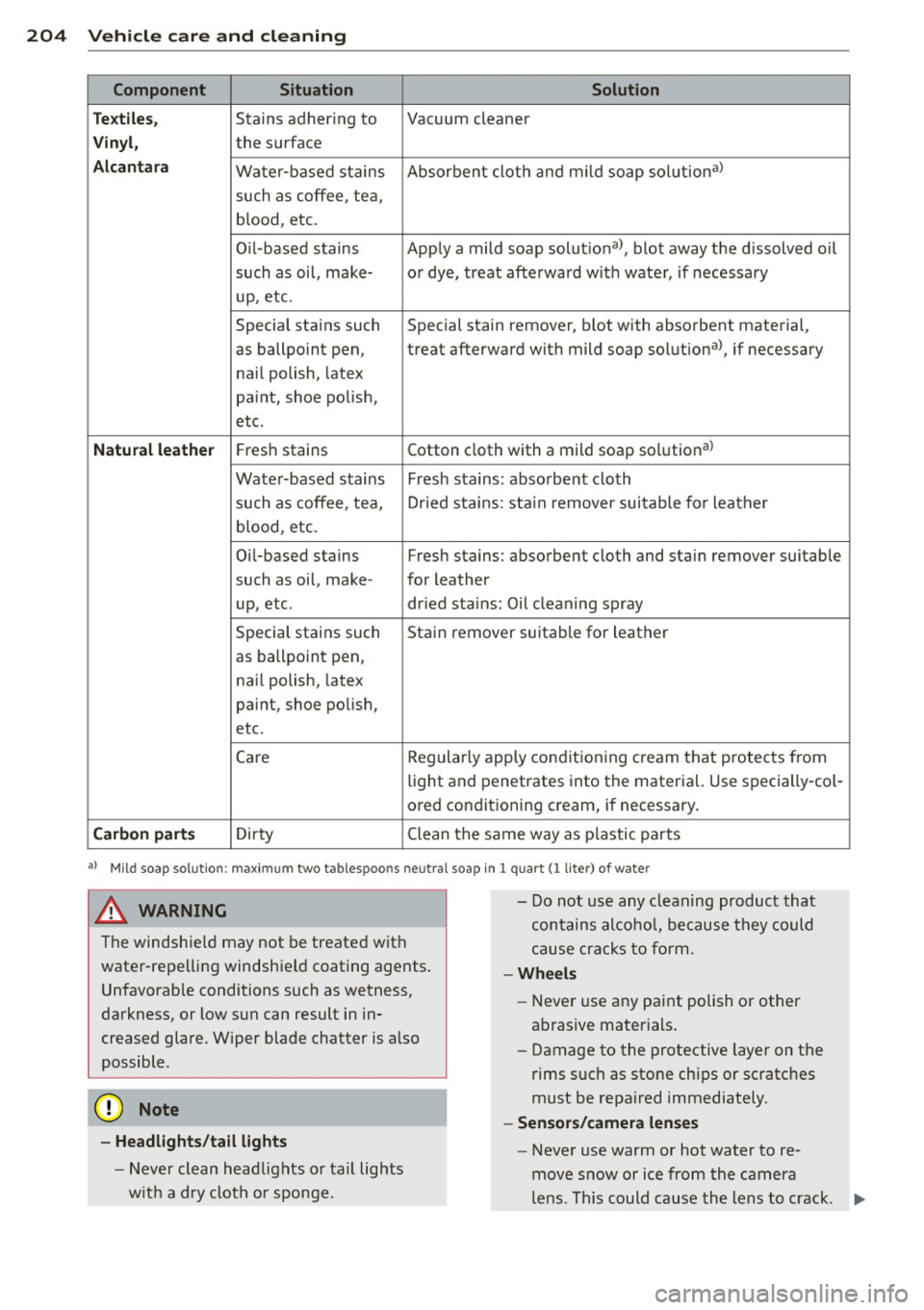
204 Vehicle care and cleaning
Component Situation Solution
T ex tile s,
Stains adhering to Vacuum cleaner
Vin yl, the surface
A lcan ta ra Water -based stains Absorbent cloth and mild soap solutiona>
such as coffee, tea,
blood, etc.
O il-based stains Apply a mild soap solutiona>, blot away the d issolved oil
such as oil, make- or dye, treat afterward w ith water, if necessary
up, etc.
Special stains such Special stain remover, blot with absorbent material,
as ballpoint pen, treat afterward with mild soap solutiona>, if necessary
na il polish, latex
pa int, shoe po lish,
etc.
N atu ral leather Fresh stains Cotton cloth with a mild soap solutiona>
Water-based stains Fresh stains: absorbent cloth
such as coffee, tea, Dr ied stains: sta in remover suitable for leather
blood, etc.
Oi l-based stains Fresh stains: absorbent cloth and sta in remover suitable
such as oil, make- for leather
up, etc. dried stains: Oil cleaning spray
Special stains such Stain remover suitable for leather
as ballpo int pen,
na il polish, latex
pa int, shoe polish,
etc.
Care Regular
ly apply condit ioning c ream that protec ts from
light a nd penetrates into the materia l. Use specially-col-
ored conditioning cream, if necessary.
Carbon part s Dirty Clean tlhe same way as plastic parts
a) Mi ld soap so lut ion : maximum two tablespoons neut ra l soap in 1 quart (I lite r) of water
& WARNING
The windshie ld may not be treated with
water -repe lling windshield coating agents .
Unfavorab le conditions such as wetness,
darkness, or low sun can result in in
creased glare. W iper blade chatter is a lso
possible .
(V Note
-Headlights /tail lights
- Never clean headlights or tail lights
w it h a dry cloth or sponge. -
Do not use any cleaning product that
contains alcohol, because they could
cause cracks to form.
-Wheels
- Never use any paint polish or other
abrasive mater ials.
- Damage to the protective layer on the
rims such as stone chips or scratc hes
must be repa ired immediately.
- Sensor s/camera len ses
- Never use warm or hot water to re-
move snow or ice from the camera
le ns. This could cause th e lens to crack . ""
Page 209 of 302
M N
0:: <.J 'SI: ,...., \!) ..,.,
,...., ..,., ,....,
-Blend must contain not more than 15%
MTBE.
Seasonally adjusted gasoline
Many gasoline grades are blended to perform
espec ially we ll for winter or summer driving.
During seasonal change-over, we suggest that
you fill up at busy gas stat ions where the sea
sonal adjustment is more likely to be made in
time .
(D Note
-Methanol fuels which do not meet these
requirements may cause corrosion and
damage to plastic and rubber compo
nents in the fuel system .
- Do not use fue ls that fail to meet the
specified criter ia in this chapter.
- If you are unable to determine whether
or not a particular fue l blend meets the
specifications, ask your service station or
its fuel supp lier.
- Do not use fuel for which the contents
cannot be identified.
- Fuel system damage and performance
problems resulting from the use of fuels
different from those specified are not
the responsibility of Audi and are not
covered under the New Vehicle or the Emission Control System Warranties.
- If you experience a loss of fuel economy
or driveability and performance prob l ems due to the use of one of these fuel
blends, we recommend that you switch
to unblended fuel.
Gasoline additives
A major concern among many auto manufac
turers is carbon deposit build- up caused by
the type of gasoline you use.
Although gasoline grades differ from one manufacturer to another , they have certain
things in common. All gasoline grades contain
substances that can cause deposits to collect
on vital engine parts, such as fuel injectors
and intake valves. Although most gasoline brands include additives to keep engine and
Fuel supply and filling your fuel tank 207
fuel systems clean, they are not equally effec
tive .
A udi recommends using TOP TIER Detergent
Gasoline. For more info rmation on TOP TIER
Detergent Gasoline, please go to the official
website (www.toptiergas.com).
After an extended period of using inadeq uate
fuels, carbon deposit build-ups can rob your
engine of peak performance.
Q) Note
Damage or malf unct ion due to poor fue l
quality is not covered by the Aud i New Ve
hicle Limited Warranty.
Fuel tank
Fuel filler neck
The fuel filler neck is located on the right rear
side panel behind the fuel fille r flap.
If the power locking system should fail, you
can still open the flap manually -for deta iled
instruct ions see
¢ page 209 .
You can find the fuel tank capacity of your ve
hicle in
¢ page 280 .
The label on the inside of the fuel fi ller flap
tells you the correct fue l for your vehicle. For
more information about fuel specifications,
see
¢ page 206.
Your vehicle fue l tank has an on board refuel
li ng vapor recovery system. This feature helps
to prevent fuel vapors from escaping from the
tank and polluting the environment while you refuel your vehicle . In order to fill the tank
properly while protecting the environment,
please fo llow this refueling procedure careful
ly.
_&. WARNING
Under normal operating conditions, never
carry additional fuel containers in your car.
Gas canisters and other containers used to
transport f uel can be dangero us. Such con
tainers, full or empty, may leak and could
cause a fire in a collision. If you must ..,.
•
•
Page 211 of 302
"' N
a:: I.J "". rl I.O
"' rl
"' rl
fuel container in your vehicle. The con
tainer, full or empty may leak and co uld
cause a fire, especially in a crash.
- If, under exceptional circumstances, yo u
must transport a portable fuel container,
please observe the following:
- Never fi ll a po rtable fue l container
while it is anywhe re in or on the vehicle
(for examp le, in the luggage compar t
ment, or on the tr unk). Static electric i
ty can bui ld up while fi lling and can ig
n ite fue l vapors causing a fire .
- Always p lace a portable fuel container
on the gro und before filling.
- Always keep the fi ller nozzle comp lete
ly inside the po rtable conta iner before
and during filling.
- If filling a portable container made of
metal, the filler nozz le must always be
in contact with the container. Th is w ill
he lp prevent static electricity from dis
charging and cause a fi re .
- Never sp ill fuel inside the vehicle or
luggage compartment. Fue l vapors are
h ighly f lammable .
- Always observe local and state/provin
cial laws regard ing the use, storage
and tra nsporta tion of fuel co ntainers .
- Make certai n the fuel container meets
industry standards (ANSI/ ASTM
F 8 52 -86) .
(D Note
If any f uel has spilled onto t he car, it
should be removed immediate ly to prevent
damage to the paint.
~ For the sake of the environment
As soon as the correctly operated nozzle sw itches off automatically fo r the fi rst
time, the tank is full. Do not try to add more fue l because fue l may spill out . In
add it io n, th e expans io n sp ace in the fuel
t ank will be fi lled -cau sin g the fue l to
over flow whe n it be come s w arm a nd pol
lu te the env iro nment.
Fu el suppl y and filli ng your fuel t ank 209
@ Tips
- Ru nning your eng ine whi le refue lli ng
may cause vapors to escape or even
cause fuel to sp ill out of the tank. T his
would then shut off the fuel nozzle be
f o re the ta nk is f ull.
- Do not refuel you r vehicle with the ign i
tion switched on. The fuel gauge may
ot herwise not i nd icate the correct fue l
lev el after r ef u ell ing .
- The fue l filler flap of yo ur vehicle is not
locked when you lock t he ve hicle from
t he insid e.
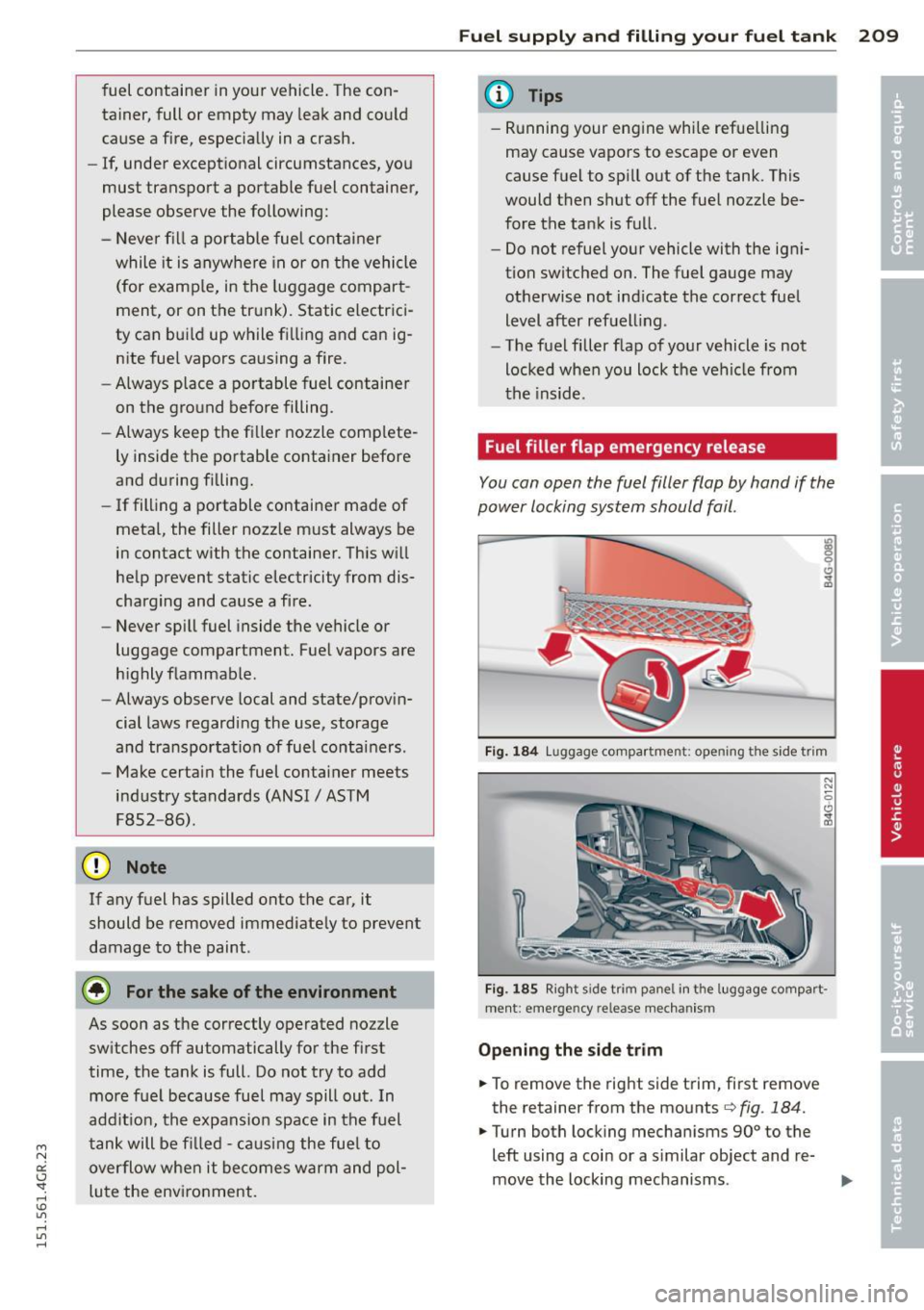
Fuel filler flap emergency release
You can open the fuel filler flap by hand if the
power locking system should fail .
Fig. 184 Luggage compa rtme nt: ope ning th e side trim
N
"' 0
~
Fig . 185 Right s ide tri m pane l in th e luggage com part ·
m ent : eme rge ncy re lease mechan is m
Opening the side trim
.. To remove the rig ht side t rim, first remove
the retainer from the mounts¢
fig. 184.
.. Turn both lock ing mechan isms 90° to the
left using a coin or a s imilar object and re-
move the locking mechanisms .
11J,,
Page 213 of 302
"' N
a:: I.J ""'. rl I.O
"' rl
"' rl
Checking and filling Engine hood
Releasing the engine hood
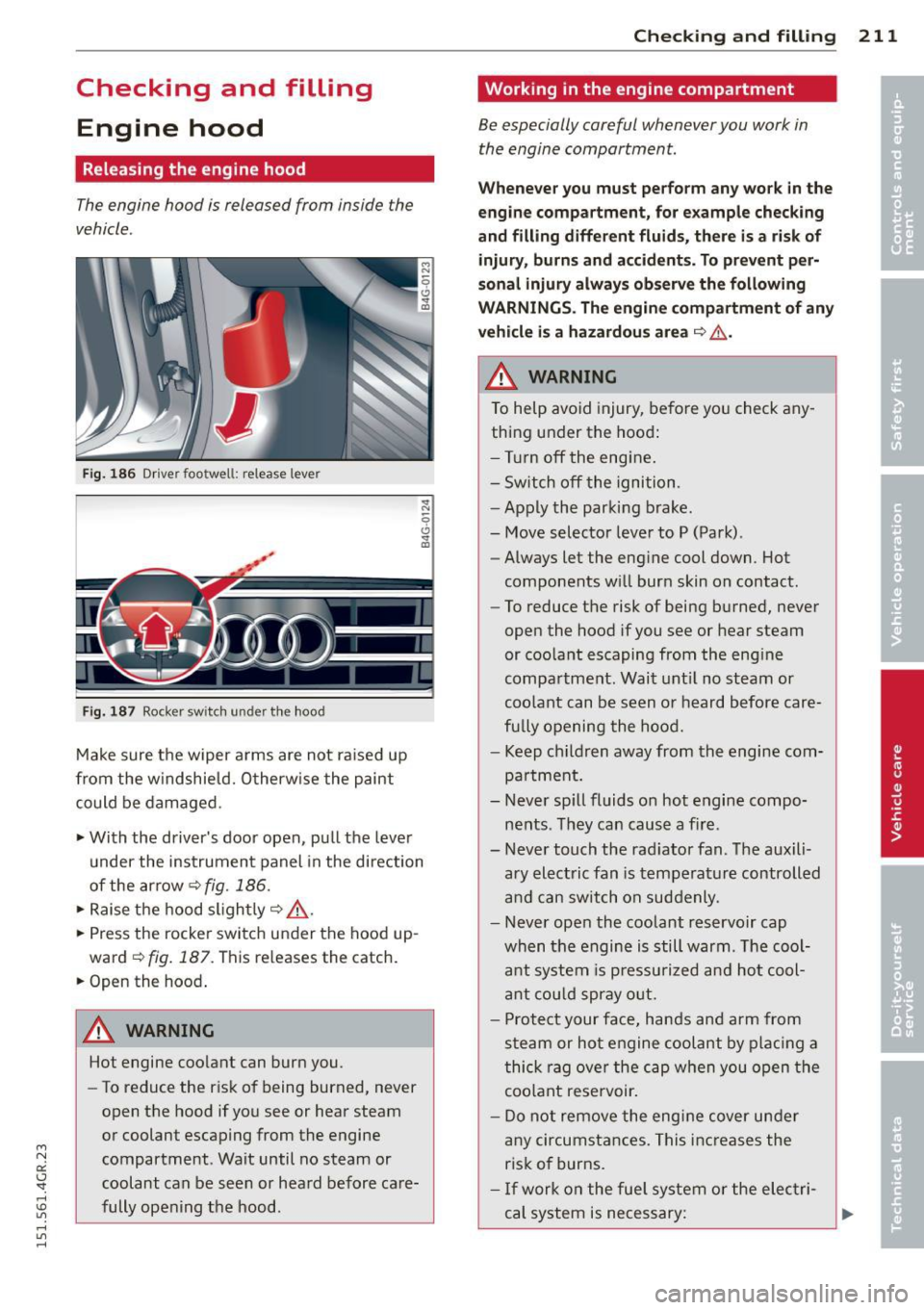
The engine hood is released from inside the
vehicle .
Fig. 186 Dr ive r foo twell: re lease leve r
Fig. 187 Rocker sw itch under the hood
Make sure the wiper arms are not raised up
from the w indshield. Otherw ise the paint
could be damaged.
.. With the driver's door open , pull the lever
under the instrument panel in the direction
of the arrow
c::> fig. 186.
.. Raise the hood slightly c::> .&. .
.. Press the rocker switch under the hood up
ward
c::> fig. 187 . This releases the catch.
.. Open the hood .
A WARNING
Hot engine coo lant can burn you.
- To reduce the risk of being burned, never
open the hood if you see or hear steam
or coolant escaping from the engine
compartment . Wait until no steam or
coolant can be seen or heard before care
fully opening the hood.
Checkin g and fillin g 211
Working in the engine compartment
Be especially careful whenever you work in
the engine compartment.
When ev er y ou must p erform an y wor k in the
en gine com pa rtm ent , for e xample checking
a nd filling diff ere nt fluid s, th ere is a risk of
inju ry, burn s and accid ent s. To pr eve nt per
so nal injury alwa ys observ e the foll owing
W ARNING S. The engin e compartm ent of any
v e hicle i s a h aza rdou s area
c::> ,& .
h WARNING
To help avoid injury, before yo u check any
thing under the hood:
- Turn off the engine.
- Sw itch off the ignition .
- Apply the parking brake.
- Move selector leve r to P (Park) .
- Always let the eng ine cool down . Hot
components w ill burn skin on contact .
- To reduce the risk of being burned, never
open the hood if you see or hear steam
or coo lant escaping from the engine
compa rtment. Wait unt il no steam or
coolant can be seen or heard before care
fu lly opening the hood.
- Keep ch ildren away from the engine com
pa rtment.
- Never sp ill fluids on hot engine compo
nents . They can cause a fire .
- Never touch the rad iator fan. The auxili
ary electric fan is temperat ure controlled
and can switch on suddenly .
- Never open the coolant reservoir cap
when the engine is still warm . The cool
ant system is p ressu rized and hot cool
a nt cou ld spray o ut.
- Protect your face, hands and arm from
steam or hot engine coolant by plac ing a
thick rag ove r the cap when you open the
coo lant rese rvoir.
- Do not remove the engine cover under
any circumstances. This inc reases the
ris k of burns.
- If work on the fue l system o r the elec tri -
cal system is necessary:
II>-
Page 219 of 302
"' N
a:: I.J "". rl I.O
"' rl
"' rl
Engine cooling system
Coolant
The engine coolant performs two functions: it
keeps the engine from overheating and it pro
tects the engine from freezing in the winter .
The cooling system is sealed and generally re
qu ires little attention .
The cooling system has been filled at the fac
tory with a permanent coolant which does not need to be changed. The coolant consists of a
mixture of specially conditioned water and the
manufacturer's glycol-based coolant addi-
tive G13 antifreeze with anticorros ion addi
tives (50% for USA models; 60% for Canadian models) . This mixture both assures the neces
sary frost protection and protects metal com
ponents in the engine's cooling system from
corrosion and scaling.
It also raises the boil
ing point of the coolant.
Do not reduce the concentration of the coo l
ant in the summer by adding plain water .
The
proportion of coolant additive must be at
least 50% but not more than 60%
to main
tain antifree ze protection and cooling efficien
cy. If the coolant frost protection is too low,
the coolant could freeze and damage the vehi
cle heating and eng ine cooling system .
For year-round driving, antifree ze is added at
the factory for temperatures down to:
- -31°F(-35°C)USA
- -40 ° F ( - 40 °C) Canada.
I f you must add coo lant, use a mixture of wa
ter and coolant addit ive. Mixing the coolant
additive with distilled water is recommended.
& WARNING
Before you check anything in the engine
compartment, always read and heed all
WARNINGS ~.&.
in Working in the engine
compartment on page 211.
(D Note
- Before winter sets in, have the coolant
checked to see if the coolant additive in
Checkin g and fillin g 217
your vehicle is sufficient to meet the cli
mate conditions. This is especia lly impor
tant if you live in a region where the win
ter is extremely co ld. If necessary, in
crease the proportion of coolant additive
to 60% .
- When adding coolant additive to your
cooling system, remember :
- We recommend using only coolant ad
ditive G12++ or G13 (check the label)
for your vehicle . This coolant additive is
avai lable at authorized Audi dealers .
Other types of antifreeze can signifi
cantly reduce corrosion protection. The resulting corrosion can cause a loss of
coolant and serious engine damage.
- Do not add any type of radiator leak seal
ant to your vehicle's engine coolant.
Adding radiator repair fluid may adverse
ly affect the function and performance of
your cooling system and could result in
damage not covered by your New Veh icle
Limited Warranty.
Checking the engine coolant level
The engine coolant level can be checked with
a quick glance.
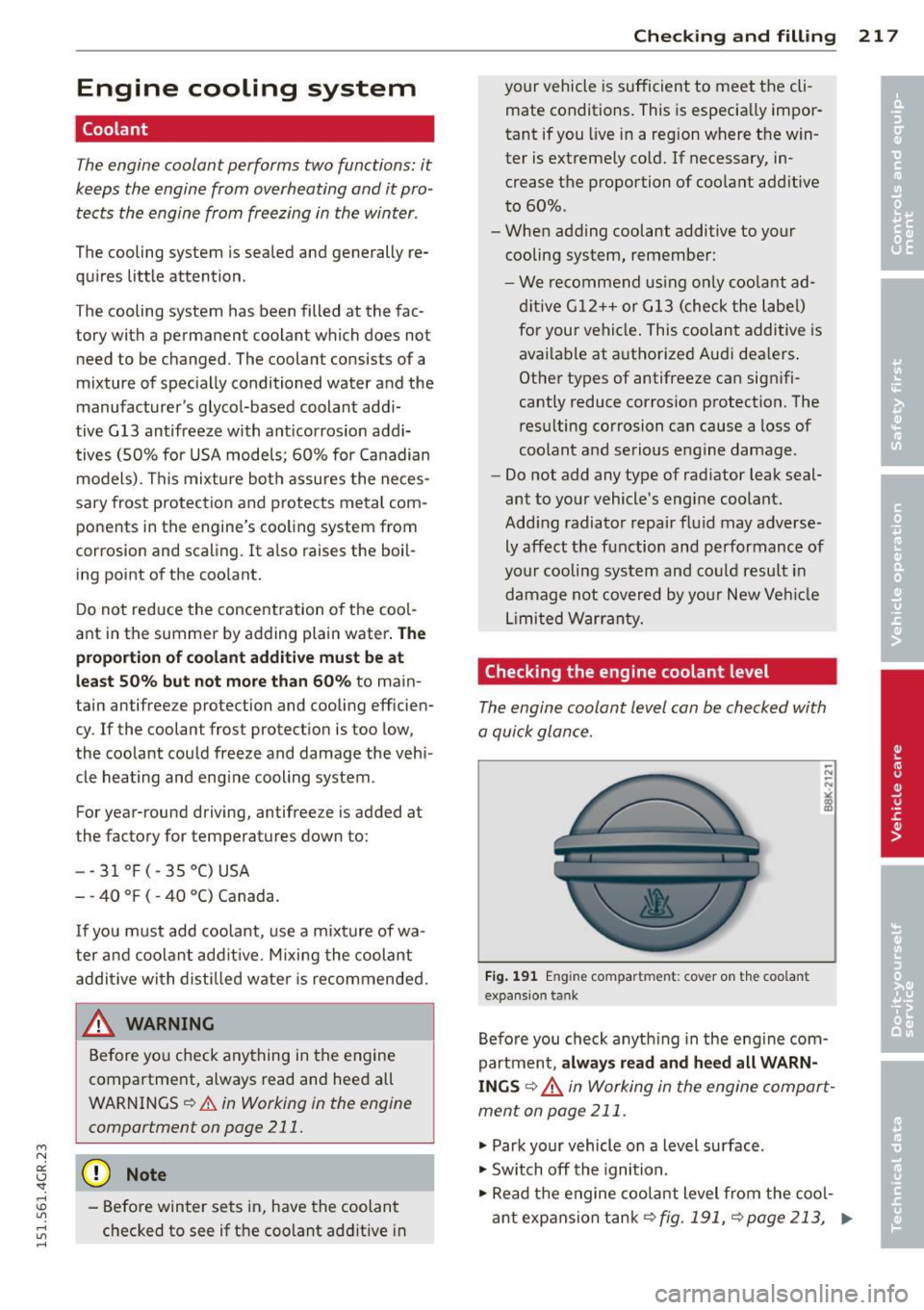
Fig. 191 En gin e compar tment: cover on the coo lant
expansio n tan k
Before you check anyth ing in the eng ine com
partment,
always read and heed all WARN
INGS¢.&, in Working in the engine compart
ment on page 211 .
"'Park your vehicle on a level surface .
"' Sw itch off the ignition.
"' Read the engine coolant level from the cool
ant expansion tank ¢
fig. 191, ¢ page 213, Ill>-
Page 223 of 302
M N
0:: <.J 'SI: ,...., \!) 1.1'1 ,...., 1.1'1 ,....,
@ For the sake of the environment
Because of the pr oblem of proper d isposa l
of brake flu id as we ll as the special tools
requ ired and the necessary expert ise, we
recommend that you have the brake fluid
changed by your author ized Audi dealer .
Battery
General information
Under normal operating conditions, the bat
tery in your Audi does not need any mainte
nance. With
high outside temperatures or
long daily dr ives we recommend that you have
the electro lyte level checked by a service fa
cility . The electrolyte level shou ld also be
checked each time the battery is charged
¢ page 223.
Have the battery checked when you take your
ve hicle in for service . You are well adv ised to
replace a battery that is older than 5 yea rs .
W ith certa in types of a irbag deployment, t he
b attery is d isconnected from the vehicle elec
tr ica l system for safety reasons¢.&.
in Re
pair, core and disposal of the airbags on
page 155.
Disconnecting the battery terminals
Some vehicle functions (power w indow regu
lators , for example) are lost if the battery ter
m inals a re d isconnected. These func tions have
to be re lea rned after the batte ry term inals a re
connected agai n. T o prevent this , the bat tery
should only be d isconnec ted from the vehicle
e lec tric al system when absolu tely necessa ry
for repairs .
Vehicles not driven for long periods
If you do not drive you r vehicle over a period
of severa l days or weeks, elec trical compo
nen ts are gr adually cut b ack o r swi tched off .
This redu ces energy cons umption and main
tains starting capab ility over a longer per io d
¢
page 193. Some of the co nvenience func
tions may not operate, s uch as the inte rior
lights or power seat adjustme nt. The conven-
Checkin g and fillin g 221
ience funct ions w ill be available again when
yo u sw itch on the ign ition and start the en
gine.
Winter operation
D ur ing the w inte r mon ths, bat tery ca pa city
tends to decrease as tempera tures drop . This
is beca use more power is a lso consumed wh ile
starting, and the headlights, rear window de
fogger, etc., are used mo re often.
Avoid unnecess ary powe r consumpt ion, pa r
ticu lar ly in city traffic o r when traveling only
sho rt distances. Let yo ur authorized A udi
dealer check the capacity of the vehicle bat
tery before w inter sets in¢
page 223 . A well
charged battery will no t on ly prevent star tin g
problems w hen the weather is cold, but w ill
also last longer .
@ Tips
If your vehicle is left standing for seve ral
weeks at extremely low temperatures, the
vehicle battery s hou ld be removed and
stored where it will not freez e. This will
p reve nt it from be ing dam aged and having
to be repl aced .
Working on the battery
Be especially careful when working on or near
the bat tery.
The battery is located in the luggage compar t
ment under the floor . B efo re you che ck any
thi ng in the luggage compartment,
read and
heed all WARNINGS
¢ .&, .
Always heed the safety warnings , when work
i ng on the veh icle batte ry or t he vehicle e lec
t rical sys tem to p reven t inju ry.
The following WARNINGS are very
important when working on the battery:
Always heed the following WARNING SYM· BO LS and safety precautions when working
on the battery .
®
Always wear eye protection.
•
•