ECU AUDI RS7 SPORTBACK 2016 User Guide
[x] Cancel search | Manufacturer: AUDI, Model Year: 2016, Model line: RS7 SPORTBACK, Model: AUDI RS7 SPORTBACK 2016Pages: 282, PDF Size: 70.78 MB
Page 66 of 282
Seats and storage
Enlarging cargo capacity of the vehicle
interior
The seat backs can be folded forward to enlarge
the cargo capacity.
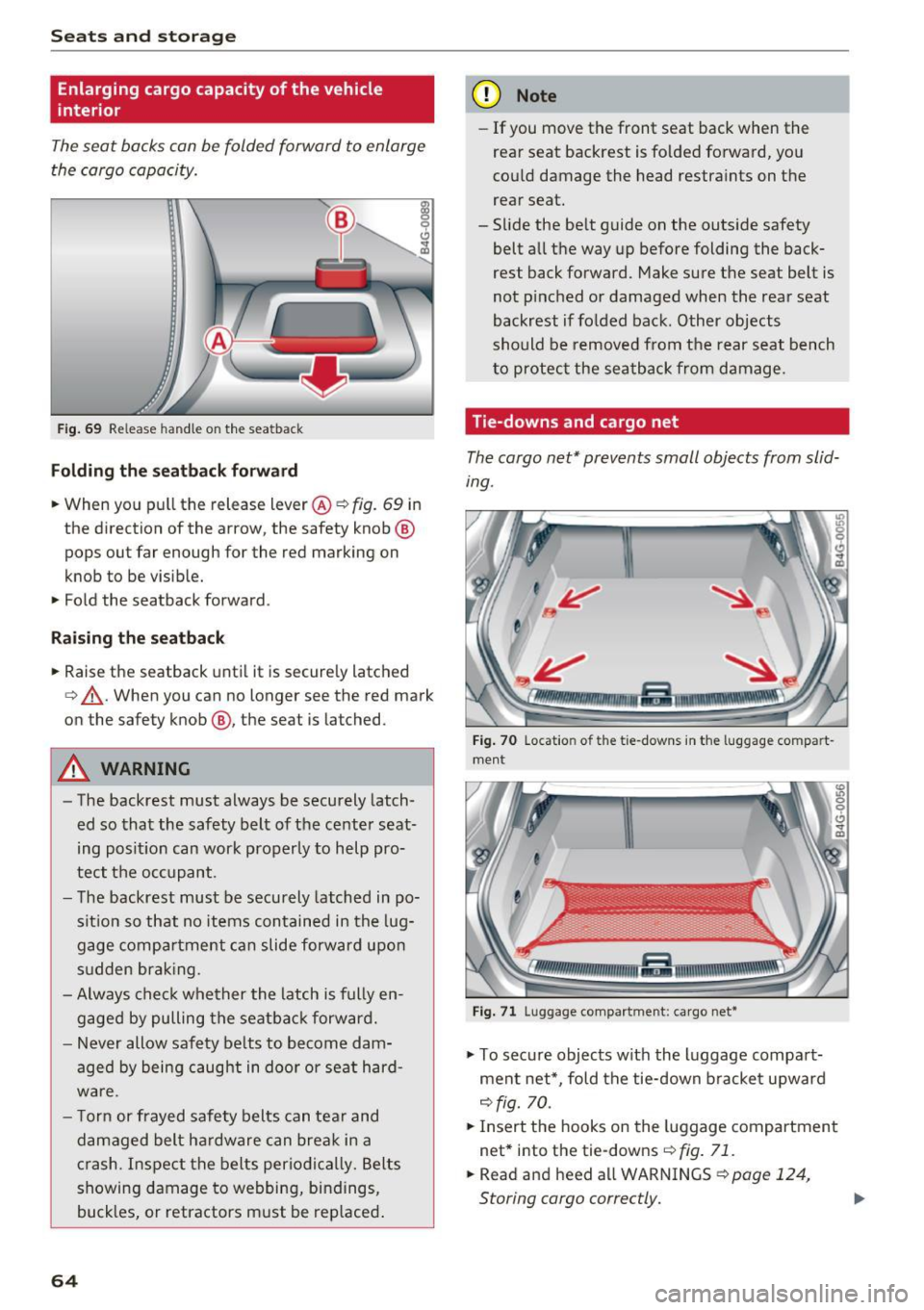
Fig. 69 Release h andle on the seatback
Folding the seatback forward
.,. When you pull the release lever@¢ fig. 69 in
the direction of the arrow, the safety knob @
pops out far enough for the red marking on
knob to be visib le.
• Fold the seatback forward.
Raising the seatback
• Raise the seatback until it is securely latched
¢ &, .When you can no longer see the red mark
on the safety knob@, the seat is latched.
A WARNING
-The backrest must always be securely latch
ed so that the safety belt of the center seat
ing position can work properly to help pro
tect the occupant.
- The backrest must be securely latched in po
sition so that no items contained in the lug
gage compartment can slide forward upon
sudden braking.
- Always check whether the latch is fully en
gaged by pulling the seatback forward.
- Never allow safety belts to become dam
aged by being caught in door or seat hard
ware.
- Torn or frayed safety belts can tear and
damaged belt hardware can break in a
crash. Inspect the belts periodically. Belts
showing damage to webbing, bindings,
buckles, or retractors must be replaced.
64
(D Note
- If you move the front seat back when the
rear seat backrest is folded forward, you
could damage the head restraints on the
rear seat.
- Slide the belt guide on the outside safety
belt all the way up before folding the back
rest back forward. Make sure the seat belt is
not pinched or damaged when the rear seat
backrest if folded back. Other objects
should be removed from the rear seat bench
to protect the seatback from damage .
Tie-downs and cargo net
The cargo net* prevents small objects from slid
ing .
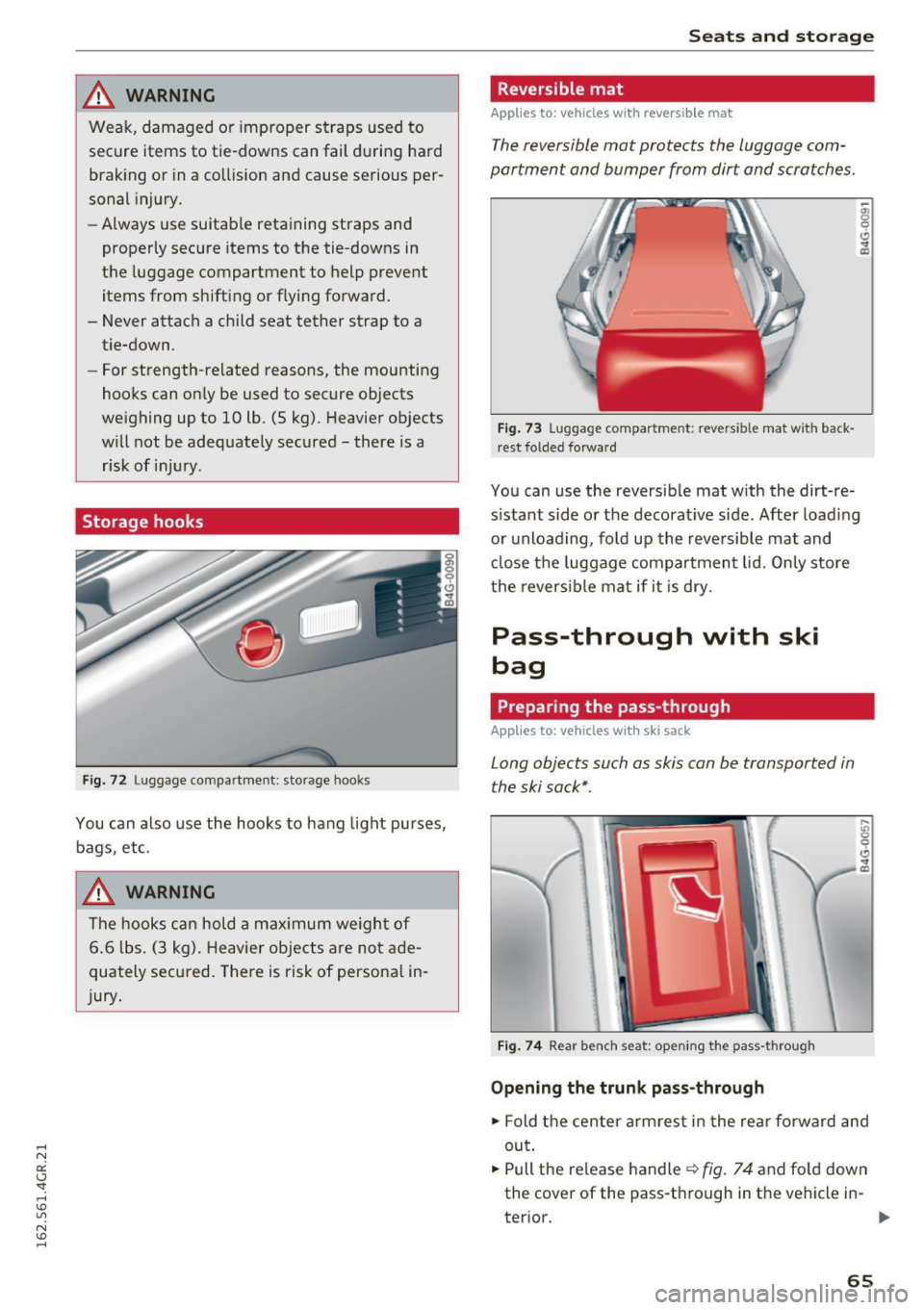
Fig. 70 Locat ion of the tie -downs in the lugg age compart
ment
Fig. 71 Lugg age compa rtment: cargo net*
• To secure objects with the luggage compart
ment net*, fold the tie-down bracket upward
¢ fig. 70 .
• Insert the hooks on the luggage compartment
net* into the tie-downs ¢
fig. 71.
• Read and heed all WARNINGS ¢ page 124,
Storing cargo correctly. ..,.
Page 67 of 282
,&_ WARNING
Weak, damaged or improper straps used to
secure items to tie-downs can fail during hard
braking or in a collision and cause serious per·
sonal injury.
- Always use suitab le retaining straps and
properly secure items to the tie -downs in
the luggage compartment to help prevent
items from shifting or flying forward.
- Never attach a child seat tether strap to a
t ie-down.
- For strength-related reasons, the mounting
hooks can on ly be used to secure objects
we ighing up to 10 lb. (5 kg). Heavier objects
will not be adequately secured -there is a
r isk of inj ury.
Storage hooks
Fig. 72 Luggage compartment: storage hooks
You can also use the hooks to hang light purses,
bags, etc.
& WARNING
-
-
Th e ho oks can hold a max imum weight of
6 .6 lbs. (3 kg). Heavier objects are not ade
quately secu red. There is risk of personal in
Jury .
Seats and storag e
Reversible mat
Applies to: veh icles w ith revers ib le m at
The reversible mat protects the luggage com·
partment and bumper from dirt and scratches .
Fig. 73 Luggage compartment: reversible mat with back
rest folded forward
You can use the reversib le mat w ith the dirt-re
s istant side or the decorat ive side. After loading
or unloading , fold up the reve rsible mat and
cl ose the luggage compartment lid. Only store
the reversible mat if it is dry.
Pass-through with ski
bag
Preparing the pass -through
Applies to : veh icles w it h sk i sack
Long objects such as skis can be transported in
the ski sack* .
Fig . 74 Rear bench seat : open ing the pass-through
Opening the trunk pass -through
.,. Fold the center a rm res t in the rear forward and
out .
.,. Pull the release handle¢
fig. 74 and fold down
the cover of the pass-through in the vehicle in-
terior. .,,.
65
Page 68 of 282
Sea ts and stor age
.,. Open the rear lid .
.,. Push the ski sack* through the opening from
the luggage compartment .
.,. Secure the ski sack¢
page 66 .
Closi ng th e trunk pass-th rough
.,. Open the rear lid .
.,. Remove the ski sack from the trunk pass
through .
.,. Push the pass-through cover up inside the vehi
cle until it latches.
.,. Raise the center armrest in the vehicle again.
.,. Close the rear lid.
A WARNING
Objects must only be transported in the sk i
sack since the ski sack can be sec ured. Individ
ual objects cannot be secured. There is a risk
o f i njury .
@ Tips
You can also open the pass-through from the
luggage compartment. Push the release but
ton down and push the cover forw ard.
Securing the ski sack
A pp lies to: ve hicles w ith sk i sack
The ski sack must be secured in the luggage com
partment.
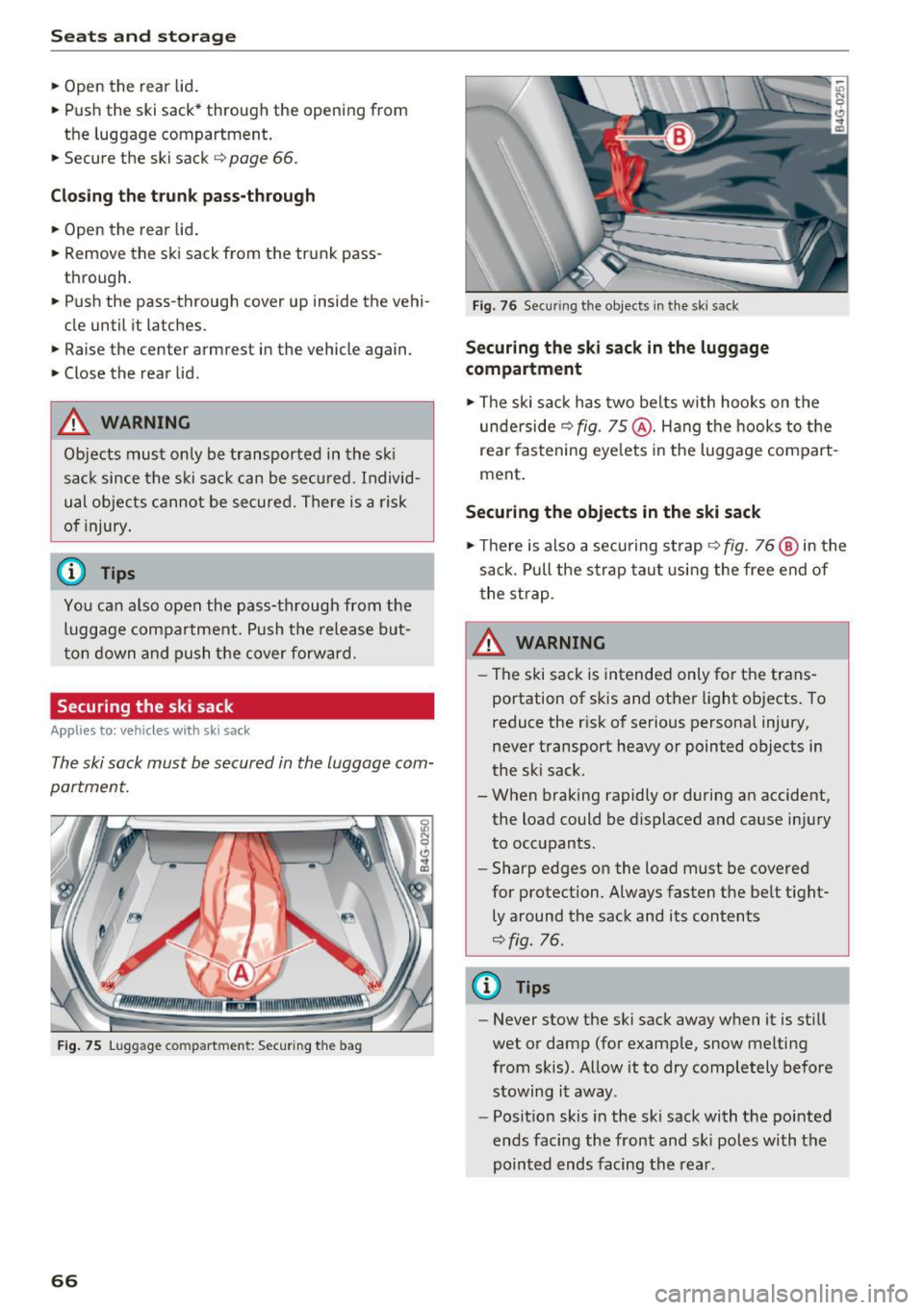
F ig . 75 Luggage compa rtment: Secur ing t he bag
66
Fig. 76 Secur ing the objects in t he ski sack
Securing the ski sack in the luggag e
compartment
.,. The ski sac k has two be lts with hooks on the
unde rside
~ fig. 75 @. Hang the hooks to the
rear fastening eye lets in the luggage compart
ment .
Securing the objects in the ski sack
.,. There is also a securing st rap ~ fig . 76 @ in the
sack. Pu ll the strap tau t using the free end of
the strap .
A WARNING
-The ski sack is intended only for the trans
portation of skis and other light objects. To
reduce the r isk of serious personal injury,
never transport heavy or pointed objects in
the sk i sack.
- When braking rapidly or during an accident,
the load could be displaced and cause injury
to occupants.
- Sharp edges on the load must be covered
for protection . Always fasten the be lt t ight
ly around the sack and its contents
~fig. 76 .
(D Tips
-Never stow the ski sack away when it is sti ll
wet or damp (for example, snow melting
from skis) . Allow it to dry completely before
stowing it away.
- Posit ion skis in the ski sack with the pointed
ends facing the front and sk i poles with the
pointed ends facing the rear.
-
Page 88 of 282
Audi adaptive cruise control and braking guard
detection and range limits that may prevent
the proper detection of other vehicles .
- The radar sensor's function and range can
be reduced by rain, snow and heavy spray.
Moving vehicles up ahead may not be
promptly detected or may not be detected
at all.
- Reflective surfaces including crash barriers
or tunnel entrances may impair the function
of the radar sensor.
@ Tips
- You can cancel the braking with increasing
force that is initiated by the system by brak
ing yourself, by accelerating noticeably or
by swerving .
- Braking guard error messages¢
page 86.
- Keep in mind that braking guard can brake
unexpectedly. Always secure any cargo or
objects that you are transporting to reduce
the risk of damage or injury.
Settings in the Infotainment system
Applies to: vehicles with Audi adapt ive cruise contro l
~ Select: the ICARI function button > (Car)* Sys
tems
control button > Driver assistance > Audi
braking guard.
System -
Switch the braking guard On/Off . When
you switch the ignition on, the message
Braking
guard: Off
appears if the system is switched off.
Early warning -The distance and approach warn
ings in the display can be switched
On/Off .
(D Tips
-Your settings are automatically stored and
assigned to the remote control key being
used.
- If you restrict or switch off the ESC, the braking guard also switches itself off
¢page 181 .
- Switch braking guard off when you are load
ing the vehicle onto a vehicle carrier, train,
ship or other type of transportation. This
can prevent undesired warnings from the
braking guard system.
86
Messages
Applies to: vehicles with Audi adapt ive c ru ise control
Braking guard: off
This driver message appears if the system is
turned off via the infotainment . Otherwise, if the
system is turned off, the information appears ev
ery time shortly after the start of the trip.
The driver message also appears if the system is
not available due to a malfunction or if the ESC is
not switched on¢
page 181. If this is the case,
the system will not provide warnings about a
possible collision.
Braking guard: activated
This driver message appears if sharp brake pres
sure was applied due to an acute warning .
ACC: Unavailable!
ACC and Audi braking guard: not available
The system cannot detect moving vehicles up
ahead correctly and is switched off. The sensors
have been displaced or are not working properly.
T he Audi pre sense funct ions may also be affect
e d. Dr ive to your authorized Audi dealer or au
thori zed Audi service facility immediately to have
the malfunction corrected.
ACC: currently unavailable. No sensor vision
ACC and braking guide: currently unavailable.
No sensor vision
This message appears if the sensor view is obstructed, for example by leaves, snow , heavy
spray or dirt. Clean the sensors ¢
page 79,
fig. 86.
ACC: Currently unavailable. Gradient too steep
The road exceeds the maximum possible angle
for proper adaptive cruise control operation .
Adaptive cruise control is switched off .
ACC: Only available in D, S or M
Select the D/S or M selector lever position.
ACC: currently unavailable. Parking brake ap
plied
Page 98 of 282
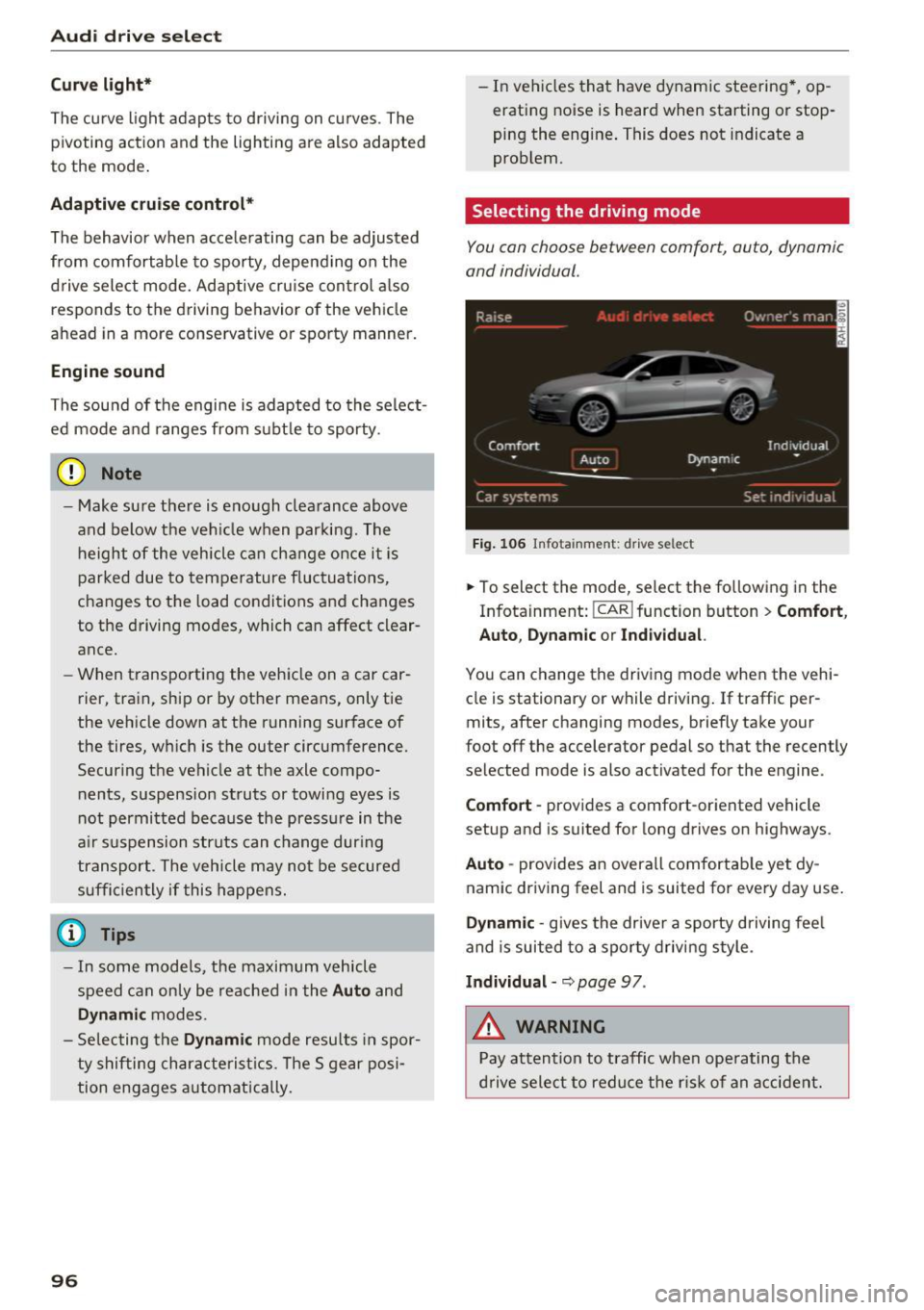
Audi dri ve s elec t
Cur ve ligh t*
The curve ligh t adapts to driving on curves . The
pivoting action and the lighting are also adapted
to the mode .
Adaptive cru is e control *
The behavior when accele rating can be adjusted
from comfortab le to sporty, depending on the
drive select mode. Adaptive cru ise control also
responds to the driving behavior of the vehicle
ahead in a more conservative or sporty manner.
Engine sound
The sound of the engine is adapted to the select
ed mode and ranges from subt le to sporty.
(D Note
- Make sure there is enough clearance above
and below the veh icle when parking. The
height of the vehicle can change once it is
parked due to temperature f luctuations,
changes to the load conditions and changes
to the driving modes, which can affect clear
ance.
- When transporting the vehicle on a car car
rier, train, ship or by other means, only tie
the vehicle down at the running surface of
the tires, which is the outer circumference.
Securing the vehicle at the axle compo
nents, suspension struts or towing eyes is
not permitted because the pressu re in the
a ir suspension struts can change dur ing
transport. The vehicle may not be secured
sufficiently if this happens.
@ Tips
- In some models, the maximum vehicle
speed can only be reached in the
Auto and
D ynami c modes.
- Se lec ting the
D ynami c mode results in spor
ty shifting characterist ics. The S gear posi
tion engages automatica lly.
96
- In veh icles that have dynamic steering *, op
erating noise is heard when starting or stop
ping the engine . This does not indicate a
problem.
Selecting the driving mode
You con choose between comfort, auto, dynamic
and individual .
Fig. 106 Infota inment: drive se lect
.,. To select the mode, select the following in the
Infotainment:
! CAR ! function button > Comf ort ,
Auto , Dyn amic or In d iv idual.
You can change the driv ing mode when the vehi
cle is stationary or while driving . If traffic per
mits, after changing modes, briefly take your
foot off the accelerator pedal so that the recently
selected mode is also activated for the engine .
Comfo rt -prov ides a comfort-oriented vehicle
setup and is suited for long drives on highways.
Aut o -provides an overall comfortab le yet dy
namic driving feel and is suited for every day use.
Dynami c -gives the drive r a sporty d riving feel
and is suited to a sporty driving style .
Indi vidua l -~ page 97 .
&_ WARNING
Pay attention to traffic when ope rating the
d rive select to reduce the r is k of an accident.
-
Page 106 of 282
Automatic transmission
-Before driving down a steep slope, reduce
your speed and shift into a lower gear with
"tiptron ic".
- Do not ride the brakes or press the brake
pedal too often or too long when driving
down a hill. Constant braking causes the
brakes to overheat and substantially re
duces braking performance, increases brak
ing distance or causes complete failure of
the brake system.
- To prevent the vehicle from rolling back
when stopping on inclines, always hold it in
place with the brake pedal or parking brake.
- Never hold the vehicle on an incline with a
slipping clutch. The clutch opens automati
cally when it becomes too hot from the
overload. An indicator lamp
[i'J illuminates
and a driver message appears
¢ page 105
when the clutch is overloaded.
- If the engine must remain running, never
have any driving position engaged when
checking under the hood. Make sure these
lector lever has securely engaged and is
locked in P with the parking brake set
¢ page 203. Otherwise, any increase in en
gine speed may set the vehicle in motion,
even with the parking brake applied .
@ Note
-When stopping on an incline, do not try to
hold the vehicle in place by pressing the ac
celerator pedal while a driving gear is se
lected . This can cause the transmission to
overheat and can damage it . Activate the
parking brake or press the brake pedal to
prevent the vehicle from rolling.
- Allowing the vehicle to roll when the engine
is stopped and the selector lever is in N will
damage the transmission because it is not
lubricated under those circumstances.
(D Tips
For safety reasons, the parking brake is re
leased automatically only when the driver's
safety belt is engaged in the buckle.
104
· Hill descent control
The hill descent control system assists the driver
when driving down declines .
Hill descent control is activated when the selec
tor lever is in D/S and you press the brake pedal.
The transmission automatically selects a gear
that is suitable for the incline. Hill descent con
trol tries to maintain the speed achieved at the
time of braking, within physical and technical
limitations. If may still be necessary to adjust the
speed with the brakes.
Hill descent control switches off once the decline
levels out or you press the accelerator pedal.
On vehicles with the cruise control system*
Q page 77, hill descent control is also activated
when the speed is set.
A WARNING
Hill descent control cannot overcome physical
limitations, so it may not be able to maintain
a constant speed under all conditions. Always be ready to apply the brakes.
Page 123 of 282
-Passengers who are unbelted, out of posi
tion or too close to the airbag can be seri
ously injured by an airbag as it unfolds with
great force in the blink of an eye.
- Always make sure that there are at least
10 inches (25 cm) between the front pas
senger's breastbone and the instrument
panel.
- Always make sure that there are at least
4 inches (10 cm) between the front passen ger's knees and the lower part of the instru
ment panel.
- Each passenger must always sit on a seat of
their own and properly fasten and wear the safety belt belonging to that seat.
- Before driving, always adjust the front pas
senger seat properly.
- For adjustable head restraints: before driv
ing, always also adjust the head restraints
properly.
-Always keep your feet on the floor in front
of the seat. Never rest them on the seat, in
strument panel, out of the window, etc. The
airbag system and safety belt will not be
able to protect you properly and can even in
crease the risk of injury in a crash .
- Never drive with the backrest reclined or
tilted far back! The farther the backrests are
tilted back, the greater the risk of injury due
to incorrect positioning of the safety belt and improper seating position.
- Children must always ride in child seats
c> page 159. Special precautions apply
when installing a child seat on the front
passenger seat
c> page 135.
Proper seating positions for passengers in
rear seats
Rear seat passengers must sit upright with both
feet on the floor consistent with their physical
size and be properly restrained whenever the ve
hicle is in use.
To reduce the risk of injury caused by an incorrect
seating position in the event of a sudden braking
maneuver or an accident, your passengers on the
rear bench seat must always observe the follow
ing:
Driving safety
.,. For adjustable head restraints: adjust the head
restraint so the upper edge is as even as possi
ble with the top of your head. If that is not pos
sible, try to adjust the head restraint so that it
is as close to this position as possible
c>page 121 .
.,. Keep both feet flat in the footwell in front of
the rear seat.
.,. Fasten and wear safety belts properly
c> page 130.
.,. Make sure that children are always properly re
strained in a child restraint that is appropriate
for their size and ager:!;>
page 159.
A WARNING
-
Passengers who are improperly seated on the
rear seat can be seriously injured in a crash.
- Each passenger must always sit on a seat of
their own and properly fasten and wear the
safety belt belonging to that seat.
- Safety belts only offer maximum protection
when the safety belts are properly posi
tioned on the body and securely latched. By not sitting upright, a rear seat passenger in
creases the risk of personal injury from im
properly positioned safety belts!
- For adjustable head restraints: always ad
just the head restraint properly so that it
can give maximum protection.
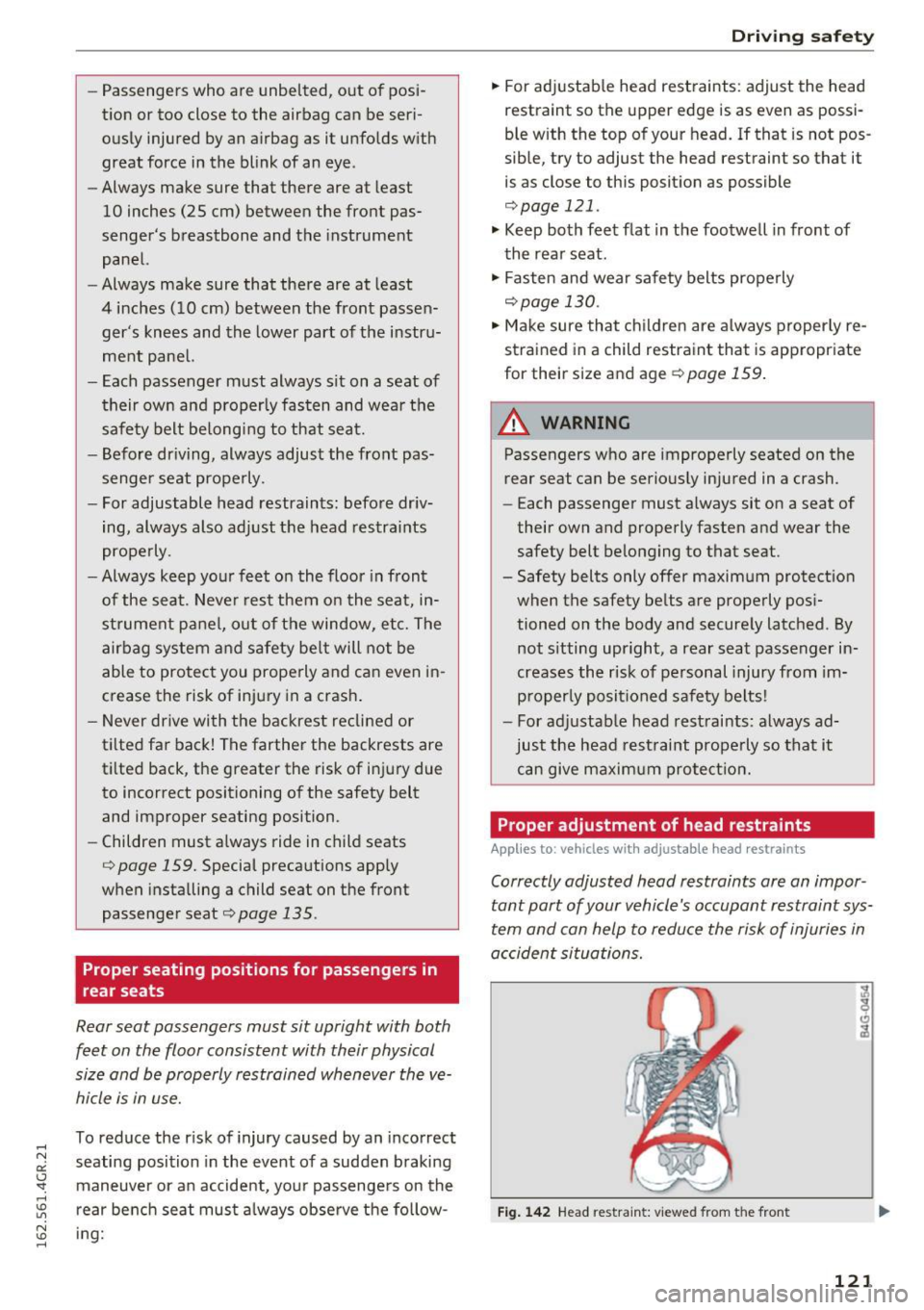
Proper adjustment of head restraints
App lies to: vehicles with adjusta ble head restraints
Correctly adjusted head restraints are an impor
tant part of your vehicle's occupant restraint sys
tem and can help to reduce the risk of injuries in
accident situations.
Fig. 142 Head restraint: viewed from the front
121
Page 125 of 282
Driver's and front
passenger's footwell
Important safety instructions
Applies to: vehicles with knee airb ags
A WARNING
Always make sure that the knee airbag can in
flate without interference . Objects between
yourself and the airbag can increase the risk
of injury in an accident by interfering with the
way the airbag deploys or by being pushed in
to you as the airbag deploys.
- No persons (children) or animals should ride
in the footwell in front of the passenger
seat . If the airbag deploys, this can result in
serious or fatal injuries.
- No objects of any kind should be carried in
the footwell area in front of the driver's or
passenger's seat. Bulky objects (shopping
bags, for example) can hamper or prevent
proper deployment of the airbag. Small ob
jects can be thrown through the vehicle if
the airbag deploys and injure you or your passengers .
Pedal area
Pedals
The pedals must always be free to move and
must never be interfered with by a floor mat or
any other object.
Make sure that all pedals move freely without in
terference and that nothing prevents them from
returning to their original positions.
Only use floor mats that leave the pedal area free
and can be secured with floor mat fasteners.
If a brake circuit fails, increased brake pedal trav
el is required to bring the vehicle to a full stop .
A WARNING
Pedals that cannot move freely can cause loss
of vehicle control and increase the risk of seri
ous inJury.
- Never place any objects in the driver's foot
we ll. An object could get into the pedal area
Driving safety
and interfere with pedal function . In case of
sudden braking or an accident, you would not be able to brake or accelerate!
- Always make sure that nothing can fall or
move into the driver's footwell.
Floor mats on the driver side
Always use floor mats that can be securely at tached to the floor mat fasteners and do not in
terfere with the free movement of the pedals.
• Make sure that the floor mats are properly se
cured and cannot move and interfere with the
pedals <=>,&. .
Use only floor mats that leave the pedal area un
obstructed and that are firmly secured so that
they cannot slip out of position. You can obtain
suitable floor mats from your authorized Audi Dealer.
Floor mat fasteners are installed in your Audi.
Floor mats used in your vehicle must be attached
to these fasteners. Properly securing the floor
mats will prevent them from sliding into posi
tions that could interfere with the pedals or im
pair safe operation of your vehicle in other ways.
A WARNING ..__
Pedals that cannot move freely can result in a
loss of vehicle control and increase the risk of
serious personal injury.
- Always make sure that floor mats are prop
erly secured.
- Never p lace or install floor mats or other
floor coverings in the vehicle that cannot be
properly secured in place to prevent them
from slipping and interfering with the ped als or the ability to control the vehicle .
- Never place or install floor mats or other floor coverings on top of already installed
floor mats. Additional floor mats and other
cover ings will reduce the size of the pedal
area and interfere with the pedals.
- Always properly re instal l and secure floor
mats that have been taken out for clean ing .
- Always make sure that objects cannot fall
into the driver footwell whi le the vehicle is ..,
123
Page 126 of 282
Driving safety
moving. Objects can becom e trapped under
the brake pedal and accelerator pedal caus ing a loss of vehicle control.
Storing cargo correctly
loading the luggage compartment
All luggage and other objects must be properly
stowed and secured in the luggage compart
ment .
Loose items in the luggage compartment can
shift suddenly, changing vehicle handling charac
teristics . Loose items can also increase the risk of
serious personal injury in a sudden vehicle ma neuver or in a collision.
.., Distribute the load evenly in the luggage com
partment.
.., Always place and properly secure heavy items in
the luggage compartment as far forward as
possible.
... Secure luggage using the tie-downs provided
c::;, page 62, Luggag e compartm ent.
... Make sure that the rear seatback is securely
la tched in place .
A WARNING
Improperly stored luggage or other items can
fly through the vehicle causing serious per sonal injury in the event of hard braking or an
accident . To help reduce the risk of serious
personal injury :
- Always put objects , for example, luggage or
other heavy items in the luggage compart
ment.
- Always secure objects in the luggage com
partment using the tie-down hooks and
suitable straps.
A WARNING
Heavy loads will influence the way your vehi
cle handles. To help reduce the risk of a loss
of control leading to serious personal injury:
- Always keep in mind when transporting
heavy objects, that a change in the center of
gravity can also cause changes in vehicle
handling:
124 -
Always distribute the load as evenly as
possible.
- Place heavy objects as far forward in the
luggage compartment as possible .
- Never exceed the Gross Axle Weight Rating
or the Gross Vehicle Weight Rating specified
on the safety compliance sticker on the left
door jamb. Exceeding permissible weight
standards can cause the vehicle to slide and
handle differently.
- Please observe information on safe driving
c::;,page 118.
A WARNING
To help prevent poisonous exhaust gas from
being drawn into the vehicle, always keep the
rear lid closed while driving .
- Never transport objects larger than those fitting completely into the luggage area be
cause the rear lid cannot be fully closed.
-If you absolutely must drive with the rear lid
open, observe the following notes to reduce
the risk of poisoning:
- Close all windows,
- Close the power roof*,
- Open all air outlets in the instrument pan-
el,
- Switch off the air recirculation,
- Set the fresh air fan to the highest speed.
A WARNING
-
Always make sure that the doors, all win
dows, the power roof* and the rear lid are se
curely closed and locked to reduce the risk of
injury when the vehicle is not being used.
- After closing the rear lid, always make sure
that it is properly closed and locked .
- Never leave your vehicle unattended espe
cially with the rear lid left open. A child
could crawl into the vehicle through the lug
gage compartment and close the rear lid be
coming trapped and unable to get out. Be ing trapped in a vehicle can lead to serious
personal injury.
- Never let children play in or around the vehi
cle.
Page 127 of 282
-Never let passengers r ide in the luggage
compartment. Vehicle occupants m ust al
ways be properly restrained in one of the ve
hicle's seating positions .
(D Tips
-Air c irculation helps to reduce window fog
ging. Stale air escapes to the outside
th rough vents in the t rim panel. Be su re to
keep these slots free and open.
- The t ire pressure must correspond to the
l oad. T he tire p ressure is shown on the tire
pressure labe l. The tire p ressure lab el is lo
cate d on t he d river 's side B-pillar. The tire
pressure labe l lists the recommend ed cold
t ire infla tio n pr essures for the vehicle at its
m aximum c ap aci ty weig ht and t he tires that
were on your vehicle at the t ime it was man
ufactu red. For recommended tire p ressures
fo r normal load con ditions, please see chap
ter
c:> page 229.
Tie-downs
The luggage compartment is equipped with four
tie-downs to secure luggage and other items.
Use t he tie -downs to secure your c argo p roperly
c':> page 124, Loading the luggage compartment .
In a coll is io n, the laws of physi cs mean th at even
s ma ller i tems th at are loose i n the vehicle will
become heavy missiles that can c ause ser ious in
jury. Items in the ve hicl e possess energy which
vary with vehicle speed and the weight of the item. Veh icle speed is the most s ignif icant facto r.
F or examp le, in a frontal collision at a speed of
30 mph (48 km/h), the forces act ing o n a 10-lb
(4.5 kg) object are a bout 20 times the no rma l
weight of the item. Th is means that the weight
of the item would suddenly be about
200 lbs . (90 kg). You can imagi ne the injuries
that a 200 lbs . (90 kg) item fly ing free ly throug h
the passenger compartmen t could cause in a co l
l ision like this .
Driv ing safety
A WARNING
Weak, damaged or imprope r straps used to
secure items to tie-dow ns can fai l dur ing hard
br aking or in a collision and cause ser io us per
sona l injury.
- Always us e suitable moun ting straps and
p rop erly secure i tems to the tie- downs in
the l uggage comp artme nt to help preven t
item s fr om sh ift ing o r flying forw ard a s dan
ge rous missiles .
- Wh en the rear sea t back res t is folde d down,
a lways u se su itable moun ting str aps a nd
p roper ly se cure i tems to the tie- down s in
the l uggage compa rtment to help preven t
items from flying forwar d as dange rous
miss iles into the passenger compartment.
- Never attach a chi ld safety seat tether strap
to a tie-down .
-
Reporting Safety Defects
Applicable to U.S.A.
If you believe that your vehicle
has a defect whi ch could cause a
crash or could cause injury or
death, you should immedia tely in
form the National Highway Traffic Safety Admini stration (NHTSA) in
addition to notifying Audi of
America, Inc.
If NHTSA receives similar complaints, it may open an investiga
tion , and if it finds that a safety
defects exists in a group of
vehicles, it may order a rec all and
remedy campaign. However,
NHTSA cannot become involved in
in dividual problems between you, ..,
125