check engine light AUDI RS7 SPORTBACK 2016 User Guide
[x] Cancel search | Manufacturer: AUDI, Model Year: 2016, Model line: RS7 SPORTBACK, Model: AUDI RS7 SPORTBACK 2016Pages: 282, PDF Size: 70.78 MB
Page 212 of 282
Checking and Filling
should be between the "min " and "max" mark
ings. When the engine is warm, the level may
be slightly above the "max" marking.
The location of the coolant expansion tank can be
seen in the engine compartment illustration
<::> page 205.
To obtain an accurate reading, the engine must
be switched off.
The expansion tank in your vehicle is equipped
with an electric coolant level sensor.
When the coolant level is too low, the warning
light in the Auto-Check System <::>
page 15 will il
luminate until you add coolant and the level has
been restored to normal. Even though there is an
electric coolant level sensor, we still recommend
you check the coolant level from time to time.
Coolant loss
Coolant loss may indicate a leak in the cooling
system. In the event of coolant loss, the cooling
system should be inspected immediately by your
authorized Audi dealer. It is not enough merely
to add coolant.
In a
sealed system, losses can occur only if the
boiling point of the coolant is exceeded as a re
sult of overheating.
A WARNING
The cooling system is under pressure and can
get very hot. Reduce the risk of scalding from
hot coolant by following these steps.
-Turn off the engine and allow itto cool down.
- Protect your face, hands and arms from es caping fluid and steam by covering the cap
with a large, thick rag.
- Turn the cap slowly and very carefully in a counter-clockwise direction while applying
light, downward pressure on the top of the
cap.
- To avoid being burned, do not spill anti
freeze or coolant on the exhaust system or
hot engine parts . Under certain conditions,
the ethylene glycol in engine coolant can
catch fire .
210
(D Note
Do not add any type of radiator leak sealant
to your vehicle's engine coolant. Adding radia
tor repair fluid may adversely affect the func
tion and performance of your cooling system
and could result in damage not covered by
your New Vehicle Limited Warranty .
Adding coolant
Be very careful when adding engine coolant.
Before you check anything in the engine compart
ment,
always read and heed all WARNINGS
<::>.& in Working in the engine compartment on
page 203 .
.. Requirement: There must be a residual amount
of coolant in the expansion tank
i:::>Q) .
.. Turn off the engine .
.. Let the engine cool down .
.. Place a thick rag over the coolant expansion
tank <::>
page 209, fig. 186 and carefully twist
the cap counter-clockwise
c::> &,.
.. Add coolant mixed in the correct ratio
<::> page 209, Coolant up to the MAX marking.
.. Make sure that the fluid level remains stable.
Add more coolant if necessary.
.. Twist the cap on again
tightly.
Replacement engine coolant must conform to ex
act specifications <::>
page 209, Coolant.
We recommend using only coolant additive G12+
+, G13 or in an emergency G12+ . Do
not use a
different additive. In an emergency use plain wa
ter until you can get the correct additive and can
restore the correct ratio. This should be done as
soon as possible.
If you have lost a considerable amount of cool
ant, then you should add cold antifreeze and cold
water only when the engine is cold.
Always use
new engine coolant when refilling.
Do not fill coolant above the "MAX" mark . Excess
coolant will be forced out through the pressure
relief valve in the cap when the engine becomes
hot.
~
Page 213 of 282
,&_ WARNING
-The cooling system is under pressure and
can get very hot. Reduce the risk of scalding
from hot coolant by following these steps.
- Turn off the engine and allow it to cool
down.
- Protect your face, hands and arms from
escaping fluid and steam by covering the
cap with a large, thick rag.
- Turn the cap slowly and very carefully in a
counter-clockwise direction while applying light, downward pressure on the top of
the cap.
- To avoid being burned, do not spill ant i
freeze or coolant on the exhaust system or
hot engine parts. Under certa in condi
tions, the ethylene glycol in engine cool
ant can catch fire.
- Antifreeze is poisonous. Always store anti
freeze in its original container and well out
of the reach of children.
- If you drain the coolant, it must be caught
and safely stored in a proper container
clearly marked "poison" .
(D Note
-Do not add coolant if the expansion tank is
empty. Air could enter the cooling system
and damage the eng ine. If this is the case,
do not continue driving. Seek professional
assistance.
- Coolant pollutes the environment and could
cause an engine fire. Excess coolant will be
forced out through the pressure relief valve
i n the cap when the engine becomes hot .
- If, in an emergency, only water can be add ed, the correct ratio between water and an
tifreeze
¢ page 209 must be restored as
soon as possible.
@ For the sake of the environment
Drained coolant should not be reused. Always
dispose of used coolant while observing all
environmental regulat ions.
-
Checking and Filling
Radiator fan
The radiator fan switches on automatically by it
self .
An auxiliary electric radiator fan switches on and
off depending on coolant temperature and other
vehicle operating conditions.
After you switch the engine off, the auxiliary fan
can continue running for up to 10 minutes -even
with the ignition off. It can even switch on again later by itself ¢&. , if
- the temperature of the engine coolant rises due
to the heat build-up from the engine in the en gine compartment, or
- the engine compartment heats up because the
vehicle is parked in intense sunlight.
A WARNING
--
- To reduce the risk of personal injury never
touch the radiator fan .
- The auxiliary electric fan is temperature
controlled and can switch on suddenly even
when the engine is not running .
- The auxiliary radiator fan switches on auto
matically when the engine coolant reaches a
certa in temperature and will continue to run
until the coolant temperature drops.
Brake fluid
Checking brake fluid level
Fig. 187 En g in e compar tment: cover on the b rake fluid
rese rvoir
Before you check anything in the engine compart
ment,
always read and heed all WARNINGS
¢ & in Working in the engine compartment on
page 203 . .,.
211
Page 214 of 282
Checking and Filling
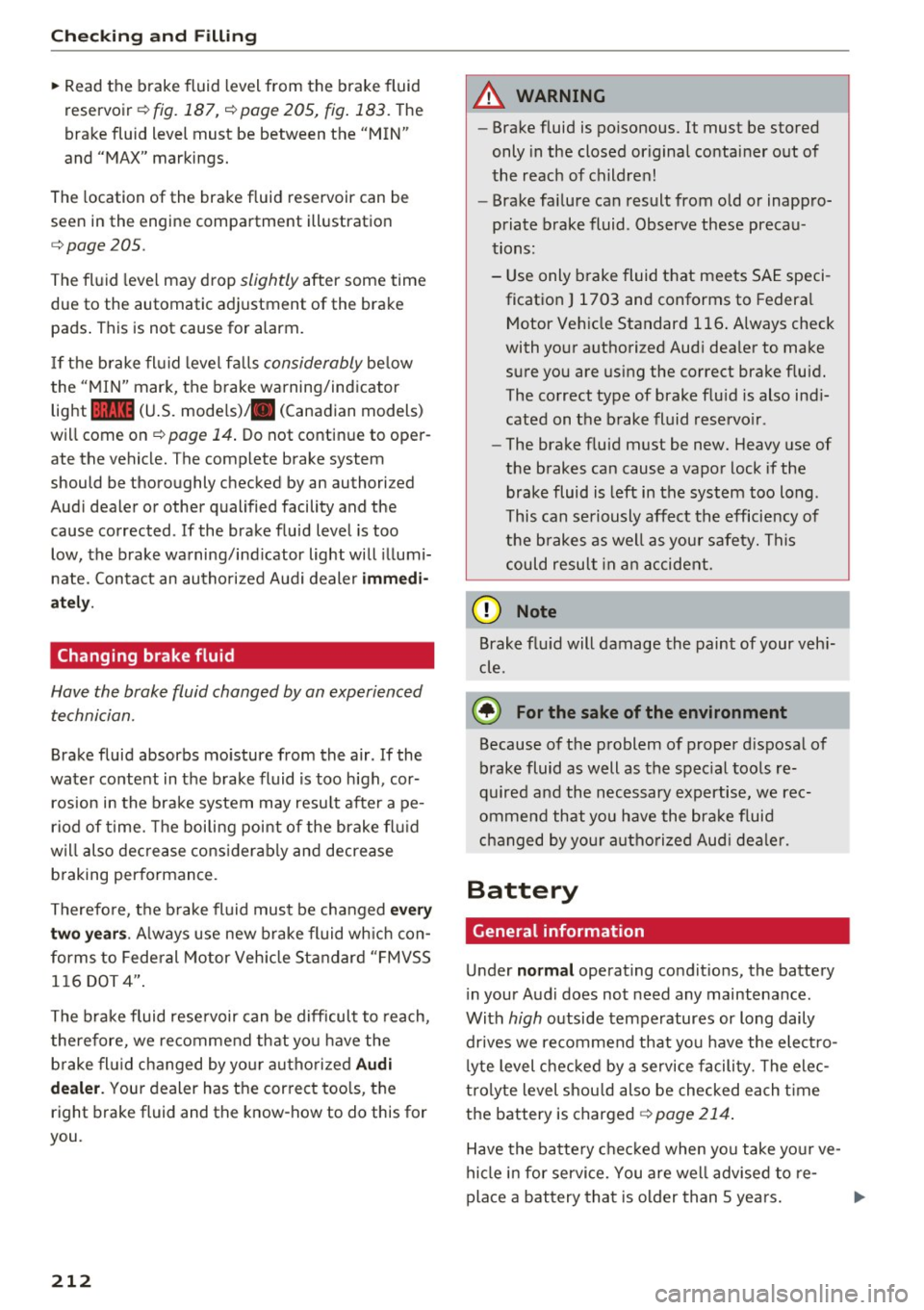
"' Read the brake fluid level from the brake fluid
reservoir
¢ fig. 187, ¢page 205, fig. 183. The
brake fluid level must be between the "MIN"
and "MAX" markings.
The location of the brake fluid reservoir can be
seen in the engine compartment illustration
c>page205.
The fluid level may drop slightly after some time
due to the automatic adjustment of the brake
pads. This is not cause for alarm.
If the brake fluid level falls considerably below
the "MIN" mark, the brake warning/indicator
light
1111 (U.S. models)/ . (Canadian models)
will come on¢
page 14. Do not continue to oper
ate the vehicle. The complete brake system
should be thoroughly checked by an authorized
Audi dealer or other qualified facility and the
cause corrected . If the brake fluid level is too
low, the brake warning/indicator light will illumi
nate. Contact an authorized Audi dealer
immedi
ately.
Changing brake fluid
Have the brake fluid changed by an experienced
technician.
Brake fluid absorbs moisture from the air . If the
water content in the brake fluid is too high , cor
rosion in the brake system may result after a pe
riod of time. The boiling point of the brake fluid
will also decrease considerably and decrease
braking performance.
Therefore, the brake fluid must be changed
every
two years.
Always use new brake fluid which con
forms to Federal Motor Vehicle Standard "FMVSS
116 DOT 4".
The brake fluid reservoir can be difficult to reach,
therefore, we recommend that you have the
brake fluid changed by your authorized
Audi
dealer.
Your dealer has the correct tools, the
right brake fluid and the know-how to do this for
you.
212
A WARNING
-
- Brake fluid is poisonous. It must be stored
only in the closed original container out of
the reach of children!
- Brake failure can result from old or inappro
priate brake fluid. Observe these precau
tions:
- Use only brake fluid that meets SAE speci
fication
J 1703 and conforms to Federal
Motor Vehicle Standard 116. Always check
with your authorized Audi dealer to make
sure you are using the correct brake fluid.
The correct type of brake fluid is also indi
cated on the brake fluid reservoir .
- The brake fluid must be new. Heavy use of
the brakes can cause a vapor lock if the
brake fluid is left in the system too long .
This can seriously affect the efficiency of
the brakes as well as your safety. This
could result in an accident.
(D Note
Brake fluid will damage the paint of your vehi
cle.
@ For the sake of the environment
Because of the problem of proper disposal of
brake fluid as well as the special tools re
quired and the necessary expertise, we rec
ommend that you have the brake fluid
changed by your authorized Audi dealer .
Battery
General information
Under normal operating conditions, the battery
in your Audi does not need any maintenance.
With
high outside temperatures or long daily
drives we recommend that you have the electro
lyte level checked by a service facility. The elec
trolyte level should also be checked each time
the battery is charged ¢
page 214.
Have the battery checked when you take your ve
hicle in for service. You are well advised to re
place a battery that is older than S years.
Page 216 of 282
Checking and Filling
-If you get battery acid in your eyes or on
your skin, immediately rinse with cold wa
ter for several minutes and get medical at
tention .
- If you should ingest any battery acid, seek
medical attention immediately.
- Do not expose the battery to an open flame,
electric sparks or an open light .
- Do not smoke.
- Do not interchange the positive and nega-
tive cables.
- When working on the battery, be sure not to
short-circuit the terminals with tools or oth
er metal objects. This would cause the bat
tery to heat up very quickly, which could lead to damage or explosion and personal
injury.
- When a battery is charged, it produces hy
drogen gas which is explosive and could
cause personal injury.
- Always keep the battery well out of the
reach of children.
- Before work is done on the electrical sys
tem, disconnect the negative ground cable.
- Before performing any work on the electri
cal system, switch off the engine and igni
tion as well as any electrical equipment. The negative cable on the battery must be dis
connected. If you are just going to replace a
light bulb, then it is enough to switch off
the lights.
- Before disconnecting the battery, switch off
the anti-theft alarm system! Otherwise you
will set off the alarm.
- When disconnecting the battery, first dis
connect the negative cable and then the
positive cable.
- Before reconnecting the battery, make sure
all electrical consumers are switched off.
Reconnect the positive cable first and then
the negative cable. Never interchange the
cables - this could start a fire!
- Never charge a frozen or a thawed-out bat
tery. It could explode! If a battery has fro
zen, then it must be replaced. A discharged
battery can freeze over at 32 °F (0 °C).
- Make sure the vent hose is always attached
to the opening on the side of the battery.
214
- Never use batteries which are damaged .
There is the danger of an explosion! Always
replace a damaged battery.
A WARNING
California Proposition 65 Warning:
- Battery posts, terminals and related acces
sories contain lead and lead compounds,
chemicals known to the State of California
to cause cancer and reproductive problems.
Wash hands after handling.
(D Note
- Do not disconnect the vehicle battery when
the ignition is on or when the engine is run
ning, otherwise, you will damage electronic
components in the electrical system.
- If your vehicle is going to stand for a long
period of time without being driven, protect
the battery from "freezing", otherwise it
will be damaged and will then have to be re
placed .
- When opening the doors, the windows low
er approximately 10 mm automatically. This
function is not available when the battery is
disconnected, which means there is a risk
that the door seal or the window could be
damaged.
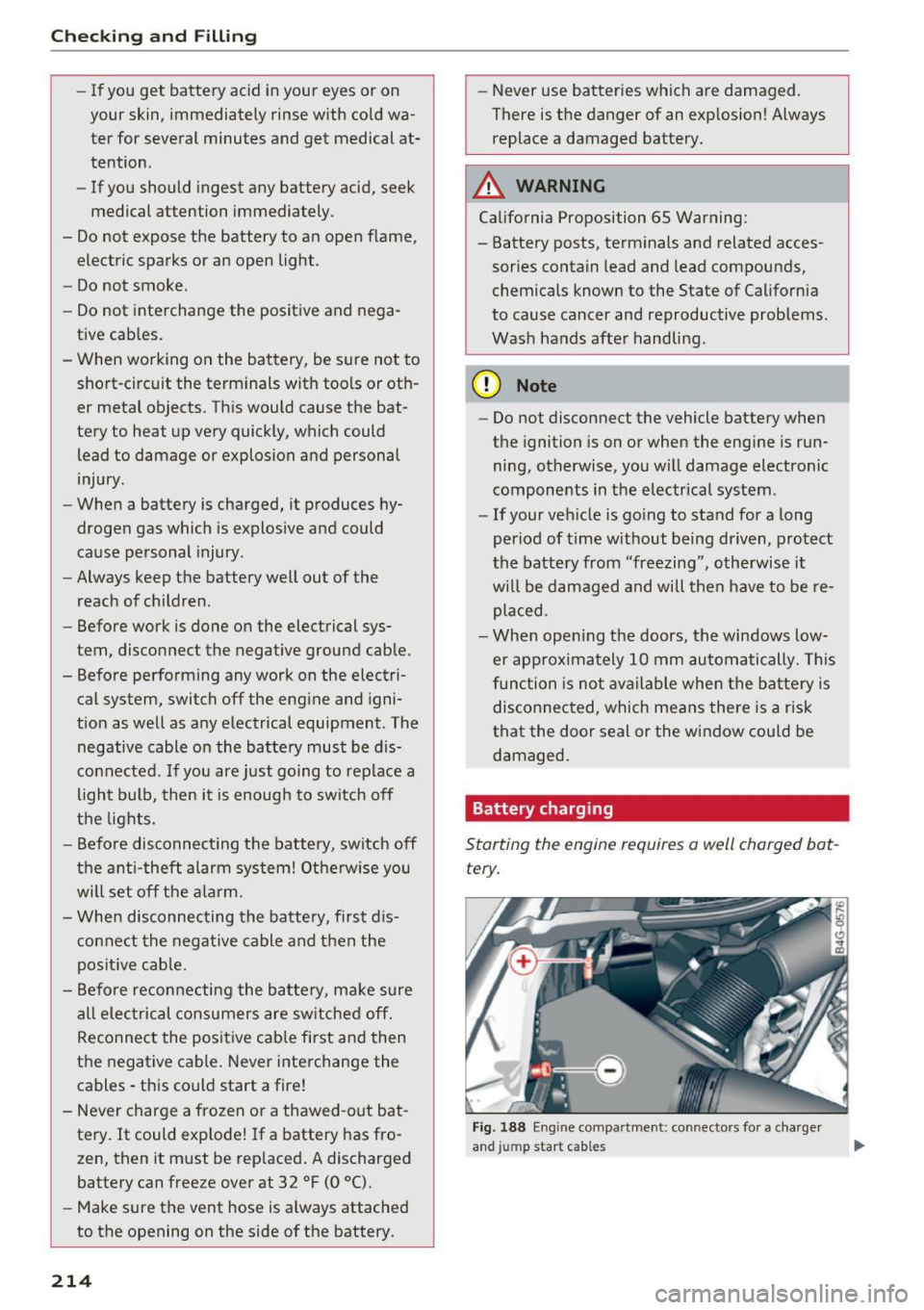
Battery charging
Starting the engine requires a well charged bat tery.
Fig . 188 En g in e compartment: con nectors fo r a charger
and jump start cab les
Page 218 of 282
Check ing and F illing
througho ut your vehicle ¢ page 186 . The intelli
gent energy management system wi ll keep the
engine battery charged better than veh icles with
out this system . To make sure the addit ional
electrical energy is avai lab le once again after you
have changed the battery, we recommend that
you install batter ies of t he same type and manu
facture on ly (the same as those insta lled at the
time your veh icle was delive red). Spec ificat ions
are listed on t he b attery housing. Your author
i z ed dealer must code the battery in the energy
management system to enable you to use the en
ergy manag ement functions correctly after re
p lacing the battery.
The new battery must have the same capac ity,
voltage (12 -vo lt), amperage, const ruction and
p lug sealing .
W hen insta lling the ba tte ry, make sure the igni
tion and all elec trical consumers are sw itched
off .
(D Note
Mak e sure the ve ntila tio n hose on t he side of
the batte ry is connecte d, othe rw ise f umes o r
battery acid can lea k out .
@) For the sake of the environment
Because of the prob lem of pr oper disposal of
a ba ttery, we recommen d your au thor ized
Audi dea le r change the battery fo r you. Bat
teries contain su lf u ric acid and lea d and must
always be disposed o f prope rly in comp liance
w ith all environmental regulations. D isposing
of vehicle batteries improperly is very danger
ous to the e nvironment.
216
Windshield washer
system
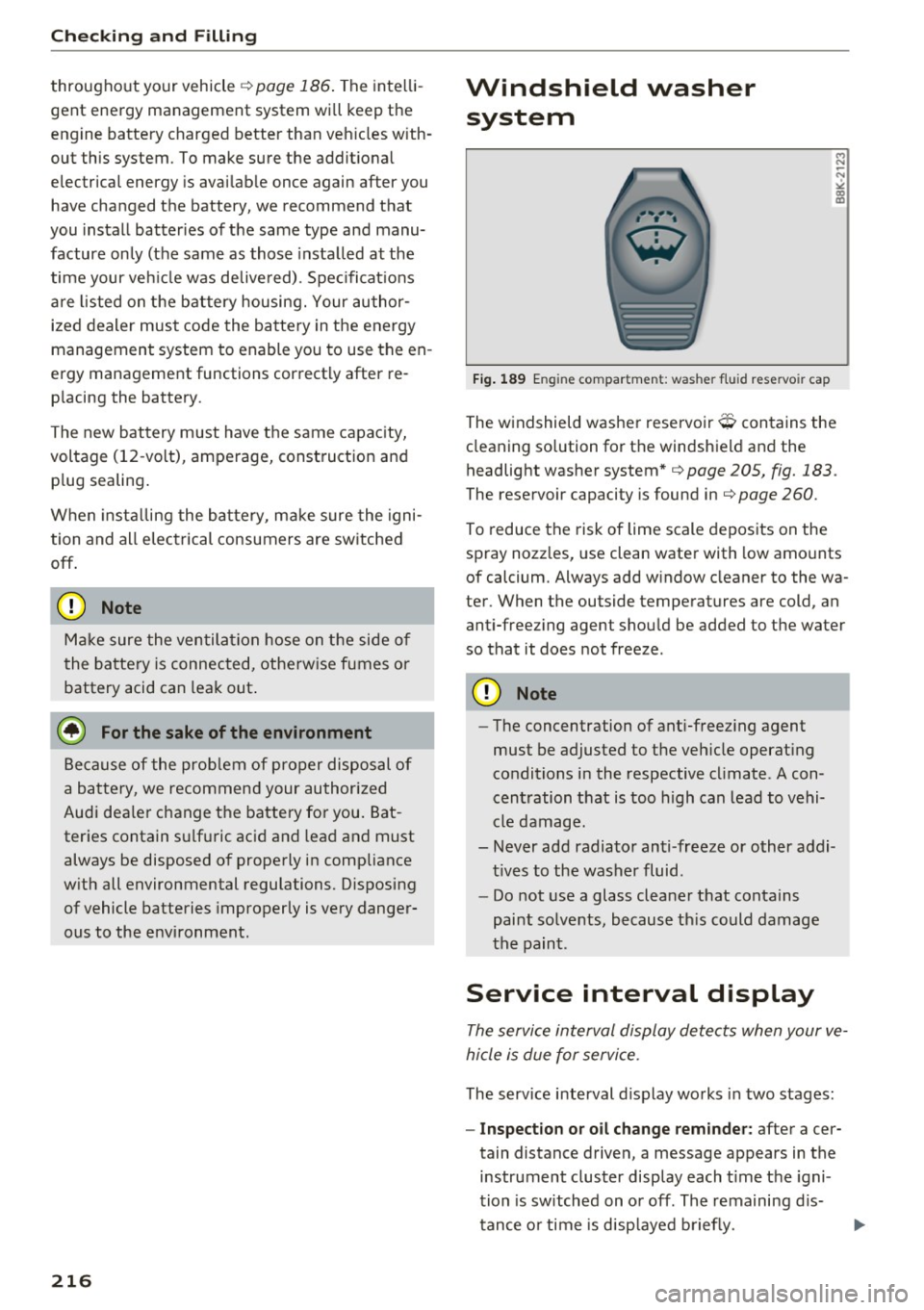
Fi g. 189 En gin e compar tm en t: was her flui d rese rvoir cap
.., N
-N ~ a, m
The w indshield washer reservoir O contains the
cleaning so lution for the windshie ld and the
headlight washer system *
9 page 205, fig. 183.
The reservoir capacity is found in 9 page 260 .
To reduce the risk of lime scale depos its on the
spray nozzles, use clean water with low amo unts
of calcium. Always add w indow cleaner to the wa
ter. When the outside temperatures are cold, an anti-freez ing agent shou ld be added to the water
so that it does not freeze .
(D Note
-The concentration of ant i-f reez ing agent
must be adjusted to the ve hicle operat ing
conditions i n the respective cl imate . A con
cen tration t hat is too high can lead to vehi
cle damage.
- Never ad d radia tor an ti-freeze or other addi
t ives to the washer fluid .
- Do not use a glass cleaner t hat contains
paint so lvents, because th is could damage
the pain t.
Service interval display
The service interval display detects when your ve
hicle is due for service .
The service interval d isplay wo rks i n two stages:
- Inspection or oil change rem inder: after a cer-
tain distance drive n, a message appears in the
instrument cluster display each t ime t he igni
tion is switched on o r off . The remaining d is-
t ance o r time is disp layed b riefly. .,..
Page 245 of 282
Replacing wheels
Before changing a wheel
Observe the following precautions for your own
and your passenger's safety when changing a
wheel.
.,. After you experience a tire failure, pull the car
well away from moving traffic and try to reach
level ground before you stop¢.,&..
.. All passengers should
leave the car and move
to a safe location (for instance, beh ind the
guardrail)¢ .,&. .
.,. Engage the
parking brake to prevent your vehi
cle from rolling unintentionally¢ .,&..
.. Move
selector lever to position P ¢ .,&. .
.. Take the
jack out of the luggage compartment
c:>page 239.
A WARNING
You or your passengers could be injured while
chang ing a wheel if you do not follow these
safety precautions:
- If you have a flat tire, move a safe distance
off the road. Turn off the engine, turn the
eme rgency flashers on and use other warn
ing devices to alert other motorists.
- Make sure that passengers wait in a safe
place away from the vehicle and well away
from the road and traffic.
- To help prevent the vehicle from moving
sudden ly and possibly slipping off the jack,
always fully set the parking brake and block
the wheel diagonally opposite the wheel be
ing changed . When one front wheel is lifted
off the ground, placing the Automatic
Transmission in P (Park) will
not prevent the
vehicle from moving.
- Before you change a wheel, be sure the
ground is level and firm. If necessary, use a
sturdy board under the jack.
- Always store the veh icle tool k it, the jack
and the replaced tire in the luggage com
partment
c> page 124.
(D Note
If you are changing the whee l on a steep in
cline, use a rock or similar object to b lock the
Emergency assistance
opposite wheel to prevent the vehicle from
moving.
(D Tips
- Before changing the wheel, you must acti
vate the jacking mode, so that the automat
ic controls for the Adaptive Air Suspension*
do not make it more difficu lt to lift the vehi
cle with the jack
c> page 245.
- Obey all laws .
Changing a wheel
When you change a wheel, follow the sequence
described below step-by-step and in exactly thot
order .
1. Activate the vehicle jack mode* c> page 245.
2. Remove the
wheel bolt caps*. For more de
tails see also
¢ page 244, Wheels with
wheel bolt caps.
3. Loosen the wheel bolts c:> page 244.
4. Locate the proper mounting point for the
jack and align the jack below that point
~page 245.
5. Raise the car with the jack c:> page 245.
6. Remove the
wheel with the flat tire and then
install the other whee l¢
page 246.
7. Tighten all whee l bolts lightly.
8.
Lower the vehicle with the jack.
9. Use the wheel bolt wrench and
firmly tighten
all wheel bolts
c> page 244.
10. Replace the
wheel bolt caps*.
11. Deact ivate the vehicle jack mode* in the
MMI:
I CARI funct ion button> (C ar )* systems
contro l butto n > Servicing & checks > Air
susp.: jack mode >
Off.
The vehicle jack mode* switches off automat ical
ly at speeds above 6 mph (10 km/h) .
A WARNING
-
Always read and follow all WARNINGS and in-
formation
¢ .&. in Raising the vehicle on
page
245 and ¢ page 247.
243
Page 255 of 282
Emergency situations
General
This chapter is intended for trained emergency
crews and working personnel who have the nec
essary tools and equipment to perform these
ope rations.
Starting by pushing or
towing
(D Note
Veh icles with an automatic transmission can
not be started by pushing or towing.
Starting with jumper
cables
If necessary, the engine can be started by con
necting it to the battery of another vehicle .
If the engine shou ld fail to start because of a dis
charged or weak battery, the battery can be con
nected to the battery of
another vehicle, using a
pair of jumpe r cables to start the engine.
Jumper cables
Use only jumper cables of suffic iently large cross
section
to carry the starter current safely. Refer
to the manufacturer's specifications.
Use only jumper cables with
insulated term inal
clamps which are dis tinct ly marked :
plus(+) cable in most cases colored re d
minus( -) cable
in most cases colored blac k.
A WARNING
Batteries contain electricity, acid, and gas.
Any of these can cause very serious or fatal in
jury. Follow the instructions below for safe
handling of your vehicle's battery.
- Always shield your eyes and avo id leaning
over the battery whenever poss ible.
- A discharged battery can freeze at tempera
tures just below 32 °F (0 °C) . Before con
necting a jumper cable, you must thaw the
Emergency situations
frozen battery completely, otherwise it
could explode .
- Do not allow battery acid to contact eyes or
skin. Flush any contacted area with water immediately.
- Improper use of a booster battery to start a
vehicle may cause an exp losion.
- Vehicle batteries generate exp losive gases.
Keep sparks, flame and lighted cigarettes
away from batteries.
- Do not try to jump start any vehicle with a
low acid level in the battery .
- The vo ltage of the booster battery must also
have a 12-volt rating. The capacity (Ah) of
the booster battery should not be lower
than that of the discharged battery. Use of
batter ies of different voltage or substantial
ly different "Ah" rating may cause an exp lo
sion and personal injury .
- Never charge a frozen battery. Gas trapped
in the ice may cause an explosion.
- Never charge or use a battery that has been
frozen . The battery case may have be weak
ened .
- Use of batter ies of different voltage or sub
stantially different capacity (Ah) rating may
cause an exp losion and injury. The capac ity
(Ah) of the booster battery should not be
lowe r than that of the discharged battery.
- Before you check anything in the eng ine
compartment, always read and heed all
WARNINGS
r::!)page 203.
(D Note
-Applying a higher voltage booster battery
will cause expensive damage to sensitive
electronic components, such as control
units, relays, radio, etc.
- Th ere must be no electrical contact between
the vehicles as otherwise current could al
ready start to flow as soon as the positive
(+) terminals are connected.
(D Tips
The discharged battery must be properly con-
nected to the vehicle's e lectrical system. ..,.
253
Page 256 of 282

Emergency situations
When jump starting or charging the battery,
never connect the negative ground cable to
the battery negative post because the battery
manager system must be able to detect the
battery's state of charge. Always connect the
negative ground cable to the negat ive ground
post of the battery manager control unit .
Use of jumper cables
Make sure to connect the jumper cable clamps in
exactly the order described below!
Fig. 212 Engine compartment: connectors for ju mp start
cab les a nd charger
® .--l @
Fig. 213 Ju mp start ing wit h the battery o f another vehicle:
@ -boos te r battery ,® -discharged vehicle battery
The procedure described below for connecting
jumper cables is intended to provide a jump start
for your vehicle.
Vehicle with discharged battery:
• Turn off lights and accessories , move lever of
automatic transmission to N (Neutral) or P
(Park) and set parking brake .
Connect POSITIVE(+) to POSITIVE(+) (red)
• Open the red cover on the positive term inal
~ fig . 212.
254
1. Connect one end of the red positive cable on
the
jump start bolt 9 fig. 213 @ (bolt under
the red cover= "positive") of the vehicle to be
started ®·
2. Connect the other end to the positive termi-
nal@ of the booster battery @.
Connect NEGATIVE (- ) to NEGATIVE (-)
(black)
3. Connect one end of the black negative cable
to the negative term inal @ of the booster
battery @.
4 . Connect the other end to the
jump start pin
@ (bolts with hex head bolt= "negat ive") of
the vehicle to be started ®·
Starting the engine
• Start the eng ine of the vehicle with the booster
battery @. Run the engine at a moderate
speed.
• Sta rt engine w ith discharged vehicle ba ttery @
in the usual manner.
• If the engine fails to start, do not keep the
starter cranking for longer than 10 seconds.
Wait for about 30 seconds and then try again.
• With engine running, remove jumper cables
from both vehicles in the exact
reverse order.
• Close the red cover on the positive terminal.
The battery is vented to the outside to prevent gases from entering the vehicle interior . Make
sure that the jumper clamps are well connected
with their metal parts in full contact with the battery terminals.
&_ WARNING
To avoid ser ious personal injury and damage
to the vehicle, heed all warnings and instruc
tions of the jumper cable manufacturer. If in
doubt, call for road service.
- Jumper cables must be long enough so that
the vehicles do not touch.
- When connecting jumper cables, make sure
that they cannot get caug ht in any moving
parts in the engine compartment.
- Before you check anything in the engine
compartment, always read and heed all
WARNINGS
¢ page 203.
Page 269 of 282
Anti-theft systems Electronic immobilizer . . . . . . . . . . . . . . . . . 31
Ashtray . . . . . . . . . . . . . . . . . . . . . . . . . . . . . . 58
Audi drive select
refer to Drive select . . . . . . . . . . . . . . . . . . . 95
Audi Service Repair Manuals and Literature 262
AUTO 4-z one deluxe automatic climate control . . 68
Automatic headlights . . . . . . . . . . . . . . . . . 43
Auto Lock . . . . . . . . . . . . . . . . . . . . . . . . . . . . 32
Automatic belt retractor . . . . . . . . . . . . . . . 130
Automatic post-collision brak ing system . . 181
Automatic Shift Lock (ASL) . . . . . . . . . . . . . 102
Automatic transmission . . . . . . . . . . . . . . . . 101
Automatic Shift Lock (ASL) . . . . . . . . . . . . 102
Driving . . . . . . . . . . . . . . . . . . . . . . . . . . . . 103
E mergency mode . . . . . . . . . . . . . . . . . . . . 105
Emergency release . . . . . . . . . . . . . . . . . . . 106
Kick-down . . . . . . . . . . . . . . . . . . . . . . . . . . 105
Manual shift program . . . . . . . . . . . . . . . . 105
Selector lever . . . . . . . . . . . . . . . . . . . . . . . 101
Automatic wipe/wash system . . . . . . . . . . . . 49
Auto Safety Hotline . . . . . . . . . . . . . . . . . . . 125
Average consumption . . . . . . . . . . . . . . . . . . . 23
Average speed . . . . . . . . . . . . . . . . . . . . . . . . 23
Avoid damaging the vehicle . . . . . . . . . . . . . 188
B
Battery . . . . . . . . . . . . . . . . . . . . . . . . . . . . . 212
Charge level . . . . . . . . . . . . . . . . . . . . . . . . 186
Charg ing ... .. ............... .. .... . 214
Energy management . . . . . . . . . . . . . . . . . 186
I mportant warn ings .......... .. .. .. . 213
Jump starting . . . . . . . . . . . . . . . . . . . . . . . 253
Location . . . . . . . . . . . . . . . . . . . . . . . . . . . 213
Replacing the battery . . . . . . . . . . . . . . . . 215
Winter operation . . . . . . . . . . . . . . . . . . . . 212
Working on the battery . . . . . . . . . . . . . . . 213
Before driving . . . . . . . . . . . . . . . . . . . . . . . . 118
Belt tensioners . . . . . . . . . . . . . . . . . . . . . . . 133
Blended gasoline . . . . . . . . . . . . . . . . . . . . . 198
Blower (4-zone deluxe automatic climate con-
trol) . . . . . . . . . . . . . . . . . . . . . . . . . . . . . . . . . 69
Boost display . . . . . . . . . . . . . . . . . . . . . . . . . 26
Booster seats . . . . . . . . . . . . . . . . . . . . . . . . 168
Boost pressure indicator . . . . . . . . . . . . . . . . 26
Index
Brake fluid
Changing the brake fluid . . . . . . . . . . . . . . 212
Checking the brake fluid level . . . . . . . . . . 211
Brakes Indicator light . . . . . . . . . . . . . . . . . . . . . . . 20
Brake system Anti-lock braking system . . . . . . . . . . . . . . . 18
Brake booster . . . . . . . . . . . . . . . . . . . . . . . 183
Brake fluid . . . . . . . . . . . . . . . . . . . . . . . . . 211
Brake fluid specifications for refill and re
placement . . . . . . . . . . . . . . . . . . . . . . . . . 212
Brake power assist unit . . . . . . . . . . . . . . . 182
Brakes..... ... .. .. ................ . 182
Electromechanical parking brake . . . . . . . . 7 4
Fluid reservoir . .. .. ............... .. 211
Warning/indicator lights . . . . . . . . . . . . . . . 14
Worn brake pads symbol . . . . . . . . . . . . . . . 19
Braking Brake assist . . . . . . . . . . . . . . . . . . . . . . . . 180
Emergency braking function . . . . . . . . . . . . 76
Braking guard . . . . . . . . . . . . . . . . . . . . . . . . . 79
Messages . . . . . . . . . . . . . . . . . . . . . . . . . . . 86
Settings . . . . . . . . . . . . . . . . . . . . . . . . . . . . 86
Break-in period
Brake pads . . . . . . . . . . . . . . . . . . . . . . . . . 182
T ires ......... .... ................ .
Breaking in
New tires
C
188
188
225
California Proposition 65 Warning . . . . . . . 204
Battery specific . . . . . . . . . . . . . . . . . . . . . 214
Capacities . . . . . . . . . . . . . . . . . . . . . . . . . . . 260
Engine oil . . . . . . . . . . . . . . . . . . . . . . . . . . 205
Car carrier Transporting your vehicle . . . . . . . . . . . . . 256
Care . . . . . . . . . . . . . . . . . . . . . . . . . . . . . . . . 193
Cargo area . . . . . . . . . . . . . . . . . . . . . . . . . . . 124
Cargo net . . . . . . . . . . . . . . . . . . . . . . . . . . . . 64
Catalytic converter . . . . . . . . . . . . . . . . . . . . 189
Center armrest Cockpit . . . . . . . . . . . . . . . . . . . . . . . . . . . . . 55
Central locking . . . . . . . . . . . . . . . . . . . . . . . . 31
Emergency locking . . . . . . . . . . . . . . . . . . . . 36
Power windows . . . . . . . . . . . . . . . . . . . . . . 40
Setting . . . . . . . . . . . . . . . . . . . . . . . . . . . . . 33
Sunroof. . . . . . . . . . . . . . . . . . . . . . . . . . . . . 40
267
Page 270 of 282
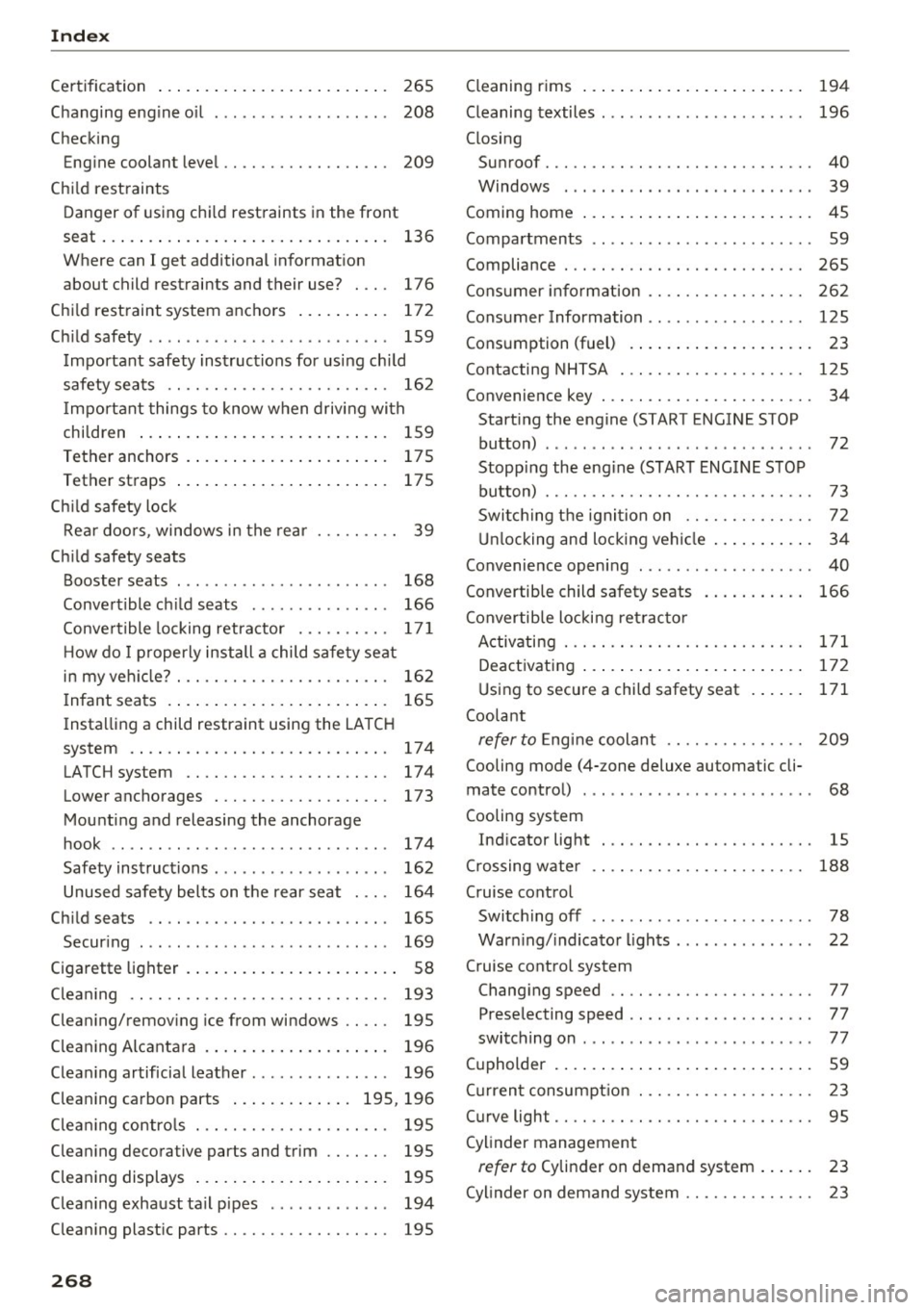
Index
Certification . . . . . . . . . . . . . . . . . . . . . . . . . 265
Changing eng ine o il . . . . . . . . . . . . . . . . . . . 208
Checking Eng ine coolant level. . . . . . . . . . . . . . . . . . 209
C hil d rest raints
D anger of using ch ild restraints in the front
seat . . . . . . . . . . . . . . . . . . . . . . . . . . . . . . . 136
Where can I get additional informat ion
about child restraints and their use? . . . . 176
Ch ild rest raint system anchors . . . . . . . . . . 172
C hi ld safety . . . . . . . . . . . . . . . . . . . . . . . . . . 15 9
I mportant safety inst ructions for using chi ld
safety sea ts . . . . . . . . . . . . . . . . . . . . . . . . 162
I mportant things to know w hen driv ing wi th
children . . . . . . . . . . . . . . . . . . . . . . . . . . . 159
Tether anchors . . . . . . . . . . . . . . . . . . . . . . 17 5
Tether straps . . . . . . . . . . . . . . . . . . . . . . . 175
C hil d safety lock
Rea r doo rs , windows in the rea r . . . . . . . . . 39
Ch ild safety seats
Booster seats . . . . . . . . . . . . . . . . . . . . . . . 168
Conve rt ible ch ild seats . . . . . . . . . . . . . . . 166
Conve rt ible locking retra ctor . . . . . . . . . . 17 1
H ow do I proper ly install a child safe ty seat
in my ve hicle? . . . . . . . . . . . . . . . . . . . . . . . 162
I nfant seats . . . . . . . . . . . . . . . . . . . . . . . . 165
Insta lling a child restraint using the LA TCH
system . . . . . . . . . . . . . . . . . . . . . . . . . . . . 17 4
LATCH system . . . . . . . . . . . . . . . . . . . . . . 174
Lower anchorages . . . . . . . . . . . . . . . . . . . 173
Mounting and releasing the anchorage
hook . . . . . . . . . . . . . . . . . . . . . . . . . . . . . . 174
Safety inst ructions . . . . . . . . . . . . . . . . . . . 162
Unused safety bel ts on t he rear seat . . . . 164
Ch ild seats . . . . . . . . . . . . . . . . . . . . . . . . . . 165
Secur ing . . . . . . . . . . . . . . . . . . . . . . . . . . . 169
Cigarette lighter . . . . . . . . . . . . . . . . . . . . . . . 58
Clean ing . . . . . . . . . . . . . . . . . . . . . . . . . . . . 193
Clean ing/remov ing ice from windows . . . . . 195
Clean ing Alcant ara . . . . . . . . . . . . . . . . . . . . 196
Clea ning artificial leather............... 196
Clean ing carbon parts . . . . . . . . . . . . . 195, 196
Clea ning contro ls . . . . . . . . . . . . . . . . . . . . . 195
Clea ning decorative parts and trim . . . . . . . 195
Clea ning displays . . . . . . . . . . . . . . . . . . . . . 195
Clea ning exha ust ta il pipes . . . . . . . . . . . . . 194
Clean ing plast ic parts . . . . . . . . . . . . . . . . . . 195
268
Cleaning r ims . . . . . . . . . . . . . . . . . . . . . . . . 194
Cleaning textiles . . . . . . . . . . . . . . . . . . . . . . 196
Closing Su nroof. . . . . . . . . . . . . . . . . . . . . . . . . . . . . 40
Windows ........................... 39
Coming home . . . . . . . . . . . . . . . . . . . . . . . . . 45
Compartments . . . . . . . . . . . . . . . . . . . . . . . . 59
Compliance . . . . . . . . . . . . . . . . . . . . . . . . . . 265
Cons umer in fo rma tion . . . . . . . . . . . . . . . . . 262
Cons umer Information . . . . . . . . . . . . . . . . . 125
Cons umption (fuel) . . . . . . . . . . . . . . . . . . . . 23
Contacting NHTSA . . . . . . . . . . . . . . . . . . . . 125
Convenience key . . . . . . . . . . . . . . . . . . . . . . . 34
Start ing the engine (START ENGINE STOP
button) . . . . . . . . . . . . . . . . . . . . . . . . . . . . . 72
Stopp ing the eng ine (START ENGINE S TO P
button) . . . . . . . . . . . . . . . . . . . . . . . . . . . . . 73
Swi tc hin g the igni tion on . . . . . . . . . . . . . . 72
U nlocking and locking vehi cle . . . . . . . . . . . 3 4
Convenience open ing . . . . . . . . . . . . . . . . . . . 40
Convertible child safety seats . . . . . . . . . . . 166
Convertible locking ret rac to r
Activ ati ng . . . . . . . . . . . . . . . . . . . . . . . . . . 171
Deact ivating . . . . . . . . . . . . . . . . . . . . . . . . 172
U sing to secure a chi ld safety seat . . . . . . 171
Coo lant
refer to E ng ine coolant . . . . . . . . . . . . . . . 209
Cooling mode (4-zone deluxe automatic cli-
mate contro l) . . . . . . . . . . . . . . . . . . . . . . . . . 68
Cooling system Ind icator light . . . . . . . . . . . . . . . . . . . . . . . 15
C rossing water . . . . . . . . . . . . . . . . . . . . . . . 188
Cruise control
Swi tching off . . . . . . . . . . . . . . . . . . . . . . . . 78
War ning/ indica to r li ghts . . . . . . . . . . . . . . . 22
Cruise contro l system
Changi ng speed . . . . . . . . . . . . . . . . . . . . . . 77
Preselecting speed . . . . . . . . . . . . . . . . . . . . 77
switching on . . . . . . . . . . . . . . . . . . . . . . . . . 77
(upholder . . . . . . . . . . . . . . . . . . . . . . . . . . . . 59
Curren t consumpt io n . . . . . . . . . . . . . . . . . . . 23
Curve light . . . . . . . . . . . . . . . . . . . . . . . . . . . . 95
Cylinder management
refer to Cyli nder on demand system . . . . . . 23
Cyl inder on demand system . . . . . . . . . . . . . . 23