transmission AUDI RS7 SPORTBACK 2016 User Guide
[x] Cancel search | Manufacturer: AUDI, Model Year: 2016, Model line: RS7 SPORTBACK, Model: AUDI RS7 SPORTBACK 2016Pages: 282, PDF Size: 70.78 MB
Page 108 of 282
Automatic transmission
rm Transmi ssi on malfunction: You can continue
driving
There is a system malfunc tion in the t ransm is
sion . Yo u may con tinue dr iving . Drive to your au
thor ized Audi dealer or qualified repair fac ility
soon to have th e malfunction cor rected.
rm Transmi ssion malfunction: You can continue
driving with limited functionality
There is a system malfunct ion i n the transm is
sion . T he transmission is sw itching to emergency
mo de. This mode only shifts in to certa in gears o r
will no longer shift at all. The engine may st all.
Drive to you r aut ho rized Aud i dea ler o r q ualified
repair faci lity immediately to have the malfunc
tion corrected .
rm Transmission malfunction: Stop vehicle and
shift to P
D o not cont inue d riving. Select the P se lector lev
er position and see yo ur author ized Aud i de aler
or qu alified repa ir fa cility for assis tance .
(D Note
If the tran smissi on switches to emergency
m ode, you s ho uld t ake the veh icle to an au
t hori zed A udi dealer sh ip a s soon as po ssible
t o have the condi tion corrected.
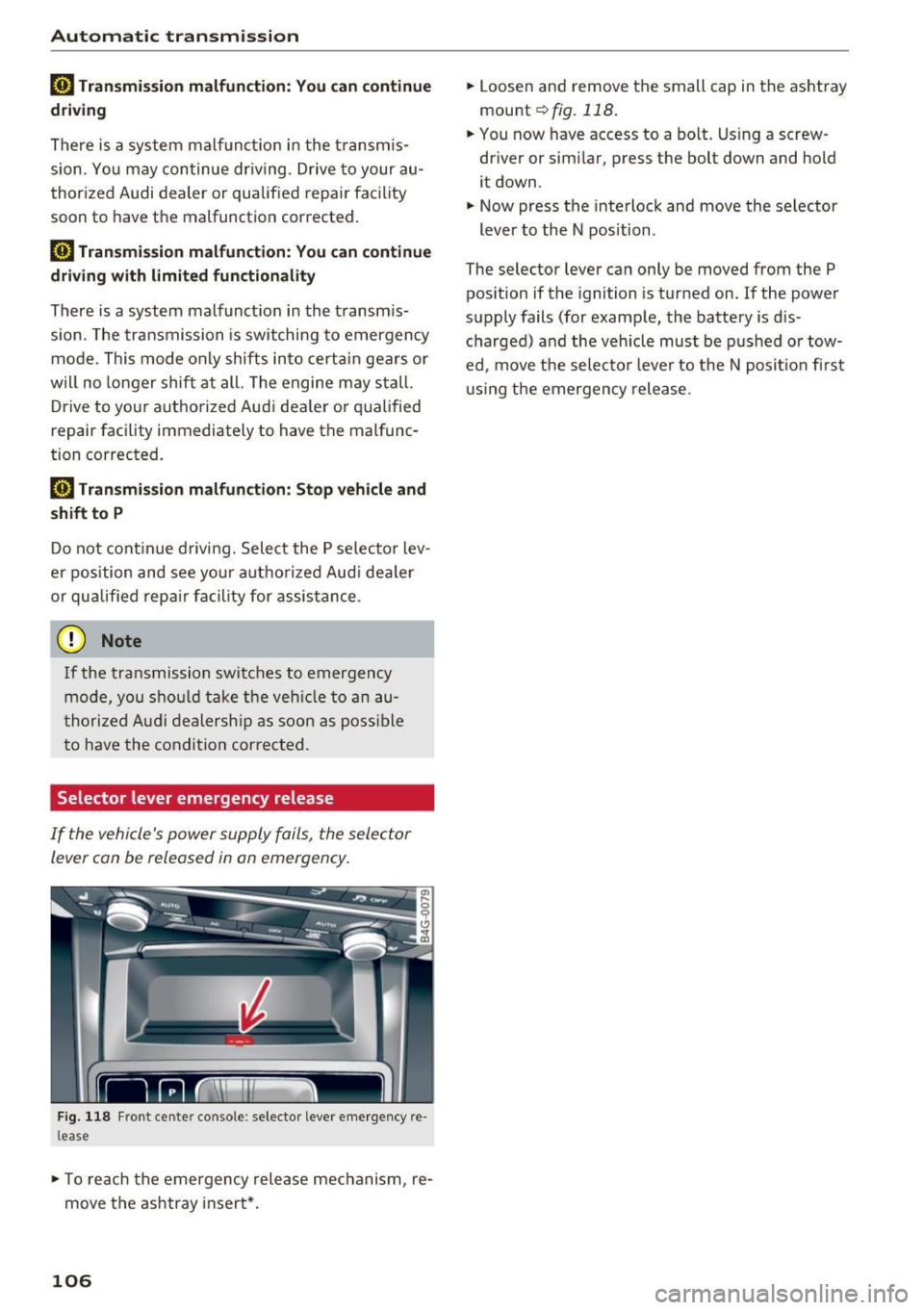
Selector lever emergency release
If the vehicle's power supply fails, the sele ctor
lever can be released in an emerg ency .
Fig . 118 Fro nt cen te r co nso le : selec to r lever e mergency re
l ease
.,. To re ach the emergency rele ase mech anism, re
move t he ashtray insert* .
106
.,. Loosen and remove the small cap in the as htray
mou nt
~ fig. 118 .
.,. You now have access to a bo lt. Using a screw
driver or simi lar , press the bolt down and hold
it down .
.,. Now press t he interlock and move the selector
lever to the N position .
The selector lever can only be moved from the P pos ition if the ignition is tur ned on.
If the powe r
supply fails (for examp le, the battery is d is
cha rged) and the veh icle must be p ushed o r tow
ed, move the selecto r lever to the N posit io n firs t
u sing the emergen cy rele ase .
Page 185 of 282
Effect of wat er and road salt
In ce rtain situations, for example after driving
through water, in heavy rain, afte r ove rnight con
densation or after washing your car, the braking
effect can be reduced by moisture or ice on the
brake rotors and brake pads. The brakes must be
dried first w ith a few careful brake applications.
At higher speeds and with the windshie ld wipers
turned on, the brake pads press against the brake rotors for a short amount of time. Th is occurs at
regular intervals without the driver noticing and
provides for better brake response time under
wet conditions .
The effectiveness of the brakes can be reduced
when the vehicle is driven on a salt-covered road
and the brakes are not used. Likewise, you clean
off accumulated salt coat ing from brake discs
and pads with a few cautious applications of the b rake ¢_&. .
Due to their surface character istics, ceramic
brake roto rs* absorb mo isture in such condit ions.
This can cause a temporary reduc tion in braking
force compared to dry brakes. You can compe n
sate fo r th is by press ing the b rake peda l harder.
Corrosion
There may be a tende ncy for d irt to bu ild up on
the brake pads and corros ion to form on the discs
if the car is not dr iven regularly or only fo r sho rt
tr ips with little use of the brakes.
If the brakes are not used frequently, or if corro
sion has formed on the discs, it is adv isable to
clean off the pads and discs by brak ing firmly a
few t imes from a mode rately h igh speed ¢,& .
Faults in the brake system
If you should notice a sudden increase in brake
pedal travel, then one of the two brake c ircuits
may have failed
¢ ,& .
Low brake fluid le vel
Malfunct ions can occur in the brake system if the
brake fl uid level is too low. The brake fluid level
is monitored electronically .
Intelligent Technology
Brake booster
The brake boos ter works w ith v acuum press ure
which is crea ted on ly when the engine is running
¢ & .
Brake lining wear status
Brake lining wea r may be chec ked by visua l in
spe ct ion of the condition of the brake pads
t hr ough the openings in t he wheel. If necessary,
the wheel may be removed for this inspection
¢ page 243, Replacing wheels .
_8 WARNING "'----
-New b rake pads don't have the best stop
p ing power and must be "broken-in" d uring
the initial 250 miles (400 km). The b reak-in
period can be considerably longer for
veh icles with ceramic brake roto rs*. You can
compensate for this by pressing the brake
pedal mo re firmly. This also applies late r
when new p ads are inst alled.
- You shou ld pe rform braking maneuvers for
the purpose of cleaning the brake system
only i f road condit io ns pe rmit. O ther ro ad
users m ust no t be put at r is k - you may
cause an accident!
- Before descending a steep g rade, reduce
speed and shift transmission into a lower
gear o r lower driving range. Do not r ide the
brakes or hold the pedal down too long or
too often. This cou ld cause t he b rakes to get
hot and dimin ish braking effic iency.
- Do not " ride the brakes" by rest ing your foot
on the pedal when you do not intend to brake. This may cause the brakes to over
heat, premature wear and increased stop
p ing distance .
- Unde r certain climatic and ope rating condi
tions such as passing t hrough water, d riving
i n heavy rain o r afte r wash ing the veh icle,
the effectiveness of the brakes ca n be re
duce d. In winter, ice can accum ulate on the
b rake pads, lin ings, discs and dr ums. Care
fu lly apply brakes for a test. Brakes will d ry
an d ice coatings will be cleaned off after a
few ca refu l brake applications.
183
Page 190 of 282
Driving and the environment
Driving and the
environment
Breaking in
New engine
The engine needs to be run-in during the first
1,000 miles (1,500 km).
For the first 600 miles (1,000 kilometers):
.,. Do not use full throttle .
.,. Do not drive at engine speeds that are more
than 2/3 of the maximum permitted RPM .
.,. Avo id high engine speeds.
From 600 to 1,000 miles (1,000 to 1,500
kilometers):
.,. Speeds can gradually be increased to the maxi
mum perm issib le road or engine speed.
During and after break-in period
.,. Do not rev the engine up to high speeds when it
is cold . This applies whether the transmission is
i n N (Neutral) or in gear .
After the break-in period
.,. Do not exceed maximum engine speed under
any circumstances.
.,. Upshift into the next higher gear
before reach
i ng the red area at the end of the tachometer
scale~
page 10 .
During the first few hours of driving, the engine's
internal friction is higher than later when all the
mov ing parts have been broken in. How well this
break- in process is done depends to a considera
b le extent on the way the vehicle is d riven during
the first 1,000 miles (1,500 kilometers).
(D Note
Extremely high engine speeds are automati
cally reduced. However, these rpm lim its are
programmed for an engine we ll run-in, not a
new engine .
188
® For the sake of the environment
Do not drive with unnecessarily high engine
speeds -upshifting early saves fuel, reduces
noise and protects the environment.
New tires
If your vehicle is running on new tires, drive par
ticularly careful for the first 350 m iles (500 kilo
meters) after f itting .
.8, WARNING
New tires tend to be slippe ry and must also
be "broken-in". Be sure to remember this dur
ing the first 350 mi les (500 kilometers).
Brake gent ly. Avoid following closely behind
other ve hicles or other situations that might
require sudden, hard braking.
Avoid damaging the
vehicle
When you are driving on poor roads, or over
curbs, steep ramps, etc., make certain that low
lying parts such as spo ilers and exhaust system
parts do not bottom out and get damaged .
-
This is especially true for vehicles with low-slung
chassis (sports chassis)* and fully loaded
vehicles.
Driving through water on
roads
Note the following to avoid vehicle damage when
driving through water, for examp le on flooded
roads:
- The water must not be any highe r than the bot
tom of the vehicle body.
- Do not drive faster than walk ing speed .
.8, WARNING
After driving through water or mud, the brak
ing effect can be red uced due to moisture on
the brake discs and brake pads . A few careful
brake applications should dry off the brakes.
Page 191 of 282
CD Note
-Vehicle components such as the engine,
transm ission, suspension or electrical sys
tem can be severely damaged by driving
through water.
- Determine the depth before driv ing through
water.
- Do not stop the vehicle, drive in reverse or
switch the eng ine off when dr iving through
water.
- Keep in mind that oncoming veh icles may
create waves that raise the water level and
make it too deep for your vehicle to drive
through safely .
- Avo id d riving through salt water (corrosion).
Warming up and cooling
down
By carefully warm ing up and cool ing down your
veh icle, you can he lp ensure that it is not over
stressed un necessa rily during sporty driving.
When warming up, the vehicle is dr iven at a max
i mum eng ine speed of 6000 RPM in order to raise
the eng ine oi l temperature to a min imum of
140 °F (60 °C). The tires a lso on ly reac h their f ull
road ho ld ing capability once they have warmed
up .
The cooling fan can continue to run in your vehi cle after the engine is swi tched off. Howeve r,
d riving the vehicle to cool it dow n is particularly
important. D uring sporty dr iv ing, the engine and
brakes, the exhaust system, and the transmission
a ll become extremely hot. Before you park the
ve hicle, you shou ld drive it for a few m iles/kilo
meters at light load in the low rpm range to al
low it to cool down.
Driving and the envir onment
Catalytic converter
Applies to: veh icles w ith gasoli ne e ngi ne
It is very important that your emission control
system (catalytic converter) is functioning prop
erly to ensure that your vehicle is running in an
environmentally sound manner .
.. Always use lead-free gasoline¢ page 198,
Fuel supply.
.. Never run the tank down all the way to empty.
.. Never put too much motor o il in yo ur engine
¢ page 20 7, Adding engine oil 9:::r. .
.,. Never try to pus h- or tow-start your veh icle.
The catalytic co nverter is an efficient "clean-up"
device built into the exhaust sys tem of t he ve hi
cle. The catalyt ic conv erter b urns ma ny of the
po llutants in the exhaust gas before they are re
leased into the atmosphere.
The exclusive use of un leaded fuel is cr itically im
po rtant fo r the life of the catalytic converte r and
prope r fu nct io ni ng of the eng ine.
_&. WARNING
The tempe ra tu re o f th e exh aus t sys tem is
hi gh, bot h when driv ing and a fter stopping
the engine.
- Never tou ch the e xhaus t tail pipes on ce they
have become hot. This cou ld res ult in burns.
- Do not p ark or operate the vehicle in ar eas
where the hot exhaus t sys tem may come in
contact w ith dry grass, b rush, fuel spill or
other mate rial which can ca use a fire.
- Do not app ly additiona l undercoating or
r u stp roofing on or near the exhaust mani
fold, exha ust pipes, cata lytic converter or
heat shields. D uring driving, the substance
used for undercoat ing could overheat and
cause a fire.
CD Note
- Be aware that just one tank fi lling with
leaded fuel w ill already seriously degrade
the performance of the catalytic converter.
- Do not exceed the correct engine oil leve l
¢page 207.
189
Page 245 of 282
Replacing wheels
Before changing a wheel
Observe the following precautions for your own
and your passenger's safety when changing a
wheel.
.,. After you experience a tire failure, pull the car
well away from moving traffic and try to reach
level ground before you stop¢.,&..
.. All passengers should
leave the car and move
to a safe location (for instance, beh ind the
guardrail)¢ .,&. .
.,. Engage the
parking brake to prevent your vehi
cle from rolling unintentionally¢ .,&..
.. Move
selector lever to position P ¢ .,&. .
.. Take the
jack out of the luggage compartment
c:>page 239.
A WARNING
You or your passengers could be injured while
chang ing a wheel if you do not follow these
safety precautions:
- If you have a flat tire, move a safe distance
off the road. Turn off the engine, turn the
eme rgency flashers on and use other warn
ing devices to alert other motorists.
- Make sure that passengers wait in a safe
place away from the vehicle and well away
from the road and traffic.
- To help prevent the vehicle from moving
sudden ly and possibly slipping off the jack,
always fully set the parking brake and block
the wheel diagonally opposite the wheel be
ing changed . When one front wheel is lifted
off the ground, placing the Automatic
Transmission in P (Park) will
not prevent the
vehicle from moving.
- Before you change a wheel, be sure the
ground is level and firm. If necessary, use a
sturdy board under the jack.
- Always store the veh icle tool k it, the jack
and the replaced tire in the luggage com
partment
c> page 124.
(D Note
If you are changing the whee l on a steep in
cline, use a rock or similar object to b lock the
Emergency assistance
opposite wheel to prevent the vehicle from
moving.
(D Tips
- Before changing the wheel, you must acti
vate the jacking mode, so that the automat
ic controls for the Adaptive Air Suspension*
do not make it more difficu lt to lift the vehi
cle with the jack
c> page 245.
- Obey all laws .
Changing a wheel
When you change a wheel, follow the sequence
described below step-by-step and in exactly thot
order .
1. Activate the vehicle jack mode* c> page 245.
2. Remove the
wheel bolt caps*. For more de
tails see also
¢ page 244, Wheels with
wheel bolt caps.
3. Loosen the wheel bolts c:> page 244.
4. Locate the proper mounting point for the
jack and align the jack below that point
~page 245.
5. Raise the car with the jack c:> page 245.
6. Remove the
wheel with the flat tire and then
install the other whee l¢
page 246.
7. Tighten all whee l bolts lightly.
8.
Lower the vehicle with the jack.
9. Use the wheel bolt wrench and
firmly tighten
all wheel bolts
c> page 244.
10. Replace the
wheel bolt caps*.
11. Deact ivate the vehicle jack mode* in the
MMI:
I CARI funct ion button> (C ar )* systems
contro l butto n > Servicing & checks > Air
susp.: jack mode >
Off.
The vehicle jack mode* switches off automat ical
ly at speeds above 6 mph (10 km/h) .
A WARNING
-
Always read and follow all WARNINGS and in-
formation
¢ .&. in Raising the vehicle on
page
245 and ¢ page 247.
243
Page 255 of 282
Emergency situations
General
This chapter is intended for trained emergency
crews and working personnel who have the nec
essary tools and equipment to perform these
ope rations.
Starting by pushing or
towing
(D Note
Veh icles with an automatic transmission can
not be started by pushing or towing.
Starting with jumper
cables
If necessary, the engine can be started by con
necting it to the battery of another vehicle .
If the engine shou ld fail to start because of a dis
charged or weak battery, the battery can be con
nected to the battery of
another vehicle, using a
pair of jumpe r cables to start the engine.
Jumper cables
Use only jumper cables of suffic iently large cross
section
to carry the starter current safely. Refer
to the manufacturer's specifications.
Use only jumper cables with
insulated term inal
clamps which are dis tinct ly marked :
plus(+) cable in most cases colored re d
minus( -) cable
in most cases colored blac k.
A WARNING
Batteries contain electricity, acid, and gas.
Any of these can cause very serious or fatal in
jury. Follow the instructions below for safe
handling of your vehicle's battery.
- Always shield your eyes and avo id leaning
over the battery whenever poss ible.
- A discharged battery can freeze at tempera
tures just below 32 °F (0 °C) . Before con
necting a jumper cable, you must thaw the
Emergency situations
frozen battery completely, otherwise it
could explode .
- Do not allow battery acid to contact eyes or
skin. Flush any contacted area with water immediately.
- Improper use of a booster battery to start a
vehicle may cause an exp losion.
- Vehicle batteries generate exp losive gases.
Keep sparks, flame and lighted cigarettes
away from batteries.
- Do not try to jump start any vehicle with a
low acid level in the battery .
- The vo ltage of the booster battery must also
have a 12-volt rating. The capacity (Ah) of
the booster battery should not be lower
than that of the discharged battery. Use of
batter ies of different voltage or substantial
ly different "Ah" rating may cause an exp lo
sion and personal injury .
- Never charge a frozen battery. Gas trapped
in the ice may cause an explosion.
- Never charge or use a battery that has been
frozen . The battery case may have be weak
ened .
- Use of batter ies of different voltage or sub
stantially different capacity (Ah) rating may
cause an exp losion and injury. The capac ity
(Ah) of the booster battery should not be
lowe r than that of the discharged battery.
- Before you check anything in the eng ine
compartment, always read and heed all
WARNINGS
r::!)page 203.
(D Note
-Applying a higher voltage booster battery
will cause expensive damage to sensitive
electronic components, such as control
units, relays, radio, etc.
- Th ere must be no electrical contact between
the vehicles as otherwise current could al
ready start to flow as soon as the positive
(+) terminals are connected.
(D Tips
The discharged battery must be properly con-
nected to the vehicle's e lectrical system. ..,.
253
Page 256 of 282

Emergency situations
When jump starting or charging the battery,
never connect the negative ground cable to
the battery negative post because the battery
manager system must be able to detect the
battery's state of charge. Always connect the
negative ground cable to the negat ive ground
post of the battery manager control unit .
Use of jumper cables
Make sure to connect the jumper cable clamps in
exactly the order described below!
Fig. 212 Engine compartment: connectors for ju mp start
cab les a nd charger
® .--l @
Fig. 213 Ju mp start ing wit h the battery o f another vehicle:
@ -boos te r battery ,® -discharged vehicle battery
The procedure described below for connecting
jumper cables is intended to provide a jump start
for your vehicle.
Vehicle with discharged battery:
• Turn off lights and accessories , move lever of
automatic transmission to N (Neutral) or P
(Park) and set parking brake .
Connect POSITIVE(+) to POSITIVE(+) (red)
• Open the red cover on the positive term inal
~ fig . 212.
254
1. Connect one end of the red positive cable on
the
jump start bolt 9 fig. 213 @ (bolt under
the red cover= "positive") of the vehicle to be
started ®·
2. Connect the other end to the positive termi-
nal@ of the booster battery @.
Connect NEGATIVE (- ) to NEGATIVE (-)
(black)
3. Connect one end of the black negative cable
to the negative term inal @ of the booster
battery @.
4 . Connect the other end to the
jump start pin
@ (bolts with hex head bolt= "negat ive") of
the vehicle to be started ®·
Starting the engine
• Start the eng ine of the vehicle with the booster
battery @. Run the engine at a moderate
speed.
• Sta rt engine w ith discharged vehicle ba ttery @
in the usual manner.
• If the engine fails to start, do not keep the
starter cranking for longer than 10 seconds.
Wait for about 30 seconds and then try again.
• With engine running, remove jumper cables
from both vehicles in the exact
reverse order.
• Close the red cover on the positive terminal.
The battery is vented to the outside to prevent gases from entering the vehicle interior . Make
sure that the jumper clamps are well connected
with their metal parts in full contact with the battery terminals.
&_ WARNING
To avoid ser ious personal injury and damage
to the vehicle, heed all warnings and instruc
tions of the jumper cable manufacturer. If in
doubt, call for road service.
- Jumper cables must be long enough so that
the vehicles do not touch.
- When connecting jumper cables, make sure
that they cannot get caug ht in any moving
parts in the engine compartment.
- Before you check anything in the engine
compartment, always read and heed all
WARNINGS
¢ page 203.
Page 257 of 282
(D Note
Im pro per hook-u p of jum per cables can ru in
the gene ra tor.
- Always connect P OSITI VE( +) to POS ITI VE
( + ), and NEGATIVE( -) to NEGATIVE( -)
ground post of t he battery manager contro l
u nit .
- Check that a ll sc rew p lugs on the battery
ce lls a re sc rewed in firmly . If not, t igh ten
pl ugs p rio r to connecting clamp on negative
batte ry te rminal.
- Please note t hat the procedure fo r con nect
i ng a jumper cab le as desc ribe d above ap
p lies specifica lly to the case of yo ur vehicle
being jump s tarte d. W hen you are giv ing a
ju mp s ta rt to an othe r vehicl e, do
not con
n ect t he nega tive (- ) ca b le t o t he nega tive
(-) t ermin al on the di scharged battery @
c::> fig . 2 13 . Instead, securely connec t the
negative (-) cable to either a solid metal
com ponent that is f irm ly bolted t o the e n
gine block o r to t he engine bloc k itsel f. If
the battery that is be ing c ha rge d d oes not
vent to the outs ide, escap ing batte ry gas
could ignite and e xplode!
Towing with a tow truck
General hints
Your Audi require s speci al handling f or towing.
Th e follow ing informat ion is to be used by com
mercia l tow tr uck o pera tors who know how to op
e rat e the ir equip men t sa fely.
- Never tow your Audi. Towing will cause dam
age to the engine and transmission .
- Never wrap the safety chains or winch cables
around the brake lines.
- To prevent unnecessary damage, your Audi
must be transported with a flat bed truck.
- To load the vehicle on to the flat bed, use the
towing loop found in the vehicle tools and at
tach to the front or rear anchorage
c::> page 255 and c::> pag e 256 .
Emergency situations
A WARNING
-A vehicle being towe d is not safe for passen-
ge rs. Neve r allow a nyo ne to ride in a vehicle
b eing towed, for any reason.
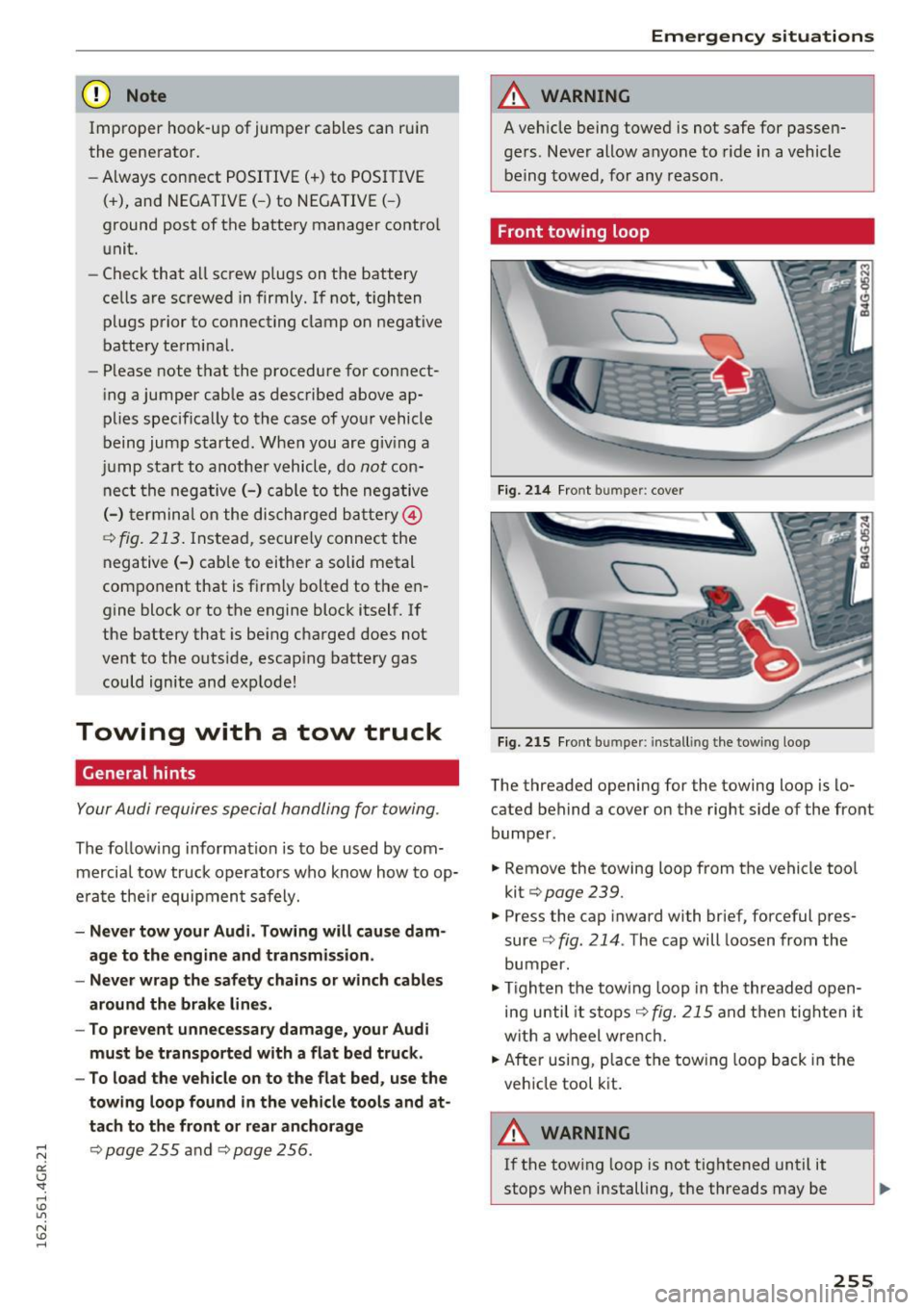
Front towing loop
Fi g. 214 Fron t bumper: cover
Fig. 215 Fron t bumper: installing the tow ing loop
The threaded opening for the towing loop is lo
cated behind a cover on the rig ht side of the front
bumper .
.,. Remove the towing loop from the vehicle too l
kit<=>
page 239.
.,. Press the cap inward with brief, forceful pres
sure <=>
fig. 214 . The cap will loosen from the
bumper.
.,. Tigh ten t he towing loop in the threaded o pen
ing until it sto ps
c::> fig. 215 and t hen tig hten it
w it h a wheel wre nc h .
.,. After usi ng, p lace the tow ing loop ba ck in t he
ve hicle tool kit.
A WARNING
--
If t he tow ing loop is not tig htened until it
stops when installing, t he threads may be
255
Page 259 of 282

Raising the vehicle
Lifting with workshop hoist and with floor
jack
The vehicle may only b e li~ ed at the lifting
points illustra ted.
F ig. 219 Front lift ing po int
F ig. 220 Rea r lift ing po int
.,. Read and heed WARNING c:> &_ .
.. Activate the vehicle jack mode* in the MMI:
I CAR I funct ion button> (Car) * systems contro l
button >
Servicing & checks > Air susp.: jack
mode > On .
.. Loca te lift ing po ints c:> fig . 219 and c:> fig . 22 0 .
.. Adju st lifting arms of wo rkshop ho ist o r floo r
j ac k t o ma tch vehicl e lifting poin ts.
.. In se rt a rub ber pa d between the f loor jack/
wor kshop hoist a nd the lifting points .
T he vehicle ja ck mode* mus t be activa ted so th at
the au tomatic a djustment of the Adaptive Air
Suspension * does not make it more d ifficult to
raise the ve hicle w it h the floo r jack.
If you must lift your vehicle with a floor jack to
work underneath , be sure the vehicle is safely
supported on stands intended for this purpose .
Emergency situations
Front lifting point
The li fting poin t is lo cate d on the floor p an rein
f orceme nt ab out at the same level as the ja ck
mounting point
c:> fig . 219 . Do not lift the vehi
cle at the vertical sill reinforcement.
Rear lifting point
T he lifting point is lo cated on the ver tic al rein
f orcement o f the lower s ill for the on- bo ar d jac k
<=> fig. 220.
Lifting with vehicle jack
Refer to c:> page 245 .
A WARNING
- To reduce the r is k of se rious inju ry and vehi
cle damag e.
- Always lift the vehicle on ly at the special
workshop h oist a nd floor jack lift points
il
lustrated c:> fig. 219 and c:> fig. 220.
- Failure to lift t he veh icle at these points
could cause t he veh icle to tilt o r fall from
a lift i f th ere is a change in vehicle weight
dist ribution and balance . This might hap
pen, fo r example, when heavy compo
n en ts such as the eng ine block o r tran s
mis sio n a re re moved .
- Whe n re mov ing heavy co m ponents like
these, an ch or vehicle t o hois t or ad d co rre
spon ding weig hts t o m aintai n the cen ter of
g ravi ty . Ot herw ise, the vehicle mig ht tilt or
slip off t he hoist, caus ing se rious pe rsonal
i njur y .
(D Note
-Be aw are of the fo llow ing points b efor e lift
ing the vehicle:
-The vehicle should never be lifted or
jacked up from underneath the engine oil
pan, the transmission housing, the front
or rear axle or the body side members.
This could lead to serious damage .
- To avoid damage to the underbody or
chassis frame, a rubber pad must be in
serted between the floor jack and the lift
points . .,.
257
Page 261 of 282

Technical data
Vehicle identification
F ig . 2 21 Vehi cle Ident if icatio n Number (VlN) plate : loca·
t ion on dr iver 's side dash pane l
XXXXX XX -X -XX XX X XX XX
CD+ ~t :1 :: xxxxxxxx xx x x x xxx xxx
T VP /fffl XXX XXX
XX XXXXXXX XX X X XX
XXX
K W XXX
®i ~:J ·f lfils~~ XXXX XXX XXX
®-+ ~N:a=i~l xxxx ; xxxx xx x ; xx
II. · AUSS, I OPTIONS
E0 A
7D5 4UB 6
XM 5SG 5R W
2EH J0Z lLB l
A S lB A
3FC SM U 7Xl
F 0 A 9G3 0G7 0YH 0JF
TL 6 3KA 8EH UlA X 98 QZ7
l XW 803 908 824 020
7T6 C V7 7 K0 4 X3 2 K2
3L4 4KC 3Y0 413
502
lS A
7GB 01A 4G0
XX. X XX X XX X xxxx
Fig. 222 Th e ve hicle identifica tion label- inside the lug
gage compartment
Veh icle Identification Number (VlN )
The Vehicle Identific ation N umbe r is locate d in
d if f eren t places:
- u nder the w indshield on the dr iver's side
¢ fig . 22 1.
- in the M MI: Select: Funct ion button ICAR I >
(Car) * systems > Servicing & check s > VIN
;:::J numb er.
(3 -on the vehicle identification label.
'
Technical data
Vehicle identification label
T he veh icle identification label is lo cate d in the
l uggage compa rtment in the spare whee l we ll.
T he labe l¢
fig. 222 shows the fo llowing vehicle
da ta:
(D Vehicle Identification Number (VIN)
@ Vehicle type, eng ine ou tput, transm ission
@ Engine and transmission code
@ Paint numbe r and interior
® Optional equipment numbers
T he information of the veh icle identification label
c a n al so be fo und in your Warran ty
& M ainte
nance booklet.
Safety compliance sticker
The safety compliance st icker is yo ur ass urance
that your new vehi cle complies w ith all applicable
Federal Motor Vehicle Safety Standards which
we re in effect at the time the vehicle w as m anu
fac tured. Yo u ca n fi nd this sticker on the door
jamb on the driver 's side. It shows the month and
year of production and t he ve hicle identification
number of your ve hicle (perforation) as well as
the Gross Vehicle Weight Rat ing (GVWR) and the
G ross A xle We ight Rati ng (GAWR).
H igh vo ltage warning label
T he high voltage warning label is located in the
engine compa rtment next to the engine hood re
lease. The spark ignition system complies with
t h e Canadian standard ICES-002.
Weights
Gross Vehicle Weight Rating
The Gross Vehicle Weight Rating (GVWR), and
t h e Gross Axle Weight Rating (GAWR) for front
and rear are listed on a sticker on the door jamb
o n the dr iver 's side.
The Gross Vehicle Weight Rating includes the
weight of the basic vehicle plus fu ll fuel tank, oil
and coolant, p lus maxim um load, which includes
passenger weight (150 lbs/68 kg per des ignated
seat ing pos ition) and luggage weight
c:> .&, . .,.
259