tow AUDI RS7 SPORTBACK 2016 Owner's Guide
[x] Cancel search | Manufacturer: AUDI, Model Year: 2016, Model line: RS7 SPORTBACK, Model: AUDI RS7 SPORTBACK 2016Pages: 282, PDF Size: 70.78 MB
Page 191 of 282
CD Note
-Vehicle components such as the engine,
transm ission, suspension or electrical sys
tem can be severely damaged by driving
through water.
- Determine the depth before driv ing through
water.
- Do not stop the vehicle, drive in reverse or
switch the eng ine off when dr iving through
water.
- Keep in mind that oncoming veh icles may
create waves that raise the water level and
make it too deep for your vehicle to drive
through safely .
- Avo id d riving through salt water (corrosion).
Warming up and cooling
down
By carefully warm ing up and cool ing down your
veh icle, you can he lp ensure that it is not over
stressed un necessa rily during sporty driving.
When warming up, the vehicle is dr iven at a max
i mum eng ine speed of 6000 RPM in order to raise
the eng ine oi l temperature to a min imum of
140 °F (60 °C). The tires a lso on ly reac h their f ull
road ho ld ing capability once they have warmed
up .
The cooling fan can continue to run in your vehi cle after the engine is swi tched off. Howeve r,
d riving the vehicle to cool it dow n is particularly
important. D uring sporty dr iv ing, the engine and
brakes, the exhaust system, and the transmission
a ll become extremely hot. Before you park the
ve hicle, you shou ld drive it for a few m iles/kilo
meters at light load in the low rpm range to al
low it to cool down.
Driving and the envir onment
Catalytic converter
Applies to: veh icles w ith gasoli ne e ngi ne
It is very important that your emission control
system (catalytic converter) is functioning prop
erly to ensure that your vehicle is running in an
environmentally sound manner .
.. Always use lead-free gasoline¢ page 198,
Fuel supply.
.. Never run the tank down all the way to empty.
.. Never put too much motor o il in yo ur engine
¢ page 20 7, Adding engine oil 9:::r. .
.,. Never try to pus h- or tow-start your veh icle.
The catalytic co nverter is an efficient "clean-up"
device built into the exhaust sys tem of t he ve hi
cle. The catalyt ic conv erter b urns ma ny of the
po llutants in the exhaust gas before they are re
leased into the atmosphere.
The exclusive use of un leaded fuel is cr itically im
po rtant fo r the life of the catalytic converte r and
prope r fu nct io ni ng of the eng ine.
_&. WARNING
The tempe ra tu re o f th e exh aus t sys tem is
hi gh, bot h when driv ing and a fter stopping
the engine.
- Never tou ch the e xhaus t tail pipes on ce they
have become hot. This cou ld res ult in burns.
- Do not p ark or operate the vehicle in ar eas
where the hot exhaus t sys tem may come in
contact w ith dry grass, b rush, fuel spill or
other mate rial which can ca use a fire.
- Do not app ly additiona l undercoating or
r u stp roofing on or near the exhaust mani
fold, exha ust pipes, cata lytic converter or
heat shields. D uring driving, the substance
used for undercoat ing could overheat and
cause a fire.
CD Note
- Be aware that just one tank fi lling with
leaded fuel w ill already seriously degrade
the performance of the catalytic converter.
- Do not exceed the correct engine oil leve l
¢page 207.
189
Page 232 of 282
Wheels
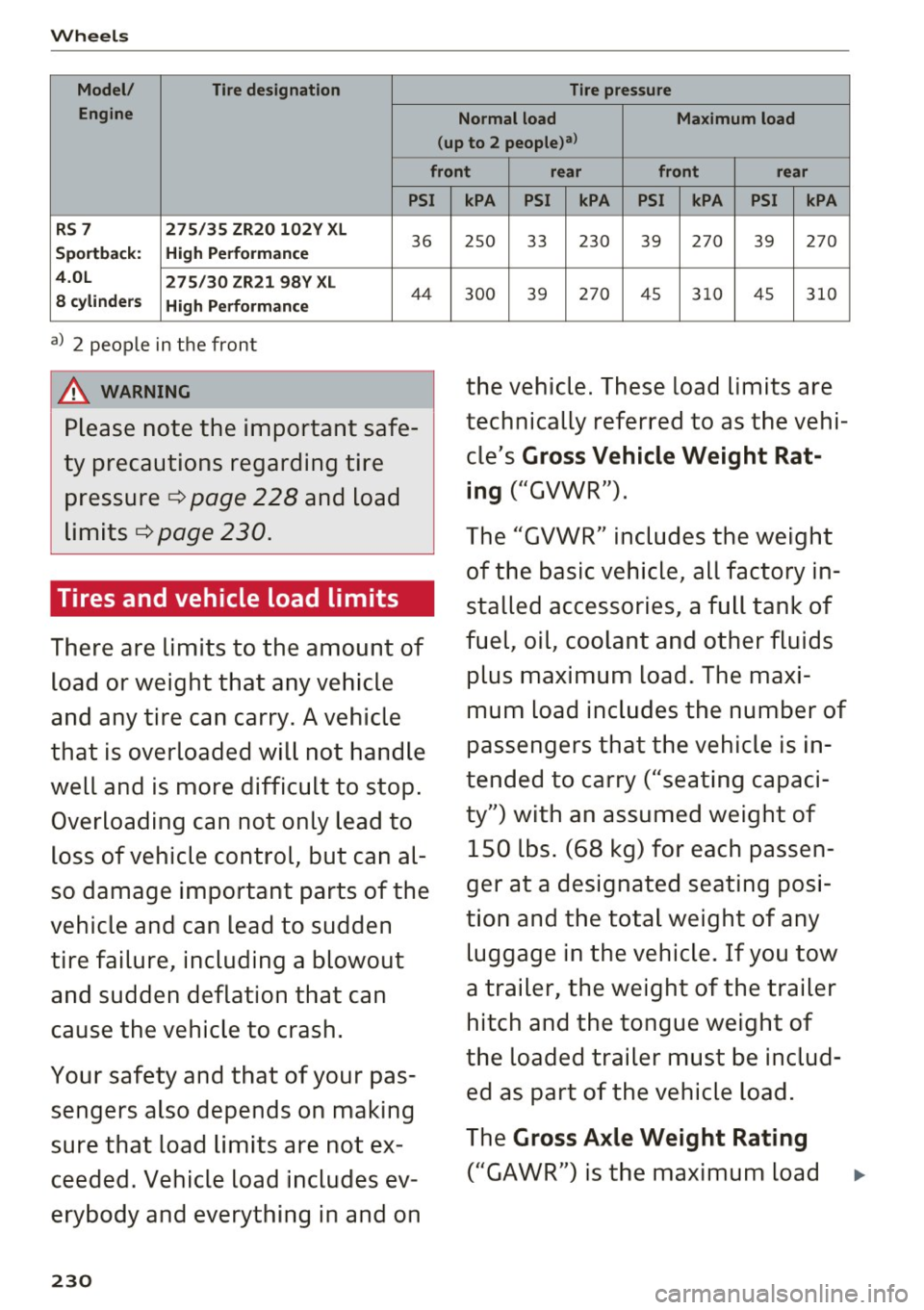
Model/ Tire designation Tire pressure
Engine Normal load Maximum load
(up to 2 people)a>
front rear front rear
PSI
RS 7 275/35 ZR20 102Y XL
Sportback: High Performance
36
4.0L 275/30 ZR21 98Y XL
8 cylinders High Performance
44
a) 2 people in the front
A WARNING
Please note the important safe
ty precautions regarding tire
pressure ¢
page 228 and load
limits ¢
page 230.
Tires and vehicle load limits
There are limits to the amount of
load or weight that any vehicle
and any tire can carry. A vehicle
that is overloaded will not handle
well and is more difficult to stop. Overloading can not only lead to
loss of vehicle control, but can al
so damage important parts of the
vehicle and can lead to sudden
tire failure, including a blowout and sudden deflation that can
cause the vehicle to crash.
Your safety and that of your pas sengers also depends on making
sure that load limits are not ex
ceeded . Vehicle load includes ev
erybody and everything in and on
230
kPA PSI kPA PSI kPA PSI kPA
25 0 33 230 39 270
39 270
30 0 39 270 45 310 45
310
the vehicle. These load limits are
technically referred to as the vehi
cle's
Gross Vehicle Weight Rat
ing
("GVWR").
The "GVWR" includes the weight of the basic vehicle, all factory in
stalled accessories , a full tank of
fuel, oil, coolant and other fluids
plus maximum load. The maxi
mum load includes the number of
passengers that the vehicle is in
tended to carry ("seating capaci
ty") with an assumed weight of 150 lbs. (68 kg) for each passen
ger at a designated seating posi
tion and the total weight of any luggage in the vehicle. If you tow
a trailer, the weight of the trailer hitch and the tongue weight of
the loaded trailer must be includ ed as part of the vehicle load.
The
Gross Axle Weight Rating
("GAWR") is the maximum load
Page 234 of 282
Wheels
NEVER EXCEED XXX KG OR XXX
LBS"on your vehicle's placard
(tire inflation pressure label)
¢page 228, fig. 192.
2. Determine the combined
weight of the driver and pas
sengers that will be riding in
your vehicle.
3. Subtract the combined weight
of the driver and passengers
from
"XXX" kilograms or "XXX"
pounds shown on the sticker
¢ page 228, fig. 192.
4. The resulting figure equals the
available amount of cargo and
luggage load capacity. For ex
ample, if the "XXX" amount
equals 1400 lbs. and there will
be five 150 lbs. passengers in
your vehicle, the amount of available cargo and luggage
load capacity is 650 lbs.
(1400-750 (5 X 150) = 650
lbs.)
5. Determine the combined
weight of luggage and cargo being loaded on the vehicle.
That weight may not safely ex ceed the available cargo and
luggage load capacity calculat
ed in Step 4.
6. If your vehicle will be towing a trailer, load from your trailer
232
will be transferred to your ve
hicle. Consult this manual to
determine how this reduces
the available cargo and lug
gage load capacity of your vehi
cle.
~check the tire sidewall
(¢page 218, fig. 190) to deter
mine the designated load rating
for a specific tire.
Wheel bolts and rims '
Wheel bolts
Wheel bolts must be clean and loosen/tighten
easily.
Rims
Rims with a bolted rim ring* or with bolted wheel
covers* consist of multiple pieces. These compo
nents were bolted together using special bolts
and a special procedure . You must not repair or
disassemble them
9 &. .
_&. WARNING
Wheel bolts that are tightened or repaired in
correctly can become loose and result in loss
of vehicle control, which increases the risk of
an accident. For the correct tightening specifi
cation, refer to
9 page 244, After changing a
wheel .
-Always keep the wheel bolts and the
threads in the wheel hub clean and free of
grease .
- Only use wheel bolts that fit the rim.
- Always have damaged rims repaired by an
authorized Audi dealer or authorized Audi
Service Facility. Never repair or disassemble
rims yourself, because this increases the risk
of an accident.
Page 255 of 282
Emergency situations
General
This chapter is intended for trained emergency
crews and working personnel who have the nec
essary tools and equipment to perform these
ope rations.
Starting by pushing or
towing
(D Note
Veh icles with an automatic transmission can
not be started by pushing or towing.
Starting with jumper
cables
If necessary, the engine can be started by con
necting it to the battery of another vehicle .
If the engine shou ld fail to start because of a dis
charged or weak battery, the battery can be con
nected to the battery of
another vehicle, using a
pair of jumpe r cables to start the engine.
Jumper cables
Use only jumper cables of suffic iently large cross
section
to carry the starter current safely. Refer
to the manufacturer's specifications.
Use only jumper cables with
insulated term inal
clamps which are dis tinct ly marked :
plus(+) cable in most cases colored re d
minus( -) cable
in most cases colored blac k.
A WARNING
Batteries contain electricity, acid, and gas.
Any of these can cause very serious or fatal in
jury. Follow the instructions below for safe
handling of your vehicle's battery.
- Always shield your eyes and avo id leaning
over the battery whenever poss ible.
- A discharged battery can freeze at tempera
tures just below 32 °F (0 °C) . Before con
necting a jumper cable, you must thaw the
Emergency situations
frozen battery completely, otherwise it
could explode .
- Do not allow battery acid to contact eyes or
skin. Flush any contacted area with water immediately.
- Improper use of a booster battery to start a
vehicle may cause an exp losion.
- Vehicle batteries generate exp losive gases.
Keep sparks, flame and lighted cigarettes
away from batteries.
- Do not try to jump start any vehicle with a
low acid level in the battery .
- The vo ltage of the booster battery must also
have a 12-volt rating. The capacity (Ah) of
the booster battery should not be lower
than that of the discharged battery. Use of
batter ies of different voltage or substantial
ly different "Ah" rating may cause an exp lo
sion and personal injury .
- Never charge a frozen battery. Gas trapped
in the ice may cause an explosion.
- Never charge or use a battery that has been
frozen . The battery case may have be weak
ened .
- Use of batter ies of different voltage or sub
stantially different capacity (Ah) rating may
cause an exp losion and injury. The capac ity
(Ah) of the booster battery should not be
lowe r than that of the discharged battery.
- Before you check anything in the eng ine
compartment, always read and heed all
WARNINGS
r::!)page 203.
(D Note
-Applying a higher voltage booster battery
will cause expensive damage to sensitive
electronic components, such as control
units, relays, radio, etc.
- Th ere must be no electrical contact between
the vehicles as otherwise current could al
ready start to flow as soon as the positive
(+) terminals are connected.
(D Tips
The discharged battery must be properly con-
nected to the vehicle's e lectrical system. ..,.
253
Page 257 of 282
(D Note
Im pro per hook-u p of jum per cables can ru in
the gene ra tor.
- Always connect P OSITI VE( +) to POS ITI VE
( + ), and NEGATIVE( -) to NEGATIVE( -)
ground post of t he battery manager contro l
u nit .
- Check that a ll sc rew p lugs on the battery
ce lls a re sc rewed in firmly . If not, t igh ten
pl ugs p rio r to connecting clamp on negative
batte ry te rminal.
- Please note t hat the procedure fo r con nect
i ng a jumper cab le as desc ribe d above ap
p lies specifica lly to the case of yo ur vehicle
being jump s tarte d. W hen you are giv ing a
ju mp s ta rt to an othe r vehicl e, do
not con
n ect t he nega tive (- ) ca b le t o t he nega tive
(-) t ermin al on the di scharged battery @
c::> fig . 2 13 . Instead, securely connec t the
negative (-) cable to either a solid metal
com ponent that is f irm ly bolted t o the e n
gine block o r to t he engine bloc k itsel f. If
the battery that is be ing c ha rge d d oes not
vent to the outs ide, escap ing batte ry gas
could ignite and e xplode!
Towing with a tow truck
General hints
Your Audi require s speci al handling f or towing.
Th e follow ing informat ion is to be used by com
mercia l tow tr uck o pera tors who know how to op
e rat e the ir equip men t sa fely.
- Never tow your Audi. Towing will cause dam
age to the engine and transmission .
- Never wrap the safety chains or winch cables
around the brake lines.
- To prevent unnecessary damage, your Audi
must be transported with a flat bed truck.
- To load the vehicle on to the flat bed, use the
towing loop found in the vehicle tools and at
tach to the front or rear anchorage
c::> page 255 and c::> pag e 256 .
Emergency situations
A WARNING
-A vehicle being towe d is not safe for passen-
ge rs. Neve r allow a nyo ne to ride in a vehicle
b eing towed, for any reason.
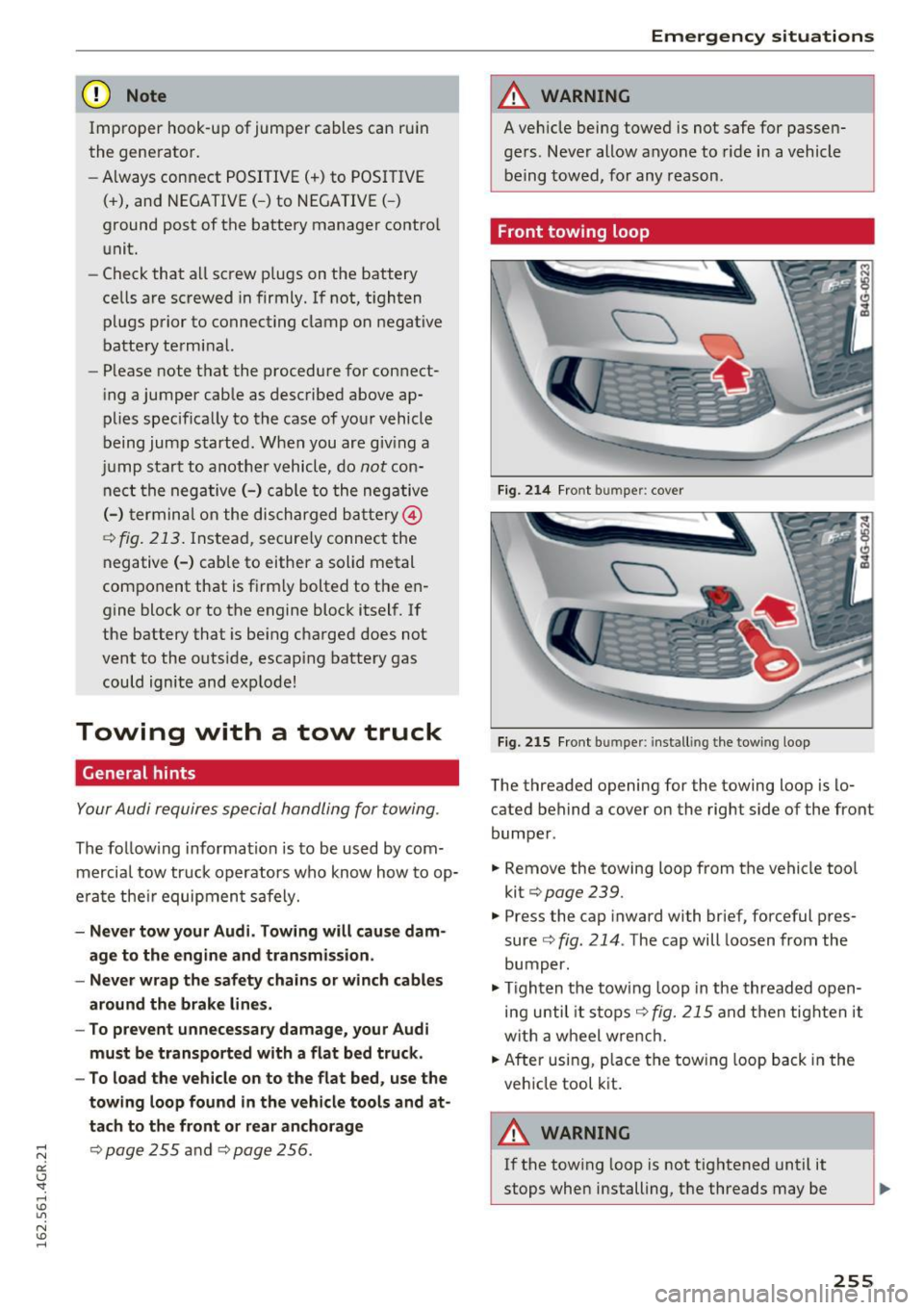
Front towing loop
Fi g. 214 Fron t bumper: cover
Fig. 215 Fron t bumper: installing the tow ing loop
The threaded opening for the towing loop is lo
cated behind a cover on the rig ht side of the front
bumper .
.,. Remove the towing loop from the vehicle too l
kit<=>
page 239.
.,. Press the cap inward with brief, forceful pres
sure <=>
fig. 214 . The cap will loosen from the
bumper.
.,. Tigh ten t he towing loop in the threaded o pen
ing until it sto ps
c::> fig. 215 and t hen tig hten it
w it h a wheel wre nc h .
.,. After usi ng, p lace the tow ing loop ba ck in t he
ve hicle tool kit.
A WARNING
--
If t he tow ing loop is not tig htened until it
stops when installing, t he threads may be
255
Page 258 of 282
Emergency situations
pulled out when towing the vehicle and that
could cause an accident.
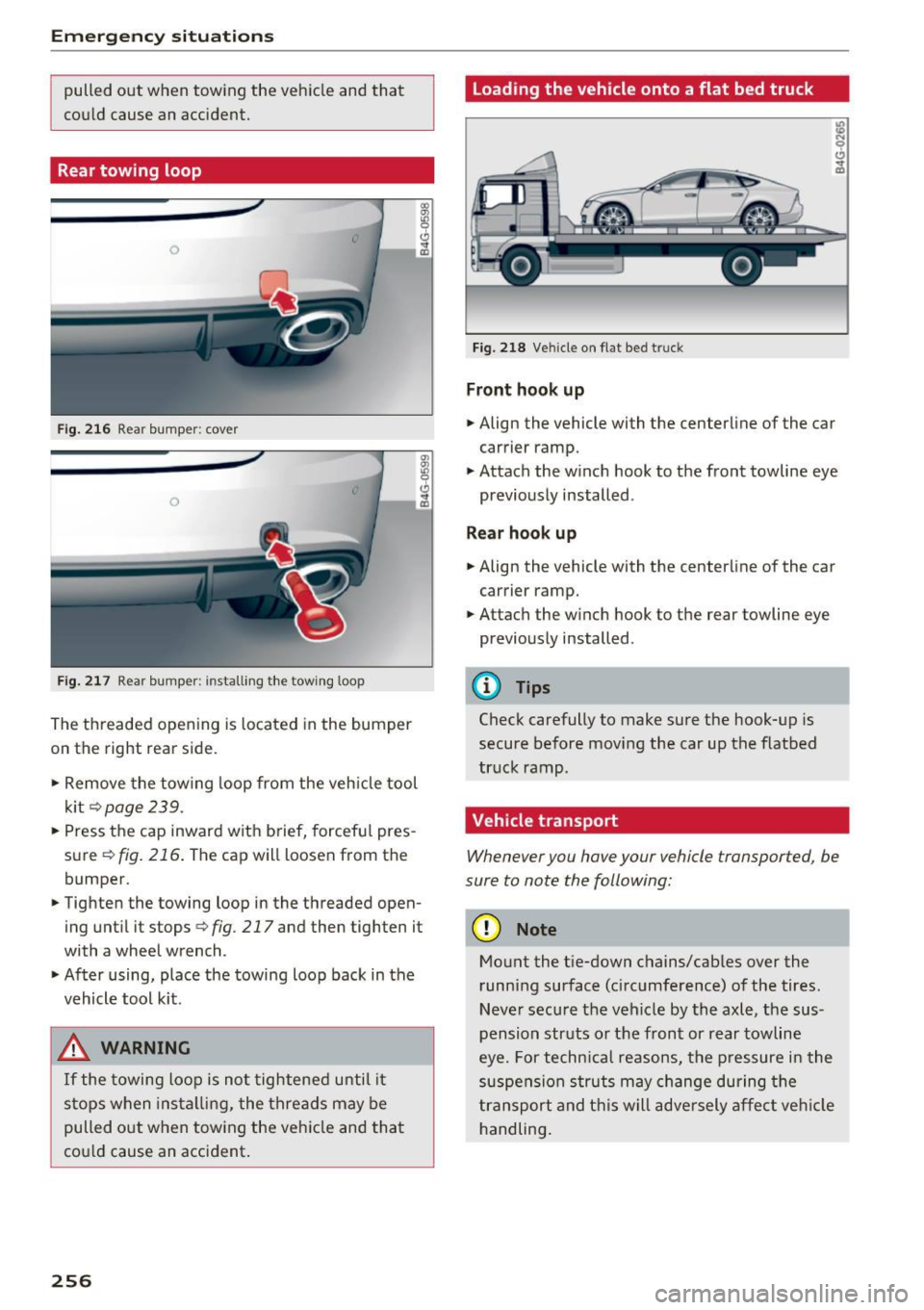
Rear towing loop
I
0 ~ • -- cc
Fig. 216 Rear bumper: cover
0
Fig. 217 Rear bumper : in stall ing the towing loop
The th readed opening is located in the bumper
on the right rear side.
"' Remove the tow ing loop from the vehicle tool
kit
~page 239.
"'Press the cap inward with brief, forceful pres
sure
¢ fig. 216 . The cap will loosen from the
bumper.
"' Tighten the towing loop in the threaded open
ing until it stops
c,, fig. 217 and then tighten it
with a wheel wrench .
"' After using, place the towing loop back in the
vehicle tool kit.
_& WARNING
If the towing loop is not tightened until it
stops when insta lling, the threads may be
pulled out when towing the vehicle and that
cou ld cause an accident .
256
-
Loading the vehicle onto a flat bed truck
Fig. 218 Vehicle on flat bed tru ck
Front hook up
"' Align the vehicle with the centerline of the car
carrier ramp.
"' Attach the winch hook to the front towline eye
previously installed .
Rear hook up
"' Align the vehicle with the centerline of the car
carrier ramp.
"' Attach the winch hook to the rear towline eye
previously installed .
@ Tips
Check carefully to make sure the hook-up is
secure before moving the car up the flatbed
truck ramp.
Vehicle transport
Whenever you have your vehicle transported, be
sure to note the following:
(D Note
Mount the tie-down chains/cables over the
running surface (circumfe rence) of the tires.
Never secure the vehicle by the axle, the sus
pension struts or the front or rear towline
eye. For technical reasons, the pressure in the
suspension struts may change during the
transport and this will adversely affect vehicle
handling.
Page 274 of 282
Index
Key replacement . . . . . . . . . . . . . . . . . . . . . 30
Master key . . . . . . . . . . . . . . . . . . . . . . . . . . 30
M echanical key . . . . . . . . . . . . . . . . . . . . . . . 30
Replac ing the battery . . . . . . . . . . . . . . . . . 31
Kick-down tiptron ic . . . . . . . . . . . . . . . . . . . . . . . . . . . 105
Knee airbags . . . . . . . . . . . . . . . . . . . . . . . . . 15 1
D escr ipt io n . . . . . . . . . . . . . . . . . . . . . . . . . 151
H ow t hey wo rk . . . . . . . . . . . . . . . . . . . . . . 15 2
I mport ant safety ins truc tions . . . . . . . . . . 15 3
L
Lane assist
refer to A ct ive lane assis t . . . . . . . . . . . . . . 88
Lap t imer . . . . . . . . . . . . . . . . . . . . . . . . . . . . . 27
E valuating t imes . . . . . . . . . . . . . . . . . . . . . 28
P aus ing timing . . . . . . . . . . . . . . . . . . . . . . . 27
Starting . . . . . . . . . . . . . . . . . . . . . . . . . . . . 27
LATCH .............................. 172
Descr ipt io n . . . . . . . . . . . . . . . . . . . . . . . . . 173
Installing a child restraint ............ . 174
L ocation . . . . . . . . . . . . . . . . . . . . . . . . . . . 173
M ount ing and releasing the anchorage
hook . . . . . . . . . . . . . . . . . . . . . . . . . . . . . . 174
Leather care/cleaning . . . . . . . . . . . . . . . . . 196
L eaving home . . . . . . . . . . . . . . . . . . . . . . . . . 4 5
Lifting jack . . . . . . . . . . . . . . . . . . . . . . . . . . 24 5
Light Ambient lighting . . . . . . . . . . . . . . . . . . . . . 46
Com ing/Leav ing home ... ... ... .. .. .. .. 45
Daytime runni ng lights . . . . . . . . . . . . . . . . 43
E me rgency flashe rs . . . . . . . . . . . . . . . . . . . 46
H eadlig ht assistant . . . . . . . . . . . . . . . . . . . 44
H igh beam . . . . . . . . . . . . . . . . . . . . . . . . . . 44
I n terior/reading lig hts . . . . . . . . . . . . . . . . 4 6
L ow beams . . . . . . . . . . . . . . . . . . . . . . . . . . 43
Parking lights . . . . . . . . . . . . . . . . . . . . . . . . 43
Rear fog lights . . . . . . . . . . . . . . . . . . . . . . . 43
Turn signa ls . . . . . . . . . . . . . . . . . . . . . . . . .
44
Light/ rain sensor
Headlig hts . . . . . . . . . . . . . . . . . . . . . . . . . . 4 3
Indicator light . . . . . . . . . . . . . . . . . . . . . . . 21
Intermittent (w indshield wipers) . . . . . . . . 49
Lighting Exterior . . . . . . . . . . . . . . . . . . . . . . . . . . . . . 43
I nterior . . . . . . . . . . . . . . . . . . . . . . . . . . . . . 46
272
Lights
Head light range cont rol system . . . . . . . . .
43
Load ing the roof rac k . . . . . . . . . . . . . . . . . . . 62
Locking
Power lock ing switc h . . . . . . . . . . . . . . . . . . 35
Remote control . . . . . . . . . . . . . . . . . . . . . . 33
U sing the key . . . . . . . . . . . . . . . . . . . . . . . . 35
Low beam Ind icator light . . . . . . . . . . . . . . . . . . . . . . . 20
Low beams . . . . . . . . . . . . . . . . . . . . . . . . . . . 43
Lowe r universal anchorages (Canada) . . . . . 172
Luggage compartment 12 Vo lt socket . . . . . . . . . . . . . . . . . . . . . . . 59
Cargo net . . . . . . . . . . . . . . . . . . . . . . . . . . . 64
Cover ..... ... ... ... ...... ....... .. .. 63
E nla rgi ng . . . . . . . . . . . . . . . . . . . . . . . . . . . 64
Load ing ...... ... .... ..... ...........
62
Revers ib le mat . . . . . . . . . . . . . . . . . . . . . . . 65
Ski sa ck . . . . . . . . . . . . . . . . . . . . . . . . . . . . . 65
Storing c argo cor rec tly . . . . . . . . . . . . . . . 124
Stowing luggage . . . . . . . . . . . . . . . . . . . . 124
Tie-downs . . . . . . . . . . . . . . . . . . . . . . . . . . . 64
Tr unk pass-throug h . . . . . . . . . . . . . . . . . . .
66
Luggage compartmen t lid
Closi ng b utton . . . . . . . . . . . . . . . . . . . . . . . 36
Emergency release . . . . . . . . . . . . . . . . . . . . 38
movement-activated opening . . . . . . . . . . . 38
Opening/closing . . . . . . . . . . . . . . . . . . . . . . 36
Lumbar sup port
Front seats . . . . . . . . . . . . . . . . . . . . . . . . . . 54
M
Maintenance . . . . . . . . . . . . . . . . . . . . . . . . . 262
Maintenance intervals . . . . . . . . . . . . . . . . . 216
Malfunc tion Ind icator Lamp (M IL) . . . . . 19, 28
Manua l shift p rogram . . . . . . . . . . . . . . . . . 105
Massage function Front seats . . . . . . . . . . . . . . . . . . . . . . . . . . 54
Mech anica l key . . . . . . . . . . . . . . . . . . . . . . . . 30
Memory f unct io n
56
Mirror Vanity mirror . . . . . . . . . . . . . . . . . . . . . . . . 49
Mir rors
dimming . ... .. .. .. .. ... .. ..... ... .. . 48
Exterior mi rro rs . . . . . . . . . . . . . . . . . . . . . . 47
Monito ring the Advanced Airbag System . . 146
Page 278 of 282
Index
Storage compartments . . . . . . . . . . . . . . . . . 59
Sto rage hooks . . . . . . . . . . . . . . . . . . . . . . . . . 65
Sunroof . . . . . . . . . . . . . . . . . . . . . . . . . . . . . . 40
Convenience opening . . . . . . . . . . . . . . . . . . 40
Eme rgency closi ng . . . . . . . . . . . . . . . . . . . . 41
Sun shade . . . . . . . . . . . . . . . . . . . . . . . . . . . . 4 9
Sun viso rs . . . . . . . . . . . . . . . . . . . . . . . . . . . . 49
Symbo ls
refer to Warning/indicator lights . . . . . . . . 11
T
Tachometer .. .. ................. 10, 11, 22
T ail lights
C lea ning . . . . . . . . . . . . . . . . . . . . . . . . . . . 194
Technical data . . . . . . . . . . . . . . . . . . . . . . . . 259
Technical modifications . . . . . . . . . . . . . . . . 264
T empe rature disp lay . . . . . . . . . . . . . . . . . . . 2 2
Coolan t . . . . . . . . . . . . . . . . . . . . . . . . . . . . . 10
Temperature ind icator
E ng ine oil . . . . . . . . . . . . . . . . . . . . . . . . . . . 26
Tether anchors . . . . . . . . . . . . . . . . . . . . . . . 17 5
T ether strap . . . . . . . . . . . . . . . . . . . . . . . . . 17 5
Tie-downs . . . . . . . . . . . . . . . . . . . . . . . . 64, 125
Time ... .. .... .. ... .. ..... ... .. .. .... 25
T ips fo r the e nvir onment
Saving fue l . . . . . . . . . . . . . . . . . . . . . . . . . . 6 2
tiptron ic (automatic transmission) . . . 101, 105
Tire Mobility System (tire repair set) . . . . . . 239
T ires ....... ... .. ............ .... ... . 218
All whee l drive . . . . . . . . . . . . . . . . . . . . . . 184
L ow aspec t rat io tires . . . . . . . . . . . . . . . . 234
Repair se t . . . . . . . . . . . . . . . . . . . . . . . . . . 239
R ep lac ing . . . . . . . . . . . . . . . . . . . . . . . . . . 24 3
Service life . . . . . . . . . . . . . . . . . . . . . . . . . 226
T ire press ure . . . . . . . . . . . . . . . . . . . . . . . 228
Tire pressu re monitor ing system . . . . . . . 235
Tire pressure table . . . . . . . . . . . . . . . . . . . 229
Treadwear indicators . . . . . . . . . . . . . . . . . 226
Unid irectional. . . . . . . . . . . . . . . . . . . . . . . 220
Uniform t ire quality g rad ing . . . . . . . . . . . 234
Tires and wheels Glossary of tire and load ing terminology . 220
Tires and vehicle load lim its . . . . . . . . . . . 230
Tool . . . . . . . . . . . . . . . . . . . . . . . . . . . . . . . . 239
T o rn o r frayed safety be lts . . . . . . . . . . . . . . 129
276
Towing
Tow t rucks . . . . . . . . . . . . . . . . . . . . . . . . . 255
Tow ing loop
TPMS 2
55, 256
Ind icator light . . . . . . . . . . . . . . . . . . . . . . 238
Tra in (transporting your veh icle) . . . . . . . . . 256
Transmission ma lfunction (indicator light) . 105
Transpo rt Canada . . . . . . . . . . . . . . . . . . . . . 126
Tr anspo rting yo ur vehicle . . . . . . . . . . . . . . . 256
Trunk
refer to L uggage compa rtment . . . . . . . . . . 62
Trunk pass-through . . . . . . . . . . . . . . . . . . . . 66
Turn signals . . . . . . . . . . . . . . . . . . . . . . . . . . 44
Warn ing/ indica tor lights . . . . . . . . . . . . . . . 21
u
Un fastening safety belts
Un iform tire qua lity grading
Un locking 132
234
Power locking switch . . . . . . . . . . . . . . . . . . 35
Remote contro l . . . . . . . . . . . . . . . . . . . . . . 33
U sing the key . . . . . . . . . . . . . . . . . . . . . . . . 35
V
Vanity mirror . . . . . . . . . . . . . . . . . . . . . . . . . . 49
Vehicle Care/cleaning . . . . . . . . . . . . . . . . . . . . . . . 193
Out of service . . . . . . . . . . . . . . . . . . . . . . . 190
Vehicle control modules . . . . . . . . . . . . . . . . 179
Vehicle e lectr ica l system . . . . . . . . . . . . . . . . 15
Vehicle iden tifica tion labe l . . . . . . . . . . . . . 259
Vehicle Identification Number (VIN) . . . . . . 259
Vehicle jack . . . . . . . . . . . . . . . . . . . . . . 239, 245
Vehicle tool ki t . . . . . . . . . . . . . . . . . . . . . . . 239
Vehicle transport . . . . . . . . . . . . . . . . . . . . . 256
Ven tilat ion . . . . . . . . . . . . . . . . . . . . . . . . . . . 6 7
w
Warning/ indica to r li ghts
A irbag sys tem . . . . . . . . . . . . . . . . . . . . . . . 17
An ti-lock b raking system (A BS) . . . . . . . . . . 18
B rake system . . . . . . . . . . . . . . . . . . . . . . . . 14
Cruise cont rol . . . . . . . . . . . . . . . . . . . . . . . . 22
E lectromechanical parking brake . . . . . . . . 14
E lectronic power contro l . . . . . . . . . . . . . . . 19