lock AUDI RS7 SPORTBACK 2016 Service Manual
[x] Cancel search | Manufacturer: AUDI, Model Year: 2016, Model line: RS7 SPORTBACK, Model: AUDI RS7 SPORTBACK 2016Pages: 282, PDF Size: 70.78 MB
Page 106 of 282
Automatic transmission
-Before driving down a steep slope, reduce
your speed and shift into a lower gear with
"tiptron ic".
- Do not ride the brakes or press the brake
pedal too often or too long when driving
down a hill. Constant braking causes the
brakes to overheat and substantially re
duces braking performance, increases brak
ing distance or causes complete failure of
the brake system.
- To prevent the vehicle from rolling back
when stopping on inclines, always hold it in
place with the brake pedal or parking brake.
- Never hold the vehicle on an incline with a
slipping clutch. The clutch opens automati
cally when it becomes too hot from the
overload. An indicator lamp
[i'J illuminates
and a driver message appears
¢ page 105
when the clutch is overloaded.
- If the engine must remain running, never
have any driving position engaged when
checking under the hood. Make sure these
lector lever has securely engaged and is
locked in P with the parking brake set
¢ page 203. Otherwise, any increase in en
gine speed may set the vehicle in motion,
even with the parking brake applied .
@ Note
-When stopping on an incline, do not try to
hold the vehicle in place by pressing the ac
celerator pedal while a driving gear is se
lected . This can cause the transmission to
overheat and can damage it . Activate the
parking brake or press the brake pedal to
prevent the vehicle from rolling.
- Allowing the vehicle to roll when the engine
is stopped and the selector lever is in N will
damage the transmission because it is not
lubricated under those circumstances.
(D Tips
For safety reasons, the parking brake is re
leased automatically only when the driver's
safety belt is engaged in the buckle.
104
· Hill descent control
The hill descent control system assists the driver
when driving down declines .
Hill descent control is activated when the selec
tor lever is in D/S and you press the brake pedal.
The transmission automatically selects a gear
that is suitable for the incline. Hill descent con
trol tries to maintain the speed achieved at the
time of braking, within physical and technical
limitations. If may still be necessary to adjust the
speed with the brakes.
Hill descent control switches off once the decline
levels out or you press the accelerator pedal.
On vehicles with the cruise control system*
Q page 77, hill descent control is also activated
when the speed is set.
A WARNING
Hill descent control cannot overcome physical
limitations, so it may not be able to maintain
a constant speed under all conditions. Always be ready to apply the brakes.
Page 108 of 282
Automatic transmission
rm Transmi ssi on malfunction: You can continue
driving
There is a system malfunc tion in the t ransm is
sion . Yo u may con tinue dr iving . Drive to your au
thor ized Audi dealer or qualified repair fac ility
soon to have th e malfunction cor rected.
rm Transmi ssion malfunction: You can continue
driving with limited functionality
There is a system malfunct ion i n the transm is
sion . T he transmission is sw itching to emergency
mo de. This mode only shifts in to certa in gears o r
will no longer shift at all. The engine may st all.
Drive to you r aut ho rized Aud i dea ler o r q ualified
repair faci lity immediately to have the malfunc
tion corrected .
rm Transmission malfunction: Stop vehicle and
shift to P
D o not cont inue d riving. Select the P se lector lev
er position and see yo ur author ized Aud i de aler
or qu alified repa ir fa cility for assis tance .
(D Note
If the tran smissi on switches to emergency
m ode, you s ho uld t ake the veh icle to an au
t hori zed A udi dealer sh ip a s soon as po ssible
t o have the condi tion corrected.
Selector lever emergency release
If the vehicle's power supply fails, the sele ctor
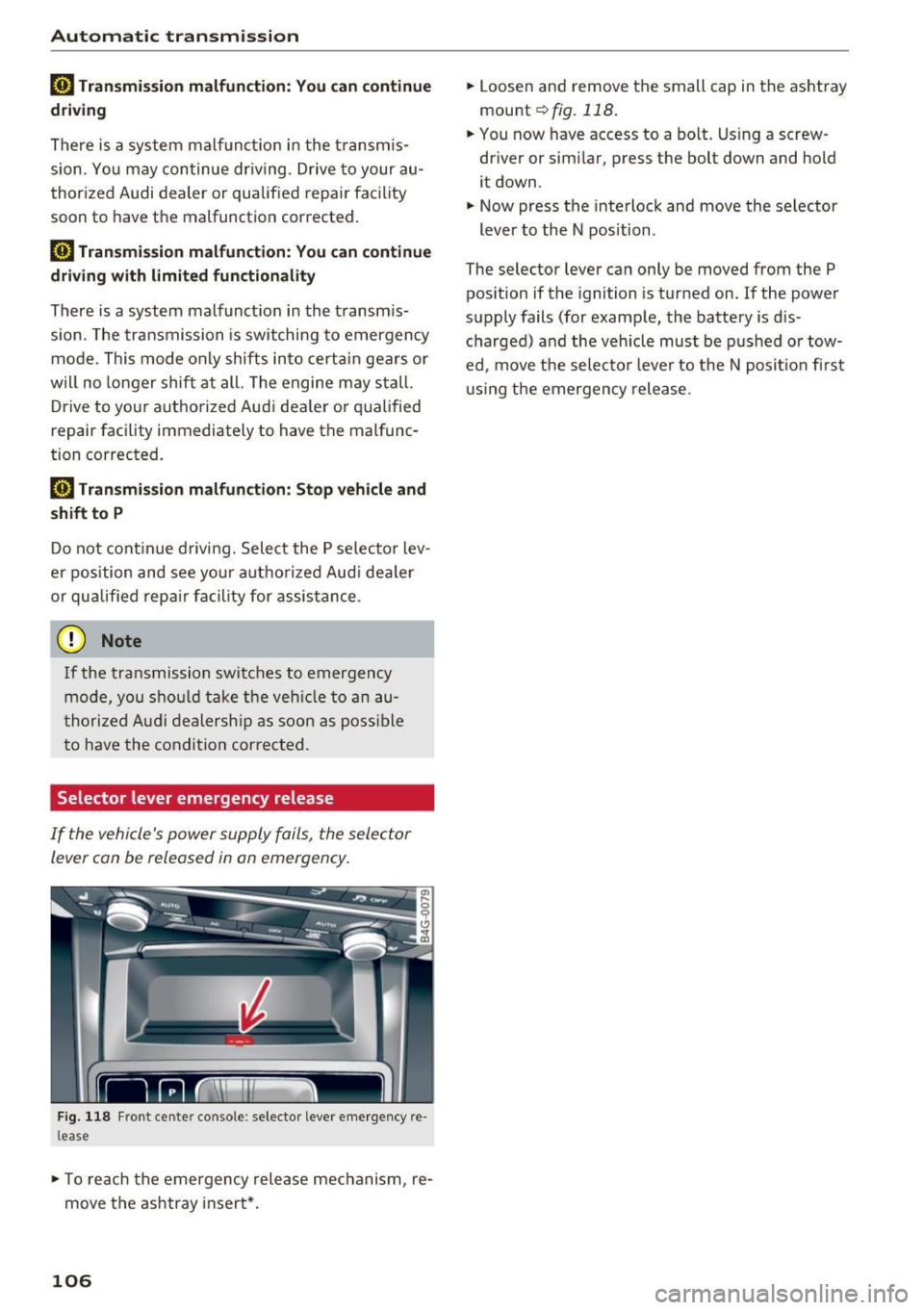
lever can be released in an emerg ency .
Fig . 118 Fro nt cen te r co nso le : selec to r lever e mergency re
l ease
.,. To re ach the emergency rele ase mech anism, re
move t he ashtray insert* .
106
.,. Loosen and remove the small cap in the as htray
mou nt
~ fig. 118 .
.,. You now have access to a bo lt. Using a screw
driver or simi lar , press the bolt down and hold
it down .
.,. Now press t he interlock and move the selector
lever to the N position .
The selector lever can only be moved from the P pos ition if the ignition is tur ned on.
If the powe r
supply fails (for examp le, the battery is d is
cha rged) and the veh icle must be p ushed o r tow
ed, move the selecto r lever to the N posit io n firs t
u sing the emergen cy rele ase .
Page 111 of 282
Rearview camera
Introduction
Applies to: vehicles wit h rearv iew camera
...
F ig. 121 Illustration: Cross parking
Fig. 122 Illustration: parallel parking
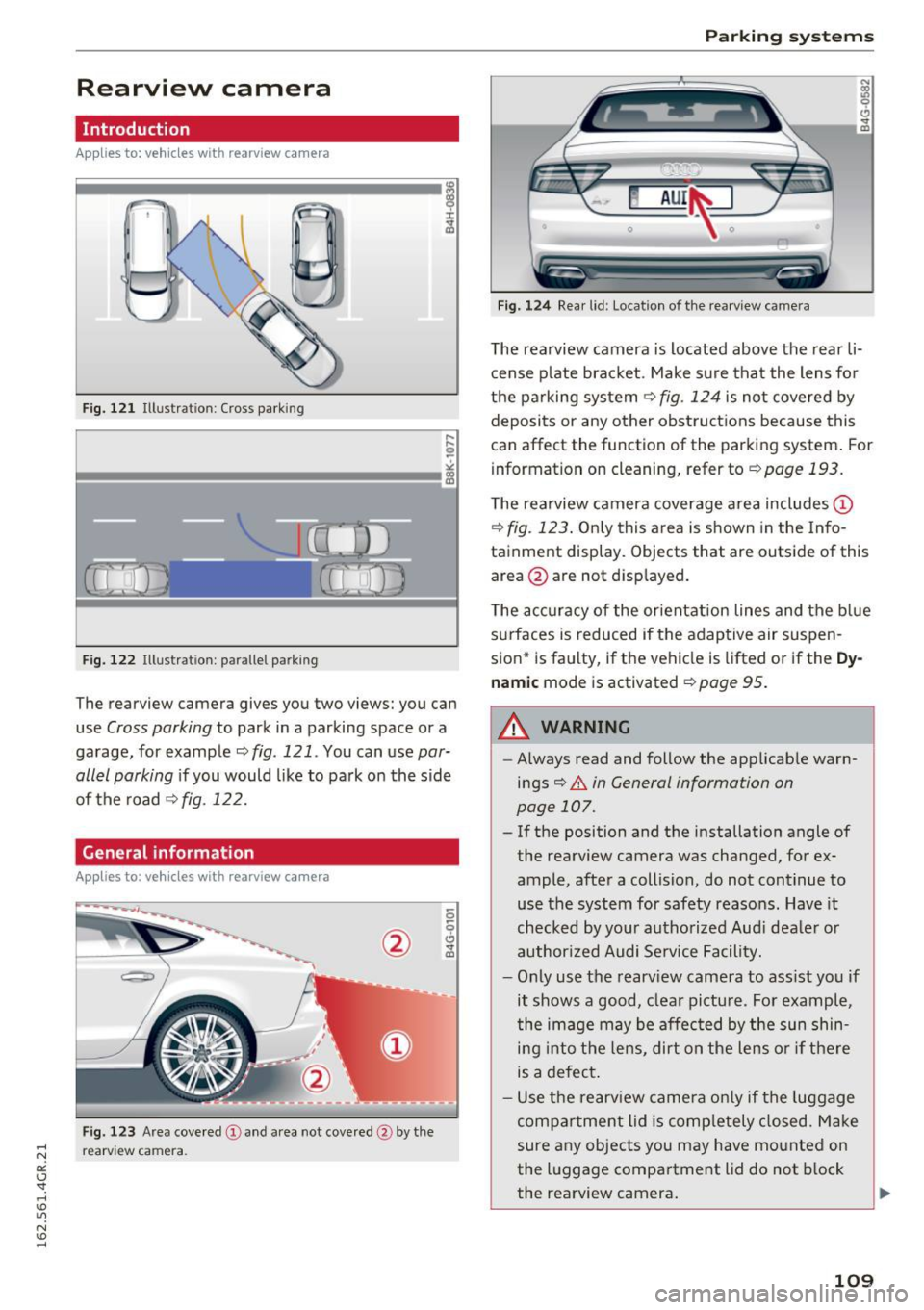
The rearview camera gives you two views: you can
use
Cross parking to park in a parking space or a
garage, for example
<::;, fig . 121 . You can use par
allel parking
i f you would like to park on the side
of the road
¢ fig . 122.
General information
Appl ies to : vehicles wit h rearv iew camera
Fig. 123 Area covered @and area not covered @by the
re arview ca mera.
Parking systems
Fig. 12 4 Rear lid : Locat ion of the rearview ca mera
The rearview camera is located above the rear li
cense p late brac ket . Make su re tha t the lens fo r
the pa rking system ¢
fig. 124 is no t covered by
deposits or any other ob struct ions because this
can affect the function of the parking system . For
information on cleaning, refer to
¢page 193.
The rearview camera coverage area includes (D
¢fig. 123. Only this area is shown in the Info
tainment display. Objects that are outside of th is
area @are not d isp layed.
T he accuracy of the orientat ion lines and the b lue
s u rfaces is reduced if the adaptive air suspen
sion* is faulty, if the vehicle is lifted or if the
Dy
nam ic mode is activated ¢ page 95.
.&_ WARNING
--Always read and follow the applicab le warn-
ings¢
& in General information on
page 107.
- If the position and the installation angle of
the rearview camera was changed, for ex
ample, after a collision, do not continue to
use the system for safety reasons. Have it
checked by you r authorized Aud i deale r o r
author ized Audi Se rvice Facility.
- Only use the rearv iew came ra to ass ist you if
it shows a good, clea r pictu re . Fo r example,
the image may be affec ted by the sun shin
ing into t he lens, dirt on the lens o r if there
is a defect .
- Use the rearv iew camera on ly if the luggage
compartment lid is comp letely closed. Make
sure any objects you may have mo unted on
the luggage compartment lid do not b lock
the rearview camera.
109
Page 122 of 282
Driving safety
"' Always keep both feet in the footwell so that
you are in control of the vehicle at all times.
For detailed information on how to adjust the
driver's seat, see
c;, page 53.
A WARNING
Drivers who are unbelted, out of position or
too close to the airbag can be seriously in
jured by an airbag as it unfolds . To help re
duce the risk of serious personal injury:
- Always adjust the driver's seat and the
steering wheel so that there are at least
10 inches (25 cm) between your breastbone
and the steering wheel.
- Always adjust the driver's seat and the
steering wheel so that there are at least
4 inches (10 cm) between the knees and the
lower part of the instrument panel.
- Always hold the steering wheel on the out
side of the steering wheel rim with your
hands at the 9 o'clock and 3 o'clock posi
tions to help reduce the risk of personal in
jury if the driver's airbag inflates.
- Never hold the steering wheel at the
12 o'clock position or with your hands at
other positions inside the steering wheel
rim or on the steering wheel hub. Holding
the steering wheel the wrong way can cause
serious injuries to the hands, arms and head if the driver's airbag inflates.
- Pointing the steering wheel toward your
face decreases the ability of the su pplemen
tal driver's airbag to protect you in a colli
sion.
- Always sit in an upright position and never lean against or place any part of your body
too close to the area where the airbags are
located .
- Before driving, always adjust the front seats
properly and make sure that all passengers
are properly restrained .
- For adjustable head restraints: before driv
ing, always also adjust the head restraints
properly .
- Never adjust the seats while the vehicle is
moving. Your seat may move unexpectedly
and you could lose control of the vehicle.
120
-
-Never drive with the backrest reclined or
tilted far back! The farther the backrests are
tilted back, the greater the risk of injury due
to incorrect positioning of the safety belt
and improper seating position .
- Children must always ride in child seats
c:;, page 159 . Special precautions apply
when installing a child seat on the front
passenger seat
c:;, page 135.
Proper seating position for the front
passenger
The proper front passenger seating position is
important for safe, relaxed driving.
For your own safety and to reduce the risk of in
jury in the event of an accident , we recommend
that you adjust the seat for the front passenger
to the following position:
"'Adjust the angle of the seatback so that it is in
an upright position and your back comes in full
contact with it whenever the vehicle is moving.
"'For adjustable head restraints: adjust the head
restraint so the upper edge is as even as possi
ble with the top of your head. If that is not pos
sible, try to adjust the head restraint so that it
is as close to this position as possible
c:;, page 121 . Move the head restraint so that it
is as close to the back of the head as possible.
"' Keep both feet flat on the floor in front of the
front passenger seat .
"' Fasten and wear safety belts correctly
c;,page 130.
For detailed information on how to adjust the
front passenger's seat, see
c:;, page 52 .
A WARNING
Front seat passengers who are unbelted, out
of position or too close to the airbag can be
seriously injured or killed by the airbag as it
unfolds. To help reduce the risk of serious
personal injury:
- Passengers must always sit in an upright po
sition and never lean against or place any part of their body too close to the area
where the airbags are located.
Ill-
Page 126 of 282
Driving safety
moving. Objects can becom e trapped under
the brake pedal and accelerator pedal caus ing a loss of vehicle control.
Storing cargo correctly
loading the luggage compartment
All luggage and other objects must be properly
stowed and secured in the luggage compart
ment .
Loose items in the luggage compartment can
shift suddenly, changing vehicle handling charac
teristics . Loose items can also increase the risk of
serious personal injury in a sudden vehicle ma neuver or in a collision.
.., Distribute the load evenly in the luggage com
partment.
.., Always place and properly secure heavy items in
the luggage compartment as far forward as
possible.
... Secure luggage using the tie-downs provided
c::;, page 62, Luggag e compartm ent.
... Make sure that the rear seatback is securely
la tched in place .
A WARNING
Improperly stored luggage or other items can
fly through the vehicle causing serious per sonal injury in the event of hard braking or an
accident . To help reduce the risk of serious
personal injury :
- Always put objects , for example, luggage or
other heavy items in the luggage compart
ment.
- Always secure objects in the luggage com
partment using the tie-down hooks and
suitable straps.
A WARNING
Heavy loads will influence the way your vehi
cle handles. To help reduce the risk of a loss
of control leading to serious personal injury:
- Always keep in mind when transporting
heavy objects, that a change in the center of
gravity can also cause changes in vehicle
handling:
124 -
Always distribute the load as evenly as
possible.
- Place heavy objects as far forward in the
luggage compartment as possible .
- Never exceed the Gross Axle Weight Rating
or the Gross Vehicle Weight Rating specified
on the safety compliance sticker on the left
door jamb. Exceeding permissible weight
standards can cause the vehicle to slide and
handle differently.
- Please observe information on safe driving
c::;,page 118.
A WARNING
To help prevent poisonous exhaust gas from
being drawn into the vehicle, always keep the
rear lid closed while driving .
- Never transport objects larger than those fitting completely into the luggage area be
cause the rear lid cannot be fully closed.
-If you absolutely must drive with the rear lid
open, observe the following notes to reduce
the risk of poisoning:
- Close all windows,
- Close the power roof*,
- Open all air outlets in the instrument pan-
el,
- Switch off the air recirculation,
- Set the fresh air fan to the highest speed.
A WARNING
-
Always make sure that the doors, all win
dows, the power roof* and the rear lid are se
curely closed and locked to reduce the risk of
injury when the vehicle is not being used.
- After closing the rear lid, always make sure
that it is properly closed and locked .
- Never leave your vehicle unattended espe
cially with the rear lid left open. A child
could crawl into the vehicle through the lug
gage compartment and close the rear lid be
coming trapped and unable to get out. Be ing trapped in a vehicle can lead to serious
personal injury.
- Never let children play in or around the vehi
cle.
Page 133 of 282
Automatic safety belt r etractors
Every safety be lt is equ ipped wi th an automatic
be lt retractor on the shoulder belt. Th is feature
l ocks the belt when the belt is p ulled out fast,
during hard braking and in an accident. The belt may also lock when you drive up or down a steep
h ill or through a sharp curve. During normal driv
ing the belt lets you move freely .
Safety be lt pret en sioner s
The safety belts are equipped with a belt preten
sioner that helps to tighten the safety belt and
remove slack when the pretensioner is activated
c:;, page 133 . The function of the pretensioner is
monitored by a warning light
c:;, page 17.
Con vertible loc king retractor
Every safety belt exc ept the one on the driver
seat is equipped with a convertible locking retrac
tor that
mu st be used when the safety belt is
used to attach a child seat. Be sure to read the
important information about this featu re
c;, page 169.
& WARNING
Improperly posit ioned safety be lts ca n cause
ser ious injury in an accident
c:;, page 131,
Safety belt position.
- Safety belts offer optimum protection only
when the seatback is upr ight and belts are
prope rly pos itioned on the body.
- If the rear seat ba ckrest is not securely
latched, the passenger wi ll move fo rward
with the ba ckrest during sudden b raking, in
a sudden mane uver and especially in a
c rash.
- Never a ttach the safety belt to the buckle
for another seat. Attaching the belt to the
wrong buckle will red uce safety belt effec
t iveness and can cause serious personal in
jury.
- A passenger who is not proper ly restrained
can be seriously in jured by the safety be lt it
self when it moves from the stronger parts
of the body into cr itical areas like-the abdo
men .
Safet y bel ts
-Always lock the convertible locking retractor
when yo u are securing a child seat in the ve
hicle
c;, page 171.
(0 Tips
For information on safety belt pretensioners,
r efer to
c:;, page 133 .
Safety belt position
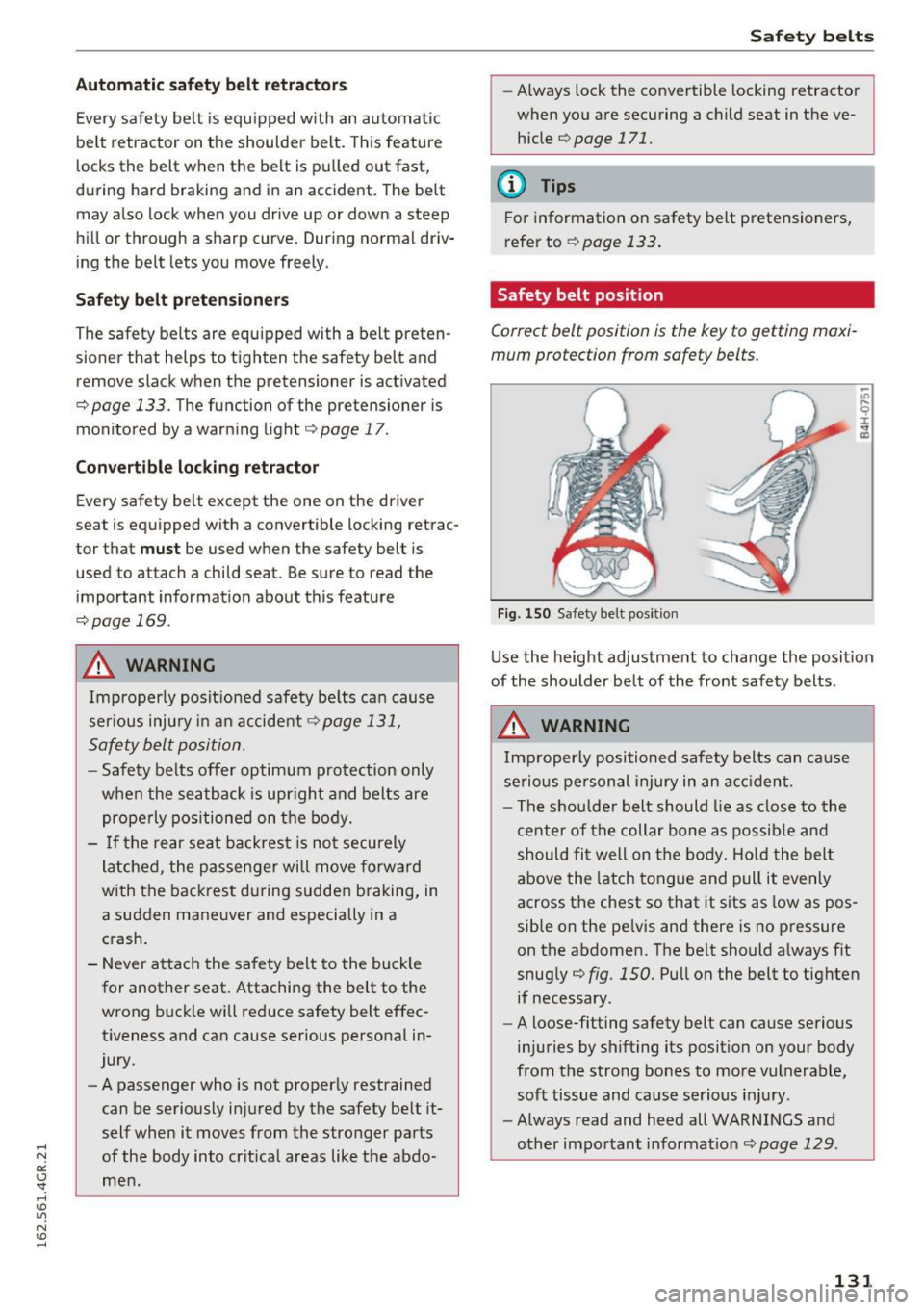
Correct belt position is the key to getting maxi
mum protection from safety belts.
Fi g. 1 50 Safety belt pos it ion
U se the height adjustme nt to change the posit ion
of the shoulder belt of the fro nt safety belts .
& WARNING
Imp roperly positioned safety belts can ca use
se rio us pe rson al injury in an a cciden t.
- The s hou lde r belt should lie as close to the
center of t he collar bone as possib le and
should fi t well on the bo d y. Ho ld the belt
above the latch tongue and pull it evenly
across the chest so that it sits as low as pos
sible on the pe lvis and there is no pressure
on the abdomen. The belt should a lways fit
snug ly
¢fig. 150. Pull on the belt to tighten
if necessary .
- A loose-fitting safety belt can cause serious
i nj uries by shifting its position on your body
from the strong bones to more vulnerable,
soft tissue and cause serious inj ury .
- Always read and heed all WARNINGS and
other important informat ion
c:;, page 129 .
131
Page 141 of 282
-Always make sure that there is nothing on
the front passenger seat that will ca use the
capacit ive passenger detection system in
the seat to signal to the Airbag System that
the seat is occupied by a person when it is
not, or to signa l that it is occupied by some
one who is heavier than the person actua lly
sitting on the seat. The p resence of addi
tional objects could cause the passenger
front airbag to be turned on when it shou ld
be off, or could cause the airbag to work in a
way that is different from the way it would
have worked without the object on the seat.
Front airbags
Description of front airbags
The airbag system con provide supplemental
protection to properly restrained front seat occu
pants.
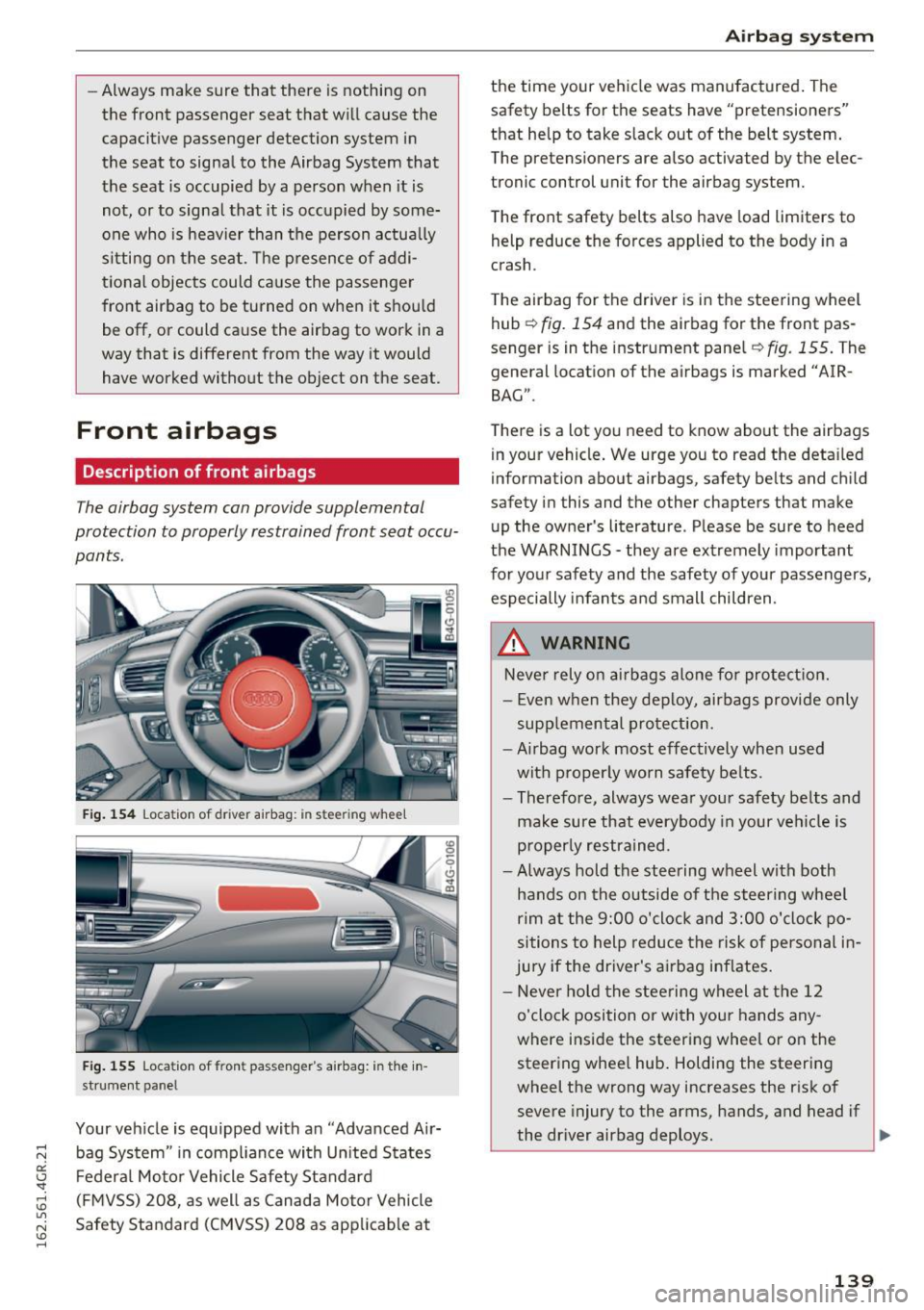
F ig. 154 Location of driver airbag: in steering whee l
Fig. 155 Location of front passenger 's airbag: in th e in
strume nt panel
Your veh icle is equipped with an "Advanced Air
bag System" in comp liance with United States
F edera l Moto r Vehicle Safety Standard
( FM VSS) 208, as well as Canad a Moto r Vehicle
Safety Standard (CMVSS) 208 as app licab le at
Airb ag sys tem
the time your ve hicle was manufactured . The
safety belts for the seats have "pretensioners"
that help to take slack out of the belt system .
The pretensioners are also activated by the elec
tronic control unit for the airbag system.
The front safety belts also have load limiters to
help reduce the forces applied to the body in a
crash.
T he airbag for the drive r is in the steering wheel
hub ~
fig. 154 and the airbag for the front pas
senger is in the instrument panel~
fig. 155 . The
general locat ion of the airbags is marked "AIR
BAG".
There is a lot you need to know about the airbags i n your vehicle . We urge you to read the deta iled
information about airbags, safety be lts and ch ild
safety in this and the other chapters that make
up the ow ner's literature . Please be sure to heed
the WARNINGS - they are extremely important
for yo ur safety and the safety of your passengers,
especially infan ts and small children.
_&. WARNING
-
Neve r rely o n ai rbags alone fo r prote ct ion.
- E ven w hen they deploy, airbags provide only
supp lemental pro tection.
- Ai rbag work most effectively when used
with p roperly worn safety belts.
- Therefo re, always wear your safety belts and
make sure that everybody in your ve hicle is
p roperly restrained.
- Always hold the steering w heel with both
ha nds on the outside of the steering wheel
rim at the 9:00 o'clock and 3 :00 o'clock po
sitions to help reduce t he risk of personal i n
jury if the driver's a irbag inflates.
- Never hold the stee ring wheel at the 12
o'clock position or wi th your hands any
where inside the steering wheel o r on the
steer ing whee l hub . Holding the steering
wheel the wrong way increases the r isk of
severe injury to the arms, hands, and head if
the dr iver airbag deploys.
~
139
Page 150 of 282
Airbag system
restraints that were used to certify your vehi
cle's compliance with the U.S . Safety Standard
~ page 161.
-will go out if the front passenger seat is occu
pied by an adult as registered by the capacitive
passenger detection system.
- The
PASSENGER AIR BAG OFF light must come
on and stay on if the ignition is on and ...
- a car bed has been installed on the front pas
senger seat, or
- a rearward -facing child restraint has been in
sta lled on the front passenger seat, or
- a fo rwa rd-facing child restraint has been instal
led on the front passenger seat,
- and if the electrica l capacitance registered on
the front passenger seat is equa l to or less than
the comb ined capacitance of a typica l 1 year
o ld infant and one of the rearward-facing or
forward-facing child restraints listed in Federal
Motor Vehicle Safety Standard 208 with which
the Advanced Airbag System in your vehicle was
certified.
If the front passenger seat is not occupied, the
front airbag w ill not deploy, and the
PASSENGER
AIR BAG OFF light will stay on. Never install a
rearward-fac ing ch ild restraint on the front pas
senger seat, the safest place for a child in any
kind of child restraint is at one of the seating po
sitions on the rear seat~
page 136, Child re
straints on the front seat -some important
things to know
and ¢ page 159, Child safety .
If the PASSENGER AIR BAG light comes
on ...
If the PASSENGER AIR BAG OFF light comes on
when one of the conditions listed above is met,
be sure to check the light regularly to make cer
tain that the
PASSENGER AIR BAG OFF light
stays on continuous ly whenever the ign ition is
on. If the
PASSENGER AIR BAG OFF light does
not appear on and does not stay on all the time,
stop as soon as it is safe to do so and
- reactivate the system by turning the ignition off for more than 4 seconds and then turning it
on again;
- remove and reinstall the child restraint. Make
sure that the child restraint is properly instal-
148
led and that the safety belt for the front pas
senger seat has been correctly routed through
the child restraint as described in the child re
straint manufacturer's instructions;
- make sure that the convertible locking retrac
tor on the safety belt for the front passenger
seat has been activated and that the safety belt
has been pulled tight.
- make sure that no electrical device (such as a laptop, CD player, electron ic games device,
power inverter or seat heater for child seats) is
placed or used on the front passenger seat if
the device is connected to the 12-volt socket or
the cigarette lighter socket;
- make sure that no seat heater has been retro
fitted or otherw ise added to the front passen
ger seat;
- make sure that noth ing can interfere with the
safety belt buckles and that they are not ob
structed;
- make sure that there are no wet objects (such
as a wet towe l) and no water or other liquids on
the front passenger seat cushion.
If the PASSENGER AIR BAG light still does
not come on ...
If the PASSENGER AIR BAG OFF light still does
not come on and does not stay on continuously
(when the ignition is switched on),
- take the child restra int off the front passenger
seat and insta ll it p roperly at one of the rear
seat positions. Have the airbag system inspect
ed by yo ur Audi dealer immediate ly.
- move the child to a rear seat position and make
sure that the child is properly restrained in a
child restraint that is appropriate for its size
and age .
The PASSENGER AIR BAG light should NOT
come on .. .
The PASSENGER AIR BAG OFF light should NOT
come on when the ignition is on and an adu lt is
sitting in a proper seating position on the front
passenger seat. If the
PASSENGER AIR BAG OFF
light comes on and stays on or flashes for about
5 seconds while dr iv ing, under these c ircumstan-
ces, make sure that: ..,.
Page 164 of 282
Child safet y
sold in the past or will be sold ove r the course of
the useful life of your vehicle.
F or this reason, the U nited States National High
way Traffic Safety Adm inis tration has p ublished a
list of specific type, makes and models of child
restraints that must be used to certify compli
ance of the Advanced Airbag System in your vehi
cle with the suppression requ irements of Federal
Motor Vehicle Safety Standard 208. These child
restraints are:
Subpart A - Car bed child re straint s
Model Manufactured on or
after
Angel Guard Angel September 25, 2007
Ride AA2403FOF
Subp art B -Rear-facing child restr aint s
Model Manufactured on or
after
Century SmartFit 4543 December 1, 1999
Cosco Arriva September 25, 2007
22-013PAW and base
22-999WHO
E venflo Discovery Ad- December 1, 1999
jus t Right 21 2
Evenflo First Cho ice December 1, 1999
204
Graco Infant 8457
December 1, 1999
Graco Snug ride September 25, 2007
Peg Perego Primo V iag- September 25, 2007
gio SIP IMUNOOUS
Subpart C - Forward -facing and convertib le
child restraint s
Model Manufactured on or
after
Britax Roundabout September 25, 2007
E9L02xx
Cosco Touriva 02519 December 1, 1999
Cosco S umm it Deluxe September 25, 2007
High Back Booste r
2 2-262
Cosco High Back Boos- September 25, 2007
ter 22-209
162
Model Manufactured on or
after
Evenflo Tribute V September 25, 2007
379xxxx
E venflo Meda llion 254 December 1, 1999
Evenflo Generat ions September 25, 2007
352xxxx
Graco ComfortSport September 25, 2007
Graco Toddler Safety September 25, 2007
Seat Step 2
Graco Plat inum Cargo September 25, 2007
A WARNING
To reduce the risk of serious injury, make sure
that the
PASSENGER AIR BAG OFF light
comes on and stays on whenever a ch ild re
stra int is installed on the front passenger seat
and the ign ition is swi tched on.
- Take the child restra int off the front passen
ge r seat and install it prope rly at one of the
rear sea t positions i f the
PASSENGER AIR
BAG
OFF light does no t stay on .
-Have the ai rbag system in spec ted by y our
author ized Audi dealer immed iate ly.
(D Tips
The child seats listed in categor ies A to C have
been statically tested by Audi only for the Ad
van ced A irbag fun ction.
Important safety instructions for using
child safety seats
Correct use of child safety sea ts substantially re
duces the risk of injury in an accident!
As the dr iver, yo u are responsib le for the safety
of eve rybody in the veh icle, e speci ally childre n:
.,. Always use the right c hild safety seat for each
child and always use it properly
~ page 165.
.,. Always carefully follow t he chi ld safety seat
man ufac turer's ins truc tions on how to route
t he sa fety belt properly th ro ugh the ch ild safe
ty seat.
.,. When using the vehicle safety belt to install a
child sa fety seat, yo u must first activate the
convertib le locking retracto r on the safety belt
Ill-
Page 167 of 282
_& WARNING
A child in a child safety seat installed with the
LATCH lower anchorages or with the standard
safety belt or a child in a booster seat on the
rear seat could play with unused rear seat
safety belts and become entangled. This
could cause the child serious personal injury
and even death.
- Always secure unused rear seat safety belts
out of reach of children in child seats such
as by properly routing them around the head restraint of the seat where the child
restraint is installed .
- Never activate the convertible locking re tractor when routing the safety belts around
the head restraints.
Child seats
Infant seats
Babies and infants up to about one year old and
20 lbs. or 9 kg need special rearward-facing
child restraints that support the bock, neck and
head in a crash .
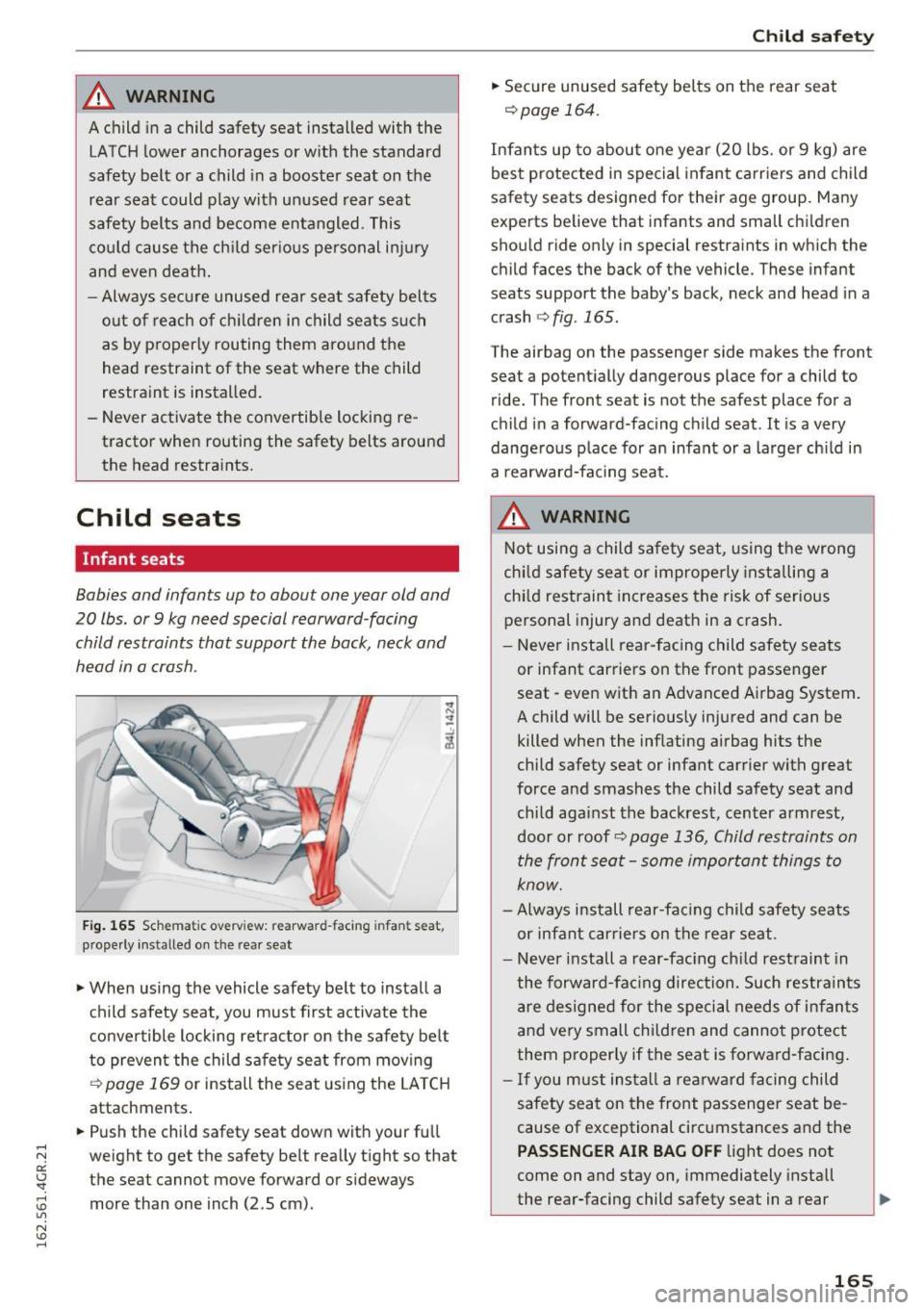
Fig. 165 Schemat ic overview: rearwa rd-facing infant seat,
properly installed on the rear seat
"'When using the vehicle safety belt to install a
child safety seat, you must first activate the
convertible locking retractor on the safety belt
to prevent the child safety seat from moving
~ page 169 or install the seat using the LATCH
attachments.
"'Push the child safety seat down with your full
weight to get the safety belt really tight so that
the seat cannot move forward or sideways
more than one inch (2.S cm).
Child safety
"' Secure unused safety belts on the rear seat
¢page 164.
Infants up to about one year (20 lbs. or 9 kg) are
best protected in special infant carriers and child
safety seats designed for their age group. Many
experts believe that infants and small children
should ride only in special restraints in which the
child faces the back of the vehicle. These infant
seats support the baby's back, neck and head in a
crash
¢fi g. 165.
The airbag on the passenger side makes the front
seat a potentially dangerous place for a child to
ride. The front seat is not the safest place for a
child in a forward -facing child seat . It is a very
dangerous place for an infant or a larger child in
a rearward-facin g seat.
_& WARNING
Not using a child safety seat, using the wrong
child safety seat or improperly installing a
child restraint increases the risk of serious
personal injury and death in a crash.
- Never install rear-facing child safety seats
or infant carriers on the front passenger
seat -even with an Advanced Airbag System.
A child will be seriously injured and can be
killed when the inflating airbag hits the
child safety seat or infant carrier with great
force and smashes the child safety seat and child against the backrest, center armrest,
door or roof¢
page 136, Child restraints on
the front seat -some important things to
know.
- Always install rear-fac ing child safety seats
or infant carriers on the rear seat.
- Never install a rear-facing child restraint in
the forward -facing direction. Such restraints
are designed for the special needs of infants
and very small children and cannot protect
them properly if the seat is forward-facing.
- If you must install a rearward facing child
safety seat on the front passenger seat be
cause of exceptional circumstances and the
PASSENGER AIR BAG OFF light does not
come on and stay on, immedia tely install
the rear-facing child safety seat in a rear
165