radio AUDI RS7 SPORTBACK 2016 Owners Manual
[x] Cancel search | Manufacturer: AUDI, Model Year: 2016, Model line: RS7 SPORTBACK, Model: AUDI RS7 SPORTBACK 2016Pages: 282, PDF Size: 70.78 MB
Page 32 of 282
Opening and closing
Opening and closing
Keys
Key set
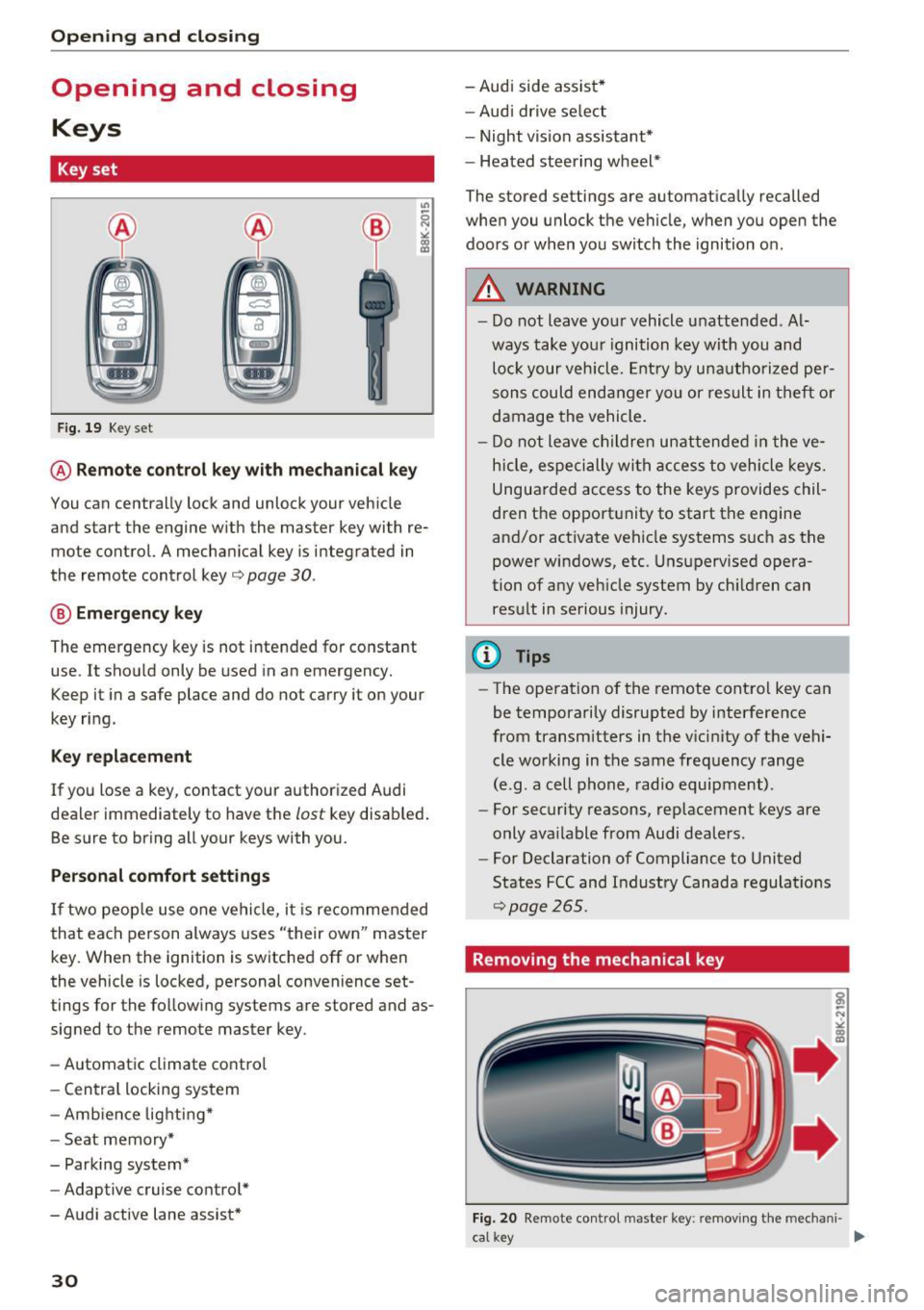
Fig. 19 Key set
@ Remote control key with mechanical key
You can centrally lock and unlock your vehicle
and start the engine w ith the master key with re
mote control. A mechanical key is integrated in
the remote control key¢
page 30.
@ Emergency key
The emergency key is not intended for constant
use. It shou ld only be used in an emergency.
Keep it in a safe place and do not carry it on your
key ring.
Key replacement
If you lose a key , contact your authorized Audi
dealer immediately to have the
lost key disab led .
Be sure to bring all your keys with you.
Personal comfort settings
If two people use one vehicle, it is recommended
that each person always uses "their own" master
key. When the ignition is switched off or when
the vehicle is locked , personal convenience set
tings for the following systems are stored and as
signed to the remote master key .
- Automatic climate contro l
- Central locking system
- Amb ience lighting*
- Seat memory*
- Parking system*
- Adaptive cruise control*
- Audi active lane assist*
30
-Audi side assist*
- Audi drive se lect
- Night vision assistant*
- Heated steering wheel*
The stored settings are automatically recalled
when you unlock the vehicle, when you open the
doors or when you switch the ignition on.
A WARNING
-
-Do not leave your vehicle unattended. Al
ways take your ignition key with you and
loc k your vehicle . Entr y by unautho rized per
sons could endanger yo u or result in theft or
damage the vehicle.
- Do not leave children unattended in the ve
hicle, especially with access to vehicle keys.
Unguarded access to the keys provides chil
dren the opport unity to start the engine
and/or activate vehicle systems s uch as the
power windows, etc. Unsupervised opera
tion of any vehicle system by ch ildren can
result in serious injury .
(D Tips
-The operation of the remote control key can
be temporarily disrupted by interference
from transmitters in the v icinity of the vehi
cle working in the same frequency range
(e.g . a cell phone, radio equipment).
- For security reasons, replacement keys are
only ava ilable from Audi dealers .
- For Declaration of Compliance to United
States FCC and Industry Canada regulations
~page 265 .
Removing the mechanical key
Fig. 20 Remote contro l maste r key : removing the mec hani -
ca l key
Ill>-
Page 33 of 282
.. Press the release button@ c::> fig. 20.
.. Pull the mechanical key @ out of the master
key.
Using the mechanical key, you can:
- lock and unlock the storage compartment on
the passenger's s ide
c::> page 60.
- lock and unlock the vehicle manually
Qpage 35.
-lock the front and rear passenger doors me
chanically
c::> page 36.
LED and batteries in the remote control key
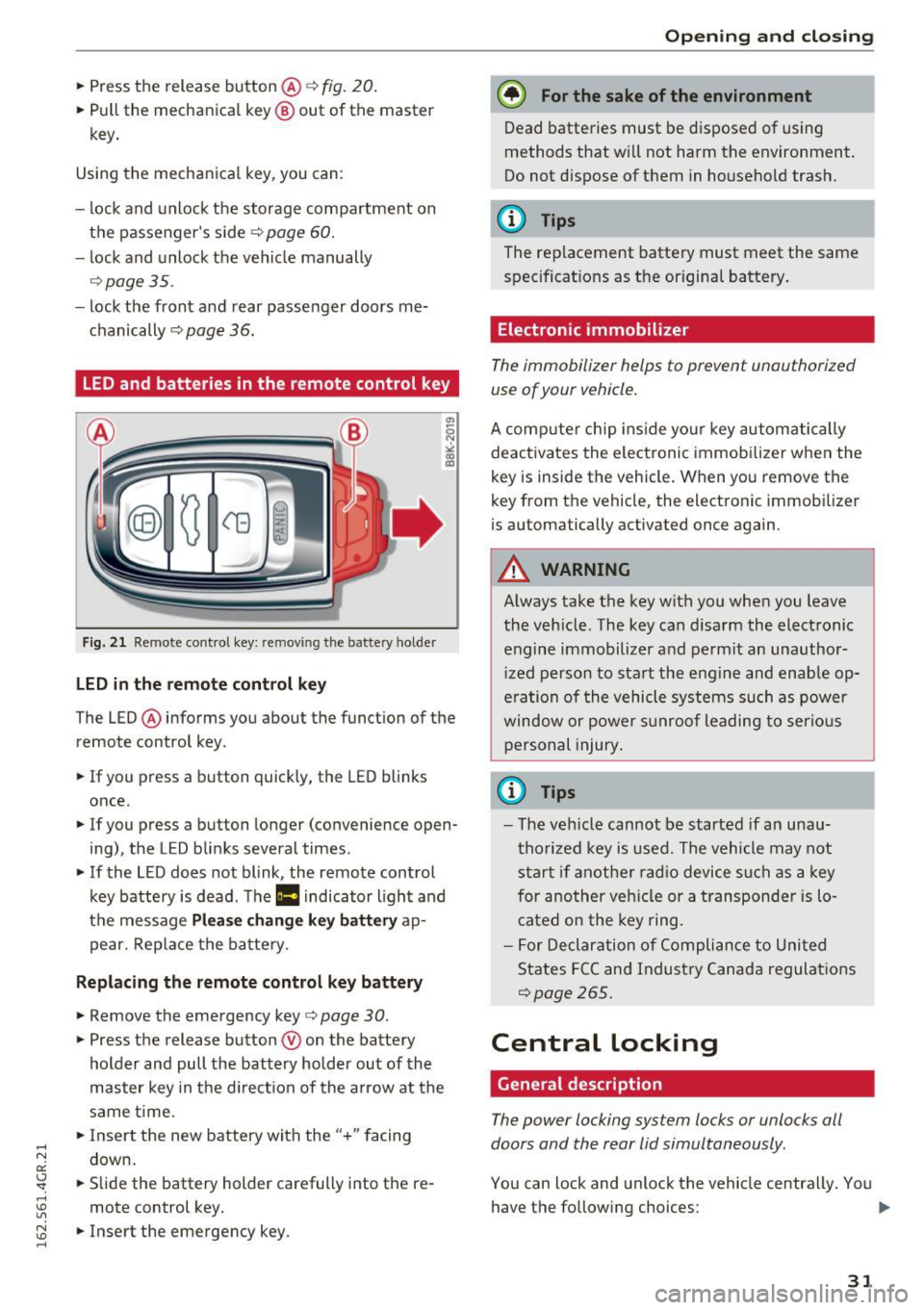
Fig. 21 Remote control key: re m ov ing the battery holder
LED in the remote control key
The LED ® informs you about the function of the
remote control key .
.. If you press a button quickly, the LED blinks
once.
.. If you press a button longer (convenience open
ing), the LED blinks several times .
.. If the LED does not blink, the remote control
key battery is dead . The
Ill indicator light and
the message
Plea se change key battery ap
pear. Replace the battery.
Replacing the remote control key battery
.. Remove the emergency key
c::> page 30 .
.,. Press the release button ® on the battery
holder and pull the battery holder out of the
master key in the direction of the arrow at the
same time.
.. Insert the new battery with the
"+ " facing
down .
.. Slide the battery holder carefully into the re
mote control key .
.. Insert the emergency key .
Opening and closing
@) For the sake of the environment
Dead batteries must be disposed of using
methods that will not harm the environment.
Do not d ispose of them in household trash.
@ Tips
The replacement battery must meet the same
specificat ions as the origina l battery.
Electronic immobilizer
The immobilizer helps to prevent unauthorized
use of your vehicle .
A computer chip ins ide your key automatically
deactivates the electronic immobilizer when the
key is inside the vehicle. When you remove the
key from the vehicle, the electronic immobilizer
is automatically activated once again.
A WARNING
-Always take the key with you when you leave
the vehicle. The key can disarm the electronic
engine immobilizer and permit an unauthor
iz ed person to start the engine and enable op
e ration of the vehicle systems such as power
window or power s unroof leading to serious
personal injury .
@ Tips
- The vehicle cannot be started if an unau
thorized key is used. The vehicle may not
start if another radio device such as a key
for another vehicle or a transponder is lo
cated on the key ring.
- For Declaration of Compliance to United
States FCC and Industry Canada regulations
Qpage265 .
Central Locking
General description
The power locking system locks or unlocks all
doors and the rear lid simultaneously.
You can lock and unlock the vehicle centrally. You have the following choices: .,.
31
Page 40 of 282
Opening and clo sin g
- There are audio si gnals when closing the
l uggage compartment lid with the remote
contro l key (veh icles w ith convenience key*)
or with the~ button in the driver's door.
- When the vehicle is locked, the luggage
compartment lid can be unlocked separately by pressing the button
!a l on the remote
control key. The luggage compartment lid locks automatically after it is closed aga in.
- You can close the luggage compartment lid
us ing the master key (veh icles with conven
i ence key*) up to a distance of approximate
l y 9 ft (3 m).
- The luggage compa rtment lid ca n be oper
ated by hand if the vehicle battery is low. It
i s necessary to use more fo rce whe n doing
th is. Move the lid slowly to red uce the
amoun t of force needed.
Luggage compartment with movement
activated opening
Applies to: vehicles with conven ience key and sensor-control·
led luggage compartmen t lid
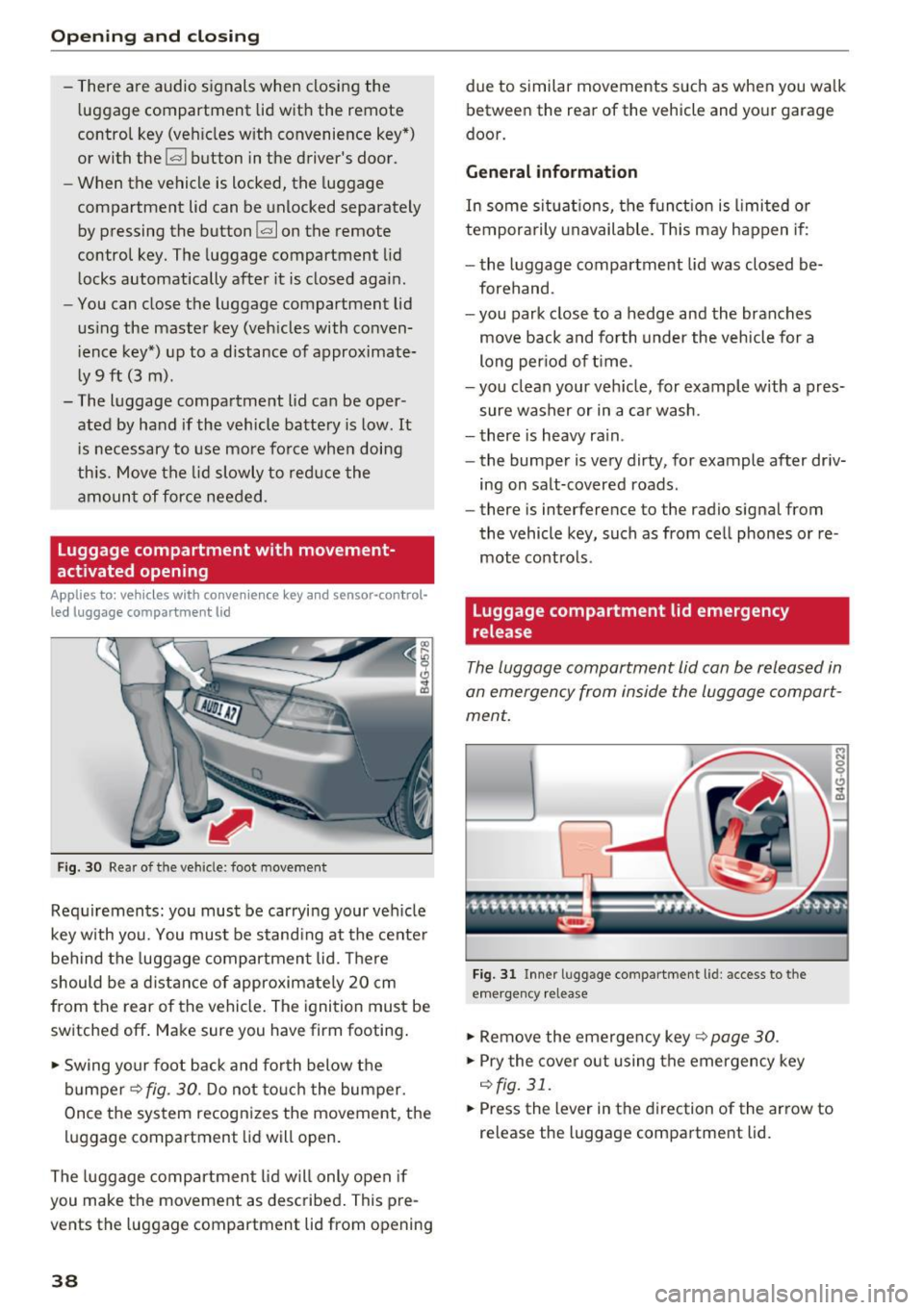
Fig . 30 Rear of the vehicle: foot movement
Req uirements: you must be carrying your ve hicle
key with you. You must be stand ing at the cente r
behind the luggage compartment lid. There
should be a d istance of approximate ly 20 cm
from the rear of the vehicle. The ignition must be
sw itched off . Make sure you have firm footing .
~ Swing your foot back and forth below the
bumper~
fig. 30. D o not to uc h the bumper.
Once the system recogni zes the movement, t he
l u ggage compartment lid will open .
The luggage compartment lid will only open if
you make the movement as described . This pre
vents the luggage compartment lid from opening
38
due to s imilar movements such as when you wa lk
between the rear of the vehicle and yo ur garage
door.
General information
In some situat io ns, the f un ct ion is limi ted or
tempora rily unavailable. Th is may happen if:
- the luggage compartment lid was closed be
forehand.
- you park close to a hedge and the branches
move back and fo rth under the veh icle for a
long per iod of t ime.
- you clean your ve hicle, for example w ith a pres
sure washer or in a c ar wash .
- there is heavy ra in .
- the bumper is very dirty, for example after dr iv-
ing on salt-covered roads .
- there is interference to the radio sig nal from
the vehicle key, such as from cel l phones or re
mote co ntrols.
Luggage compartment lid emergency
release
Th e luggage compartment lid can be released in
an emergen cy from inside the luggage compart
ment.
Fi g. 31 Inner luggage compartment lid: access to the
e m ergency release
~ Remove the emerge ncy key Q page 30 .
~ Pry the cove r out using the emerge ncy key
Q fig.31.
~ Press the lever in the direction of the arrow to
re lease the luggage compartment lid.
Page 152 of 282
Airbag system
(D Tips
If the capacitive passenger detection system
determines that the front passenger seat is
empty, the frontal airbag on the passenger
side will be turned off, and the
PASSENGER
AIR BAG OFF
light will stay on.
Repair , care and disposal of the airbags
Parts of the airbag system are installed at many
different places on your Audi. Installing, remov
ing, servicing or repairing a part in an area of the
vehicle can damage a part of an airbag system
and prevent that system from working properly
in a collision.
There are some important things you have to
know to make sure that the effectiveness of the
system will not be impaired and that discarded
components do not cause injury or pollute the
environment.
A WARNING
-Improper care, servicing and repair proce
dures can increase the risk of personal injury
and death by preventing an airbag from de
ploying when needed or deploying an airbag
unexpectedly:
- Never cover, obstruct, or change the steer ing wheel horn pad or airbag cover or the in
strument panel or modify them in any way.
- Never attach any objects such as cup holders or telephone mountings to the surfaces cov
ering the airbag units.
- For cleaning the horn pad or instrument
panel, use only a soft, dry cloth or one mois
tened with plain water. Solvents or cleaners could damage the airbag cover or change
the stiffness or strength of the material so
that the airbag cannot deploy and protect
properly.
- Never repair, adjust, or change any parts of the airbag system.
- All work on the steering wheel, instrument
panel, front seats or electrical system (in
cluding the installation of audio equipment,
cellular telephones and CB radios, etc.)
must be performed by a qualified technician
150
who has the training and special equipment necessary.
- For any work on the airbag system, we
strongly recommend that you see your au
thorized Audi dealer or qualified workshop.
- Never modify the front bumper or parts of
the vehicle body.
- Always make sure that the side airbag can
inflate without interference:
- Never install seat covers or replacement
upholstery over the front seatbacks that
have not been specifically approved by
Audi.
- Never use additional seat cushions that
cover the areas where the side airbags in
flate.
- Damage to the original seat covers or to
the seam in the area of the side airbag
module must always be repaired immedi
ately by an authorized Audi dealer.
- The airbag system can deploy only once. Af
ter an airbag has been deployed, it must be
replaced with new replacement parts de
signed and approved especially for your
Audi model version. Replacement of com plete airbag systems or airbag components
must be performed by qualified workshops
only . Make sure that any airbag service ac
tion is entered in your Audi Warranty
&
Maintenance booklet under AIRBAG RE
PLACEMENT RECORD.
- For safety reasons in severe accidents, the
alternator and starter are separated from
the vehicle battery with a pyrotechnic circuit
interrupter.
- Work on the pyrotechnic circuit interrupt
er must only be performed by a qualified
technicians who have the experience, in
formation and special tools necessary to perform the work safely.
- If the vehicle or the circuit interrupter is
scrapped, all applicable safety precautions must be followed.
~
Page 189 of 282
@ Tips
-Energy management cannot overcome the
laws of physics. Note that the charge level
and length of the battery life are limited.
- When the starting ability is endangered, the
(•j indicator light turns on¢ page 15.
What you should know
Maintaining the starting ability is the highest
priority.
A lot o f stress is placed on the battery when driv
ing short distances, in traffic, and at cold times
of the year. A lot of ene rgy is used but little is
generated. It is also critical when the engine is
not running but electrical equipment is switched
on. In this case, energy is used but none is gener
ated.
In s ituations like this, energy management will
actively regulated the distribution of energy.
Long pe riods without u se
If yo u do not drive your vehicle for several days or
weeks, e lectrica l equipment is gradually scaled
back or switched off. This reduces energy use a nd
ensures the veh icle w ill be able to start after long
periods of time. Some convenience functions,
such as interior lighting or power seat adjust
ment, may not be available under certain circum
stances . These convenience functions will be
ava ilab le aga in once you switch the ign ition on
and st art the engine.
With the engine switched off
The battery will drain if you use functions such as
listening to the radio while the engine is sw itch
ed off.
The vehicle's ability to start may be impaired by
the energy use, a message will appear in the In
fotainment system d isplay.
The message ind icates that the system will
sw itch off automatically soon. If you wou ld like
;:::: to continue using the funct ions, you must start
er: u the eng ine . 'SI: ,....,
With the engine running
Although e lec trica l energy is ge nerated wh ile
driv ing, the b attery can dra in. This can happen
when litt le energy is generated, a nd much is used
and t he charge level of the batte ry is not optimal.
T o res to re the balance of ene rgy, components
that req uire large amoun ts of energy are tempo
rarily scaled back or sw itched
off . Heat ing sys
tems in particular req uir e a great deal of energy .
If you notice, for example, that the seat heating*
or rear window defroster is not working, then it
has been tempora rily reduced or sw itched off.
These systems are availab le aga in as soo n as the
energy supply has bee n restored .
In add ition, you may notice that the idle speed
has slig htly increased. That is normal and no
ca use for concern. Due to the increased id ling
speed, the addi tional required energy will be
generated and t he battery w ill be charged .
187
Page 217 of 282
Always r ead and h eed all W ARNING S below
~ A. and
¢A. in Working on the battery on
page 213.
.,. Switch off the ignition and all electrica l con
sumers .
.,. Make sure the area is well venti lated when you
charge the battery.
.,. Open the engine hood
¢page 203.
.,. Open the red cover on the positive pole
¢fig . 188 .
.,. Connect the charger co nnectors according to
the instructions to the
j ump start bo lt s. (Bolts
under the red cover= "positive", Bolts with hex
head
= "negat ive") .
.,. Only now plug the mains lead for the charging
equipment into the wall outlet and turn it on
¢&_ .
.,. M ake s ure th e char ging rate is not o ver
30 amp s/14.8 Volt.
.,. When the battery is fully charged: Turn the
charg ing equipment off and remove the mains
lead from the wall outlet.
.,. Now remove the clamps for the charging equ ip-
ment.
.,. Close the red cover on the positive pole.
.,. Close the hood
¢ page 204.
A discharged battery can fre eze at temperatures
of only 32 F
0 (0 °C). A llow a frozen battery to
thaw comp lete ly before attempt ing to charge it
¢ ,&. However, we recommend not using a
thawed battery again because the battery casing
can be cracked due to ice formation and can leak
battery acid.
Battery chargin g (Ma ximum cha rging rate of
30 amp s/14 .8 Volt )
When charging at low voltages (e.g. with a trick
le cha rger ),
the battery cables do not have to be
d isconnected first. The battery caps should
not
be opened when charging a battery .
It is not necessary to remove the battery from
the luggage compartment, and it is also not nec
essary to disconnect the cables.
Check ing and Filling
Fast charging the batt ery (charging rate
ab ove 14.8 Volt )
For technical reasons do not use a battery charg
er that uses vo ltage greater than 14.8 Volt to
charge your vehicle's battery.
A WARNING
=
Charging a battery can be dangerous .
-Always follow the operating instructions
provided by the battery charger manufactur
er when charging your battery .
- Never charge a frozen battery. It may ex
plode because of gas trapped in the ice. Al
low a froze n battery to thaw out first .
- Do not reuse batter ies which were frozen.
The battery hous ing may have cracked and
weakened when the battery froze .
- Charge the battery in a well ventilated area.
Keep away from open flame or electrical
spark. Do not smoke . Hydrogen gas generat
ed by the battery is explos ive.
- To reduce the danger of explosion, never connect or d isconnect charge r cables while
the charger is ope rating .
- Fast charg ing a battery is dangerous and
should only be attempted by a competent
technicia n w ith the prope r equipment.
- Batte ry acid that may spill during charging
should be washed off w ith a so lution of
warm water and baking soda to neutra lize
t he acid .
{[) Note
Never use a fast charger as a booster to start
the e ngine. This will se riously damage sensi
tive electronic components, such as control
units, re lays, radio, etc., as well as the bat tery
charge r.
Battery replacement
The new battery must have the same specifica
tions and dimensions as the original equipment
battery .
Intelligent ene rgy manageme nt in yo ur vehicle is
responsib le for distr ib uting the electrica l energy
Iii>-
215
Page 222 of 282
Wheels
happy to provide more informa
tion .
® Mud and snow capability
"M/S" or "M+S" indicates the tire
has characteristics that make it
suitab le for driving on mud and
snow .
& indicates a winter t ire .
@ Compos ition of the tire cord
and materials
The number of plies indicates the
number of rubberized fabric lay
ers in the tire . In general: the
more layers, the more weight a
tire can carry. Tire manufacturers must also specify the materia ls
used in the tire . These include
steel, nylon, polyester and other
materials .
@ Maximum permitted load
This number indicates the maxi
mum load in k ilograms and
pounds that the tire can carry.
@ Uniform tire quality grade
standards for treadwear,
traction and temperature
resistance
Treadwear, traction and tempera
ture ranges
c::> page 234 .
@ Running direction
The arrows indicate the running
direction of unidirec tiona l tires.
220
You must a lways follow the speci
fied runn ing direction
c::> page 247.
@ Maximum permitted
inflation pressure
This number indicates the maxi
mum pressure to which a tire can be inflated unde r normal operat
ing condit ions .
Glossary of tire and loading
terminology
Accessory weight
means the comb ined we ight (in
excess of those standard items
which may be replaced) o f auto
matic tra nsmission , power steer
ing , power brakes , power wi n
dows, power seats , radio , and
heater, to the extent that these
items a re available as facto ry-in
stalled equipment (whet her in
stalled or not).
Aspect ratio
means the rat io of the height to
the width o f the tire in pe rcent.
Numbe rs of 55 or lower indicate a
low sidewa ll for imp roved steer
ing response and better overa ll
handling on dry pavement .
...
Page 238 of 282
Wheels
Your vehicle has also been equipped with a TPMS
malfunction indicator to indicate when the sys
tem is not operat ing properly . The TPMS mal
function indicator is combined with the low tire pressure telltale. When the system detects a
malfunction, the telltale will flash for approxi
mately one minute and then remain cont inuously
illum inated . This sequence will continue upon
subsequent veh icle start-ups as long as the ma l
function ex ists .
When the malfunct io n indicator is illuminated,
the system may not be able to detect or signal low tire pressu re as intended . TP MS ma lfunctions
may occur for a variety of reasons, including the
installation of replacement or alternate ti res or
wheels on the vehicle that prevent the TPMS
from functioning properly. A lways check the
TPMS malfunction telltale after replacing one or
more tires or wheels on your vehicle to ensure
t hat the replacement or alternate tires and
wheels allow the TPMS to continue to function
properly.
Description
The tire pressure monitoring system monitors
the pressure in the four tires when driving .
The system uses sensors that measure the tem
perature and pressure in the tires. The data is
sent from these sensors to the control module by
radio frequency .
The tire pressure monitoring system shows the current pressures and temperatures of the tires in the Infotainment system
c.>page 236. It also
compares the current t ire pressures with the
stored tire pressures and gives a warning in the
driver information system if the tire pressure is
d ifferent from what is stored¢
page 237.
The system does not detect if the stored t i re
pressures match the recommended tire pres
sures. You must resave the tire pressures
c.> page 23 7:
-every time the tir e pressures change, for exam
ple when the load in the vehicle changes,
- after replac ing a tire, or
- if wheels with new wheel sensors are used .
236
A WARNING ,_
- The tire pressure monitoring system ass ists
the dr iver in monitoring tire pressures. The
driver is responsible for having the tires in
flated to the correct pressure.
- Do not change the t ire pressure when the
temperature of the tire is high . This could
result in serious damage to the tire and
even cause the tire to burst, increasing the
ris k of an accident.
- A tire with low pressure flexes more. This
heats the tire up too much. This could cause
the tread to separate and even cause the
tire to burst, increasing the risk of an acci
dent .
- The tire pressure monitoring system does
not warn about damage or defects in the
tire construction that could cause the tire to burst, for example. Inspect your t ires regu
larly.
@ Tips
- If tires are replaced, the sensors/va lves do
not need to be removed or replaced. Just re
placed the va lve stem and, if necessary, the
valve and the wheel electronics. If you have
questions, see your authorized Audi dealer
or authorized Audi Service Facility.
- An incorrect display or a malfunction in the
tire pressure monitoring system can occur
after using the tire mobility kit. Have the
sensors rep laced by an authorized Audi
dealer or authorized Audi Service Facility.
Display tire pressures/temperatures
Requirement: the ignition must be switched off.
.,. Select: the
I CARI funct ion button > Car systems
> Service & control > Tire pressure monitor >
Display tire pre ssure .
The current tire pressures are shown in green and
yellow numbers in the Infotainment system:
-green: the current tire pressure and the spec i
fied tire pressure are approx imately the same .
-yellow: the current tire pressure is too low
compared to the spec ified t ire pressure .
Page 242 of 282
Emerg enc y assis ta nc e
Your vehicle is equipped with a tire repair kit, the
Tire M obil ity Syste m (TMS ).
In the event of a tire fa il u re, the TMS is in the
luggage compartment under the floor.
It con
sists of the tire sealant and an electric air pump.
Using
TMS , tire damage caused by foreign bod ies
up to about
0 .1 6 inch (4 mm ) in diameter can be
sealed re liably.
The foreign object can stay in the tire.
The tire se a lant must not be used :
- for cuts or punctures in the tire which are larger
th an 0.16 inch (4 mm)
c> fig. 198 (i)
- for damage to the rim@
- if you have been driving with very low tire pres-
sures or tires with no air @
Using the
TMS is described i n the section
c> page 241, Preliminary steps.
TMS can be used at temperatu res down to -4 ° F
(- 20 °().
/i\, WARNING
Take the following precautions after repair ing
the tire :
- Do not drive faster than SO mph (80 km/ h)!
- Avoid full-throttle accelerat ion, heavy b rak-
i ng and fast cornering.
- The veh icle's road behavior can be affected .
- Tires sealed with
TM S are intended only for
te mpor ary , s hort-term use .
- After using the tire sealant the t ire pressure
monitoring system may no longer work
properly . Drive carefully to the next profes
sional repair fac ility.
- TMS must NOT be used,
- for cu ts or punctures in the tire wh ich are
larger than 0 .16 inch (4 mm)
- for damage to the rim
- if you have been dr iving with very low t ire
p ressures or t ires with no a ir
- Seek professional assistance if it is not pos
sible to repa ir the tire with the tire sealant.
240
A WARNING ,_
The tire sealant must not come into contact
with skin, eyes or clothing .
- lfyou get any tire sealant in your eyes or
come into contact w ith it, rinse the affected
area thoroughly with clean water . Find a
phys ician immediately!
- Change any clothing contaminated w it h tire
sealant immediately .
- Do not inhale the vapor!
- If you have swallowed tire sea lant, r inse
your mouth thoroughly right away and drink plenty of water .
- Do not induce vom it in g! Find a physician
i mmediately !
- I f you have allergic rea ctions, find a physi
cian immediate ly .
- Keep the ti re sealant away from children.
- In vehicles with a tire pressure monitoring
system, using t ire sealant can resu lts in an
incor rect d isp lay or a system malfunction.
Dr ive carefully to the nearest a utho rized
Audi dea ler o r qualified workshop .
(D Note
Do not use commercially ava ilable tire sea l
ants. The e lectrical components of the t ire
pressure monitoring system will no longer
work prope rly .
@ For the sake of the environment
Used sealant bottles ca n be dropped off at a
recycl ing facility.
(D Tips
- If sea lant has run out, allow it to dry. Then
you can pee l it off.
- Have the tire sealant rep laced every 4 years
at a dea le rship.
- Radio reception may be impaired when the
electric a ir pump* is in use .
Page 255 of 282
Emergency situations
General
This chapter is intended for trained emergency
crews and working personnel who have the nec
essary tools and equipment to perform these
ope rations.
Starting by pushing or
towing
(D Note
Veh icles with an automatic transmission can
not be started by pushing or towing.
Starting with jumper
cables
If necessary, the engine can be started by con
necting it to the battery of another vehicle .
If the engine shou ld fail to start because of a dis
charged or weak battery, the battery can be con
nected to the battery of
another vehicle, using a
pair of jumpe r cables to start the engine.
Jumper cables
Use only jumper cables of suffic iently large cross
section
to carry the starter current safely. Refer
to the manufacturer's specifications.
Use only jumper cables with
insulated term inal
clamps which are dis tinct ly marked :
plus(+) cable in most cases colored re d
minus( -) cable
in most cases colored blac k.
A WARNING
Batteries contain electricity, acid, and gas.
Any of these can cause very serious or fatal in
jury. Follow the instructions below for safe
handling of your vehicle's battery.
- Always shield your eyes and avo id leaning
over the battery whenever poss ible.
- A discharged battery can freeze at tempera
tures just below 32 °F (0 °C) . Before con
necting a jumper cable, you must thaw the
Emergency situations
frozen battery completely, otherwise it
could explode .
- Do not allow battery acid to contact eyes or
skin. Flush any contacted area with water immediately.
- Improper use of a booster battery to start a
vehicle may cause an exp losion.
- Vehicle batteries generate exp losive gases.
Keep sparks, flame and lighted cigarettes
away from batteries.
- Do not try to jump start any vehicle with a
low acid level in the battery .
- The vo ltage of the booster battery must also
have a 12-volt rating. The capacity (Ah) of
the booster battery should not be lower
than that of the discharged battery. Use of
batter ies of different voltage or substantial
ly different "Ah" rating may cause an exp lo
sion and personal injury .
- Never charge a frozen battery. Gas trapped
in the ice may cause an explosion.
- Never charge or use a battery that has been
frozen . The battery case may have be weak
ened .
- Use of batter ies of different voltage or sub
stantially different capacity (Ah) rating may
cause an exp losion and injury. The capac ity
(Ah) of the booster battery should not be
lowe r than that of the discharged battery.
- Before you check anything in the eng ine
compartment, always read and heed all
WARNINGS
r::!)page 203.
(D Note
-Applying a higher voltage booster battery
will cause expensive damage to sensitive
electronic components, such as control
units, relays, radio, etc.
- Th ere must be no electrical contact between
the vehicles as otherwise current could al
ready start to flow as soon as the positive
(+) terminals are connected.
(D Tips
The discharged battery must be properly con-
nected to the vehicle's e lectrical system. ..,.
253