brake fluid AUDI S3 2009 User Guide
[x] Cancel search | Manufacturer: AUDI, Model Year: 2009, Model line: S3, Model: AUDI S3 2009Pages: 324, PDF Size: 76.02 MB
Page 229 of 324
_____________________________________________ C_h_ e_ c _ k_in -= g_a _ n_d _ f_il _li _n ..;::g =--____.•
© Brake fluid reservoir ( ) . ....... ... ............ .
© Battery .. ... ................................. .
& WARNING
Before you check anything in the engine compartment, always
read and heed all WARNINGS
~ & in "Working in the engine
compartment" on
page 225. •
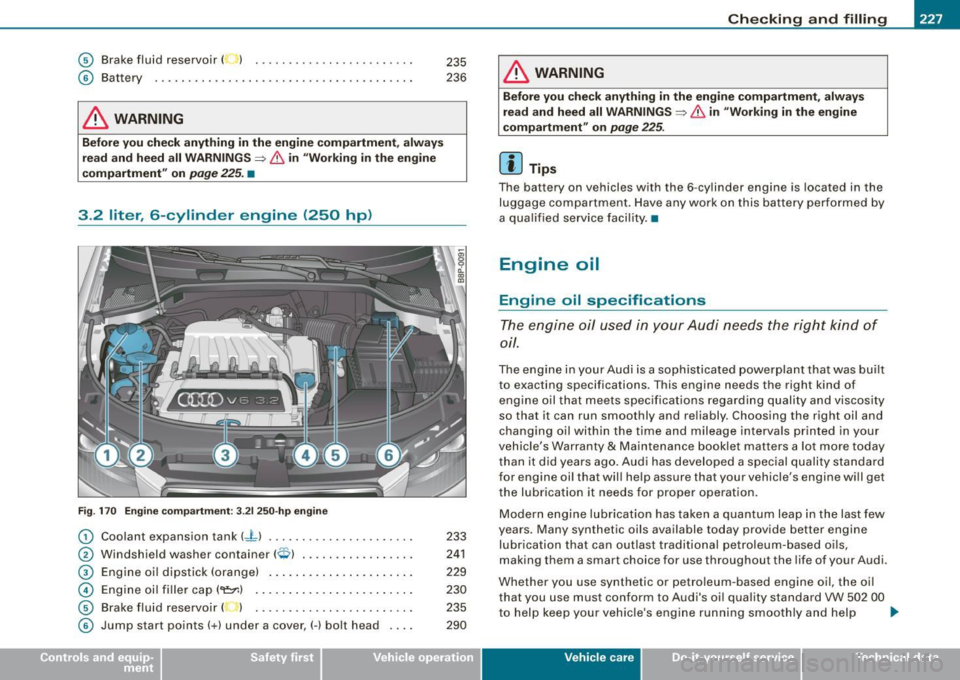
3.2 liter , 6 -cylinder engine (250 hp)
Fig. 170 Engine compartment: 3.21 250-hp engine
G) Coolant expansion tank (-L ) ................. .... .
@ Windshield washer container (,$ ) . ... ... .. .... ... .
@ Engine oil dipstick (orange) ...... ... ... .... .. ... .
© Engine oil filler cap ("1::r.) ..... .... .............. .
© Brake fluid reservoir ( ) . ...... ...... .......... .
© Jump start points(+) under a cover,(-) bolt head ... .
235
236
233
241
229
230
235
290
& WARNING
Before you check anything in the engine compartment, always
read and heed all WARNINGS
~ & in "Working in the engine
compartment" on
page 225.
[ i] Tips
The battery on vehicles with the 6-cylinder engine is located in the
luggage compartment. Have any work on this battery performed by
a qualified service facility.•
Engine oil
Engine oil specifications
The engine oil used in your Audi needs the right kind of
oil.
The engine in your Audi is a sophisticated powerplant that was built
to exacting specifications . This engine needs the right kind of
engine oil that meets specifications regarding quality and viscosity
so that it can run smoothly and reliably. Choosing the right oil and
changing oil within the time and mileage intervals printed in your
vehicle's Warranty
& Maintenance booklet matters a lot more today
than it did years ago. Audi has developed a special quality standard
for engine oil that will help assure that your vehicle's engine will get
the lubrication it needs for proper operation .
Modern engine lubrication has taken a quantum leap in the last few
years. Many synthetic oils available today provide better engine
lubrication that can outlast traditional petroleum-based oils,
making them a smart choice for use throughout the life of your Audi .
Whether you use synthetic or petroleum-based engine oil, the oil
that you use must conform to Audi's oil quality standard VW 502 00
to help keep your vehicle's engine running smoothly and help
ti,,,
Vehic le care I I irechnical data
Page 237 of 324
Checking and filling -
---------------------=----"=---------
Radiator fan
The radiator fa n switches on au toma tically by i tself.
T he e lectric radiator fan is control led bythermoswitches that switch
on and off depending on coolan t and engine compar tm ent temper
atures .
An auxiliary e lectric radiator fan * switches on and off depending on
coolant temperature and other vehicle operation conditions.
After switching off the engine , the auxiliary fan -even with the igni
tio n off -ca n co ntinue runni ng for u p to 10 minutes. It can even
switch on again later by itself=>&, if
• the temperat ure of the engine coolant rises due to the heat
build -up from the engine in the engine compartment, or
• t he engine co mpart men t heats up because the vehicle is parked
in intense sunlight.
& WARNING
• To reduce the risk of personal injury never tou ch the r ad iator
fan .
• The auxiliary electric fan is temperature controlled and can
switch on suddenly even when the engine i s not running .
• The auxiliary radiator fan switches on automatically when the
engine cool ant reache s a certain temperature and will continue to
run until the coolant temperature drop s. •
Brake fluid
Checking brake fluid level
The bra ke flu id l evel can be che cke d wi th a q uick gla nce.
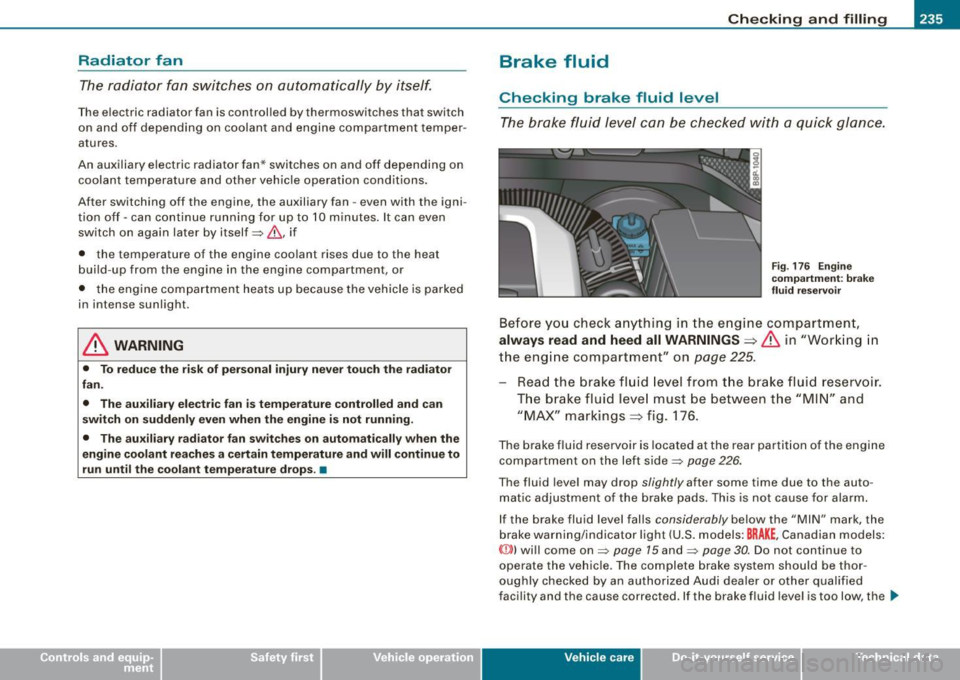
Fig . 17 6 Engine
c o mpartment : brake
fluid re ser vo ir
Be fore yo u check anythin g in the e ng ine compar tm ent,
always read and heed all WARNINGS=> & in "Working in
t h e eng ine compartment" on
page 225.
Read t he brake fl uid lev el from t he brake flui d res ervoir .
T he b rak e fluid l eve l must b e between the
"MI N" and
"M AX" markings => fig. 176.
The brake f luid reservoir is located at the rear pa rtit ion of the engine
compartment on the left side=> page 226.
T he fluid leve l may drop slightly after some time due to the auto
ma tic adjustment o f the brake pads. Th is is not cause for alarm .
I f the brake flu id leve l falls considerably below the "MIN" mark, the
brake warning/indicator light (U.S . models :
BRAKE, Canadian models:
ID ) will come on=> page 15 and=> page 30. Do not continue to
operate the vehic le . The complete brake system should be thor
oughly checked by an au thorized Audi dealer or other qualified
facility and the cause corrected. If the brake fluid leve l is too low, the .,,_
Vehicle care I I irechnical data
Page 238 of 324
___ C_h_ e_ c_k _in --== g'-- a_n _d_ f_il _li _n ..:::g:::..- ___________________________________________ _
brake warning/indicator light will illuminate . Contact an authorized
Audi dealer
i m medi at ely.•
Changing brake fluid
Have the brake fluid changed by an experienced techni
cian.
Brake fluid absorbs moisture from the ai r. If the water content in the
brake fluid is too high, corrosion in the brake system may result
after a period of time. The boiling point of the brake fluid wil l also
decrease considerably and decrease braking performance .
Therefore, the brake fluid must be changed
e ver y two years. Always
use new brake fluid which conforms to Federa l Motor Vehicle Stan
dard "FMVSS 116 DOT 4" .
The brake fluid reservoir can be difficu lt to reach , therefore, we
recommend that you have the brake fluid changed by your autho
rized
Audi d ealer. Your dealer has the correct tools, the right brake
fluid and the know-how to do this for you.
& WARNING
• Bra ke fluid i s poisonous . It mu st be stored on ly in the close d
ori ginal container out of the rea ch of children!
• Bra ke fa ilure can result from old or inappropri ate brake fluid .
Observe the se pre caution s:
- Use o nly brake fluid that meets SAE spe cifi ca tion
J 170 3 and
c onform s to Fed era l Moto r Vehic le Sta nda rd 116 . Always c heck
w ith your authori zed Audi de aler to m ake sure you are using
the correct brake fluid. The corr ect type of brake fluid i s als o
indi cated o n the br ake fl uid reser vo ir.
- The br ake flu id mu st be ne w. Hea vy use of the brake s can
c au se a vap or lo ck if the bra ke fluid i s left in the system too
long. Thi s can seriou sly affect the efficienc y of the brake s as
we ll as your safet y. Thi s co uld re su lt in an acci dent .
0 Note
Brake fluid wi ll damage the paint of your vehicle .
<£' For the sake of the environment
Because o f the problem of prope r disposal of brake flu id as we ll as
the special tools required and the necessary expertise, we recom
mend that you have the brake fluid changed by your authorized Audi
dea ler. •
Battery
General information
All w ork on the battery requires technical knowledge!
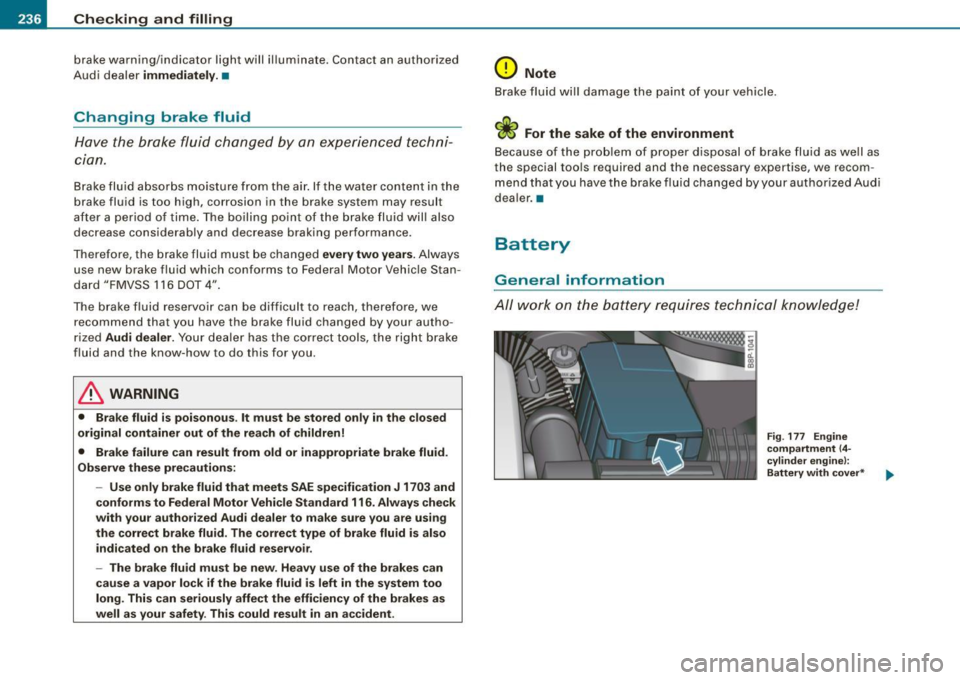
Fi g. 177 E ng ine
co mp artm ent (4 -
c yli nder engin e):
Bat tery w it h cove r"
Page 254 of 324
-Tires and wheels
P'tr:1-------------------
and is more difficult to stop. Overloading can not only lead to loss
of vehicle control, but can also damage important parts of the
vehicle and can lead to sudden tire failure, including a blowout and
sudden deflation that can cause the vehicle to crash.
Your safety and that of your passengers also depends on making
sure that load limits are not exceeded. Vehicle load includes every
body and everything in and on the vehicle. These load limits are
technically referred to as the vehicle's
Gross Vehicle Weight Rating
("GVWR").
The "GVWR" includes the weight of the basic vehicle, all factory
installed accessories, a full tank of fuel, oil, coolant and other fluids
plus maximum load. The maximum load includes the number of
passengers that the vehicle is intended to carry ("seating capacity")
with an assumed weight of 150 lbs (68 kg) for each passenger at a
designated seating position and the total weight of any luggage in
the vehicle. If you tow a trailer, the weight of the trailer hitch and the
tongue weight of the loaded trailer must be included as part of the
vehicle load.
The
Gross Axle Weight Rating ("GAWR") is the maximum load that
can be applied at each of the vehicle's two axles.
The Gross Vehicle Weight Rating and the Gross Axle Weight Rating
are listed on the safety compliance sticker label located either on
the driver's side B-pillar or on the inside of the fuel filler flap. Your
Audi has 5 seating positions, 2 in the front and 3 in the rear for total
seating capacity of 5. Each seating position has a safety belt
=>
page 137, "Safety belts".
The fact that there is an upper limit to your vehicle's Gross Vehicle
Weight Rating means that the total weight of whatever is being
carried in the vehicle (including the weight of a trailer hitch and the
tongue weight of the loaded trailer) is limited. The more passengers
in the vehicle or passengers who are heavier than the standard
weights assumed mean that less weight can be carried as luggage.
The tire pressure label on your Audi also lists the maximum
combined weight of all of the occupants and luggage or other cargo that the vehicle can carry.
For the location of the label=>
page 247,
fig. 180.
& WARNING
Overloading a vehicle can cause loss of vehicle control, a crash or
other accident, serious personal injury, and even death.
• Carrying more weight than your vehicle was designed to carry
will prevent the vehicle from handling properly and increase the
risk of the loss of vehicle control.
• The brakes on a vehicle that has been overloaded may not be
able to stop the vehicle within a safe distance.
• Tires on a vehicle that has been overloaded can fail suddenly,
including a blowout and sudden deflation, causing loss of control
and a crash.
• Always make sure that the total load being transported -
including the weight of a trailer hitch and the tongue weight of a
loaded trailer -does not make the vehicle heavier than the
vehicle's Gross Vehicle Weight Rating. •
Determining correct load limit
Use the example below to calculate the
total weight of the passengers and luggage or other things that you plan to
transport so that you can make sure that
your vehicle will not be overloaded.
~
Page 257 of 324
Tires and wheels -_______________ _____.
Incorrect wheel alignm ent
Inc orrect wheel alignment ca n cause excessive tire wear, impairing
the safety of the vehicle . If tires show excessive wear, have the
whee l alignment chec ked by an autho rized A udi deale r or qu alifie d
wor kshop .
All Wheel Drive
Vehicles with quattro® must always have tires of the same size,
co nst ructi on an d tread type . For detail s see =>
page 196 .
& WARNING
Sudden tire failure can lead to lo ss of control, a crash and serious
personal injury!
• Never drive a vehicle when the tread on any tire is worn down
to the wear indi cators.
• Worn tire s are a safety hazard , they do not grip well on wet
roads and increase your risk of "hydroplaning " and loss of control.
• Always keep chemicals that can cau se tire damage , such a s
grease , oil , gasoline and brake fluid away from tires.
• Tires age even if they are not being used and can fail suddenly ,
especially at high speeds . Tire s that are more than 6 years old can
only be used in an emergency and then with special care and at
lower speeds .
• Never mount used tire s on your vehicle if you are not sure of
their "previou s hi story. " Old used tires may have been damaged
even though the damage cannot be seen that can lead to sudden
tire failu re and loss of vehi cle control. •
New tires and replacing tires and wheels
N ew tires a nd wh eels hav e to be b ro ken in.
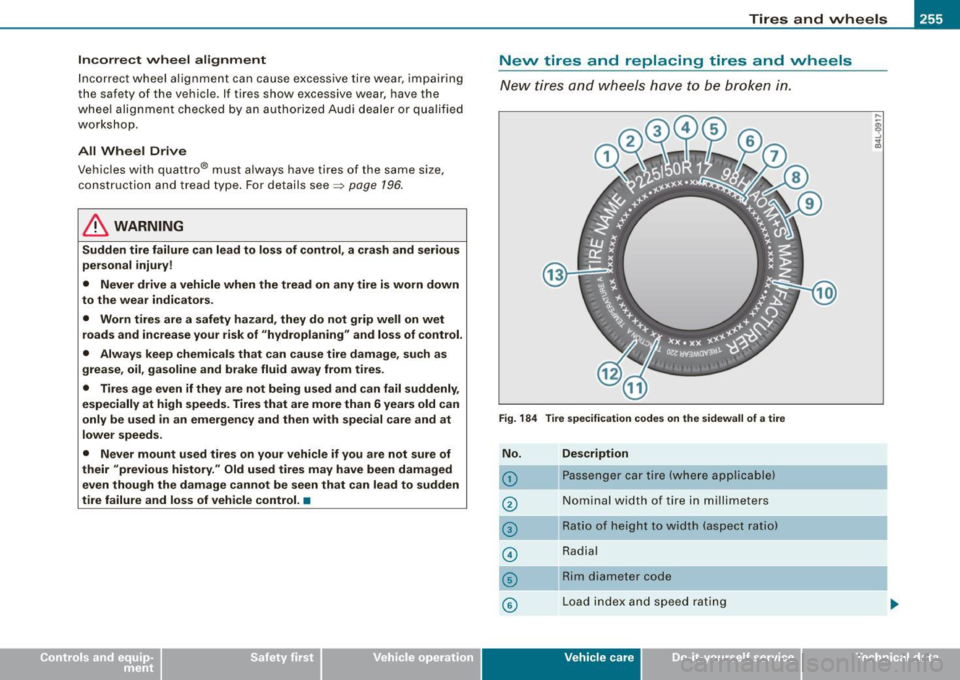
Fig. 184 T ire spe cificati on c od es on the sidewall of a tire
No .
©
0
©
©
©
©
Descr iption
Passenger car tire (where applicable)
Nominal width of tire in mi llimeters
Ratio of height to width (aspect ratio)
Radial
ii Rim diameter code
Load index an d spee d rating
Vehic le care I I irechnical data
Page 307 of 324
------------------------------------------------=C :..:o=. n :..:..: s:..:u::.: m:...:..:. e::.:.. r..:l~ n .:..:f:..: o:.: r :..:m~ a::.:. ti:.:o::. n:....:__ _11111
& WA RNIN G (continu ed )
• Alway s be extremely careful when working on the v ehicle .
Alway s follo w commonly accepted safety pr actice s and general
c ommon sen se . Never risk per sonal inju ry .
• Do n ot attempt any of the m aint enance , check s or rep air s
de scribed on the following pages if you are not fully famili ar with
the se or othe r procedures with respect to the vehicle , or are u ncer
t a in ho w to pro ceed .
• Do not do any work w ithout the proper tool s and equipment .
Have the necessary work done by your authorized Audi de aler or
anothe r properly equipped and qual ified work shop .
• The engine compartment of any motor vehicle i s a potentially
h azardou s are a. Ne ver rea ch into the are a around or touch the
radiator fan. It is te mperature controlled and can switch on
s uddenly · even when the engine is off and the ignition key has
been remo ved . The radi ator fan switches on automat icall y when
the coolant reaches a certain temperature and will continue to run
until the coolant t emper ature drops .
• Alway s remo ve the ignition key befor e anyone get s under the
v ehi cle .
• Alway s support your vehicle with safety sta nd s if it i s nece s
sary to work underneath the vehicle . The ja ck supplied with the
vehi cle is not adequate for this p urpo se a nd co uld coll apse
c au sing ser iou s person al in jur y.
• If you m ust w ork under neath the vehi cle with the wheel s on
the ground , alway s make sure the vehicle is on lev el ground , that
the wheels are alway s secu rel y blocked and that the engine
c annot be started .
• Alway s make sure the t ran sm iss ion selector lever (automat ic
tran smi ssion ) is in "P " (Park position ) (automati c transmis sion) or
Neutr al ( ma nual transmission ) and the h and brake i s firmly
appli ed .
Controls and equip ment Safety first Vehicle operation
<£' For the sake of the environment
•
Changing the engine settings will adverse ly affect em ission
levels. This is detrimental to the environment and increases fuel
consu mption.
• Always observe environmenta l regulations when disposing of
old engine oil, used brake fluid, d irty engine coolant, spent batteries
or worn out tires .
• Undeployed airbag modules and pretensioners might be classi
fied as Perch lorate Material -special handling may apply, see
www.dtsc.ca.gov/hazardouswaste/perchlo rate. When the vehicle or
parts of the restraint system including airbag modules safety be lts
with pretensioners are scrapped, a ll applicable laws and regu la
tions must be observed. Your authorized Audi dealer is familiar with
these requirements and we recommend that you have your dea ler
perform this service for you. •
Additional accessories,
modifications and parts replacement
Additional accessories and parts
replacement
Al ways consult an authorized Au di de aler befo re
purchasing accessories.
Your vehicle incorporates the latest safety design features ensuring
a high standard of act ive and passive sa fety.
This safety could be compromised by non -approved changes to the
vehic le . Fo r th is reason, if par ts have t o be re p laced, please observe
the fo llowing points when insta lling additional accessories:
Approved Audi accessories and genuine Audi parts are available
from autho rized Audi dealers . .,_
Vehicle care Do-it-yourself service Tec hn ica l da ta
Page 310 of 324
___ A_l.:,. p _h_ a_ b_e _t _ic _ a_l _in _ d_e _x ____________________________________________ _
A
ABS
See Anti-lock brake system
ABS (Anti-lock brake system) 194
Wa rning/indicato r lights .. ... .... .. 16
Accessori es . . . . . . . . . . . . . . . . . . . . . . . . 305
Adapter for anti-theft wheel bo lts . . . . . 275
Adaptive Light Air conditioning
Switching on and off
Air distribution 101
Climate controls .. ...... .... ... .. 103
Air outlets
Adjusting the outlets for rapid Side airbags
... .... .... ... .. ..... 163
Side curtain airbags ....... .... .. . 166
When must the system be inspected? ...
158
All Whee l Drive . ...... .... .......... 196
Alloy wheels ....... ... .... ...... ... 212
defrosting/defogging .... .... ... .
104 All -whe el drive
Climate controls .. .... .... .... ... 104
Winter tires ... ... ... .. ...... .... 260
Air quality sensor . . . . . . . . . . . . . . . . . . . 102
Alternator
defective ....................... . 34 Air recirculation
....... .. .... ....... 103
See Generator . . . . . . . . . . . . . . . . . . . . 14
Adaptive light . . . . . . . . . . . . . . . . . . . . . . . 55
Adding Engine coolant ... .... .... ....... 234
Engine oil . ................... ... 230
Windshield washer fluid .... ...... 241
Additiona l accessories .... ...... ... .. 305
Additives Engine oil .... .... ... ... ... .. .... 230
Adjustable steering whee l column ..... 107
Adjusting Steering wheel column .... ... .... 107
Adjusting front seats ............. ... . 74
Advanced Airbag System Children . ... .. .... .... ..... ..... 170
Components ...... .... ......... . 154
Front airbags ......... .... ....... 152
How the components work together 155
Monitoring . . . . . . . . . . . . . . . . . . . . . . 158
PASSENGER AIR BAG OFF ligh t .. ... 159
W eight -sensing mat .. .. .. .... .... 170
Air conditioner . . . . . . . . . . . . . . . . . . . . . 101
See also Climate controls . . . . . . . . . . . 98 Climate controls
.... . ......... ... 102
When should I use the air recirculation?
102
Air r ecirculation mode
Clima te controls .. ...... .... ... . . 102
Airbag Warning /indicator lights ....... .... 14
Airbag system .... .... .... .... .. 147, 164
Advanced Airbag System .......... 151
Care . . . . . . . . . . . . . . . . . . . . . . . . . . . . 161
Child restraints .. ... ... .... .... .. 171
Components (front airbags) ..... ... 154
Danger of fitting a chi ld safety seat on the
front passenger seat . .... .... ... 149
Disposal . .... .... ...... .... ... .. 161
Front airbags . ... .. ..... ... .. ... . 151 Aluminum alloy wheels
...... .... .... 212
Amb ient lighting .. ... .... .... .... .... 61
Anti-glare inside day-night mirror .... .. 69
An ti-lock brake system
How the ABS system works ........ 194
Anti -lock brake system (ABS )
Warning /indicator lights ... .... .... . 16
Anti-Slip Regulation System (ASR) How the system works . . . . . . . . . . . . 192
An ti-theft sys tems
An ti-Theft Alarm System .. . .. .. .... 45
Anti -theft wheel bolts ..... .... .... ... 275
Armrest Center armrest ....... .. .. .. ..... .. 81
Rear armrest ................. .. .. 82
How do the front ai rrbags work? . . . . 156 Ashtray
How many airbags does my vehicle have?
154
Important things to know . ... .. ... 147
Indicator ligh t .... ... .. ..... .. ... 158
Monitoring . . . . . . . . . . . . . . . . . . . . . . 158
Repairs . . . . . . . . . . . . . . . . . . . . . . . . . 161 Rea
r .... ... .. .. ... ... .. .. ... ... .. 93
ASR How the Anti -Slip Regulation System
works ... .... .... .... ... .... ... 192
Page 311 of 324
______________________________________________ A_ l_,_ p _h_ a_ b_e _t_i c_ a _ l _in _ d_e _ x __ lll
Asterisk
What does it mean when something is marked with an asterisk? ... .. .. .. .. 5
Audi magnet ic ride .. .... .... ..... 12, 115
Description ...................... 115
Ind icator light .. ...... .... .... .... . 12
Audi parking system ................. 112
Audi Service Repair Manuals and Literature 303
AUTO Climate controls ...... .... ... .... . 101
Switching on .................... 101
When should I use AU TO? . ....... . 10 1
Au to Safety Ho tline ... .. .... .... .... . 135
Automatic air recircu lation ........... 102
A utomatic belt retracto r ...... .... .... 1 41
Automa tic car wash
See Washing ...... .... ... .. .. .... 207
Automatic headlight control ....... .... 53
Automat ic headlights
defective ... .. .... .... ... .... .... . 34
Automat ic Transmission
Au tomatic Transmission . ...... .... 120
Automatic transmission . ............. 117
Driving Notes . . . . . . . . . . . . . . . . . . . . 119
Emergency program . ........... .. 123
Emergency release . . . . . . . . . . . . . . . 123
I gn ition key safety lock ....... .... . 108
Kick-down ... .... .... .... ... .... . 122
L aunch Co ntrol Program ...... ..... 122
Se lector lever lock .. ...... ...... .. 1 18
Se lecto r lever posi tions .. ...... ... 11 7
Controls and equip
ment Safety first
T
iptronic ... .... . .. .. ... ... .. .... 121
Tiptronic controls on the steering whee l
122
Average fuel mileage ................ . 22
Average speed ... .... ..... ... .... ... . 22
Avo id damagi ng the v ehicle ...... .... . 199
B
Battery ... .. .... ... .... .... .... .... 236
charg ing (4-cy lind er engine) . ....... 240
c harging (6 -cy li n der engine) ... ..... 241
Disconnecting and c onnecting .. ... 237
I mpo rtant warnings when working on the
battery . .... .... .... .... .... ... 238
Replaci ng the battery .. ... .... .... 237
Winter operation ... .. .... .... .... 237
Working on the battery .. ...... .... 238
Battery voltage ...................... 33
Before driving . ....... .. .... .... .... 127
Bi -Xenon headlights .. ........ .... ... . 58
Blended gasoline . ... ... ..... .... .... 219
Body cavity sealing ...... ...... ... .. . 212
Booster seats .... .... .... .... .... ... 177
How do I properly install a booster seat i n
my vehicle? .. ... .... .... .... ... 177
Safety instructions ................ 177
Brake assistan t ..... .... .... .... .... 195
Brake booster .......... ...... ..... .. 194
Brake fluid Changing the brake fluid .. ........ 236
Checking the brake fluid leve l .. .... 235
Reservoir ........................ 235 What is
the correct brake fluid leve l? 235
What should I do if the brake fluid warning
light c omes on? ... .. .... .... .... 235
Brake pads ... ... .... ....... .... ... . 198
Brake system ....................... 235
Anti -lock brake system (ABS) .. .... .. 16
Brake fluid ....................... 235
Brake f luid specifications for refi ll and
r eplacement ... .. .... .... ...... . 236
Brake light defective . ........ .... .. 33
General information .. .... .... .... 193
How does moisture or road salt affect the
b rakes? .. ............... .... ... 193
Ma lfunct io n . .... .... .... .... ..... 30
Warning/indica tor lights .... .... .... 15
Worn brake pads symbo l ...... .... . 32
Break -in period ...... .... .... .... ... 197
Brake pads ....... ........ ....... 198
Tires ... .. .... .... .... ... .... .... 197
Bu lbs .... .... .... .... ... ....... .... 285
C
California Proposition 65 Warning . .... 226
Battery specific ...... ... .. ... ..... 239
Capac it ies . .... ... ... .... ... .... .... 300
Car care . .... ........ ....... .... .... 206
In ter ior . ...... .... .... ... .... .... 213
P last ic a nd vinyl . ...... .... .... ... 210
Weatherstrips ... .. .... ...... ... .. 211
Care of exterior .... ... .. .... .... .... 206
Ca rgo area
See Loading the luggage compartment
133
Vehicle operation Vehicle care Do-it-yourself service Technical data
Page 314 of 324
-Al
phab eti ca l ind ex
_.:_.__ ____ _...::.:...::..;.:___ ________________ _
Emergency flashers . . . . . . . . . . . . . . . . . . 58
Eme rgency operation
panoramic sliding sunroof . .... ..... 49
Rear lid . .... ... .. .... .... ...... .. 43
Emergency release for selector lever . . . 123
Emergency starting . . . . . . . . . . . . . . . . . 287
Emergency towing . . . . . . . . . . . . . . . . . . 292
Engine 4-cylinder (200 hp) ..... ... .... ... 226
6 -cylinder (250 hp) ............... 227
Coolant .......... .... ....... .... 232
Hood .... ... .. ...... .... ... .... . 224
Starting .... .... .... .... .... 108, 109
Starting with jumper cables ...... . 287
Stopping ... .... .... .... ........ 109
E . ngine compartment . .... .... .... .. .
Safety instructions ...... .... .... .
226
225
Working in the engine compar tment 225
Engine coolant system .............. 232
Adding coolant .... .... .......... 234
Checking coolant level .... .... .... 233
Checking the engine coolant leve l .. 233
Radiator fan . . . . . . . . . . . . . . . . . . . . . 235
Engine coolant temperature
Gauge .............. .............. 9
Engine cooling system
Malfunction ...... .... ....... .... . 30
E . d ngine ata ...... .... ........... .. . 300
Engine hood Closing ......................... 225
Release lever . ............... .... 224
R I . d . e easing an opening .... ... ... .. 224 Engine
oil .... ...... ........ ... .... . 227
Adding ...... ... .. .... .... ...... 230
Additives ....................... 230
Changing .. ............. ........ 231
Check ing the engine oil level .... ... 229
Indications and conditions requiring extra checking .......... ...... ...... 229
Oil consumption ................. 229
Oil grades . .... ...... ... .. .... ... 227
Recommended oil check intervals .. 229
Specification and viscosity ........ 227
Engine oil level ... ..... .. ...... ...... 32
Engine oil pressure (malfunction) ... .. . 31
Engine oil sensor defective ............ 32
Engine speed limitation .. .... .... .... . 32
Environment
B k. . d
rea -in peno .... .... .... .... . . 197
Catalytic converter . . . . . . . . . . . . . . . 198
Disposing of your vehic le battery ... 237
Driving at high speeds . . . . . . . . . . . . 199
Driving to minimize pollution and noise .
199
Fuel ............................ 221
Fuel economy . . . . . . . . . . . . . . . . . . . 199
Leaks under your vehicle . .... ..... 225
Letting the vehicle stand and warm up ..
200
Proper disposal of drained brake fluid
236
Proper disposa l of
di ra ined engine
coo lant .. .... ... .... .... .... ... 234
Proper disposa l of drained engine oil
230,231
Recycling used engine oil .. .... ... 230 Unleaded fuel
...... ... .. ... .... . 219
What should I do with an old battery?
237
EPC
See Electronic power control . . . . . . . . 13
ESP
See Electronic Stability Program .... 190
Event Data Recorder (EDR) ... .... .... . 190
Expans ion tank 233
F
Fahrenheit
Switching between Fahrenheit and Centigrade . .... .. ... ... .... .... 103
Fan Adjusting the fan speed .. .... .. .. . 103
Cl imate controls ...... ...... .... . 103
Radiator .... .... .... ... .. .... .. . 235
Fastening eyes ... ........ .... .... ... 84
Flat tire Changing ....................... 272
Floor mats . ....... ..... ... .... .... . 132
Fog lights, front ...... .... ... ... ... .. 56
Folding master key with remote control . 35
Foot pedals . ... .. .... .... ...... .... 132
For the sake of the environment
Gasoline fumes and the environment 221
Letting your engine warm up . ..... . 109
Reducing engine noise by upshifting
early ... .. .... .... ... .... .... .. 8, 9
Refueling .. ........... ........ .. 221