heating AUDI S3 2009 User Guide
[x] Cancel search | Manufacturer: AUDI, Model Year: 2009, Model line: S3, Model: AUDI S3 2009Pages: 324, PDF Size: 76.02 MB
Page 219 of 324
_____________________________________________ C_ l_ e _ a_ n_ in--= g'--- a_n _d___, p_ r _o_ te_ c_t _io _ n __ fflllll
•
Safety belts
Only well-maintained safety belts work reliably when
needed.
- Keep belts clean.
- For cleaning, use a mild soap and water solution. Let
belts dry thoroughly and away from direct sunlight.
- Do not allow inertia reel safety belts to retract before
they are completely dry.
- Check the condition of your safety belts
regularly.
Heavily soiled safety belts may not retract properly.
& WARNING
Damaged safety belts can break in a crash .
• Anything that might damage your safety belts could mean that
you and your passengers would not be adequately protected in an
accident.
• Safety belt performance depends on correct installation. Never
remove belts from the vehicle to clean them .
• Do not use chemical cleaning agents, bleach or dyes. They have
corrosive properties which weaken the webbing.
• When cleaning your safety belts, inspect them for damage. If
you discover damage, see your authorized Audi dealer.
• Always read and heed all WARNINGS and other information
=:, page 206. •
Engine compartment
Be especially careful when cleaning the engine compart
ment.
Always switch off the ignition before cleaning the engine =:> &.
Plenum panel
Remove leaves from the plenum panel in front of the windshield
under the engine hood. This prevents the water drain holes from
becoming blocked, and it prevents debris from entering the vehicle
interior through the heating and ventilation ducts .
Corrosion protection
The engine compartment and transmission have been corrosion
protected at the factory.
Good anti-corrosion treatment is very important, particularly in the
winter. If the vehicle is frequently driven on salt treated roads, the
entire engine compartment and plenum panel should be thor
oughly cleaned at the end of winter and retreated to prevent salt
damage. At the same time, the underside of the vehicle should be
washed as well.
If the engine compartment is cleaned at any time with grease
removing solutions
3l, or if you have the engine washed , the anti
corrosion treatment is almost always removed as well . It is therefore
essential to have a long-lasting corrosion protection reapplied to all
surfaces, seams, joints and components in the engine compart
ment.
& WARNING
Be aware: The engine compartment of any motor vehicle is a
potentially hazardous area.
• Before working in the engine compartment, be sure to read the
information
=:> page 217 . .,,_
31 Use only the correct cleaning solutions. Never use gasoline or diesel fuel.
Vehicle care I t •
Page 234 of 324
-Checking and filling
P'N:1--------=-------------------
& WARNING
To reduce the ri sk of personal inju ry if you mu st change the engine
oil in your vehicle your self:
• Wear eye prote ction .
• To reduce the ri sk of bu rn s from hot engine oil , let the engine
c ool down to the tou ch .
• When remo ving th e oil dr ain pl ug w ith your fing ers, s tay a s fa r
a w ay as po ssibl e. Alw ays keep your forearm p arallel to the grou nd
to help prevent hot oil from running down your arm .
• Drai n the oil into a container de signed for th is purpose , one
l a rg e enough to hold at le ast the tot al a mount of oil in your eng ine .
• Engine oil is poi sonou s. Keep it well out of the rea ch of children .
• Continuous contact with used engine oil i s harmful to your
skin. Always prote ct your skin by wa shin g oil off thoroughly with
s oap and water .
0 Note
Never mix oil additives with your engine oil. These additives can
damage your engine and adversely affect your Audi New Vehicle Limited Warranty .
~ For the sake of the environment
• Before changing your oil, first make sure you know where you
can proper ly dispose of the used oil.
• Always dispose of used engine oil properly . Do not dump it on
garden soil, wooded areas, into open st reams or down sewage
drains .
• Recycle used engine oi l by taking it to a used engine oi l collec
tion facility in your area, or contact a service station .•
Engine cooling system
Coolant
The engine coolan t perf orms two func tions: it keeps the
engine from overheating an d it protects the engine from
freezing in the winter.
The cooling system is sealed and general ly requires litt le attention.
The coo ling system has been fi lled at the factory with a permanent
coo lant which does not need to be changed. The coolant consists of
a mixture of water and the manufacturer's glycol -basedcoolant
additive G12+ + antifreeze with anti corrosion additives (50% for USA
models; 60% for Canadian mode ls) . This mixture both assures the
necessary frost protection and protects metal components in the
engine's cooling system from corrosion and scaling. It also raises
the boil ing point o f the coolant.
D o not reduce the concentration of the coo lant in the summer by
adding pla in water.
Th e proporti on of coolant additive must b e at
l e as t 50 % but not more than 60 %
to maintain antifreeze protection
and cooling efficiency . If the coolant frost protect ion is too low, the
coo lant could freeze and damage the vehicle heating and engine
coo ling system.
For year-round driving, antifreeze is added at the factory for temper
atures down to :
• -31 °F ( -35 °C) USA
• - 40 °F ( - 40 °C) Canada .
You can mix the G12 ++ coolan t additive with other additives G12 + or
G12. Always check with your authorized Audi dealer.
& WARNING
Bef ore you che ck anything in the engine compartment , alwa ys
read and heed all WARNING S
~ & in "Working in the engine
c ompartment " on
page 225.
Page 235 of 324
Checking and filling -
---------------------=----"=---------
0 Note
• Before winter sets in, have the coolant checked to see if the
coolant additive in your vehicle is sufficient to meet the climate
conditions. This is especially important if you live in a region where
the winter is extremely cold. If necessary, increase the proportion of
coolant additive to 60%.
• When adding coolant additive to your cooling system,
remember:
-We recommend using only coolant additive G12+ + (check the
label) for your vehicle. This coolant additive is available at autho
rized Audi dealers. Other types of antifreeze can significantly
reduce corrosion protection . The resulting corrosion can cause a
loss of coolant and serious engine damage .
• Do not add any type of radiator leak sealant to your vehicle's
engine coolant. Adding radiator repair fluid may adversely affect the
function and performance of your cooling system and could result
in damage not covered by your New Vehicle Limited Warranty .•
Checking the engine coolant level
The engine coolant level can be checked with a quick
glance.
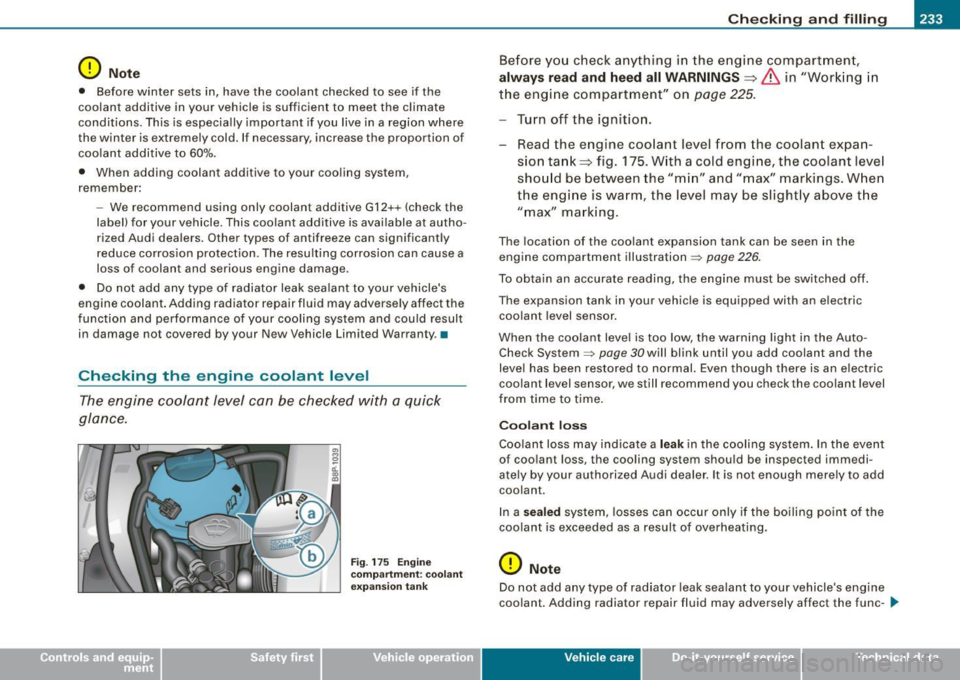
Fig . 175 Engine
compartment : coolant
expansion tank
Before you check anything in the engine compartment,
always read and heed all WARNINGS==> & in "Working in
the engine compartment" on
page 225.
Turn off the ignition.
Read the engine coolant level from the coolant expan
sion tank==> fig. 175. With a cold engine, the coolant level
should be between the "min" and "max" markings. When
the engine is warm, the level may be slightly above the
" max" marking.
The location of the coolant expansion tank can be seen in the
engine compartment illustration=>
page 226.
To obtain an accurate reading, the engine must be switched off.
The expansion tank in your vehicle is equipped with an electric
coolant level sensor.
When the coolant level is too low, the warning light in the Auto
Check System =>
page 30will blink until you add coolant and the
level has been restored to normal. Even though there is an electric
coolant level sensor, we still recommend you check the coolant level
from time to time.
Coolant loss
Coolant loss may indicate a leak in the cooling system. In the event
of coolant loss, the cooling system should be inspected immedi
ately by your authorized Audi dealer. It is not enough merely to add
coolant.
In a
sealed system, losses can occur only if the boiling point of the
coolant is exceeded as a result of overheating.
0 Note
Do not add any type of radiator leak sealant to your vehicle's engine
coolant. Adding radiator repair fluid may adversely affect the tune- _..
Vehicle care I I Technical data
Page 284 of 324
11111.___F_ u_ s _ e_s _ a_n _ d_ b_ u_lb _ s _______________________________________________ _
Equipment Amps No. Equipment Amps
Manual headlight beam adjustment, automatic 14 Electronic Stabilization Program (ESP) (control
10
1 headlight beam adjustment, AFS control mod-
10 module),
shift gate automatic transmission
ule, engine components, light switch (switch
15 Interior lights, reading lights 10
lighting/illumination), diagnosis socket
Diagnostic connector, rain sensor, a ir condit ion-
!! Automatic transmission, control module for
16 ing (control module), tire pressure monitor dis- 10
CAN data transfer (gateway), electro -mechanical
play (control module)
steering, shift gate automatic transmission, 17 Anti-theft alarm warning system 5
2 engine relay, fuel tank control unit, engine con
-10
trol unit, brakes control (ABS), Electronic Stabili- 18 Terminal 15
5
zation Program (ESP), Anti -Slip Regulation
19 All Wheel Drive
10
(ASR), brake light switch
-20 Magnetic ride 5
3 Airbag
5
-21 Not used
Air -conditioning (pressure sensor, air quality
sensor), button for Electronic Stabilization Pro- 22
Blower fan 40
gram (ESP), Anti -Slip Regulat ion (ASRl, tire pres -
23 Driver's side power window, front 30
sure mon itor display, oil level sensor, back-up
4 light switch, front seat heating, parking aid, 5 24 Power outlet front
20
seat-occupancy recognition (on USA vehicles), 25 Rear window defogger 30
navigation, garage door opener, automatic mir- 26 Power outlet in luggage compartment 20
ror dimming, heated windshield washer noz-
zles, air conditioning (control module) 27 Fuel tank control module, fuel pump 15
5 AFS headlights (left side)
5 28 Power
window, rear
30
6 AFS headlights (r ight side) 5 29 Not used
7 Not used 30 Not used
8 Not used 31 Automatic transmission (vacuum pump)
20
9 Not used 32 Headlight washer system 30
10 Not used
33 Sliding/pop-up roof
20
1 1 Not used 34 Not used
12 Central locking (front doors} 10 35 Not used
13 Central locking (rear doors) 10
36 Lumbar
support 10
Page 291 of 324
______________________________________________ E_ m_ e_r .;::g ;...e _ n_ c __,c. y_ s_it _u_ a_ ti_o _ n_ s _ __.ffllll
Use of jumper cables (4 cylinder
engine)
Make sure to connect the jumper cable clamps in exactly
the order described below!
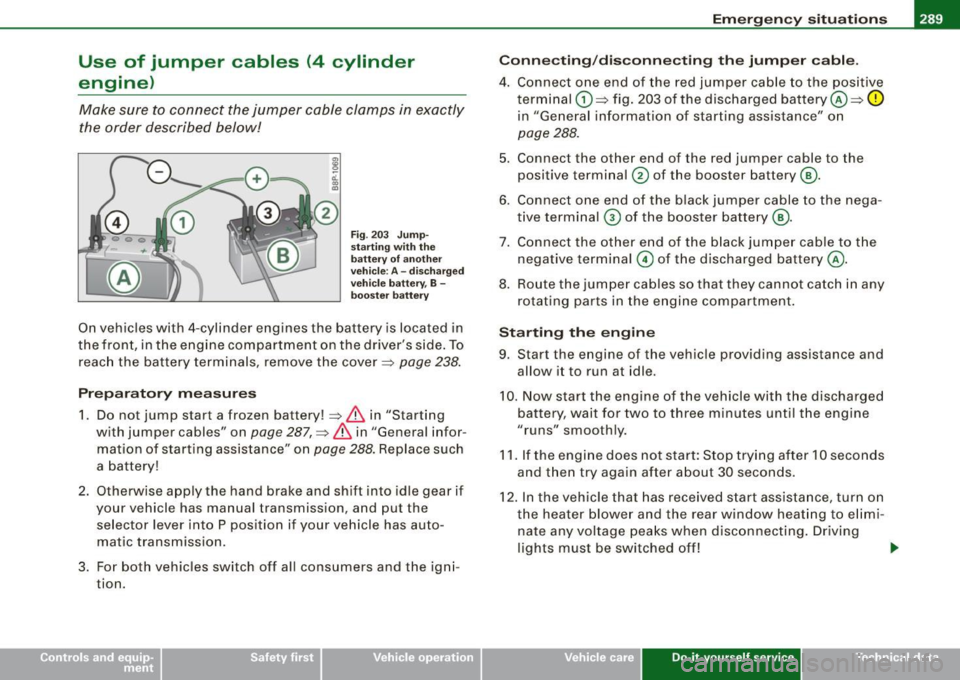
Fig . 203 Jump
starting with the
battery of another
vehicle: A -discharged
vehicle battery, B -
booster battery
On vehicles with 4-cylinder engines the battery is located in
the front, in the engine compartment on the driver's side. To
reach the battery terminals, remove the cover=>
page 238.
Preparatory measures
1. Do not jump start a frozen battery!=> & in "Starting
with jumper cables" on
page 287, => & in "General infor
mat ion of starting assistance" on
page 288. Replace such
a battery!
2. Otherwise apply the hand brake and shift into idle gear if your vehicle has manual transmission, and put the selector lever into P position if your vehicle has automatic transmission.
3. For both vehicles switch off all consumers and the igni
tion.
Connecting/disconnecting the jumper cable.
4. Connect one end of the red jumper cable to the positive
terminal
G) => fig. 203 of the discharged battery©=> 0
in "General information of starting assistance" on
page 288.
5. Connect the other end of the red jumper cable to the
positive terminal
@ of the booster battery ®·
6. Connect one end of the black jumper cable to the nega tive terminal
G) of the booster battery ®·
7. Connect the other end of the black jumper cable to the negative terminal
© of the discharged battery@.
8. Route the jumper cables so that they cannot catch in any
rotating parts in the engine compartment.
Starting the engine
9. Start the engine of the vehicle providing assistance and
allow it to run at idle.
10. Now start the engine of the vehicle with the discharged
battery, wait for two to three minutes until the engine
"runs " smoothly.
11. If the engine does not start: Stop trying after 10 seconds
and then try again after about 30 seconds.
12. In the vehicle that has received start assistance, turn on
the heater blower and the rear window heating to elimi nate any voltage peaks when disconnecting. Driving
lights must be switched off! ._
Vehicle care Do-it-yourself service irechnical data
Page 292 of 324
IIII.___E_ m_ e_r -=g "-e_ n _ c-=y _ s_ i_t _u _a _t_ i_o _n_ s _______________________________________________ _
13. Disconnect the c able while the engine is r unning exactly
in
reverse order to that described in~ page 289,
"Connecting/d isconnecting the jumper ca ble .". When
doing so, make sure t hat the cable cannot contact
rotating engine parts.
14 . Tur n the heater blower and t he rea r window heating off
again .
The battery is vented to the outside to prevent gases from entering
the vehicle interior.
Make sure that the jumper clamps are well connected with their
metal par ts in full contac t with the battery terminals.
& WARNING
To avoid seri ous pe rson al injur y and d am age to the vehi cle , heed
all warning s and in struct ion s of the jumper cable m anufa ctur er. If
in doubt , call for ro ad se rvic e.
• Jumper cable s mu st be l ong enough so that the vehicle s do not
t ou ch .
• When connecting jumper cable s, make sure that th ey cannot
g et ca ught in any mov ing p arts in the e ngine compa rt m ent .
• Bef ore you che ck anything in the engine com partment , al way s
r ea d and h eed all WARNINGS ~
page 217, "Engine compar tment".
0 Note
Improperly connected jumper cables can damage or destroy the
generator.
• Always conn ect POSITIVE ( +l to POSITIVE( +), and NEGATIVE( -) to
NEGAT IVE( -) terminal.
• Check that all screw plugs on the battery cel ls are screwed in
firm ly. If no t, tigh ten plugs prior to connecting clamp on negative
battery term inal. •
Please no te that the procedure for connecting a jumper cable as
described above applies specifical ly to the case of your vehicle
being jump started. When you are giving a jump start to another
veh ic le , do
not connect the minus(-) cab le to the minus( -) terminal
on the discharged battery ©~
page 289 , fig. 203 . Instead, securely
connect the minus( -) cab le to either a massive metal component
that is firmly bolted to the engine block or to the engine block itself .
I f the battery that is being charged does not vent to the outside,
escap ing battery gas cou ld ignite and explode !•
Use of jumper cables (6 cylinder
engine)
Make sure to connect the jumper cable clamps in exactly
the order described below!
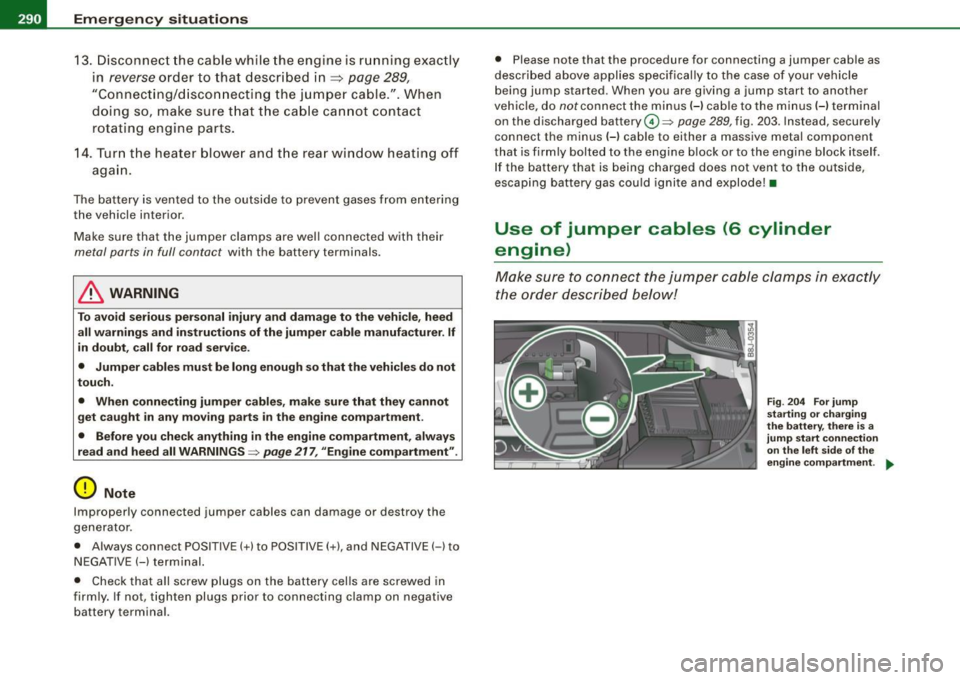
Fi g. 2 04 For jump
starti ng or charging
th e batt ery, th ere is a
j ump start co nnect io n
o n th e le ft side o f the
en gine com partment. .,_
Page 293 of 324
Emergency situations -____________________________ ___,::,:.___:_ ___ _
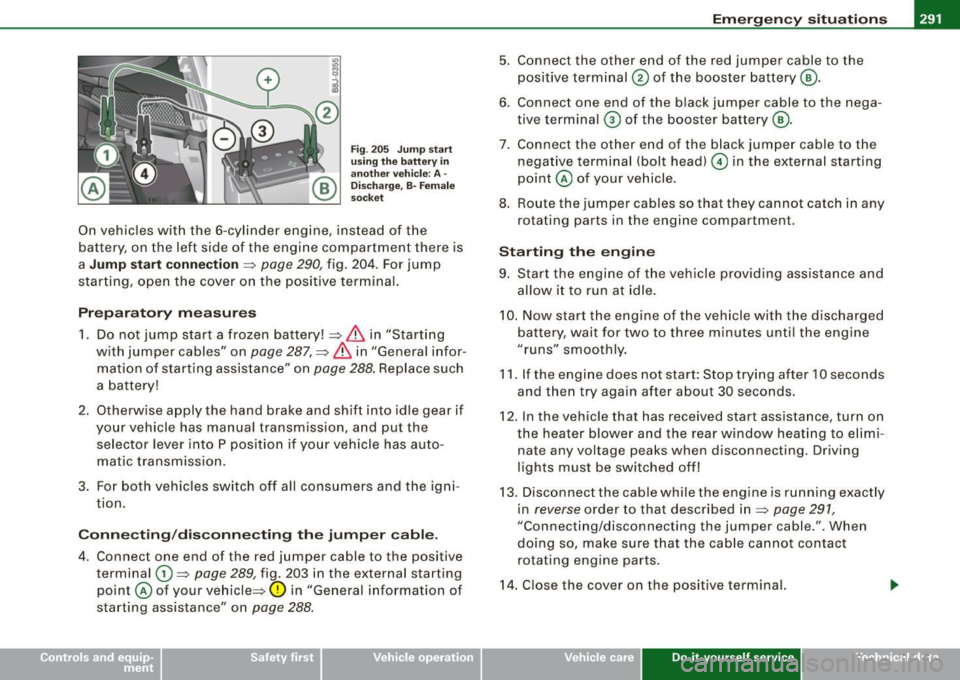
Fig. 205 Jump start
using the battery in
another vehicle: A -
Discharge, B- Female
socket
On vehicles with the 6-cylinder engine, instead of the
battery, on the left side of the engine compartment there is
a
Jump start connection => page 290, fig. 204. For jump
starting, open the cover on the positive terminal.
Preparatory measures
1. Do not jump start a frozen battery!=> & in "Starting
with jumper cables" on page
287, => & in "General infor
mation of starting assistance" on page
288. Replace such
a battery!
2. Otherwise apply the hand brake and shift into idle gear if
your vehicle has manual transmission, and put the selector lever into P position if your vehicle has auto
matic transmission.
3. For both vehicles switch off all consumers and the igni
tion.
Connecting/disconnecting the jumper cable.
4. Connect one end of the red jumper cable to the positive
terminal
G) => page 289, fig. 203 in the external starting
point @of your vehicle =>
0 in "General information of
starting assistance" on page
288.
5. Connect the other end of the red jumper cable to the
positive terminal
® of the booster battery @.
6. Connect one end of the black jumper cable to the nega tive terminal
0 of the booster battery @.
7. Connect the other end of the black jumper cable to the
negative terminal (bolt head)
© in the external starting
point @ of your vehicle.
8. Route the jumper cables so that they cannot catch in any
rotating parts in the engine compartment.
Starting the engine
9. Start the engine of the vehicle providing assistance and allow it to run at idle.
10. Now start the engine of the vehicle with the discharged battery, wait for two to three minutes until the engine
"runs" smoothly.
11. If the engine does not start: Stop trying after 10 seconds and then try again after about 30 seconds.
12. In the vehicle that has received start assistance, turn on the heater blower and the rear window heating to elimi
nate any voltage peaks when disconnecting. Driving
lights must be switched off!
13. Disconnect the cable while the engine is running exactly in reverse order to that described in=> page 291,
"Connecting/disconnecting the jumper cable .". When
doing so, make sure that the cable cannot contact
rotating engine parts.
14. Close the cover on the positive term inal. .,_
Vehicle care Do-it-yourself service irechnical data