manual transmission AUDI S3 2009 User Guide
[x] Cancel search | Manufacturer: AUDI, Model Year: 2009, Model line: S3, Model: AUDI S3 2009Pages: 324, PDF Size: 76.02 MB
Page 227 of 324
Checking and filling -
--------------~-
•
Closing the engine hood
-Pull the hood dow n until the pressure fro m t he s trut is
r edu ce d .
- Let the hood
drop dow n and latch in p lace . Do not try to
pus h it shut ;
it ma y fail to enga ge => & .
& WARNING
A hood that is not completely latched could fly up and block your
view while driving.
• When you close the engine hood, check it to make sure the
safety catch has properly engaged. The hood should be flush with
the surrounding vehicle body parts .
• If you notice while driving that the hood is not secured prop
erly , stop at on ce and close it. •
Working in the engine compartment
B e e speci ally ca reful wh ene ver you work in th e e ng in e
co mpartmen t!
Whenever you must perform any work in the engine compartment ,
for example checking and filling different fluids , there is a ri sk of
injury , burns and accidents . To prevent personal injury always
observe the following WARNINGS . The engine compartment of any
vehicle is a hazardous area!
~ &
& WARNING
To help avoid injury , before you check anything under the hood :
• Turn off the engine.
• Remove the ignition key .
• Set the parking brake fully .
& WARNING (continued )
• Move selector lever of automatic transmission to "P" (Park) ;
put manual transmission in Neutral .
• Always let the engine cool down . Hot components will burn
skin on contact.
• To reduce the risk of being burned , never open the hood if you
see or hear steam or coolant escaping from the engine compart
ment . Wait until no steam or coolant can be seen or heard before
carefully opening the hood .
• Keep children away from the engine compartment .
• Never spill fluids on hot engine components . They can cause a
fire.
• Never touch the radiator fan. The auxiliary electric fan is
temperature controlled and can switch on suddenly.
• Never open the coolant reservoir cap when the engine is still
warm . The coolant system is pressurized and hot coolant could
spray out!
• Protect your face , hands and arm from steam or hot engine
coolant by placing a thick rag over the cap when you open the
coolant reservoir .
• If work on the fuel system or the electri cal system is necessary :
- Always disconnect the battery .
- Never smoke or work near heaters or open flames . Fluids in
the engine compartment could start a fire .
- Keep an approved fire extinguisher immediately available.
• To avoid electrical shock and personal injury while the engine
is running or being started , never touch :
- Ignition cables
- Other components of the high voltage electronic ignition
system .
• If you must perform a check or repair with the engine running : ..,
Vehicle care
I t •
Page 228 of 324
___ C_ h_ e _ c_k _in--= g'-- a_n _d_ f_il _li _n --=g==-- --------------------------------------------
& WARNING (continued )
-First, fully apply the park ing brake, move selector lever of
automatic transmission to "P " (Park ); put manual transmission
in Neutral.
- Alway s use extreme c aution to prevent clothing , jewel ry , or
long hair from gettin g caught in the radiator fan , V-belts or
other moving parts , or from contacting hot parts. Tie back hair
before starting , and do not wear clothing that will hang or
droop into the engine .
• Minimize exposure to emission and chemi cal hazard s
=> &.
& WARNING
Californ ia Proposition 65 Warning :
• Engine exhaust , some of its constituents , and certa in vehicle
component s contain or emit chemical s known to the State of Cali
fornia to cause cancer and birth defe cts and reproductive h arm . In
addition, certain fluid s contained in vehicles and certain products
of component wear contain or emit chem icals known to the State
of California to cause cancer and birth defects or other reproduc
tive harm.
• Battery posts , terminals and related ac cessories contain lead
and lead compounds , chem icals known to the State of California
to cause cancer and reproductive harms. Wash hand s after
handling .
0 Note
When adding fluids , always make sure that the y are pou red into the
proper conta iner or filler opening, otherw ise serious damage to
vehicle systems will occur .
<£' For the sake of the environment
To detect leaks in t ime , inspect the veh icle floor pan from unde r
neath regularly. If you see spots from oil or other veh ic le fluids, have
you r ve hicle i nsp ected by a n authori zed Audi dealer .•
Engine compartment
A pp lies t o ve hicles: wit h 2.0 I tur bo, 4-cy linder •engi ne
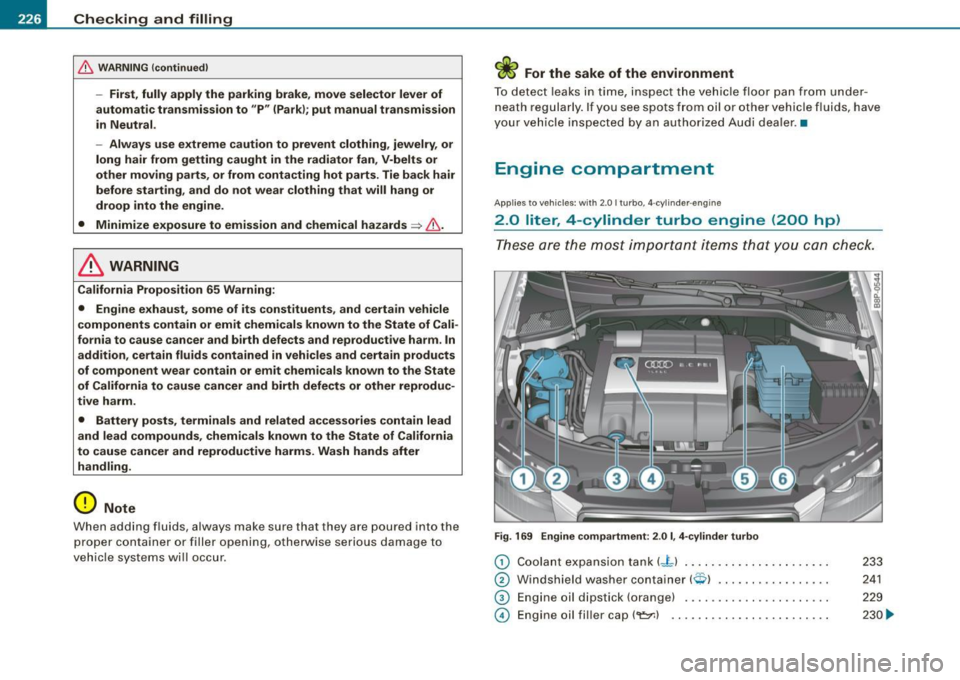
2 .0 liter , 4 -cylinder turbo engine (200 hp )
These a re th e mo st imp ortan t items that you can check.
F ig . 169 Engine comp artment : 2.0 I , 4 -cylinder turbo
G) Coolant expans ion tank ( - f- ) ... .. .... ... .... ..... .
0 Windshie ld washe r con tainer ( Q ) .. ..... .... ..... .
© Engi ne oil dipstick (orange) .............. ... .... .
© Engin e oil filler cap ('e:r.) ............ ..... .... .. .
233
241
229
2 30 ..,,
Page 275 of 324
What do I do now? -__________________ __;__:....:....:..:: __ _
•
-All passengers should leave the car and move to a safe
location (for instance, behind the guardrail)~& .
- Apply the
parking brake firmly ~& .
- Move
selector lever to position Pon an automatic trans-
miss ion; put manual transmission in
first gear ~& .
-If you are towing a trailer : unhitch the trailer from your
vehicle.
- Take the
tool and the spare tire~ page 270 out of the
luggage compartment.
& WARNING
You or your passengers could be injured while changing a wheel if
you do not follow these safety precautions:
• If you have a flat tire, move a safe distance off the road. Turn off
the engine, turn the emergency flasher on and use other warning
devices to alert other motorists.
• Make sure that passengers wait
in a safe place away from the
vehicle and well away from the roadway and traffic.
• To help prevent the vehicle from moving suddenly and possibly
slipping off the jack, always fully set the parking brake and block
the wheel diagonally opposite the wheel being changed. When one
front wheel is lifted off the ground, placing the automatic trans
mission in "P" (Park), or engaging a gear in a manual transmission
will
not prevent the vehicle from moving.
• Before you change a wheel, be sure the ground is level and firm.
If necessary, use a sturdy board under the jack.
• After installing the spare wheel, make sure that you remount
the flat tire/wheel in its storage area properly and tighten the
knurled retaining screw securely. •
Changing a wheel
When you change a wheel, follow the sequence described
below step-by-step and exactly in that order.
1. Remove the decorative wheel cover*. For more details
see also
~ page 274, "Decorative wheel covers" or
~ page 275, "Wheels with cap-covered wheel bolts".
2. Loosen the
wheel bolts ~ page 276.
3. Locate the proper mounting point for the jack and align the jack below that point~
page 276.
4. Lift the car with the jack~ page 276.
5. Take the flat wheel off and then put the spare on
~ page 278.
6. Tighten all wheel bolts lightly .
7.
Lower the vehicle with the jack .
8. Use the wheel bolt wrench and
firmly tighten all wheel
bolts
~ page 276.
9. Put the decorative wheel cover* back on.
& WARNING
Always read and head all WARNINGS and information ::} & in
"Raising the vehicle" on
page 276 and ~ page 279. •
After changing a wheel
A wheel change is not complete without the following
actions.
- Store and secure the replaced wheel in the spare wheel
well. .,._
Do-it-yourself service
Page 284 of 324
11111.___F_ u_ s _ e_s _ a_n _ d_ b_ u_lb _ s _______________________________________________ _
Equipment Amps No. Equipment Amps
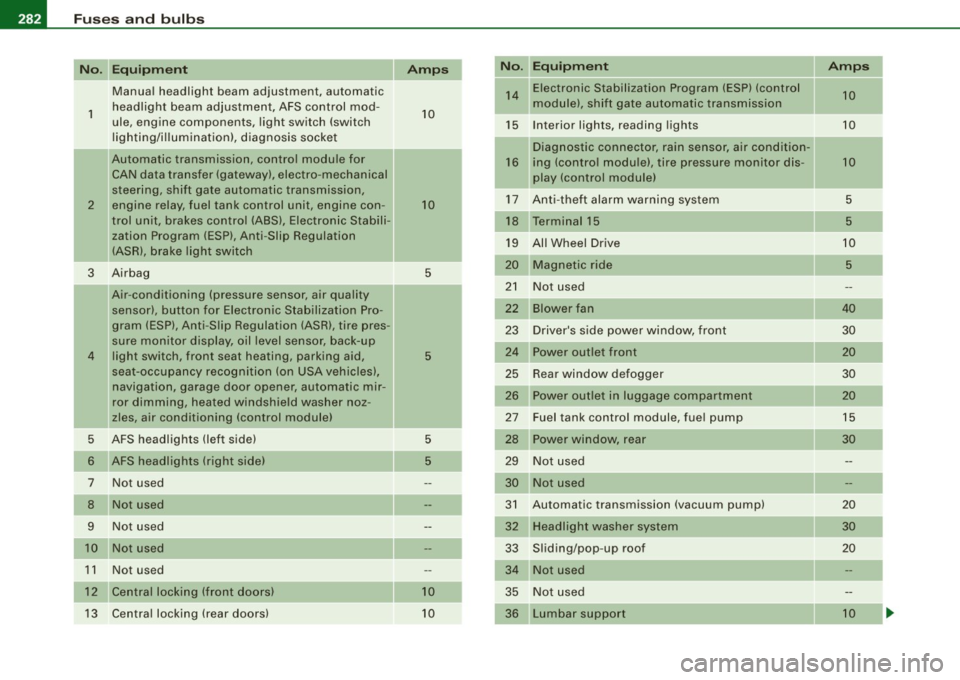
Manual headlight beam adjustment, automatic 14 Electronic Stabilization Program (ESP) (control
10
1 headlight beam adjustment, AFS control mod-
10 module),
shift gate automatic transmission
ule, engine components, light switch (switch
15 Interior lights, reading lights 10
lighting/illumination), diagnosis socket
Diagnostic connector, rain sensor, a ir condit ion-
!! Automatic transmission, control module for
16 ing (control module), tire pressure monitor dis- 10
CAN data transfer (gateway), electro -mechanical
play (control module)
steering, shift gate automatic transmission, 17 Anti-theft alarm warning system 5
2 engine relay, fuel tank control unit, engine con
-10
trol unit, brakes control (ABS), Electronic Stabili- 18 Terminal 15
5
zation Program (ESP), Anti -Slip Regulation
19 All Wheel Drive
10
(ASR), brake light switch
-20 Magnetic ride 5
3 Airbag
5
-21 Not used
Air -conditioning (pressure sensor, air quality
sensor), button for Electronic Stabilization Pro- 22
Blower fan 40
gram (ESP), Anti -Slip Regulat ion (ASRl, tire pres -
23 Driver's side power window, front 30
sure mon itor display, oil level sensor, back-up
4 light switch, front seat heating, parking aid, 5 24 Power outlet front
20
seat-occupancy recognition (on USA vehicles), 25 Rear window defogger 30
navigation, garage door opener, automatic mir- 26 Power outlet in luggage compartment 20
ror dimming, heated windshield washer noz-
zles, air conditioning (control module) 27 Fuel tank control module, fuel pump 15
5 AFS headlights (left side)
5 28 Power
window, rear
30
6 AFS headlights (r ight side) 5 29 Not used
7 Not used 30 Not used
8 Not used 31 Automatic transmission (vacuum pump)
20
9 Not used 32 Headlight washer system 30
10 Not used
33 Sliding/pop-up roof
20
1 1 Not used 34 Not used
12 Central locking (front doors} 10 35 Not used
13 Central locking (rear doors) 10
36 Lumbar
support 10
Page 291 of 324
______________________________________________ E_ m_ e_r .;::g ;...e _ n_ c __,c. y_ s_it _u_ a_ ti_o _ n_ s _ __.ffllll
Use of jumper cables (4 cylinder
engine)
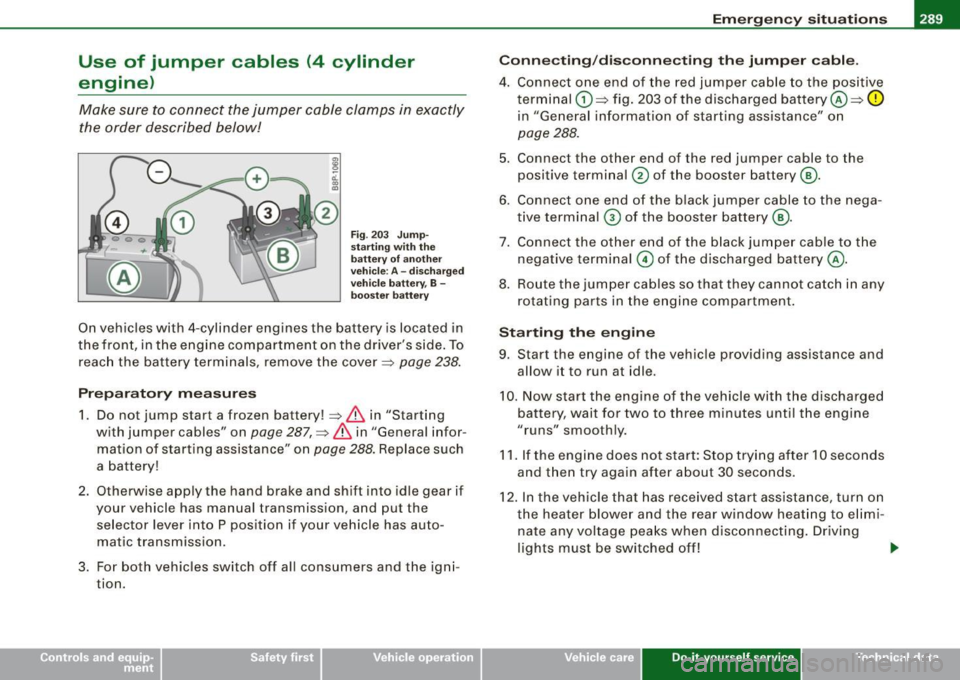
Make sure to connect the jumper cable clamps in exactly
the order described below!
Fig . 203 Jump
starting with the
battery of another
vehicle: A -discharged
vehicle battery, B -
booster battery
On vehicles with 4-cylinder engines the battery is located in
the front, in the engine compartment on the driver's side. To
reach the battery terminals, remove the cover=>
page 238.
Preparatory measures
1. Do not jump start a frozen battery!=> & in "Starting
with jumper cables" on
page 287, => & in "General infor
mat ion of starting assistance" on
page 288. Replace such
a battery!
2. Otherwise apply the hand brake and shift into idle gear if your vehicle has manual transmission, and put the selector lever into P position if your vehicle has automatic transmission.
3. For both vehicles switch off all consumers and the igni
tion.
Connecting/disconnecting the jumper cable.
4. Connect one end of the red jumper cable to the positive
terminal
G) => fig. 203 of the discharged battery©=> 0
in "General information of starting assistance" on
page 288.
5. Connect the other end of the red jumper cable to the
positive terminal
@ of the booster battery ®·
6. Connect one end of the black jumper cable to the nega tive terminal
G) of the booster battery ®·
7. Connect the other end of the black jumper cable to the negative terminal
© of the discharged battery@.
8. Route the jumper cables so that they cannot catch in any
rotating parts in the engine compartment.
Starting the engine
9. Start the engine of the vehicle providing assistance and
allow it to run at idle.
10. Now start the engine of the vehicle with the discharged
battery, wait for two to three minutes until the engine
"runs " smoothly.
11. If the engine does not start: Stop trying after 10 seconds
and then try again after about 30 seconds.
12. In the vehicle that has received start assistance, turn on
the heater blower and the rear window heating to elimi nate any voltage peaks when disconnecting. Driving
lights must be switched off! ._
Vehicle care Do-it-yourself service irechnical data
Page 293 of 324
Emergency situations -____________________________ ___,::,:.___:_ ___ _
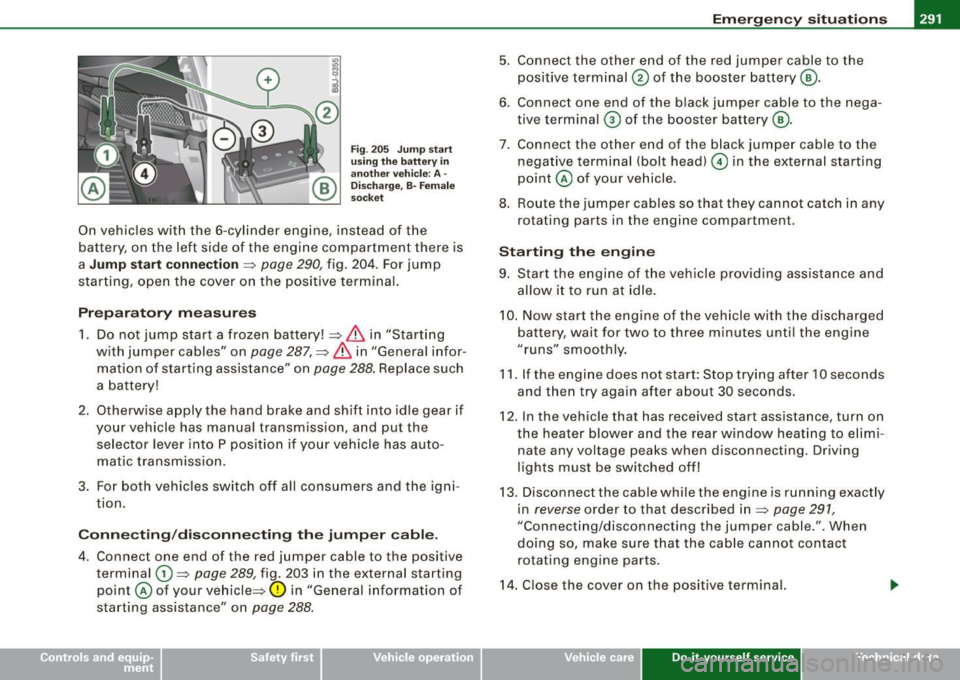
Fig. 205 Jump start
using the battery in
another vehicle: A -
Discharge, B- Female
socket
On vehicles with the 6-cylinder engine, instead of the
battery, on the left side of the engine compartment there is
a
Jump start connection => page 290, fig. 204. For jump
starting, open the cover on the positive terminal.
Preparatory measures
1. Do not jump start a frozen battery!=> & in "Starting
with jumper cables" on page
287, => & in "General infor
mation of starting assistance" on page
288. Replace such
a battery!
2. Otherwise apply the hand brake and shift into idle gear if
your vehicle has manual transmission, and put the selector lever into P position if your vehicle has auto
matic transmission.
3. For both vehicles switch off all consumers and the igni
tion.
Connecting/disconnecting the jumper cable.
4. Connect one end of the red jumper cable to the positive
terminal
G) => page 289, fig. 203 in the external starting
point @of your vehicle =>
0 in "General information of
starting assistance" on page
288.
5. Connect the other end of the red jumper cable to the
positive terminal
® of the booster battery @.
6. Connect one end of the black jumper cable to the nega tive terminal
0 of the booster battery @.
7. Connect the other end of the black jumper cable to the
negative terminal (bolt head)
© in the external starting
point @ of your vehicle.
8. Route the jumper cables so that they cannot catch in any
rotating parts in the engine compartment.
Starting the engine
9. Start the engine of the vehicle providing assistance and allow it to run at idle.
10. Now start the engine of the vehicle with the discharged battery, wait for two to three minutes until the engine
"runs" smoothly.
11. If the engine does not start: Stop trying after 10 seconds and then try again after about 30 seconds.
12. In the vehicle that has received start assistance, turn on the heater blower and the rear window heating to elimi
nate any voltage peaks when disconnecting. Driving
lights must be switched off!
13. Disconnect the cable while the engine is running exactly in reverse order to that described in=> page 291,
"Connecting/disconnecting the jumper cable .". When
doing so, make sure that the cable cannot contact
rotating engine parts.
14. Close the cover on the positive term inal. .,_
Vehicle care Do-it-yourself service irechnical data
Page 300 of 324
___ G_ e_ n_ e_r_ a _ l_ in_ f_ o _r_m _ a_ t_ i_ o _ n __________________________________________________ _
General information
Explanation of technical data
Some of the technical data listed in this manual requires
further explanation.
The technical data for your vehicle is listed in the charts starting on
~ page 300. This section provides general information, notes and
restrictions which apply to this data. •
Vehicle identification
The key data are given on the vehicle identification
number (VIN) plate and the vehicle data sticker.
Fig. 213 Vehicle Identi
fication Number (VIN)
plate: location on
driver's side dash
panel Fig
. 214 The vehicle
identification label -
inside the luggage
compartment
The Vehicle Identification Number (VIN)
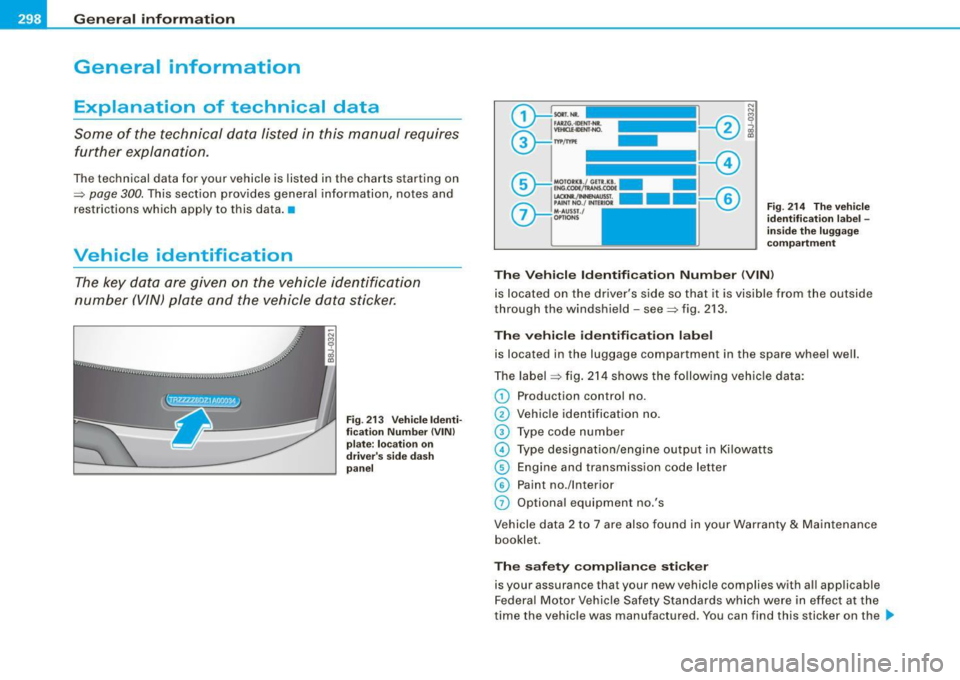
is located on the driver's side so that it is visible from the outside
through the windshield -see ~ fig. 213.
The vehicle identification label
is located in the luggage compartment in the spare wheel well.
The label ~ fig. 214 shows the following vehicle data:
© Production control no.
0 Vehicle identification no.
© Type code number
© Type designation/engine output in Kilowatts
© Engine and transmission code letter
© Paint no./lnterior
0 Optional equipment no.'s
Vehicle data 2 to 7 are also found in your Warranty
& Maintenance
booklet .
The safety compliance sticker
is your assurance that your new vehicle complies with all applicable
Federal Motor Vehicle Safety Standards which were in effect at the
time the vehicle was manufactured. You can find this sticker on the ._
Page 311 of 324
______________________________________________ A_ l_,_ p _h_ a_ b_e _t_i c_ a _ l _in _ d_e _ x __ lll
Asterisk
What does it mean when something is marked with an asterisk? ... .. .. .. .. 5
Audi magnet ic ride .. .... .... ..... 12, 115
Description ...................... 115
Ind icator light .. ...... .... .... .... . 12
Audi parking system ................. 112
Audi Service Repair Manuals and Literature 303
AUTO Climate controls ...... .... ... .... . 101
Switching on .................... 101
When should I use AU TO? . ....... . 10 1
Au to Safety Ho tline ... .. .... .... .... . 135
Automatic air recircu lation ........... 102
A utomatic belt retracto r ...... .... .... 1 41
Automa tic car wash
See Washing ...... .... ... .. .. .... 207
Automatic headlight control ....... .... 53
Automat ic headlights
defective ... .. .... .... ... .... .... . 34
Automat ic Transmission
Au tomatic Transmission . ...... .... 120
Automatic transmission . ............. 117
Driving Notes . . . . . . . . . . . . . . . . . . . . 119
Emergency program . ........... .. 123
Emergency release . . . . . . . . . . . . . . . 123
I gn ition key safety lock ....... .... . 108
Kick-down ... .... .... .... ... .... . 122
L aunch Co ntrol Program ...... ..... 122
Se lector lever lock .. ...... ...... .. 1 18
Se lecto r lever posi tions .. ...... ... 11 7
Controls and equip
ment Safety first
T
iptronic ... .... . .. .. ... ... .. .... 121
Tiptronic controls on the steering whee l
122
Average fuel mileage ................ . 22
Average speed ... .... ..... ... .... ... . 22
Avo id damagi ng the v ehicle ...... .... . 199
B
Battery ... .. .... ... .... .... .... .... 236
charg ing (4-cy lind er engine) . ....... 240
c harging (6 -cy li n der engine) ... ..... 241
Disconnecting and c onnecting .. ... 237
I mpo rtant warnings when working on the
battery . .... .... .... .... .... ... 238
Replaci ng the battery .. ... .... .... 237
Winter operation ... .. .... .... .... 237
Working on the battery .. ...... .... 238
Battery voltage ...................... 33
Before driving . ....... .. .... .... .... 127
Bi -Xenon headlights .. ........ .... ... . 58
Blended gasoline . ... ... ..... .... .... 219
Body cavity sealing ...... ...... ... .. . 212
Booster seats .... .... .... .... .... ... 177
How do I properly install a booster seat i n
my vehicle? .. ... .... .... .... ... 177
Safety instructions ................ 177
Brake assistan t ..... .... .... .... .... 195
Brake booster .......... ...... ..... .. 194
Brake fluid Changing the brake fluid .. ........ 236
Checking the brake fluid leve l .. .... 235
Reservoir ........................ 235 What is
the correct brake fluid leve l? 235
What should I do if the brake fluid warning
light c omes on? ... .. .... .... .... 235
Brake pads ... ... .... ....... .... ... . 198
Brake system ....................... 235
Anti -lock brake system (ABS) .. .... .. 16
Brake fluid ....................... 235
Brake f luid specifications for refi ll and
r eplacement ... .. .... .... ...... . 236
Brake light defective . ........ .... .. 33
General information .. .... .... .... 193
How does moisture or road salt affect the
b rakes? .. ............... .... ... 193
Ma lfunct io n . .... .... .... .... ..... 30
Warning/indica tor lights .... .... .... 15
Worn brake pads symbo l ...... .... . 32
Break -in period ...... .... .... .... ... 197
Brake pads ....... ........ ....... 198
Tires ... .. .... .... .... ... .... .... 197
Bu lbs .... .... .... .... ... ....... .... 285
C
California Proposition 65 Warning . .... 226
Battery specific ...... ... .. ... ..... 239
Capac it ies . .... ... ... .... ... .... .... 300
Car care . .... ........ ....... .... .... 206
In ter ior . ...... .... .... ... .... .... 213
P last ic a nd vinyl . ...... .... .... ... 210
Weatherstrips ... .. .... ...... ... .. 211
Care of exterior .... ... .. .... .... .... 206
Ca rgo area
See Loading the luggage compartment
133
Vehicle operation Vehicle care Do-it-yourself service Technical data
Page 316 of 324
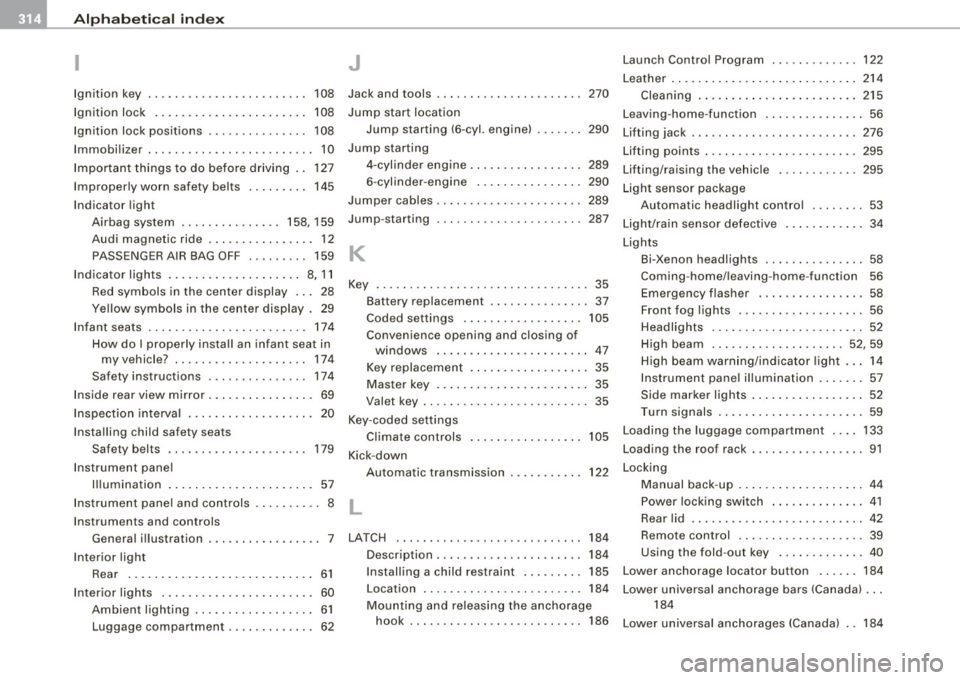
___ A_l.:,. p _h_ a_ b_e _t _ic _ a_l _in _ d_e _x ____________________________________________ _
I
Ignition key 108
Ignition lock ...... ...... .... ...... . 108
Ignition lock posit ions ............... 108
Immobilizer .. .... .... ....... .... .... 10
Important things to do before driving . . 127
Im properly worn safety belts . . . . . . . . . 145
Indicator light
Airbag system . . . . . . . . . . . . . . . 158 , 159
Audi magnetic ride ................ 12
PASSENGER AIR BAG OFF ......... 159
Indicator lights ........... ...... ... 8, 11
Red symbols in the center display . .. 28
Ye llow symbols in the center display . 29
lnfantseats . ........... .... .... .... 174
How do I properly install an infant seat in
my vehicle? .................... 174
Safety instructions ............... 174
Inside rear view mirror .... ... .... ..... 69
Inspection interval ................... 20
Installing child safety seats Safety belts . . . . . . . . . . . . . . . . . . . . . 179
Instrument pane l
I llum ination ........ ... .. .... .... . 57
Instrument pane l and controls .......... 8
Instruments and controls General illustration ........... .... .. 7
Interior light
Rear ................. ........ ... 61
Interior lights ....... ........... .... . 60
Ambient lighting .................. 61
Luggage compartment ............. 62
J
Jack and tools ...................... 270
Jump start location Jump starting (6 -cyl. engine) ....... 290
Jump starting 4-cylinder engine ...... .... .... ... 289
6 -cylinder -engine .... .... ... .. ... 290
Jumper cables .... .... .... .... .... .. 289
Jump -starting 287
K
Key ......... ............ .... ... .... 35
Battery replacement . . . . . . . . . . . . . . . 37
Coded settings .................. 105
Convenience opening and closing of
windows .......... ...... .... ... 47
Key replacement . . . . . . . . . . . . . . . . . . 35
Master key . . . . . . . . . . . . . . . . . . . . . . . 35
Valet key . . . . . . . . . . . . . . . . . . . . . . . . . 35
Key-coded settings Climate controls ...... .... ..... .. 105
Kick-down Automatic transmission 122
L
LATCH 184
Description .......... .......... .. 184
Installing a child restraint ...... ... 185
Location . . . . . . . . . . . . . . . . . . . . . . . . 184
Mounting and releasing the anchorage
hook ...... ............... ..... 186 Launch
Control Program ...... .... ... 122
Leather ...... .... .... .... ...... ... . 214
Cleaning ..................... ... 215
Leaving-home-function .... ... .... .... 56
Lifting jack ... .... .... .... ... .... ... 276
Lifting points ... .. .... .... .... .... .. 295
Lifting/raising the vehicle . ... ... .... . 295
Light sensor package
Automatic headlight control ........ 53
Light/rain sensor defective .. ...... .... 34
Lights Bi-Xenon headlights ....... .... .... 58
Coming-home/ leaving-home-function 56
Emergency flasher .... ........ .... 58
Front fog lights ................... 56
Headlights .... .... ....... .... .... 52
High beam ..... .. .... .... ..... 52, 59
High beam warning/indicator light .. . 14
Instrument panel illumination . ...... 57
Side marker lights ...... ........... 52
Turn signals . ...... .... ...... ... .. 59
Loading the luggage compartment .... 133
Loading the roof rack . ............ .... 9 1
Locking Manual back-up .. ............. .... 44
Power locking switch ...... .... .... 41
Rear lid ..... ...... .... ........... 42
Remote control ................... 39
Using the fold -out key ............. 40
Lower anchorage locator button ...... 184
Lower universal anchorage bars (Canada) ...
184
Lower universal anchorages (Canada) .. 184
Page 317 of 324

Alphab eti ca l ind ex -
--------------------------'-----
Luggage
Stowing . .... .... .... ....... .... . 133
Luggage compartment Cargo net ..... .. .... .... ...... ... 85
Fastening eyes ... .... .... .... .... . 84
Increasing size ... .... ...... ...... . 83
Ligh t .. .... ... .. .......... .... ... 62
Retractable cover ....... ... .. ... ... 86
Ski sack . .... .... .... .... ..... .. .. 87
See also Loading the luggage
compartment .... ....... .... .... 133
Luggage compartment floor .. .... .... . 87
Lumbar support .. ...... ..... .... .... . 78
M
Maintenance ....................... 304
Malfunction Indicator Lamp (MIU .... 13, 21
Manual transmission ............. ... 116
Gearshift lever ...... ..... .... .... 116
Master key .. .... .... .... ... ... ... .. . 36
Battery replacement ............... 37
Master key remo te control . ...... .... .. 36
Menu button ... .... .... .... ..... .. .. 25
Menu display Driver Information Display .......... 23
Mirrors Activating the digita l compass ...... 72
Adjusting the anti -g lare . .... .... ... 69
Automatic dimming for the outside mirrors . .... .... .... ... ... ... .. . 71
Automatically dimming inside mirror . 69
Inside day -night mirror ... .... .... .. 69
Controls and equip ment Safety first Interior
mirror ..... .. ... .... ... .. . 69
Outside mirrors .. .... .... .... ... .. 70
Monitoring the Advanced Airbag System ..
158
Mounting hooks ..................... 85
N
Natural leather ...................... 214
New tires and whee ls ... .. .... .... ... 255
NHTSA Contacting ... ...... .... ... .. .... 135
Number of seats 137
0
Occupant seating positions 128
Octane rat ing ........ .... .... ....... 219
Odometer ......................... .. 10
Oil What kind of oi l should I put in my
engine? . .... ........ ..... .. .... 227
See also Engine oil . .... .... .... ... 227
Older children and safety belts ........ 178
On -Boa rd Diagnostic System ... .. .... .. 21
Electronic speed limiter ...... .... .. 21
Malfunction Indicato r Lamp (MIU .... 21
On -Board Diagnostic System
(080) ..... 21
Data Link Connector (DLCl .... ...... 21
Open door or front lid warning ..... .. .. 18
Operate your vehicle econom ical ly and m ini -
mize pollution .. .............. .. 199 Optional equipment
Marked with an asterisk ... .... .... .. 5
Outlets ...... ... .... .... ....... .. .. . 93
Outside air pollution How to prevent from enter ing the vehic le
103
Ou tside mirrors ...... .... .... .... .... 70
Outs ide temperature display ........... 18
Owner 's manual
How the Owner's Manua l is organized . 5
p
Paint
Touch -up ........................ 210
Paint no .. ...... .... .... ... .... .... 298
panoramic sliding sunroof .... .... ... .. 48
Comfort closing ....... .... ...... .. 49
Emergency operat ion . .... ... 49, 50, 51
to close ...... .... .... ... .... .... . 48
to open ...... .... .... ... .... .... . 48
Parking ............................ 110
Automatic transmission .... ... .... 119
Park ing a id
Audi parking system ...... .. ...... 112
Parking brake .. ...... ... .... .... .... 110
Setting an d releasing ... .. .... .... 110
Parking brake warning ... ....... ...... 30
Parking on a dec line (downhill) ... ... .. 110
Parking on an incline (uphill) .......... 110
parking system ...... .... ... .... .... 112
Par ts replacement . ....... ... .... .... 305
PASSENGER A IR BAG OFF light .... .... 159
Vehicle operation Vehicle care Do-it-yourself service Technical data