ECO mode AUDI S3 2009 Owner's Guide
[x] Cancel search | Manufacturer: AUDI, Model Year: 2009, Model line: S3, Model: AUDI S3 2009Pages: 324, PDF Size: 76.02 MB
Page 195 of 324
•
the ESP check light comes on, see~ page 13. The message ASR off
appears in the display as well.
The ASR should normally be activated all the time . Only in certain
exceptional situations when some slip is desirable does it make
sense to deactivate the ASR. Examples:
• when driving with tire chains
• when driving in deep snow or on loose ground and
• when rocking the vehicle loose after it has become stuck.
When the abnormal situation is over, you should activate the ASR
again.
& WARNING
The increased safety afforded by ASR does not mean that you can
take safety risks. Always adapt your driving style to the road
conditions and traffic situation.
[ i] Tips
To ensure that the ASR works properly, all four wheels must be fitted
with identical tires. Any differences in rolling radius of the tires can
cause the system to reduce engine power when this is not desired.
See also ~
page 255, "New tires and replacing tires and wheels". •
Braking
General information
What affects braking efficiency?
Operating conditions and driving habits
The brakes on today's automobiles are still subject to wear,
depending largely on operating conditions and driving habits~& .
On vehicles that are either driven mostly in stop-and-go city traffic
or are driven hard, the brake pads should be checked by your autho-
Intelligent technology
rized Audi dealer more often than specified in the Warranty & Main
tenance booklet.
Failure to have your brake pads inspected can
result in reduced brake performance.
On steep slopes, you should use the braking effect of the engine.
This way, you prevent unnecessary wear on the brake system. If you
must use your brakes, do not hold the brakes down continuously.
Pump the brakes at intervals.
Moisture or road salt
If you are driving faster than 50 mph (80 km/h) and the windshield
wipers are on, the brake pads will briefly touch the brake discs in
regular intervals so as to improve reaction time when braking on
wet surfaces. You, the driver, will not notice anything.
Under certain conditions, for example, when driving through water
or very heavy rain, or even after washing your vehicle, the braking
effect can be reduced due to moisture (or in freezing conditions ice)
on the brake pads. A few cautious brake applications should dry off
the brake pads or remove any ice coatings.
The effectiveness of the brakes can be reduced when the vehicle is
driven on a salt-covered road and the brakes are not used . Likewise,
you clean off accumulated salt coating from brake discs and pads
with a few cautious applications of the brake~&.
Corrosion
There may be a tendency for dirt to build up on the brake pads and
corrosion to form on the discs if the car is not driven regularly or
only for short trips with little use of the brakes .
If the brakes are not used frequently, or if corrosion has formed on
the discs, it is advisable to clean off the pads and discs by braking
firmly a few times from a moderately high speed~& .
Faults in the brake system
If you should notice a sudden increase in brake pedal travel, then
one of the two brake circuits may have failed~&. ..,
I t •
Page 201 of 324
- Lack of proper maintenance as wel l as improper use of the
vehic le wi ll impair the func tion of the emission con tro l system
and could lead to damage.
<£> For the sake of th e envir onm ent
Even when the Emission Control System is operating properly, the
exhaust gas can have a su lfur -like exhaust gas smell under some
operating states . This depends on the sulfur content of the fuel
being used. Using a different brand of fue l may help, or filling the
tank with lead-free super grade gasoline. •
Avoid damaging the vehicle
When you are driving on poor roads, or over curbs, steep ramps,
etc., make certain that low- lying parts such as spoi lers and exhaust
system parts do not bottom out and get damaged.
This is especially true for vehicles with low-slung chassis (sports
chassis) and fully loaded vehicles. •
Operate your vehicle economically
and minimize pollution
General
Your personal style of driving will determine the economy
of your vehicle, as well as exhaust and noise levels.
Fuel economy, environmental impact, and wear on your engine,
brakes and tires largely depend on three factors:
• your personal driving style
• operating cond itions
• technica l limitations
Controls and equip
ment Safety first Vehicle operation
Dri
ving and environm ent
If you anticipate what you need to do next and drive economica lly,
you can easily cut your fuel consumpt ion by 10 -15 percent . This
section wil l give you some tips on how you can help the environ
ment and your pocketbook.
[ i ] Tips
The consumption estimates as published by ENV IRONMENTAL
PRO TEC TION AGENCY (EPA) and Transport Canada may not corre
spond to your actua l consumption on the road, which wi ll vary
depending upon vehic le load and speed, road and weather condi
tions, trip length, etc. •
Drive smoothly and keep a lookout ahead
Vehicles use the most fuel when they ore accelerating.
Avoid unnecessary accelerating and braking .
Vehicles use the most fuel when they are accelerating . If you antici
pate what is going to happen next, you wi ll need to brake less and,
thus, acce lerate less. Let the vehicle coast whenever possib le - for
examp le when you see that the next traffic light is red. •
Avoid full throttle
Driving at moderate speeds saves fuel and improves your
mileage.
-Try and keep well below your car's max imum speed.
Acce lerating gently reduces fue l consumption , engine wear, and
does not disturb the environment.
Fue l consumption, exhaust emissions and engine noise increase
disproportionately at high speeds . If you drive at approximate ly
three quarters of top speed, fuel consumption wil l be reduced by
Vehicle care Do-it-yourself service Technical data
Page 250 of 324
-~_T_ ir_e_ s_ a_ n_d _ w_ h_ e_e _l_s _________________________________________________ _
vehicle at its maximum capacity weight and tires that were on your
vehicle at the time it was manufactured.
If you wish to improve comfort when operating the vehicle at
normal load (up to 3 occupants), you can adjust tire pressures to
those specified for normal vehicle load. Before operating the vehicle at maximum load, you must increase the tire pressures to those
specified for maximum vehicle load
=> &.
Bear in mind that the tire pressure monitoring system* can only
monitor the tire pressures you have stored. The system does not
recognize the load condition of your vehicle.
The effectiveness of the tire pressure monitoring system* will be impaired if you store normal load pressures but then operate the
vehicle at its maximum load=>&. See
the illustrat ion=>
page 247, fig. 180 for the location of the label
either on driver's side B -pillar or inside the fuel filler flap (color of
the actual label and exact location on the vehicle will vary slightly).
Note that the following table is accurate at the time of going to
press and is subject to change . In the event of discrepancies, the tire
pressure label (on USA vehicles, the tire pressure label is loc ated on
driver's side B-pillar; on Canada vehicles, the tire pressure label is
loca ted either on the driver's side B-pillar or inside the fue l filler
flap.I always takes precedence.
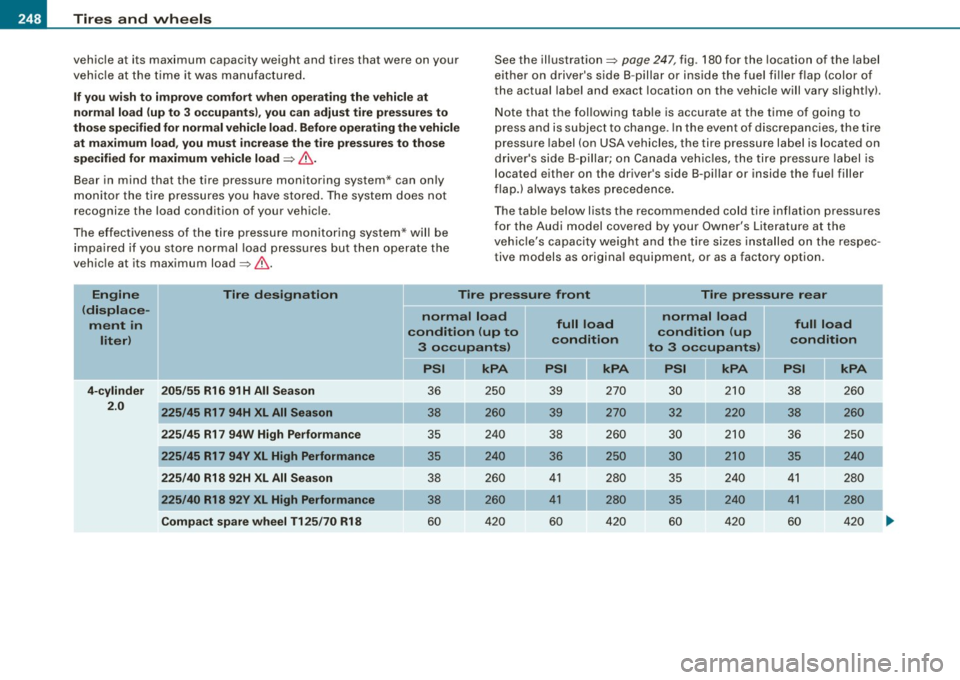
The table below lists the recommended cold tire inflation pressures
for the Audi model covered by your Owner's Literature at the
vehicle's capacity weight and the tire sizes installed on the respec
tive models as original equipment, or as a factory option.
Engine
(displace
ment in
liter)
Tire designation Tire pressure front
Tire pressure rear
4-cylinder
2.0
205/55 R16 91 H All Season
225/45 R17 94H XL All Season
225/45 R17 94W High Performance
225/45 R17 94Y XL High Performance
225/40 R18 92H XL All Season
225/40 R18 92Y XL High Performance
Compact spare wheel T125/70 R18 normal load
condition (up to
3 occupants)
PSI
36 250
38 260
35 240
35 240
38 260
38 260
60 420
full load
condition
kPA
39 270
39 270
38 260
36 250
41 280
41 280
60 420
normal load
full load
condition (up
condition to 3 occupants)
kPA kPA
30 210
38 260
32 220 38 260
30 210
36 250
30 210
35 240
35 240 41 280
35 240 41 280
60 420
60 420
Page 258 of 324
-~_T_ ir_e_ s_ a_ n_d _ w_ h_ e_e _l_s _________________________________________________ _
0
©
G)
@
U.S. DOT tire identification number
Audi Original tire
Tire ply composition and materials used Maximum load rating
Treadwear, traction and temperature grades Maximum permissible inflation pressure
The tires and rims are essential parts of the vehicle's design. The
tires and rims approved by Audi are specially matched to the char acteristics of the vehicle and can make a major contribution to good
road holding and safe handling when in good condition and prop
erly inflated =>& .
We recommend that al l work on tires and wheels be performed by
an authorized Audi dealer . They are familiar with recommended
procedures and have the necessary special tools and spare parts as
we ll as the proper facilities for disposing of the old tires .
Authorized Audi dealers have the necessary information about tech
nical requirements for insta lling or changing tires and rims .
Rep lac ing t ires a nd w heels
Tires should be replaced at least in pairs and not individually (for
example both front tires or both rear tires together) .
Be sure to read and heed the tire pressure monitoring system*
information :::>
page 257.
Always buy replacement radial tires t hat have the same specifica
tions as the tires approved for your vehicle by Audi . Replacement
tires must always have the same load rating specification as the
original equipment or approved optional tires listed in the table
=>
page 247.
Audi -approved specification tires are specially matched to your
vehic le and its load limits, and can contribute to the important road- holding, driving characteristics, and safety of the vehicle
. The table
( =>
page 247) lists specifications of the tires approved for the Audi
models covered by your Owner's Literature.
The tire pressure label located either on driver's side 8 -pi llar or
inside the fuel fi ller flap( =>
page 247, fig. 181 l lists the specifica
tions of the original equipment tires installed on your vehicle at the
time it was manufactured.
Federal law requires tire manufacturers to place standardized infor
mation on the sidewa ll of all tires=>
page 255, fig. 184. This informa
tion identifies and describes the fundamenta l characteristics, the
quality grade of the tire and also provides a tire identification
number for safety standard certification and in case of a recall.
T ire s pec ific ation s
Knowledge of tire specifications makes it easier to choose the
correct tires. Radial tires have the tire specifications marked on the
sidewal l, for example:
P 22 5 / 45 R 17 91H XL
This contains the following information:
P Ind icates the tire is for passenger cars (where applicable)
2 25 Nominal tire width in mm of the tire from sidewall edge to s ide -
wall edge. In general, the larger the number, the wider the tire
45 Height/width ratio in percent (aspect ratio)
R Tire construction: Radial
17 Rim diameter code (in inches)
91 Load rating code
H Speed rating letter code
XL (or "xi", "EXTRA LOAD" or "RF ") indicates that the tire is "Rein
forced" or an "Extra Load" tire
M +S (or "M/S"l Indicates that the tire has some mud and snow capa
bility
The tires cou ld also have the information of direction of rotation
=>
page 243 .
Page 260 of 324
-~_T_ ir_e_ s_ a_ n_d _ w_ h_ e_e _l_s _________________________________________________ _
toring system* would not be able to monitor the tire pressure or
warn yo u if it is n ece ssa ry .
• The battery inside of t he ti re pressure sensor has a l imited
service life.
• Always driv e with the valv e stem caps s ecurely mount ed. We
r ecomme nd u sing fact ory insta lled valve s tem caps . As k your autho
rized Audi d ealer to replace lost va lve stem caps.
T he installation of rep lacement tires with steel cord body p lies in
the t ir e si dewa ll may caus e malf unc tio n of th e tir e pre ssure mo ni
toring system*, and is not recommended (cord material informat ion
in mo lded o n th e tire s idewa ll).
Always check your tire pressu re monitoring system* indicator after
r eplacing one o r more tir e s on yo ur veh icle . If the ti re p ressure
monito ring sy ste m* in dicato r flas hes or is illum inated, you r syste m
is not working p ro perl y. Yo ur replacement ti re might be incompat
i b le with you r tire p ressu re mo nitoring sys tem*, or some compo
nent of the tire pressure monitori ng system* may be damaged.
& WARNING
• Using incorrect or unmatched tires and I or wheels or improper
tire and wheel combinations can lead to loss of control , collision
and serious personal injury .
• Always use tires , rims and wheel bolts that meet the specifica
tions of original factory-installed tires or other combinations that
have been specifically approved by the vehicle manufacturer.
• Tires age even if they are not being used and can fail suddenly,
especially at high speeds . Tires that are more than 6 years old can
only be used in an emergency and then with special care and at
lower speeds .
• Never mount used tires on your vehicle if you are not sure of
their "previous history ." Old used tires may have been damaged
even though the damage cannot be seen that can lead to sudden
tire failure and loss of vehicle control.
& WARNING (continued)
• All four wheels must be fitted with radial tires of the same type,
size (rolling circumference ) and the same tread pattern. Driving
with different tires reduces vehicle handling and can lead to a loss
of control.
• If the spare tire is not the same as the tires that are mounted
on the vehicle - for e xample with winter tires - only use the spare
tire for a short period of time and drive with extra care . Refit the
normal road wheel as soon as safely possible.
• Never drive faster than the maximum speed for which the tires
on your vehicle are rated because tires that are driven faster than
their rated speed can fail suddenly .
• Overloading tires cause heat build-up , sudden tire failure ,
including a blowout and sudden deflation and loss of control .
• Temperature grades apply to tires that are properly inflated and
not over or underinflated .
• For te chnical reasons it is not always possible to use wheels
from other vehicles -in some cases not even wheels from the
same vehicle model.
• If you install wheel trim discs on the vehicle wheels, make sure
that the air flow to the brakes is not blocked. Redu ced airflow to
the brakes can them to overheat , increasing stopping distances
and causing a collision.
• Run flat tires may only be used on vehicles that were equipped
with them at the fa ctory . The vehicle must have a chassis designed
for run flat tires and a factory-installed tire pressure monitoring
system * that indicates a loss of tire pressure . Incorre ct use of run
flat tires can lead to vehicle damage or accidents . Check with an
authorized Audi dealer or t ire specialist to see if your vehicle can
be equipped with run flat tires .
If run flat tires are used, they must
be installed on all four wheels . Mixing tire types is not permitted. .,
Page 264 of 324
_L_T~ir ~e :..:s~ a~n~ d~ w~ h ~e~e~ l~ s '.,_ ______________________________________________ _
Wheel bolts
W heel b olts mus t al wa ys be tigh te n ed to t he cor rect
to rqu e.
The design of wheel bolts is matched to the factory instal led rims . If
d ifferen t rims are fitted, the co rrect w heel bo lts wit h th e rig ht length
and correctly shaped bolt heads m ust be used. This ensures that
w hee ls are fitt ed s ecure ly a nd th at t he brake sys te m funct ions
correctly .
I n certain circums tances, yo u may no t use w heel b olts fr om a
differ ent vehicle -even if it is the same mode l.
&_ WARNING
Improperly tightened or maintained wheel bolts can become loose
causing loss of control, a collision and serious personal injury.
• Always keep the wheel bolts and the threads in the wheel hubs
clean so the wheel bolts can turn easily and be properly tightened.
• Never grease or oil the wheel bolts and the threads in the wheel
hubs. They can become loose while driving if greased or oiled,
even if tightened to the specified torque .
• Only use wheel bolts that belong to the rim being installed.
• Never use different wheels bolts on your vehicle.
• Always maintain the correct tightening torque for the wheel
bolts to reduce the risk of a wheel loss. If the tightening torque of
the wheel bolts is too low , they can loosen and come out when the
vehicle is moving . If the tightening torque is too high, the wheel
bolts and th reads can be damaged and the wheel can become
loose .
0 Note
The specified torque for the wheel bolts is 90 ft lb (120 Nm) with a
t ole ranc e of ± 7,4 ft lb(± 1 0 Nm). To rque whee l bolts diag onally.
After changing a wheel, the torque must be checked as soon as possible with a to
rque wrench -preferab ly by an authorized Audi
dea ler o r qu alif ied wo rksh op.•
Low aspect ratio tires
Yo ur Audi is fac tory-equip ped wi th l ow asp ect rati o tires. Th ese tires
have been thorough ly tested and been selected specifically for your
mod el for thei r su per b p erfo rma nce, road feel an d handl in g u nder
a variety of driving conditions . Ask your author ized Aud i dea ler for
mo re deta ils.
T he low aspec t ra tio o f th ese t ires is ind icate d by a numera l o f 55 or
less in the t ire's size designation. The numera l represents the ratio
of the ti re's s idewa ll height in re la ti on to its tread w idth e xpress ed
in percentage. Conventiona l tires have a height/width ratio of 60 or
mo re .
The performance of low -aspect -ratio t ires is part icularly sensitive to
improper inflation pressure . It is therefore important that low
aspect ratio tires are inflated to the specified pressure and that the
inflation pressure is regularly checked and maintained. Tire pres
sures should be checked at least once a month and alway s before a
long trip=>
page 250, "Checking tire p ressure".
What you can do to avoid tire and rim damage L ow a spect rati o tires can be damaged more easi ly by impact with
potho les, curbs, gull ies or ridges on the road, particu larly if the t ire
is underinflated.
In orde r to minimi ze the occurrence o f im pact da mage to th e tire s
of your vehicle, we recommend that you observe the fo llowing
p reca utions:
• Always ma intain reco mm ende d inflat io n pressu res . C heck your
tire p ressure every 2, 000 miles (3 ,000 km) and add ai r if neces sary .
• D rive car eful ly on roads with potholes, deep gullies or ridges.
Th e impact from d riving th ro ugh o r ove r such o bstac les can
dama ge you r tires . Impact w ith a curb may also cause da mage to
your tires . .,_
Page 312 of 324
___ A_l.:,. p _h_ a_ b_e _t _ic _ a_l _in _ d_e _x ____________________________________________ _
Cargo net .... .... ...... .. ... ..... ... 85
Catalytic converter . . . . . . . . . . . . . . . . . . 198
Center armrest . . . . . . . . . . . . . . . . . . . . . . 81
Centigrade Switching between Centigrade and Fahrenheit ..................... 103
Central locking panoramic sliding sunroof closing .. . 49
Certification . . . . . . . . . . . . . . . . . . . 268, 307
Changing a flat tire ...... .... ....... 272
Changing engine oi l .. .... .... .... ... 231
Chassis Undercoating . . . . . . . . . . . . . . . . . . . . 213
See also Audi magnetic ride
Checking 115
Engine coolant level .. .... .... .... 233
Checking tire pressure ...... ........ . 250
Child restraint
Danger of using child restraints in the
front seat . . . . . . . . . . . . . . . . . . . . . . 149
Child restraints What types of child restraint anchors are available? ... .... .... ......... . 182
Where can I get additional information
about child restraints? ... .... .... 183
Child safety ...... ... .... .... ... 169, 174
Additional information .... .... .... 186
Booster seats . . . . . . . . . . . . . . . . . . . . 177
Convertible child safety seats . . . . . . 175
Convertible locking retractor . . . . . . . 179
Important safety instructions for using child safety seats .. ......... .... 172 Important things to know when driving
with children ................... 169
Infant seats ..................... 174
Installing a child restraint using the
LATCH system . . . . . . . . . . . . . . . . . . 185
Lower anchorages . . . . . . . . . . . . . . . . 184
Mounting and releasing the anchorage
hook .... .... ... ........ .... ... 186
Older children and safety belts . .... 178
Safety belts and ol dler children .... . 178
Tether anchors .... .... .... ... ... 186
Tether strap .... ... .... .... .... .. 187
Which restraint system should my o lder
child wear? .. .... .... .... ...... 178
Child safety lock ..................... 44
child safety seat LATCH system . .... .... .... .... .. 185
Child safety seats ... ........... ..... 174
Convertible locking retractor . ...... 179
How do I properly install a child safety
seat in my vehicle? .. ...... .... .. 172
Installing .... ...... ... .... .... .. 179
Safety instructions . . . . . . . . . . . . . . . 172
Cleaning Alcantara (synthetic suede) . .... ... 216
Engine compartment ... .... ...... 217
Fabrics and fabric coverings ..... .. 213
Instrument panel .. ... .. .... .... .. 214
Interior .. .... .... ..... .... .... .. 213
Leather .. .... ... .......... ...... 215
Plastic and vinyl ................. 210
Plastic parts ............... ... ... 214
Safety belts .. .... .... ... ..... ... 217 Trim
strips .... ........ .. . .. .. .. . 209
trim strips .. .... .... ... .... .... .. 210
Cleaning and protection ............. 206
Climate controls .. ........ .... .... ... 98
Air distribution .... .... ... .... ... 103
Air outlets ... .. .... .... .... ...... 104
Air recirculation ... ...... ... ...... 103
Air recirculation mode (manual) ... . 102
AUTO (standard setting) .. .... ... .. 101
Automatic air recirculation ........ 102
Controls . ........... .. .... .... .. 100
Defrosting/defogging .. ........ ... 101
Description .... ........ ....... .... 98
Fan ........ ... .. .... .... .... ... 103
Key-coded setting ..... ... . ....... 105
Recommended settings .... .... .... 98
Setting the temperature .... .... ... 101
Switching between Fahrenheit and
Centigrade ... .... .... ... .... ... 103
Switching the air conditioning on and off 101
Using the climate control economically . .
104
Warm and cold ... .... .... .... ... . 98
Clock . .... .... ............... ........ 9
Coat hooks . . . . . . . . . . . . . . . . . . . . . . . . . . 97
Co ld tire inflation pressure . ..... ... .. 247
Coming -home -function .. ...... ... ... . 56
Compartments in the door trims ... ... . 96
Compass mirror .. .... ....... .... .... 72
Compliance ........................ 307
Consumer Information .......... . 135, 303
Contacting NHTSA ... .... .... .... ... 135