ignition AUDI S3 2009 Manual Online
[x] Cancel search | Manufacturer: AUDI, Model Year: 2009, Model line: S3, Model: AUDI S3 2009Pages: 324, PDF Size: 76.02 MB
Page 221 of 324
•
Fuel supply and filling your fuel tank
Gasoline
Fuel supply Using the right fuel helps keep the environment clean and
prevents engine damage.
Fuel r ecomm end ati on
The fuel recommended for your vehic le is unl eade d prem ium grade
gaso line . See also ~
page 300, "Data". Audi recommends using TOP
T IER Detergent Gasoline with a minimum octane rating of 91 AKI (95
RON). For more information on TOP TIER Detergent Gaso line, please
go to the official website (www.toptiergas .com).
The recommended gasoline octane rating for your engine can also be found on a label located on the inside of the fuel fille r flap. This
rating may be specified as AK I or RON .
Your vehic le may also be operated us ing unleaded regular gasoline
with a minimum octane rating of 87 AKl/91 RON . However, using 87
AKl/9 1 RON octane fuel will slightly reduce engine performance.
Use unle ad ed ga so line only . Unleaded gaso line is avai lable
throughout the USA, Canada, and in most European countries. We
recommend that you do not take your vehicle to areas or countr ies
where un leaded gasoline may not be available .
For more information on refueling your vehicle, see~
page 220.
Octane ra tin g
Octane rating indicates a gaso line's ability to resist engine
damaging "knock" caused by premature ignition and detonation.
Therefore, buying the correct grade of gaso line is very important to
help prevent possible engine damage and a loss of engine perfor
mance.
F ue l supply and fillin g you r fu el tank
Gasoline most common ly used in the United States and Canada has
the following octane ratings that can usua lly be found on the filler
pump:
• Premium Grade : 91 -96 AKI
• Regular Grade: 87 -90 AKI
Explanation of the abbreviations:
AKI = Anti Knock Index= (R +M)/2 = (RON +MON)/2
RON = Research Octane Number
MON
= M otor Octane Number .
0 Note
• Do not use any fue l with octane ratings lower than 87 AKI or 91
RON otherwise expensive engine damage will occur .
• Do
not use leaded gasoline! The use of leaded gasoline will
severe ly damage your vehicle's catalytic converter and its abi lity to
control exhaust emissions. •
Blended gasoline
Use of g aso line containing alco hol or M TB E ( meth yl
t er tiary butyl e ther )
You may use unleaded gasoline blended with alcohol or MTBE
(commonly referred to as oxygenates) if the blended mixture meets
the follow ing criteria:
Bl end of g asoline m eth anol (wood al coho l or methyl alc oh ol)
• Anti-knock index must be 87 AKI or higher .
• Blend must contain no more than 3% methanol.
• Blend must contain more than 2% co-solvents.
Vehicle care I t •
Page 225 of 324
Fuel supply and filling your fuel tank -------------=-=--=-------=:a....:.--------J
<£> For the sake of the environment
As soon as the correctly operated nozzle switches off automatically
for the first time, the tank is full. Do not try to add more fuel because
fuel may spill out. In addition, the expansion space in the fuel tank
will be filled -causing the fuel to overflow when it becomes warm
and pollute the environment.
[ i] Tips
• Running your engine while refuelling may cause vapors to
escape or even fuel to spill out of the tank. This would then shut off
the fuel nozzle before the tank is full.
• Do not refuel your vehicle with the ignition switched on. The fuel
gauge may otherwise not indicate the correct fuel level after
refuelling. •
Unlocking th e fuel filler flap by hand
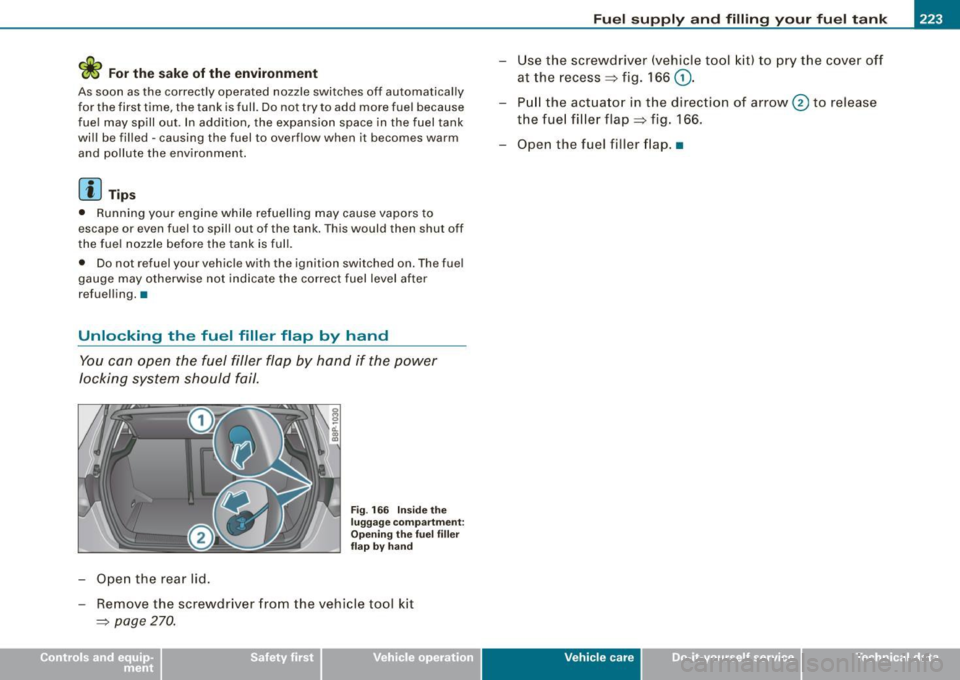
You can open the fuel filler flap by hand if the power
locking system should fail.
- Open the rear lid.
Fig . 166 Inside the
luggage compartment:
Opening the fuel filler
flap
by hand
- Remove the screwdriver from the vehicle tool kit
=> page 270.
-Use the screwdriver (vehicle tool kit) to pry the cover off
at the recess => fig. 166
G).
- Pull the actuator in the direction of arrow @ to release
the fuel filler flap
=> fig. 166 .
- Open the fuel filler flap.•
Vehic le care I I irechnical data
Page 227 of 324
Checking and filling -
--------------~-
•
Closing the engine hood
-Pull the hood dow n until the pressure fro m t he s trut is
r edu ce d .
- Let the hood
drop dow n and latch in p lace . Do not try to
pus h it shut ;
it ma y fail to enga ge => & .
& WARNING
A hood that is not completely latched could fly up and block your
view while driving.
• When you close the engine hood, check it to make sure the
safety catch has properly engaged. The hood should be flush with
the surrounding vehicle body parts .
• If you notice while driving that the hood is not secured prop
erly , stop at on ce and close it. •
Working in the engine compartment
B e e speci ally ca reful wh ene ver you work in th e e ng in e
co mpartmen t!
Whenever you must perform any work in the engine compartment ,
for example checking and filling different fluids , there is a ri sk of
injury , burns and accidents . To prevent personal injury always
observe the following WARNINGS . The engine compartment of any
vehicle is a hazardous area!
~ &
& WARNING
To help avoid injury , before you check anything under the hood :
• Turn off the engine.
• Remove the ignition key .
• Set the parking brake fully .
& WARNING (continued )
• Move selector lever of automatic transmission to "P" (Park) ;
put manual transmission in Neutral .
• Always let the engine cool down . Hot components will burn
skin on contact.
• To reduce the risk of being burned , never open the hood if you
see or hear steam or coolant escaping from the engine compart
ment . Wait until no steam or coolant can be seen or heard before
carefully opening the hood .
• Keep children away from the engine compartment .
• Never spill fluids on hot engine components . They can cause a
fire.
• Never touch the radiator fan. The auxiliary electric fan is
temperature controlled and can switch on suddenly.
• Never open the coolant reservoir cap when the engine is still
warm . The coolant system is pressurized and hot coolant could
spray out!
• Protect your face , hands and arm from steam or hot engine
coolant by placing a thick rag over the cap when you open the
coolant reservoir .
• If work on the fuel system or the electri cal system is necessary :
- Always disconnect the battery .
- Never smoke or work near heaters or open flames . Fluids in
the engine compartment could start a fire .
- Keep an approved fire extinguisher immediately available.
• To avoid electrical shock and personal injury while the engine
is running or being started , never touch :
- Ignition cables
- Other components of the high voltage electronic ignition
system .
• If you must perform a check or repair with the engine running : ..,
Vehicle care
I t •
Page 235 of 324
Checking and filling -
---------------------=----"=---------
0 Note
• Before winter sets in, have the coolant checked to see if the
coolant additive in your vehicle is sufficient to meet the climate
conditions. This is especially important if you live in a region where
the winter is extremely cold. If necessary, increase the proportion of
coolant additive to 60%.
• When adding coolant additive to your cooling system,
remember:
-We recommend using only coolant additive G12+ + (check the
label) for your vehicle. This coolant additive is available at autho
rized Audi dealers. Other types of antifreeze can significantly
reduce corrosion protection . The resulting corrosion can cause a
loss of coolant and serious engine damage .
• Do not add any type of radiator leak sealant to your vehicle's
engine coolant. Adding radiator repair fluid may adversely affect the
function and performance of your cooling system and could result
in damage not covered by your New Vehicle Limited Warranty .•
Checking the engine coolant level
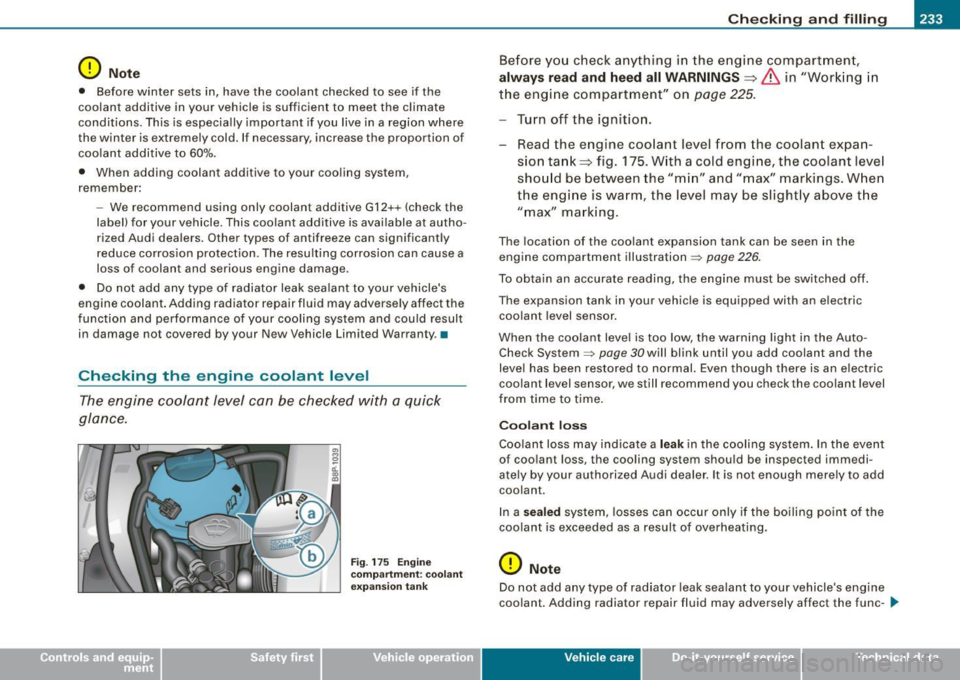
The engine coolant level can be checked with a quick
glance.
Fig . 175 Engine
compartment : coolant
expansion tank
Before you check anything in the engine compartment,
always read and heed all WARNINGS==> & in "Working in
the engine compartment" on
page 225.
Turn off the ignition.
Read the engine coolant level from the coolant expan
sion tank==> fig. 175. With a cold engine, the coolant level
should be between the "min" and "max" markings. When
the engine is warm, the level may be slightly above the
" max" marking.
The location of the coolant expansion tank can be seen in the
engine compartment illustration=>
page 226.
To obtain an accurate reading, the engine must be switched off.
The expansion tank in your vehicle is equipped with an electric
coolant level sensor.
When the coolant level is too low, the warning light in the Auto
Check System =>
page 30will blink until you add coolant and the
level has been restored to normal. Even though there is an electric
coolant level sensor, we still recommend you check the coolant level
from time to time.
Coolant loss
Coolant loss may indicate a leak in the cooling system. In the event
of coolant loss, the cooling system should be inspected immedi
ately by your authorized Audi dealer. It is not enough merely to add
coolant.
In a
sealed system, losses can occur only if the boiling point of the
coolant is exceeded as a result of overheating.
0 Note
Do not add any type of radiator leak sealant to your vehicle's engine
coolant. Adding radiator repair fluid may adversely affect the tune- _..
Vehicle care I I Technical data
Page 239 of 324
_____________________________________________ C_h_ e_ c _ k_in -= g_a _ n_d _ f_il _li _n ..;::g =--____.•
N
~ a:. 00 m
F ig . 178 Battery in the
lugg ag e co mpartme nt
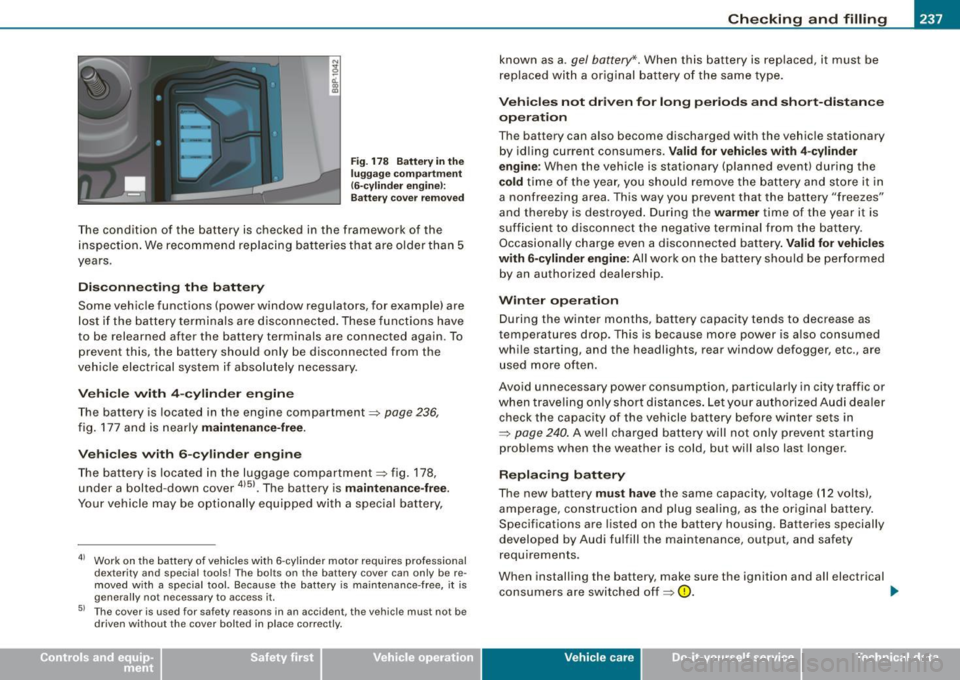
(6-c ylind er eng ine !:
Ba tter y cove r remo ved
T he condition of the battery is checked in the framework of the
inspection . We recommend rep lacing bat teries that are older than 5
years .
Disconnecting the battery
Some vehic le functions (power window regu lators, for example) are
lost if the battery terminals are disconnected . These functions have
to be relearned after the battery terminals are connected again. To
prevent this, the battery should only be disconnected from the
veh icle electr ical system if absolutely necessary.
V ehicle with 4 -cylind er engin e
The battery is located in the engine compartment~ page 236,
fig. 177 and is nearly maintenance -free.
Vehi cle s with 6 -cylinder engine
The bat tery is loca ted in the luggage compartmen t=:> fig . 178,
under a bolted-down cover
4151 • The battery is maintenan ce -free .
Your ve hicle may be optionally equipped with a special battery,
41 Wor k on the battery of vehicles with 6-cy linder motor requires professional
dexterity and special tools! The bolts on the battery cover can only be re
m oved w ith a s pecial tool. Because the batte ry is ma in tenance -free, it is
genera lly not necessary to access it.
51 The cover is used for safety reasons in an acc ident, the vehicle must not be
driven without the cover bolted in place correctly.
known as a. gel battery* . When this battery is replaced, it must be
replaced wi th a or iginal bat tery o f th e same type.
Vehicles not dri ven for long periods and short-distance
operation
The battery can a lso become discharged with the vehicle stationary
by id ling current consumers .
Valid for vehicles with 4 -cylinder
engine :
When the vehic le is stationary (planned event) during the
cold time of the year, you sh ould remove the battery an d store it in
a nonfreezing area. This way you prevent that the battery "freezes"
and thereby is destroyed . During the
warmer time of the year it is
suff icient to disconnect the negative terminal from the battery .
Occasiona lly charge even a disconnected battery .
Valid for veh icles
with 6 -cylinder engine:
All wor k on the ba ttery should be per formed
by an authorized dealership.
Winter op eration
During the winter months, battery capacity tends to decrease as
temperatures drop. This is because more power is a lso consumed
while starting, and the headlights, rear window defogger, etc., are
use d more often .
Avoid unnecessary power consumption, particularly in city traffic or
wh en trave ling on ly shor t distances . Let you r au thor ize d Audi dea ler
check the capacity of the vehicle battery before winter sets in
~ page 240 . A well charged battery will not on ly prevent sta rting
problems when the weather is cold, but wi ll a lso last longer .
Replacing battery
The new battery must have the same capacity , vo ltage (12 volts),
a m perage, con struction and plug sea ling, as t he origina l battery.
Specifications are listed on the battery housing. Batteries specially
developed by Audi fulfill the maintenance, output, and safety
requirements.
When installing the battery , make sure the ignition and all electrical
co nsumers are switche d off ~
0. ..,
Vehicle care I I irechnical data
Page 241 of 324
___________________________________________ C_ h_e _c_ k_ i_n _g _ a_n _d_ f_il _li _n _g __ lR
•
& W ARNING (continu ed )
• Always wear eye protection. Do not let battery acid or any lead
particles get on your skin or clothing . Shield your eyes. Explosive
gases can cause blindness or other injury !
• Battery acid contains sulfuric acid . Sulfuric ac id can cause
blindness and severe burns .
- Always wear gloves and eye protection. Do not tilt the
battery because acid could leak out of the ventilation openings.
- If you get battery acid in your eyes or on your skin , immedi
ately rinse with cold water for several minutes and get medical
attention .
- If you should ingest any battery acid , seek medical attention
immediately .
• Do not expose the battery to an open flame , electric sparks or
an open l ight .
• Do not smoke.
• Do not interchange the positive and negative cables .
• When working on the batte ry , be sure not to short -circuit the
terminals with tools or other metal objects . This would cause the
battery to heat up very quickly , whi ch could lead to damage or
explosion and personal injury .
• When a battery is charged , it produces hydrogen gas which is
explosive and could cause personal injury .
• Always keep the battery well out of the reach of children .
• Before work is done on the electrical system, disconnect the
negat ive ground cable .
• Before performing any work on the electrical system , switch off
the engine and ignition as well as any electrical equipment . The
negative cable on the battery must be disconnected . If you are just
going to replace a light bulb , then it is enough to switch off the
lights.
• Before disconnecting the battery , sw itch off the anti-theft
alarm sy stem! Otherwise you will set off the alarm.
& W ARNING (continued )
• When disconnecting the battery, first disconnect the negative
cable and then the positive cable.
• Before reconnecting the battery , make sure all electrical
consumers are switched off. Reconnect the positive cable first and
then the negative cable . Never interchange the cables -this could
start a fire!
• Never charge a frozen or a thawed -out battery. It could
explode!
If a battery has frozen , then it must be replaced . A
discharged battery can freeze over at 32 °F (0 °CI.
• Make sure the vent hose is always atta ched to the opening on
the side of the battery.
• Never use batteries which are damaged . There is the danger of
an explosion! Always replace a damaged battery .
& WARNING
California Proposition 65 Warning:
• Battery posts , terminals and related accessories contain lead
and lead compounds , chemicals known to the State of Californi a
to cause cancer and reproductive problems . Wash hands after
handling.
0 Note
• D o not d iscon nect the veh ic le bat tery w hen the ign it io n i s
switched on or when the engine is ru nning, otherwise, you wi ll
da mag e ele ctro nic c ompo nents in the e lectr ical system.
• Appl ies to vehic les with 4 -cylinde r engine: When working on the
eng ine, protec t th e batter y hous ing from ultrav iolet ( UV) rays by not
parking the vehicle in direct sun light .
• If y our veh icl e is goi ng to sta nd for a lo ng period o f time with out
being dr iven, protect the battery from "freezing", otherwise it will
b e dama ged and w ill t hen ha ve to be replaced .•
Vehicle care
I t •
Page 268 of 324
-Tire pressure monitoring system* __ ..:.._____:__..:...::....:..:..:..-=.:..: ..:..::.-=.:..~~.:.=.:..:.::...__ ____________________ _
-Inspect all tires.
- Change the tire if necessary~ page
272.
The warning light in the instrument cluster comes on when the
tire is significantly underinflated .
In addition, the tire symbol ,_, appears in the display together with
the message
Please check tire pressure=> page 265, fig. 185.
After a few seconds, the message disappears again. If you would
like to show the message again, press the Set/Check button
=>
page 8, fig. 2 @ .
[ i ] Tips
• In the case of an intentional loss of air pressure, such as when
readjusting tire pressure, the pressure must be stored again after
ward =>
page 266.
• Tire pressure must only be adjusted when the temperature of the
tires is about the same as ambient air temperature.
• The yellow symbol disappears when the tire pressure is
corrected and the new pressure is stored in the system=>
page 266.
• After changing a wheel or replacing a wheel with the spare tire
you have to adjust the tire pressures on all wheels. In addition, you must then initialize the new tire pressures in the tire pressure moni
toring system =>
page 267. •
Applies to vehicles: with tire pr essu re mon itoring system
Storing tire pressures
Correct storage of specified pressure is the basic require
ment for reliable tire pressure monitoring .
1 1 1 J
Fig. 186 Car: Tire pres
sure monitoring
system
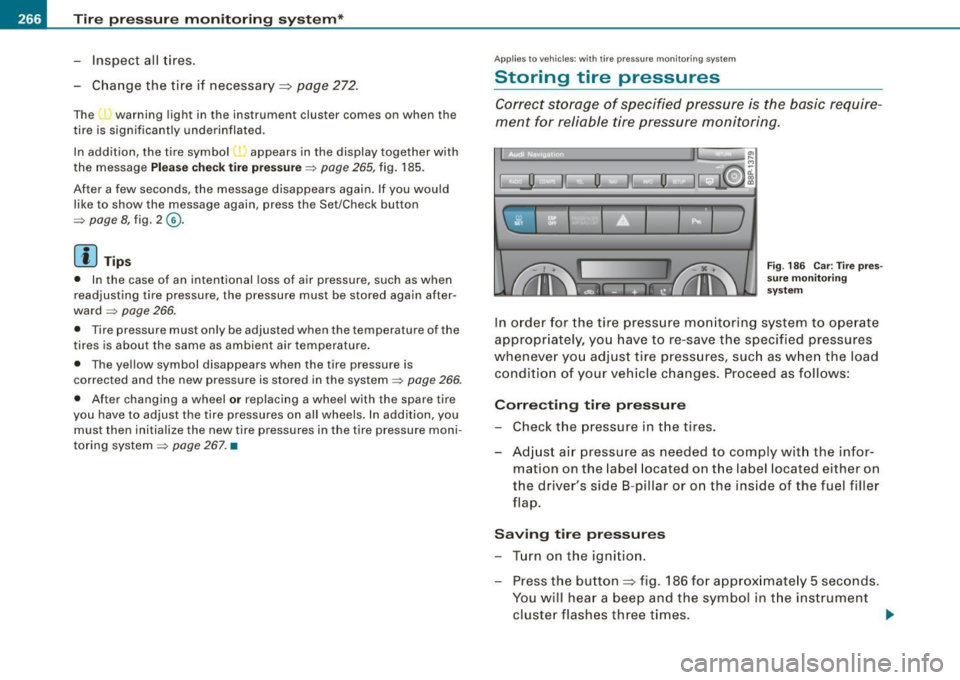
In order for the tire pressure monitoring system to operate
appropriately, you have to re-save the specified pressures
whenever you adjust tire pressures, such as when the load condition of your vehicle changes. Proceed as follows:
Correcting tire pressure
- Check the pressure in the tires.
- Adjust air pressure as needed to comply with the infor- mation on the label located on the label located either on
the driver's side 8 -pillar or on the inside of the fuel filler
flap .
Saving tire pressures
-Turn on the ignition.
- Press the button~ fig. 186 for approximately 5 seconds.
You will hear a beep and the symbol in the instrument
cluster flashes three times. ..,.
Page 269 of 324
__________________________________________ T_i_re _ p =----r_e _s _ s_ u_ r_e _ m_ o_n_ i_ t _o _r_ i_n -=g =-- s....: y:.... s_ te_ m_ * __ !II
•
All pressure warning indicators in the display will be canceled.
Fo llowing each intent ional change in specified pressures, tire pres
sures must be saved again .
After the pressures are saved, the tire pressure monitoring system
measures the current tire pressures and saves them as the new
specified pressures.
[ i] Tips
• The tire pressure is shown on the tire pressure label. The tire
pressure label is located either on the driver's side B -pillar or on the
inside of the fuel filler flap. The tire pressure label lists the recom
mended cold tire inflation pressures for the vehicle at its maximum
capacity weight and the tires that were on your vehicle at the time
it was manufactured. For recommended tire pressures for normal
load conditions, please see chapter~
page 247.
• The tire pressure monitoring system helps the driver monitor tire
pressures, but the driver is still responsible for maintaining the
correct tire pressure. •
Applies to vehicles: with tir e pressure monitor ing system
Wheel change
If a wheel is changed, the wheels that were exchanged
have to be reprogrammed.
- Turn on the ignition.
- Press the button=>
page 266, fig. 186 for approximately 5
seconds. You will hear a beep and the symbol in the
button flashes three times.
Programming is necessary:
• after the tires have been rotated on the vehicle, or the spare tire
is used, •
if tires with new wheel sensors are used.
All pressure warning indicators in the display will be canceled. The
system malfunction error message will not disappear until the
vehicle is underway. With pressing the button~
page 266, fig. 186,
the reprogramming of the new sensors and storing of actual pres
sures starts . This learning phase can take up to 10 minutes driving
time.
During the learning process the tire pressure monitoring system is
not available. •
Applies to vehic les: with tir e pr essure monitor ing system
Malfunctions *
A malfunction can have various causes.
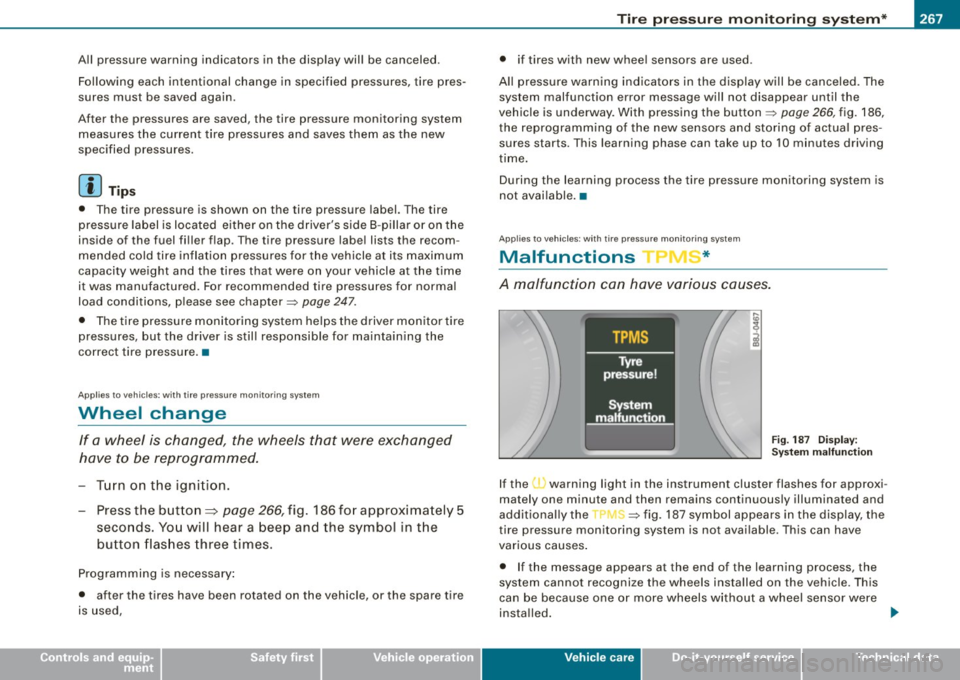
Fig. 187 Display:
System malfunction
If the '-warning light in the instrument cluster flashes for approxi
mately one minute and then remains continuously illuminated and
additionally the
~ f ig. 187 symbol appears in the display, the
tire pressure monitoring system is not available . This can have
various causes.
• If the message appears at the end of the learning process, the
system cannot recognize the wheels installed on the vehicle . This
can be because one or more wheels without a wheel sensor were
installed. .,,_
Vehicle care I t •
Page 282 of 324

1111...__F_ u_ s_ e_s _ a_n _ d_ b_ u_lb _ s _______________________________________________ _
Fuses and bulbs
Fuses
Replacing a fuse
A problem in the electrical system may be caused by a
blown fuse.
Fig . 199 End face of
instrument panel:
removing cover plate
to access fuses
Fig .
200 Left side of
engine compartment :
fuse cover
Fuse cover on the left end face of the instrument
panel
- Switch off the ignition and the electrical component
affected. - Carefully pry the fuse cover off the instrument panel
using the ignition key or a screwdriver~ fig. 199.
- Check the fuse listing on the next pages to find out which fuse belongs to the component which has failed
~ page 281, "Fuse Locatio n, Instrument Panel left".
- Remove the blown fuse with the plastic clip provided.
The clip is located on the holder in the fuse box.
- Replace a blown fuse (recognizable by the melted metal
strip inside) w ith a fuse of the same amperage .
- Firmly snap the cover back onto the instrument panel
face.
Fuse cover in engine compartment
- Switch the ignition and the affected consumer off.
- Unlatch the fuse cover, push the two slides forward
~ fig. 200.
- Find out which fuse belongs to the equipment which
stopped working~ page 283, "Fuse location, left side of
engine compartment".
- Remove the plastic from its reta iner in the fuse box cover
(left face end of the instrument panel), place it on the
fuse in question and pull it out.
- If the fuse is burned out (recognizable by melted strips of
metal), replace it with a new fuse of the same rating.
- Replace the fuse cover.
- Push the two slides to the rear~ fig. 200. Install the fuse
cover carefully to prevent water from entering.
~
Page 286 of 324

IIJII Fuses and bulbs i,.__....;,___;:,,;_,;,,.:_;__;;:_.:.:..:..=-=;____ ______________________ _
No. UEquipment Amps I No. Equipment Amps
F6 Steering wheel electronics, instrument cluster
5 F28
Not used
F7 Transmission control module 30 Fuse assignment in the left-side instrument
F29 50
F8 Navigation system, radio system 15/25 panel (special equipment)
Navigation system, digital radio, cell phone, TV F30 Power supply relay terminal
15 50
F9 equipment 5
F10 Engine control module, main relay 5/10 Variation
(2) with 54 Plug-in Fuses
F11 Not used No. Equipment
Amps
Control module for CAN data transfer (gateway) 5 F1
Vehicle
electrical system control unit (right)
30
F13 Engine control module 15/25 F2
ESP valves, Anti
-lock brake system (ABS) valves
20/30
F14 Ignition coils 20 F3 Not used
F15 Tank diagnosis, oxygen sensor 5/10 F4
Battery voltage
5
F16 Vehicle electrical system control unit (right) 30 F5 Horn
15
F17 Horn
15 F6 Engine components, fuel pump 15
F18 Audio amplifier 30 F7
Not used
F19 Front windshield wiper system 30 F8
Not used
F20 Water return
-flow pump, volume regulator valve F9 Engine components
10
F21 Oxygen sensor, vacuum pump 15 F10
Fuel tank control, mass air flow sensor
10
F22 Clutch pedal switch, brake light switch 5 F11 Oxygen sensors, in front of catalytic converter 10
F23 Engine relays, engine components
5/10/15 F12 Oxygen sensors, behind catalytic converter
10
F24 Engine components, water return-flow pump 10 F13 Automatic transmission
15
F25 Pump (ESP/ABS), ABS valve 30/40 F14 Not used
F26 Vehicle electrical system control unit (left)
30 F15 Water return-flow pump
10
F27 Secondary air pump 40 F16 Volume control valve
20
F17 Steering wheel electronics, instrument cluster
5
F18 Audio amplifier 30
F19 Navigation system, radio system 15/25