coolant AUDI S3 2010 User Guide
[x] Cancel search | Manufacturer: AUDI, Model Year: 2010, Model line: S3, Model: AUDI S3 2010Pages: 320, PDF Size: 75.34 MB
Page 225 of 320

Checking and filling -
------------- --------=----" =---------
Checking and filling
Engine hood
Releasing the engine hood
The engine hood is released from inside the vehicle.
- Open the driver's door .
Fig. 162 Driver's side
footwell: engine hood
release lever
- Pull the release lever on the left under the instrument
panel => fig. 162 in direction of the arrow.
The hood pops up slightly under spring pressure. •
Opening the engine hood
Fig. 163 Engine hood
release lever
Before opening the engine hood , make sure that the wind
shield wipers are folded flat against the windshield. Other
wise, they could damage the paint on the hood.
Pull the release lever=> fig. 163 in the direction indicated
by the arrow. This release the hook under the hood.
- Open the hood all the way.
& WARNING
Hot engine coolant can burn you!
• To reduce the risk of being burned, never open the hood if you
see or hear steam or coolant escaping from the engine compart
ment. Wait until no steam or coolant can be seen or heard before
carefully opening the hood. •
Vehicle care I I irechnical data
Page 226 of 320
-~_C_ h_e _c _ k_ i_n ...:::g::;...._ a_n_ d_ f_ i_ll _in -'g:::;.._ ___________________________________________ _
Closing the engine hood
- Pull the hood down until the pressure from the strut is
reduced.
- Let the hood
drop down and latch in place. Do not try to
push it shut;
it may fail to engage~& .
& WARNING
A hood that is not completely latched could fly up and block your
view while driving.
• When you close the engine hood, check it to make sure the
safety catch has properly engaged. The hood should be flush with
the surrounding vehicle body parts.
• If you notice while driving that the hood is not secured prop
erly, stop at once and close it. •
Working in the engine compartment
Be especially careful whenever you work in the engine
compartment!
Whenever you must perform any work in the engine compartment,
for example checking and filling different fluids, there is a risk of injury, burns and accidents. To prevent personal injury always
observe the following WARNINGS. The engine compartment of any
vehicle is a hazardous area!
=> &
& WARNING
To help avoid injury, before you check anything under the hood :
• Turn off the engine.
• Remove the ignition key.
• Set the parking brake fully .
& WARNING (continued)
• Move selector lever of automatic transmission to "P" {Park);
put manual transmission in Neutral.
• Always let the engine cool down. Hot components will burn
skin on contact.
• To reduce the risk of being burned, never open the hood if you
see or hear steam or coolant escaping from the engine compart
ment. Wait until no steam or coolant can be seen or heard before
carefully opening the hood .
• Keep children away from the engine compartment.
• Never spill fluids on hot engine components. They can cause a
fire.
• Never touch the radiator fan. The auxiliary electric fan is
temperature controlled and can switch on suddenly.
• Never open the coolant reservoir cap when the engine is still
warm. The coolant system is pressurized and hot coolant could
spray out!
• Protect your face, hands and arm from steam or hot engine
coolant by placing a thick rag over the cap when you open the
coolant reservoir.
• If work on the fuel system or the electrical system is necessary:
- Always disconnect the battery .
- Never smoke or work near heaters or open flames. Fluids in
the engine compartment could start a fire.
- Keep an approved fire extinguisher immediately available.
• To avoid electrical shock and personal injury while the engine
is running or being started, never touch :
- Ignition cables
- Other components of the high voltage electronic ignition
system.
• If you must perform a check or repair with the engine running: .,_
Page 228 of 320
___ C_h_ e_ c_k _in --== g'-- a_n _d_ f_il _li _n ..:::g:::..- ___________________________________________ _
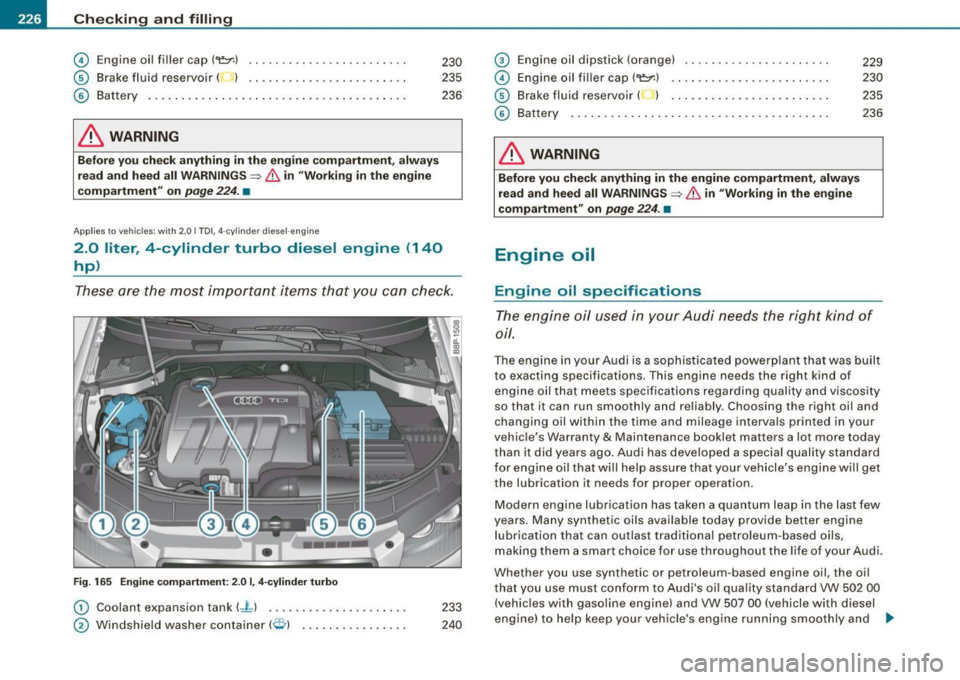
© Engine oil filler cap ("t=:?:) .... ........ .... ... ... . .
© Brake fluid reservoir ( l .......... ... .. ...... .. .
© Battery ...... .. ........ ....... ......... .. .... .
& WARNING
Before you check anything in the engine compartment , always
read and heed all WARNINGS ~
& in "Working in the engine
compartment" on
page 224. •
Applies to veh icles : with 2.0 I TO I, 4-cyl inder diese l-engine
230
235
236
2 .0 liter , 4-cylinder turbo diesel engine (140
hp)
These are the most important items that you can check.
Fig. 165 Engine compartment: 2.0 I, 4-cylinder turbo
G) Coolant expansion tank ( J_ ) ....... ... .... .... .. .
0 Windshield washer container ('C,;> ) •••• •• •••• ••• •• •
233
240
© Engine oil dipstick (orange) ..... ... ...... .... ... .
© Engine oil filler cap ("t=:?:) .. ...... ..•........... ..
G) Brake fluid reservoir ( ) ..... ....... ...... .... . .
© Battery . .................. ..... .............. .
& WARNING
Before you check anything in the engine compartment, always
read and heed all WARNINGS
~ & in "Working in the engine
compartment" on
page 224. •
Engine oil
Engine oil specifications
229
230
235
236
The engine oil used in your Audi needs the right kind of
oil.
The engine in your Audi is a sophisticated powerp lant that was built
to exacting specifications. This engine needs the right kind of
engine oil that meets specifications rega rding quality and viscosity
so that it can run smoothly and reliably. Choosing the right oil and
changing oil within the time and mileage intervals printed in your
vehic le's Warranty
& Maintenance booklet matters a lot more today
than it did years ago. Audi has developed a special quality standard
for engine oi l that will help assure that your vehicle's engine will get
the lubrication it needs for proper operation.
Modern engine lubrication has taken a quantum leap in the last few
years. Many synthetic oils available today provide better engine
lubrication that can outlast traditional petroleum -based oils,
making them a smart choice for use throughout the life of your Audi.
Whether you use synthetic or petroleum -based engine oil, the oil
that you use must conform to Audi's oi l quality standard VW 502 00
(vehicles with gasoline engine) and VW 507 00 (vehicle with diesel
engine) to help keep your vehicle's engine running smoo thly and _,..
Page 234 of 320

___ C_ h_ e_c _k _in -= g_ a_ n_d _ fi_ll _in --= g __________________________________________ _
& WARNING
Fa ilure to use eng ine o il for your die sel eng ine th at ex pre ssly
c onform s to Audi oil specification VW 50 7 00 can cau se engine
f a ilure on the high way that can ca us e a cra sh and seriou s per sona l
injury.
• N ever u se any a mount of eng ine o il in the die sel eng ine th at
does not conform to Audi oil spec ification VW 507 0 0.
• Alwa ys carry with you an e xtra q uart lliter l of eng in e oil that
c onform s to Audi oil spe cification VW 507 00 in case you mu st top
o ff the oi l while on the road .
& WARNING
Improperly stored item s ca n be come air borne mi ssiles , fl ying
through the veh icl e cau sing serious per sonal injury in t he event of
h ard br aking or an acc ident . To help r educe the risk of ser ious
personal in jury :
• Alw ays s tore e xtr a qu art lliter ) of eng ine o il for your diesel
engine in its original oil container that is securely clo sed in the
lugg age comp artment . M ak e sur e the cont ainer is secu re ly stored
and mounted.
0 Note
• If you use eng ine oi l tha t does not expressly conform to Audi oil
specification VW 507 00, very serious and very expensive damage to
your vehicle's engine wil l occu r. Engine damage caused by using
the wrong engine oi l is not covered by your New Vehicle Limited
Warranty .
• Not a ll commercia lly available oils conform to this very rigid Audi
oi l quality standard even though they may be synthe tic -based and
have the same viscosity. •
Engine cooling system
Coolant
The engine coolant perf orms two functions: it keeps the
engine from overheating an d it protects the engine from
freezing in the winter.
The cooling system is sealed and general ly requires litt le attention.
The coo ling system has been fi lled at the factory with a permanent
coo lant which does not need to be changed. The coolant consists of
a mixture of water and the manufacturer's glycol -basedcoolant
additive G12+ + antifreeze with anti corrosion additives (50% for USA
models; 60% for Canadian mode ls) . This mixture both assures the
necessary frost protection and protects metal components in the
engine's cooling system from corrosion and scaling. It also raises
the boil ing point o f the coolant.
Do not reduce the concentration of the coo lant in the summer by
adding pla in water. The proporti on of coolant additive mu st b e at
l e as t 50 % but not more than 60 % to maintain antifreeze protection
and cooling efficiency . If the coolant frost protect ion is too low, the
coo lant could freeze and damage the vehicle heating and engine
coo ling system.
For year-round driving, antifreeze is added at the factory for temper
atures down to :
• -31 °F ( -35 °C) USA
• -40 °F ( -40 °C) Canada .
You can mix the G12 ++ coolan t additive with other additives G12 + or
G12. Always check with your authorized Audi dealer.
& WARNING
Bef ore you che ck anything in the engine compartment , alwa ys
read and heed all WARNING S
~ & in "Working in the engine
c ompartment " on
page 22 4.
Page 235 of 320

Checking and filling -
---------------------=----"=---------
0 Note
• Before winter sets in, have the coolant checked to see if the
coolant additive in your vehicle is sufficient to meet the climate
conditions. This is especially important if you live in a region where
the winter is extremely cold. If necessary, increase the proportion of
coolant additive to 60%.
• When adding coolant additive to your cooling system,
remember:
-We recommend using only coolant additive G12+ + (check the
label) for your vehicle. This coolant additive is available at autho
rized Audi dealers. Other types of antifreeze can significantly
reduce corrosion protection . The resulting corrosion can cause a
loss of coolant and serious engine damage .
• Do not add any type of radiator leak sealant to your vehicle's
engine coolant. Adding radiator repair fluid may adversely affect the
function and performance of your cooling system and cou ld result
in damage not covered by your New Vehicle Limited Warranty .•
Checking the engine coolant level
The engine coolant level can be checked with a quick
glance.
Fig . 169 Engine
compartment : coolant
expansion tank
Before you check anything in the engine compartment,
always read and heed all WARNINGS==> & in "Working in
the engine compartment" on
page 224.
Turn off the ignition .
Read the engine coolant level from the coolant expan
sion tank==> fig. 169. With a cold engine, the coolant level
should be between the "min" and "max" markings. When
the engine is warm, the level may be slightly above the
" max" marking .
The location of the coolant expansion tank can be seen in the
engine compartment illustration=>
page 225.
To obtain an accurate reading, the engine must be switched off .
The expansion tank in your vehicle is equipped with an electric
coolant level sensor.
When the coolant level is too low, the warning light in the Auto
Check System =>
page 30will blink until you add coolant and the
level has been restored to normal. Even though there is an electric
coolant level sensor, we still recommend you check the coolant level
from time to time.
Coolant loss
Coolant loss may indicate a leak in the cooling system. In the event
of coolant loss, the cooling system should be inspected immedi
ately by your authorized Audi dealer. It is not enough merely to add
coolant.
In a
sealed system, losses can occur only if the boiling point of the
coolant is exceeded as a result of overheating.
0 Note
Do not add any type of radiator leak sea lant to your vehicle's engine
coolant. Adding radiator repair fluid may adversely affect the tune- _..
Vehicle care I I Technical data
Page 236 of 320

-~_C_ h_e _c _ k_ i_n ...:::g::;...._ a_n_ d_ f_ i_ll _in -'g:::;.._ ___________________________________________ _
tion and performance of your cooling system and could resu lt in
d am age not co vered by yo ur Ne w Vehicle Li mited Warranty .•
Adding coolant
B e very caref ul whe n addin g engine c oo lant.
Before you check a nything in the e ngine compartmen t,
always read and heed all WARNINGS=> & in "Work ing in
the en gine compartmen t" on
pa ge 224.
- Turn off the engine.
- Le t the engin e coo l down.
Place a thi ck ra g o ver th e c oolan t expansio n ta nk
=> pa ge 233, fi g. 1 69 an d carefully twi st th e cap coun te r
cl ockwi se
=> &.
- Add cool ant.
- Twist the cap on aga in
tightly.
Replacement engine coolant must conform to exact specifications
~ page 232, "Coolant". Even in a n eme rge ncy, if co olant add it ive
G 12++. G12+ or G 12 is not availab le, do
not use a diffe rent additive.
Use plain water instead unt il you ca n get the c orrect additive and
can restore the correct ratio . This should be done as soon as
possible.
If you have lost a considerable amount of coo lant, then you should
add co ld antifreeze and cold water only when the engine is cold.
A lways use
new e n gin e c oolan t wh en refi llin g.
Do not fi ll coo lant above the "MAX" mark . Excess coolant will be
f o rced ou t through the pressure re lief va lve in the cap when the
engine becomes hot.
& WARNING
• The cooling system is under pressure and can get very hot .
Redu ce the risk of scalding from hot coolant by following these
steps .
- Turn off the engine and allow it to cool down.
- Protect your face , hands and arms from e scaping fluid and
steam by covering the cap with a large, thick rag.
- Turn the cap slowly and very carefully in a counter -clockwise
direction while applying light , downward pressure on the top
of the cap.
- To avoid being burned , do not spill antifreeze or coolant on
the e xhaust system o r hot engine parts . Under certain condi
tions , the ethylene glycol in engine coolant can catch fire.
• Antifreeze is poisonous . Always store antifreeze in its original
container and well out of the rea ch of children.
• If you drain the coolant , it must be caught and safely stored in
a proper container clearly marked "poison".
0 Note
• Coo la n t po llutes t he environ ment and cou ld cause a n engine
fire . Excess coolant will be forced out through the pressure re lief
va lve in t he cap when t he eng in e b ecomes hot .
• I f, in an emergency, on ly water can be added, the correct ratio
be tween wa ter and antifree ze~
page 232 mus t be restore d as soon
as possib le .
'£> For the sake of the environment
D rained coolant should not be reused. Always d ispose of used
coo la nt whi le observing all e nvi ro n men tal reg ulat ions .•
Page 237 of 320

Checking and filling -
---------------------=----"=---------
Radiator fan
The radiator fa n switches on au toma tically by i tself.
T he e lectric radiator fan is control led bythermoswitches that switch
on and off depending on coolan t and engine compar tm ent temper
atures .
An auxiliary e lectric radiator fan * switches on and off depending on
coolant temperature and other vehicle operation conditions.
After switching off the engine , the auxiliary fan -even with the igni
tio n off -ca n co ntinue runni ng for u p to 10 minutes. It can even
switch on again later by itself=>&, if
• the temperat ure of the engine coolant rises due to the heat
build -up from the engine in the engine compartment, or
• t he engine co mpart men t heats up because the vehicle is parked
in intense sunlight.
& WARNING
• To reduce the risk of personal injury never tou ch the r ad iator
fan .
• The auxiliary electric fan is temperature controlled and can
switch on suddenly even when the engine i s not running .
• The auxiliary radiator fan switches on automatically when the
engine cool ant reache s a certain temperature and will continue to
run until the coolant temperature drop s. •
Brake fluid
Checking brake fluid level
The bra ke flu id l evel can be che cke d wi th a q uick gla nce.
Fig . 17 0 Engine
co mpartment : brake
fluid re ser vo ir
Be fore yo u check anythin g in the e ng ine compar tm ent,
always read and heed all WARNINGS=> & in "Working in
t h e eng ine compartment" on
page 224.
Read t he brake fl uid lev el from t he brake flui d res ervoir .
T he b rak e fluid l eve l must b e between the
"MI N" and
"M AX" markings => fig. 170.
The brake f luid reservoir is located at the rear pa rtit ion of the engine
compartment on the left side=> page 225.
T he fluid leve l may drop slightly after some time due to the auto
ma tic adjustment o f the brake pads. Th is is not cause for alarm .
I f the brake flu id leve l falls considerably below the "MIN" mark, the
brake warning/indicator light (U.S . models :
BRAKE, Canadian models:
ID ) will come on=> page 15 and=> page 30. Do not continue to
operate the vehic le . The complete brake system should be thor
oughly checked by an au thorized Audi dealer or other qualified
facility and the cause corrected. If the brake fluid leve l is too low, the .,,_
Vehicle care I I irechnical data
Page 253 of 320

Tires and wheels -
----------------
•
and is more difficult to stop. Overloading can not only lead to loss
of ve hicle control, but can a lso damage important parts of the
vehicle and can lead to sudden tire failure, inc luding a blowout and
sudden deflation that can cause the vehic le to crash.
Your safety and that of your passengers also depends on making
sure that load limits are not exceeded. Vehicle load includes every
body and everything in and on the veh icle . These load limits are
technically referred to as the vehicle's
Gross Vehicle Weight Rating
("GVWR"l.
The "GVWR" includes the weight of the basic vehicle, al l factory
insta lled accessories, a full tank of fuel, oil, coolant and other fluids
plus maximum load. The maximum load includes the number of
passengers that the vehicle is intended to carry ("seating capacity")
with an assumed weight of 150 lbs (68 kg) for each passenger at a
designated seating position and the total weight of any luggage in
the vehicle. If you tow a trailer, the weight of the trailer hitch and the
tongue weight of the loaded trai ler must be included as part of the
vehicle load .
The
Gross Axle Weight Rating ("GAWR") is the maximum load that
can be applied at each of the vehic le's two axles .
The Gross Vehicle Weight Rating and the Gross Axle Weight Rating
are listed on the safety compliance sticker label located either on
the driver's side B-pillar or on the inside of the fuel filler flap. Your
Audi has 5 seating positions, 2 in the front and 3 in the rear for total
seating capacity of 5. Each seating position has a safety belt
=> page 135, "Safety belts".
The fact that there is an upper limit to your vehicle's Gross Vehicle
Weight Rating means that the total weight of whatever is being
carried in the vehicle (including the weight of a trailer hitch and the
tongue weight of the loaded trailer) is limited. The more passengers
in the vehicle or passengers who are heavier than the standard
weights assumed mean that less weight can be carried as luggage .
T he tire pressure label on your Audi also lists the maximum
combined weight of all of the occupants and luggage or other cargo that the vehicle can carry.
For the location of the label
=> page 246,
fig. 173.
& WARNING
Overloading a vehicle can cause loss of vehicle control, a crash or
other accident, serious personal injury , and even death .
• Carrying more weight than your vehicle was designed to carry
will prevent the vehicle from handling properly and increase the
risk of the loss of vehicle control.
• The brakes on a vehicle that has been overloaded may not be
able to stop the vehicle within a safe distance.
• Tires on a vehicle that has been overloaded can fail suddenly,
including a blowout and sudden deflation, causing loss of control
and a crash.
• Always make sure that the total load being transported -
including the weight of a trailer hitch and the tongue weight of a
loaded trailer -does not make the vehicle heavier than the
vehicle's Gross Vehicle Weight Rating .•
Determining correct load limit
Use the example below to calculate the
total weight of the passengers and
luggage or other things that you plan to
transport so that you can make sure that
your vehicle will not be overloaded.
~
Vehicle care I t •
Page 297 of 320
_________________________________________________ G_ e_ n_ e_r _a _l_ i_n _f_o _ r_ m_ a_ t _i _o _ n __ _
left door jamb. It shows the month and year of production and the
vehicle identification number of your vehicle (perforation) as well as
the Gross Vehicle Weight Rating (GVWR) and the Gross Axle Weight
Rating (GAWR).
The high voltage warning label
is located on the lock carrier.
The spark ignition system complies with the Canadian
standard ICES-002. •
Weights
Gross Vehicle Weight Rating
The Gross Vehicle Weight Rating (GVWR), and the Gross Axle Weight
Rating (GAWR) for front and rear are listed on a sticker on the left
door jamb.
The Gross Vehicle Weight Rating includes the weight of the basic
vehicle plus full fuel tank, oil and coolant, plus maximum load,
which includes passenger weight (150 lbs/68 kg per designated
seating position) and luggage weight.
Gross Axle Weight Rating
The Gross Axle Weight Rating is the maximum load that can be
applied at each axle of the vehicle ~& .
Vehicle capacity weight
The vehicle capacity weight (max. load) is listed either on the
driver's side B-pillar or inside the fuel filler flap .
Roof weight
The maximum permissible roof weight is 165 lb (75 kgl. The roof
weight is made up of the weight of the roof rack system and the
weight of the object being transported~
page 89, "Loading the
roof rack".
Controls and equip ment Safety first Vehicle operation
& WARNING
•
The actual Gross Axle Weight Rating at the front and rear axles
should not exceed the permissible weights, and their combination
must not exceed the Gross Vehicle Weight Rating.
• Exceeding permissible weight ratings can result in vehicle
damage, accidents and personal injury.
0 Note
• The vehicle capacity weight figures apply when the load is
distributed evenly in the vehicle (passengers and luggage). When
transporting a heavy load in the luggage compartment, carry the
load as near to the rear axle as possible so that the vehicle's
handling is not impaired.
• Do not exceed the maximum permissible axle loads or the
maximum gross vehicle weight. Always remember that the vehicle's
handling will be affected by the extra load. Therefore, adjust your
speed accordingly.
• Always observe local regulations.•
Dimensions
The specifications refer to the basic model. Differences may occur
depending on the model type and options ordered, for example, tire
sizes.
0 Note
When driving up steep ramps, on rough roads, over curbs, etc. it is
important to remember that some parts of your vehicle, such as
spoilers or exhaust system components, may be close to the
ground. Be careful not to damage them. •
Vehicle care Do-it-yourself service Tec hn ica l da ta
Page 302 of 320
___ C_ o_n_ s_ u_m _ e_ r_ ln_ f_o _r_m _ a_ t_ i_o _n ______________________________________________ _
& WARN ING (continued )
• Always be extremely careful when working on the vehicle.
Alway s follow commonly a ccepted safety practices and general
c ommon sen se . Never risk per sonal injury .
• Do not attempt any of the maintenance, checks or repairs
described on the following pages if you are not fully familiar with
the se or other procedures with re spect to the vehicle , or are uncer
tain how to proceed .
• Do not do any work without the proper tools and equipment.
Have the necessary work done by your authorized Audi dealer or
another properly equipped and qualified work shop .
• The engine compartment of any motor vehicle is a potentially
hazardous area . Never reach into the a rea around or touch the
radiator fan. It is temperature controlled and can switch on
suddenly · even when the engine is off and the ignition key has
been removed . The radiator fan switches on automatically when
the coolant reaches a certain temperature and will continue to run
until the coolant temperature drops .
• Always remove the ign ition key before anyone gets under the
vehicle .
• Always support your vehicle with safety stands if it is neces
sary to work underneath the vehicle. The jack supplied with the
vehicle is not adequate for this purpose and could collap se
c ausing serious personal injury .
• If you must work underneath the vehicle with the wheel s on
the ground , always make sure the vehicle is on level ground , that
the wheels are always securely blocked and that the engine c annot be started .
• Always make sure the tr ansmission selecto r lever (automatic
transmission ) is in "P" (Park position ) (automatic transmission ) or
Neutral (manual transmi ssion) and the hand brake is firmly
applied .
W For the sake of the environment
• Cha nging t he en gine setti ngs will adversely a ffec t emi ssio n
l evels. This is detrimenta l to the environment and increases fuel
consumptio n.
• Always o bse rve enviro nmenta l regu lations when dis posing of
o ld eng ine o il, used brake flu id, d irty eng ine coola nt, spe nt batter ies
or worn out tires .
• Undeployed airbag modules and pretensioners might be classi
fied as Pe rchlorate Mate rial -specia l handl ing may apply, see
www .dtsc.ca.gov/ hazardouswaste/perchlora te. W hen t he veh icle or
parts of the restraint system including airbag modu les safety belts
w ith pretens ione rs are sc rapped, all appl icab le laws and regu la
tions must be observed. Your authorized Audi dea ler is familiar with
th ese requi reme nts a nd we reco mme nd t hat you have your dealer
perform this service for you. •
Additional accessories,
modifications and parts replacement
Additional accessories and parts
replacement
A lways co ns ult an author ized Audi d eal er befor e
purc hasing accessorie s.
Your vehicle incorporates the latest safety design features ensuring
a h igh s tanda rd of act ive and pass ive sa fety.
T his safety could be compromised by non -approved changes to the
veh ic le . Fo r thi s reason, if pa rts have to be re place d, please o bserve
the fo llowing points w hen insta lli ng additional accessories:
Approved Audi accessories and genuine Audi parts are avai lable
from autho rized Aud i dea lers.
~