fuel cap AUDI S3 2010 User Guide
[x] Cancel search | Manufacturer: AUDI, Model Year: 2010, Model line: S3, Model: AUDI S3 2010Pages: 320, PDF Size: 75.34 MB
Page 249 of 320

________________________________________________ T_ i _r_e _s_ a_n_ d_ w_ h_ e_e _ l_s __ !II
•
vehicle at its maximum capacity weight and tires that were on your
vehicle at the time it was manufactured .
If yo u w is h to impr ove co mfort w hen op erati ng th e vehicle at
n or mal load (u p to 3 occup ants), y ou ca n adj us t t ire pr essures to
tho se spe cified for normal vehicle load. Before oper ating the vehicle
a t m aximum lo ad , you mu st in cre as e t he t ire pre ssure s to t hose
s pecified for ma ximum vehi cle load =>
&.
Bear in mind that the tire pressure monitoring system * can only
monitor the tire pressu res you have stored. The syste m does not
recognize the load condition of your vehicle .
The effectiveness of the tire pressure monitoring system * will be
impaired if you store normal load pressures but then operate the
vehicle at its maximum load=>& . See the
illustration=>
page 246, fig. 173 for the location of the label
either o n driver's side 8 -p illar or inside the fue l filler flap (color of
the actual label and exact location on the vehicle will vary slight ly).
Note that the following tab le is accurate at the time of going to
press and is subject to change . In the event of discrepancies, the t ire
pressure label (on USA vehicles, the tire pressure label is located on
driver's side 8-pillar; on Canada vehic les, the tire pressure label is
located either on the driver's side 8-pi llar or inside the fuel filler
flap.) always takes precedence .
The table below lists the recommended cold tire inflation pressures
for the Audi mode l covered by your Owner's Literature at the
vehic le's capacity weight and the tire sizes installed on the respec
tive models as original equipment, or as a factory option.
Engin e
(displ ace
ment in
liter )
Tire d es ig nation Tir e pr essur e front Tir e pr essur e rear
4-cylinde r
2 .0 TF SI (ga s
o line) 2
05 /55 R16 91H All Se aso n
225 /45 R17 91W High Performanc e
22 5/45 R1 7 94H XL All Season
2 2 5/45 R17 94V XL High Performan ce
2 25 /40 R18 92V XL High Performance
Comp act spare wheel T12 5/70 R18
norm al lo ad
condit ion (up to
3 o ccup ants )
36 250
35 240
38 260
35 240
38 260
60 420 full lo
ad
condition
PSI kPA
39 270
38 260 39 270
36 250
41 280
60 420
Vehicle care
norm
al lo a d
full load
condition (up
condition
to 3 o ccup ants )
kPA kPA
30 210
38 260
30 2 10 36 250
32 220 38 260
30 2
10
35 240
35 240 41 280
60 420
60 420
I t •
Page 251 of 320
________________________________________________ T_ ir_e _s_ a_n_ d_ w_ h _e_e_ l_s __ lJlll
•
& WARNING
• Incorrect tire pressures and/or underinflation can lead to a
serious or fatal accident.
• Incorrect tire pressures and/or underinflation cause increased
tire wear and can affect the handling of the vehicle.
• Incorrect tire pressures and/or underinflation can also lead to
sudden tire failure, including a blowout and sudden deflation,
causing loss of vehicle control. •
Checking tire pressure
The correct tire pressure for the tires originally installed
on your vehicle is listed on the tire pressure label located
either on driver's side 8-pillar or inside the fuel filler flap.
The recommended tire pressures are on the tire pressure label and
in the table=> page
246, "Cold tire inflation pressure ". This means
that the pressure must be checked and adjusted when the tire has
not been driven for more than a couple of miles (kilometers) at low
speeds during the previous three hours. Air in the tires expands
when the tire heats up as a result of internal friction as it flexes in
use. The tire pressure is higher when the tire has warmed up than
when it is "cold."
It is the inflation pressure in a "cold" tire that counts. Therefore, you
should never let air out of a warm tire to match "Cold tire inflation
pressure" recommendations=>
page 246. The tires would then be
underinflated and could fail suddenly.
The tire pressure label on your Audi lists the recommended cold tire
inflation pressures for the new, original equipment tires that were
on your vehicle at the time it was manufactured. For the location of
the label =>
page 246, fig. 173.
Most tires lose air naturally over time. They can also lose some air if
you drive over a pothole or hit a curb while parking. It is usually not possible to see whether the radial tires used today are underinflated
just by looking at them.
Therefore, be sure to check tire pressures at least once a month and
always before going on a long trip. Make sure to take the number of
people and the amount of luggage into account when adjusting tire
pressure for a trip -even one that you would not consider to be
"long." See=>
page 250, "Tires and vehicle load limits" for more
important information .
Always use an accurate tire pressure gauge when checking and adjusting inflation pressures . Check all of the tires and be sure not
to forget the spare tire. If the pressure in any tire is too high when
the tire is "cold," let air out of the tire slowly with the edge of the tire
gauge and keep checking the pressure until you reach the pressure
that is correct for the load (passengers and luggage) and kind of
driving you plan to do .
If the pressure in any tire is too low, note the difference between the
pressure in the cold tire and the pressure you need and add the air
that you need to reach the correct pressure for the vehicle load
(passengers and luggage) for the tires on your vehicle as listed on
the on your vehicle and in this manual and the kind of driving you
plan to do.
Never exceed the maximum inflation pressure listed on the tire
sidewall for any reason.
Remember that the vehicle manufacturer, not the tire manufacturer ,
determines the correct tire pressure for the tires on your vehicle.
It is important to check the tire pressure when the tires are cold.
• Read the required tire pressure from the tire pressure label. On
USA vehicles, the tire pressure label is located on driver's side B
pillar. On Canada vehicles, the tire pressure label is located either on
the driver's side B -pillar or inside the fuel filler flap.
• Turn the valve stem cap counter-clockwise to remove it from the
tire valve.
• Place the air pressure gauge on the valve. ..,.
Vehicle care I t •
Page 252 of 320

-~_T_ ir_e_ s_ a_ n_d _ w_ h_ e_e _l_s _________________________________________________ _
• The tire pressures should only be checked and adjusted when
t he tires are cold . The s lig htly raised pressures of warm tires must
not be reduced .
• Adjust the ti re pressure to t he loa d you are carrying.
• Reinstal l the valve stem cap on the valve.
When should I c heck the tire pressure?
The correct ti re p re ssure is especially impo rtant at h ig h speeds . The
pressure should the re fore be checked a t le ast once a month and
a lways before starting a journey. Do not forget to check the tire pres
sure for the spare whee l
::::> page 269.
When should
I adjust the tire pressure s?
Adjust the tire pressure to the load you are carrying. A fter chang ing
a wheel
or r eplac ing whee ls you have to adjus t th e tire pre ssures on
a ll whee ls. In addit io n, you must the n initia lize the new t ire pres
sures in the tire pressure monitoring system* =>
page 263.
& WARNING
Incorrect tire pressures and/or underinflation can lead sudden tire
failure, los s of control, colli sion , serious personal injury or even
death .
• When the warning symbol appears in the instrument
c luster , stop and inspect the tire s.
• Incorrect tire pressure and /or underinflation can cause
increased tire wear and can affect the handling of the vehicle and
stopping ability .
• Incorrect tire pressures and /or underinfla tion can also lead to
sudden tire failure , including a blowout and sudden deflation ,
causing loss of vehicle control .
• The driver is responsible for the correct tire pressures for all
tires on the vehicle. The applicable pre ssure values are located on
a sticke r on the driver 's side B -pillar o r on the inside of the fuel
filler flap.
& WARNING (continued )
• Only when all tires on the vehicle are filled to the correct pre s
sure , the tire pres sure monitoring sy stem * can work correctly.
• The use of incorrect tire pressure values can lead to accidents
or other damage . Therefore it is e ssential that the driver observe
the specified tire pressure v alue s for the tires and the correct pres
sures for the function of the tire pre ssure monitoring system* .
• Always inflate tires to the recommended and correct tire pres
s ure before driving off.
• Driving with underinflated tires bend more , letting them get
too hot re sulting in tread separation , sudden tire fa ilure and loss
of control.
• Excessive speed and /overloading can cause heat build -up ,
sudden tire failure and loss of control.
• If the tire pressure is too low or too high, the tires will wear
prematurely and the vehicle will not handle well.
• If the tire is not flat and you do not have to change a wheel
immediately , drive at reduced speed to the nearest service station
to che ck the tire pressure and add air as required .
0 Note
Driving without valve stem caps can cause damage to the tire
va lves. To prevent this, always make sure that fac tory ins talled va lve
stem caps on all whee ls are securely mounted on the valve.
Tires and vehicle load limits
There are limits to the amount of load or weight that any vehic le and
any tire ca n carry. A vehicle that is ove rlo aded wil l n ot h andle wel l ...
Page 253 of 320

Tires and wheels -
----------------
•
and is more difficult to stop. Overloading can not only lead to loss
of ve hicle control, but can a lso damage important parts of the
vehicle and can lead to sudden tire failure, inc luding a blowout and
sudden deflation that can cause the vehic le to crash.
Your safety and that of your passengers also depends on making
sure that load limits are not exceeded. Vehicle load includes every
body and everything in and on the veh icle . These load limits are
technically referred to as the vehicle's
Gross Vehicle Weight Rating
("GVWR"l.
The "GVWR" includes the weight of the basic vehicle, al l factory
insta lled accessories, a full tank of fuel, oil, coolant and other fluids
plus maximum load. The maximum load includes the number of
passengers that the vehicle is intended to carry ("seating capacity")
with an assumed weight of 150 lbs (68 kg) for each passenger at a
designated seating position and the total weight of any luggage in
the vehicle. If you tow a trailer, the weight of the trailer hitch and the
tongue weight of the loaded trai ler must be included as part of the
vehicle load .
The
Gross Axle Weight Rating ("GAWR") is the maximum load that
can be applied at each of the vehic le's two axles .
The Gross Vehicle Weight Rating and the Gross Axle Weight Rating
are listed on the safety compliance sticker label located either on
the driver's side B-pillar or on the inside of the fuel filler flap. Your
Audi has 5 seating positions, 2 in the front and 3 in the rear for total
seating capacity of 5. Each seating position has a safety belt
=> page 135, "Safety belts".
The fact that there is an upper limit to your vehicle's Gross Vehicle
Weight Rating means that the total weight of whatever is being
carried in the vehicle (including the weight of a trailer hitch and the
tongue weight of the loaded trailer) is limited. The more passengers
in the vehicle or passengers who are heavier than the standard
weights assumed mean that less weight can be carried as luggage .
T he tire pressure label on your Audi also lists the maximum
combined weight of all of the occupants and luggage or other cargo that the vehicle can carry.
For the location of the label
=> page 246,
fig. 173.
& WARNING
Overloading a vehicle can cause loss of vehicle control, a crash or
other accident, serious personal injury , and even death .
• Carrying more weight than your vehicle was designed to carry
will prevent the vehicle from handling properly and increase the
risk of the loss of vehicle control.
• The brakes on a vehicle that has been overloaded may not be
able to stop the vehicle within a safe distance.
• Tires on a vehicle that has been overloaded can fail suddenly,
including a blowout and sudden deflation, causing loss of control
and a crash.
• Always make sure that the total load being transported -
including the weight of a trailer hitch and the tongue weight of a
loaded trailer -does not make the vehicle heavier than the
vehicle's Gross Vehicle Weight Rating .•
Determining correct load limit
Use the example below to calculate the
total weight of the passengers and
luggage or other things that you plan to
transport so that you can make sure that
your vehicle will not be overloaded.
~
Vehicle care I t •
Page 257 of 320
Tires a nd wh eels -
----------------
•
0
-
©
®
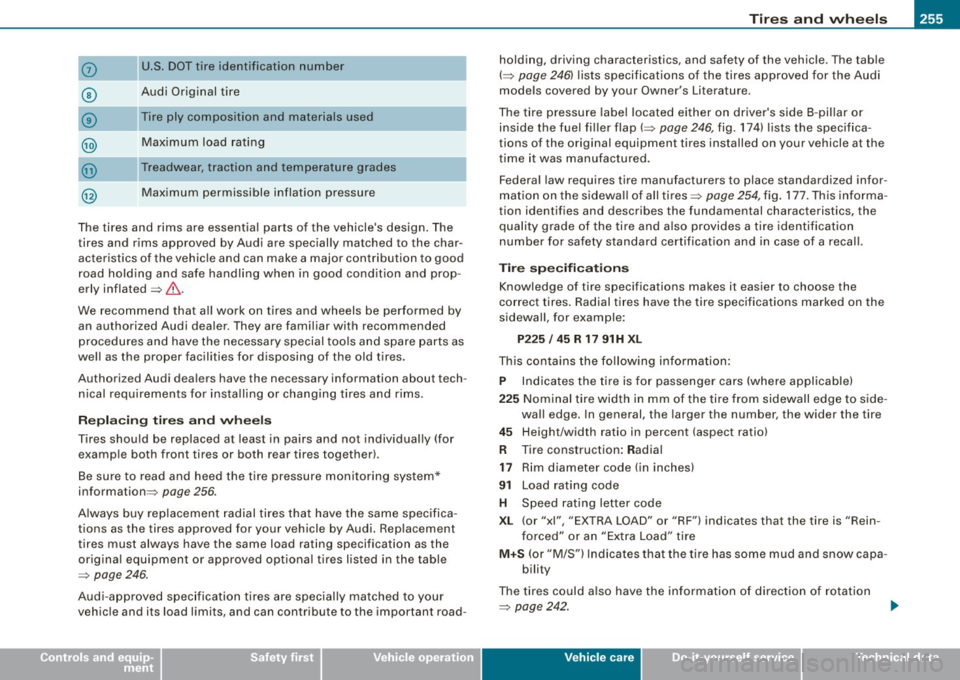
U.S. DOT tire identification number
Audi Original tire
Tire ply composition and materials used Maximum load rating
Treadwear, traction and temperature grades
@ Maximum permissible inflation pressure
The tires and rims are essential parts of the vehicle 's design. The
tires and rims approved by Audi are specially matched to the char
acteristics of the vehicle and can make a major contribution to good
road hold ing and safe handling when in good cond ition and prop
erly inflated =>& .
We recommend that a ll work on tires and wheels be performed by
an authorized Audi dealer. They are familiar with recommended
procedures and have the necessary special tools and spare parts as
well as the proper facilities for disposing of the old tires.
Authorized Audi dea lers have the necessary info rmation about tech
nical requirements for insta lling or changing tires and rims.
R epl ac ing tires and wheels
Tires shou ld be replaced at least in pairs and not individual ly (for
examp le both front tires or both rear tires together).
Be sure to read and heed the tire pressure monitoring sys tem*
information=>
page 256.
A lways buy replacement radial tires that have the same specifica
tions as the tires approved for your vehicle by Audi. Rep lacement
tires must always have the same load rating specification as the
origina l equipment or approved optional t ires listed in the table
=>
page 246.
Audi -appr oved spec ification tires are spec ially matched to your
vehicle and its load limits, and can contribute to the important road- holding, driving characteristics, and safety of the vehicle
. The table
( =>
page 246) lists specifications of the tires approved for the Audi
models covered by your Owner's Literature.
The tire pressure labe l located either on driver's side 8 -pi llar or
inside the fuel fi ller flap(=>
page 246, fig. 174) lists the specifica
tions of the original equipment tires installed on your vehicle at the
ti me it was manufactured.
Federa l law requires tire manufacturers to place standardized infor
mation on the sidewa ll of all tires =>
page 254, fig . 177. This informa
t ion identifies and describes the fundamental characteristics, the
qua lity grade of the ti re and also provides a tire identification
number for safety standard certificat ion and in case of a recal l.
Tire specificat ions
Knowledge of tire specifications makes it easier to choose the
co rrect t ires . Radial tires have the tire specifications marked on the
sidewall, for example :
P225 / 45 R 17 91H XL
This contains the fo llowing informa tion:
P Indicates the ti re is for passenger cars (where applicab le)
225 No minal tire width i n mm of the tire fro m sidewall edge to side -
wa ll edge. In general, the larger the number, the wider the tire
45 Height/width ratio in percent (aspect ratio)
R Tire construction: Radial
17 Rim diameter code (in inches)
91 Load rating code
H Speed rating lette r code
XL (or "xi", "EX TRA LOA D" or "RF") indicates that the tire is "Rein
forced" or an "Extra Load" ti re
M +S (o r "M/S") Indicates that the tire has some mud and snow capa
bility
The tires could a lso have the information of direct ion of rotation
=>
page 242.
Vehicle care I t •
Page 262 of 320

-~_T_ ir_e_ s_ a_ n_d _ w_ h_ e_e _l_s _________________________________________________ _
& WARN ING (continued )
personal injur ies . Have worn or damaged tires replaced immedi
ately.
• Winter tires have ma ximum speed rating that may be lower
than your vehicle' s maximum speed.
• Never drive faster than the speed for which th e winter or other
tire s installed on your vehi cle are rated.
& WARNING
Always adjust your driving to the road and traffic condit ions .
Never let the good acceleration of the winter tire s and all -wheel
d rive tempt you into taking extra risks. Always remember :
• When braking , an all -wheel drive vehicle handles in the same
way as a front drive vehicle .
• Drive carefully and reduce your speed on icy and slippery roads ,
even winter tires cannot help under black ice conditions.
<£> For the sake of the environment
Use summer tires when weather conditions permit. They are
quieter, d o not wear as quick ly a nd r educe fuel cons ump tion.•
Snow chains
Sn ow cha ins may be fitte d only to th e fron t whee ls, and o nly to
certain tire sizes . Ask your authorized Audi dealer on which tire
s iz es snow c hains can be used.
If you are going to use snow cha ins, then you must install them on
the front wheels at least.
The s now chains mus t have low-pro file l inks and must not be thicker
than 0. 53 inch ( 13.5 mm), including the lock. Remove wheel
center covers and trim discs before putting snow
chains on y our vehicle =>
(D. For safety reasons cove r caps mus t
then be fitted over the wheel bo lts . These are avai lable from autho
r ized Audi deale rs .
& WARNING
Using the wrong snow chain s for your vehi cle or in stalling them
incorre ctly can increase the risk of loss of control leading to
serious personal injury.
• Snow cha ins are available in different sizes . Alw ays make sure
to follow the instructions provided by the snow chain manufac
turer .
• When driving with snow chains never drive faster than the
speed permitted for your specific snow chains .
• Always observe local regulations .
0 Note
• Remove snow c ha ins before driving o n roads not covered with
snow to avoid damaging tires and wearing the snow cha ins down
u n n ecessa ri ly .
• Snow chains, which come into direct contact with the wheel rim,
ca n scratc h or da mage it . There fore, make sur e th at the sn ow cha ins
are suitab ly cove red . Check the position of the snow chains after
dr ivi ng a few yards a nd correct if ne cessary. Foll ow th e instruct io ns
from the snow chain manufacturer when doing so.
[ i ] Tips
Where snow chains are mandatory on certain roads, this norma lly
a lso ap plies to veh ic les wit h A ll Wheel Drive .•
Page 268 of 320

___ T _i_r e_=- p_r_e _ s_ s_ u_r_ e _ m_ o_ n_i_t _o _r_ i _ n .,;:g ::;.._ s_ y=--- s_t _e _m_ * __________________________________________ _
All pressure warning indicators in the display will be canceled.
Following each intentional change in specified pressures, tire pres
sures must be saved again .
After the pressures are saved, the tire pressure monitoring system measures the current tire pressures and saves them as the new
specified pressures.
[ i ] Tip s
• The tire pressure is shown on the tire pressure label. The tire
pressure label is located either on the driver's side 8 -pillar or on the
inside of the fuel filler flap . The tire pressure label lists the recom
mended cold tire inflation pressures for the vehicle at its maximum
capacity weight and the tires that were on your vehicle at the time
it was manufactured. For recommended tire pressures for normal
load conditions, p lease see chapter=>
page 246.
• The tire pressure monitoring system helps the driver monitor t ire
pressures, but the driver is still responsible for mainta ining the
correct tire pressure. •
Applie s to v ehic les : wi th tir e pr essure monito ring syst em
Wheel change
If a wheel is changed, the wheels that were exchanged
have to be reprogrammed.
- Turn o n the igniti on.
- Press the button=>
page 265, fig. 179 for approximately 5
seco nds . You will he ar a beep and the symbol in the
button flas hes three times .
Programming is necessary :
• after the tires have been rotated on the vehicle, or the spare tire
is used, •
if tires with new wheel sensors are used .
All pressure warning indicators in the disp lay wil l be canceled . The
system malfunction error message will not disappear until the
vehic le is underway. With pressing the button=>
page 265, fig. 179,
t he reprogramming of the new sensors a nd storing of actua l pres
sures starts. This learning phase can take up to 10 minutes driving
time .
During the learning process the tire pressure monitoring system is
no t avai lable. •
Applies t o vehicl es: with tire pr essur e mon itoring syst em
Malfunctions *
A mal functi on can have various c auses.
Fig . 18 0 Di sp lay:
Syst em m alfunction
If the I warning l ight in the instrument clus ter flashes for approxi
mately one minute and then remains continuously illuminated and
additiona lly the
T M => fig. 180 symbol appears in the display, the
tire pressure monitoring system is not available. This can have
various causes .
• I f the message appears at the end of the learning process, the
system cannot recognize the wheels installed on the vehicle . This
can be because one or more whee ls without a whee l sensor were
insta lled. ..,_
Page 297 of 320
_________________________________________________ G_ e_ n_ e_r _a _l_ i_n _f_o _ r_ m_ a_ t _i _o _ n __ _
left door jamb. It shows the month and year of production and the
vehicle identification number of your vehicle (perforation) as well as
the Gross Vehicle Weight Rating (GVWR) and the Gross Axle Weight
Rating (GAWR).
The high voltage warning label
is located on the lock carrier.
The spark ignition system complies with the Canadian
standard ICES-002. •
Weights
Gross Vehicle Weight Rating
The Gross Vehicle Weight Rating (GVWR), and the Gross Axle Weight
Rating (GAWR) for front and rear are listed on a sticker on the left
door jamb.
The Gross Vehicle Weight Rating includes the weight of the basic
vehicle plus full fuel tank, oil and coolant, plus maximum load,
which includes passenger weight (150 lbs/68 kg per designated
seating position) and luggage weight.
Gross Axle Weight Rating
The Gross Axle Weight Rating is the maximum load that can be
applied at each axle of the vehicle ~& .
Vehicle capacity weight
The vehicle capacity weight (max. load) is listed either on the
driver's side B-pillar or inside the fuel filler flap .
Roof weight
The maximum permissible roof weight is 165 lb (75 kgl. The roof
weight is made up of the weight of the roof rack system and the
weight of the object being transported~
page 89, "Loading the
roof rack".
Controls and equip ment Safety first Vehicle operation
& WARNING
•
The actual Gross Axle Weight Rating at the front and rear axles
should not exceed the permissible weights, and their combination
must not exceed the Gross Vehicle Weight Rating.
• Exceeding permissible weight ratings can result in vehicle
damage, accidents and personal injury.
0 Note
• The vehicle capacity weight figures apply when the load is
distributed evenly in the vehicle (passengers and luggage). When
transporting a heavy load in the luggage compartment, carry the
load as near to the rear axle as possible so that the vehicle's
handling is not impaired.
• Do not exceed the maximum permissible axle loads or the
maximum gross vehicle weight. Always remember that the vehicle's
handling will be affected by the extra load. Therefore, adjust your
speed accordingly.
• Always observe local regulations.•
Dimensions
The specifications refer to the basic model. Differences may occur
depending on the model type and options ordered, for example, tire
sizes.
0 Note
When driving up steep ramps, on rough roads, over curbs, etc. it is
important to remember that some parts of your vehicle, such as
spoilers or exhaust system components, may be close to the
ground. Be careful not to damage them. •
Vehicle care Do-it-yourself service Tec hn ica l da ta
Page 298 of 320
___ D_ a_ ta ______________________________________________________ _
Data
Applies to vehi cles: with 2.0 lite r TFS I 4-cyl. g asoline eng ine ,
200 hp, 2.0 liter 4-cyl. turbo gasoline engine
Engin e data
Maximum output SAE net
Maximum torque SAE net
No. of cy linders
Disp lacement
Stroke
Bore
Compression ratio
Fuel
D im ensio ns (a pprox.)
Length (with licence plate bracket)
Width (across mirrors)
Height (unladen, incl. roof rails)
Turning circle diameter (curb to cu rb)
Ca pacitie s (a pprox.)
F u el t ank
-Total capacity
- Reserve (of total capacity)
W ind shi eld was her fluid cont ain er
Engine oil
with filter change hp@rpm
lb
-ft@ rpm
CID (cm
3 )
in (mm)
in (mm)
200@ 5100 -6000
207 @ 1700 -5000
4 121 (1984)
3.65 (92.8)
3 .25 (82 .5)
9 .6 : 1
Premium unleaded (91 AKI) Recommended for maximum engine performance . Fur
ther det ails =:>
page 277, "Gasol ine"
in (mm)
in (mm)
in (mm)
ft. (ml
168.9 (4292)
78 .5 (1995)
56.0 (1423)
35.1 (10.7)
gal/liters
gal/liters
quarts/liters
quarts/liters 14 .6 / 55.0
1 .8/7.0
3 .1 / 3 .0
4 .8 / 4.6
•
Page 299 of 320
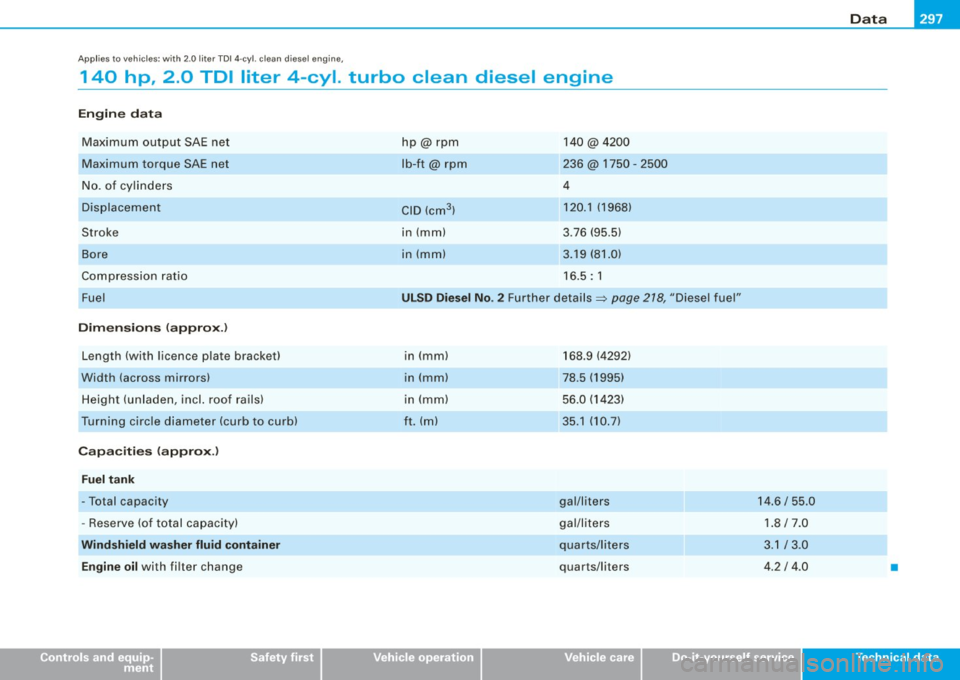
___________________________________________________ D_a_ t_ a __ !II
A pp lies to veh ic les : w it h 2 .0 liter TDI 4 -cyl. c le an di esel e ngin e,
140 hp , 2 .0 TOI liter 4-cyl. turbo clean diesel engine
Engine data
Maximum output SAE net
Maximum torque SAE net
N o. o f cy linders
Displacement
Stroke
Bore
Co mpression ratio
Fuel
Dimensions (approx .)
Length (with licence p late bracket)
Width (across mirrors) H eight (unla den, incl. roof ra ils)
Turning circle diameter (curb to curb)
Capacities (approx .)
Fuel tank
-Total capacity
- Reserve (of t otal capacity)
Wind shield wa sher fluid container
Engine oil
with filter change
Controls and equip ment Safety first
hp@rpm
lb-ft@ rpm
CID (cm
3
)
in (mm)
in (mm)
14 0 @4200
236 @ 1750 · 2500
4
120.1 (1968)
3 .76 (95 .5)
3.19 (81 .0)
16. 5: 1
ULSD Diesel No . 2 Further details=> page 218, "Diesel fue l"
in (mm)
in (mm)
in ( mm)
ft. (ml
Vehicle operation
168.9 (4292)
78.5 (1995) 56.0 (14 23)
35.1 (10.7)
gal/liters
gal/li te rs
quarts/liters
quarts/liters
Vehicle care
14.6 / 55.0 1.8/7.0
3.1 / 3_0
4.2 I 4 .0
Do-it-yourself service
•
T ec hn ica l da ta