fuel cap AUDI S3 2010 Owners Manual
[x] Cancel search | Manufacturer: AUDI, Model Year: 2010, Model line: S3, Model: AUDI S3 2010Pages: 320, PDF Size: 75.34 MB
Page 12 of 320
Instruments and warning/indicator lights
Engine cold
As long as the needle remains at the left end of the gauge, the
engine still has not reached its operating temperature . Avoid high
engine speeds, heavy engine loads and heavy throttle.
Normal temperature
When the engine has reached its operating temperature, the needle
will move into the middle of the gauge and remain there. If the engine is working hard at high outside temperatures, the needle
may turn further to the right. This is no cause for concern as long as
the
_ f_ warning light in the instrument cluster does not illuminate.
When the
-L warning light starts to flash, this can mean one of two
things: either the coolant
temperature is too high, or the coolant
level is too low=> page 30.
& WARNING
• Always observe the warning in=> page 215, "Engine compart
ment" before opening the engine hood and checking the engine
coolant level.
• Never open the engine hood if you see or hear steam, or if you
see engine coolant dripping from the engine compartment. You
could burn yourself. Let the engine cool off first so that you cannot
hear or see any steam or engine coolant.
0 Note
• Mounting additional lights or accessories in front of the air inlets
reduces the cooling effect of the radiator . At high outside tempera
tures or high engine load, the engine could overheat.
• The front spoiler has been designed to properly distribute the
cooling air when the vehicle is moving. If the spoiler is damaged,
this could reduce the cooling effect and the engine could then over
heat. Ask your authorized Audi dealer for assistance. •
Fuel gauge
The fuel gauge works only when the ignition is on.
When the needle reaches the red area, the warning light in the
instrument cluster will illuminate=>
page 32 I). This means you
have approximately 1.8 gallons (7 liters) of fuel left in the tank.
Time
to refuel!
The total tank capacity of your vehicle is listed in=> page 296,
"Data".
0 Note
Never run the tank completely dry! An irregular supply of fuel can
cause engine misfiring and fuel could enter into the exhaust
system. The catalytic converter could then overheat and be
damaged .•
Speedometer with odometer
The speedometer shows you the vehicle speed, and the
odometer shows you how many miles (kilometers) you
have driven.
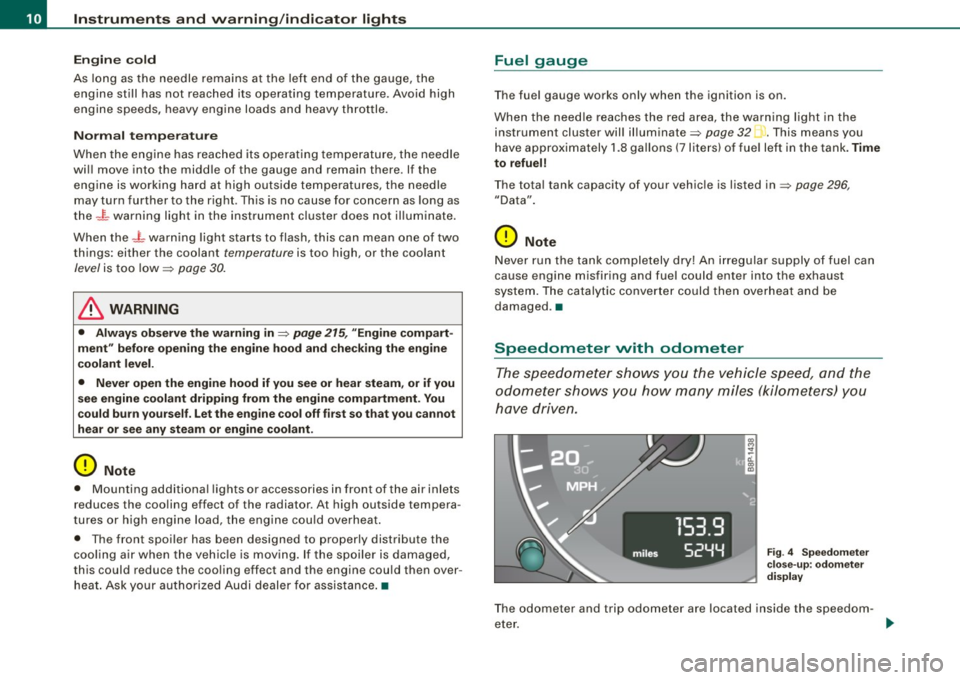
Fig. 4 Speedometer
close-up : odometer
display
The odometer and trip odometer are located inside the speedom
eter.
Page 20 of 320
Driver informati on displ ay
Driver information display
Introduction
Introduction
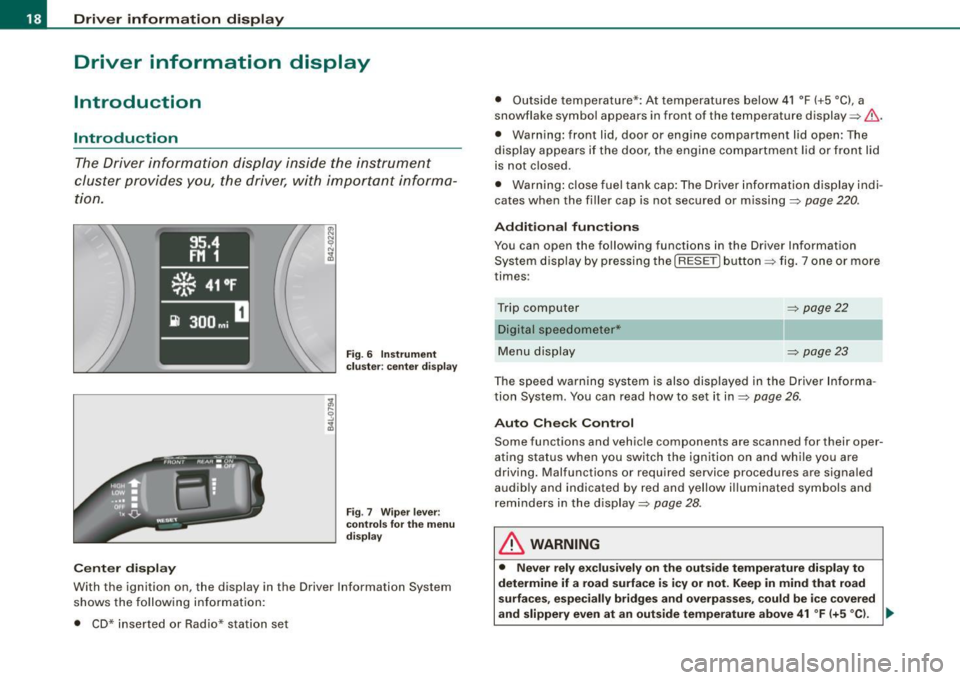
The Driver information display inside the instrument
cluster provides you , the driver, with important informa
tion.
Ce nter d isplay
Fig . 6 Inst rum ent
c lu ster : cente r dis pl ay
Fig .
7 Wiper lever :
co ntrol s for t he m enu
d isp lay
W ith th e ignition on, the displ ay in th e Driver Info rmation System
shows the follow ing information :
• CD* inserted or Radio* station set •
Outside tempe rature *: At temperatures below 41 °F ( +5 °C l, a
snowflake symbol appea rs in front of the temp erature display ~& .
• Warning: front lid , door or engine compartment l id open: The
display appears if the door, the engine compartment lid or front lid
is not closed .
• Warning : close fuel tank cap: The Driver information display indi
cates when the filler cap is not secured or missing~
page 220.
Additional fun ctions
You can open the following fun ctions in the Driver Information
System display by pressing the
I RESE T] button ~ fig. 7 one or more
times :
Trip computer Digital s peedometer*
Menu display
~ page22
~ page23
The speed warning system is also displayed in the Driver Informa
t ion System. You can read how to set it in~
page 26.
Auto Check Con trol
Some functions and vehicle componen ts are scanned for their oper
ating status when you switch the ignition on and wh ile you are
driving. Malfunc tions or required service procedures are signa led
audib ly and indicated by red and yel low illuminated symbols and
rem inders in the display~
page 28 .
& WARNING
• Never rely e xclusivel y on the outside temperature di spla y to
det ermine if a road surface is ic y or not. Keep in mind that road
s urface s, esp ec ia lly bridge s and overp asses, co uld be i ce cove red
and slippery even at an out side t emperatur e above 41 °F (+ 5
°C l. -.,
Page 23 of 320
On-Board Diagnostic system (08D)
On-Board Diagnostics
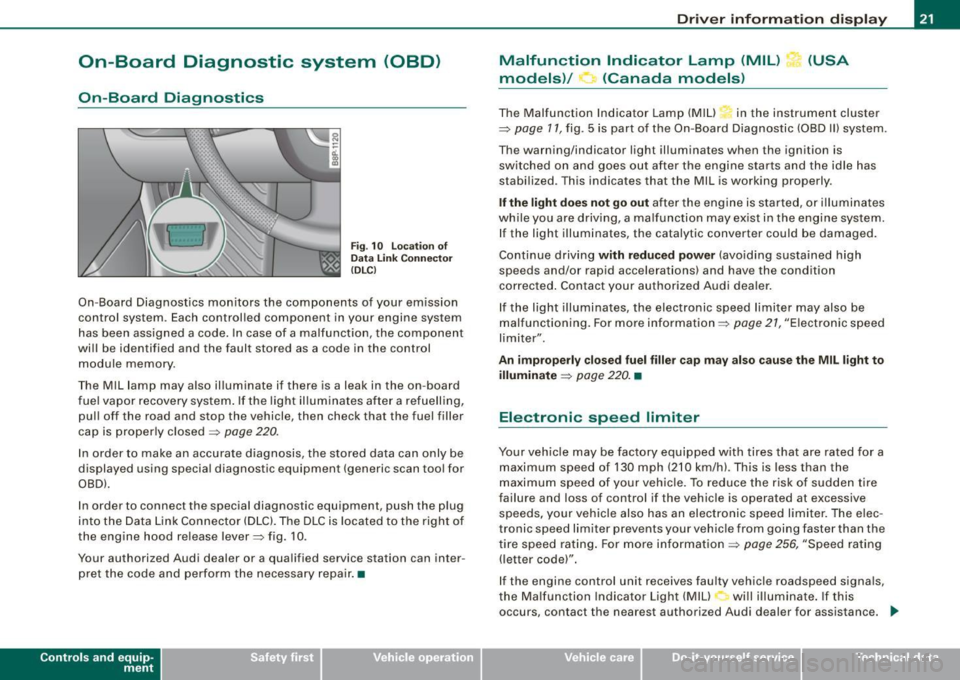
Fig. 10 location of
Data Link Connecto r
( DL C)
On-Board Diagnostics monitors the components of your emission
control system . Each controlled component in your engine system
has been assigned a code. In case of a malfunction , the component
will be identified and the fault stored as a code in the control
module memory .
The Mil lamp may also illuminate if there is a leak in the on-board
fuel vapor recovery system . If the light illuminates after a refuelling,
pull off the road and stop the vehicle, then check that the fuel filler
cap is properly closed
=> page 220 .
In order to make an accurate diagnosis, the stored data can only be
displayed using special diagnostic equipment (generic scan tool for
OBDl.
In order to connect the special diagnostic equipment, push the plug
into the Data Link Connector (DLC). The DLC is located to the right of
the engine hood re lease lever=> fig. 10.
Your authorized Audi dealer or a qualified service station can inter
pret the code and perform the necessary repair. •
Contro ls and eq uip
ment
Driver information display
Malfunction Indicator Lamp (MIL) (USA
models)/ (Canada models)
The Malfunction Indicator Lamp (MIU in the instrument cluster
=> page 11, fig . 5 is part of the On-Board Diagnostic (OBD II) system .
The warning/indicator light illuminates when the ignition is
switched on and goes out after the engine starts and the idle has
stabilized. This indicates that the Mil is working properly .
If the light does not go out after the engine is started, or illuminates
while you are driving, a ma lfunction may exist in the engine system.
If the light illuminates, the catalytic converter could be damaged.
Continue driving
with reduced power (avoiding sustained high
speeds and/or rapid accelerations) and have the condition
corrected . Contact your authorized Audi dealer.
If the light illuminates , the electronic speed limiter may also be
malfunctioning. For more information=>
page 21, "Electronic speed
limiter".
An improperly closed fuel filler cap may also cause the MIL light to
illuminate
=> page 220. •
Electronic speed limiter
Your vehicle may be factory equipped with tires that are rated for a
maximum speed of 130 mph (210 km/h) . This is less than the
maximum speed of your vehicle. To reduce the risk of sudden tire
failure and loss of control if the vehicle is operated at excessive
speeds, yo ur vehicle also has an electronic speed limiter. The elec
tronic speed limiter prevents your vehicle from going faster than the
tire speed rating. For more information
=> page 256, "Speed rating
(letter code)".
If the engine control unit receives faulty vehicle roadspeed signals,
the Malfun cti on Indicator Light (MIU will illuminate . If this
occurs, contact the nearest authori zed Audi dealer for assistance. _.,
Vehicle care I I irechnical data
Page 221 of 320
•
labeled ask the station operator what fuel is being dispensed before
filling up your vehic le .
Service stations offering diesel fuel are generally located on truck
routes or major highways. Directories of diesel fuel stations are
usually available at diese l fuel stations.
Some states in the USA require permits to purchase diesel fuel.
Check with your State Motor Vehicle Department.
Diesel fuel may not be available outside the USA and Canada . Be
su re to check before traveling to other countries .
Winte r ope ra ti on
At temperatures be low 20° F (- 7° Cl, Diesel fuel No. 2 loses its fluidity
due to wax separation, which may c log the fuel filter or tank filter
and keep the engine from running.
To he lp the filter from being clogged by wax, the fue l filter in your
vehic le is automatically preheated. Preheating the fuel fi lter makes
operation of your vehicle poss ible with Diese l fue l No. 2 down to -
10° F (- 24° Cl.
If you expect tempe ratures below 5° F ( -15° C) ask your fuel dealer
whether their Diesel fuel No. 2 is sufficiently winterized for the prevai ling and expected temperatures .
If not winterized or insufficiently winterized diesel fuel has already
thickened to the extent that the engine will not start, warm the
vehicle up by leaving it in a heated garage.
It is normal that the engine noise level (dieseling) is louder during
the warm -up per iod in winter. It is also normal when whitish -blue
smoke comes out of the tailpipe after starting and dur ing warm-up.
The amount of smoke depends on the outside temperature .
Do not let your diese l eng ine idle unnecessarily after a cold start.
Driving off slowly will shorten the warm -up period.
F ue l supply and fillin g you r fu el tank
& WARNING
• Never use "s tarting a ssis t f luid s." They m ay be pot entiall y
explo sive or c au se a " run-away " engine condition. Thi s cou ld
re sult in serious e ngin e da ma ge a nd pe rsonal injury.
• Never use fu el line anti -free ze offer ed f or ga soline engine s.
0 Note
• Your diesel engine has been speci fically designed to operate
only on Ultra Low Sulfur Diese l fuel. Therefore, never use home
heating oi l or regular gaso line . The properties of these fuels may
cause serious damage to the fuel injection system and to the
engine . Using these fuels can cause expensive engine repairs and
wi ll also adversely affect your New Vehic le Limited Warranty.
• I f diese l fue l should get on any rubber hose, it must be wiped off
immediately . Then wash the contaminated hose portion with soap
and warm water. Do not allow diesel fuel to remain on connecting
hoses. They may develop leaks and cause serious damage. •
Fuel tank
Fuel filler neck
The fuel filler neck is located o n the right rear s ide panel behind the
fuel filler f lap.
I f the powe r locking system should fa il, you can still open the flap
manually - for detailed instructions see:::::,
page 222.
You can find the fuel tank capacity of your vehicle in Techni cal Data
:::::, page 296 .
The label on the inside of the fuel filler flap tells you the correct fuel
for your vehicle. F or more informa tion about fue l specifications, see
=:> page 217. _,,
Vehicle care I t •
Page 222 of 320

Fuel supply and filling your fuel tank
Your vehicle fuel tank has an on-board refuelling vapor recovery
sys te m. Th is f eat ure he lp s to p re vent f uel vapors from es ca pin g
from the tan k and polluting the environment while you refue l your
vehic le . In ord er to fill t he tank pr ope rly while protec tin g the e nvi
ronm ent, pl eas e follow this refu eling procedur e carefu lly.
& WARNING
Under normal operat ing conditions , never carry additional fuel
containers in your car. Gas canisters and other containers used to
tran sport fuel can be dangerous . Such containers , full or empty ,
may leak and could cause a fire in a collision .
If you must transport
fuel to use for your lawn mower , snow blower , etc ., be very careful
and always observe local and state laws regarding the use , trans
portation and storage of such fuel container s. Make certain the
container meets industry standards (ANSI/ASTM F852 -86).
0 Note
Never drive your vehicle unti l the fue l tank is completely d ry . The
i rre gular supply o f fu el can cause mis firin g. Gaso lin e cou ld en ter
into the exhaust system and damage the catalytic converter. •
Refuelling
The fu el filler fl ap is unlo cke d from a bu tton i n t he driver 's
d oo r.
Fi g. 159 Dr iver' s door :
Unlocking fuel fille r
flap
Fig . 160 Fuel cap
hooked on the opened
fuel filler flap
W hen addin g fuel , th e ign itio n a nd a ny ce llular phon es in
th e ve hicle mu st b e switche d
off.
Taking the fuel cap off
To open t he fue l filler flap, pull t he button~ fig. 1 59 .
Unsc rew fuel filler cap co unter-clock wise an d hang it o n
t h e fuel fille r flap ~ fig. 16 0.
~
Page 223 of 320

Fuel supply and filling your fuel tank -___________ ...:._:......:,_______;::;...a,__ __
•
Refuelling procedure
-Inse rt the fuel nozz le f rom the gaso line pump i nto the
fuel filler neck as fa r as it w ill go.
- Select a medium refue lling rate so that the nozzle
s w itches off automat ica lly wh en the tank is ful l.
Putting the fuel cap back on
- Afte r fillin g yo ur ta nk, twi st the f uel fill er ca p clockwi se
unt il you h ear a de finite cli ck.
- Cl ose the fue l fille r fla p.
To avo id fuel sp illing or evapora tin g from the fuel tan k alwa ys close
f u el filler cap p roper ly an d co mple te ly . A n im prope rly clo sed f uel
fil ler cap may also caus e a m essa ge in th e dr iver in for matio n syst em
or cause the MIL lamp => page 21 to come on.
& WARNING
Improper refueling or handling of fuel can cause fire , explosion
and severe burns .
• Fuel is highly flammable and can cause severe burns and other
injuries .
• Failure to shut the engine off while refueling and /or to insert
the pump nozzle fully into the fuel filler ne ck could cause fuel to
spray out of filler neck or to overflow. Fuel spray and overflowing
fuel can cause a fire .
• Never use a cellular telephone while refueling . The electromag
netic radiation can cause sparks that can ignite fuel vapors and
c ause a fire .
• Never get ba ck into your vehicle while refueling .
If in excep
tional circumstances you must get back in your vehicle while refu
eling , make certain that you close the door and touch metal to
discharge static electricity before touching the filler nozzle again.
& WARNING (continued )
Static electricity can cause sparks that can ignite fuel vapors
released during refueling .
• Never smoke or have an open flame anywhere in or near your
vehicle when refueling or filling a portable fuel container.
• For your safety, we strongly recommend that you do not travel
with a portable fuel container in your vehicle. The container , full or
empty may leak and could cause a fire , especially in a crash .
• If, under e xceptional circumstances , you must transport a
portable fuel container, please observe the following:
-Never fill a portable fuel container while it is anywhere in or
on the vehicle (for example , in the luggage compartment , or on
the trunk). Static electricity can build up while filling and can ignite fuel vapors cau sing a fire.
- Always place a portable fuel container on the ground before
filling.
- Always keep the filler nozzle completely inside the portable
container before and during filling .
- If filling a portable container made of metal , the filler nozzle
must always be in contact with the container. This will help
prevent static electricity from discharging and cause a fire.
- Never spill fuel inside the vehicle or luggage compartment .
Fuel vapors are h ighly flammable.
- Alway s observe local and state /provincial laws regarding the
use , storage and transportation of fuel containers.
- Make certain the fuel container meets industry standards
(ANSI / ASTM F852-86I.
0 Note
• I f any f uel has sp illed onto the car , it shou ld be removed imme
d iate ly to pr event damage to the pa int.
• I f the f uel ta nk ru ns co mplete ly empty in a vehic le wi th a diesel
engine , the ignitio n mus t remain sw itched on for at least 30 seconds .,
Vehicle care
I t •
Page 224 of 320

-Fuel supply and filling y our fu el ta nk P'lf:l _ -----=-=--=-- --=-.c.-------------
after refueling before starting the engine. It may take longer than
usual for the engine to start, even up to a minute. This is because
the air must first bleed out of the fuel system when starting the
engine.
W For the sak e of the environm ent
As soon as the correctly ope rated nozzle swi tches off automatical ly
for the first time, the tank is full. Do not try to add more fuel because
fue l may spill out . In addition, the expansion space in the fuel tank
wi ll be filled -causing the fuel to overflow when it becomes warm
and pollute the environment.
[ i J Tip s
• Running your engine while refuelling may cause vapors to
escape or even fuel to spill out of the tank . Th is would then shut off
the fue l nozzle before the tank is full.
• Do not refuel your veh ic le with the ignit ion switched on. The fue l
gauge may otherwise not indicate the correct fuel level after
refuel ling .•
Unlocking the fuel filler flap by hand
You can open the fuel filler flap by hand
if the power
locking system should fail.
Fi g. 16 1 In side th e
lu ggag e compartm ent:
O pen in g th e f ue l fill er
fl ap
by ha nd
- Ope n the rear lid.
- Remove the screwdrive r from the vehicle tool kit
=>
page 268 .
- Use the screwdriver (vehicle tool kit) to pry the cover off
at the recess => fig. 161
(D.
- P ull the actuator in the direction of arrow@ to release
the fuel filler flap=> fig. 161.
- Open the fuel filler fl ap .•
Page 226 of 320
-~_C_ h_e _c _ k_ i_n ...:::g::;...._ a_n_ d_ f_ i_ll _in -'g:::;.._ ___________________________________________ _
Closing the engine hood
- Pull the hood down until the pressure from the strut is
reduced.
- Let the hood
drop down and latch in place. Do not try to
push it shut;
it may fail to engage~& .
& WARNING
A hood that is not completely latched could fly up and block your
view while driving.
• When you close the engine hood, check it to make sure the
safety catch has properly engaged. The hood should be flush with
the surrounding vehicle body parts.
• If you notice while driving that the hood is not secured prop
erly, stop at once and close it. •
Working in the engine compartment
Be especially careful whenever you work in the engine
compartment!
Whenever you must perform any work in the engine compartment,
for example checking and filling different fluids, there is a risk of injury, burns and accidents. To prevent personal injury always
observe the following WARNINGS. The engine compartment of any
vehicle is a hazardous area!
=> &
& WARNING
To help avoid injury, before you check anything under the hood :
• Turn off the engine.
• Remove the ignition key.
• Set the parking brake fully .
& WARNING (continued)
• Move selector lever of automatic transmission to "P" {Park);
put manual transmission in Neutral.
• Always let the engine cool down. Hot components will burn
skin on contact.
• To reduce the risk of being burned, never open the hood if you
see or hear steam or coolant escaping from the engine compart
ment. Wait until no steam or coolant can be seen or heard before
carefully opening the hood .
• Keep children away from the engine compartment.
• Never spill fluids on hot engine components. They can cause a
fire.
• Never touch the radiator fan. The auxiliary electric fan is
temperature controlled and can switch on suddenly.
• Never open the coolant reservoir cap when the engine is still
warm. The coolant system is pressurized and hot coolant could
spray out!
• Protect your face, hands and arm from steam or hot engine
coolant by placing a thick rag over the cap when you open the
coolant reservoir.
• If work on the fuel system or the electrical system is necessary:
- Always disconnect the battery .
- Never smoke or work near heaters or open flames. Fluids in
the engine compartment could start a fire.
- Keep an approved fire extinguisher immediately available.
• To avoid electrical shock and personal injury while the engine
is running or being started, never touch :
- Ignition cables
- Other components of the high voltage electronic ignition
system.
• If you must perform a check or repair with the engine running: .,_
Page 247 of 320

________________________________________________ T_ i _r_e _s_ a_n_ d_ w_ h_ e_e _ l_s __ _
•
Sidewa ll
means that portion of a tire between the tread and bead.
Speed ra ting
extended periods of time. The ratings range from 93 mph (150 km/h)
t o 186 mph (298 km/h) =>
page 256. You may not find this informa
tion on all tires because it is not required by law.
The speed rating letter code, where applicab le, is molded on the tire
sidewal l and indicates the maximum permissible road speeds.=:>
&
in "Winter tires" on page 259
T ire pre ssu re m onit orin g sys te m *
means a system that detects when one or more of a vehicle's tires
are under inflated and illuminates a low tire pressure warning tell
tale .
Tre ad
means that portion of a tire that comes into contact with the road .
Tread se para ti on
means pu lling away of the tread from the tire carcass.
Tr eadw ear indi cato rs ( TWI)
means the projections with in the principal grooves designed to give
a visual indication of the degrees of wear of the tread. See
~ page 253, "Tread Wear Indicator (TWI)" for more information on
measuring tire wear.
U ni form Tire Q ua lity G rading
is a tire information system developed by the United States Nationa l
Highway Traffic Safety Administration (N HTSA) that is designed to
help buyers make re lative comparisons among tires. The UTQG is
not a safety rating and not a guarantee that a tire will last for a
prescribed number of miles or perform in a certain way. It simply
gives tire buyers additiona l information to combine with other
considerations, such as price, brand loya lty and dealer recommen- dations
. Under UTQG, tires are graded by the tire manufacturers in
three areas : treadwea r, trac tion and temperature resistance. The
U TQG information on the tires, molded into the sidewalls.
U .S . DOT Tire Identifi cation Number (TIN )
This is the tire's "serial number" It begins with the letters "DOT" and
indicates that the ti re meets a ll federa l standards. The next two
numbers or letters indicate the plant where it was manufactured,
and the last four num bers represent the week a nd year of manufac
ture. For example,
DOT ... 2209 ...
means that the tire was produced in the 22nd week of 2009. The
other numbers are marketing codes that may or may not be used by
t he tire manufacturer. This information is used to contact
consumers if a tire defect requires a recall.
Vehicle capa cit y weight
means the rated cargo and luggage load plus 150 lbs. (68 kilograms)
times the vehicle's tota l seating capacity as l is ted on the label
located either on the driver's side 8-pillar or on the inside of the fuel
f iller flap .
Vehicle maximum lo ad on the tire
means that load on an individual tire that is determined by distrib
uting to each axle its share of the maximum loaded vehic le weight
and dividi ng by two .
Vehi cle normal load on t he tire
means that load on an individual tire that is determined by d istr ib
uting to each axle its share of the curb weight, accessory weight,
and normal occupant weig ht (distribute d in acc orda nce with table
below=>
page 246) and dividing by two. .,
Vehicle care I t •
Page 248 of 320

___ T_ i_ r_e _s_ a_ n_ d_ w_ h_ e_ e _ ls _________________________________________________ _
Occupant loading and distribution for vehicle normal load for various designated seating capacities
Designated seating capacity, num
ber of occupants Vehicle normal load, number of
occupants Occupant distribution in a normally
loaded vehicle
5 3
2 in front, 1 in back seat
Cold tire inflation pressure
Tire
pressure affects the overall handling, performance and safety of a vehicle.
Fig. 173 Tire pressure
label: located either on
driver's side B-pillar or
inside the fuel filler flap
Tire pressure generally refers to the amount of air in a tir e that it
needs it to do its job and safely carry the combined load of the entire
vehicle and its contents. Tire pressure is measured in kilopascals
(kPa), the international measuring unit and in pounds per square
inch (PSI). Tire pressure is based in part on the vehicle's design and
load limit -the greatest amount of weight that the vehicle can carry
safely and the tire size. The proper tire pressure is frequently
referred to as the "recommended cold tire inflation pressure." Air in
the tires expands when the tire heats up because of internal friction
when it flexes in use. The tire pressure is higher when the tire has
warmed up than when it is "cold ." It is the inflation pressure in a
"cold" tire that counts. Therefore, you should never let air out of a
warm tire to match "cold tire inflation pressure" recommendations .
The tires would then be underinflated and could fail suddenly.
SIZf COlD fflE PRESSUAf DIMENSION'S MfSSK)N DE$ l"NEV$ A fFIOiD
- KPA .• PSI
- KPA .• PSI
- KPA .• PSI
Fig. 174 Tire pressure
label
Maintaining proper tire pressure is one of the most important
th ings you can do to help avoid sudden tire failure . Underinflated
tires are a major cause of sudden tire failure. Keeping tires at the
right pressure is also important for safe and responsive vehicle
handling, traction, braking and load carrying .
Tire pressures are
particularly important when the vehicle is being driven at higher
speeds, and then especially when heavily loaded even within the
permissible load -carrying capacities approved for your vehicle.
The recommended tire pressures for your Audi depend on the kind
of tires on your vehicle and the number of passengers and/or
amount of luggage you will be transporting.
On USA vehicles, the tire pressure label is located on driver's side B
pillar. On Canada vehicles, the tire pressure label is located either on
the driver's side B -pillar or inside the fuel filler flap. The tire pressure
•
label lists the recommended cold tire inflation pressures for the .,