transmission AUDI S3 2010 User Guide
[x] Cancel search | Manufacturer: AUDI, Model Year: 2010, Model line: S3, Model: AUDI S3 2010Pages: 320, PDF Size: 75.34 MB
Page 120 of 320

_L_T.:...:.. r.:::a :.:n.: S::::.. m:.:..: iS::.::: S::iO ::::.:. n.:.._ _____________________________________________________ _
& WARNING
Hill Descent Assist cannot overcome physical limitations, so it
may not be possible to maintain a constant vehicle speed under all
circumstances. Always be ready to apply the brakes. •
Appl ies to vehic le s: w ith S I roni c®
tiptronic operation
Tiptronic allows the driver to shift gears manually.
"' "' ..,
;;;: ., m
Fig . 117 Center
console: Manual
shifting (tiptronicl
Fig. 118 Display:
Manual shifting
(tiptronic)
Switching to manual
Push the selector lever to the right from D. As the trans
mission has switched,
6 5 4 3 2 1 appears in the display,
with the gear that is engaged highlighted.
Upshifting
Tap the selector lever forward (in the tiptronic setting)
~ fig. 117 0-
Downshifting
Tap the selector lever backward (in the tiptronic setting)
0-
Switching to manual can be carried out with the vehicle stationary
as well as moving.
When accelerating, the transmission shifts into the next gear in
gears 1, 2, 3, 4 and 5 shortly before the maximum permissible
engine speed is reached.
If you have selected a lower gear than the current one, the transmis
sion will only shift down when the engine cannot be overspeeded.
If kick -down is actuated, the transmission shifts into a lower gear
independently of speed and engine rpm .•
Page 121 of 320
____________________________________________________ T_ r_ a _n _s_ m_ i_ s _ s_ i_ o _ n _ ___.1111111
Ap plies to vehicl es: with S tro ni c® and w ith Tip tr onic cont rols o n the stee ring wh eel
Steering wheel with Tiptronic ® controls
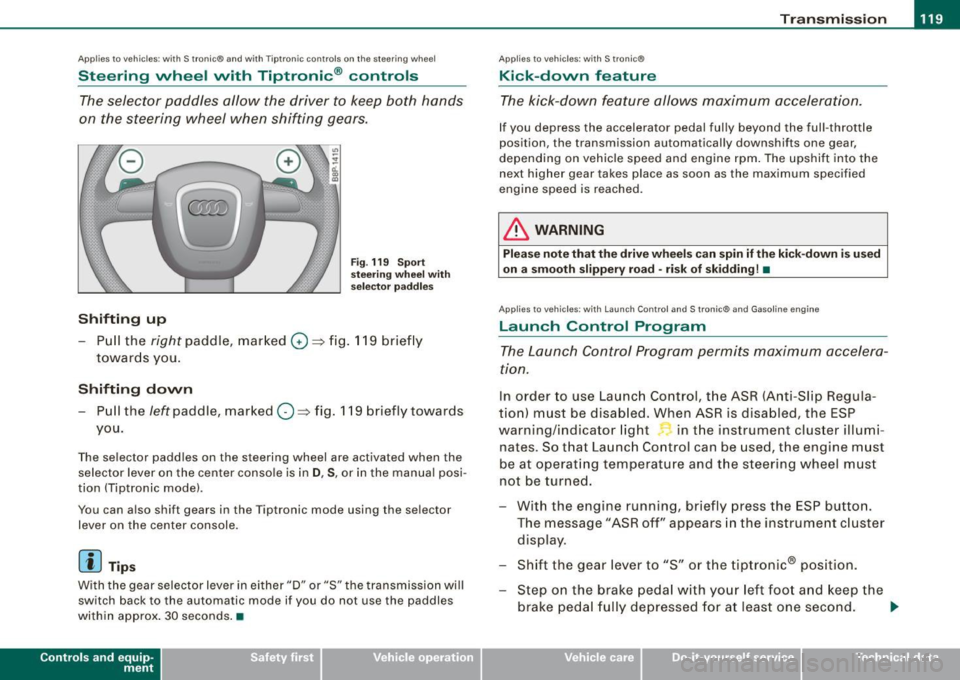
The selector paddles allow the driver to keep both hands
on the steering wheel when shifting gears.
Shifting up
Fig . 119 S port
s tee ring w he el w it h
selector pa ddles
-Pull the right paddle, marked 0 ==> fig. 11 9 briefly
towar ds you .
Shifting down
-Pull the left paddle, mar ked O ==> fig. 119 briefly towards
you.
The selector paddles on the steering wheel are activated when the se lector lever on the center console is in
D , S , or in the manua l posi
tion (Tiptronic mode) .
You can a lso shift gears in the Tiptronic mode using the se lector
lever on the center console .
[ i] Tips
With the gear selector lever in ei ther "D" or "S" the transmission wi ll
switch back to the automatic mode if you do not use the paddles
within approx . 30 seconds .•
Con tro ls and eq uip
ment
Ap plies to vehi cles: wit h S tr on ic ®
Kick -down feature
T he kick-down feature allows maximum acceleration.
If you depress the accelerator pedal ful ly beyond the ful l- throt tle
position, the transmission automatically downshifts one gear,
depending on vehic le speed a nd eng ine rpm . The upshi ft into the
next higher gear takes place as soon as the max imum specified
engine speed is reached .
& WARNING
Please note th at th e drive wheel s can spin if the kick -do wn is used
o n a s mooth slippery r oad -ri sk of sk idding! •
Applies to ve hicles: w it h L aunch Contro l and S tronic ® and Gaso line engine
Launch Control Program
The Launch Control Program permits maximum accelera
ti on.
In order to use Launc h Control, t he ASR (Anti-Slip Regula
tion) must be disab led . When ASR is disabled, the ESP
warning/indicator light in t he instrument cluster illumi
nates . So that Launch Control can be used, the engine must
be at operat ing temperature and the stee ring wheel must
not be turned.
- With the engine running, briefly press the ESP button.
The message "ASR off" appears in the instrument c luster
disp lay .
- Shift the gear lever to "S" or the tiptronic® pos ition.
- Step on the brake peda l w ith yo ur left foo t and keep the
brake peda l fully depressed for at least one second . _,.
Vehicle care I I Technical data
Page 122 of 320
• ..__T_ r_a _n_ s_ m_ is_ s_io _ n ______________________________________________________ _
- With your right foot, step on the accelerator to the wide
open throttle position or Kickdown. The engine speed
settles at about
3,200 rpm.
Take your left foot off the brake.
The S tronic® in your vehicle is electronically controlled. A special
Launch Control Program provides th e best acceleration from a
standing start .
& WARNING
• Always adapt your driving to the traffic flow.
• Only use Launch Control when road and traffic conditions allow
it and other drivers will not be endangered or annoyed by your
driving and the acceleration of the vehicle.
• Make sure that ESP remains enabled. With the ESP disabled,
the vehicle could brake away, particularly on a slick and slippery
road -risk of skidding!
• Once acceleration is finished, switch ASR on again by briefly
pushing the ESP button . •
Ap plies to ve hicles : wit h S t ro ni c®
Back-up program
In the event of a system malfunction, there is an back-up
program.
In the event of system malfunction, the automatic transmission
switches to th e fail -safe mode . All o f the selec tor lever pos ition
displays for the automatic transmission are highlighted with a light
background in the instrument clust er display. In some cases you
cannot drive in the reverse gear any more .
If the transmission swi tches to fail-safe mode, you should take the
vehicle to an authorized Audi dealership as soon as possible to have
the condition corrected .•
A pp lies to veh ic les: w ith s tro nic®
Emergency release for selector lever version
A
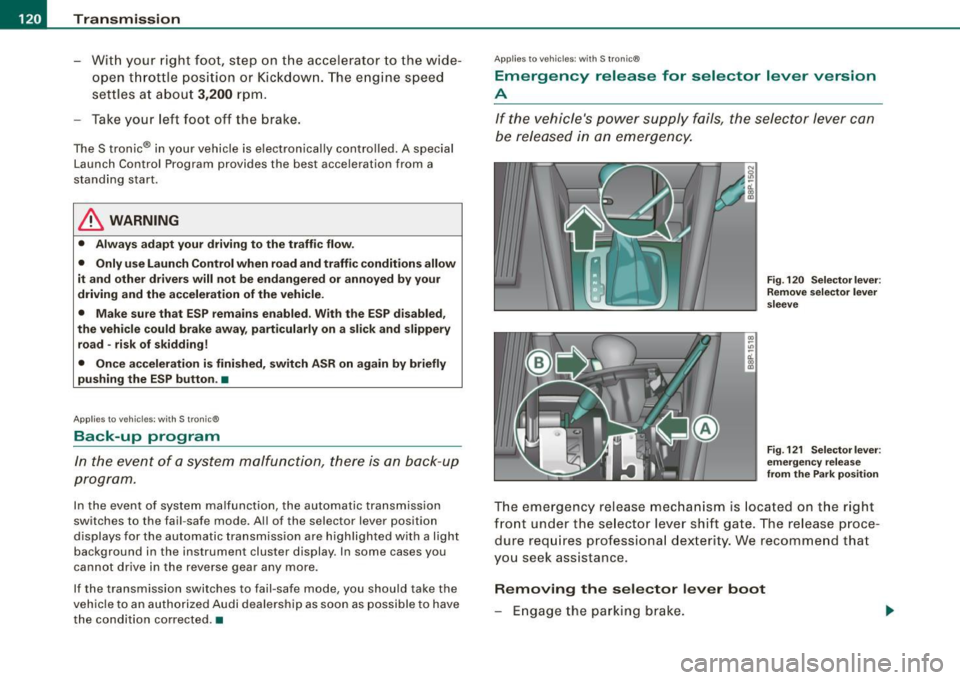
If the vehicle's power supply fails , the selector lever can
be released in an emergency.
Fig. 120 Selector lever :
Remove selector lever
sleeve
Fig . 121 Selector lever :
emergency release
from the Park position
The emergency release mechanism is located on the right
front under the selector lever shift gate. The release proce
dure requires professional dexter ity. We recommend that
you seek assistance.
Removing the selector lever boot
- Engage the parking brake.
Page 123 of 320
Transmission -_______________ ___.
- Remove the screwdriver from the vehicle tool kit. Use the
flat side of the reversible screwdriver blade~
page 268.
-Carefully pry the cover out with the screwdriver and pull
it ~
page 120, fig. 120 toward the shifter knob in the
direction of the arrow. The screwdriver must grip at the
lower edge of the cover to loosen it.
Emergency release for selector lever
-Press the release lever toward the center of the vehicle
with the screwdriver ~
page 120, fig. 121 @and hold it
in this position.
- Now press the lock button on the selector lever @ and
move the selector lever to the N position.
- Clip the shift boot back into the shift gate.
If the vehicle has to be pushed or towed if the power supply fails
(e.g. battery is discharged) , the selector lever must be moved to the
N position using the emergency locking device.
& WARNING
The selector must only be shifted from the P position if the hand
brake is firmly applied . Otherwise the vehicle would start moving
unexpectedly on a grade when the selector lever is shifted from
the P position -increasing the risk of an accident . •
Con tro ls and eq uip
ment
Ap plies to vehic les: with S tron ic®
Emergency release for selector lever version
B
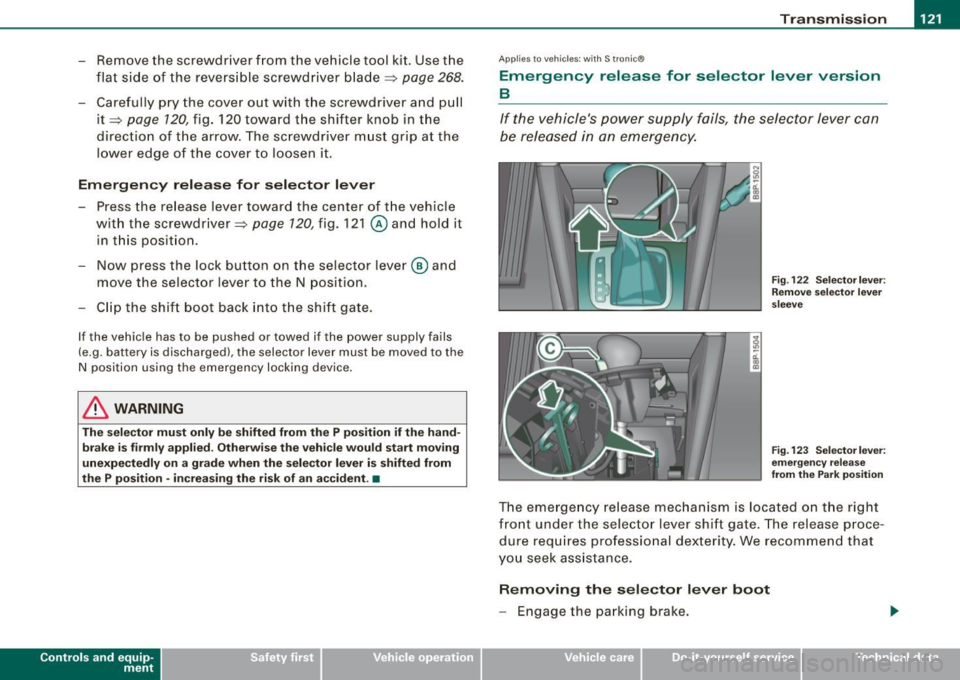
If the vehicle's power supply fails, the selector lever can
be released in an emergency.
Fig . 122 Selector lever :
Remove selector lever
sleeve
Fig. 123 Selector lever:
emergency release
from the Park position
The emergency release mechanism is located on the right
front under the selector lever shift gate. The release proce
dure requires professional dexterity. We recommend that
you seek assistance.
Removing the selector lever boot
- Engage the parking brake.
Vehicle care I I irechnical data
Page 124 of 320
-Transmission --------------------
-
Remove the screwdriver from the vehicle tool kit. Use the
flat side of the reversible screwdriver blade
~ page 268.
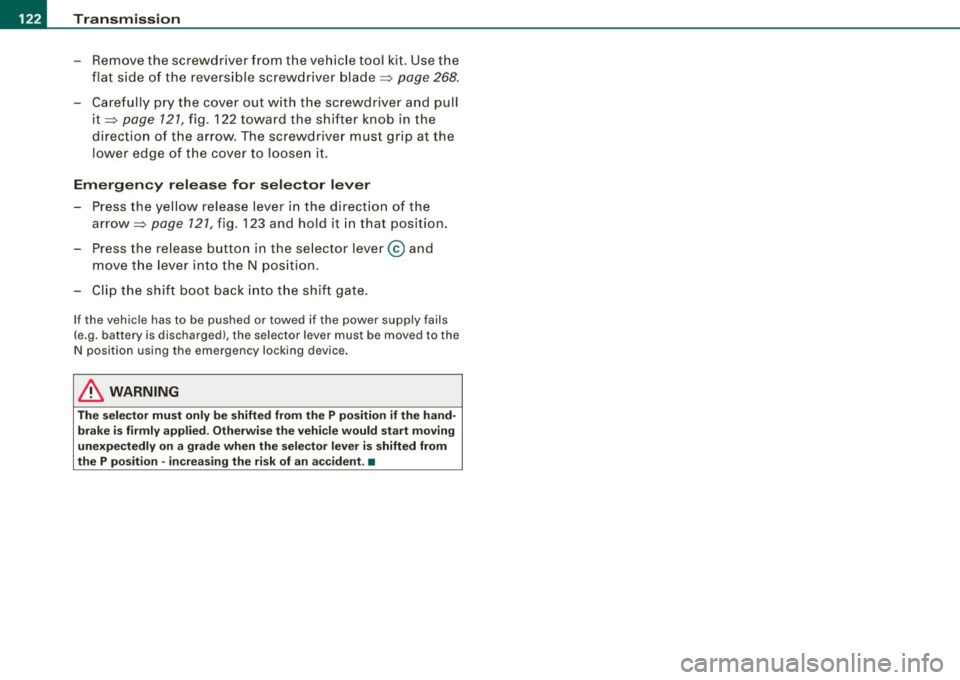
- Carefully pry the cover out with the screwdriver and pull
it~
page 121, fig. 122 toward the shifter knob in the
direction of the arrow. The screwdriver must grip at the
lower edge of the cover to loosen it.
Emergency release for selector lever
-Press the yellow release lever in the direction of the
arrow ~
page 121, fig. 123 and hold it in that position.
- Press the release button in the selector lever@ and
move the lever into the N position .
- Clip the shift boot back into the shift gate.
If the vehicle has to be pushed or towed if the power supply fails
(e.g . battery is discharged), the selector lever must be moved to the
N position using the emergency locking device.
& WARNING
The selector must only be shifted from the P position if the hand
brake is firmly applied. Otherwise the vehicle would start moving
unexpectedly on a grade when the selector lever is shifted from
the P position -increasing the risk of an accident. •
Page 125 of 320

Transmission -
----------------
Controls and equip
ment I • •
Page 198 of 320

-Driving and environment ___ _....,_ _____ ___:_ ____________________________ _
New brake pa_ds
Remember that new brake pads do not have a full braking
effect during the first 250 miles (400 kilometers) after they
are installed.
New brake pads have to be "burnished in" before they have optimal
grab =>& .
During the break -in period, you should avoid putting severe loads
on the brakes . Severe loads include, for example, sudden hard
braking, in particular at very high speeds or, for example, on moun
tain passes .
& WARNING
Until they develop the maximum "bite" for best stopping power,
the surfaces on new brake pads require some "breaking-in" during
the initial 100 to 150 miles (150 to 200 kilometers) of normal city
driving. You can compensate for this by pressing the brake pedal
more firmly. This applies whenever new pads are installed. •
Driving through water on roads
Note the following to avoid vehicle damage when driving through
water, for example on flooded roads:
• The water must not be any higher than the bottom of the vehicle
body .
• Do not drive faster than walking speed .
& WARNING
After driving through water, mud, slush, etc., the brakes may be
slow to take effect because of wet brake rotors and pads. Dry the
brakes first by braking carefully to restore the full braking effect .
0 Note
Vehicle components such as the engine, transmission , suspension
or electrical system can be severely damaged by driving through
water .
[ i] Tips
• Check the depth of the water before driving through it .
• Do not stop th e vehicle, drive in reverse or switch the engine off
when driving through water.
• Keep in mind that oncoming vehicles may create waves that
raise the water level and make it too deep for your vehicle to drive
through safely.
• Avoid driving through salt water because it can cause
corrosion. •
Catalytic converter
It is very important that your emission control system
(catalytic converter) is functioning properly to ensure that
your vehicle is running in an environmentally sound
manner .
- Always use lead-free gasoline~ page 217, "Fuel supply".
- Never run the tank down all the way to empty.
- Never put too much motor oil in your engine ~ page
230,
"Adding engine oil 'l:::r.".
- Never try to push -or tow -start your vehicle.
Th e ca taly tic conv ert er is an ef ficient "clean-up " device built into the
exhaust system of the vehicle . The catalytic converter burns many
of the pollutants in the exhaust gas before they are released into the
atmosphere. •
Page 205 of 320
![AUDI S3 2010 User Guide [ i] Tips
• Do not tow a trailer during the break-in period of your vehicle.
• If you tow a trailer, your Audi may require more frequent mainte
nance due to the extr](/img/6/57545/w960_57545-204.png "AUDI S3 2010 User Guide [ i] Tips
• Do not tow a trailer during the break-in period of your vehicle.
• If you tow a trailer, your Audi may require more frequent mainte
nance due to the extr")
[ i] Tips
• Do not tow a trailer during the break-in period of your vehicle.
• If you tow a trailer, your Audi may require more frequent mainte
nance due to the extra load=> page 299 . •
Parking on a slope
-----------------
Do not park with a trailer on a slope. If it cannot be
avoided, do so only after doing the following:
When parking:
-Apply the foot brake.
- Have someone place chocks under both the vehicle and the trailer wheels .
- With chocks in place, slowly release the brakes until
wheel blocks absorb the load.
- Turn the wheels towards the curb.
- Apply the parking brake.
- Place an automatic transmission in
P, respectively a
manual transmission in first or reverse gear.
When restarting after parking:
- Start the engine.
- Shift transmission into gear.
- Release the parking brake and slowly pull out and away from the wheel blocks.
- Stop and have someone retrieve the wheel blocks.
Controls and equip
ment Safety first Vehicle operation
Trailer towing
[
i] Tips
If you move the selector lever of the automatic transmission to P
before applying the parking brake and before blocking the wheels,
you may have to use more force later to move the lever out of the
P
position .•
Vehicle care Do-it-yourself service Technical data
Page 217 of 320

Cleaning and protection -
----------------=-----=------
•
Safety belts
Only well-maintained safety belts work reliably when
needed.
-Keep belts clean.
- For cleaning, use a mild soap and water solution. Let
belts dry thoroughly and away from direct sunlight.
- Do not allow inertia reel safety belts to retract before
they are completely dry.
- Check the condition of your safety belts
regularly.
Heavily soiled safety belts may not retract properly.
& WARNING
Damaged safety belts can break in a crash .
• Anything that might damage your safety belts could mean that
you and your passengers would not be adequately protected in an
accident.
• Safety belt performance depends on correct installation. Never
remove belts from the vehicle to clean them .
• Do not use chemical cleaning agents, bleach or dyes. They have
corrosive properties which weaken the webbing.
• When cleaning your safety belts, inspect them for damage. If
you discover damage, see your authorized Audi dealer.
• Always read and heed all WARNINGS and other information
=:, page 204. •
Engine compartment
Be especially careful when cleaning the engine compart
ment.
Always switch off the ignition before cleaning the engine =:> &.
Plenum panel
Remove leaves from the plenum panel in front of the windshield
under the engine hood. This prevents the water drain holes from
becoming blocked, and it prevents debris from entering the vehicle
interior through the heating and ventilation ducts .
Corrosion protection
The engine compartment and transmission have been corrosion
protected at the factory.
Good anti-corrosion treatment is very important, particularly in the
winter. If the vehicle is frequently driven on salt treated roads, the
entire engine compartment and plenum panel should be thor
oughly cleaned at the end of winter and retreated to prevent salt
damage. At the same time, the underside of the vehicle should be
washed as well.
If the engine compartment is cleaned at any time with grease
removing solutions
3l, or if you have the engine washed , the anti
corrosion treatment is almost always removed as well . It is therefore
essential to have a long-lasting corrosion protection reapplied to all
surfaces, seams, joints and components in the engine compart
ment.
& WARNING
Be aware: The engine compartment of any motor vehicle is a
potentially hazardous area.
• Before working in the engine compartment, be sure to read the
information
=:> page 215 . .,_
31 Use only the correct cleaning solutions. Never use gasoline or diesel fuel.
Vehicle care I t •
Page 226 of 320
-~_C_ h_e _c _ k_ i_n ...:::g::;...._ a_n_ d_ f_ i_ll _in -'g:::;.._ ___________________________________________ _
Closing the engine hood
- Pull the hood down until the pressure from the strut is
reduced.
- Let the hood
drop down and latch in place. Do not try to
push it shut;
it may fail to engage~& .
& WARNING
A hood that is not completely latched could fly up and block your
view while driving.
• When you close the engine hood, check it to make sure the
safety catch has properly engaged. The hood should be flush with
the surrounding vehicle body parts.
• If you notice while driving that the hood is not secured prop
erly, stop at once and close it. •
Working in the engine compartment
Be especially careful whenever you work in the engine
compartment!
Whenever you must perform any work in the engine compartment,
for example checking and filling different fluids, there is a risk of injury, burns and accidents. To prevent personal injury always
observe the following WARNINGS. The engine compartment of any
vehicle is a hazardous area!
=> &
& WARNING
To help avoid injury, before you check anything under the hood :
• Turn off the engine.
• Remove the ignition key.
• Set the parking brake fully .
& WARNING (continued)
• Move selector lever of automatic transmission to "P" {Park);
put manual transmission in Neutral.
• Always let the engine cool down. Hot components will burn
skin on contact.
• To reduce the risk of being burned, never open the hood if you
see or hear steam or coolant escaping from the engine compart
ment. Wait until no steam or coolant can be seen or heard before
carefully opening the hood .
• Keep children away from the engine compartment.
• Never spill fluids on hot engine components. They can cause a
fire.
• Never touch the radiator fan. The auxiliary electric fan is
temperature controlled and can switch on suddenly.
• Never open the coolant reservoir cap when the engine is still
warm. The coolant system is pressurized and hot coolant could
spray out!
• Protect your face, hands and arm from steam or hot engine
coolant by placing a thick rag over the cap when you open the
coolant reservoir.
• If work on the fuel system or the electrical system is necessary:
- Always disconnect the battery .
- Never smoke or work near heaters or open flames. Fluids in
the engine compartment could start a fire.
- Keep an approved fire extinguisher immediately available.
• To avoid electrical shock and personal injury while the engine
is running or being started, never touch :
- Ignition cables
- Other components of the high voltage electronic ignition
system.
• If you must perform a check or repair with the engine running: .,_