transmission AUDI S3 2010 Owner's Manual
[x] Cancel search | Manufacturer: AUDI, Model Year: 2010, Model line: S3, Model: AUDI S3 2010Pages: 320, PDF Size: 75.34 MB
Page 227 of 320
_____________________________________________ C_h_ e;::..:. c:..:..k :..:..in ;..:..= g:.....:.; a:..:..n :....:d :..:....:. f.:.:il .:.:li :..:..n :.::g:!-_ ___,JIJIII
& WARNING !continued )
-First, fully apply the parking brake, move selector lever of
automatic transmission to "P" (Park); put manual transmission
in Neutral.
- Always use extreme caution to prevent clothing, jewelry, or
long hair from getting caught in the radiator fan, V-belts or
other moving parts, or from contacting hot parts. Tie back hair
before starting, and do not wear clothing that will hang or
droop into the engine .
• Minimize exposure to emission and chemical hazards
:=> &.
& WARNING
California Proposition 65 Warning :
• Engine exhaust , some of its constituents, and certain vehicle
components contain or emit chemicals known to the State of Cali
fornia to cause cancer and birth defects and reproductive harm . In
addition, certain fluids contained in vehicles and certain products
of component wear contain or emit chemicals known to the State
of California to cause cancer and birth defects or other reproduc
tive harm.
• Battery posts, terminals and related accessories contain lead
and lead compounds , chemicals known to the State of California
to cause cancer and reproductive harms. Wash hands after
handling.
0 Note
When adding fluids , always make sure that they are poured into the
proper container o r filler opening, otherwise serious damage to
vehicle systems will occur .
ffi For the sake of the environment
To detect leaks in time, inspect the vehicle floor pan from under
neath regularly. If you see spots from oil or other vehicle fluids, have
your vehicle inspected by an authorized Audi dealer .•
Engine compartment
Ap plie s to veh icl es: wit h 2.0 I tur bo, 4-cy lind er•e ng ine
2.0 liter , 4-cylinder turbo gasoline engine (200
hp)
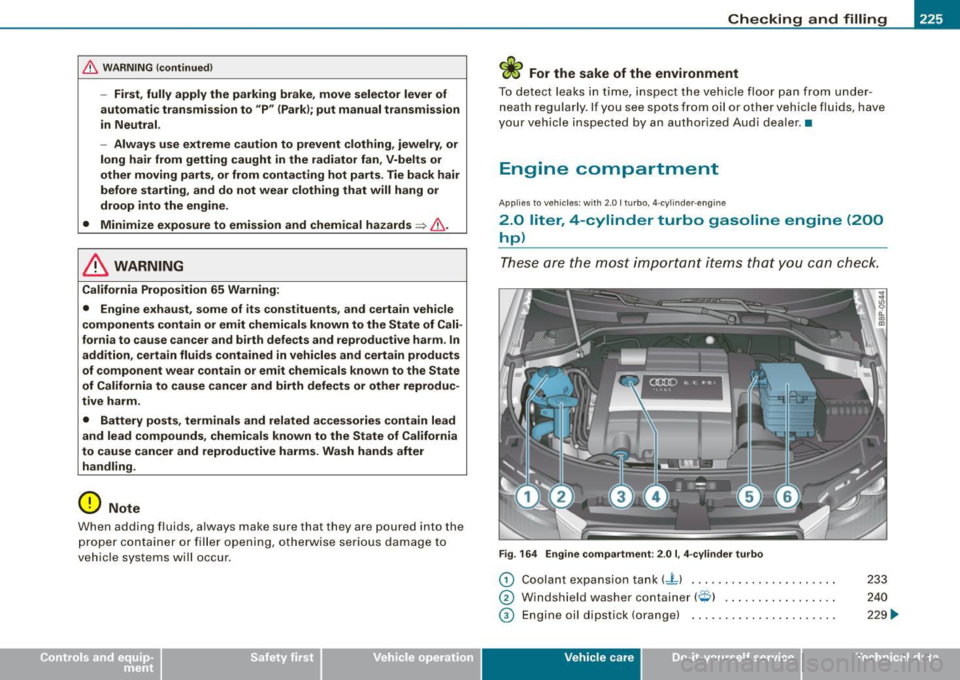
These are the most important items that you can check.
Fig. 164 Engine compartment : 2 .0 I , 4-cy linder turbo
G) Coolan t expansion tank (- L l .... ... .... .... ... .. . .
0 Windshield washer container (W ) ... .... ... ... ... .
© Eng ine oil d ipstick (orange) .. ...... ........ ..... .
Vehic le care I I
233
240
229 ~
irechnical data
Page 245 of 320

__________________________________________________ T_ ir_e_ s_ a_ n_d _ w_ h_ e_ e_l_s __ __
•
& WARNING (continu ed )
crashes and serious personal in jur ies . Have worn or da maged t ires
replaced immediately .
• Tires age even if they are not being u sed and can fail suddenly ,
especially at high speeds. T ires that are more than 6 years old can
only be used in an emergency and then w ith special care and at
low speed.
Glossary of tire and loading terminology
Accessory weight
means the co mbined we ig ht ( in excess o f those sta nda rd items
which may be rep laced) of automatic transmission, power steering,
power brakes, power w indows, powe r seats, rad io, a nd heater, to
the extent that these items are avai lab le as factory-installed equip
m ent (w hether insta lled or not).
Aspect ratio
means t he ratio o f th e height to t he w idt h of the tire in perce nt.
N umbers of 55 or lower indicate a low sidewa ll for improved
steer ing respo nse and b ette r overall ha ndl ing on dry pave ment.
Bead
means the part of the tire that is made of stee l wires, wrapped or
reinforced by ply cords and that is shaped to fit the rim.
Bead separation
means a breakdow n of the bond be tween co mponents i n the bead.
Cord
means the strands fo rmi ng the plies in the ti re.
& W ARNING (continued )
• Never mount used tires on your vehicle if you are not sure of
their "previous history. " Old used t ire s may ha ve been damaged
even though the damage cannot be seen that can lead to sudden
tire failure and lo ss of vehicle control.
• If you noti ce unusual vibration or if the vehicle pulls to one side
when driving , always stop as soon as it is safe to do so and check
the wheels and tires for damage . •
Cold tire inflation pressure
mea ns t he ti re pressure reco mm ended by the ve hicle ma nufacturer
for a tire of a designated size that has not been d riven for more tha n
a cou ple o f miles (k ilometers) at low speeds in t he t hre e ho ur per iod
before the tire pressure is measured or ad justed .
Curb weight
means the weight of a moto r vehic le with standard equipment
i nc lud ing the max imu m capac ity o f fue l, o il, and coola nt, a ir c ond i
tioning and additiona l weight of optional equipment.
Extra load tire
means a tire designed to ope rate at higher loads and at higher infla
tion pressures than the corresponding standard tire. Extra load tires
my be identified as "XL",
"xi", "EX TRA LOA D", or "RF" on the side
wa ll.
Gross Axle Weight Rating ("GAWR ")
means the load -carrying capacity of a sing le ax le system, measured
at the ti re -ground interfaces.
Gross Vehicle Weight Rating ("GVWR "l
means the ma ximum tot al l oade d weigh t of the vehicle.
Vehicle care I t •
Page 273 of 320
What do I do now? -__________________ __;__:....:....:..:: __ _
•
-All passengers should leave the car and move to a safe
location (for instance, behind the guardrail)~& .
- Apply the
parking brake firmly ~& .
- Move
selector lever to position Pon an automatic trans-
miss ion; put manual transmission in
first gear ~& .
-If you are towing a trailer : unhitch the trailer from your
vehicle.
- Take the
tool and the spare tire~ page 268 out of the
luggage compartment.
& WARNING
You or your passengers could be injured while changing a wheel if
you do not follow these safety precautions:
• If you have a flat tire, move a safe distance off the road. Turn off
the engine, turn the emergency flasher on and use other warning
devices to alert other motorists.
• Make sure that passengers wait
in a safe place away from the
vehicle and well away from the roadway and traffic.
• To help prevent the vehicle from moving suddenly and possibly
slipping off the jack, always fully set the parking brake and block
the wheel diagonally opposite the wheel being changed. When one
front wheel is lifted off the ground, placing the automatic trans
mission in "P" (Park), or engaging a gear in a manual transmission
will
not prevent the vehicle from moving.
• Before you change a wheel, be sure the ground is level and firm.
If necessary, use a sturdy board under the jack.
• After installing the spare wheel, make sure that you remount
the flat tire/wheel in its storage area properly and tighten the
knurled retaining screw securely. •
Changing a wheel
When you change a wheel, follow the sequence described
below step-by-step and exactly in that order.
1. Remove the decorative wheel cover*. For more details
see also
~ page 272, "Decorative wheel covers" or
~ page 273, "Wheels with cap-covered wheel bolts".
2. Loosen the
wheel bolts~ page 274.
3. Locate the proper mounting point for the jack and align
the jack below that point~
page 274.
4. Lift the car with the jack~ page 274.
5. Take the flat wheel off and then put the spare on
~ page 276.
6. Tighten all wheel bolts lightly .
7.
Lower the vehicle with the jack .
8. Use the wheel bolt wrench and
firmly tighten all wheel
bolts ~
page 274.
9. Put the decorative wheel cover* back on.
& WARNING
Always read and head all WARNINGS and information ::} & in
"Raising the vehicle" on
page 274 and ~ page 277. •
After changing a wheel
A wheel change is not complete without the following
actions.
- Store and secure the replaced wheel in the spare wheel
well. .,._
Do-it-yourself service
Page 277 of 320
What do I do now? -
------------------
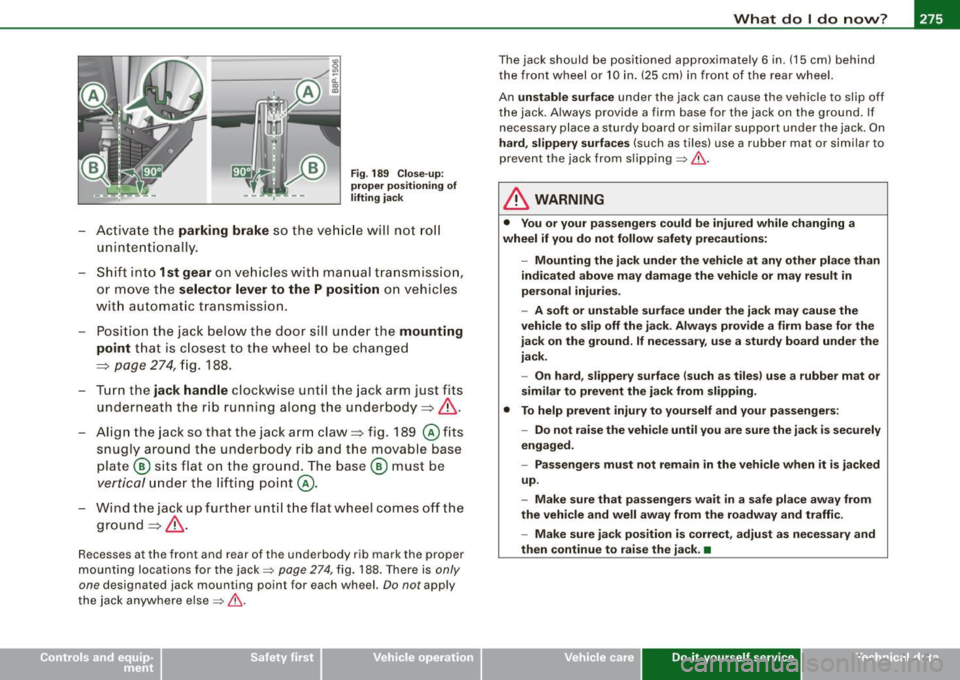
Fig. 189 Close-up:
proper positioning of
lifting jack
-Activate the parking brake so the vehicle will not roll
unintentionally.
- Shift into
1st gear on vehicles with manual transmission,
or move the
selector lever to the P position on vehicles
with automatic transmission.
- Position the jack below the door sill under the
mounting
point
that is closest to the wheel to be changed
=> page 274, fig. 188.
- Turn the
jack handle clockwise until the jack arm just fits
underneath the rib running along the underbody
=> &.
- Align the jack so that the jack arm claw => fig . 189 @ fits
snugly around the underbody rib and the movable base
plate @ sits flat on the ground. The base @ must be
vertical under the lifting point@.
- Wind the jack up further until the flat wheel comes off the
ground =>& .
Recesses at the front and rear of the underbody rib mark the proper
mounting locations for the jack ~
page 274, fig. 188. There is only
one
designated jack mounting point for each wheel. Do not apply
the jack anywhere else~& . The
jack should be positioned approximately 6 in. (15 cm) behind
the front wheel or 10 in. (25 cm) in front of the rear wheel.
An unstable surface under the jack can cause the vehicle to slip off
the jack. Always provide a firm base for the jack on the ground. If
necessary place a sturdy board or similar support under the jack. On
hard, slippery surfaces (such as tiles) use a rubber mat or similar to
prevent the jack from slipping ~& .
& WARNING
• You or your passengers could be injured while changing a
wheel if you do not follow safety precautions:
-Mounting the jack under the vehicle at any other place than
indicated above may damage the vehicle or may result in
personal injuries.
- A soft or unstable surface under the jack may cause the
vehicle to slip off the jack. Always provide a firm base for the
jack on the ground. If necessary, use a sturdy board under the
jack.
- On hard, slippery surface (such as tiles) use a rubber mat or
similar to prevent the jack from slipping.
• To help prevent injury to yourself and your passengers:
- Do not raise the vehicle until you are sure the jack is securely
engaged.
- Passengers must not remain in the vehicle when it is jacked
up.
- Make sure that passengers wait in a safe place away from
the vehicle and well away from the roadway and traffic.
- Make sure jack position is correct, adjust as necessary and
then continue to raise the jack. •
Vehicle care Do-it-yourself service irechnical data
Page 282 of 320

1111.___F_ u_ s _ e_s _ a_n _ d_ b_ u_lb _ s _______________________________________________ _
Equipment Amps No. Equipment Amps
Manual headlight beam adjustment, automatic
14 Electronic Stabilization Program (ESP) (control 10
1
headlight beam adjustment, AFS control mod-10
module), shift gate automatic transmission
ule, engine components, light switch (switch
15 Interior lights, reading lights 10
lighting/illumination), diagnosis socket
Diagnostic connector, rain sensor, air condition-
Automatic transmission, control module for
16 ing (control module), tire pressure monitor dis-10
CAN data transfer (gateway), electro -mechanical
play (control module)
2 steering, shift gate automatic transmission, 10 17 Anti-theft alarm warning system 5 engine relay, fuel tank control unit, engine con -
trol unit, brakes control (ABS), Electronic Stabili-
18 Diagnose Starter 5
zation Program (ESP), Anti -Slip Regulation (ASR) 19 All Wheel Drive 10
3
Airbag 5 20 Not used
!! Air-conditioning (pressure sensor, air quality
sensor), button for Electronic Stabilization Pro -
21 Not used
gram (ESP), Anti-Slip Regulat ion (ASR), tire pres-
22 Blower fan 40
sure monitor display, oil level sensor, back -up 23 Driver's side power window, front 30
4 light switch, front seat heating , parking aid, 5
seat-occupancy recognition (on USA vehicles), 24 Power outlet front 20
garage door opener, automatic mirror dimming, 25 Rear window defogger 30
headlight assistant, heated windshield washer
26 Power outlet in luggage compartment 20 nozzles, air conditioning (control module)
-27 Fuel tank control module, fuel pump 15
5 AFS headlights (left side) 5
AFS headlights (right side) 5 28 Power window, rear 30
7
Not used 29 Not used
Not used
30 Not used
9 Navigation system, radio system 15 31 Not used
10 digital
radio, cell phone, TV equipment 7,5 32 Not used
11 Automa tic mirror dimming, headlight assistan t 10 33 Sliding/pop-up roof 20
Central locking (front doors) 10 34 Not used
13 Central locking (rear doors) 10 35 Not used
36 Lumbar support 10
Page 283 of 320

_________________________________________________ F_ u_ s_ e_s _ a_n _d_ b_ u _ lb_ s_--J _
No. Equipm ent
37 Heated seats, front
38 Passenger s ide power window, front
39 Special function interface
Starter
41 Rear window wiper
42 Not used
43 Body control module
44 Not use
d
45 Not used
Not used
47 Cell phone package (VOA
interface)
48 Not used
49 Not used
Autom atic cir cuit br eake rs: Amps
20
30
5
4
0
15
20
5
The electric power windows and the electric seat adjusters are protected with circuit breakers which reset automatically after the
circu it overload has been corrected.
[ i J Tip s
• Whenever replacing a fuse, always consult the sticker on the
inside of the fuse panel cover. It contains the most up-to-date infor
mation regarding the fuse arrangement. If in doubt, ask your autho
rized Audi Service advisor.
• Some of the equipment items listed are optiona l or on ly avail
able on certain model configurations. •
Fuse location , left side of engine
compartment
N M N
~ (X) 0)
Fig . 195 F use ass ign
m ent in th e e ngin e
co mpar tment in th e
e xampl e wit h
54 p lu g
in fu ses
Please check your car's fuse layout, there are two different layouts.
Check the fuse layout with the fuse panel cover removed
~ page 278, "Fuse cover in engine compartment" .
Some of the equipment items listed are optional or on ly available on
certain model configurations.
Please note that the preceding table was accurate at the time of
printing and is subject to change . In the event of discrepancies, the
label on the inside of the cover a lways takes precedence.
V ariation (1 ) with 30 Plu g-in F uses
No . Equipm ent Amps
F1 Terminal 30 40
E ngine components
20
F3 Battery voltage 5
F4 ESP valves, Anti -lock brake system (ABS) valves 20/30
F5 Transmission control module
15
Vehicle care Do-it-yourself service Technical data
Page 284 of 320

IIIJl1.--___;;F...; u::. s .::..:: e~s :.....:: a..:..n .:..; d::....; b.:..:. u..:..lb ;:..:: s _______________________________________________ _
No. UEquipment Amps I No. Equipment
Amps
F6 Steering wheel electronics
5 F28
Not used
F7 Not used F29 Fuse assignment in the
left-side instrument
50
F8 Not used panel (special equipment)
F9 Not used F30 Power supply relay terminal
15 50
F10 Engine control module, main relay 5/10
Variation
(2) with 54 Plug-in Fuses
F11 Not used No. Equipment Amps
F12 Control module for CAN data
transfer (gateway)
5
Body control module (right)
F1 30
F13 Engine control module 15/25/30
20/30
F2 ESP valves, Anti-lock brake system (ABS) valves
F14 Ignition coils, engine components (diesel
20 F3 Terminal 30 40
engine)
Preheating control module/engine component, F4
Battery voltage
5
F15 tank diagnosis, oxygen sensor 5/10
F5 Horn 15
F16 Body control module (right)
30 F6 Not used
F17 Horn 15
F7 Not used
Audio amplifier 30 F8 Not used
F19 Front windshield wiper system 30
F9 Engine components 10
F20 Water pump, volume regulator valve 10/20
F10 Fuel tank control, mass air flow sensor
10
F21 Oxygen sensor, vacuum pump 10/15
F11 Oxygen sensors, in front of catalytic converter 10
F22 Clutch pedal switch, brake light switch 5
F12 Oxygen sensors, behind catalytic converter 10
F23 engine components, water pump 5/10/15
F13 Automatic transmission 15
Engine components, water pump 10 F14 Not used
F25 Pump (ESP/ABS), ABS valve
40
F15 Water pump 10
F26 Body control module (left) 30
F16 Volume control valve 20
F27 Secondary air pump, preheating control module 40 F17 Steering wheel electronics 5
F18 Audio amplifier 30
F19 Not used
Page 289 of 320
______________________________________________ E_ m_ e_r .;::g ;...e _ n_ c __,c. y_ s_it _u_ a_ ti_o _ n_ s _ __._
Use of jumper cables
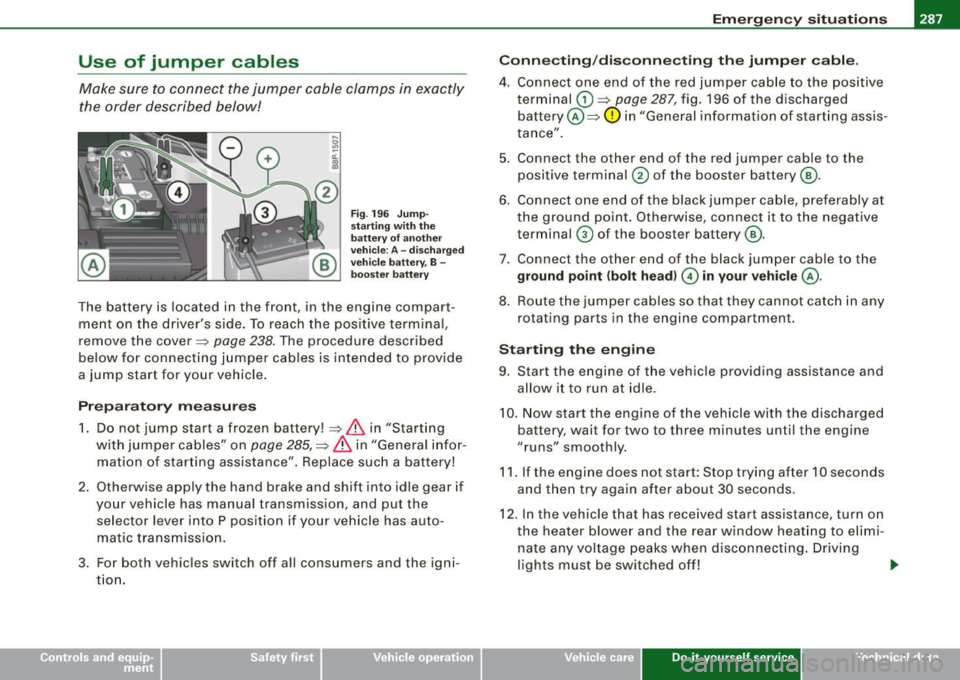
Make sure to connect the jumper cable clamps in exactly
the order described below!
Fig . 196 Jump
starting with the
battery of another
vehicle : A -discharged
vehicle battery , B -
booster battery
The battery is located in the front, in the engine compart
ment on the driver's side. To reach the positive terminal,
remove the cover=>
page 238. The procedure described
below for connecting jumper cables is intended to provide
a jump start for your vehicle.
Preparatory measures
1. Do not jump start a frozen battery ! => & in "Sta rting
with jumper cables" on
page 285, => & in "General infor
mation of starting assistance" . Replace such a battery!
2. Otherwise apply the hand brake and shift into idle gear if
your vehicle has manual transmiss ion, and put the
selector lever into P position if your vehicle has auto
matic transmission.
3. For both veh ic les switch o ff a ll co nsumers and the igni
tion.
Connecting/disconnecting the jumper cable.
4. Connect one end of the red jumper cable to the positive
terminal
(D => page 287, fig . 196 of the discharged
battery @=> (Din "General information of starting assis
tance".
5. Connect the other end o f the red jumper cable to the
positive terminal
@ of th e boost er battery ®·
6. Connect one end of the black jumper cable, preferably at the ground point. Otherwise, connect it to the negat ive
terminal
0 of the booster battery ®·
7. Connect the other end of the black jumper cable to the
ground point (bolt head) © in your vehicle @.
8. Route the jumper cables so that they cannot catch in any
rotating parts in the engine compartment.
Starting the engine
9. Start the engine of the veh icle providing ass istance and
allow it to run at idle.
10. Now start the engine of the vehicle with the discharged
battery , wait for two to three minutes unt il the eng ine
" runs " smoothly.
11. If the engine does not start: Stop t rying after 10 seconds
and then try again after about 30 seconds.
12. In the vehicle that has received start assistance, turn on the heater blower and the rear window heating to elimi
nate any voltage peaks when disconnecting. Driving lights must be switched off! .,
Vehicle care Do-it-yourself service irechnical data
Page 290 of 320

11111.___E_ m _ e _r-==g :...e_ n_ c...:y _ s_ i_t _u _a _t_ i_o _n_ s _______________________________________________ _
13. Disconnect the cable while the engine is running exactly
in
reverse order to that described in~ page 287,
11Connecting/disconnecting the jumper cable.11
• When
doing so, make sure that the cable cannot contact rotating engine parts.
14. Turn the heater blower and the rear window heating off again.
The battery is vented to the outside to prevent gases from entering
the vehicle interior.
Make sure that the jumper clamps are well connected with their
metal ports in full contact with the battery terminals .
& WARNING
To avoid serious personal injury and damage to the vehicle, heed
all warnings and instructions of the jumper cable manufacturer. If
in doubt, call for road service.
• Jumper cables must be long enough so that the vehicles do not
touch .
• When connecting jumper cables, make sure that they cannot
get caught in any moving parts in the engine compartment.
• Before you check anything in the engine compartment, always
read and heed all WARNINGS =>
page 215, "Engine compartment" .
0 Note
Improperly connected jumper cables can damage or destroy the
generator.
• Do not use the battery negative terminal for jump starting or a
malfunction could occur in the vehicle electrical system.
• Always connect POSITIVE(+) to POSITIVE(+), and NEGATIVE( -) to
NEGATIVE (-l terminal. •
Check that all screw plugs on the battery cells are screwed in
firmly. If not, tighten plugs prior to connecting clamp on negative battery terminal.
• Please note that the procedure for connecting a jumper cable as
described above applies specifically to the case of your vehicle
being jump started. When you are giving a jump start to another
vehicle, do
not connect the minus(-) cable to the minus 1-l terminal
on the discharged battery@=>
page 287, fig. 196. Instead, securely
connect the minus(-) cable to either a massive metal component
that is firmly bolted to the engine block or to the engine block itself.
If the battery that is being charged does not vent to the outside,
escaping battery gas could ignite and explode! •
Emergency towing with commercial
tow truck
General hints
Your Audi requires special handling for towing.
The following information is to be used by commercial tow truck
operators who know how to operate their equipment safely.
• Never tow your Audi, towing will cause damage to the engine
and transmission.
• Never wrap the safety chains or winch cables around the brake
lines.
• To prevent unnecessary damage, your Audi must be transported
with a car carrier (flat bed truck).
• To load the vehicle on to the flat bed, use the towing loop found
in the vehicle tools and attach to the front or rear anchorage
=>
page 289 and => page 289 . .,_
Page 293 of 320
________________________________________________ E_ m_ e_r .::g :...e_ n _ c_,y'-- s_ i_t _u _a_ t_ i_o _n_ s _---J_
Lifting the vehicle
Important safety precautions
Be aware of the following hazards before lifting the vehicle with a
workshop hoist or floor jack:
• The vehicle should never be lifted or jacked up from underneath
the engine oil pan, the transmission housing, the front or rear axle
or the body side members. This could lead to serious damage.
• Use lifting equipment with padded contact surfaces to avoid
damage to the underbody or chassis frame.
• Alternatively, cover the contact surfaces on workshop hoist or
floor jack with rubber pads before lifting .
• Before driving over a workshop hoist, check that the vehicle
weight does not exceed the permissible lifting capacity of the hoist .
• Before driving over a workshop hoist, ensure that there is suffi
cient clearance between the hoist and low parts of the vehicle .
& WARNING
To reduce the risk of serious injury and vehicle damage:
• Always lift the vehicle only at the special workshop hoist and
floor jack lift points illustrated
=> fig. 202 and => fig. 203 .
• Failure to lift the vehicle at these points could cause the vehicle
to tilt or fall from a lift if there is a change in vehicle weight distri
bution and balance. This might happen, for example, when heavy
components such as the engine block or transmission are
removed .
• When removing such heavy components, anchor vehicle to
hoist or add corresponding weights to maintain the center of
gravity . Otherwise , the vehicle might tilt or slip off the hoist,
causing serious personal injury. •
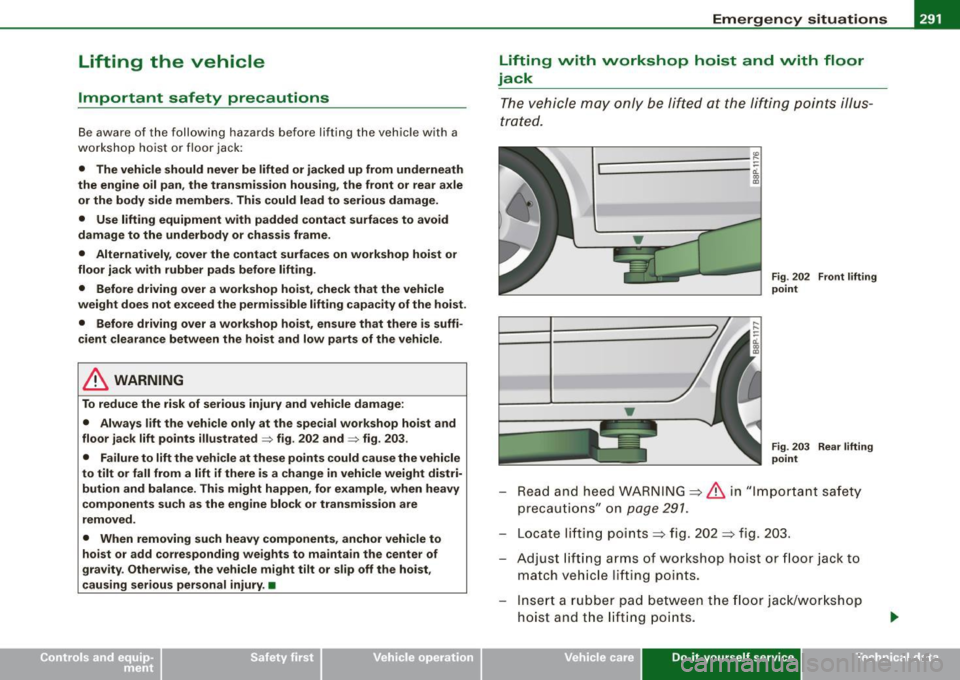
Lifting with workshop hoist and with floor
jack
The vehicle may only be lifted at the lifting points illus
trated.
.... L===========::::==:: ~ 0:.
Fig . 202 Front lifting
point
Fig . 203 Rear lifting
point
Read and heed WARNING ~ & in "Important safety
precautions " on
page 291.
Locate lifting points~ fig. 202 ~ fig. 203.
Adjust lift ing arms of workshop hoist or floor jack to
match vehicle lifting points.
Inse rt a rubber pad between the floo r jack/workshop
hoist and the lifting poin ts.
Vehicle care Do-it-yourself service irechnical data