door lock AUDI S3 2010 Owner's Manual
[x] Cancel search | Manufacturer: AUDI, Model Year: 2010, Model line: S3, Model: AUDI S3 2010Pages: 320, PDF Size: 75.34 MB
Page 61 of 320

Applies to vehi cle s: wi th lig ht pac kag e
Interior lights and forward reading lights
The interior lights include the both reading lights for the
driver and the front passenger.
!: ........ : .. : ..... : ... ..... .......... ... : ... :. ~ .... ...... ............. ............. .......... =
® ;i~!;J';i~L '!
~ [;] ) B
• •
Fig . 54 Control panel
above windshield : inte·
rior light switches
Light switch @~ page 58, fig. 53 has the following func
tions:
Door contact activation
- Move the switch to the center position. The forward
dome light is turned on/off by the contact switches on
any of the doors.
Forward dome light on
-Move the switch to position I. The forward dome light
goes on and stays on regardless of door position.
Forward dome light off
- Move the switch to position 0. The light will not go on
regardless of door position.
Con tro ls and eq uip
ment
Clear vision
Forward reading lights
~
- Press the left or right switch ® to switch the left or right
forward reading light on or off.
Glove compartment light
Open the glove compartment -the light in the glove
compartment automatically illuminates as long as the
side marker lights or headlights are on. When you close
the glove compartment, the light goes off.
With the interior light switch at the door contact (center) position,
the forward dome light illuminates whenever you unlock the vehicle or open a door . The dome light goes out after approximately 30
seconds after you have closed the door. Likewise, when you lock
your vehicle or switch on the ignition , the dome light goes out.
If you leave a door open, the dome light will go out after ten minutes
to conserve battery charge.
A dimmer automatically controls the brightness of the lights when
they are switched on. •
Vehicle care I I irechnical data
Page 112 of 320

• ..__O_ n_ t_h _ e_ r_ o_ a_ d ____________________________________________________ _
& WARNING (continued )
• Never allow anyone -especially small children -to remain in the
vehicle when it is locked. Locked doors make it more difficult for
rescuers to access the passenger compa rtment in the event of an
emergency . Danger to life!
• Never leave children unsupervised in the vehicle. Children
could release the parking brake or move the gearshift lever out of
ge ar. The vehicle could start to roll away and cause an ac cident .
• No matter what the season is , the temperature in a parked
vehicle can reach dangerous levels. •
Applies to vehicles: with hill hold assist
Starting on hills
Hill hold assis t mak es it eas ier to star t on h ills .
T he system is activated when the brake peda l is depressed
for a few
seconds .
After releasing the brake pedal, the brake power is held for a brief
moment to pr event the vehicle fr om r olling back whe n star ting . A t
this time, you can easily begin to move your vehicle.
& WARNING
• If you did not beg in moving immediately after releasing the
brake pedal , under certain circumstances , the vehicle would begin
to roll backward . Depress the brake pedal immediately or engage
the hand brake.
• Should the engine stall , depress the brake pedal immediately
or engage the hand brake .
• In order to prevent the vehicle from rolling back unintentionally
when starting in stop -and-go traffic, keep the brake pedal
depressed for a few seconds before driving off.
[ i ] Tips
You can find out if your ve hicle is equ ipped w it h "Hi ll ho ld ass ist" at
an authorized Audi dealershi p.•
Cruise control
Switching the system on
Th e cruise con trol sys tem mak es it possible to dr ive a t a
c onstant spe ed s tartin g at 20 mp h (30 km /h).
Fig . 111 Control lever
with set button
F ig . 112 Display:
Sele cted speed
P ull the le v er to p ositi o n G) => fig. 11 1 to sw itch the
s y st em o n.
Page 134 of 320

-Driving
Safely ------=-------=----------------
& WARNING
Improperly stored luggage or other items can fly through the
vehicle causing serious personal injury in the event of hard braking or an accident. To help reduce the risk of serious personal injury:
• Always put objects, for example, luggage or other heavy items
in the luggage compartment.
• Always secure objects in the luggage compartment using the
tie-down eyelets and suitable straps.
& WARNING
Heavy loads will influence the way your vehicle handles. To help
reduce the risk of a loss of control leading to serious personal
injury :
• Always keep in mind when transporting heavy objects, that a
change in the center of gravity can also cause changes in vehicle
handling:
-Always distribute the load as evenly as possible.
- Place heavy objects as far forward in the luggage compart-
ment as possible.
• Never exceed the Gross Axle Weight Rating or the Gross
Vehicle Weight Rating specified on the safety compliance sticker on the left door jamb. Exceeding permissible weight standards
can cause the vehicle to slide and handle differently.
• Please observe information on safe driving~
page 124.
& WARNING
To help prevent poisonous exhaust gas from being drawn into the
vehicle, always keep the rear lid closed while driving.
• Never transport objects larger than those fitting completely
into the luggage area because the rear lid cannot be fully closed.
& WARNING (continued)
• If you absolutely must drive with the rear lid open, observe the
following notes to reduce the risk of poisoning :
- Close all windows,
- Close the power roof*,
- Open all air outlets in the instrument panel,
- Switch off the air recirculation,
- Set the fresh air fan to the highest speed.
& WARNING
Always make sure that the doors , all windows, the power roof*
and the read lid are securely closed and locked to reduce the risk
of injury when the vehicle is not being used.
• After closing the rear lid, always make sure that it is properly
closed and locked .
• Never leave your vehicle unattended especially with the rear lid
left open. A child could crawl into the vehicle through the luggage
compartment and close the rear lid becoming trapped and unable
to get out . Being trapped in a vehicle can lead to serious personal
injury.
• Never let children play in or around the vehicle.
• Never let passengers ride in the luggage compartment . Vehicle
occupants must always be properly restrained in one of the
vehicle's seating positions.
[ i] Tips
The tire pressure must correspond to the load -see the tire pressure
sticker on the fuel filler door. •
Page 176 of 320
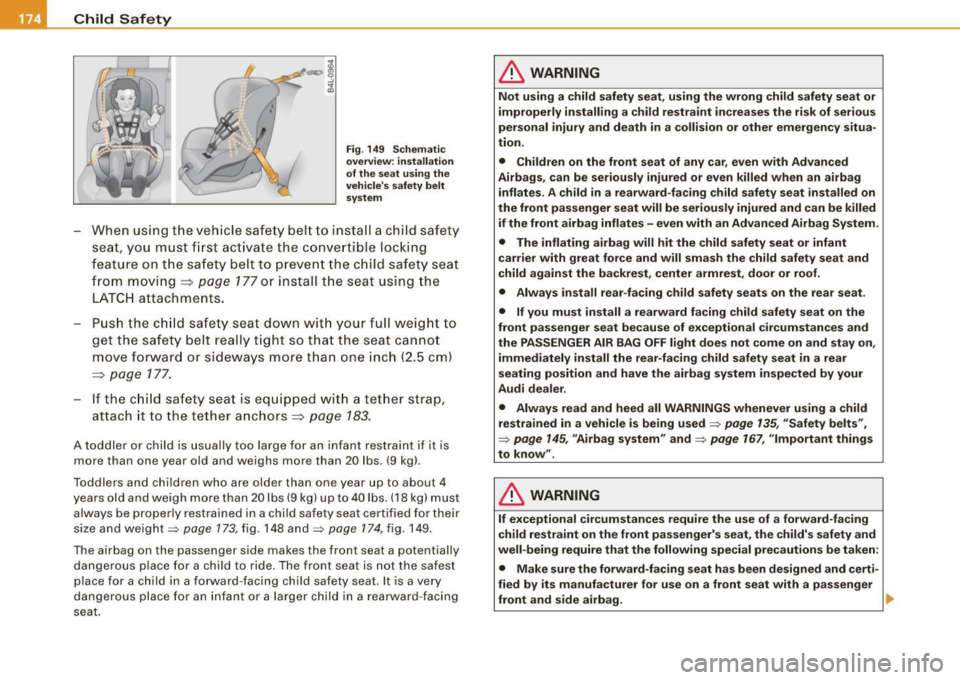
•---=C:...:.h.:.: i.:.:ld ::.....: S~ a::. f~ e~ t~ y~ ----------------------------------------------
Fig. 149 Schematic
overview: installation
of the seat using the
vehicle's safety belt
system
- When using the vehicle safety belt to install a child safety
seat, you must first activate the convertible locking
feature on the safety belt to prevent the child safety seat
from moving ==>
page 177 or install the seat using the
LATCH attachments.
- Push the child safety seat down with your full weight to
get the safety belt really tight so that the seat cannot
move forward or sideways more than one inch (2.5 cm)
==> page 177.
If the child safety seat is equipped with a tether strap,
attach it to the tether anchors ==>
page 183.
A toddler or child is usually too large for an infant restraint if it is
more than one year old and weighs more than 20 lbs. (9 kg) .
Toddlers and children who are older than one year up to about 4
years old and weigh more than 20 lbs (9 kg) up to 40 lbs. (18 kg) must always be properly restrained in a child safety seat certified for their
size and weight=>
page 173, fig. 148 and => page 174 , fig. 149.
The airbag on the passenger side makes the front seat a potentially dangerous place for a child to ride. The front seat is not the safest
place for a child in a forward-facing child safety seat . It is a very
dangerous place for an infant or a larger child in a rearward -facing
seat.
& WARNING
Not using a child safety seat, using the wrong child safety seat or
improperly installing a child restraint increases the risk of serious
personal injury and death in a collision or other emergency situa
tion.
• Children on the front seat of any car, even with Advanced
Airbags, can be seriously injured or even killed when an airbag
inflates. A child in a rearward-facing child safety seat installed on
the front passenger seat will be seriously injured and can be killed
if the front airbag inflates -even with an Advanced Airbag System.
• The inflating airbag will hit the child safety seat or infant
carrier with great force and will smash the child safety seat and
child against the backrest, center armrest, door or roof.
• Always install rear-facing child safety seats on the rear seat.
• If you must install a rearward facing child safety seat on the
front passenger seat because of exceptional circumstances and
the PASSENGER AIR BAG OFF light does not come on and stay on, immediately install the rear-facing child safety seat in a rear
seating position and have the airbag system inspected by your
Audi dealer.
• Always read and heed all WARNINGS whenever using a child
restrained in a vehicle is being used=>
page 135, "Safety belts",
=> page 145, "Airbag system" and=> page 167, "Important things
to know".
& WARNING
If exceptional circumstances require the use of a forward-facing
child restraint on the front passenger's seat, the child's safety and
well-being require that the following special precautions be taken:
• Make sure the forward-facing seat has been designed and certi
fied by its manufacturer for use on a front seat with a passenger
front and side airbag. ...
Page 179 of 320
Child Safety -
--------------------''----
& WARNING (continued )
• If you must install a booster seat on the front passenger seat
because of exceptional c ircumstances the PASSENGER AIR BAG
OFF light must come on and stay on , whenever the ignition is
switched on.
• If the PASSENGER AIR BAG OFF light does not come on and stay
on , perform the checks described=>
page 156, "Monitoring the
Advanced A irbag System ".
• Take the ch ild restraint off the front passenger seat and install
it properly at one of the rear seat positions if the PASSENGER AIR
BAG OFF light does not stay on wheneve r the ignition is switched
on .
• Always read and heed all WARNINGS whenever using a child
restrained in a vehicle is being used=>
page 135, "Safety belts",
=> page 145, "Airbag system " and => page 167 , "Important things
to know ".•
Installing a child safety seat
Securing a child safety seat using a safety
belt
S a fety belt s for the rea r sea ts and the front passenger con
b e lo cked with t he conver tible lo ckin g retr actor to p rop
e rly sec ure c hild saf ety sea ts.
T he s afe ty bel ts e merge ncy lo cking re trac to rs fo r th e rea r sea ts
safety belts and for the front pass enger's seat safety belt have a
c o nve rtible loc king re tr ac tor fo r child r estrai nts. The sa fe ty b elt
must be loc ked so that be lt webbin g cannot unr eel. The re trac tor
c an be activa te d to lock the safety be lt and prevent the safet y belt
w ebbi ng fr om l oos en ing up dur in g n orm al dr ivi ng . A chi ld sa fety
seat can only be properly insta lled when t he safety be lt is locked so
th at th e child and chil d sa fet y seat will sta y in p lace .
Controls and equip ment Safety first Vehicle operation A
lways remember: Even though your vehic le is equipped with an
A dva nce d Airb ag sys tem, all chi ld re n, e sp ec ially those 12 yea rs a nd
youn ger, should a lways ride in the back seat prop erly restrained for
t hei r age a nd size .
& WARNING
Improperly installed child safety seats increase the risk of serious
personal injury and death in a collision .
• Always make sure that the safety belt retractor is locked when
installing a child safety seat . An unlocked safety belt retractor
cannot hold the child safety seat in place during normal driving or
in a crash .
• Always buckle the child safety seat firmly in place even if a
child is not sitting in it . A loose child safety seat can fly around
during a sudden stop or in a collision .
• Always make sure that the rear seat backrest to which the
center rear safety belt is attached is securely latched whenever
the rear center safety belt is being used to secure a child restraint.
• If the backrest is not securely latched , the child and the child
restraint will be thrown forward together with the backrest and
will strike parts of the vehicle interior. The child can be seriously injured or killed.
• Never install rear -facing child safety seats or infant carriers on
the front passenger seat . A child will be seriously injured and can
be killed when the passenger airbag inflates .
• The inflating airbag will hit the child safety seat or infant
carrier with great force and will smash the child safety seat and
child against the backrest , center armrest , door or roof .
• Always install rear-facing child safety seats or infant carriers on
the rear seat .
• Forward-facing child safety seats or infant carriers installed on
the front passenger's seat may interfere with the deployment of
the airbag and cause serious injury to the child . ..
Vehicle care Do-it-yourself service Technical data
Page 208 of 320
___ C_ le_ a _ n_i_n ~g _ a_ n_ d __ p_r _o _t _e _c_ t_ i_o _n ___________________________________________ _
& WARN ING (c o ntinu ed )
• Always read and heed all WARNINGS and oth er informat ion
~ page 2 04 .
0 Not e
• Never try to remove dirt, mud or dust if the surface of the vehicle
is dry. Never use a dry cloth or sponge, since this cou ld scratch your
veh ic le's paint or w indows .
• Never wash your car in bright sunlight. Drops of water act as
magnifying lenses and may damage your paint.
• When you wash your car in t he winter : if you rinse your vehic le
with a hose, be careful not to aim the stream of water directly at
locks, or at door or hatch openings -they can freeze shut.
• Never use sponges designed to remove insects, or any kitchen
scouring s ponges or simila r pr oducts. They can damage your paint
finish .
• Never use a dry cloth or sponge to c lean the head ligh ts. O nly use
wet cloths or sponges to prevent scratches . It is best to use soapy
water.
c£, For the sake of the environment
In the interest of the environment, the vehicle shou ld on ly be
washed in specia l wash bays. •
Washing your vehicle with a power washer
Cleaning the exterior of your car wi th a high -p ressure
power washer is safe as l ong as y ou observe a few simple
rules .
-Before us ing the p ower washer, make s ure you have read
and unde rs too d t he WAR NINGS=:>
& in "General in for
mati on" o n
page 204.
-Always follow the operati ng inst ructions fo r th e pow er
washer.
Make sure that the jet on t he spray hose produces a "fan
sha ped sp ray".
D o
not hold the spray nozzle too close to soft materials.
When cleaning the vehicle with a power washer always follow the
opera ting instructions. Th is appl ies particularly to the
operating
pre ssure
and the spraying distance . Maintain a sufficient distance
t o so ft ma teria ls such as rubber hoses a nd sound/vibrat ion dead
ening materia ls (particularly on the underside of the engine hood).
Do not use a jet which sp rays water in a
direct stream o r one tha t
has a
rotating j et.
Water temperature shou ld not exceed 140 °F (60 °Cl.
& WARNING
Never wash tires with a jet that sp ray s water in a dire ct stream .
This could c ause invi sible damage to the tire s and weake n them ,
even if the spray is from a relatively long distan ce and for a short
time . Damaged and weakened tires can fail and cau se ac cident s
a nd person al injury.
0 Note
To avoid damaging your vehic le, always make sure that there is
suffic ient distance between the spray hea d and so ft m ateria ls like
rubber hoses, plastic parts and sound -deadening materials . Never
aim the spray head at the same p oint for a l ong time . This a lso
applies to cleaning head lights and painted bumpers . Remember:
t he c loser the n ozzle is to the surface of the materia l, the greater the
stress on the material. •
Page 213 of 320
Cleaning and prote ction 1111
----------------
•
Chassis
Have the underco ating checke d for damage from time to
time .
The lower body shell of your Audi is a lso thorough ly protected
against corros ion.
Any damage to the undercoating caused by road hazards should be repa ired p romptly .
& WARNING
Too mu ch undercoat ing in the wrong place s can cau se a fire.
• Do not app ly additional undercoating or rustproofing on or
near the exhau st manifold , ex haust p ipe s, cat alytic con verter or
heat shields . While d riving, the sub stan ce used for undercoating
c o uld overhe at and cause a fire.
• Alw ays read a nd heed all WARNINGS and other information
=> p age 2 04 . •
Care of interior
Aluminum trim
Use only neutral-pH products to remove spots and deposits from
a luminum surfaces. Chrome care products and alka line cleaners
w ill attack aluminum s urfaces and ca n damage them over time .
& WARNING
Always read and he ed all WARNINGS and other information
=> page 204. •
Fabrics and fabric coverings
Fabrics and fabric coverings (e.g . seats, door trim pane ls, etc.)
shou ld be c leaned at regular intervals with a vacuum cleaner . This
removes surface dirt partic les which could become embedded in
t he fabric through use. Steam clea ners shou ld not be used, because
the steam tends to push the dirt deeper into the fabric and lock it
there .
No rmal cleaning
Genera lly, we recommend using a soft sponge or a lint-free
microfiber c loth to the clean fabric . Brushes should on ly be used for
carpe ts and floor mats, since other fabric su rfaces co uld be harmed
by brushes.
N orma l surface stains can be cleaned using a commercially avail
able foam cleaner. Spread the foam on the surface o f the fabric with
a soft sponge and work it in gent ly. Do not saturate the fabric . Then
pat the foam dry us ing absorbent, dry cloths (e.g. microfiber cloth)
and vacuum it after it has dried completely .
C leaning stains
Stains caused by beverages (e.g. coffee, fruit juice, etc.) can be
t reated with a mild detergent so lution . Apply the detergent so lution
with a sponge. In the case of stubborn stains, a detergent paste can
be applied directly to the stain and worked into the fabric . After
wards, use copious amounts of clean water to remove the
re maining dete rgent . Apply the water w ith a damp cloth or sponge
and pat the fabric dry with an absorbent, dry c loth .
Stains from chocolate or makeup should have detergent paste (e.g .
ox -ga ll soap) rubbed into them. Afterwards, remove the soap with
water (damp sponge) .
A lcoho l can be used to treat s tains from grease, oi l, lipst ick or a ba ll
point pen . Melted grease or dye must be patted off using absorbent
ma terial. It may be neces sary to retrea t the areas with de tergent
paste and water. _.,
Vehicle care
I t •
Page 222 of 320

Fuel supply and filling your fuel tank
Your vehicle fuel tank has an on-board refuelling vapor recovery
sys te m. Th is f eat ure he lp s to p re vent f uel vapors from es ca pin g
from the tan k and polluting the environment while you refue l your
vehic le . In ord er to fill t he tank pr ope rly while protec tin g the e nvi
ronm ent, pl eas e follow this refu eling procedur e carefu lly.
& WARNING
Under normal operat ing conditions , never carry additional fuel
containers in your car. Gas canisters and other containers used to
tran sport fuel can be dangerous . Such containers , full or empty ,
may leak and could cause a fire in a collision .
If you must transport
fuel to use for your lawn mower , snow blower , etc ., be very careful
and always observe local and state laws regarding the use , trans
portation and storage of such fuel container s. Make certain the
container meets industry standards (ANSI/ASTM F852 -86).
0 Note
Never drive your vehicle unti l the fue l tank is completely d ry . The
i rre gular supply o f fu el can cause mis firin g. Gaso lin e cou ld en ter
into the exhaust system and damage the catalytic converter. •
Refuelling
The fu el filler fl ap is unlo cke d from a bu tton i n t he driver 's
d oo r.
Fi g. 159 Dr iver' s door :
Unlocking fuel fille r
flap
Fig . 160 Fuel cap
hooked on the opened
fuel filler flap
W hen addin g fuel , th e ign itio n a nd a ny ce llular phon es in
th e ve hicle mu st b e switche d
off.
Taking the fuel cap off
To open t he fue l filler flap, pull t he button~ fig. 1 59 .
Unsc rew fuel filler cap co unter-clock wise an d hang it o n
t h e fuel fille r flap ~ fig. 16 0.
~
Page 223 of 320

Fuel supply and filling your fuel tank -___________ ...:._:......:,_______;::;...a,__ __
•
Refuelling procedure
-Inse rt the fuel nozz le f rom the gaso line pump i nto the
fuel filler neck as fa r as it w ill go.
- Select a medium refue lling rate so that the nozzle
s w itches off automat ica lly wh en the tank is ful l.
Putting the fuel cap back on
- Afte r fillin g yo ur ta nk, twi st the f uel fill er ca p clockwi se
unt il you h ear a de finite cli ck.
- Cl ose the fue l fille r fla p.
To avo id fuel sp illing or evapora tin g from the fuel tan k alwa ys close
f u el filler cap p roper ly an d co mple te ly . A n im prope rly clo sed f uel
fil ler cap may also caus e a m essa ge in th e dr iver in for matio n syst em
or cause the MIL lamp => page 21 to come on.
& WARNING
Improper refueling or handling of fuel can cause fire , explosion
and severe burns .
• Fuel is highly flammable and can cause severe burns and other
injuries .
• Failure to shut the engine off while refueling and /or to insert
the pump nozzle fully into the fuel filler ne ck could cause fuel to
spray out of filler neck or to overflow. Fuel spray and overflowing
fuel can cause a fire .
• Never use a cellular telephone while refueling . The electromag
netic radiation can cause sparks that can ignite fuel vapors and
c ause a fire .
• Never get ba ck into your vehicle while refueling .
If in excep
tional circumstances you must get back in your vehicle while refu
eling , make certain that you close the door and touch metal to
discharge static electricity before touching the filler nozzle again.
& WARNING (continued )
Static electricity can cause sparks that can ignite fuel vapors
released during refueling .
• Never smoke or have an open flame anywhere in or near your
vehicle when refueling or filling a portable fuel container.
• For your safety, we strongly recommend that you do not travel
with a portable fuel container in your vehicle. The container , full or
empty may leak and could cause a fire , especially in a crash .
• If, under e xceptional circumstances , you must transport a
portable fuel container, please observe the following:
-Never fill a portable fuel container while it is anywhere in or
on the vehicle (for example , in the luggage compartment , or on
the trunk). Static electricity can build up while filling and can ignite fuel vapors cau sing a fire.
- Always place a portable fuel container on the ground before
filling.
- Always keep the filler nozzle completely inside the portable
container before and during filling .
- If filling a portable container made of metal , the filler nozzle
must always be in contact with the container. This will help
prevent static electricity from discharging and cause a fire.
- Never spill fuel inside the vehicle or luggage compartment .
Fuel vapors are h ighly flammable.
- Alway s observe local and state /provincial laws regarding the
use , storage and transportation of fuel containers.
- Make certain the fuel container meets industry standards
(ANSI / ASTM F852-86I.
0 Note
• I f any f uel has sp illed onto the car , it shou ld be removed imme
d iate ly to pr event damage to the pa int.
• I f the f uel ta nk ru ns co mplete ly empty in a vehic le wi th a diesel
engine , the ignitio n mus t remain sw itched on for at least 30 seconds .,
Vehicle care
I t •
Page 277 of 320
What do I do now? -
------------------
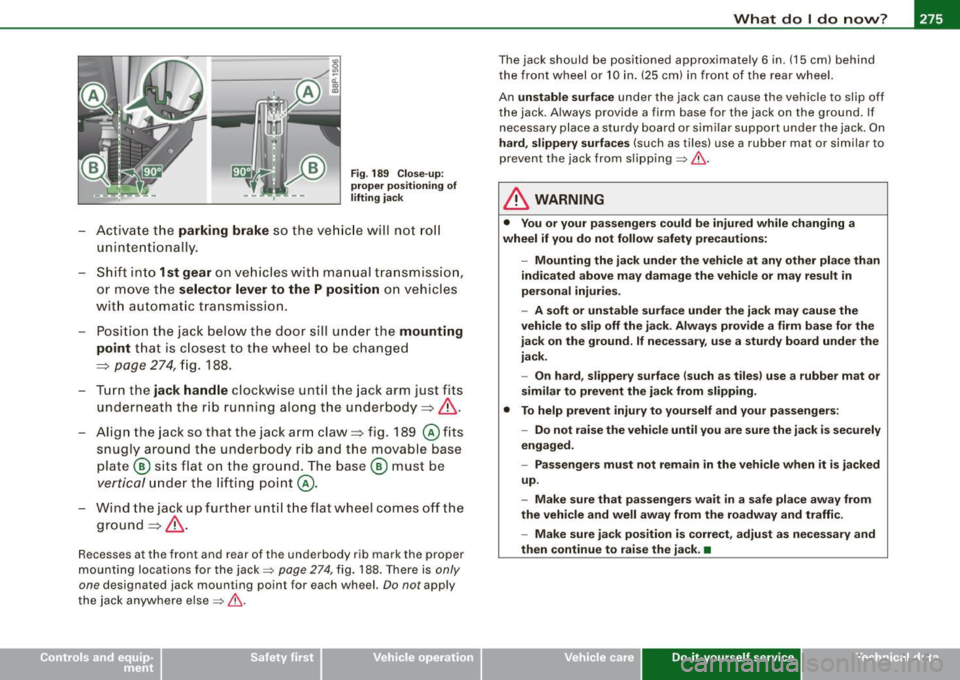
Fig. 189 Close-up:
proper positioning of
lifting jack
-Activate the parking brake so the vehicle will not roll
unintentionally.
- Shift into
1st gear on vehicles with manual transmission,
or move the
selector lever to the P position on vehicles
with automatic transmission.
- Position the jack below the door sill under the
mounting
point
that is closest to the wheel to be changed
=> page 274, fig. 188.
- Turn the
jack handle clockwise until the jack arm just fits
underneath the rib running along the underbody
=> &.
- Align the jack so that the jack arm claw => fig . 189 @ fits
snugly around the underbody rib and the movable base
plate @ sits flat on the ground. The base @ must be
vertical under the lifting point@.
- Wind the jack up further until the flat wheel comes off the
ground =>& .
Recesses at the front and rear of the underbody rib mark the proper
mounting locations for the jack ~
page 274, fig. 188. There is only
one
designated jack mounting point for each wheel. Do not apply
the jack anywhere else~& . The
jack should be positioned approximately 6 in. (15 cm) behind
the front wheel or 10 in. (25 cm) in front of the rear wheel.
An unstable surface under the jack can cause the vehicle to slip off
the jack. Always provide a firm base for the jack on the ground. If
necessary place a sturdy board or similar support under the jack. On
hard, slippery surfaces (such as tiles) use a rubber mat or similar to
prevent the jack from slipping ~& .
& WARNING
• You or your passengers could be injured while changing a
wheel if you do not follow safety precautions:
-Mounting the jack under the vehicle at any other place than
indicated above may damage the vehicle or may result in
personal injuries.
- A soft or unstable surface under the jack may cause the
vehicle to slip off the jack. Always provide a firm base for the
jack on the ground. If necessary, use a sturdy board under the
jack.
- On hard, slippery surface (such as tiles) use a rubber mat or
similar to prevent the jack from slipping.
• To help prevent injury to yourself and your passengers:
- Do not raise the vehicle until you are sure the jack is securely
engaged.
- Passengers must not remain in the vehicle when it is jacked
up.
- Make sure that passengers wait in a safe place away from
the vehicle and well away from the roadway and traffic.
- Make sure jack position is correct, adjust as necessary and
then continue to raise the jack. •
Vehicle care Do-it-yourself service irechnical data