service AUDI S3 2010 Workshop Manual
[x] Cancel search | Manufacturer: AUDI, Model Year: 2010, Model line: S3, Model: AUDI S3 2010Pages: 320, PDF Size: 75.34 MB
Page 229 of 320
___________________________________________ C_ h_e _c_ k_ i_n _g _ a_n _d_ f_il _li _n _g __ fflllll
•
help prevent the formation of harmful deposits, sometimes called
"s ludge," that over time can lead to expensive repairs.
At the time of printing, engine oi ls available in the U .S . and Canada
that meet the exacting specifications of Audi oil standard VW 502 00
(vehicles with gasoline engine) and VW 507 00 (vehicles with diesel
engine) are synthetic engine oils. This does not mean, however, that
every synthe tic engine oil wi ll meet Audi o il standard VW 502 00
(gasoline engines) and VW 507 00 (diesel engines). So always be
sure that you use an approved oil.
To help p reve nt th e for matio n of ha rmful d epo sit s use only oil wit h
the following sp ecific ati ons print ed on th e oil contain er:
• Gas oline engine s: Audi oil sta ndard VW 502 00
• Dies el en gin es: Aud i oil stand ard VW 507 00
O il container labels may carry the speci fication singly or in combi
nation with other designations and oil qua lity standards.
Vi sc osity
Engine o ils are graded according to their viscosity. The proper
viscosity grade oil for your engine depends on climactic or seasona l
conditions where you drive . You can use o il with a v iscosity grade o f
SAE 5W-40 across all temperature ranges for normal driving condi
tions.
However, if engine oil viscosity grade SAE 5W-40 is not avai lab le,
you can also use viscosity grade SAE 5W -30 or SAE 0W -40 as long as
it meets Audi oil quality standard VW 502 00 (vehicles with gaso line
engine) or VW 507 00 (vehicles with diesel engine) specifications.
Because engine oil that meets the Aud i o il standard may not be
avai lable everywhere when you need it, we strong ly recommend
that you a lways carry with you an extra quart (liter) of oil that
expressly conforms to the VW 502 00 (vehic les with gaso line engine)
or VW 507 00 (vehicles with diesel engine) specification, in case you
have to top off the oil while on the road.
Ap plie s to veh icles with g asoline eng ine onl y: Only if the level of the
oi l is at or below the min imum mark on the oil dipstick -and no oil that expressly conforms to Audi oi
l standard VW 502 00 specifica
tions is availab le -may you top off with a high quality e ngine oi l,
preferably synthetic-based, that meets ACEA A3, ACEA A5 or
ACEA 85 or AP I SL specifications, but even then, on ly in viscos ity
grades SAE 5W-40, SAE 5W -30, or SAE 0W-40. However, during the
entire time between oil change intervals, never top off with more
than a total of 0.5 qt/liter engine oil that does not con form to Audi
oi l specification VW 502 00 .
Applies to veh icle s with die sel eng ine only: Only if the level of the
oi l is at or below the minimum mark on the oi l dipstick -and no oil
that expressly confo rms to Aud i oi l standard VW 507 00 specifica
tions is available -may you top off with a high quality engine oil, that
meets ACEA C3 or API CF specifications, but even then, only in
v iscosity grades SAE 5W -40, SAE 5W -30 , or SAE 0W-40. However,
during the entire time between oi l change interva ls, never top off
with more than a total of 0.5 qt/liter engine oil that does not conform to Audi oil specification VW 507 00.
For more information abo ut engine oi l that has been app roved for
your vehicle, p lease contact either your authorized Audi dea ler or
Audi Custo mer Relations at 1 (800) 822 -2834 or visit our web site at
www.audiusa.com or www.audicanada.ca . Here you will a lso find a
current list of oils (manufacturers, brand names etc.) that conform
to Audi oi l standard VW 502 00 (vehicles with gaso line engine) or
VW 507 00 (vehicles with diese l engine) .
Changin g the engine oil
The engine oil and oil filter must be changed according to the
mi leage (ki lometers) and time in tervals specified in your vehic le's
Warranty
& Maintenance book let. Do not exceed these intervals -
harmful deposits from old engine oil can reduce engine perfor
mance and can lead to expensive engine repairs.
Changing the oil at the recommended intervals is so very important
because the lub ricating prope rties of oi l decrease gradua lly during
normal vehicle use . If you are not sure when you have your oil
changed, ask your authorized Audi Service Advisor . ..,.
Vehicle care I t •
Page 230 of 320
-~_C_ h_e _c _ k_ i_n ...:::g::;...._ a_n_ d_ f_ i_ll _in -'g:::;.._ ___________________________________________ _
Under some circumstances the engine oil should even be changed
more frequently. Change oil more often if you drive mostly short
distances, operate the vehicle in dusty areas or mostly under stop
and -go traffic conditions, or when you use your vehicle where
temperatures stay below freezing point for long periods .
Detergent additives in the oil will make fresh oil look dark after the
engine has been running for a short time. This is normal and is not
a reason to change the oil more often than recommended .
Damage or malfunctions due to lack of maintenance
It is essential that you change your oi l at the recommended intervals
using only engine oil that complies with Audi oil standard
VW 502 00 (vehicles with gasoline engine) or VW 507 00 (vehicles
with diesel engine). Your Limited New Vehicle Warranty does not
cover damage or malfunctions due to failure to follow recom
mended maintenance and use requirements as set forth in the Audi
Owner's Manual and Warranty
& Maintenance booklet. Your dealer
will have to deny warranty coverage unless you present to the dealer proof in the form of Service or Repair Orders that all scheduled
maintenance was performed in a timely manner .•
Engine oil consumption
The engine in your vehicle depends on an adequate
amount of oil to lubricate and cool all of its moving parts.
In order to provide effective lubrication and cooling of interna l
engine components, all internal combustion engines consume a
certain amount of oil. Oil consumption varies from engine to engine
and may change significant ly over the life of the engine. Typically,
engines with a specified break -in period (see=>
page 195) consume
more oil during the break-in period than they consume after oil
consumption has stabilized.
Under normal conditions, the rate of oil consumption depends on
the quality and viscosity of the oil, the RPM (revolutions per minute)
at which the engine is operated, the ambient temperature and road
conditions. Further factors are the amount of oil dilution from water condensation or fuel residue and the oxidation level of the oil. As
any
engine is subject to wear as mileage builds up, the oil consump
tion may increase over time until replacement of worn components
may become necessary .
With all these variables coming into play, no standard rate of oi l
consumption can be established or specified. There is no alternative
to regular and frequent checking of the oil level, see
Note.
If the yellow engine oil level warning symbol in the instrument
cluster lights up, you should check the oil level as soon as
possible
with the oil dipstick=> page 229. Top off the oi l at your
earliest convenience =>
page 230.
& WARNING
Before you check anything in the engine compartment, always
read and heed all WARNINGS
=> &. in "Work ing in the engine
compartment" on
page 224.
0 Note
Driving with an insufficient oil level is likely to cause severe damage
to the engine.
[ i ] Tips
• The oil pressure warning display~ is not an indicator of the oil
level. Do not rely on it. Instead, check the oil level in your engine at
regular intervals , preferably each time you refuel, and always before
going on a long trip.
• If you have the impression your engine consumes excessive
amounts of oil, we recommend that you consu lt your authorized
Audi dealer to have the cause of your concern properly diagnosed .
Keep in mind that the accurate measurement of oil consumption
requires great care and may take some time. Your authorized Audi
dealer has instructions about how to measure oil consumption
accurately. •
Page 232 of 320
___ C_h_ e_ c_k _in --=:: g;__ a_n _d_ f_il _li _n ..:g:a.- ___________________________________________ _
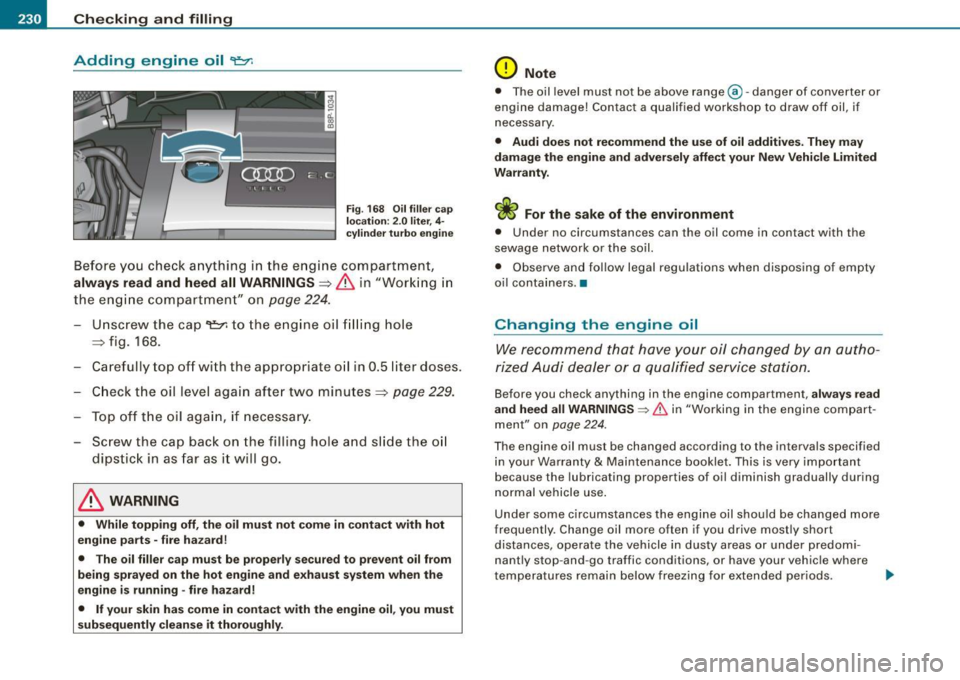
Adding engine oil ~
Fig. 168 Oil filler cap
location : 2.0 liter, 4-
cylinder turbo engine
Before you check anything in the engine compartment,
always read and heed all WARNINGS::::,
& in "Working in
the engine compartment" on
page 224.
- Unscrew the cap ce::,; to the e ngine oil filling hole
::::> fig. 168.
Carefully top off with the appropriate oil in 0.5 liter doses.
- Check the oil level again after two minutes::::,
page 229.
Top off the oil again, if necessary.
- Screw the cap back on the filling hole and slide the oil
d ips tick in as far as it will go.
& WARNING
• While topping off, the oil must not come in contact with hot
engine parts -fire hazard!
• The oil filler cap must be properly secured to prevent oil from
being sprayed on the hot engine and exhaust system when the
engine is running -fire hazard!
• If your skin has come in contact with the engine oil, you must
subsequently cleanse it thoroughly.
0 Note
• The oil level must not be above range @-danger of converter or
engine damage! Contact a qualified workshop to draw off oil, if
necessary .
• Audi does not recommend the use of oil additives. They may
damage the engine and adversely affect your New Vehicle Limited
Warranty .
<£> For the sake of the environment
• Under no circumstances can the oil come in contact with the
sewage network or the soil.
• Observe and fol low legal regulations when disposing of empty
oi l containers. •
Changing the engine oil
We recommend that hove your oil changed by an autho
rized Audi dealer or a qualified service station.
Before you check anything in the engine compartment, always read
and heed all WARNINGS~
& in "Working in the engine compart
ment" on
page 224.
T he engine oil must be changed according to the intervals specified
in your Warranty
& Maintenance booklet. This is very important
because the lubricating properties of oil diminish gradually during
normal vehicle use.
Under some circumstances the engine oil shou ld be changed more
frequently. Change oil more often if you drive most ly short
distances , operate the vehicle in dusty areas or under predomi
nantly stop -and -go traffic conditions, or have your vehicle where
temperatures remain below freezing for extended periods . .,_
Page 233 of 320

Checking and filling ---------------~-!':WIii
•
Detergent additives in the oil will make fresh oil look dark after the
engine has been running for a short time. This is normal and is not
a reason to change the oil more often than recommended.
Because of the problem of proper disposal, along with the special
tools and necessary expertise required, we strongly recommend
that you have your oil changed by an authorized
Audi dealer or a
qualified service station.
If you choose to change your oil yourself, please note the following
important information:
& WARNING
To reduce the risk of personal injury if you must change the engine oil in your vehicle yourself :
• Wear eye protection.
• To reduce the risk of burns from hot engine oil, let the engine
cool down to the touch.
• When removing the oil drain plug with your fingers, stay as far
away as possible. Always keep your forearm parallel to the ground
to help prevent hot oil from running down your arm.
• Drain the oil into a container designed for this purpose, one
large enough to hold at least the total amount of oil in your engine.
• Engine oil is poisonous. Keep it well out of the reach of children.
• Continuous contact with used engine oil is harmful to your
skin. Always protect your skin by washing oil off thoroughly with
soap and water.
0 Note
Never mix oil additives with your engine oil. These additives can
damage your engine and adversely affect your Audi New Vehicle
Limited Warranty.
<£' For the sake of the environment
• Before changing your oil, first make sure you know where you
can properly dispose of the used oil.
• Always dispose of used engine oil properly. Do not dump it on
garden soil, wooded areas, into open streams or down sewage
drains.
• Recycle used engine oil by taking it to
a used engine oil collec
tion facility in your area, or contact a service station. •
Applies to veh icles: with diesel engine
Important information for vehicles with diesel
engine when adding or changing engine oil
On vehicles with a diesel engine always use engine oil that conforms to Audi oil specification VW 507 00 when
adding or changing engine oil.
Vehicles with diesel engines require and must always use special
engine oil that conforms to Audi oil specification
VW 507 00.
Never use any other kind of engine oil in your vehicle, not even to
top off the oil level.
At the time of printing, we are aware that Castrol® produces engine
oil that conforms to Audi oil specification VW 507 00. This oil may
not yet be available throughout North America. Other oil manufac
turers may offer engine oil that conforms to Audi oil specification
VW 507 00 at this time or some future date.
Please be sure to consult with your authorized Audi dealer for infor
mation and availability of the proper engine oil for your vehicle's
diesel engine and for the latest technical information.
Because this special engine oil may not be available when need it,
we strongly recommend that you always carry with you extra quart
!liter! of oil that conforms to Audi oil specification VW 507 00, in
case you have to top off oil while on the road. .,_
Vehicle care I t •
Page 252 of 320

-~_T_ ir_e_ s_ a_ n_d _ w_ h_ e_e _l_s _________________________________________________ _
• The tire pressures should only be checked and adjusted when
t he tires are cold . The s lig htly raised pressures of warm tires must
not be reduced .
• Adjust the ti re pressure to t he loa d you are carrying.
• Reinstal l the valve stem cap on the valve.
When should I c heck the tire pressure?
The correct ti re p re ssure is especially impo rtant at h ig h speeds . The
pressure should the re fore be checked a t le ast once a month and
a lways before starting a journey. Do not forget to check the tire pres
sure for the spare whee l
::::> page 269.
When should
I adjust the tire pressure s?
Adjust the tire pressure to the load you are carrying. A fter chang ing
a wheel
or r eplac ing whee ls you have to adjus t th e tire pre ssures on
a ll whee ls. In addit io n, you must the n initia lize the new t ire pres
sures in the tire pressure monitoring system* =>
page 263.
& WARNING
Incorrect tire pressures and/or underinflation can lead sudden tire
failure, los s of control, colli sion , serious personal injury or even
death .
• When the warning symbol appears in the instrument
c luster , stop and inspect the tire s.
• Incorrect tire pressure and /or underinflation can cause
increased tire wear and can affect the handling of the vehicle and
stopping ability .
• Incorrect tire pressures and /or underinfla tion can also lead to
sudden tire failure , including a blowout and sudden deflation ,
causing loss of vehicle control .
• The driver is responsible for the correct tire pressures for all
tires on the vehicle. The applicable pre ssure values are located on
a sticke r on the driver 's side B -pillar o r on the inside of the fuel
filler flap.
& WARNING (continued )
• Only when all tires on the vehicle are filled to the correct pre s
sure , the tire pres sure monitoring sy stem * can work correctly.
• The use of incorrect tire pressure values can lead to accidents
or other damage . Therefore it is e ssential that the driver observe
the specified tire pressure v alue s for the tires and the correct pres
sures for the function of the tire pre ssure monitoring system* .
• Always inflate tires to the recommended and correct tire pres
s ure before driving off.
• Driving with underinflated tires bend more , letting them get
too hot re sulting in tread separation , sudden tire fa ilure and loss
of control.
• Excessive speed and /overloading can cause heat build -up ,
sudden tire failure and loss of control.
• If the tire pressure is too low or too high, the tires will wear
prematurely and the vehicle will not handle well.
• If the tire is not flat and you do not have to change a wheel
immediately , drive at reduced speed to the nearest service station
to che ck the tire pressure and add air as required .
0 Note
Driving without valve stem caps can cause damage to the tire
va lves. To prevent this, always make sure that fac tory ins talled va lve
stem caps on all whee ls are securely mounted on the valve.
Tires and vehicle load limits
There are limits to the amount of load or weight that any vehic le and
any tire ca n carry. A vehicle that is ove rlo aded wil l n ot h andle wel l ...
Page 255 of 320
Tires and wheels -_______________ _____.
Tire service life
The service life of tires depends on a lot of different things
including proper installation and balancing, correct tire
pressure and driving style.
(r
\'"-----JJ
Tread Wear Indicator (TWI)
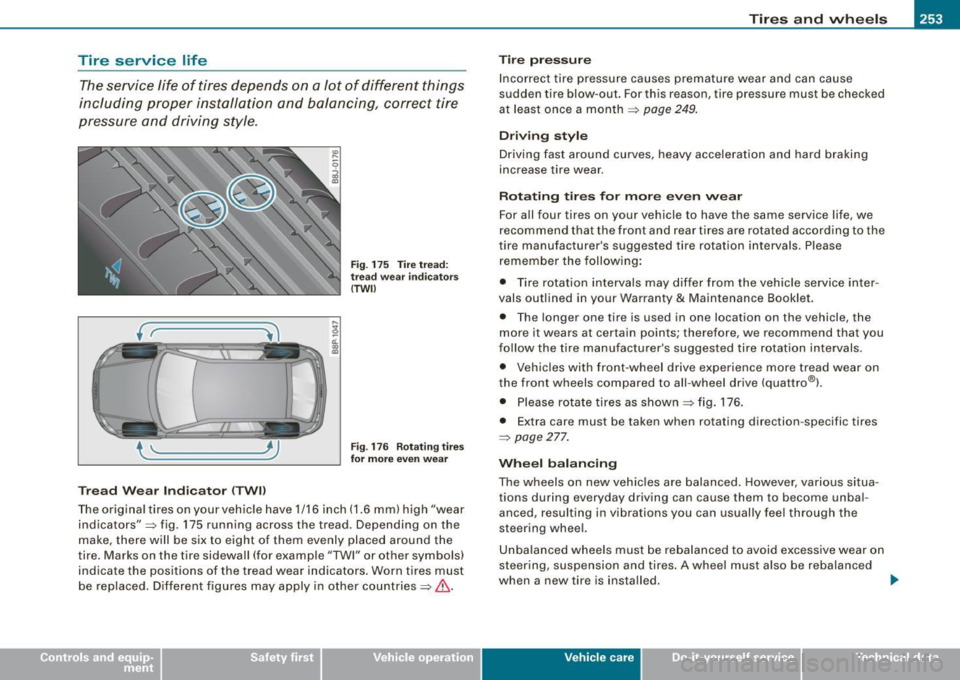
Fig . 175 Tire tread:
tread wear indicators
(TWI)
Fig . 176 Rotating tires
for more even wear
The original tires on your vehicle have 1/16 inch (1.6 mm) high "wear
indicators":::::, fig. 175 running across the tread. Depending on the
make, there will be six to eight of them evenly placed around the
tire. Marks on the tire sidewall (for example "TWI" or other symbols)
indicate the positions of the tread wear indicators. Worn tires must
be replaced. Different figures may apply in other countries.:::::,&.
Tire pressure
Incorrect tire pressure causes premature wear and can cause
sudden tire blow-out. For this reason, tire pressure must be checked
at least once a month .:::::,
page 249.
Driving style
Driving fast around curves, heavy acceleration and hard braking
increase tire wear.
Rotating tires for more even wear
For all four tires on your vehicle to have the same service life, we
recommend that the front and rear tires are rotated according to the
tire manufacturer's suggested tire rotation intervals. Please
remember the following:
• Tire rotation intervals may differ from the vehicle service inter
vals outlined in your Warranty
& Maintenance Booklet.
• The longer one tire is used in one location on the vehicle, the
more it wears at certain points; therefore, we recommend that you
follow the tire manufacturer 's suggested tire rotation intervals.
• Vehicles with front-wheel drive experience more tread wear on
the front wheels compared to all-wheel drive (quattro®l .
• Please rotate tires as shown .:::::, fig. 176.
• Extra care must be taken when rotating direction -specific tires
:::::, page 277.
Wheel balancing
The wheels on new vehicles are balanced. However, various situa
tions during everyday driving can cause them to become unbal
anced, resulting in vibrations you can usually feel through the
steering wheel.
Unbalanced wheels must be rebalanced to avoid excessive wear on
steering, suspension and tires. A wheel must also be rebalanced
when a new tire is installed. _,,
Vehicle care I I Technical data
Page 259 of 320
________________________________________________ T_ i _r_e _s_ a_n_ d_ w_ h_ e_e _ l_s __ !II
•
to ring s yst em * would not b e ab le to moni tor the tire pr essur e or
war n yo u if i t is nec essa ry.
• T he battery ins ide of the tire pressure s ensor has a l imited
service life.
• Always driv e with the va lv e stem caps s ecure ly m ounted. We
r e co mm end usi ng fact ory insta lled valve stem cap s. Ask y our a utho
rized Audi d ealer to replac e lost valve stem caps .
T he installat ion of replacement tires with steel cord body plies in
t he ti re s id ew all m ay ca use ma lfun ction o f th e tire press ure m oni
toring system *, and is not recommended (co rd mater ial information
i n mo lded on t he tire sid ewa ll).
Always check your t ire pressure mo nitoring system* indicator after
r eplaci ng o ne or more tir es o n you r veh ic le . If t he ti re p ressu re
mo nito ring syste m* in dicato r flashes o r is ill um in ated, your s ystem
is not working p rope rly . Yo ur replacement t ire might be inco mpat
i b le with you r tir e p ressure mon itori ng sys te m *, or so me comp o
nent of the tire pressure monitoring system * may be damaged .
& WARNING
• Using incorrect or unmatched tires and / or wheels or improper
tire and wheel combinations can lead to loss of control , collision
and serious personal injury .
• Always use tires , rims and wheel bolts that meet the specifica
tions of original factory-installed tires or other combinations that
have been specifically approved by the vehicle manufacturer .
• Tires age even if they are not being used and can fail suddenly,
espe cially at high speeds . Tires that are more than 6 years old can
only be used in an emergency and then with special care and at
lower speeds.
• Never mount used tires on your vehicle if you are not sure of
their "previous history. " Old used tires may have been damaged
even though the damage cannot be seen that can lead to sudden
tire failure and loss of vehicle control.
& WARNING (continued )
• All four wheels must be fitted with radial tires of the same type,
size {rolling circumference ) and the same tread pattern. Driving
with different tires reduces vehicle handling and can lead to a loss
of control.
• If the spare tire is not the same as the tires that are mounted
on the vehicle -for example with winter tires -only use the spare
tire for a short period of time and drive with extra care . Refit the
normal road wheel as soon as safely possible.
• Never drive faster than the maximum speed for which the tires
on your vehicle are rated because tires that are driven faster than
their rated speed can fail suddenly .
• Overloading tires cause heat build-up , sudden tire failure ,
including a blowout and sudden deflation and loss of control.
• Temperature grades apply to tires that are properly inflated and
not over or underinflated.
• For technical reasons it is not always possible to use wheels
from other vehicles -in some cases not even wheels from the
same vehicle model.
• If you install wheel trim discs on the vehicle wheels , make sure
that the air flow to the brakes is not blocked . Reduced airflow to
the brakes can them to overheat , increasing stopping distances
and causing a collision .
• Run flat tires may only be used on vehicles that were equipped
with them at the factory . The vehicle must have a chassis designed
for run flat tires and a factory-installed tire pressure monitoring
system* that indicates a loss of tire pressure . Incorrect use of run
flat tires can lead to vehicle damage or accidents . Check with an
authorized Audi dealer or tire specialist to see if your vehicle can
be equipped with run flat tires . If run flat tires are used , they must
be installed on all four wheels . Mi xing tire types is not permitted. _,.
Vehicle care
I t •
Page 260 of 320
-~_T_ ir_e_ s_ a_ n_d _ w_ h_ e_e _l_s _________________________________________________ _
0 Note
• For technical reasons, it is not generally possible to use the
wheel rims from other vehicles. This can hold true for wheels of the
same vehicle type.
• If the spare tire is different from the tires that you have mounted
on your vehicle (for example winter tires or wide profile t ires), then
use the spare tire for a short period of time only and drive with extra
care. Replace the f lat tire with the tire matching the others on your
vehic le as soon as possib le.
• If you put different whee ls and tires on your vehic le (e .g. winter
whee ls and tires), you must be certain that the wheels and tires are
compatible with the tire pressure monitoring system*. Otherwise
the system will register a malfunction and a fault message wi ll be
displayed. For more information, contact your authorized Aud i
dea ler.
(D Note
• When installing new tires, be careful not to damage the valves or
tire pressure monitoring system* sensors.
• Never drive without the valve stem cap. The valves could get
damaged.
• If the sensors must be replaced, then the valve must also be
replaced at the same time.
<£> For th e sake of the environm ent
Dispose of o ld tires in accordance with the loca l requirements. •
Uniform tire quality grading
• Tread wear
• Traction AA A B C
• Temperature A B C Quality grades can be found where applicable on the tire side wal
l
between tread shoulder and maximum section width~
page 254,
fig. 177 .
For exa mple: Tread wear 200, Traction AA , Temperature A.
All passenger car tires must conform to Federal Safety Requ ire
ments in addition to these grades.
T rea d w ear
The
tread wear grade is a comparative rating based on the wear rate
of the tire when tested under controlled condit ions on a specified
government test course .
Fo r example, a tire graded 150 wou ld wear one and one hal f (1 1/2)
times as well on the government course as a tire graded 100.
The relative performance of tires depends upon the actua l condi
tions of their use, however, and may depart significantly from the norm due to variations in driving habits, service practices and differ
ences in road characteristics and climate .
Tr act ion
The
traction grades, from highest to lowest, are AA, A, Band C.
T hose grades represent the tire 's ability to stop on wet pavement as
measured under contro lled co nditions on specified government
test surfaces of asphalt and concrete. A tire marked C may have
poor traction performance
~ & .
Temp erature
T he
temperature grades are A (the highest), B , and C , represent ing
the tire's resistance to the generation of heat and its abi lity to dissi
pate heat when tested under control led conditions on a specified
indoor laboratory test wheel.
Susta ined high temperature can cause the mater ial of the tire to
degenerate and reduce tire life, and excessive temperature can lead
to sudden tire failure~& .
T he grade C corresponds to a leve l of performance which a ll
passenger car tires must meet under the Federal Motor Vehicle
Page 271 of 320
_______________________________________________ W_ h_ a _ t_d_ o_ l _d _o_ n_ o_ w_ ? _ __.ffllll
& WARNING !continued)
• Always make sure the spare tire and even a flat tire are secured
in place and not loose, otherwise they could fly forward, causing
personal injury to passengers in the vehicle in an accident or
sudden maneuver .
• Never use the jack supplied with your Audi on another vehicle,
particularly on a heavier one. The jack is only suitable for use on
the vehicle it came with. •
Ap plies to vehicles: w ith compact spare wheel
Compact spare wheel
The compact spare wheel is only intended to be used for
a short Nme.
Fig . 183 Compact
spare wheel in the
wheel well
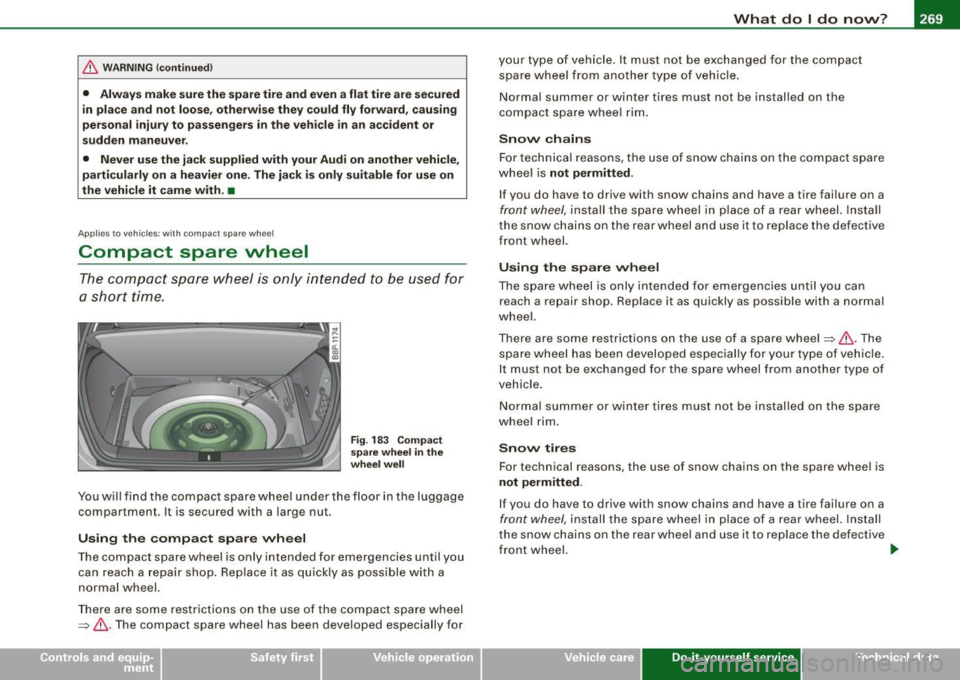
You will find the compact spare wheel under the floor in the luggage
compartment. It is secured with a large nut.
Using the compact spare wheel
The compact spare wheel is only intended for emergencies until you
can reach a repair shop. Replace it as quickly as possible with a
normal wheel.
There are some restrictions on the use of the compact spare wheel
=>
& -The compact spare wheel has been developed especially for your type of vehicle
. It must not be exchanged for the compact
spare wheel from another type of vehicle.
Normal summer or winter tires must not be installed on the
compact spare wheel rim.
Snow chains
For technical reasons, the use of snow chains on the compact spare
wheel is
not permitted .
If you do have to drive with snow chains and have a tire failure on a
front wheel, install the spare wheel in place of a rear wheel. Install
the snow chains on the rear wheel and use it to replace the defective
front wheel.
Using the spare wheel
The spare wheel is only intended for emergencies until you can
reach a repair shop. Replace it as quickly as possible with a normal
wheel.
There are some restrictions on the use of a spare wheel =>& .The
spare wheel has been developed especially for your type of vehicle.
I t must not be exchanged for the spare wheel from another type of
vehicle.
Normal summer or winter tires must not be installed on the spare
wheel rim .
Snow tires
For technical reasons , the use of snow chains on the spare wheel is
not permitted .
If you do have to drive with snow chains and have a tire failure on a
front wheel, install the spare wheel in place of a rear wheel. Install
the snow chains on the rear wheel and use it to replace the defective
front wheel.
t,.
Vehicle care Do-it-yourself service irechnical data
Page 273 of 320
What do I do now? -__________________ __;__:....:....:..:: __ _
•
-All passengers should leave the car and move to a safe
location (for instance, behind the guardrail)~& .
- Apply the
parking brake firmly ~& .
- Move
selector lever to position Pon an automatic trans-
miss ion; put manual transmission in
first gear ~& .
-If you are towing a trailer : unhitch the trailer from your
vehicle.
- Take the
tool and the spare tire~ page 268 out of the
luggage compartment.
& WARNING
You or your passengers could be injured while changing a wheel if
you do not follow these safety precautions:
• If you have a flat tire, move a safe distance off the road. Turn off
the engine, turn the emergency flasher on and use other warning
devices to alert other motorists.
• Make sure that passengers wait
in a safe place away from the
vehicle and well away from the roadway and traffic.
• To help prevent the vehicle from moving suddenly and possibly
slipping off the jack, always fully set the parking brake and block
the wheel diagonally opposite the wheel being changed. When one
front wheel is lifted off the ground, placing the automatic trans
mission in "P" (Park), or engaging a gear in a manual transmission
will
not prevent the vehicle from moving.
• Before you change a wheel, be sure the ground is level and firm.
If necessary, use a sturdy board under the jack.
• After installing the spare wheel, make sure that you remount
the flat tire/wheel in its storage area properly and tighten the
knurled retaining screw securely. •
Changing a wheel
When you change a wheel, follow the sequence described
below step-by-step and exactly in that order.
1. Remove the decorative wheel cover*. For more details
see also
~ page 272, "Decorative wheel covers" or
~ page 273, "Wheels with cap-covered wheel bolts".
2. Loosen the
wheel bolts~ page 274.
3. Locate the proper mounting point for the jack and align
the jack below that point~
page 274.
4. Lift the car with the jack~ page 274.
5. Take the flat wheel off and then put the spare on
~ page 276.
6. Tighten all wheel bolts lightly .
7.
Lower the vehicle with the jack .
8. Use the wheel bolt wrench and
firmly tighten all wheel
bolts ~
page 274.
9. Put the decorative wheel cover* back on.
& WARNING
Always read and head all WARNINGS and information ::} & in
"Raising the vehicle" on
page 274 and ~ page 277. •
After changing a wheel
A wheel change is not complete without the following
actions.
- Store and secure the replaced wheel in the spare wheel
well. .,._
Do-it-yourself service