service AUDI S3 2010 Repair Manual
[x] Cancel search | Manufacturer: AUDI, Model Year: 2010, Model line: S3, Model: AUDI S3 2010Pages: 320, PDF Size: 75.34 MB
Page 275 of 320
What do I do now ? -
------------------
Applies to vehicle s: with cap-covered wheel bolts
Wheels with cap-covered wheel bolts
The caps must be removed first from the wheel bolts
before the bolts can be unscrewed.
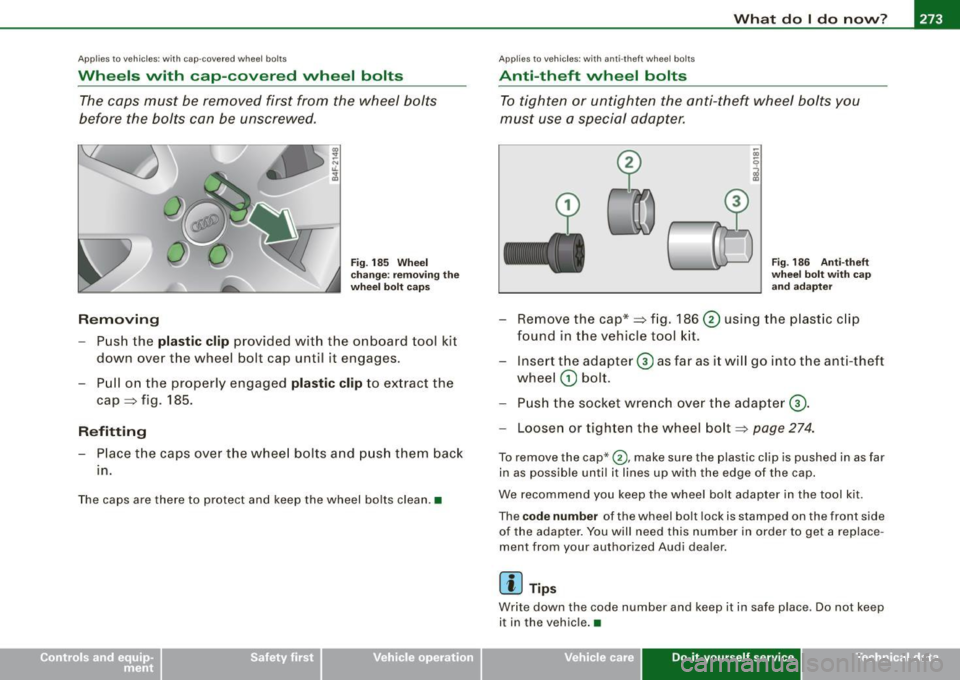
Rem ovin g
Fig. 185 W hee l
c h ange : removin g th e
whee l bolt ca ps
- Push the plastic clip provided with the onboard tool kit
down over the wheel bolt cap until it engages.
- Pull on the properly engaged plastic clip to extract the
cap
~ fig . 185.
R efitting
- Place the caps over the whee l bolts and p ush them back
1n.
The caps are there to protect and keep the wheel bo lts clean .•
Ap plies to vehicles: with anti-theft wheel bo lts
Anti-theft whee l bolts
To tighten or untighten the anti-theft wheel bolts you
must use a special adapter.
....
(
V"
..
Fi g. 18 6 An ti-t heft
whee l bolt wit h ca p
a n d ada pter
- Remove the cap*~ fig. 186 0 using the plastic clip
found in the vehicle tool kit.
- Insert the adapter
0 as far as i t wi ll go into the anti-theft
wheel
G) bolt.
- Push the socket wre nch over t he adap ter
G) .
- Loosen or tighten the wheel bolt~ page 274.
To remove the cap* 0, make sure the plastic clip is pushed in as far
in as possib le until it lines up wi th the edge of the cap .
We recommend you keep the wheel bolt adapter in the tool kit.
The
c od e numb er of the wheel bolt lock is stamped on the front side
of the adap ter. You will need this number in orde r to get a replace
ment from your author ized Audi dealer.
[ i ] Tip s
Write down the code number and keep it in safe place . Do not keep
it in the vehicle. •
Vehicle care Do-it-yourself service Technical data
Page 277 of 320
What do I do now? -
------------------
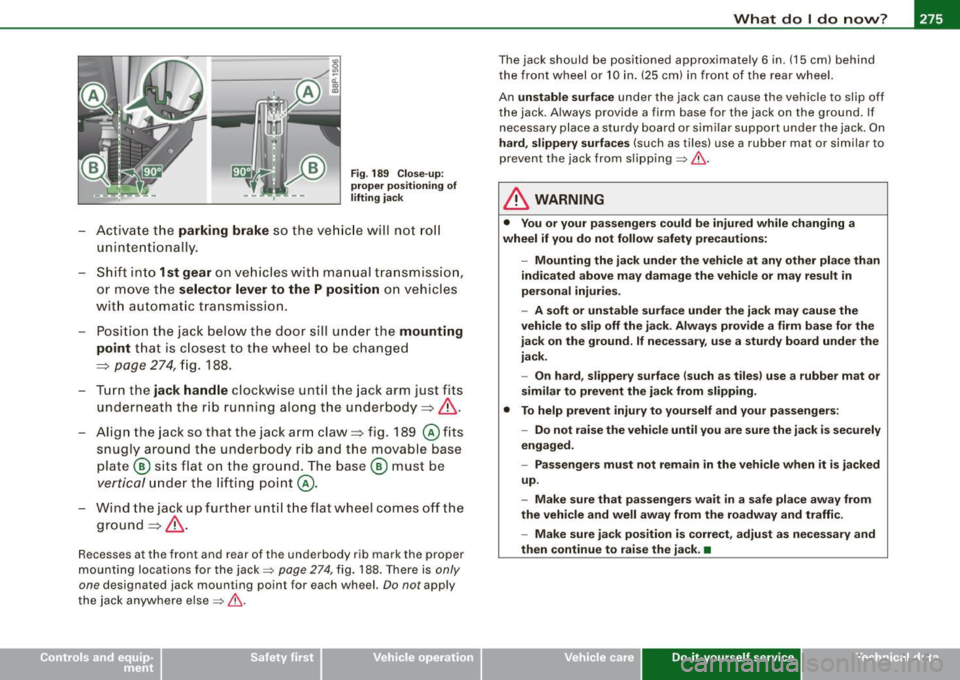
Fig. 189 Close-up:
proper positioning of
lifting jack
-Activate the parking brake so the vehicle will not roll
unintentionally.
- Shift into
1st gear on vehicles with manual transmission,
or move the
selector lever to the P position on vehicles
with automatic transmission.
- Position the jack below the door sill under the
mounting
point
that is closest to the wheel to be changed
=> page 274, fig. 188.
- Turn the
jack handle clockwise until the jack arm just fits
underneath the rib running along the underbody
=> &.
- Align the jack so that the jack arm claw => fig . 189 @ fits
snugly around the underbody rib and the movable base
plate @ sits flat on the ground. The base @ must be
vertical under the lifting point@.
- Wind the jack up further until the flat wheel comes off the
ground =>& .
Recesses at the front and rear of the underbody rib mark the proper
mounting locations for the jack ~
page 274, fig. 188. There is only
one
designated jack mounting point for each wheel. Do not apply
the jack anywhere else~& . The
jack should be positioned approximately 6 in. (15 cm) behind
the front wheel or 10 in. (25 cm) in front of the rear wheel.
An unstable surface under the jack can cause the vehicle to slip off
the jack. Always provide a firm base for the jack on the ground. If
necessary place a sturdy board or similar support under the jack. On
hard, slippery surfaces (such as tiles) use a rubber mat or similar to
prevent the jack from slipping ~& .
& WARNING
• You or your passengers could be injured while changing a
wheel if you do not follow safety precautions:
-Mounting the jack under the vehicle at any other place than
indicated above may damage the vehicle or may result in
personal injuries.
- A soft or unstable surface under the jack may cause the
vehicle to slip off the jack. Always provide a firm base for the
jack on the ground. If necessary, use a sturdy board under the
jack.
- On hard, slippery surface (such as tiles) use a rubber mat or
similar to prevent the jack from slipping.
• To help prevent injury to yourself and your passengers:
- Do not raise the vehicle until you are sure the jack is securely
engaged.
- Passengers must not remain in the vehicle when it is jacked
up.
- Make sure that passengers wait in a safe place away from
the vehicle and well away from the roadway and traffic.
- Make sure jack position is correct, adjust as necessary and
then continue to raise the jack. •
Vehicle care Do-it-yourself service irechnical data
Page 279 of 320
_____________________________________________ W_ h _a_t _ d_ o_ l _d _o _ n_o_ w_ ?_ . __ ffllll
•
• T he whe el bo lts should be cl ean and easy to turn . C heck for dirt
an d corro sion on the mati ng s urfaces o f both th e wheel a nd the
hub. Remove a ll dirt fro m these surfaces before remountin g the
whee l.•
Tires with unidirectional tread design
Tires with unidire ctional tread des ig n must be mou nted
w ith the ir tr ead patter n p oin ted in the right d irection .
Using a spare tire with a tread pattern intended for use
in a specific direction
Whe n u sin g a spare tir e with a trea d p att ern in te nd ed fo r use in a
sp ec if ic dir ection, p lease no te t he followin g:
• T he direction of rotation is ma rked by an arrow o n the side of the
ti re .
• I f the spare tire has to b e ins talled in the inco rrec t d irecti on in th e
e vent of a fla t tire , use t he sp are tir e only tem pora rily sin ce the ti re
wi ll not be ab le to achieve its o ptim um performance cha racteristics
wi th re gar d to aqua planing , n ois e an d wea r.
• W e rec omme nd t hat p arti cula r att enti on be pa id to th is f act
du ring w et we ather and th at you a djust you r sp eed to m atc h ro ad
condition s.
• Re place t he flat t ire w it h a n ew on e and have it insta lled on y our
v e hi cle as soo n as possi ble to res to re the ha nd ling a dvant ages of a
p roper ly pointed di re ction-d epe nde nt tire. •
Notes on wheel change
Ple ase r ead the inf ormatio n=> pa ge 254, "N ew tir es and r eplaci ng
ti res an d wheels" if yo u are g oin g to use a spare ti re wh ich is
d iff ere nt from the tires o n your vehi cle .
A fter you change a tire:
• Check the tire pressure on the spare immediately after
mounting.
• Have the wheel bolt tightening torque checked with a torque
wrench as soon as possible by your authorized Audi dealer or a qualified service station .
• On steel and alloy wheel rims, the wheel bolts are correctly tight
ened with a torque of 90 ft lb (120 Nml.
• If you notice while changing a tire that the wheel bolts are
corroded and difficult to turn , then they should be replaced before
you check the tightening torque.
• Replace the flat t ire with a new one and have it installed on your
vehicle as soon as possible . Remount the wheel cover .
Until then, drive with extra care and at reduced speeds.
& WARNING
• If you are going to equip your vehicle with tires or rims which
differ from those which were factory installed , then be sure to read
the information
=> page 254 , "New tires and replacing tires and
wheels ".
• Always make sure the damaged wheel or even a flat tire and
the jack and tool kit are properly secured in the luggage compart
ment and are not loose in the passenger compartment .
• In an accident or sudden maneuver they could fly forward,
injuring anyone in the vehicle .
• Always store damaged wheel , jack and tools securely in
luggage compartment . Otherwise , in an accident or sudden
maneuver they could fly forward, causing injury to passengers in
the vehicle . •
Do-it-yourself service
Page 281 of 320

_________________________________________________ F_ u_ s_ e_s _ a_n _d_ b_ u _ lb_ s _ __.ffllll
The various electrical circuits are protected by fuses. The fuses are
clustered in a centralized unit. The unit is located behind the face
panel at the end of the instrument panel. The crank for operating
the sunroof in case of a power failure is a lso stored behind the face
panel
~ page 50.
Two spare fuses and a sticker identifying the fuses are located on
the inside of the fuse box cover.
You are well advised to keep a supply of spare fuses in your vehicle .
Fuses with the proper ampere ratings are available at your autho
rized Audi dealer.
& WARNING
Never replace a fuse with one that has a higher amperage rating.
• A fuse with a too high amperage could damage the electrical
part and cause a fire .
0 Note
• On no account should fuses be repaired (e.g . patched up with tin
foil or wire) as this may cause serious damage elsewhere in the elec
trical circuit or cause fire.
• If a fuse blows repeatedly, do not keep replacing it. Instead, have
the cause for the repeated short circuit or overload tracked and
fixed. •
Fuse Location , Instrument Panel left
Fus es which can be replaced.
Fig. 194 Fuse carrier
behind the instrument
panel end face, cover
removed
Note that the following table is accurate at the time of going to
press and is subject to change. In the event of discrepancies , the
label on the inside of the cover always takes precedence .
The power seats are protected by circuit breakers, which automati
cally reset after a few seconds after the overload has been reme -
died. .._
Vehicle care Do-it-yourself service irechnical data
Page 283 of 320

_________________________________________________ F_ u_ s_ e_s _ a_n _d_ b_ u _ lb_ s_--J _
No. Equipm ent
37 Heated seats, front
38 Passenger s ide power window, front
39 Special function interface
Starter
41 Rear window wiper
42 Not used
43 Body control module
44 Not use
d
45 Not used
Not used
47 Cell phone package (VOA
interface)
48 Not used
49 Not used
Autom atic cir cuit br eake rs: Amps
20
30
5
4
0
15
20
5
The electric power windows and the electric seat adjusters are protected with circuit breakers which reset automatically after the
circu it overload has been corrected.
[ i J Tip s
• Whenever replacing a fuse, always consult the sticker on the
inside of the fuse panel cover. It contains the most up-to-date infor
mation regarding the fuse arrangement. If in doubt, ask your autho
rized Audi Service advisor.
• Some of the equipment items listed are optiona l or on ly avail
able on certain model configurations. •
Fuse location , left side of engine
compartment
N M N
~ (X) 0)
Fig . 195 F use ass ign
m ent in th e e ngin e
co mpar tment in th e
e xampl e wit h
54 p lu g
in fu ses
Please check your car's fuse layout, there are two different layouts.
Check the fuse layout with the fuse panel cover removed
~ page 278, "Fuse cover in engine compartment" .
Some of the equipment items listed are optional or on ly available on
certain model configurations.
Please note that the preceding table was accurate at the time of
printing and is subject to change . In the event of discrepancies, the
label on the inside of the cover a lways takes precedence.
V ariation (1 ) with 30 Plu g-in F uses
No . Equipm ent Amps
F1 Terminal 30 40
E ngine components
20
F3 Battery voltage 5
F4 ESP valves, Anti -lock brake system (ABS) valves 20/30
F5 Transmission control module
15
Vehicle care Do-it-yourself service Technical data
Page 285 of 320
_________________________________________________ F_ u_ s_ e_s _ a_n _ d_ b_ u_lb _ s __ ffllll
N "E .
o . qu1pm ent Amps I No. Equ ipment Amps
F20 Not used
I F45 Not used
F21 Not used F46 Not used
F22 Not used F47 Body control module Ueftl 30
F23 Engine control module, main re
lay
10 Pump (ESP/ABS), ABS va
lve
40
F24 Control module for CAN d ata transfer (gateway) 5 F49 Not used
F25 Not used F50 Not used
Not used F51 Not used
F27 Not used F52 Power supply re lay terminal 15 50
F28 Engine control module 15/25
F53 Fuse assignment in the left
-side instrument
50
F29 Engine components 5 panel (special equipment)
Not use d Not used
•
F31 Front windshield wiper system
30
Not used
Bulbs
F33 Not used
Replacing light bulbs
F34 Not used
F35 Not used
For your safety, we recommend that you have your autho-
rized Audi dealer replace burned out bulbs for you.
Not use d
F37 Not used It is becom
ing increasingly more and more difficult to replace
vehic le light bu lbs since in many cases, other parts of the car must
F38 Engine components, tank diagnosis 1 0 first be removed before you a re able to get to the bulb . This applies
F39 Clutch pedal switch, b rake light switch 5 especia
lly to the light bu lbs in the front of your car which you can
only reac h through the engine compartment.
Ignition coils
20
Sheet meta l and bulb holders can have sharp edges that can cause
F41 Not used
serious cuts, and parts must be correctly taken apart and then prop -
Not use d erly put back together to he
lp prevent breakage of parts and long
F43 Not used term damage from water that can enter housings that have not
been properly resea led .
...
Not used
• Do-it -yourself service
Page 287 of 320

________________________________________________ E_m _ e_r..:: g ~ e_ n_c__, y:._ s_ i_ t ..:u ;..:a:.:. t.:.. i..: o :..; n..:..:: s __ ffllll
•
Emergency situations
General
This chapter is intended for trained emergency crews and working
pe rsonnel who have the necessary tools and equ ipment to perform
these operations. •
Starting by pushing or towing
(D Note
Vehicles with an automatic transmis sion cannot be started by
push ing or towing . •
Starting with jumper cables
Ju mpe r cabl e: Note the man ufa ct ure r's in for matio n.
If the battery is discharged, another veh icle can provide starting
assistance. For this you require a jumper cable. Both batteries must
h ave t he same vo ltage (V) and a s im ilar capacity (Ah).
Jumper cables
Use
only jumper cables of sufficiently large cross section to safely
car ry the starter current . Refer to the manufactu rer's specifications.
Use only j um per ca bles with
isolated term in al cl am ps and pr operly
marked for distinction :
plus
(+) cable in mo st c ases c olored red
minus( -) cable i n most cas es co lor ed black .
T he wire cross section must be at least 0 .038 in
2 (25 mm2
) for gaso
l ine e ngines and a t lea st 0.054 in
2 (35 mm2
) fo r diese l e ng ines .
& WARNING
Batteries contain electricity, acid , and gas. Any of the se can cause
very ser ious or fatal injury . Follow the instructions below for safe
handling of your vehicle 's battery .
• Always shield your eyes and avoid leaning over the battery
whenever possible .
• A discharged battery can already freeze at temperatures just
below 32 °F (0 °C l. Never attempt to provide starting assistance on
a frozen or thawed out battery- Danger of explosion and chemical
burns! Replace a battery if it has been frozen.
• Do not allow battery acid to contact eyes or skin. Flush any
contacted area with water immediately .
• Improper use of a booster battery to start a vehicle may cause
an explosion .
• Vehicle batteries generate explosive gases . Keep sparks, flame
and lighted cigarettes away from batteries .
• Do not try to jump start any vehicle with a low acid level in the
battery .
• The voltage of the booster battery must also have a 12 -Volt
rating . The capacity (Ah ) of the booster battery should not be
lower than that of the discharged battery . Use of batteries of
different voltage or substantially different "Ah " rating may cause
an explosion and personal injury .
• Never charge a frozen battery . Gas trapped in the ice may cause
an explosion.
• Never charge or use a battery that has been frozen . The battery
case may have be weakened .
• Use of batter ies of different voltage or substantially different
capacity (Ah) rating may cau se an e xplosion and inju ry . The
c apacity (Ah ) of the booster battery should not be lower than that
of the discharged battery. .,.
Do-it -yourself service
Page 289 of 320
______________________________________________ E_ m_ e_r .;::g ;...e _ n_ c __,c. y_ s_it _u_ a_ ti_o _ n_ s _ __._
Use of jumper cables
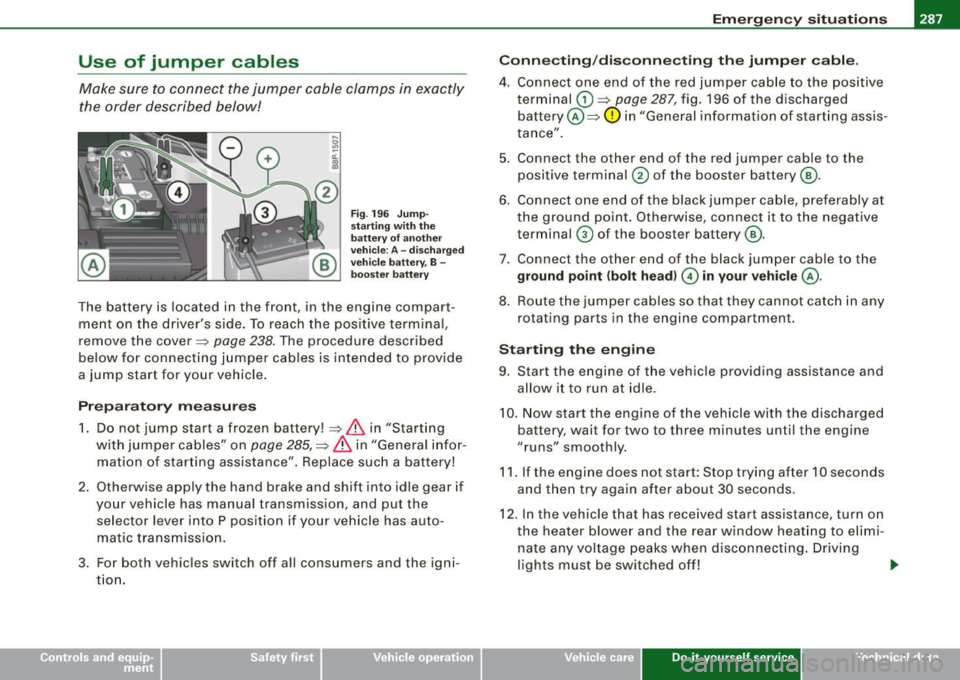
Make sure to connect the jumper cable clamps in exactly
the order described below!
Fig . 196 Jump
starting with the
battery of another
vehicle : A -discharged
vehicle battery , B -
booster battery
The battery is located in the front, in the engine compart
ment on the driver's side. To reach the positive terminal,
remove the cover=>
page 238. The procedure described
below for connecting jumper cables is intended to provide
a jump start for your vehicle.
Preparatory measures
1. Do not jump start a frozen battery ! => & in "Sta rting
with jumper cables" on
page 285, => & in "General infor
mation of starting assistance" . Replace such a battery!
2. Otherwise apply the hand brake and shift into idle gear if
your vehicle has manual transmiss ion, and put the
selector lever into P position if your vehicle has auto
matic transmission.
3. For both veh ic les switch o ff a ll co nsumers and the igni
tion.
Connecting/disconnecting the jumper cable.
4. Connect one end of the red jumper cable to the positive
terminal
(D => page 287, fig . 196 of the discharged
battery @=> (Din "General information of starting assis
tance".
5. Connect the other end o f the red jumper cable to the
positive terminal
@ of th e boost er battery ®·
6. Connect one end of the black jumper cable, preferably at the ground point. Otherwise, connect it to the negat ive
terminal
0 of the booster battery ®·
7. Connect the other end of the black jumper cable to the
ground point (bolt head) © in your vehicle @.
8. Route the jumper cables so that they cannot catch in any
rotating parts in the engine compartment.
Starting the engine
9. Start the engine of the veh icle providing ass istance and
allow it to run at idle.
10. Now start the engine of the vehicle with the discharged
battery , wait for two to three minutes unt il the eng ine
" runs " smoothly.
11. If the engine does not start: Stop t rying after 10 seconds
and then try again after about 30 seconds.
12. In the vehicle that has received start assistance, turn on the heater blower and the rear window heating to elimi
nate any voltage peaks when disconnecting. Driving lights must be switched off! .,
Vehicle care Do-it-yourself service irechnical data
Page 290 of 320

11111.___E_ m _ e _r-==g :...e_ n_ c...:y _ s_ i_t _u _a _t_ i_o _n_ s _______________________________________________ _
13. Disconnect the cable while the engine is running exactly
in
reverse order to that described in~ page 287,
11Connecting/disconnecting the jumper cable.11
• When
doing so, make sure that the cable cannot contact rotating engine parts.
14. Turn the heater blower and the rear window heating off again.
The battery is vented to the outside to prevent gases from entering
the vehicle interior.
Make sure that the jumper clamps are well connected with their
metal ports in full contact with the battery terminals .
& WARNING
To avoid serious personal injury and damage to the vehicle, heed
all warnings and instructions of the jumper cable manufacturer. If
in doubt, call for road service.
• Jumper cables must be long enough so that the vehicles do not
touch .
• When connecting jumper cables, make sure that they cannot
get caught in any moving parts in the engine compartment.
• Before you check anything in the engine compartment, always
read and heed all WARNINGS =>
page 215, "Engine compartment" .
0 Note
Improperly connected jumper cables can damage or destroy the
generator.
• Do not use the battery negative terminal for jump starting or a
malfunction could occur in the vehicle electrical system.
• Always connect POSITIVE(+) to POSITIVE(+), and NEGATIVE( -) to
NEGATIVE (-l terminal. •
Check that all screw plugs on the battery cells are screwed in
firmly. If not, tighten plugs prior to connecting clamp on negative battery terminal.
• Please note that the procedure for connecting a jumper cable as
described above applies specifically to the case of your vehicle
being jump started. When you are giving a jump start to another
vehicle, do
not connect the minus(-) cable to the minus 1-l terminal
on the discharged battery@=>
page 287, fig. 196. Instead, securely
connect the minus(-) cable to either a massive metal component
that is firmly bolted to the engine block or to the engine block itself.
If the battery that is being charged does not vent to the outside,
escaping battery gas could ignite and explode! •
Emergency towing with commercial
tow truck
General hints
Your Audi requires special handling for towing.
The following information is to be used by commercial tow truck
operators who know how to operate their equipment safely.
• Never tow your Audi, towing will cause damage to the engine
and transmission.
• Never wrap the safety chains or winch cables around the brake
lines.
• To prevent unnecessary damage, your Audi must be transported
with a car carrier (flat bed truck).
• To load the vehicle on to the flat bed, use the towing loop found
in the vehicle tools and attach to the front or rear anchorage
=>
page 289 and => page 289 . .,_
Page 291 of 320

________________________________________________ E_ m_ e_r ,,::g c..e_ n _ c..::y;._ s_ i_t _u _a_ t_ i_o _n_ s _ ___.ffllll
& WARNING
A vehicle being towed is not safe for passengers. Never allow
anyone to ride in a vehicle being towed, for any reason. •
Front towing loop
Do not install the front towing loop until it is needed.
Fig. 197 Front
bumper : removing the
cover cap
Fig . 198 Front
bumper : screwing in
the towing loop
The towing loop fits into the threaded hole located on the
right side of the front bumper and covered by a small cover
when not in use. Note that the towing loop has a
left-hand
thread !
-Remove the towing loop from the vehicle toolkit
=:>
page 268.
- Press on the bottom edge of the cover cap to disengage
and take it out of the bumper. The cap remains
connected to the bumper =:> fig. 197.
- Insert the towing loop into the threaded hole=:> fig. 198
and turn it all the way in until it is seated securely, then
tighten it with the wheel bolt wrench.
When it is no longer needed, unscrew the towing loop and put it
back into the on-board toolkit. Make sure to have the towing loop
stored in the vehicle at all times.
& WARNING
If the towing loop is not screwed in as far as it will go, the thread
can pull out when the vehicle is towed -potential risk of an
accident. •
Rear towing loop
Do not install the rear towing loop until it is needed.
Fig. 199 Rear bumper:
cover ....
Vehicle care Do-it-yourself service irechnical data