ABS AUDI S3 2010 Owners Manual
[x] Cancel search | Manufacturer: AUDI, Model Year: 2010, Model line: S3, Model: AUDI S3 2010Pages: 320, PDF Size: 75.34 MB
Page 14 of 320

Instruments and warning/indicator lights
El ectronic stabilization p rogram (ESP) =:::> page 13 & WARNING
USA models : =:::> page 14 • Failure to heed warning lights and other important vehicle
Malfunction Indicator lamp (M IU information may result in serious personal injury or vehicle
--damage .
Canada models :
=:::> page 14
Whenever stalled or stopped for repair, move the vehi cle a safe Ma lfunction lnd icto r Lamp ( MIU •
distance off the road , stop the engine , and turn on the emergen cy
_D H igh beam =:::> page 14 flasher =:::> page 56.
-- -• The engine compartment of any motor veh icle is a potentially
¢ Le ft tu rn s ig na l =:::> page 1 4 hazardous area. Before you check anything in the engine compart -
ment , stop the engine and let it cool down . Alway s exer cise
c> Right turn signa l =:::> page 14 extreme caution when working under the engine hood
=:::> page 215, "Engine compartment "
CRUISE
USA models: =:::> page 14 Cruise con trol activate d [ i ] Tips -
R~ Canada models : =:::> page 14 • When a yellow warn ing symbo l appears, one warning tone
Cruise control activated sounds. C heck the function displayed as soon as possible.
-.o. A irbag syst em =:::> page 1 4 • When a red symbol appears, three warning tones sound in v-q
succession . The symbo l continues to flash unti l th e fault has bee n
0 Generator =:::> page 1 4 corrected. •
A v
Safety belt =:::> page 15 Ap plies to vehicles: w it h tire press ure mon ito ring sy stem
BRAKE
USA models :
Tire pressure monitoring system -telltale
=:::> page 15 indicator lamp L Bra ke sy stem , park ing b ra ke set
((D) Canada models : =:::> page 15 The war ning/ind ica tor li ght ap pears in the eve nt of a
Brake system, par king brake set significan t loss of air pressure.
USA models : =:::> page 16 The ' , wa rn in g/ind ica to r lig ht illu min ates fo r a few seconds a fter
Anti -lock bra ke system (ABS)
the ignition is turned on as function check and then goes out.
-Canada models : =:::> page 16 If t he 'symbo l ap pears, press ure i s too low i n at leas t one tire.
Ant i- loc k brake s yst em (ABS) When t he system detects a malfu nct ion, the warn ing/ind icator light
/ ~ E
lectro -mechanica l power assist
=:::> page 1 6 will flash for approximately one minute and then remain continu -
ous ly illum inated. Th is seque nce wi ll cont inue upon subsequent
..
Page 15 of 320

vehicle starts up as long as the malfunction exists. Contact your
authorized Audi dealer and have the malfunction corrected .
For more information
:::::> page 264. •
Electronic power control )f'
This warning/indicat or light m onitors the electronic
power control.
The warning/indicator light (E lectronic Power Controll illumi-
nates when you switch on the ignition as a function check.
[ i ] Tips
If this warning/indicator light illuminates while you are driving, then
there is a malfunction in the engine electronics . Have the malfunc
tion corrected as soon as possible by your authorized Audi dealer or
qualified workshop. •
Applies to vehicles : wit h diese l en gine
Glovv plug system / Engine malfunction X-
The indicator lamp lights up to show that the glow plugs
are preheating. It flashes if there is an engine malfunc
tion.
W arning l ight ~ s ta ys lit up
If the indicator light illuminates , the glow plug system is active .
You should start the engine immediately after the indicator light
switches off. The indicator light only illuminates for approximately 1 second if the engine is warm or if the outside temperature is
above 46 °F (8 °Cl.
T here is a fault in the g low plug system if the warning light does
not light up when the engine is
c old. Contact an authorized Aud i
dea ler or a qualified workshop.
Controls and equip
ment
In st rum ent s a nd w arnin g/indi cato r ligh ts
Warn in g light "' flas hes
If a malfunction develops in the engine management system while
you are driving, the glow plug light will flash ......... The engine shou ld
be checked by an authorized Audi dealer or a qua lified workshop as
soon as possible.
& WARNING
If you do not p ay atte nti on to the warning light s th at hav e come
o n, thi s could l ead to per sona l injury or d am age to your vehi cle. •
Electronic Stabilization Program (ESP) r;
The warning/indicator light monitors the electronic stabi
lization program.
The warning/indicator l ight has the following functions:
• it flashes while you are driving, when the ESP or the ASR (Anti·
Slip Regulation) is working .
• it illuminates when you switch on the ignition for approximate ly
2 seconds as a func tion check .
• it illuminates when there is a ma lfunction in the ESP.
• it illum inates after the battery has been d isconnected .
• it illuminates continuous ly when the ESP is switched off.
• it illuminates if there is a malfunction in the ABS, since the ESP
is part of the ABS system .
If the ESP warning/indicator light illuminates and stays on after you
have started the engine, this may mean that the control system has
temporari ly switched off the ESP. If this is case, you can reactivate
the ESP by switching the ignition off and then on again . The
warning/ indicator light should go out to show that the system is
fully functional again.
The ESP warning/indicator light will i lluminate when the ignition is
switched on if the vehicle battery has been disconnected and then .,,
I • •
Page 17 of 320

Safety belts i
This warning/indicator light reminds you to put on your
safety belt.
Th e ,{f. warning/indicator light illuminat es when the ignition is
switched on to remind the driver and (on USA models only) any front
passenger to put on the safety belt. Additionally, an acoustic
warning (gong) will also sound.
For more Information:::::, page
135, "Safety belt warning light-*-"·•
Brake system
BRAKE (USA models) / (CD) (Canada models)
This warning/indicator light illuminates when the brake
fluid level is too low or when there is a malfunction in the
ABS, or when the parking brake is set.
The light illuminates when the ignition is turned on. It goes out after
the engine has been started and the parking brake is fully released.
This indicates that the brake warning light is functioning properly.
If the brake warning light does not light up when the engine is
cranking or the parking brake is applied, there may be a malfunction
in the electrical system. In this case, contact your Audi dealer. If the brake system warning/indicator light flashes, there is a brake
system malfunction.
If the ABS fails, the ABS warning /indicator light (USA
models)/
.J (Canada models) flashes together with the brake system
warning/indicator light:::::,& .
(USA models): If the warning light
BRAKE and the warning light
illuminate together, immediately contact your authorized Audi
dealer or qualified workshop to have all brake pads inspected
=:> page 33.
When the light comes on, an audible warning signal is also given.
Controls and equip
ment
Instruments and warning/indicator lights
Parking brake set
The BRAKE or CCi)) (Canada) warning/indicator light illuminates when
the parking brake is set:::::,&.
& WARNING
• USA models : If both the BRAKE warning light and the
warning light come on at the same time, the rear wheels could lock up first under hard braking. Lock-up of the rear wheel brakes
can cause loss of vehicle control and an accident. Have your
vehicle repaired immediately by your authorized Audi dealer or a qualified workshop. Drive slowly and avoid sudden, hard brake
application.
• Canada models: If both the brake warning light CCi)) and the ABS
warning light come on at the same time, the rear wheels could
lock up first under hard braking. Lock-up of the rear wheel brakes
can cause loss of vehicle control and an accident. Have your
vehicle repaired immediately by your authorized Audi dealer or a
qualified workshop. Drive slowly and avoid sudden, hard brake
application
• If the brake warning/ indicator light does not go out after a few
seconds and the parking brake released, or lights up while you are
driving, the fluid level in the brake fluid reservoir is too low. If you
believe that it is safe to do so, proceed immediately at low speed
to the nearest authorized Audi dealer or qualified workshop and have the brake system inspected.
• Always keep in mind that after several brake applications, you
will need greater pressure on the brake pedal to stop your vehicle .
Do not rely on strained brakes to respond with maximum stopping
power in critical situations. You must allow for increased braking
distances. The extra distance used up by fading brakes could lead
to an accident. •
I • •
Page 18 of 320
Instruments and warning/indicator lights
Anti-lock brake system
~ _ (USA models)/ .... (Canada models)
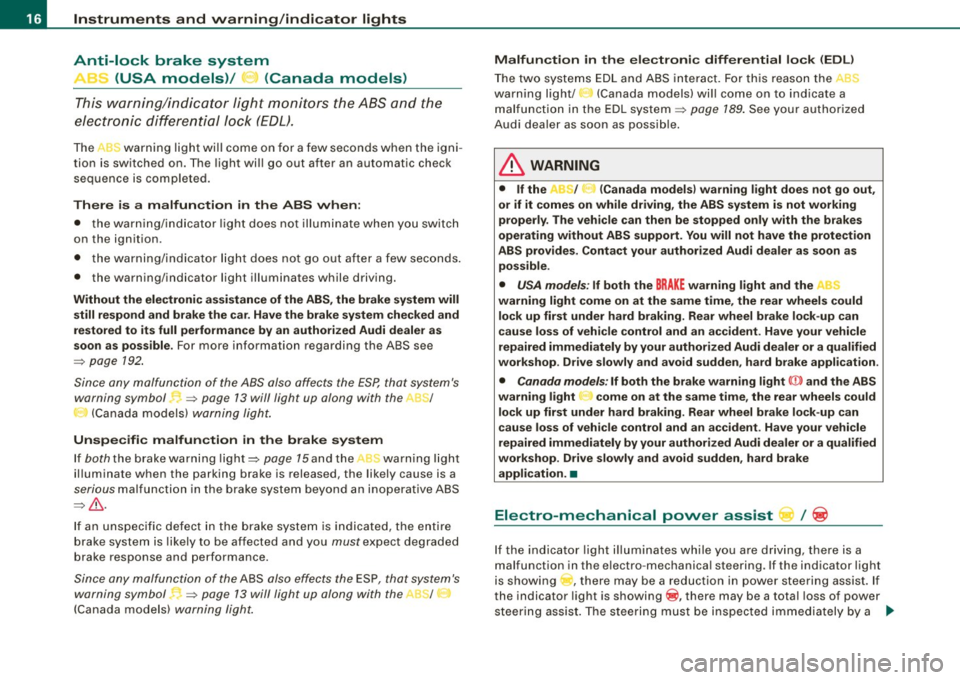
This warning/indicator light monit ors the A BS and the
electronic differenti al lock (EO L).
The ,I<-warning light wi ll come on for a few seconds when the igni
tion is switched on. The light will go out after an automatic check
sequence is completed.
There is a malfunction in the ABS when:
• t he war ning/in dicat or li ght does not illuminate when yo u switc h
on the ignition .
• th e warning/indicator l ig ht doe s no t go out after a few sec onds.
• the warning/indicator light illum inates while driving.
Without the electronic assistance of the ABS , the brake system will
still respond and br ake the car. Have the brake system che cked and
restored to its full performance by an authorized Audi dealer a s
soon as possible.
For more information regarding the ABS see
=> page 192 .
Since any malfunction of the ABS also affe cts the ESP, that system's
warning symbol •
=> page 13 will light up along with the A8~/
I':!. (Canada models) warning light.
Unspecific malfunction in the brake system
If bo th the brake warn ing lig ht=> page 15and the wa rn ing l ight
il luminate when the parking brake is released, the likely cause is a
serious m alfun ction in t he brake system beyond an inoperative ABS
=> & .
If an unspec ific defect in the brake sys te m i s indica ted, the e ntire
brake system is likely to be affected and you
must expect degraded
bra ke response and performance.
Since any malfunc tion of the ABS a lso effects the ESP, that system's
warning symbol ~=> page 13 will light up along with the ~1
J
(Canada models) warning light . Malfun
ction in the ele ctronic differential lock
(EDL )
The two syste ms E DL and ABS in te ract. F or th is rea son th e,. ::,
warning li ght/
~ (Canada mode ls) wi ll come on to ind icate a
m alf unctio n in the EDL system =>
page 189 . See your a uthor ized
Aud i dea ler as soon as poss ib le.
& WARNING
• If the / .t (Canada models} warning light does not go out ,
or if it comes on while driving , the ABS system is not working
properly . The veh icle can then be stopped only with the brakes
operating without ABS support . You will not have the protection
ABS provides. Contact your authori zed Audi dealer as soon a s
possible .
• USA models : If both the BRAKE warning light and the
warning light come on at the same time, the rear wheels could
lock up first under hard braking. Rear wheel brake lock -up can
cause loss of veh icle control and an accident . Have your vehicle
repaired immediately by your authorized Audi dealer or a qualified
workshop . Drive slowly and avoid sudden , hard brake application .
• Canada models : If both the brake wa rning light {(j)) and the ABS
warning light come on at the same time , the rear wheels could
lock up first under hard braking. Rear wheel brake lock -up can
cause loss of vehicle control and an accident . Have your vehicle
repaired immediately by your authorized Audi dealer or a qualified
workshop . Drive slowly and avoid sudden, hard brake
application. •
Electro-mechanical power assist / ~
If the i ndicator ligh t illum inates w hile you a re driving, ther e is a
malfunction in the e lectro -mechanica l steering . If the indicator light
is showi ng ....,, , ther e may be a r educ tion i n po w er s teerin g assist. I f
the indicator light is showing @, there may be a total loss of power
s teer ing assis t. The stee ring must be i nspec ted i mme diately by a ._
Page 32 of 320

Driver information display
Driver information appears in the display when a defective light
bulb is reported by the defective light bulb warning~
page 34,
when the brake pads are worn and before you engage a gear on
vehicles with S tronic.
In addition, driver information may appear when a red symbol
flashes in the driver display .
To display Driver information
As an example, the~ symbol appears in the display. If you now
press the button~
page 29, fig. 21 , the following driver message
appears in the display:
Switch off engine and check oil level
The driver message in the display goes out after about 5 seconds.
You can display the driver message again by briefly pressing the
button. •
Brake system malfunction
BRAKE (USA models) /((D) (Canada models )
The indicator light flashes if the brake fluid level is too
low, if there is a malfunction in the ABS system or when
the parking brake is engaged.
If the BRA KE/(CD) symbol flashes in the display with the
parking brake released, there is a malfunction in the brake
system. In addition to the symbol, one of two messages
appears in the display:
Stop vehicle and check brake fluid
ABS fault
! See owner's manual
- Pull off the road and stop the vehicle.
- Obtain professional assistance.
USA models: if there is a malfunction in the ABS system, the • c:::;
warning/indicator light illuminates along with the BRAKE system
malfunction warning/indicator light~
/.1.
Canada models: if there is a malfunction in the ABS system, the
warning/indicator light illuminates together with the
CCD) brake
system malfunction warning/indicator light~
/.1.
Parking brake set
The parking brake warning light Brake /«D> (Canada models) illumi
nates when the parking brake is set . In addition, a warning tone will
sound after you have driven for longer than 3 seconds and faster
than 3 mph (5 km/h).
& WARNING
• Always observe the warnings in~ page 215, "Engine compart
ment", before opening the engine hood and checking the brake
fluid.
• Driving with low brake fluid is a safety hazard! Stop the car and
get professional assistance.
• If the brake system warning/indicator light illuminates
together with the ABS warning/indicator light, then the ABS
system is malfunctioning. The rear wheels could quickly lock up
when you apply the brakes. This could lead to loss of control and
your vehicle could slide! Drive carefully to the nearest authorized
Audi dealer and have the malfunction corrected. •
Engine cooling system malfunction _t_
A malfunction in the engine cooling system must be
repaired as soon as possible.
When the J_ symbol in the display flashes, then either the
engine coolant temperature is too high, or the coolant level
~
Page 134 of 320

-Driving
Safely ------=-------=----------------
& WARNING
Improperly stored luggage or other items can fly through the
vehicle causing serious personal injury in the event of hard braking or an accident. To help reduce the risk of serious personal injury:
• Always put objects, for example, luggage or other heavy items
in the luggage compartment.
• Always secure objects in the luggage compartment using the
tie-down eyelets and suitable straps.
& WARNING
Heavy loads will influence the way your vehicle handles. To help
reduce the risk of a loss of control leading to serious personal
injury :
• Always keep in mind when transporting heavy objects, that a
change in the center of gravity can also cause changes in vehicle
handling:
-Always distribute the load as evenly as possible.
- Place heavy objects as far forward in the luggage compart-
ment as possible.
• Never exceed the Gross Axle Weight Rating or the Gross
Vehicle Weight Rating specified on the safety compliance sticker on the left door jamb. Exceeding permissible weight standards
can cause the vehicle to slide and handle differently.
• Please observe information on safe driving~
page 124.
& WARNING
To help prevent poisonous exhaust gas from being drawn into the
vehicle, always keep the rear lid closed while driving.
• Never transport objects larger than those fitting completely
into the luggage area because the rear lid cannot be fully closed.
& WARNING (continued)
• If you absolutely must drive with the rear lid open, observe the
following notes to reduce the risk of poisoning :
- Close all windows,
- Close the power roof*,
- Open all air outlets in the instrument panel,
- Switch off the air recirculation,
- Set the fresh air fan to the highest speed.
& WARNING
Always make sure that the doors , all windows, the power roof*
and the read lid are securely closed and locked to reduce the risk
of injury when the vehicle is not being used.
• After closing the rear lid, always make sure that it is properly
closed and locked .
• Never leave your vehicle unattended especially with the rear lid
left open. A child could crawl into the vehicle through the luggage
compartment and close the rear lid becoming trapped and unable
to get out . Being trapped in a vehicle can lead to serious personal
injury.
• Never let children play in or around the vehicle.
• Never let passengers ride in the luggage compartment . Vehicle
occupants must always be properly restrained in one of the
vehicle's seating positions.
[ i] Tips
The tire pressure must correspond to the load -see the tire pressure
sticker on the fuel filler door. •
Page 138 of 320
___ S_a_ f_ e_ t-= y_ b_e_ l_ t _s _______________________________________________ _
- Make sure that your passengers also b uckle up and prop
erly wea r th eir sa fety belts.
Protect children wit h a child restraint system appropriate
for the size and age.
The warning light i in the instrument cluster lights up when the
ignition is switched on as a reminder to fasten the safety belts. In
addition , you will hear a warning tone.
After the ignition is switched on, the warning light in the instrument cluster will a lways come on for about 6 seconds and if the driver has
not fastened the safety belt, a warning tone will also sound for
about 6 seconds . As soon as the driver has fastened the safety belt,
the warning tone will stop and the warning light will go out .
If the driver or front seat passenger have not buckled -up within
about 10 seconds after the warning tone has stopped and the
vehicle is moving faster than about 15 mph, the warning tone will
sound again for about 6 seconds and then stop for 24 seconds and
then repeat this reminder sequence for a maximum of 2 minutes. At
speeds be low 5 mph, the warning tone will not sound.
Fa sten your safe ty belt and m ake su re that your p assengers also
properl y put on th eir s afet y belts .
& WARNING
• Safety belt s are the single mo st effective mean s available to
reduce th e risk of ser ious injur y and death in a utomobile acci
dent s. For your prote ction and th at of your pas senger s, alwa ys
c orre ctl y we ar safety belt s when t he vehicle is moving .
• Failure t o pay att ention to th e warning light that co me on,
c ould lead to per sonal injury .•
Why safety belts?
Frontal co11isions and the law of physics
Front al crashes create very strong forces for pe ople riding
in vehicles.
F ig. 12 9 Unbel ted
o cc up ants i n a ve hicle
he ading for a wa ll
Fi g. 13 0 The vehi cle
c ras hes in to t he wa ll
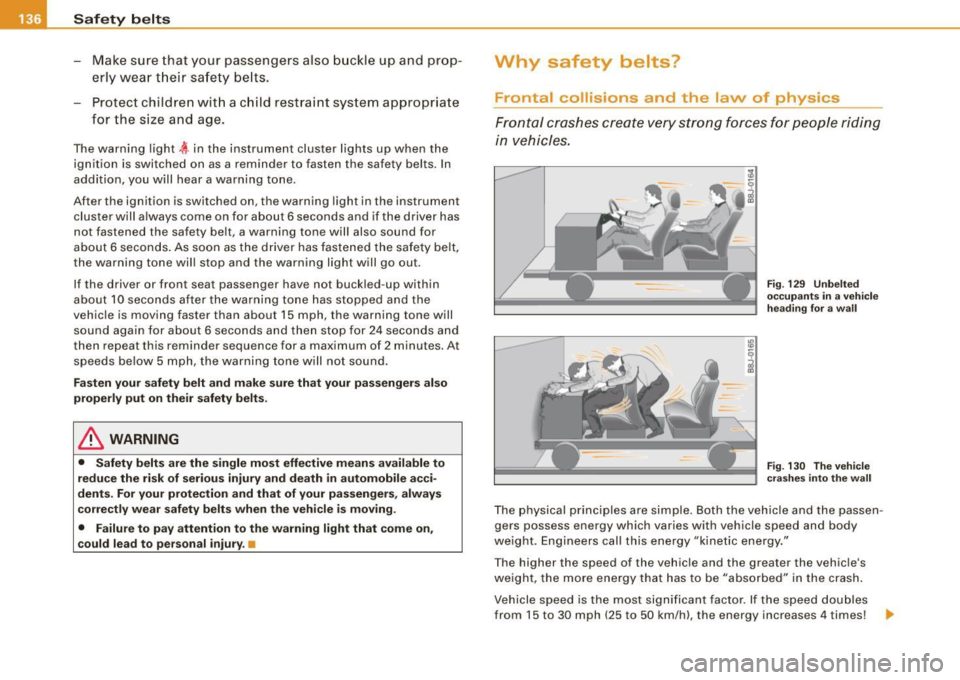
The physical principles are simple. Both the vehicle and the passen
gers possess energy which varies with vehicle speed and body
we ight . Engineers cal l this energy "kinetic energy ."
T he higher the speed of the vehicle and the greater the vehic le's
we ight, the more energy that has to be "absorbed" in the crash .
Vehicle speed is the most significan t factor. If the speed doubles
from 15 to 30 mph (25 to 50 km/h), the energy increases 4 times! .,
Page 140 of 320

__ __::S~a ~f ~e ~ty ~ b~ e~ l~ t ~s ____________________________________________ _
Safety belts protect
People think it's possible to use the hands to brace the
body in a minor collision. It's simply not true!
Fi g. 133 Driver is
co rrec tly res trai ned in
a sudden braking
m an euver
Safety belts used properly can make a big difference . Safety belts
help to keep passengers in their seats, gradually reduce energy
levels applied to the body in an accident , and help prevent the
uncontrolled movement that can cause serious injuries. In addition,
safety be lts reduce the danger of being thrown out of the vehic le.
Safety belts attach passengers to the car and g ive them the benefit
of being s lowed down more gently or "softly" through the "give" in
the safety belts, crush zones and other safety features engineered
into today's vehicles . By "absorbing" the kinetic energy
over a
longer period of time, the safety belts make the forces on the body
more "tolerable" and less like ly to cause injury.
Although these examples are based on a frontal collision , safety
belts can also substantially reduce the risk of injury in other kinds
of crashes. So, whether you're on a long trip or just going to the
corner store, always buckle up and make sure others do, too. Acci
dent statistics show that vehicle occupants proper ly wearing safety
bel ts have a lower risk of being injured and a much better chance o f
surviving an accident . Proper ly using safety belts also greatly
increases the abi lity of the supplementa l airbags to do their job in a
collision. For this reason, wearing a safety be lt is legally required in
most countries including much of the United States and Canada . Although your Audi is equipped with airbags, you sti
ll have to wear
the safety belts provided . Fron t airbags, for example, are activated
only in some frontal collisions . T he front airbags are not activated in
all frontal col lisions, in side and rear collisions, in roll overs or in
cases where there is not enough dece leration through impact to the
front of the vehicle . The same goes for the other airbag systems in
your Audi . So, always wear your safety belt and make sure
every
body in your vehic le is properly restrained! •
Important safety instructions about safety
belts
Safety belts must always be correctly positioned across
t he strongest bones of your body.
Always wear safety belts as illustrated and described in
this chapter.
Make sure tha t your safe ty belts are a lways ready for use
and are not damaged .
& WARNING
Not wearing safety belts or w earing them improperl y increas es
the ri sk of s eriou s pers onal inj ury an d death . S afe ty belt s can work
onl y w hen used corre ctl y.
• Alway s fas te n yo ur sa fe ty belt s corre ctl y befo re dri ving off and
mak e sure all p assenger s ar e correctly re strain ed.
• For m aximum protect ion , safet y belt s mu st alway s be p osi
ti oned properly on the body .
• Never strap more th an one person , includi ng sm all child ren ,
into any belt.
• Never pla ce a sa fety belt ove r a child sitting on your l ap .
• Alway s keep feet in t he foot well
in front of the seat while t he
vehi cle is being dri ven .
~
Page 152 of 320

___ A_ ir_ b_ a-g _ s_y _s_ t_ e_ m _________________________________________________ _
& WARN ING (continued )
• Airbag work most effectively when used with properly worn
safety belt s.
• Therefore , always wear your safety belts and make sure that
everybody in your vehicle is properly restra ined .
& WARNING
A person on the front passenger seat , espe cially infants and small
c hildren, will receive serious injuries and can even be killed by
being too close to the airbag when it inflates .
• Although the Advanced Airbag System in your vehicle is
designed to turn off the front passenger airbag if an infant or a
small child is on the front passenger seat , nobody can absolutely
guarantee that deployment unde r these spe cial conditions is
impossible in all conce ivable situations that may happen during
the useful life of your vehicle.
• The Advanced Airbag System can deploy in accordance with
the "low risk" option under the U .S . Federal Standa rd if a child that
is heavier than the typical one -year old child is on the front
pas senger seat and the other cond itions for airbag deployment
are met.
• Accident statistics have shown that children are generally safer
in the rear seat area than in the front seating position .
• For their own safety , all children , espec ially 12 years and
younger, should always ride in the back properly restrained for
their age and size . •
Advanced front airbag system
Your vehicle is equipped with a front Advanced Airbag System in
c ompl ia n ce wi th Un it ed Sta tes Federa l Motor Vehicle Safet y Sta n
dard 208 as appl icab le at the time your vehicle was manufactured. T
he front Advanced Airbag System supplements the safety belts to
p rovide addit ional protecti on for the d river's a nd fro nt passenger's
heads and upper bodies in fronta l crashes . The ai rbags inflate only
in fron tal impac ts w hen the vehic le dece le ra tion is high en ough .
Th e fro nt Advanced A irbag System for t he fro nt seat occupa nts is
not a substitute for your safety belts . Rather, it is pa rt of the overall
occu pan t restra int system in your v ehicle. A lways remembe r that
the airbag system can only help to protect you, if you are sitting
uprigh t, weari ng you r sa fe ty bel t an d wea ring it proper ly . T hi s is w hy
you and your passengers must always be proper ly restrained, not
jus t beca use t he law requi res y ou t o be .
T he Advanced A irbag Syste m in your ve hicle has been cert ified to
meet the " lo w risk" requ irements fo r 3 an d 6 year -o ld chi ldren on the
passen ger side and ve ry small a dults on t he dr iver s ide. The low r isk
deployment criteria are intended to he lp reduce the risk of injury
th ro ugh in te ract io n with the front a irbag t hat ca n occur, fo r
example, by being too close to the steering wheel and instrument
p anel whe n the a irbag inflates.
I n addition, the syst em has been cert ified to comply with the
"su ppression" req uirem en ts of the Safe ty Standa rd, to turn off th e
fron t airbag for in fants 1 2 months o ld a nd youn ger who are
restrained on the front passenger seat in child restraints that are
li s ted in th e Stan dard=>
page 169 .
"Suppress ion" requires the front airbag on the passenger side to be
t urne d off if:
• a child up to about one year of a ge is restra in ed on the front
passenger seat in one of the rear -facing or forward -facing infant
re stra ints l is ted in Fed era l Motor V ehicle Safety Standard 208 w ith
whic h the Advanced Airbag System in your vehic le was ce rtified. For
a lis ting o f the child res traint s th at we re us ed to cer tify y our
vehic le 's compliance with the US Safety Standard =>
page 169,
• weight less t han a thr esho ld leve l sto red in th e contro l un it is
detected on the front passenger seat.
When a pers on is dete ct ed on th e fro nt pas senge r seat, weighi ng
more than the total weight of a ch ild that is about 1 year old ._
Page 162 of 320

___ A_ ir_ b_ a-g _ s_y _s_ t_ e_ m _________________________________________________ _
& WARN ING (continued )
• Always make sure that the side airbag can inflate without inter
fe rence :
- Never install seat covers or replacement upholstery over the
front seatback s that have not been spe cifically approved by
Audi.
- Never use additional seat cushions that cover the areas
where the side airbags inflate .
- Damage to the original seat covers or to the seam
in the area
of the side airbag module must always be repaired immedi
ately by an authorized Audi dealer .
• The airbag system can be activated only once. After an airbag
ha s inflated , it must be replaced by an authorized Audi de aler or
qualified technician who has the technical information , training
and special equipment necessary .
• The airbag system can be deployed only once. After an airbag
has been deployed , it must be repla ced with new repla cement
parts designed and approved especially for your Audi model
version . Replacement of complete airbag systems or airbag
components must be performed by qualified workshops only .
Make sure that any airbag service action is entered in your Audi
Warranty
& Maintenance booklet under AIRBAG REPLACEMENT
RECORD .•
Other things that can affect Advanced Airbag
performance
Changing the vehic le's suspension system can change the way that
th e Adva nced A ir b ag Sy stem per fo rms in a cras h. For exa m ple,
using tire -rim combinations not approved by Audi, lowering the
vehic le, c hanging the st iff ne ss of th e susp ens ion , incl udi ng the
spr ings, suspension struts, s hock absorbers etc . ca n chan ge the
forces that are mea su red by the air bag sensors and sent to the elec
tronic control unit. Some suspension chan ges can, for examp le, increase the force levels
measured by the sensors and make the
airbag sys te m d eploy in c ras hes i n wh ich i t wou ld not d epl oy i f the
changes had not been made. Other kinds of changes may reduce
t he fo rce level s measu red by the se nso rs and p reve nt the ai rbag
from dep loying when it should.
T he sensors in the safety belt buckle for the driver and front
p assenge r seat te ll the e lectro nic c ont ro l m odu le if th e safety belt is
l atched or not. If the safety belt is being used, the front airbag wi ll
d eploy at a sl igh tly higher rate o f ve hic le dece lera tio n th an if the
safety be lt is not be ing used. Therefore, in a particular coll ision, it is
p os sible that an airbag wi ll no t de ploy a t a seating position where
the safety be lt is being used but wi ll inflate at the position where the
safe ty be lt is not be ing used . It i s important tha t n othing in terfe re
with the safety b elt buckles so that t he se nsors can send the cor rec t
i nfo rma tion abo ut safe ty belt use to the elec tro nic con trol u nit .
& WARNING
Changing the vehicle' s suspension including use of unapproved
tire -rim combinations can change Advanced Airbag performan ce
and increase the risk of serious personal injury in a crash.
• Never install suspension components that do not have the
same performance characteristics as the components originally
installed on your vehi cle .
• Never use tire -rim combinations that have not been approved
by Audi.
& WARNING
Items stored between the safety belt buckle and the center
console can cause the sensors in the buckle to send the wrong
information to the electronic control module and prevent the
Advanced Airbag System from working properly .
• Always make sure that noth ing can interfere w ith the safety
belt buckles and that they are not obstructed.